1
Chapter 16
Just-In-Time
Systems
2
JIT/Lean Production
• Just-in-time: Repetitive production system in
which processing and movement of materials
and goods occur just as they are needed,
usually in small batches
• JIT is characteristic of lean production
systems
• JIT operates with very little “fat”
3
JIT Goals
• Eliminate disruptions
• Make system flexible by reduce
setup and lead times
• Eliminate waste, especially excess
inventory
4
Sources of Waste
• Overproduction
• Waiting time
• Unnecessary transportation
• Processing waste
• Inefficient work methods
• Product defects
5
• Big JIT – broad focus
– Vendor relations
– Human relations
– Technology management
– Materials and inventory management
• Little JIT – narrow focus
– Scheduling materials
– Scheduling services of production
Big vs. Little JIT
6
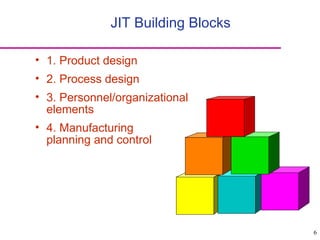
JIT Building Blocks
• 1. Product design
• 2. Process design
• 3. Personnel/organizational
elements
• 4. Manufacturing
planning and control
7
1. Product Design
• Standard parts
• Modular design
• Highly capable production systems
8
2. Process Design
• Small lot sizes
• Setup time reduction
• Manufacturing cells
• Limited work in process
• Quality improvement
• Production flexibility
• Little inventory storage
9
Benefits of Small Lot Sizes
Reduces inventory
Less storage space
Less rework
Problems are more apparent
Increases product flexibility
Easier to balance operations
10
Production Flexibility
• Reduce downtime by reducing
changeover time
• Use preventive maintenance to
reduce breakdowns
• Cross-train workers to help clear
bottlenecks
• Reserve capacity for important
customers
11
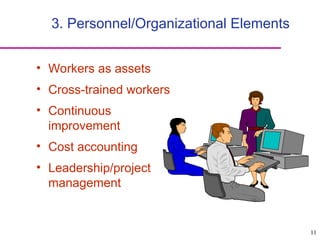
3. Personnel/Organizational Elements
• Workers as assets
• Cross-trained workers
• Continuous
improvement
• Cost accounting
• Leadership/project
management
12
4. Manufacturing Planning and Control
• Level loading
• Pull systems
• Visual systems
• Close vendor relationships
• Reduced transaction processing
• Preventive maintenance
13
Pull/Push Systems
• Pull system: System for moving work
where a workstation pulls output from
the preceding station as needed. (e.g.
Kanban)
• Push system: System for moving work
where output is pushed to the next
station as it is completed
14
Kanban Production Control System
• Kanban: Card or other device that communicates demand for
work or materials from the preceding station
• Kanban is the Japanese word meaning “signal” or “visible
record”
• Paperless production control system
• Authority to pull, or produce comes
from a downstream process.
15
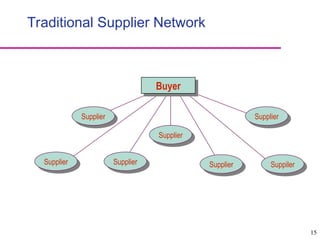
Traditional Supplier Network
Buyer
Supplier
Supplier Supplier Suppiler
Supplier
Supplier
Supplier
16
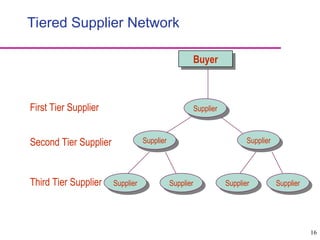
Tiered Supplier Network
Supplier
Supplier
Supplier
Supplier
Supplier Supplier
Buyer
Supplier
First Tier Supplier
Second Tier Supplier
Third Tier Supplier
17
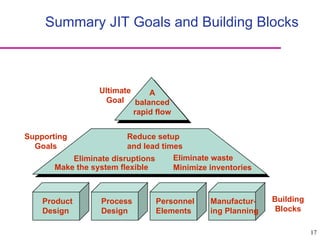
Summary JIT Goals and Building Blocks
Product
Design
Process
Design
Personnel
Elements
Manufactur-
ing Planning
Eliminate disruptions
Make the system flexible
Reduce setup
and lead times
Eliminate waste
Minimize inventories
A
balanced
rapid flow
Ultimate
Goal
Supporting
Goals
Building
Blocks
18
Converting to a JIT System
• Get top management commitment
• Decide which parts need most effort
• Obtain support of workers
• Start by trying to reduce setup times
• Gradually convert operations
• Convert suppliers to JIT
• Prepare for obstacles
19
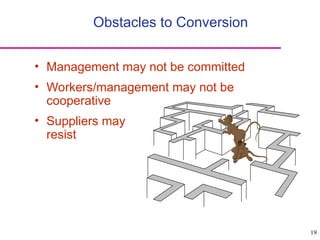
Obstacles to Conversion
• Management may not be committed
• Workers/management may not be
cooperative
• Suppliers may
resist
20
JIT in Service
The basic goal of the demand flow technology in the service organization is to
provide optimum response to the customer with the highest quality service
and lowest possible cost.
– Eliminate disruptions
– Make system flexible
– Reduce setup and lead times
– Eliminate waste
– Minimize WIP
– Simplify the process
21
• New challenges
– Meeting manufacturing requirements
– Changing from traditional thinking and practices –
frequent on-time delivery of small quantities
– Long term relationships with suppliers as
partners
• How about Exchange purchasing: Auctions?
JIT Purchasing
22
• JIT II: the practice of allowing vendors
to manage some aspects of buying their
products or services for the buyer
JIT II
23
Benefits of JIT Systems
• Reduced inventory levels
• High quality
• Flexibility
• Reduced lead times
• Increased productivity
24
Benefits of JIT Systems (cont’d)
• Increased equipment utilization
• Reduced scrap and rework
• Reduced space requirements
• Pressure for good vendor relationships
• Reduced need for indirect labor
25
• Smooth flow of work (the ultimate goal)
• Elimination of waste
• Continuous improvement
• Eliminating anything that does not add
value
• Simple systems that are easy to manage
• Use of product layouts to minimize
moving materials and parts
• Quality at the source
Elements of JIT
26
• Poka-yoke – fail safe tools and methods
• Preventative maintenance
• Good housekeeping
• Set-up time reduction
• Cross-trained employees
• A pull system
Elements of JIT (cont’d)

Just-In-Timeasdfffffffghhhhhhhhhhj Systems.ppt

  • 1.
  • 2.
    2 JIT/Lean Production • Just-in-time:Repetitive production system in which processing and movement of materials and goods occur just as they are needed, usually in small batches • JIT is characteristic of lean production systems • JIT operates with very little “fat”
  • 3.
    3 JIT Goals • Eliminatedisruptions • Make system flexible by reduce setup and lead times • Eliminate waste, especially excess inventory
  • 4.
    4 Sources of Waste •Overproduction • Waiting time • Unnecessary transportation • Processing waste • Inefficient work methods • Product defects
  • 5.
    5 • Big JIT– broad focus – Vendor relations – Human relations – Technology management – Materials and inventory management • Little JIT – narrow focus – Scheduling materials – Scheduling services of production Big vs. Little JIT
  • 6.
    6 JIT Building Blocks •1. Product design • 2. Process design • 3. Personnel/organizational elements • 4. Manufacturing planning and control
  • 7.
    7 1. Product Design •Standard parts • Modular design • Highly capable production systems
  • 8.
    8 2. Process Design •Small lot sizes • Setup time reduction • Manufacturing cells • Limited work in process • Quality improvement • Production flexibility • Little inventory storage
  • 9.
    9 Benefits of SmallLot Sizes Reduces inventory Less storage space Less rework Problems are more apparent Increases product flexibility Easier to balance operations
  • 10.
    10 Production Flexibility • Reducedowntime by reducing changeover time • Use preventive maintenance to reduce breakdowns • Cross-train workers to help clear bottlenecks • Reserve capacity for important customers
  • 11.
    11 3. Personnel/Organizational Elements •Workers as assets • Cross-trained workers • Continuous improvement • Cost accounting • Leadership/project management
  • 12.
    12 4. Manufacturing Planningand Control • Level loading • Pull systems • Visual systems • Close vendor relationships • Reduced transaction processing • Preventive maintenance
  • 13.
    13 Pull/Push Systems • Pullsystem: System for moving work where a workstation pulls output from the preceding station as needed. (e.g. Kanban) • Push system: System for moving work where output is pushed to the next station as it is completed
  • 14.
    14 Kanban Production ControlSystem • Kanban: Card or other device that communicates demand for work or materials from the preceding station • Kanban is the Japanese word meaning “signal” or “visible record” • Paperless production control system • Authority to pull, or produce comes from a downstream process.
  • 15.
    15 Traditional Supplier Network Buyer Supplier SupplierSupplier Suppiler Supplier Supplier Supplier
  • 16.
    16 Tiered Supplier Network Supplier Supplier Supplier Supplier SupplierSupplier Buyer Supplier First Tier Supplier Second Tier Supplier Third Tier Supplier
  • 17.
    17 Summary JIT Goalsand Building Blocks Product Design Process Design Personnel Elements Manufactur- ing Planning Eliminate disruptions Make the system flexible Reduce setup and lead times Eliminate waste Minimize inventories A balanced rapid flow Ultimate Goal Supporting Goals Building Blocks
  • 18.
    18 Converting to aJIT System • Get top management commitment • Decide which parts need most effort • Obtain support of workers • Start by trying to reduce setup times • Gradually convert operations • Convert suppliers to JIT • Prepare for obstacles
  • 19.
    19 Obstacles to Conversion •Management may not be committed • Workers/management may not be cooperative • Suppliers may resist
  • 20.
    20 JIT in Service Thebasic goal of the demand flow technology in the service organization is to provide optimum response to the customer with the highest quality service and lowest possible cost. – Eliminate disruptions – Make system flexible – Reduce setup and lead times – Eliminate waste – Minimize WIP – Simplify the process
  • 21.
    21 • New challenges –Meeting manufacturing requirements – Changing from traditional thinking and practices – frequent on-time delivery of small quantities – Long term relationships with suppliers as partners • How about Exchange purchasing: Auctions? JIT Purchasing
  • 22.
    22 • JIT II:the practice of allowing vendors to manage some aspects of buying their products or services for the buyer JIT II
  • 23.
    23 Benefits of JITSystems • Reduced inventory levels • High quality • Flexibility • Reduced lead times • Increased productivity
  • 24.
    24 Benefits of JITSystems (cont’d) • Increased equipment utilization • Reduced scrap and rework • Reduced space requirements • Pressure for good vendor relationships • Reduced need for indirect labor
  • 25.
    25 • Smooth flowof work (the ultimate goal) • Elimination of waste • Continuous improvement • Eliminating anything that does not add value • Simple systems that are easy to manage • Use of product layouts to minimize moving materials and parts • Quality at the source Elements of JIT
  • 26.
    26 • Poka-yoke –fail safe tools and methods • Preventative maintenance • Good housekeeping • Set-up time reduction • Cross-trained employees • A pull system Elements of JIT (cont’d)