Bottleneck OperationBottleneck Operation
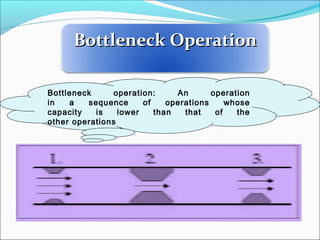
Bottleneck operation: An operation
in a sequence of operations whose
capacity is lower than that of the
other operations
Capacity planning
Capacity is the maximum output rate of a production
or service facility.
Capacity also includes
Equipment
Space
Employee skills
02/09/17 3
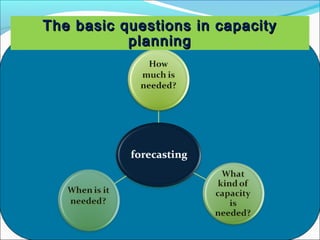
The basic questions in capacityThe basic questions in capacity
planningplanning
Capacity planning is the process of establishing
the output rate that may be needed at a facility.
02/09/17 5
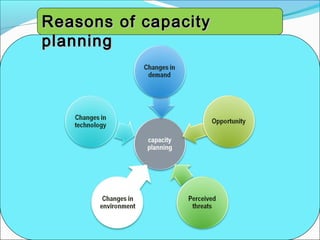
Reasons of capacityReasons of capacity
planningplanning
Impacts ability to meet future demands
Affects operating costs
Major determinant of initial costs
Involves long-term commitment
Affects competitiveness
Affects ease of management
Importance of Capacity Decisions
02/09/17 7
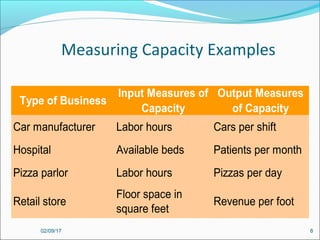
Measuring Capacity Examples
Type of Business
Input Measures of
Capacity
Output Measures
of Capacity
Car manufacturer Labor hours Cars per shift
Hospital Available beds Patients per month
Pizza parlor Labor hours Pizzas per day
Retail store
Floor space in
square feet
Revenue per foot
02/09/17 8
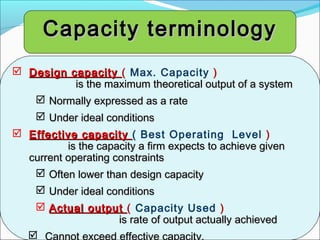
Capacity terminologyCapacity terminology
 Design capacityDesign capacity ( Max. Capacity )
is the maximum theoretical output of a systemis the maximum theoretical output of a system
 Normally expressed as a rateNormally expressed as a rate
 Under ideal conditionsUnder ideal conditions
 Effective capacityEffective capacity ( Best Operating Level )
is the capacity a firm expects to achieve givenis the capacity a firm expects to achieve given
current operating constraintscurrent operating constraints
 Often lower than design capacityOften lower than design capacity
 Under ideal conditionsUnder ideal conditions
 Actual outputActual output ( Capacity Used )
is rate of output actually achievedis rate of output actually achieved
 Cannot exceed effective capacity.
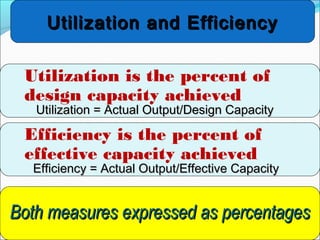
Utilization is the percent of
design capacity achieved
Efficiency is the percent of
effective capacity achieved
Utilization = Actual Output/Design CapacityUtilization = Actual Output/Design Capacity
Efficiency = Actual Output/Effective CapacityEfficiency = Actual Output/Effective Capacity
Utilization and EfficiencyUtilization and Efficiency
Both measures expressed as percentagesBoth measures expressed as percentages
Calculating Capacity Utilization
Measures how much of the available capacity is
actually being used:
Measures effectiveness
 Use either effective or design capacity in
denominator
( )100%
capacity
rateoutputactual
nUtilizatio =
02/09/17 11
Efficiency/UtilizationEfficiency/Utilization
Actual output 36 units/day
Efficiency = = = 90%
Effective capacity 40 units/ day
Actual output 36 units/day
Utilization = = = 72%
Design capacity 50 units/day
Design capacity = 50 trucks/day
Effective capacity = 40 trucks/day
Actual output = 36 units/day
Ex.Ex.
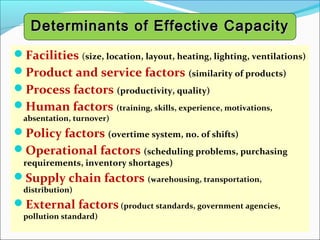
Facilities (size, location, layout, heating, lighting, ventilations)
Product and service factors (similarity of products)
Process factors (productivity, quality)
Human factors (training, skills, experience, motivations,
absentation, turnover)
Policy factors (overtime system, no. of shifts)
Operational factors (scheduling problems, purchasing
requirements, inventory shortages)
Supply chain factors (warehousing, transportation,
distribution)
External factors (product standards, government agencies,
pollution standard)
Determinants of Effective CapacityDeterminants of Effective Capacity
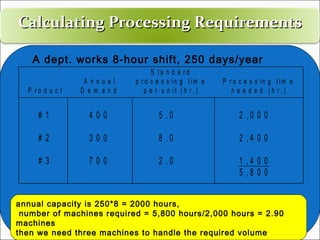
P r o d u c t
A n n u a l
D e m a n d
S t a n d a r d
p r o c e s s in g t im e
p e r u n it ( h r . )
P r o c e s s in g t im e
n e e d e d ( h r . )
# 1
# 2
# 3
4 0 0
3 0 0
7 0 0
5 . 0
8 . 0
2 . 0
2 , 0 0 0
2 , 4 0 0
1 , 4 0 0
5 , 8 0 0
Calculating Processing RequirementsCalculating Processing Requirements
A dept. works 8-hour shift, 250 days/year
annual capacity is 250*8 = 2000 hours,
number of machines required = 5,800 hours/2,000 hours = 2.90
machines
then we need three machines to handle the required volume
Forecast
Demand
Compute
Needed
Capacity
Compute
Rated
Capacity
Evaluate
Capacity
Plans
Implement
Best Plan
Qualitative
Factors
(e.g., Skills)
Select Best
Capacity
Plan
Develop
Alternative
Plans
Quantitative
Factors
(e.g., Cost)
Capacity Planning Process
Modify capacityModify capacity Use capacityUse capacity
Planning Over a Time HorizonPlanning Over a Time Horizon
Intermediate-Intermediate-
rangerange
planningplanning
Subcontract Add personnel
Add equipment Build or use inventory
Add shifts
Short-rangeShort-range
planningplanning
Schedule jobs
Schedule personnel
Allocate machinery*
Long-rangeLong-range
planningplanning
Add facilities
Add long lead time equipment
*
* Limited options exist* Limited options exist
02/09/17 16
Economies of Scale
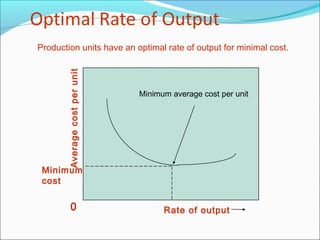
Economies of scale
If the output rate is less than the optimal level,
increasing output rate results in decreasing average unit
costs
Diseconomies of scale
If the output rate is more than the optimal level,
increasing the output rate results in increasing average
unit costs
Minimum
cost
Averagecostperunit
0 Rate of output
Production units have an optimal rate of output for minimal cost.
Minimum average cost per unit
5-19
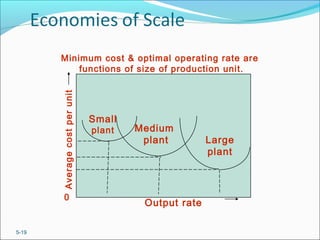
Minimum cost & optimal operating rate are
functions of size of production unit.Averagecostperunit
0
Small
plant Medium
plant Large
plant
Output rate
02/09/17 20
Cost Volume Analysis:
Breakeven Analysis
Technique for evaluating process & equipment
alternatives
Objective: Find the point at which total cost
equals total revenue
Assumptions
•Revenue & costs are related linearly to volume
•All information is known with certainty
•No time value of money
22
Break-Even Analysis
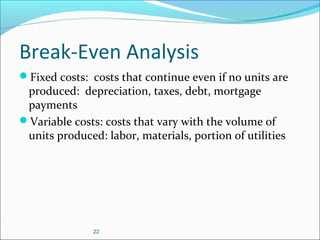
Fixed costs: costs that continue even if no units are
produced: depreciation, taxes, debt, mortgage
payments
Variable costs: costs that vary with the volume of
units produced: labor, materials, portion of utilities
Breakeven Chart
Fixed cost
Variable cost
Total cost line
Total revenue line
ProfitBreakeven point
Total cost = Total revenue
Volume (units/period)
CostinDollars
Loss
5-24
1. One product is involved
2.Everything produced can be sold
3. Variable cost per unit is the same regardless of
volume
4.Fixed costs do not change with volume
5.Revenue per unit constant with volume
6.Revenue per unit exceeds variable cost per unit
Assumptions of Cost-Volume
Analysis
5-25
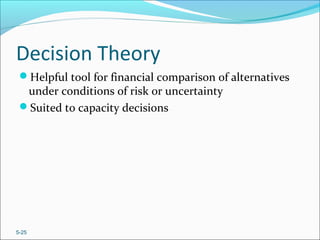
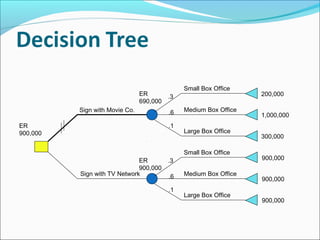
Decision Theory
Helpful tool for financial comparison of alternatives
under conditions of risk or uncertainty
Suited to capacity decisions
Small Box Office
Medium Box Office
Large Box Office
Small Box Office
Medium Box Office
Large Box Office
Sign with Movie Co.
Sign with TV Network
200,000
1,000,000
300,000
900,000
900,000
900,000
.3
.6
.1
.3
.6
.1
ER
900,000
ER
690,000
ER
900,000
5-27
Financial Analysis
Cash Flow - the difference between cash received
from sales and other sources, and cash outflow for
labor, material, overhead, and taxes.
Present Value - the sum, in current value, of all
future cash flows of an investment proposal.
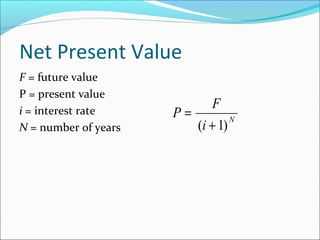
Net Present Value
F = future value
P = present value
i = interest rate
N = number of years
N
i
F
P
)1( +
=
5-29
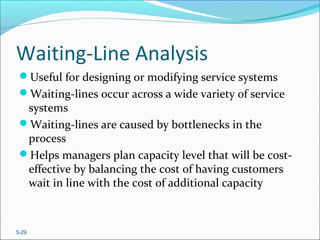
Waiting-Line Analysis
Useful for designing or modifying service systems
Waiting-lines occur across a wide variety of service
systems
Waiting-lines are caused by bottlenecks in the
process
Helps managers plan capacity level that will be cost-
effective by balancing the cost of having customers
wait in line with the cost of additional capacity
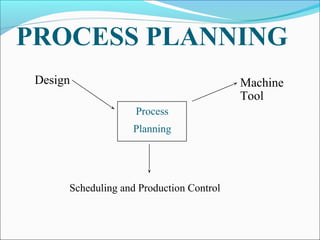
PROCESS PLANNING
Design Machine
Tool
Scheduling and Production Control
Process
Planning
What methods were used?
Machining methods
Pressworking
Welding/fabrication
Casting
Powder materials
Layered deposition
Others
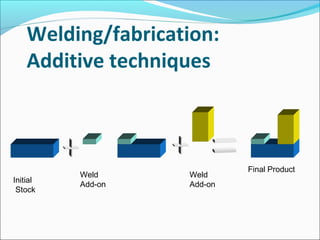
Welding/fabrication:
Additive techniques
Initial
Stock
Weld
Add-on
Weld
Add-on
Final Product
Machining Methods:
Subtractive techniques
Initial
Stock
Slotting Drilling
Final Product
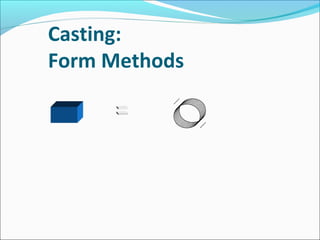
Casting:
Form Methods
ENGINEERING DESIGN MODELING
10" +0.01
-0.01
1'-4" +0.01
-0.01
4" +0.01
-0.01
7" +0.05
-0.05
5" +0.01
-0.01
3" +0.01
-0.01
2" +0.01
-0.01 0.001 A B
A
B
S.F. 64 u inch
U*
- *
CSG MODEL
Fa c e
Lo o p
Ed g e
V e rt e x
B-REP MODEL
INTERACTION OF
PLANNING FUNCTIONS
GEOMETRIC REASONING
PROCESS SELECTION
CUTTER SELECTION
MACHINE TOOL SELECTION
SETUP PLANNING
FIXTURE PLANNING
CUTTER PATH GENERATION
• global & local geometry
• process capability
• process cost
• available tools
• tool dimension and geometry
• geometric constraints
• machine availability, cost
• machine capability
• feature relationship
• approach directions
• process constraints
• fixture constraints
• fixture element function
• locating, supporting, and
clamping surfaces
• stability
• feature merging and split
• path optimization
• obstacle and interference
avoidance

CAPACITY PLANNING

  • 1.
    Bottleneck OperationBottleneck Operation Bottleneckoperation: An operation in a sequence of operations whose capacity is lower than that of the other operations
  • 3.
    Capacity planning Capacity isthe maximum output rate of a production or service facility. Capacity also includes Equipment Space Employee skills 02/09/17 3
  • 4.
    The basic questionsin capacityThe basic questions in capacity planningplanning
  • 5.
    Capacity planning isthe process of establishing the output rate that may be needed at a facility. 02/09/17 5
  • 6.
    Reasons of capacityReasonsof capacity planningplanning
  • 7.
    Impacts ability tomeet future demands Affects operating costs Major determinant of initial costs Involves long-term commitment Affects competitiveness Affects ease of management Importance of Capacity Decisions 02/09/17 7
  • 8.
    Measuring Capacity Examples Typeof Business Input Measures of Capacity Output Measures of Capacity Car manufacturer Labor hours Cars per shift Hospital Available beds Patients per month Pizza parlor Labor hours Pizzas per day Retail store Floor space in square feet Revenue per foot 02/09/17 8
  • 9.
    Capacity terminologyCapacity terminology Design capacityDesign capacity ( Max. Capacity ) is the maximum theoretical output of a systemis the maximum theoretical output of a system  Normally expressed as a rateNormally expressed as a rate  Under ideal conditionsUnder ideal conditions  Effective capacityEffective capacity ( Best Operating Level ) is the capacity a firm expects to achieve givenis the capacity a firm expects to achieve given current operating constraintscurrent operating constraints  Often lower than design capacityOften lower than design capacity  Under ideal conditionsUnder ideal conditions  Actual outputActual output ( Capacity Used ) is rate of output actually achievedis rate of output actually achieved  Cannot exceed effective capacity.
  • 10.
    Utilization is thepercent of design capacity achieved Efficiency is the percent of effective capacity achieved Utilization = Actual Output/Design CapacityUtilization = Actual Output/Design Capacity Efficiency = Actual Output/Effective CapacityEfficiency = Actual Output/Effective Capacity Utilization and EfficiencyUtilization and Efficiency Both measures expressed as percentagesBoth measures expressed as percentages
  • 11.
    Calculating Capacity Utilization Measureshow much of the available capacity is actually being used: Measures effectiveness  Use either effective or design capacity in denominator ( )100% capacity rateoutputactual nUtilizatio = 02/09/17 11
  • 12.
    Efficiency/UtilizationEfficiency/Utilization Actual output 36units/day Efficiency = = = 90% Effective capacity 40 units/ day Actual output 36 units/day Utilization = = = 72% Design capacity 50 units/day Design capacity = 50 trucks/day Effective capacity = 40 trucks/day Actual output = 36 units/day Ex.Ex.
  • 13.
    Facilities (size, location,layout, heating, lighting, ventilations) Product and service factors (similarity of products) Process factors (productivity, quality) Human factors (training, skills, experience, motivations, absentation, turnover) Policy factors (overtime system, no. of shifts) Operational factors (scheduling problems, purchasing requirements, inventory shortages) Supply chain factors (warehousing, transportation, distribution) External factors (product standards, government agencies, pollution standard) Determinants of Effective CapacityDeterminants of Effective Capacity
  • 14.
    P r od u c t A n n u a l D e m a n d S t a n d a r d p r o c e s s in g t im e p e r u n it ( h r . ) P r o c e s s in g t im e n e e d e d ( h r . ) # 1 # 2 # 3 4 0 0 3 0 0 7 0 0 5 . 0 8 . 0 2 . 0 2 , 0 0 0 2 , 4 0 0 1 , 4 0 0 5 , 8 0 0 Calculating Processing RequirementsCalculating Processing Requirements A dept. works 8-hour shift, 250 days/year annual capacity is 250*8 = 2000 hours, number of machines required = 5,800 hours/2,000 hours = 2.90 machines then we need three machines to handle the required volume
  • 15.
    Forecast Demand Compute Needed Capacity Compute Rated Capacity Evaluate Capacity Plans Implement Best Plan Qualitative Factors (e.g., Skills) SelectBest Capacity Plan Develop Alternative Plans Quantitative Factors (e.g., Cost) Capacity Planning Process
  • 16.
    Modify capacityModify capacityUse capacityUse capacity Planning Over a Time HorizonPlanning Over a Time Horizon Intermediate-Intermediate- rangerange planningplanning Subcontract Add personnel Add equipment Build or use inventory Add shifts Short-rangeShort-range planningplanning Schedule jobs Schedule personnel Allocate machinery* Long-rangeLong-range planningplanning Add facilities Add long lead time equipment * * Limited options exist* Limited options exist 02/09/17 16
  • 17.
    Economies of Scale Economiesof scale If the output rate is less than the optimal level, increasing output rate results in decreasing average unit costs Diseconomies of scale If the output rate is more than the optimal level, increasing the output rate results in increasing average unit costs
  • 18.
    Minimum cost Averagecostperunit 0 Rate ofoutput Production units have an optimal rate of output for minimal cost. Minimum average cost per unit
  • 19.
    5-19 Minimum cost &optimal operating rate are functions of size of production unit.Averagecostperunit 0 Small plant Medium plant Large plant Output rate
  • 20.
  • 21.
    Cost Volume Analysis: BreakevenAnalysis Technique for evaluating process & equipment alternatives Objective: Find the point at which total cost equals total revenue Assumptions •Revenue & costs are related linearly to volume •All information is known with certainty •No time value of money
  • 22.
    22 Break-Even Analysis Fixed costs:costs that continue even if no units are produced: depreciation, taxes, debt, mortgage payments Variable costs: costs that vary with the volume of units produced: labor, materials, portion of utilities
  • 23.
    Breakeven Chart Fixed cost Variablecost Total cost line Total revenue line ProfitBreakeven point Total cost = Total revenue Volume (units/period) CostinDollars Loss
  • 24.
    5-24 1. One productis involved 2.Everything produced can be sold 3. Variable cost per unit is the same regardless of volume 4.Fixed costs do not change with volume 5.Revenue per unit constant with volume 6.Revenue per unit exceeds variable cost per unit Assumptions of Cost-Volume Analysis
  • 25.
    5-25 Decision Theory Helpful toolfor financial comparison of alternatives under conditions of risk or uncertainty Suited to capacity decisions
  • 26.
    Small Box Office MediumBox Office Large Box Office Small Box Office Medium Box Office Large Box Office Sign with Movie Co. Sign with TV Network 200,000 1,000,000 300,000 900,000 900,000 900,000 .3 .6 .1 .3 .6 .1 ER 900,000 ER 690,000 ER 900,000
  • 27.
    5-27 Financial Analysis Cash Flow- the difference between cash received from sales and other sources, and cash outflow for labor, material, overhead, and taxes. Present Value - the sum, in current value, of all future cash flows of an investment proposal.
  • 28.
    Net Present Value F= future value P = present value i = interest rate N = number of years N i F P )1( + =
  • 29.
    5-29 Waiting-Line Analysis Useful fordesigning or modifying service systems Waiting-lines occur across a wide variety of service systems Waiting-lines are caused by bottlenecks in the process Helps managers plan capacity level that will be cost- effective by balancing the cost of having customers wait in line with the cost of additional capacity
  • 30.
    PROCESS PLANNING Design Machine Tool Schedulingand Production Control Process Planning
  • 31.
    What methods wereused? Machining methods Pressworking Welding/fabrication Casting Powder materials Layered deposition Others
  • 32.
  • 33.
  • 34.
  • 35.
    ENGINEERING DESIGN MODELING 10"+0.01 -0.01 1'-4" +0.01 -0.01 4" +0.01 -0.01 7" +0.05 -0.05 5" +0.01 -0.01 3" +0.01 -0.01 2" +0.01 -0.01 0.001 A B A B S.F. 64 u inch U* - * CSG MODEL Fa c e Lo o p Ed g e V e rt e x B-REP MODEL
  • 36.
    INTERACTION OF PLANNING FUNCTIONS GEOMETRICREASONING PROCESS SELECTION CUTTER SELECTION MACHINE TOOL SELECTION SETUP PLANNING FIXTURE PLANNING CUTTER PATH GENERATION • global & local geometry • process capability • process cost • available tools • tool dimension and geometry • geometric constraints • machine availability, cost • machine capability • feature relationship • approach directions • process constraints • fixture constraints • fixture element function • locating, supporting, and clamping surfaces • stability • feature merging and split • path optimization • obstacle and interference avoidance

Editor's Notes

  • #16 This slide outlines the capacity planning process. It is probably useful to discuss, at least briefly, each step in the process. If time permits, the boxes representing Quantitative factors, Qualitative factors, Evaluation of Capacity Plans, and Selecting the Best Capacity Plan, merit the most attention.
  • #22 This chart introduces breakeven analysis and the breakeven or crossover chart. As you discuss the assumptions upon which this techniques is based, it might be a good time to introduce the more general topic of the limitations of and use of models. Certainly one does not know all information with certainty, money does have a time value, and the hypothesized linear relationships hold only within a range of production volumes. What impact does this have on our use of the models?