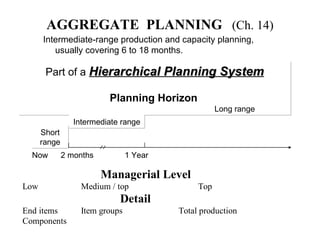
AGGREGATE  PLANNING   (Ch. 14) Intermediate-range production and capacity planning, usually covering 6 to 18 months. Part of a  Hierarchical Planning System Planning Horizon   Long range Short range Intermediate range Now 2 months 1 Year
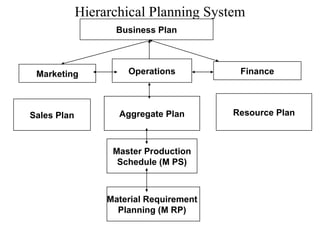
Hierarchical Planning System Business Plan Sales Plan Marketing Finance Operations Master Production Schedule (M PS) Aggregate Plan Material Requirement  Planning (M RP)  Resource Plan
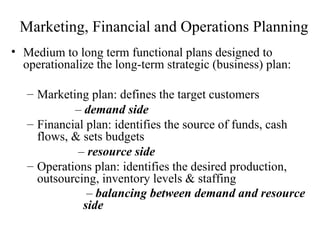
Marketing, Financial and Operations Planning Medium to long term functional plans designed to operationalize the long-term strategic (business) plan: Marketing plan: defines the target customers  –  demand side Financial plan: identifies the source of funds, cash flows, & sets budgets  –  resource side     Operations plan: identifies the desired production, outsourcing, inventory levels & staffing  –  balancing between demand and resource side
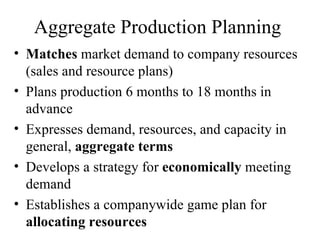
Aggregate Production Planning  Matches  market demand to company resources (sales and resource plans) Plans production 6 months to 18 months in advance Expresses demand, resources, and capacity in general,  aggregate terms Develops a strategy for  economically  meeting demand Establishes a companywide game plan for  allocating resources
Aggregate Planning Based on composite (representative) products: Simplifies calculations Forecasts for grouped items are more accurate Considers trade-offs between holding inventory & short-term capacity based on workforce
Planning Approaches Proactive approach: Coordinate Marketing & Production plans to level demand using advertising & price incentives Reactive approach: Allow volume forecasts based on Marketing plan to drive production planning
Strategies for Managing Demand Proactive  Strategies Create demand for idle resources advertising,  pricing,  promotions.  Shift demand into other periods backorder (lost case), appointments
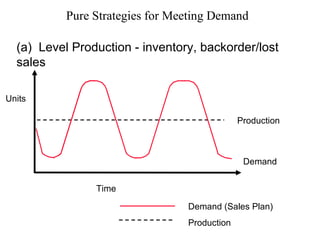
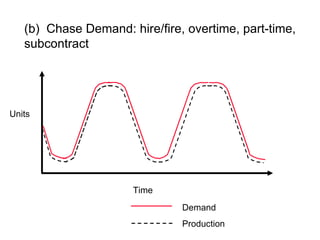
Basic (Pure)  Reactive  Strategies Level capacity:  Maintaining a steady rate of regular-time output while meeting variations in demand by a combination of options. Chase demand:  Matching capacity to demand; the planned output for a period is the expected demand for that period.
Pure Strategies for Meeting Demand (a)  Level Production - inventory, backorder/lost sales Units Time Production Demand (Sales Plan) Production Demand
Time Units Demand Production (b)  Chase Demand: hire/fire, overtime, part-time, subcontract
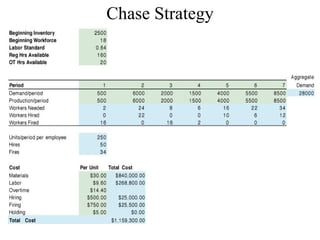
Evaluating Alternative Plans Level strategy plan Chase strategy plan
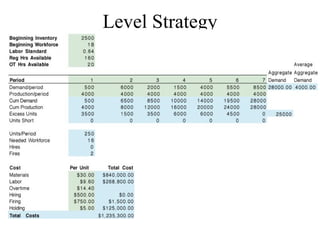
Level Strategy
Chase Strategy
Basic Reactive Strategies Level plans: Use a constant workforce & produce similar quantities each time period. Use inventories & backorders to absorb demand peaks & valleys Chase plans: Minimize finished good inventories by trying to keep pace with demand fluctuations
Hybrid Reactive Strategies Use a combination of options: Build-up inventory ahead of rising demand & use backorders to level extreme peaks Layoff or furlough workers during lulls Subcontract production or hire temporary workers to cover short-term peaks Reassign workers to preventive maintenance during lulls
Mixed Strategies for Meeting Demand Overtime/Undertime  Hiring/Firing Inventory/Backordering Subcontracting Out/In Part-time/Full-Time
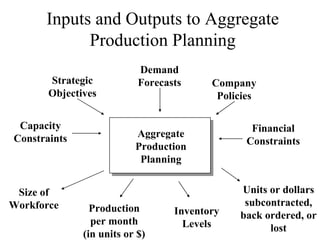
Inputs and Outputs to Aggregate Production Planning Aggregate Production Planning Demand Forecasts Company Policies Financial Constraints Strategic Objectives Capacity Constraints Size of Workforce Production per month (in units or $) Inventory Levels Units or dollars subcontracted, back ordered, or lost
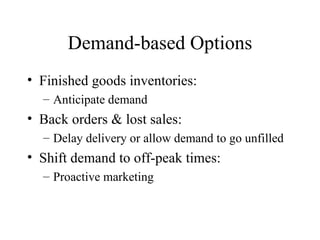
Demand-based Options Finished goods inventories: Anticipate demand Back orders & lost sales: Delay delivery or allow demand to go unfilled Shift demand to off-peak times: Proactive marketing
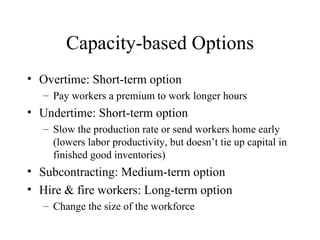
Capacity-based Options Overtime: Short-term option  Pay workers a premium to work longer hours Undertime: Short-term option  Slow the production rate or send workers home early (lowers labor productivity, but doesn’t tie up capital in finished good inventories) Subcontracting: Medium-term option Hire & fire workers: Long-term option  Change the size of the workforce
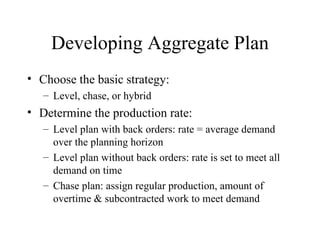
Developing Aggregate Plan Choose the basic strategy: Level, chase, or hybrid Determine the production rate:  Level plan with back orders: rate = average demand over the planning horizon Level plan without back orders: rate is set to meet all demand on time  Chase plan: assign regular production, amount of overtime & subcontracted work to meet demand
Developing the Aggregate Plan Calculate the size of the workforce needed Calculate period-to-period inventory levels, shortages, expected hiring & firings, and overtime Calculate period-by-period costs, then sum for total costs of the plan Evaluate the plan’s impact on customer service and human resource issues
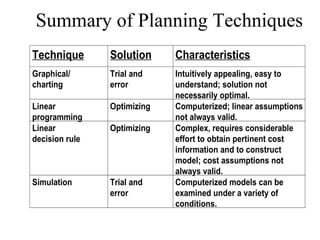
Summary of Planning Techniques
Service Planning Issues Intangible products can’t be inventoried Possible approaches: Try to proactively shift demand away from peaks Use overtime or subcontracting to handle peaks Allow lost sales
Master schedule : The result of disaggregating an aggregate plan; shows quantity and timing of specific end items for a scheduled horizon. Rough-cut capacity planning : Approximate balancing of capacity and demand to test the feasibility of a master schedule. Disaggregating
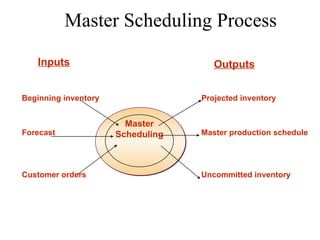
Master Scheduling Process Master Scheduling Beginning inventory Forecast Customer orders Inputs Outputs Projected inventory Master production schedule Uncommitted inventory

Aggregate Planning

  • 1.
    AGGREGATE PLANNING (Ch. 14) Intermediate-range production and capacity planning, usually covering 6 to 18 months. Part of a Hierarchical Planning System Planning Horizon Long range Short range Intermediate range Now 2 months 1 Year
  • 2.
    Hierarchical Planning SystemBusiness Plan Sales Plan Marketing Finance Operations Master Production Schedule (M PS) Aggregate Plan Material Requirement Planning (M RP) Resource Plan
  • 3.
    Marketing, Financial andOperations Planning Medium to long term functional plans designed to operationalize the long-term strategic (business) plan: Marketing plan: defines the target customers – demand side Financial plan: identifies the source of funds, cash flows, & sets budgets – resource side Operations plan: identifies the desired production, outsourcing, inventory levels & staffing – balancing between demand and resource side
  • 4.
    Aggregate Production Planning Matches market demand to company resources (sales and resource plans) Plans production 6 months to 18 months in advance Expresses demand, resources, and capacity in general, aggregate terms Develops a strategy for economically meeting demand Establishes a companywide game plan for allocating resources
  • 5.
    Aggregate Planning Basedon composite (representative) products: Simplifies calculations Forecasts for grouped items are more accurate Considers trade-offs between holding inventory & short-term capacity based on workforce
  • 6.
    Planning Approaches Proactiveapproach: Coordinate Marketing & Production plans to level demand using advertising & price incentives Reactive approach: Allow volume forecasts based on Marketing plan to drive production planning
  • 7.
    Strategies for ManagingDemand Proactive Strategies Create demand for idle resources advertising, pricing, promotions. Shift demand into other periods backorder (lost case), appointments
  • 8.
    Basic (Pure) Reactive Strategies Level capacity: Maintaining a steady rate of regular-time output while meeting variations in demand by a combination of options. Chase demand: Matching capacity to demand; the planned output for a period is the expected demand for that period.
  • 9.
    Pure Strategies forMeeting Demand (a) Level Production - inventory, backorder/lost sales Units Time Production Demand (Sales Plan) Production Demand
  • 10.
    Time Units DemandProduction (b) Chase Demand: hire/fire, overtime, part-time, subcontract
  • 11.
    Evaluating Alternative PlansLevel strategy plan Chase strategy plan
  • 12.
  • 13.
  • 14.
    Basic Reactive StrategiesLevel plans: Use a constant workforce & produce similar quantities each time period. Use inventories & backorders to absorb demand peaks & valleys Chase plans: Minimize finished good inventories by trying to keep pace with demand fluctuations
  • 15.
    Hybrid Reactive StrategiesUse a combination of options: Build-up inventory ahead of rising demand & use backorders to level extreme peaks Layoff or furlough workers during lulls Subcontract production or hire temporary workers to cover short-term peaks Reassign workers to preventive maintenance during lulls
  • 16.
    Mixed Strategies forMeeting Demand Overtime/Undertime Hiring/Firing Inventory/Backordering Subcontracting Out/In Part-time/Full-Time
  • 17.
    Inputs and Outputsto Aggregate Production Planning Aggregate Production Planning Demand Forecasts Company Policies Financial Constraints Strategic Objectives Capacity Constraints Size of Workforce Production per month (in units or $) Inventory Levels Units or dollars subcontracted, back ordered, or lost
  • 18.
    Demand-based Options Finishedgoods inventories: Anticipate demand Back orders & lost sales: Delay delivery or allow demand to go unfilled Shift demand to off-peak times: Proactive marketing
  • 19.
    Capacity-based Options Overtime:Short-term option Pay workers a premium to work longer hours Undertime: Short-term option Slow the production rate or send workers home early (lowers labor productivity, but doesn’t tie up capital in finished good inventories) Subcontracting: Medium-term option Hire & fire workers: Long-term option Change the size of the workforce
  • 20.
    Developing Aggregate PlanChoose the basic strategy: Level, chase, or hybrid Determine the production rate: Level plan with back orders: rate = average demand over the planning horizon Level plan without back orders: rate is set to meet all demand on time Chase plan: assign regular production, amount of overtime & subcontracted work to meet demand
  • 21.
    Developing the AggregatePlan Calculate the size of the workforce needed Calculate period-to-period inventory levels, shortages, expected hiring & firings, and overtime Calculate period-by-period costs, then sum for total costs of the plan Evaluate the plan’s impact on customer service and human resource issues
  • 22.
  • 23.
    Service Planning IssuesIntangible products can’t be inventoried Possible approaches: Try to proactively shift demand away from peaks Use overtime or subcontracting to handle peaks Allow lost sales
  • 24.
    Master schedule :The result of disaggregating an aggregate plan; shows quantity and timing of specific end items for a scheduled horizon. Rough-cut capacity planning : Approximate balancing of capacity and demand to test the feasibility of a master schedule. Disaggregating
  • 25.
    Master Scheduling ProcessMaster Scheduling Beginning inventory Forecast Customer orders Inputs Outputs Projected inventory Master production schedule Uncommitted inventory

Editor's Notes