Overview: ITK Registration Methods Lydia Ng Allen Institute for Brain Science
Overview Introduction ITK Registration Framework Component Overview Registration Strategies GUI Communication Deformable Registration in ITK Resources Application: Allen Brain Atlas
Introduction Image registration Process of finding the spatial transform that maps all points from one image to their homologous points in another image Medical applications Monitoring change in an individual Fuse information from multiple sources to aid clinical interpretation Compare one subject to another
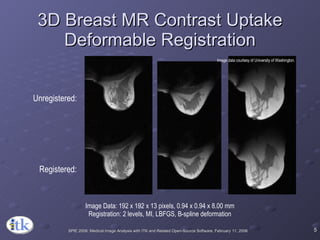
Intra-subject Registration Repeated image scans of the same subject can be used to capture the effect of disease development, treatment progress, contrast bolus propagation etc. Registration can be used to compensate for differences in patient placement Subtraction/overlay of registered images can be used for visualization and quantification
3D Breast MR Contrast Uptake Deformable Registration Unregistered: Registered: Image Data: 192 x 192 x 13 pixels, 0.94 x 0.94 x 8.00 mm Registration: 2 levels, MI, LBFGS, B-spline deformation Image data courtesy of University of Washington.
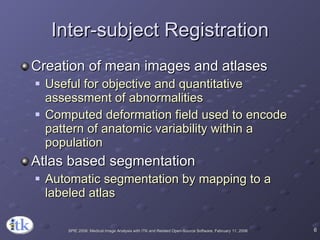
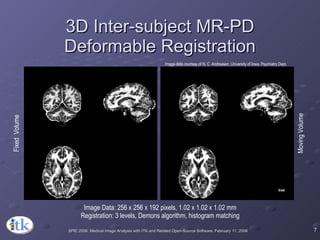
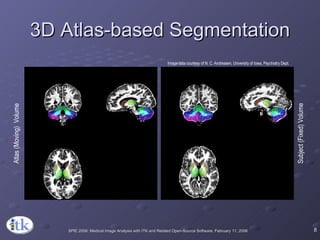
Inter-subject Registration Creation of mean images and atlases Useful for objective and quantitative assessment of abnormalities Computed deformation field used to encode pattern of anatomic variability within a population Atlas based segmentation Automatic segmentation by mapping to a labeled atlas
3D Inter-subject MR-PD Deformable Registration Image Data: 256 x 256 x 192 pixels, 1.02 x 1.02 x 1.02 mm Registration: 3 levels, Demons algorithm, histogram matching Image data courtesy of N. C. Andreasen, University of Iowa, Psychiatry Dept. Fixed  Volume Moving Volume
3D Atlas-based Segmentation Atlas (Moving)  Volume Subject (Fixed) Volume Image data courtesy of N. C. Andreasen, University of Iowa, Psychiatry Dept.
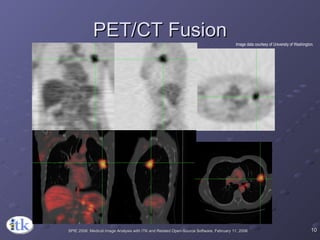
Multi-modality Registration Combine or fuse information from multiple sources to aid clinical interpretation Some modalities MR: soft tissue discrimination; lesion identification CT: bone localization; surgical guidance PET/SPECT: functional information; tumor localization
PET/CT Fusion Image data courtesy of University of Washington.
Image Registration Classification Registration criteria Quantitative measure of a “good match” Focus on intensity based measures Spatial transform type Allowable mapping from one image to another Rigid versus non-rigid Optimization algorithm used Optimize transform parameters with respect to match criteria Image interpolation method Value of image at non-grid position
ITK Registration Framework
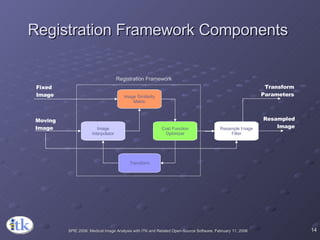
ITK Registration Framework Generic framework for building intensity based registration algorithms Each functionality encapsulated as components Components are inter-changeable allowing a combinatorial variety of registration methods Components are generic Can be used outside the registration framework
Registration Framework Components  Cost Function Optimizer Transform Resample   Image Filter Fixed Image Moving Image Resampled Image Transform Parameters Registration Framework Image Similarity Metric Image Interpolator
itk::ImageRegistrationMethod Simple helper driver class that connects up the components and starts the optimizer Examples in Software Guide
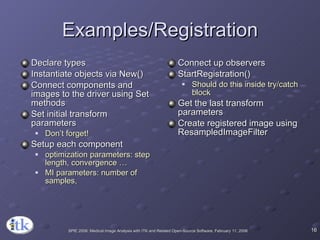
Examples/Registration Declare types Instantiate objects via New() Connect components and images to the driver using Set methods Set initial transform parameters Don’t forget! Setup each component optimization parameters: step length, convergence … MI parameters: number of samples,  Connect up observers StartRegistration() Should do this inside try/catch block Get the last transform parameters Create registered image using ResampledImageFilter
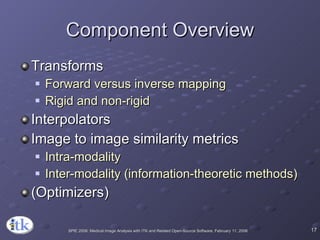
Component Overview Transforms Forward versus inverse mapping Rigid and non-rigid Interpolators Image to image similarity metrics Intra-modality Inter-modality (information-theoretic methods) (Optimizers)
itk::Transfrom Encapsulates the mapping of points and vectors from an “input” space to an “output” space ITK provides a variety of transforms from simple translation, rotation and scaling to general affine, kernel and B-spline transfoms  Forward versus inverse mapping Parameters representation “ Transform Jacobians”
Forward and Inverse Mappings Relationship between points of two images can be expressed in two ways: Forward: pixel of input (moving) image mapped onto the output (fixed) image Inverse: output (fixed image) pixels are mapped back onto the input (moving) image
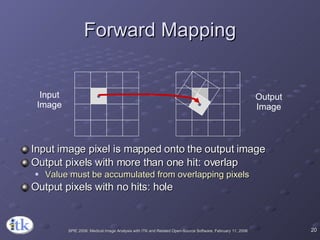
Forward Mapping Input image pixel is mapped onto the output image Output pixels with more than one hit: overlap Value must be accumulated from overlapping pixels Output pixels with no hits: hole Input Image Output Image
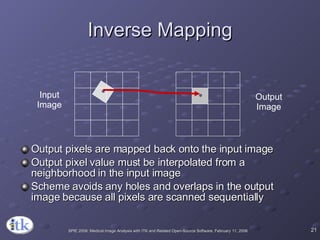
Inverse Mapping Output pixels are mapped back onto the input image Output pixel value must be interpolated from a neighborhood in the input image Scheme avoids any holes and overlaps in the output image because all pixels are scanned sequentially Input Image Output Image
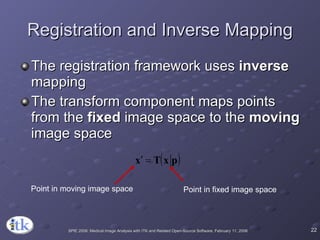
Registration and Inverse Mapping The registration framework uses  inverse  mapping The transform component maps points from the  fixed  image space to the  moving  image space Point in fixed image space Point in moving image space
Transform Parameters Each transform class is defined by a set of parameters Translation, angle of rotation etc Represented as a flat array of doubles to facilitate communication with generic ITK Optimizers Transform parameters define the search space for the optimizer Goal of registration Find the set of transform parameters that result in the best value of an image similarity metric
Transform Jacobian Some metrics require the knowledge of the “transform Jacobian” in order to compute metric derivatives The “transform Jacobian” is a matrix whose elements are the partial derivatives of the output point with respect to the transform parameters
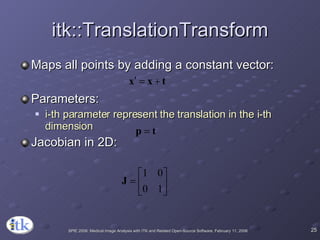
itk::TranslationTransform Maps all points by adding a constant vector: Parameters: i-th parameter represent the translation in the i-th dimension Jacobian in 2D:
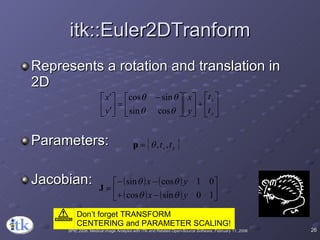
itk::Euler2DTranform Represents a rotation and translation in 2D Parameters: Jacobian: Don’t forget TRANSFORM    CENTERING and PARAMETER SCALING!
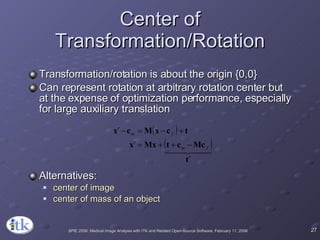
Center of Transformation/Rotation Transformation/rotation is about the origin {0,0} Can represent rotation at arbitrary rotation center but at the expense of optimization performance, especially for large auxiliary translation Alternatives:  center of image  center of mass of an object
Parameter Scaling Different type of parameters (translation vs. angle vs. scaling) have different dynamic ranges E.g. a unit change in rotation has a much larger impact than a unit change in translation Differences in scale appears as long narrow valleys in the search space making optimization difficult Rescaling the parameters can help fix this problem
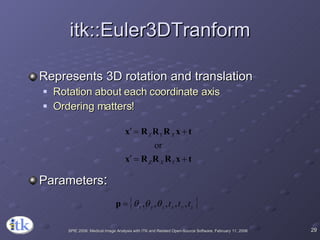
itk::Euler3DTranform Represents 3D rotation and translation Rotation about each coordinate axis Ordering matters! Parameters :
Alternative 3D Rigid Transforms itk::QuaternionRigidTransform 3D rotation represented by a quaternion Represented by 4 numbers Similar to axis/angle representation Unit quaternion is equivalent to pure rigid Does not suffer from “Gimbal lock” itk::VersorRigidTransform Strictly the rotational part of a quaternion (always rigid) Represented by 3 numbers Both quaternion and versor components do not form vector spaces Specialized optimizers required!
I will not register images in pixel space I will not register images in pixel space I will not register images in pixel space I will not register images in pixel space I will not register images in pixel space I will not register images in pix
Image Spacing and Origin Medical image volume are typically anisotropic In-plane pixel size smaller than inter-slice spacing A transform is rigid only with respect to physical coordinates and not pixel coordinates PhysCoord = PixelCoord x ImageSpacing + ImageOrigin The registration is always with respect to physical coordinates Make sure spacing and origin information is set correctly in the images!
itk::AffineTransform General affine transform can represent rotation, scaling, shearing and translation Parameters: matrix coefficient + translation (6 in 2D, 12 in 3D) Parallel lines are preserved Don’t forget TRANSFORM    CENTERING and PARAMETER SCALING!
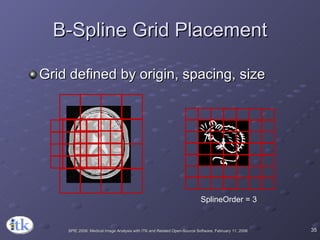
itk::BSplineDeformableTransform Represent a low-dimensional smooth deformable warp Deformation field represented by B-splines coefficient on a regular grid Parameters: B-spline coefficient for each dimension at each grid position
B-Spline Grid Placement Grid defined by origin, spacing, size SplineOrder = 3
itk::InterpolateImageFunction When a point is mapped from one image space to another image space, it will generally be mapped to a non-grid position Interpolation is needed to compute the intensity value at the mapped position
Choice of Interpolation Method Interpolation affects smoothness of metric space Interpolations computed 1000’s of times in a single optimization cycle Trade-off efficiency with ease of optimization
Interpolation Schemes itk::NearestNeighborInterpolateFunction Assumes image is piecewise constant itk::LinearInterpolateFunction Assumes image is piecewise linear itk::BSplineInterpolateFunction Underlying image represented using B-spline basis functions On connection, image of B-spline coefficients is computed
itk::ImageToImageMetric Measures how well a transformed moving image “matches” the fixed image The most critical component Scalar function of the transform parameters For given, fixed image, moving image, transformation type and interpolation type
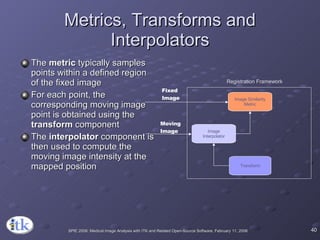
Metrics, Transforms and Interpolators The  metric  typically samples points within a defined region of the fixed image For each point, the corresponding moving image point is obtained using the  transform  component The  interpolator  component is then used to compute the moving image intensity at the mapped position Transform Registration Framework Image Similarity Metric Image Interpolator Fixed Image Moving Image
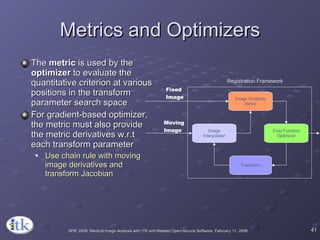
Metrics and Optimizers The  metric  is used by the  optimizer  to evaluate the quantitative criterion at various positions in the transform parameter search space For gradient-based optimizer, the metric must also provide the metric derivatives w.r.t each transform parameter Use chain rule with moving image derivatives and transform Jacobian Cost Function Optimizer Transform Fixed Image Moving Image Registration Framework Image Similarity Metric Image Interpolator
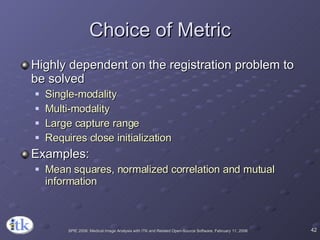
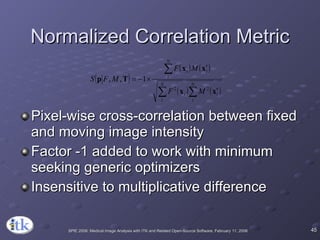
Choice of Metric Highly dependent on the registration problem to be solved Single-modality Multi-modality Large capture range Requires close initialization Examples: Mean squares, normalized correlation and mutual information
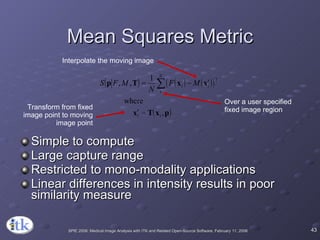
Mean Squares Metric Simple to compute Large capture range Restricted to mono-modality applications Linear differences in intensity results in poor similarity measure Over a user specified fixed image region Transform from fixed image point to moving image point Interpolate the moving image
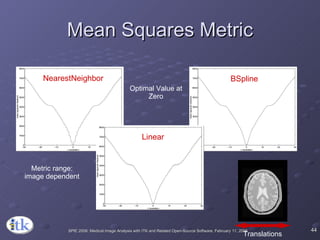
Mean Squares Metric NearestNeighbor Linear BSpline Optimal Value at Zero Metric range: image dependent Translations
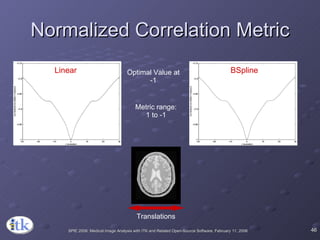
Normalized Correlation Metric Pixel-wise cross-correlation between fixed and moving image intensity Factor -1 added to work with minimum seeking generic optimizers Insensitive to multiplicative difference
Normalized Correlation Metric Linear BSpline Optimal Value at -1 Metric range: 1 to -1 Translations
Mutual Information Metric Information theoretic entity that qualitatively measures how much information is gained about one RV (intensity in one image) by the knowledge of another RV (intensity in another image)
Mutual Information Metric Introduced in the context of multi-modality registration by two different groups: Viola and Wells (1997) and Collignon et al. (1995) MI well suited since actual form of dependency between the two RVs does not have to be specified MI defined in terms of entropy Measure of information contained in a piece of data
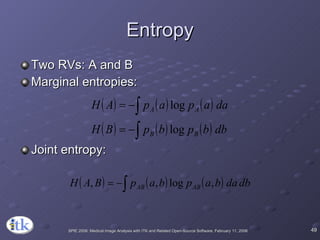
Entropy Two RVs: A and B Marginal entropies: Joint entropy:
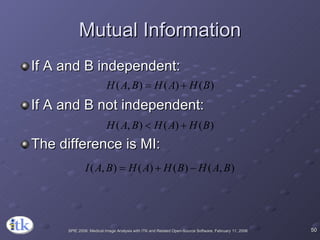
Mutual Information If A and B independent: If A and B not independent: The difference is MI:
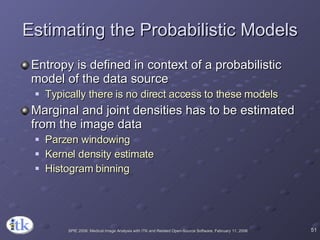
Estimating the Probabilistic Models Entropy is defined in context of a probabilistic model of the data source Typically there is no direct access to these models  Marginal and joint densities has to be estimated from the image data Parzen windowing Kernel density estimate Histogram binning
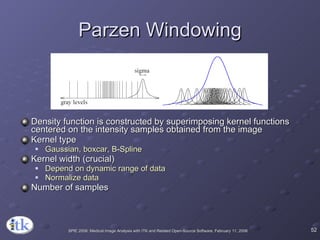
Parzen Windowing Density function is constructed by superimposing kernel functions centered on the intensity samples obtained from the image Kernel type Gaussian, boxcar, B-Spline Kernel width (crucial) Depend on dynamic range of data Normalize data Number of samples
Estimating Entropy Using the density estimate, approximate entropy integral by a sum Evaluate at discrete positions/bins uniformly spread within dynamic range Computing a sampled mean using another set of intensity samples randomly drawn from image
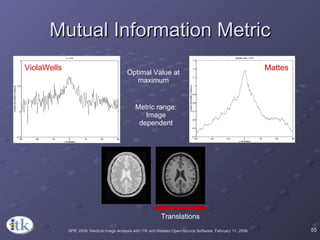
Flavors of Mutual Information itk::MutualInformationImageToImageMetric Viola and Wells New samples (50-100) each iteration itk::MattesMutualInformationImageToImageMetric Mattes et al, Thevenaz and Unser One set of samples (5-10% of image) itk::MutualInformationHistogramImageToImageMetric Use all pixels
Mutual Information Metric ViolaWells Mattes Optimal Value at maximum Metric range: Image dependent Translations
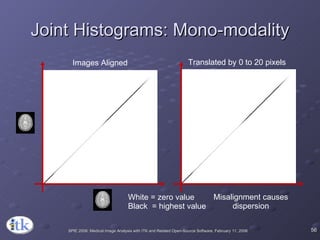
Joint Histograms: Mono-modality Images Aligned Translated by 0 to 20 pixels White = zero value Black  = highest value Misalignment causes dispersion
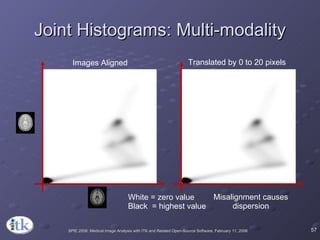
Joint Histograms: Multi-modality Translated by 0 to 20 pixels Misalignment causes dispersion Images Aligned White = zero value Black  = highest value
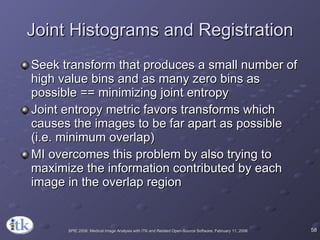
Joint Histograms and Registration Seek transform that produces a small number of high value bins and as many zero bins as possible == minimizing joint entropy Joint entropy metric favors transforms which causes the images to be far apart as possible (i.e. minimum overlap) MI overcomes this problem by also trying to maximize the information contributed by each image in the overlap region
Registration Strategies Naive application of registration may not work Coarse to fine strategy Improves computational speed and robustness Low to high dimensional transform Translation to rigid to deformable Sparse to fine grid
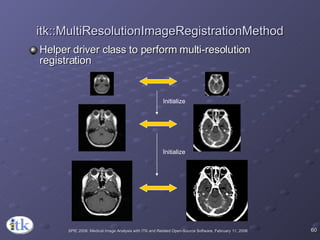
itk::MultiResolutionImageRegistrationMethod Helper driver class to perform multi-resolution registration Initialize Initialize
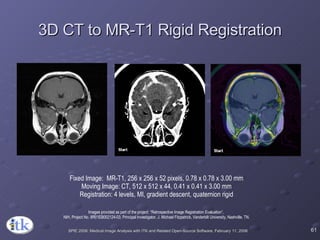
3D CT to MR-T1 Rigid Registration Fixed Image:  MR-T1, 256 x 256 x 52 pixels, 0.78 x 0.78 x 3.00 mm Moving Image: CT, 512 x 512 x 44, 0.41 x 0.41 x 3.00 mm Registration: 4 levels, MI, gradient descent, quaternion rigid Images provided as part of the project: “Retrospective Image Registration Evaluation”,  NIH, Project No. 8R01EB002124-03, Principal Investigator, J. Michael Fitzpatrick, Vanderbilt University, Nashville, TN.
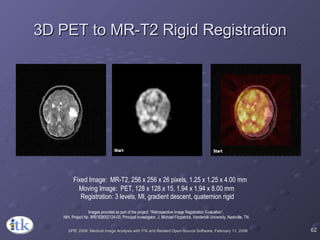
3D PET to MR-T2 Rigid Registration Fixed Image:  MR-T2, 256 x 256 x 26 pixels, 1.25 x 1.25 x 4.00 mm Moving Image:  PET, 128 x 128 x 15, 1.94 x 1.94 x 8.00 mm  Registration: 3 levels, MI, gradient descent, quaternion rigid Images provided as part of the project: “Retrospective Image Registration Evaluation”,  NIH, Project No. 8R01EB002124-03, Principal Investigator, J. Michael Fitzpatrick, Vanderbilt University, Nashville, TN.
Registration To GUI Communication Drive progress bar Observe registration progress Interrogate metric values Interrogate current parameters Display current results Resample and display ROI Change component parameters Terminate registration
ITK Observers/Commands itk::Object can invoke events Start, End, Progress, Iteration itk::Object maintains a linked list of event observers Observers register themselves to an object and declare the type of events they are interested in
Observing Registration ITK Optimizers typically execute an iterative process Most Optimizers invoke an IterationEvent at the end of each iteration Observing IterationEvents provide periodic communication facilitating progress feedback and opportunity to control the registration itk::MultiResolutionImageRegistrationMethod also invokes an IterationEvent between levels to give the GUI an opportunity to change components and/or parameters
ITK Registration Examples  ITK Software Guide 9+ examples InsightApplications ImageRegistration MRIRegistration MultiResMIRegistration MutualInformationEuler2DRegistration Landmark Initialized 3D Registration Tool CADD Lab, UNC
Deformable Registration in ITK Low dimensional transformations can be handled in the basic registration framework For high dimensional transformations: Finite Element Methods (FEM) Finite Different Methods Metric optimization Mean squares, normalized correlation, MI FEM framework additionally supports regularization and landmark constraints: Diffeomorphic constraints Linear elastic and large deformation (fluid and transient-quadratic) models Simple examples in Software Guide
Resources ITK Software Guide “ Insight into Images”,  Yoo (ed), 2004 “ A Survey of Medical Image Registration” Maintz and Viergever, Medical Image Analysis, 1998 “ Handbook of Medical Imaging: Medical Image Processing and Analysis” Fitzpatrick et al (eds), SPIE, 2000 “ Handbook of Medical Imaging: Processing and Analysis” Bankman (ed.), Academic Press, 2000 “ Medical Image Registration” Hajnal et al (eds), CRC Press, 2001 “ Mutual-Information-Based Registration of Medical Images: A Survey” Pluim et al, IEEE-TMI, 22(8), 2003 IEEE Transaction of Medical Imaging Special Issue November 2003
Data for Registration Testing Retrospective Registration Project http://www.vuse.vanderbilt.edu/~image/registration/ Multi-modality images of the brain Internet Brain Segmentation Repository http://www.cma.mgh.harvard.edu/ibsr/ MR-TI images of brain with segmentations BrainWeb http://www.bic.mni.mcgill.ca/brainweb/ Simulated brain database International Consortium For Brain Mapping (ICBM) http://www.loni.ucla.edu/ICBM/ICBM_Databases.html
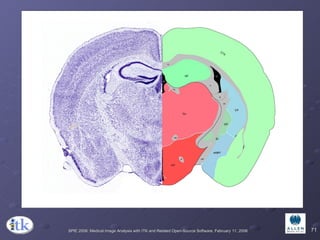
Application: Allen Brain Atlas Detailed, cellular-resolution, genome-wide map of gene expression in the mouse brain http://www.brain-map.org The Allen Reference Atlas is being developed to allow comparison of the gene expression data in a common anatomic framework Created from 528 coronal sections from fresh frozen tissue 3D reconstruction is needed to take into account differences between specimens and slicing orientation
 
3D Atlas Reconstruction Inherently 2D data Spatial relationship between sections is lost Artifacts (distortions, tears, smears, inhomogeneity etc) appear independently on per section basis Blind application of section-to-section registration could result in non-realistic 3D reconstructions requiring post-processing or constraints
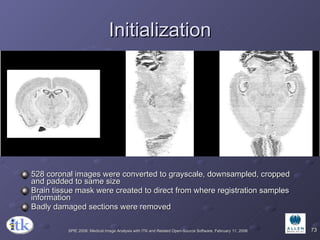
Initialization 528 coronal images were converted to grayscale, downsampled, cropped and padded to same size Brain tissue mask were created to direct from where registration samples information Badly damaged sections were removed
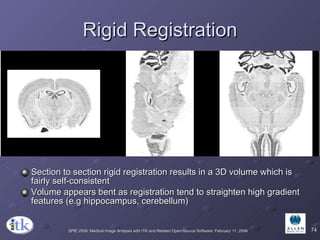
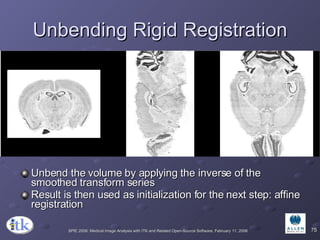
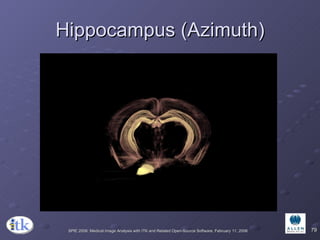
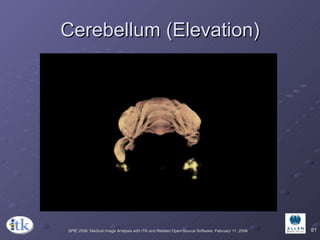
Rigid Registration Section to section rigid registration results in a 3D volume which is fairly self-consistent Volume appears bent as registration tend to straighten high gradient features (e.g hippocampus, cerebellum)
Unbending Rigid Registration Unbend the volume by applying the inverse of the smoothed transform series Result is then used as initialization for the next step: affine registration
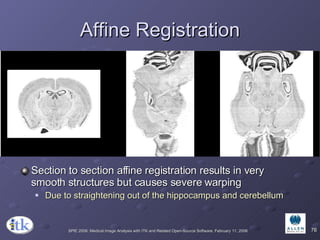
Affine Registration Section to section affine registration results in very smooth structures but causes severe warping Due to straightening out of the hippocampus and cerebellum
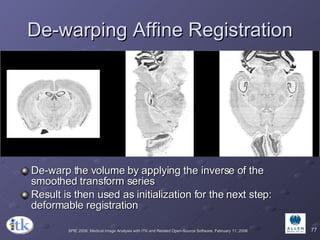
De-warping Affine Registration De-warp the volume by applying the inverse of the smoothed transform series Result is then used as initialization for the next step: deformable registration
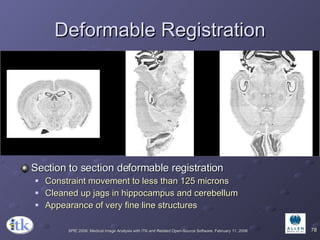
Deformable Registration Section to section deformable registration Constraint movement to less than 125 microns Cleaned up jags in hippocampus and cerebellum Appearance of very fine line structures
Hippocampus (Azimuth)
Hippocampus (Elevation)
Cerebellum (Elevation)
Ventricles (Elevation)

ITK Tutorial Presentation Slides-947

  • 1.
    Overview: ITK RegistrationMethods Lydia Ng Allen Institute for Brain Science
  • 2.
    Overview Introduction ITKRegistration Framework Component Overview Registration Strategies GUI Communication Deformable Registration in ITK Resources Application: Allen Brain Atlas
  • 3.
    Introduction Image registrationProcess of finding the spatial transform that maps all points from one image to their homologous points in another image Medical applications Monitoring change in an individual Fuse information from multiple sources to aid clinical interpretation Compare one subject to another
  • 4.
    Intra-subject Registration Repeatedimage scans of the same subject can be used to capture the effect of disease development, treatment progress, contrast bolus propagation etc. Registration can be used to compensate for differences in patient placement Subtraction/overlay of registered images can be used for visualization and quantification
  • 5.
    3D Breast MRContrast Uptake Deformable Registration Unregistered: Registered: Image Data: 192 x 192 x 13 pixels, 0.94 x 0.94 x 8.00 mm Registration: 2 levels, MI, LBFGS, B-spline deformation Image data courtesy of University of Washington.
  • 6.
    Inter-subject Registration Creationof mean images and atlases Useful for objective and quantitative assessment of abnormalities Computed deformation field used to encode pattern of anatomic variability within a population Atlas based segmentation Automatic segmentation by mapping to a labeled atlas
  • 7.
    3D Inter-subject MR-PDDeformable Registration Image Data: 256 x 256 x 192 pixels, 1.02 x 1.02 x 1.02 mm Registration: 3 levels, Demons algorithm, histogram matching Image data courtesy of N. C. Andreasen, University of Iowa, Psychiatry Dept. Fixed Volume Moving Volume
  • 8.
    3D Atlas-based SegmentationAtlas (Moving) Volume Subject (Fixed) Volume Image data courtesy of N. C. Andreasen, University of Iowa, Psychiatry Dept.
  • 9.
    Multi-modality Registration Combineor fuse information from multiple sources to aid clinical interpretation Some modalities MR: soft tissue discrimination; lesion identification CT: bone localization; surgical guidance PET/SPECT: functional information; tumor localization
  • 10.
    PET/CT Fusion Imagedata courtesy of University of Washington.
  • 11.
    Image Registration ClassificationRegistration criteria Quantitative measure of a “good match” Focus on intensity based measures Spatial transform type Allowable mapping from one image to another Rigid versus non-rigid Optimization algorithm used Optimize transform parameters with respect to match criteria Image interpolation method Value of image at non-grid position
  • 12.
  • 13.
    ITK Registration FrameworkGeneric framework for building intensity based registration algorithms Each functionality encapsulated as components Components are inter-changeable allowing a combinatorial variety of registration methods Components are generic Can be used outside the registration framework
  • 14.
    Registration Framework Components Cost Function Optimizer Transform Resample Image Filter Fixed Image Moving Image Resampled Image Transform Parameters Registration Framework Image Similarity Metric Image Interpolator
  • 15.
    itk::ImageRegistrationMethod Simple helperdriver class that connects up the components and starts the optimizer Examples in Software Guide
  • 16.
    Examples/Registration Declare typesInstantiate objects via New() Connect components and images to the driver using Set methods Set initial transform parameters Don’t forget! Setup each component optimization parameters: step length, convergence … MI parameters: number of samples, Connect up observers StartRegistration() Should do this inside try/catch block Get the last transform parameters Create registered image using ResampledImageFilter
  • 17.
    Component Overview TransformsForward versus inverse mapping Rigid and non-rigid Interpolators Image to image similarity metrics Intra-modality Inter-modality (information-theoretic methods) (Optimizers)
  • 18.
    itk::Transfrom Encapsulates themapping of points and vectors from an “input” space to an “output” space ITK provides a variety of transforms from simple translation, rotation and scaling to general affine, kernel and B-spline transfoms Forward versus inverse mapping Parameters representation “ Transform Jacobians”
  • 19.
    Forward and InverseMappings Relationship between points of two images can be expressed in two ways: Forward: pixel of input (moving) image mapped onto the output (fixed) image Inverse: output (fixed image) pixels are mapped back onto the input (moving) image
  • 20.
    Forward Mapping Inputimage pixel is mapped onto the output image Output pixels with more than one hit: overlap Value must be accumulated from overlapping pixels Output pixels with no hits: hole Input Image Output Image
  • 21.
    Inverse Mapping Outputpixels are mapped back onto the input image Output pixel value must be interpolated from a neighborhood in the input image Scheme avoids any holes and overlaps in the output image because all pixels are scanned sequentially Input Image Output Image
  • 22.
    Registration and InverseMapping The registration framework uses inverse mapping The transform component maps points from the fixed image space to the moving image space Point in fixed image space Point in moving image space
  • 23.
    Transform Parameters Eachtransform class is defined by a set of parameters Translation, angle of rotation etc Represented as a flat array of doubles to facilitate communication with generic ITK Optimizers Transform parameters define the search space for the optimizer Goal of registration Find the set of transform parameters that result in the best value of an image similarity metric
  • 24.
    Transform Jacobian Somemetrics require the knowledge of the “transform Jacobian” in order to compute metric derivatives The “transform Jacobian” is a matrix whose elements are the partial derivatives of the output point with respect to the transform parameters
  • 25.
    itk::TranslationTransform Maps allpoints by adding a constant vector: Parameters: i-th parameter represent the translation in the i-th dimension Jacobian in 2D:
  • 26.
    itk::Euler2DTranform Represents arotation and translation in 2D Parameters: Jacobian: Don’t forget TRANSFORM CENTERING and PARAMETER SCALING!
  • 27.
    Center of Transformation/RotationTransformation/rotation is about the origin {0,0} Can represent rotation at arbitrary rotation center but at the expense of optimization performance, especially for large auxiliary translation Alternatives: center of image center of mass of an object
  • 28.
    Parameter Scaling Differenttype of parameters (translation vs. angle vs. scaling) have different dynamic ranges E.g. a unit change in rotation has a much larger impact than a unit change in translation Differences in scale appears as long narrow valleys in the search space making optimization difficult Rescaling the parameters can help fix this problem
  • 29.
    itk::Euler3DTranform Represents 3Drotation and translation Rotation about each coordinate axis Ordering matters! Parameters :
  • 30.
    Alternative 3D RigidTransforms itk::QuaternionRigidTransform 3D rotation represented by a quaternion Represented by 4 numbers Similar to axis/angle representation Unit quaternion is equivalent to pure rigid Does not suffer from “Gimbal lock” itk::VersorRigidTransform Strictly the rotational part of a quaternion (always rigid) Represented by 3 numbers Both quaternion and versor components do not form vector spaces Specialized optimizers required!
  • 31.
    I will notregister images in pixel space I will not register images in pixel space I will not register images in pixel space I will not register images in pixel space I will not register images in pixel space I will not register images in pix
  • 32.
    Image Spacing andOrigin Medical image volume are typically anisotropic In-plane pixel size smaller than inter-slice spacing A transform is rigid only with respect to physical coordinates and not pixel coordinates PhysCoord = PixelCoord x ImageSpacing + ImageOrigin The registration is always with respect to physical coordinates Make sure spacing and origin information is set correctly in the images!
  • 33.
    itk::AffineTransform General affinetransform can represent rotation, scaling, shearing and translation Parameters: matrix coefficient + translation (6 in 2D, 12 in 3D) Parallel lines are preserved Don’t forget TRANSFORM CENTERING and PARAMETER SCALING!
  • 34.
    itk::BSplineDeformableTransform Represent alow-dimensional smooth deformable warp Deformation field represented by B-splines coefficient on a regular grid Parameters: B-spline coefficient for each dimension at each grid position
  • 35.
    B-Spline Grid PlacementGrid defined by origin, spacing, size SplineOrder = 3
  • 36.
    itk::InterpolateImageFunction When apoint is mapped from one image space to another image space, it will generally be mapped to a non-grid position Interpolation is needed to compute the intensity value at the mapped position
  • 37.
    Choice of InterpolationMethod Interpolation affects smoothness of metric space Interpolations computed 1000’s of times in a single optimization cycle Trade-off efficiency with ease of optimization
  • 38.
    Interpolation Schemes itk::NearestNeighborInterpolateFunctionAssumes image is piecewise constant itk::LinearInterpolateFunction Assumes image is piecewise linear itk::BSplineInterpolateFunction Underlying image represented using B-spline basis functions On connection, image of B-spline coefficients is computed
  • 39.
    itk::ImageToImageMetric Measures howwell a transformed moving image “matches” the fixed image The most critical component Scalar function of the transform parameters For given, fixed image, moving image, transformation type and interpolation type
  • 40.
    Metrics, Transforms andInterpolators The metric typically samples points within a defined region of the fixed image For each point, the corresponding moving image point is obtained using the transform component The interpolator component is then used to compute the moving image intensity at the mapped position Transform Registration Framework Image Similarity Metric Image Interpolator Fixed Image Moving Image
  • 41.
    Metrics and OptimizersThe metric is used by the optimizer to evaluate the quantitative criterion at various positions in the transform parameter search space For gradient-based optimizer, the metric must also provide the metric derivatives w.r.t each transform parameter Use chain rule with moving image derivatives and transform Jacobian Cost Function Optimizer Transform Fixed Image Moving Image Registration Framework Image Similarity Metric Image Interpolator
  • 42.
    Choice of MetricHighly dependent on the registration problem to be solved Single-modality Multi-modality Large capture range Requires close initialization Examples: Mean squares, normalized correlation and mutual information
  • 43.
    Mean Squares MetricSimple to compute Large capture range Restricted to mono-modality applications Linear differences in intensity results in poor similarity measure Over a user specified fixed image region Transform from fixed image point to moving image point Interpolate the moving image
  • 44.
    Mean Squares MetricNearestNeighbor Linear BSpline Optimal Value at Zero Metric range: image dependent Translations
  • 45.
    Normalized Correlation MetricPixel-wise cross-correlation between fixed and moving image intensity Factor -1 added to work with minimum seeking generic optimizers Insensitive to multiplicative difference
  • 46.
    Normalized Correlation MetricLinear BSpline Optimal Value at -1 Metric range: 1 to -1 Translations
  • 47.
    Mutual Information MetricInformation theoretic entity that qualitatively measures how much information is gained about one RV (intensity in one image) by the knowledge of another RV (intensity in another image)
  • 48.
    Mutual Information MetricIntroduced in the context of multi-modality registration by two different groups: Viola and Wells (1997) and Collignon et al. (1995) MI well suited since actual form of dependency between the two RVs does not have to be specified MI defined in terms of entropy Measure of information contained in a piece of data
  • 49.
    Entropy Two RVs:A and B Marginal entropies: Joint entropy:
  • 50.
    Mutual Information IfA and B independent: If A and B not independent: The difference is MI:
  • 51.
    Estimating the ProbabilisticModels Entropy is defined in context of a probabilistic model of the data source Typically there is no direct access to these models Marginal and joint densities has to be estimated from the image data Parzen windowing Kernel density estimate Histogram binning
  • 52.
    Parzen Windowing Densityfunction is constructed by superimposing kernel functions centered on the intensity samples obtained from the image Kernel type Gaussian, boxcar, B-Spline Kernel width (crucial) Depend on dynamic range of data Normalize data Number of samples
  • 53.
    Estimating Entropy Usingthe density estimate, approximate entropy integral by a sum Evaluate at discrete positions/bins uniformly spread within dynamic range Computing a sampled mean using another set of intensity samples randomly drawn from image
  • 54.
    Flavors of MutualInformation itk::MutualInformationImageToImageMetric Viola and Wells New samples (50-100) each iteration itk::MattesMutualInformationImageToImageMetric Mattes et al, Thevenaz and Unser One set of samples (5-10% of image) itk::MutualInformationHistogramImageToImageMetric Use all pixels
  • 55.
    Mutual Information MetricViolaWells Mattes Optimal Value at maximum Metric range: Image dependent Translations
  • 56.
    Joint Histograms: Mono-modalityImages Aligned Translated by 0 to 20 pixels White = zero value Black = highest value Misalignment causes dispersion
  • 57.
    Joint Histograms: Multi-modalityTranslated by 0 to 20 pixels Misalignment causes dispersion Images Aligned White = zero value Black = highest value
  • 58.
    Joint Histograms andRegistration Seek transform that produces a small number of high value bins and as many zero bins as possible == minimizing joint entropy Joint entropy metric favors transforms which causes the images to be far apart as possible (i.e. minimum overlap) MI overcomes this problem by also trying to maximize the information contributed by each image in the overlap region
  • 59.
    Registration Strategies Naiveapplication of registration may not work Coarse to fine strategy Improves computational speed and robustness Low to high dimensional transform Translation to rigid to deformable Sparse to fine grid
  • 60.
    itk::MultiResolutionImageRegistrationMethod Helper driverclass to perform multi-resolution registration Initialize Initialize
  • 61.
    3D CT toMR-T1 Rigid Registration Fixed Image: MR-T1, 256 x 256 x 52 pixels, 0.78 x 0.78 x 3.00 mm Moving Image: CT, 512 x 512 x 44, 0.41 x 0.41 x 3.00 mm Registration: 4 levels, MI, gradient descent, quaternion rigid Images provided as part of the project: “Retrospective Image Registration Evaluation”, NIH, Project No. 8R01EB002124-03, Principal Investigator, J. Michael Fitzpatrick, Vanderbilt University, Nashville, TN.
  • 62.
    3D PET toMR-T2 Rigid Registration Fixed Image: MR-T2, 256 x 256 x 26 pixels, 1.25 x 1.25 x 4.00 mm Moving Image: PET, 128 x 128 x 15, 1.94 x 1.94 x 8.00 mm Registration: 3 levels, MI, gradient descent, quaternion rigid Images provided as part of the project: “Retrospective Image Registration Evaluation”, NIH, Project No. 8R01EB002124-03, Principal Investigator, J. Michael Fitzpatrick, Vanderbilt University, Nashville, TN.
  • 63.
    Registration To GUICommunication Drive progress bar Observe registration progress Interrogate metric values Interrogate current parameters Display current results Resample and display ROI Change component parameters Terminate registration
  • 64.
    ITK Observers/Commands itk::Objectcan invoke events Start, End, Progress, Iteration itk::Object maintains a linked list of event observers Observers register themselves to an object and declare the type of events they are interested in
  • 65.
    Observing Registration ITKOptimizers typically execute an iterative process Most Optimizers invoke an IterationEvent at the end of each iteration Observing IterationEvents provide periodic communication facilitating progress feedback and opportunity to control the registration itk::MultiResolutionImageRegistrationMethod also invokes an IterationEvent between levels to give the GUI an opportunity to change components and/or parameters
  • 66.
    ITK Registration Examples ITK Software Guide 9+ examples InsightApplications ImageRegistration MRIRegistration MultiResMIRegistration MutualInformationEuler2DRegistration Landmark Initialized 3D Registration Tool CADD Lab, UNC
  • 67.
    Deformable Registration inITK Low dimensional transformations can be handled in the basic registration framework For high dimensional transformations: Finite Element Methods (FEM) Finite Different Methods Metric optimization Mean squares, normalized correlation, MI FEM framework additionally supports regularization and landmark constraints: Diffeomorphic constraints Linear elastic and large deformation (fluid and transient-quadratic) models Simple examples in Software Guide
  • 68.
    Resources ITK SoftwareGuide “ Insight into Images”, Yoo (ed), 2004 “ A Survey of Medical Image Registration” Maintz and Viergever, Medical Image Analysis, 1998 “ Handbook of Medical Imaging: Medical Image Processing and Analysis” Fitzpatrick et al (eds), SPIE, 2000 “ Handbook of Medical Imaging: Processing and Analysis” Bankman (ed.), Academic Press, 2000 “ Medical Image Registration” Hajnal et al (eds), CRC Press, 2001 “ Mutual-Information-Based Registration of Medical Images: A Survey” Pluim et al, IEEE-TMI, 22(8), 2003 IEEE Transaction of Medical Imaging Special Issue November 2003
  • 69.
    Data for RegistrationTesting Retrospective Registration Project http://www.vuse.vanderbilt.edu/~image/registration/ Multi-modality images of the brain Internet Brain Segmentation Repository http://www.cma.mgh.harvard.edu/ibsr/ MR-TI images of brain with segmentations BrainWeb http://www.bic.mni.mcgill.ca/brainweb/ Simulated brain database International Consortium For Brain Mapping (ICBM) http://www.loni.ucla.edu/ICBM/ICBM_Databases.html
  • 70.
    Application: Allen BrainAtlas Detailed, cellular-resolution, genome-wide map of gene expression in the mouse brain http://www.brain-map.org The Allen Reference Atlas is being developed to allow comparison of the gene expression data in a common anatomic framework Created from 528 coronal sections from fresh frozen tissue 3D reconstruction is needed to take into account differences between specimens and slicing orientation
  • 71.
  • 72.
    3D Atlas ReconstructionInherently 2D data Spatial relationship between sections is lost Artifacts (distortions, tears, smears, inhomogeneity etc) appear independently on per section basis Blind application of section-to-section registration could result in non-realistic 3D reconstructions requiring post-processing or constraints
  • 73.
    Initialization 528 coronalimages were converted to grayscale, downsampled, cropped and padded to same size Brain tissue mask were created to direct from where registration samples information Badly damaged sections were removed
  • 74.
    Rigid Registration Sectionto section rigid registration results in a 3D volume which is fairly self-consistent Volume appears bent as registration tend to straighten high gradient features (e.g hippocampus, cerebellum)
  • 75.
    Unbending Rigid RegistrationUnbend the volume by applying the inverse of the smoothed transform series Result is then used as initialization for the next step: affine registration
  • 76.
    Affine Registration Sectionto section affine registration results in very smooth structures but causes severe warping Due to straightening out of the hippocampus and cerebellum
  • 77.
    De-warping Affine RegistrationDe-warp the volume by applying the inverse of the smoothed transform series Result is then used as initialization for the next step: deformable registration
  • 78.
    Deformable Registration Sectionto section deformable registration Constraint movement to less than 125 microns Cleaned up jags in hippocampus and cerebellum Appearance of very fine line structures
  • 79.
  • 80.
  • 81.
  • 82.