Introduction to ITK Segmentation The Insight Consortium presented by Josh Cates Scientific Computing and Imaging Institute University of Utah
Session Objectives Review some important considerations when using ITK filters Overview of low-level image processing filters denoising / scale space feature extraction Overview some common segmentation filters connected component pixel classification watersheds level-set methods Brief introduction to image processing “frameworks” in ITK See examples  simple command line full applications with user interaction
Important Facts about ITK Filters Most filters are N dimensional Many filters run multi-threaded Filters are implemented within frameworks Most filters are documented Filters are regression tested Data type matters Pixel spacing matters Filters are not full applications Filters require parameter tuning
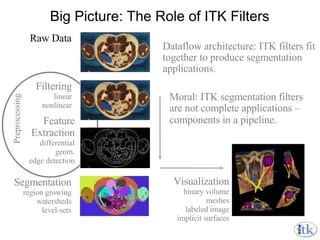
Big Picture: The Role of ITK Filters Raw Data Filtering linear nonlinear Feature Extraction differential geom. edge detection Segmentation region growing watersheds level-sets Visualization binary volume meshes labeled image implicit surfaces Dataflow architecture: ITK filters fit together to produce segmentation applications. Preprocessing Moral: ITK segmentation filters  are not complete applications –  components in a pipeline.
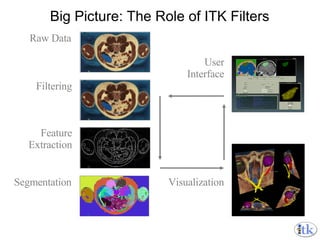
Big Picture: The Role of ITK Filters Raw Data Filtering Feature Extraction Segmentation Visualization User Interface
Where to go to  really  learn to use the filters http://www.itk.org Doxygen Manual Pages Software Guide Algorithm descriptions Tutorials for using algorithms Theory Book Insight into Images , Terry Yoo, ed. Users Mailing List CVS Repositories: Insight/Examples InsightApplications
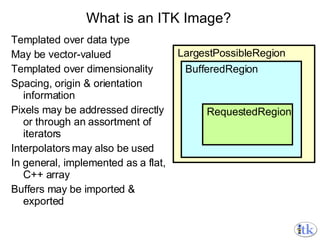
What is an ITK Image? Templated over data type May be vector-valued Templated over dimensionality Spacing, origin & orientation information Pixels may be addressed directly or through an assortment of iterators Interpolators may also be used In general, implemented as a flat, C++ array Buffers may be imported & exported LargestPossibleRegion BufferedRegion RequestedRegion
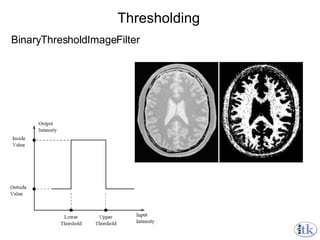
Thresholding BinaryThresholdImageFilter
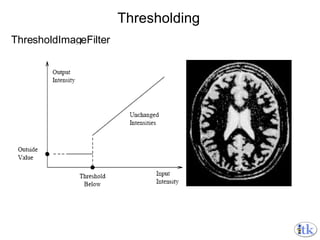
Thresholding ThresholdImageFilter
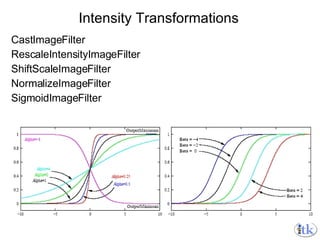
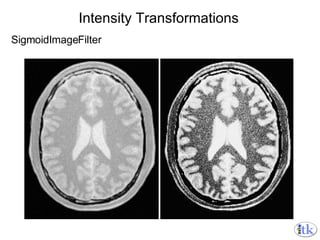
Intensity Transformations CastImageFilter RescaleIntensityImageFilter ShiftScaleImageFilter NormalizeImageFilter SigmoidImageFilter
Intensity Transformations SigmoidImageFilter
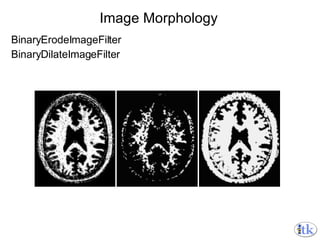
Image Morphology BinaryErodeImageFilter BinaryDilateImageFilter
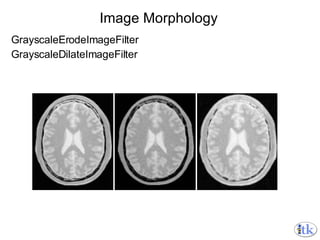
Image Morphology GrayscaleErodeImageFilter GrayscaleDilateImageFilter
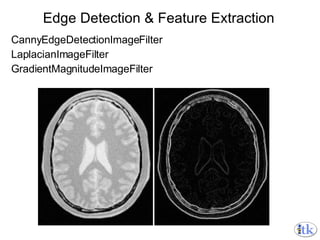
Edge Detection & Feature Extraction CannyEdgeDetectionImageFilter LaplacianImageFilter GradientMagnitudeImageFilter
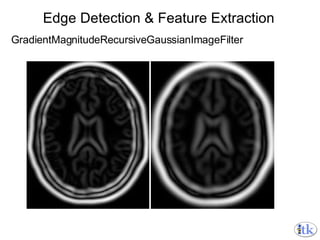
Edge Detection & Feature Extraction GradientMagnitudeRecursiveGaussianImageFilter
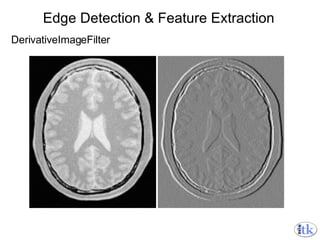
Edge Detection & Feature Extraction DerivativeImageFilter
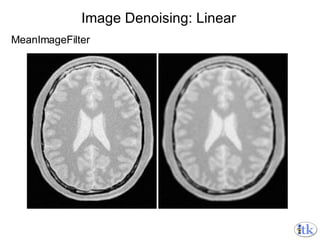
Image Denoising: Linear MeanImageFilter
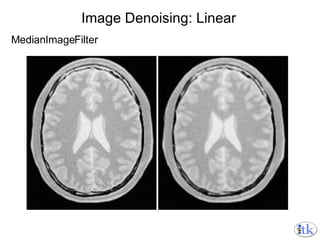
Image Denoising: Linear MedianImageFilter
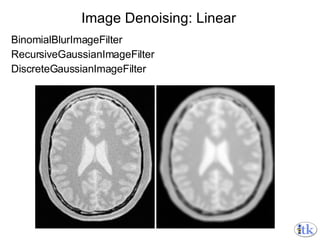
Image Denoising: Linear BinomialBlurImageFilter RecursiveGaussianImageFilter DiscreteGaussianImageFilter
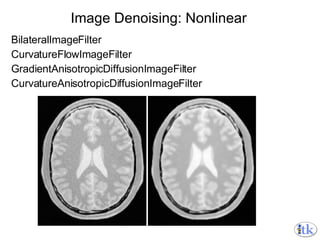
Image Denoising: Nonlinear BilateralImageFilter CurvatureFlowImageFilter GradientAnisotropicDiffusionImageFilter CurvatureAnisotropicDiffusionImageFilter
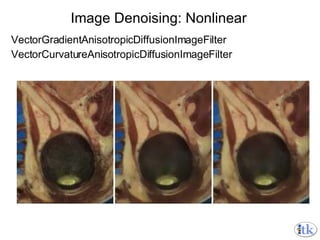
Image Denoising: Nonlinear VectorGradientAnisotropicDiffusionImageFilter VectorCurvatureAnisotropicDiffusionImageFilter
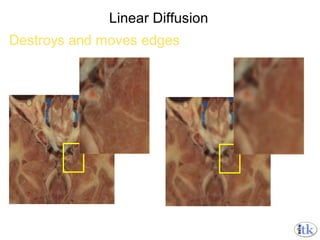
Linear Diffusion
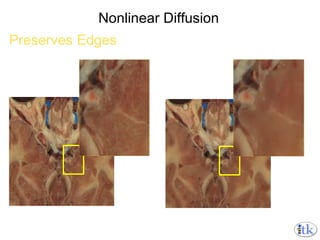
Nonlinear Diffusion
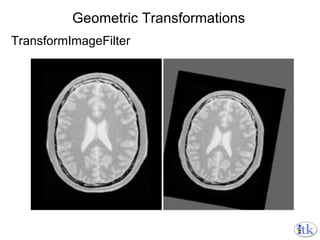
Geometric Transformations TransformImageFilter
Remember Filters generalize to N dimensions Filters “work” on arbitrary data types, but only some data types make sense Filters are implemented within  extensible  frameworks
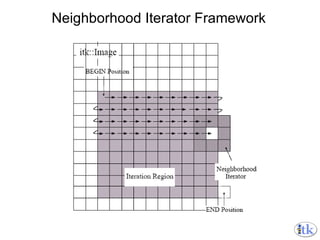
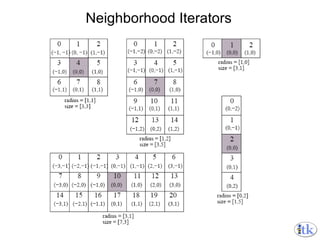
Image Neighborhood Framework Neighborhood is a set of pixels local adjacent to one another Used to implement algorithms where result at pixel  i  is based on some computation within the neighborhood of  i Iterators abstract the API for working with a neighborhood of pixels in arbitrary dimensions Operators are applied to image neighborhood to perform various calculations Boundary conditions are handled automatically
Neighborhood Iterator Framework
Neighborhood Iterators
ITK Segmentation Algorithms Classification / Thresholding Region Growing Watersheds Level-set Methods “ Hybrid” Methods
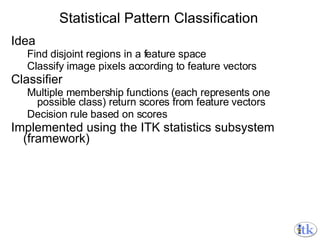
Statistical Pattern Classification Idea Find disjoint regions in a feature space Classify image pixels according to feature vectors Classifier Multiple membership functions (each represents one possible class) return scores from feature vectors Decision rule based on scores Implemented using the ITK statistics subsystem (framework)
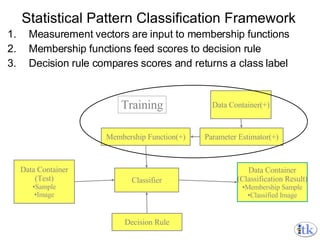
Statistical Pattern Classification Framework Measurement vectors are input to membership functions Membership functions feed scores to decision rule Decision rule compares scores and returns a class label Data Container (Test) Sample Image Membership Function(+) Classifier Decision Rule Data Container (Classification Result) Membership Sample Classified Image Parameter Estimator(+) Data Container(+) Training
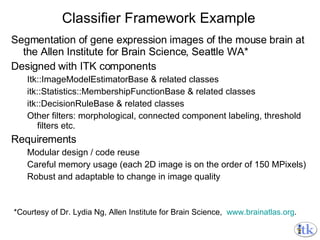
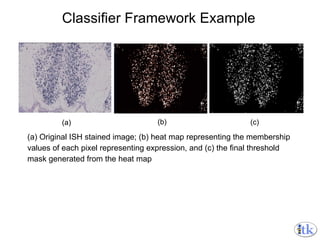
Segmentation of gene expression images of the mouse brain at the Allen Institute for Brain Science, Seattle WA* Designed with ITK components Itk::ImageModelEstimatorBase & related classes itk::Statistics::MembershipFunctionBase & related classes itk::DecisionRuleBase & related classes Other filters: morphological, connected component labeling, threshold filters etc. Requirements Modular design / code reuse Careful memory usage (each 2D image is on the order of 150 MPixels) Robust and adaptable to change in image quality Classifier Framework Example *Courtesy of Dr. Lydia Ng, Allen Institute for Brain Science,  www.brainatlas.org .
Classifier Framework Example (a) Original ISH stained image; (b) heat map representing the membership  values of each pixel representing expression, and (c) the final threshold  mask generated from the heat map
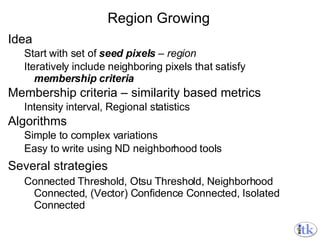
Region Growing Idea Start with set of  seed pixels  – region Iteratively include neighboring pixels that satisfy  membership criteria Membership criteria – similarity based metrics Intensity interval, Regional statistics Algorithms Simple to complex variations Easy to write using ND neighborhood tools Several strategies Connected Threshold, Otsu Threshold, Neighborhood Connected, (Vector) Confidence Connected, Isolated Connected
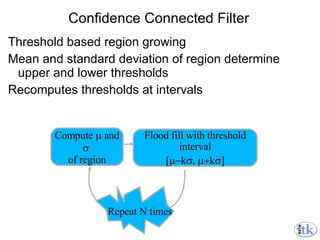
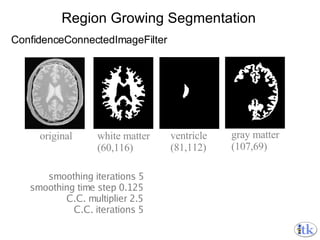
Confidence Connected Filter Threshold based region growing Mean and standard deviation of region determine upper and lower thresholds Recomputes thresholds at intervals Compute   and   of region Flood fill with threshold interval  k  k  Repeat N times
Region Growing Segmentation ConfidenceConnectedImageFilter smoothing iterations 5 smoothing time step 0.125 C.C. multiplier 2.5 C.C. iterations 5 white matter (60,116) original ventricle (81,112) gray matter (107,69)
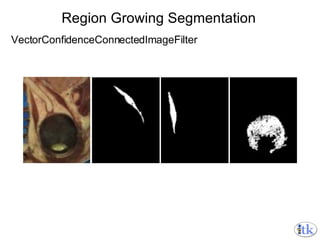
Region Growing Segmentation VectorConfidenceConnectedImageFilter
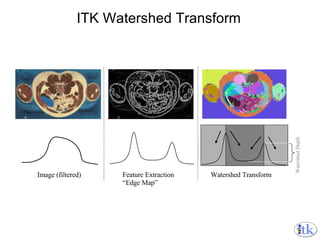
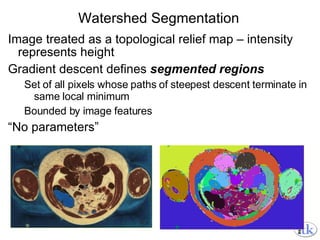
Watershed Segmentation Image treated as a topological relief map – intensity represents height Gradient descent defines  segmented regions Set of all pixels whose paths of steepest descent terminate in same local minimum Bounded by image features  “ No parameters”
ITK Watershed Transform Image (filtered) Feature Extraction “ Edge Map” Watershed Transform Watershed Depth
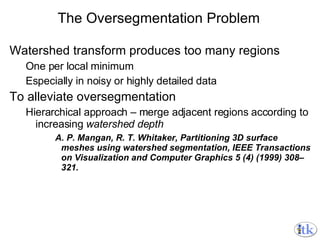
The Oversegmentation Problem Watershed transform produces too many regions One per local minimum Especially in noisy or highly detailed data To alleviate oversegmentation Hierarchical approach – merge adjacent regions according to increasing  watershed depth A. P. Mangan, R. T. Whitaker, Partitioning 3D surface meshes using watershed segmentation, IEEE Transactions on Visualization and Computer Graphics 5 (4) (1999) 308–321.
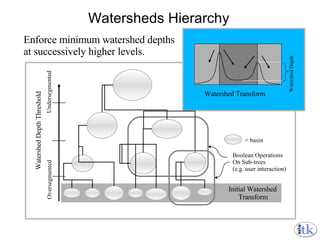
Watersheds Hierarchy Watershed Depth Threshold Boolean Operations On Sub-trees (e.g. user interaction) Oversegmented Undersegmented = basin  Watershed Transform Watershed Depth Enforce minimum watershed depths at successively higher levels. Initial Watershed  Transform
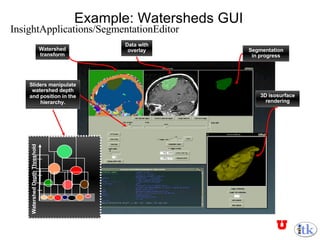
Example: Watersheds GUI Watershed Depth Threshold InsightApplications/SegmentationEditor 3D isosurface rendering Data with overlay Watershed transform Segmentation in progress Sliders manipulate watershed depth and position in the hierarchy.
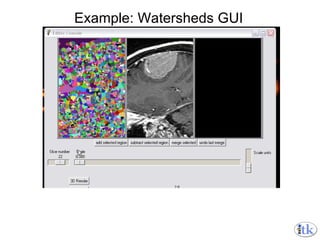
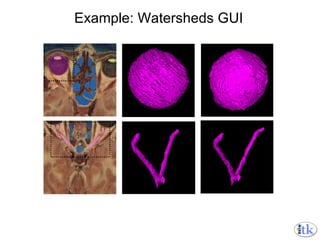
Example: Watersheds GUI
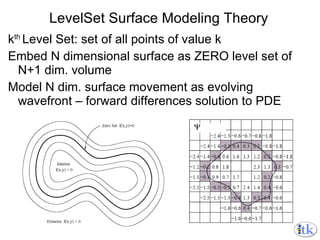
LevelSet Surface Modeling Theory k th  Level Set: set of all points of value k Embed N dimensional surface as ZERO level set of N+1 dim. volume Model N dim. surface movement as evolving wavefront – forward differences solution to PDE
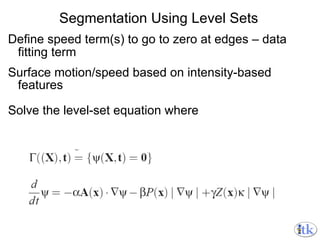
Segmentation Using Level Sets Define speed term(s) to go to zero at edges – data fitting term Surface motion/speed based on intensity-based features Solve the level-set equation where
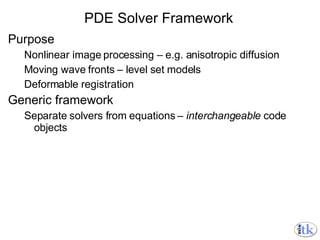
PDE Solver Framework Purpose Nonlinear image processing – e.g. anisotropic diffusion Moving wave fronts – level set models Deformable registration Generic framework Separate solvers from equations –  interchangeable  code objects
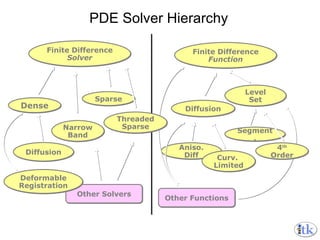
PDE Solver Hierarchy Dense Finite Difference Solver Sparse Narrow Band Diffusion Other Solvers Finite Difference Function Diffusion Level Set Other Functions Aniso. Diff Curv.  Limited Segment. Threaded Sparse 4 th  Order Deformable Registration
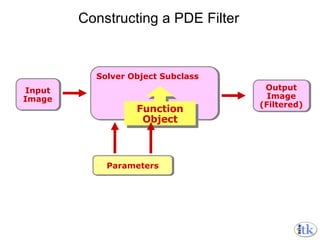
Constructing a PDE Filter Input Image Output Image (Filtered) Solver Object Subclass Function Object Parameters
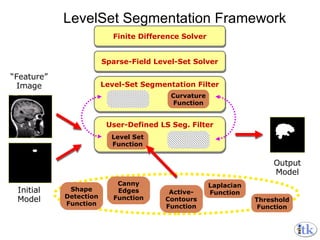
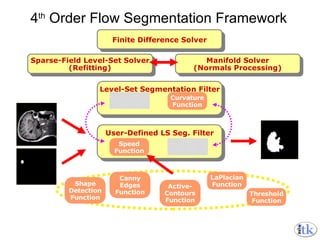
LevelSet Segmentation Framework “ Feature” Image Initial Model Output Model User-Defined LS Seg. Filter Level-Set Segmentation Filter Finite Difference Solver Curvature Function Finite Difference Solver Sparse-Field Level-Set Solver Level Set Function Shape Detection Function Active-Contours Function Laplacian Function Threshold Function Canny Edges Function
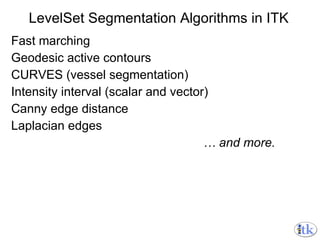
LevelSet Segmentation Algorithms in ITK Fast marching Geodesic active contours CURVES (vessel segmentation) Intensity interval (scalar and vector) Canny edge distance Laplacian edges …  and more.
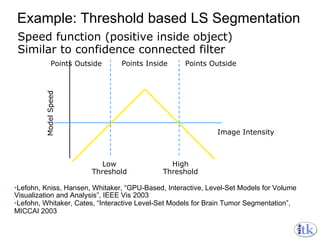
Example: Threshold based LS Segmentation Speed function (positive inside object) Similar to confidence connected filter Points Inside Points Outside Points Outside Low Threshold High Threshold Image Intensity Model Speed Lefohn, Kniss, Hansen, Whitaker, “GPU-Based, Interactive, Level-Set Models for Volume Visualization and Analysis”, IEEE Vis 2003 Lefohn, Whitaker, Cates, “Interactive Level-Set Models for Brain Tumor Segmentation”, MICCAI 2003
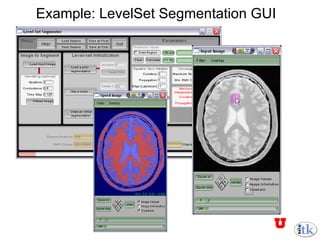
Example: LevelSet Segmentation GUI
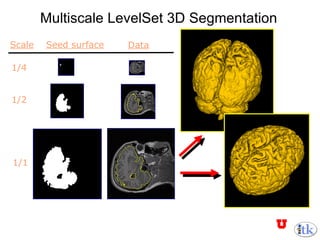
Multiscale LevelSet 3D Segmentation Seed surface Data Scale 1/4 1/2 1/1
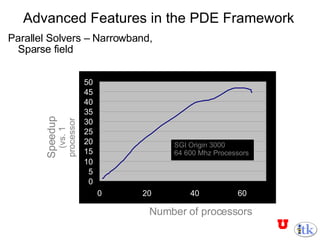
Advanced Features in the PDE Framework Parallel Solvers – Narrowband, Sparse field Speedup (vs. 1 processor Number of processors SGI Origin 3000 64 600 Mhz Processors
4 th  Order Flow Segmentation Framework
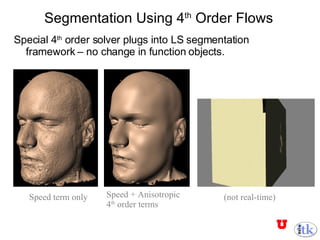
Segmentation Using 4 th  Order Flows Special 4 th  order solver plugs into LS segmentation  framework – no change in function objects. Speed term only Speed + Anisotropic 4 th  order terms (not real-time)
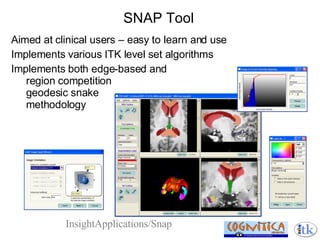
SNAP Tool Aimed at clinical users – easy to learn and use Implements various ITK level set algorithms Implements both edge-based and  region competition  geodesic snake  methodology InsightApplications/Snap
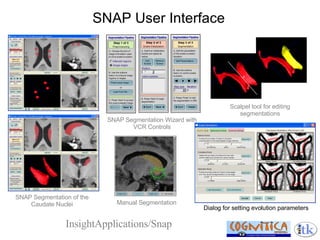
SNAP User Interface Dialog for setting evolution parameters Scalpel tool for editing segmentations Manual Segmentation InsightApplications/Snap SNAP Segmentation of the Caudate Nuclei SNAP Segmentation Wizard with VCR Controls
“Hybrid” Segmentation Methods Apply several algorithms in sequence Utilize strengths of each Speed / accuracy tradeoffs — e.g. connected component vs. level-sets Maximize use of information in data — e.g. region based plus boundary based
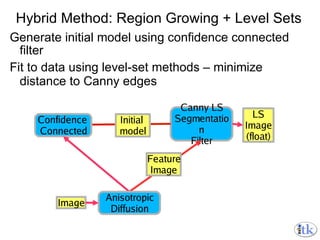
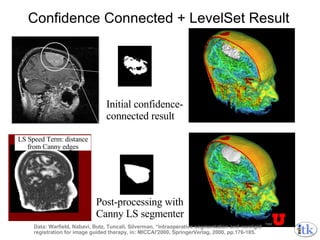
Hybrid Method: Region Growing + Level Sets Generate initial model using confidence connected filter Fit to data using level-set methods – minimize distance to Canny edges Canny LS Segmentation Filter LS Image (float) Image Confidence  Connected Initial  model Anisotropic Diffusion Feature Image
Confidence Connected + LevelSet Result Initial confidence- connected result Post-processing with  Canny LS segmenter LS Speed Term: distance from Canny edges Data: Warfield, Nabavi, Butz, Tuncali, Silverman, “Intraoperative segmentation and nonrigid  registration for image guided therapy, in: MICCAI'2000, SpringerVerlag, 2000, pp.176-185.
http://www.itk.org enjoy ITK!

ITK Tutorial Presentation Slides-946

  • 1.
    Introduction to ITKSegmentation The Insight Consortium presented by Josh Cates Scientific Computing and Imaging Institute University of Utah
  • 2.
    Session Objectives Reviewsome important considerations when using ITK filters Overview of low-level image processing filters denoising / scale space feature extraction Overview some common segmentation filters connected component pixel classification watersheds level-set methods Brief introduction to image processing “frameworks” in ITK See examples simple command line full applications with user interaction
  • 3.
    Important Facts aboutITK Filters Most filters are N dimensional Many filters run multi-threaded Filters are implemented within frameworks Most filters are documented Filters are regression tested Data type matters Pixel spacing matters Filters are not full applications Filters require parameter tuning
  • 4.
    Big Picture: TheRole of ITK Filters Raw Data Filtering linear nonlinear Feature Extraction differential geom. edge detection Segmentation region growing watersheds level-sets Visualization binary volume meshes labeled image implicit surfaces Dataflow architecture: ITK filters fit together to produce segmentation applications. Preprocessing Moral: ITK segmentation filters are not complete applications – components in a pipeline.
  • 5.
    Big Picture: TheRole of ITK Filters Raw Data Filtering Feature Extraction Segmentation Visualization User Interface
  • 6.
    Where to goto really learn to use the filters http://www.itk.org Doxygen Manual Pages Software Guide Algorithm descriptions Tutorials for using algorithms Theory Book Insight into Images , Terry Yoo, ed. Users Mailing List CVS Repositories: Insight/Examples InsightApplications
  • 7.
    What is anITK Image? Templated over data type May be vector-valued Templated over dimensionality Spacing, origin & orientation information Pixels may be addressed directly or through an assortment of iterators Interpolators may also be used In general, implemented as a flat, C++ array Buffers may be imported & exported LargestPossibleRegion BufferedRegion RequestedRegion
  • 8.
  • 9.
  • 10.
    Intensity Transformations CastImageFilterRescaleIntensityImageFilter ShiftScaleImageFilter NormalizeImageFilter SigmoidImageFilter
  • 11.
  • 12.
  • 13.
  • 14.
    Edge Detection &Feature Extraction CannyEdgeDetectionImageFilter LaplacianImageFilter GradientMagnitudeImageFilter
  • 15.
    Edge Detection &Feature Extraction GradientMagnitudeRecursiveGaussianImageFilter
  • 16.
    Edge Detection &Feature Extraction DerivativeImageFilter
  • 17.
    Image Denoising: LinearMeanImageFilter
  • 18.
    Image Denoising: LinearMedianImageFilter
  • 19.
    Image Denoising: LinearBinomialBlurImageFilter RecursiveGaussianImageFilter DiscreteGaussianImageFilter
  • 20.
    Image Denoising: NonlinearBilateralImageFilter CurvatureFlowImageFilter GradientAnisotropicDiffusionImageFilter CurvatureAnisotropicDiffusionImageFilter
  • 21.
    Image Denoising: NonlinearVectorGradientAnisotropicDiffusionImageFilter VectorCurvatureAnisotropicDiffusionImageFilter
  • 22.
  • 23.
  • 24.
  • 25.
    Remember Filters generalizeto N dimensions Filters “work” on arbitrary data types, but only some data types make sense Filters are implemented within extensible frameworks
  • 26.
    Image Neighborhood FrameworkNeighborhood is a set of pixels local adjacent to one another Used to implement algorithms where result at pixel i is based on some computation within the neighborhood of i Iterators abstract the API for working with a neighborhood of pixels in arbitrary dimensions Operators are applied to image neighborhood to perform various calculations Boundary conditions are handled automatically
  • 27.
  • 28.
  • 29.
    ITK Segmentation AlgorithmsClassification / Thresholding Region Growing Watersheds Level-set Methods “ Hybrid” Methods
  • 30.
    Statistical Pattern ClassificationIdea Find disjoint regions in a feature space Classify image pixels according to feature vectors Classifier Multiple membership functions (each represents one possible class) return scores from feature vectors Decision rule based on scores Implemented using the ITK statistics subsystem (framework)
  • 31.
    Statistical Pattern ClassificationFramework Measurement vectors are input to membership functions Membership functions feed scores to decision rule Decision rule compares scores and returns a class label Data Container (Test) Sample Image Membership Function(+) Classifier Decision Rule Data Container (Classification Result) Membership Sample Classified Image Parameter Estimator(+) Data Container(+) Training
  • 32.
    Segmentation of geneexpression images of the mouse brain at the Allen Institute for Brain Science, Seattle WA* Designed with ITK components Itk::ImageModelEstimatorBase & related classes itk::Statistics::MembershipFunctionBase & related classes itk::DecisionRuleBase & related classes Other filters: morphological, connected component labeling, threshold filters etc. Requirements Modular design / code reuse Careful memory usage (each 2D image is on the order of 150 MPixels) Robust and adaptable to change in image quality Classifier Framework Example *Courtesy of Dr. Lydia Ng, Allen Institute for Brain Science, www.brainatlas.org .
  • 33.
    Classifier Framework Example(a) Original ISH stained image; (b) heat map representing the membership values of each pixel representing expression, and (c) the final threshold mask generated from the heat map
  • 34.
    Region Growing IdeaStart with set of seed pixels – region Iteratively include neighboring pixels that satisfy membership criteria Membership criteria – similarity based metrics Intensity interval, Regional statistics Algorithms Simple to complex variations Easy to write using ND neighborhood tools Several strategies Connected Threshold, Otsu Threshold, Neighborhood Connected, (Vector) Confidence Connected, Isolated Connected
  • 35.
    Confidence Connected FilterThreshold based region growing Mean and standard deviation of region determine upper and lower thresholds Recomputes thresholds at intervals Compute  and  of region Flood fill with threshold interval  k  k  Repeat N times
  • 36.
    Region Growing SegmentationConfidenceConnectedImageFilter smoothing iterations 5 smoothing time step 0.125 C.C. multiplier 2.5 C.C. iterations 5 white matter (60,116) original ventricle (81,112) gray matter (107,69)
  • 37.
    Region Growing SegmentationVectorConfidenceConnectedImageFilter
  • 38.
    Watershed Segmentation Imagetreated as a topological relief map – intensity represents height Gradient descent defines segmented regions Set of all pixels whose paths of steepest descent terminate in same local minimum Bounded by image features “ No parameters”
  • 39.
    ITK Watershed TransformImage (filtered) Feature Extraction “ Edge Map” Watershed Transform Watershed Depth
  • 40.
    The Oversegmentation ProblemWatershed transform produces too many regions One per local minimum Especially in noisy or highly detailed data To alleviate oversegmentation Hierarchical approach – merge adjacent regions according to increasing watershed depth A. P. Mangan, R. T. Whitaker, Partitioning 3D surface meshes using watershed segmentation, IEEE Transactions on Visualization and Computer Graphics 5 (4) (1999) 308–321.
  • 41.
    Watersheds Hierarchy WatershedDepth Threshold Boolean Operations On Sub-trees (e.g. user interaction) Oversegmented Undersegmented = basin Watershed Transform Watershed Depth Enforce minimum watershed depths at successively higher levels. Initial Watershed Transform
  • 42.
    Example: Watersheds GUIWatershed Depth Threshold InsightApplications/SegmentationEditor 3D isosurface rendering Data with overlay Watershed transform Segmentation in progress Sliders manipulate watershed depth and position in the hierarchy.
  • 43.
  • 44.
  • 45.
    LevelSet Surface ModelingTheory k th Level Set: set of all points of value k Embed N dimensional surface as ZERO level set of N+1 dim. volume Model N dim. surface movement as evolving wavefront – forward differences solution to PDE
  • 46.
    Segmentation Using LevelSets Define speed term(s) to go to zero at edges – data fitting term Surface motion/speed based on intensity-based features Solve the level-set equation where
  • 47.
    PDE Solver FrameworkPurpose Nonlinear image processing – e.g. anisotropic diffusion Moving wave fronts – level set models Deformable registration Generic framework Separate solvers from equations – interchangeable code objects
  • 48.
    PDE Solver HierarchyDense Finite Difference Solver Sparse Narrow Band Diffusion Other Solvers Finite Difference Function Diffusion Level Set Other Functions Aniso. Diff Curv. Limited Segment. Threaded Sparse 4 th Order Deformable Registration
  • 49.
    Constructing a PDEFilter Input Image Output Image (Filtered) Solver Object Subclass Function Object Parameters
  • 50.
    LevelSet Segmentation Framework“ Feature” Image Initial Model Output Model User-Defined LS Seg. Filter Level-Set Segmentation Filter Finite Difference Solver Curvature Function Finite Difference Solver Sparse-Field Level-Set Solver Level Set Function Shape Detection Function Active-Contours Function Laplacian Function Threshold Function Canny Edges Function
  • 51.
    LevelSet Segmentation Algorithmsin ITK Fast marching Geodesic active contours CURVES (vessel segmentation) Intensity interval (scalar and vector) Canny edge distance Laplacian edges … and more.
  • 52.
    Example: Threshold basedLS Segmentation Speed function (positive inside object) Similar to confidence connected filter Points Inside Points Outside Points Outside Low Threshold High Threshold Image Intensity Model Speed Lefohn, Kniss, Hansen, Whitaker, “GPU-Based, Interactive, Level-Set Models for Volume Visualization and Analysis”, IEEE Vis 2003 Lefohn, Whitaker, Cates, “Interactive Level-Set Models for Brain Tumor Segmentation”, MICCAI 2003
  • 53.
  • 54.
    Multiscale LevelSet 3DSegmentation Seed surface Data Scale 1/4 1/2 1/1
  • 55.
    Advanced Features inthe PDE Framework Parallel Solvers – Narrowband, Sparse field Speedup (vs. 1 processor Number of processors SGI Origin 3000 64 600 Mhz Processors
  • 56.
    4 th Order Flow Segmentation Framework
  • 57.
    Segmentation Using 4th Order Flows Special 4 th order solver plugs into LS segmentation framework – no change in function objects. Speed term only Speed + Anisotropic 4 th order terms (not real-time)
  • 58.
    SNAP Tool Aimedat clinical users – easy to learn and use Implements various ITK level set algorithms Implements both edge-based and region competition geodesic snake methodology InsightApplications/Snap
  • 59.
    SNAP User InterfaceDialog for setting evolution parameters Scalpel tool for editing segmentations Manual Segmentation InsightApplications/Snap SNAP Segmentation of the Caudate Nuclei SNAP Segmentation Wizard with VCR Controls
  • 60.
    “Hybrid” Segmentation MethodsApply several algorithms in sequence Utilize strengths of each Speed / accuracy tradeoffs — e.g. connected component vs. level-sets Maximize use of information in data — e.g. region based plus boundary based
  • 61.
    Hybrid Method: RegionGrowing + Level Sets Generate initial model using confidence connected filter Fit to data using level-set methods – minimize distance to Canny edges Canny LS Segmentation Filter LS Image (float) Image Confidence Connected Initial model Anisotropic Diffusion Feature Image
  • 62.
    Confidence Connected +LevelSet Result Initial confidence- connected result Post-processing with Canny LS segmenter LS Speed Term: distance from Canny edges Data: Warfield, Nabavi, Butz, Tuncali, Silverman, “Intraoperative segmentation and nonrigid registration for image guided therapy, in: MICCAI'2000, SpringerVerlag, 2000, pp.176-185.
  • 63.