V. Karthikeyan / International Journal of Computer Science & Engineering Technology (IJCSET)

A NOVEL HISTOGRAM BASED
ROBUST IMAGE REGISTRATION
TECHNIQUE
V. Karthikeyan
Department of ECE, SVS College of Engineering
Coimbatore, India,
Karthick77keyan@gmail.com
Abstract-In this paper, a method for Automatic Image Registration (AIR) through histogram is proposed.
Automatic image registration is one of the crucial steps in the analysis of remotely sensed data. A new
acquired image must be transformed, using image registration techniques, to match the orientation and
scale of previous related images. This new approach combines several segmentations of the pair of images
to be registered. A relaxation parameter on the histogram modes delineation is introduced. It is followed
by characterization of the extracted objects through the objects area, axis ratio, and perimeter and fractal
dimension. The matched objects are used for rotation and translation estimation. It allows for the
registration of pairs of images with differences in rotation and translation. This method contributes to
subpixel accuracy.
Keywords- Automatic Image Registration (AIR), Registration Techniques, Rotation and Translation Estimation
I.
INTRODUCTION
Image registration refers to the task of aligning two or more images acquired at different times, from different
sensors or from different viewpoints. Image registration is widely used in remote sensing, medical imaging,
computer vision etc. In general, its applications can be divided into four main groups according to the manner of
the image acquisition: Different viewpoints (multitier analysis) - Images of the same scene are acquired from
different viewpoints and its main aim is to gain a larger 2D representation or a 3D representation. Different
times (multitemporal analysis) - Images of the same scene are acquired at different times, often on regular basis,
and possibly under different conditions and its main aim is to find and evaluate changes in the scene which
appeared between the consecutive image acquisitions. Different sensors (multimodal analysis) - Images of the
same scene are acquired by different sensors. The aim is to integrate the information obtained from different
source streams to gain more complex and detailed scene representation. Image registration can roughly be
classified into categories, namely, feature- and intensity-based techniques. Feature-based techniques depend
upon detecting and matching landmark features within the images, and on the other hand, in intensity-based
techniques, images are registered based on a relation between pixel intensity values of image. Automatic image
registration is to perform the image registration task without the guidance and intervention of users. The large
amount of incoming satellite images from the Earth Observing System (EOS) program and from new missions
with hyper spectral instruments authorize the need for automatic image registration. One of the well-known
techniques for image registration is to use Ground Control Points (GCPs). Most image segmentation methods
can be classified according to their nature: histogram thresholding, feature space clustering, region-based
approaches, edge detection approaches, fuzzy approaches, neural networks, physics-based approaches and any
combination of these. Any of these generally intends to transform any image to a binary image: objects and
background. Regarding histogram thresholding, several methods have been reported. Histogram-based image
segmentation comprises three stages: recognizing the modes of the histogram, finding the valleys between the
identified modes and finally apply thresholds to the image based upon the valleys. In this paper, a method for
automatic image registration through histogram is proposed, which allows for a more detailed histogram-based
segmentation than the other methods, and consequently to an accurate image registration. It estimates the
rotation and translation between two images.
II.
METHOD DESCRIPTIONS
A. Preprocessing
To avoid undesirable segmentation results due to too much detail on the pixel domain it is advisable an image
enhancement step before further processing. By image enhancement, it is intended to obtain an image with less
detail than the original version. Image segmentation is to remove the degradation, which is assumed to be
additive random noise. Histogram equalization of image 2 using the histogram counts of original image is
performed, prior to the application of the Wiener filter. In this way, reduction of the image detail, as well as to
the smoothing of the histogram is resulted

ISSN : 2229-3345

Vol. 4 No. 07 Jul 2013

1029
V. Karthikeyan / International Journal of Computer Science & Engineering Technology (IJCSET)

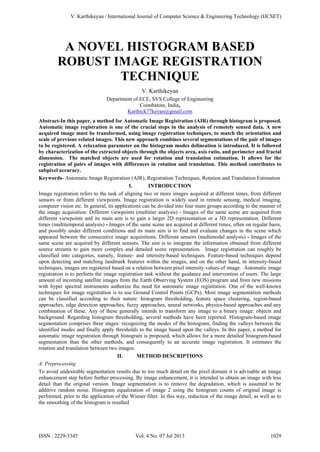
image1

Pre-processing

image
2

Histogram-Based
Segmentation

Characterization of
Extracted objects

Matching

Image
registration

Translation
Estimation

Rotation Estimation

Fig.1. Block diagram of proposed AIR. through histogram
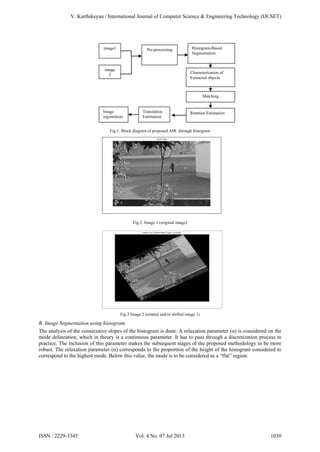
original image

Fig.2. Image 1 (original image)
rotation and shifted/shifted image of image1

Fig.3 Image 2 (rotated and/or shifted image 1)

B. Image Segmentation using histogram:
The analysis of the consecutive slopes of the histogram is done. A relaxation parameter (α) is considered on the
mode delineation, which in theory is a continuous parameter. It has to pass through a discretization process in
practice. The inclusion of this parameter makes the subsequent stages of the proposed methodology to be more
robust. The relaxation parameter (α) corresponds to the proportion of the height of the histogram considered to
correspond to the highest mode. Below this value, the mode is to be considered as a “flat” region.

ISSN : 2229-3345

Vol. 4 No. 07 Jul 2013

1030
V. Karthikeyan / International Journal of Computer Science & Engineering Technology (IJCSET)

2500

Histogram counts

2000

1500

1000

500

0

0

0.1

0.2

0.4

0.3

0.5
DN

0.6

0.7

0.9

0.8

1

Fig..4 Histogram of the image presented in Fig.2 representing seven identified modes
enhanced version of histogram plot
2500

histogram counts

2000

1500

1000

500

0

100

50

0

150
DN

200

300

250

Fig. 5 Enhanced version of histogram plot of fig.4

C. Extracted Objects and its characterization :
The extracted objects are characterized by four attributes . They allow for their adequate morphological
description: area(A rea ) , perimeter(P erim) , axis ratio(A rt ) and fractal dimension(D b ).
D. Matching
The matching step is done with the evaluation of a cost function, between every possible two-by-two
combination of objects obtained by the segmentation of the two images. The cost function, is defined as follows:
( Area1 − Area2 )
𝐴 𝑟𝑒𝑎

( Arat1 − Arat2 )
𝐴 𝑟𝑎𝑡

( Perim1 − Perim2 )
𝑃 𝑒𝑟𝑖𝑚

( Db1 − Db2 )
𝐷𝑏

where 𝐴 𝑟𝑒𝑎 ,𝐴 𝑟𝑎𝑡 ,𝑃 𝑒𝑟𝑖𝑚 and 𝐷 𝑏 are the average of each property for images 1 and 2 values.
�
E. Rotation Estimation:𝜃
γ=

R

+

R

+

R

+

The rotation and translation are determined on a statistical basis. The histogram of the extracted objects
orientation differences is represented. � is found, through considering the frequencies of the rotation candidates,
𝜃
and finding the rotation value which absolute frequency corresponds to the higher occupant. This procedure
leads to a robust estimation of θ.
̂ 𝛿
F. Translation Estimation:𝛿 x , ̂ y

Once � is obtained, only the initial matching candidates which correspond to the obtained rotation are
𝜃
considered. Then, a similar procedure as that followed in the rotation estimation is considered for obtaining
̂ 𝑥 and ̂ y .
𝛿
𝛿
R

R

R

R

ISSN : 2229-3345

Vol. 4 No. 07 Jul 2013

1031
V. Karthikeyan / International Journal of Computer Science & Engineering Technology (IJCSET)

III.
RESULTS AND DISCUSSION
In the presented examples, a pair of images with completely different histograms is accurately registered.
registering original image with unregisterd image

Fig.6 Registration of original image with the simulated rotation and translation version of unregistered image.
TABLE I

α (%)

20

Parameter
�
Rotation(𝜃)
̂
Translation in x (𝛿 x )
̂
Translation in y (𝛿 y )
Elapsed time (sec)
Rotation
Translation in x
Translation in y
Elapsed time(sec)
Rotation
Translation in x
Translation in y
Elapsed time(sec)
R

R

10

5

values for given
image with
reference
values(30°,60,40)
30°
60
41.04
151
60
41.04
77.51
60
41.04
78.55

30°
30°

The proposed method is based upon detecting closed similar regions in both images and it will usually be
possible to detect it, even for regions with low contrast. Furthermore, one important characteristic is the
segmentation which is produced at different levels, by considering a range of values for the relaxation
parameter. This allows for the robust subsequent stage of initial matching. Robust determinations of the rotation
and translation parameters are determined on a statistical basis. For larger images than those included in this
work, the division of the images into tiles may be appropriate, since too much differences on the image content
may difficult the application of the proposed methodology. The limit to consider the division of the image into
tiles may depend upon several factors, such as the image content, among others. Moreover, the division of larger
scenes into tiles, and considering the centers of each tile as matching points, it may become possible to correct
for stronger distortions than the rigid-body transformation.
IV.
CONCLUSION AND FUTURE WORK
It was observed that the proposed method generally outperformed SIFT and the contour-based approach, in
particular for the remote sensing examples. The implementation code of segmentation stage can be optimized in
the future in order to provide a faster performance. The method was applied to single-band images at a time.
However, in the future, adequate transformations of multispectral images to single-band images will certainly
lead to even better results. The proposed methodology of image registration allowed for accurate results, even in
the presence of noise. This method has shown to correctly register a pair of images at the subpixel accuracy.

ISSN : 2229-3345

Vol. 4 No. 07 Jul 2013

1032
V. Karthikeyan / International Journal of Computer Science & Engineering Technology (IJCSET)

REFERENCES
[1]
[2]
[3]
[4]
[5]

S. Sure and P. Reenacts, “Mutual-information-based registration of Tarrasa- X and Mikonos imagery in urban areas,” IEEE Trans.
Goes. Remote Sens., vol. 48, no. 2, pp. 939–949, Feb. 2010.
Y. Bentoutou, N. Taleb, K. Kpalma, and J. Ronsin, “An automatic image registration for applications in remote sensing,” IEEE Trans.
Goes. Remote Sens., vol. 43, no. 9, pp. 2127–2137, Sep. 2005.
C. I. Chang, Y. Du, J. Wang, S. M. Guo, and P. D. Thou in, “Survey and comparative analysis of entropy and relative entropy
thresholding techniques,” IEEE Proc.-Vis. Image Signal Process., vol. 153, no. 6, pp. 837–850, 2006.
H. Chen, P. K. Varshney, and M. K. Aurora, “Performance of mutual information similarity measure for registration of multitemporal
remote sensing images,” IEEE Trans. Goes. Remote Sens., vol. 41, no. 11, pp. 2445–2454, Nov. 2003.
H. D. Cheng and Y. Sun, “A hierarchical approach to color image segmentation using homogeneity,” IEEE Trans. Image Process., vol.
9, no. 12, pp. 2071–2082, Dec. 2000.

ISSN : 2229-3345

Vol. 4 No. 07 Jul 2013

1033

V.KARTHIKEYAN PUBLISHED ARTICLE 1

  • 1.
    V. Karthikeyan /International Journal of Computer Science & Engineering Technology (IJCSET) A NOVEL HISTOGRAM BASED ROBUST IMAGE REGISTRATION TECHNIQUE V. Karthikeyan Department of ECE, SVS College of Engineering Coimbatore, India, Karthick77keyan@gmail.com Abstract-In this paper, a method for Automatic Image Registration (AIR) through histogram is proposed. Automatic image registration is one of the crucial steps in the analysis of remotely sensed data. A new acquired image must be transformed, using image registration techniques, to match the orientation and scale of previous related images. This new approach combines several segmentations of the pair of images to be registered. A relaxation parameter on the histogram modes delineation is introduced. It is followed by characterization of the extracted objects through the objects area, axis ratio, and perimeter and fractal dimension. The matched objects are used for rotation and translation estimation. It allows for the registration of pairs of images with differences in rotation and translation. This method contributes to subpixel accuracy. Keywords- Automatic Image Registration (AIR), Registration Techniques, Rotation and Translation Estimation I. INTRODUCTION Image registration refers to the task of aligning two or more images acquired at different times, from different sensors or from different viewpoints. Image registration is widely used in remote sensing, medical imaging, computer vision etc. In general, its applications can be divided into four main groups according to the manner of the image acquisition: Different viewpoints (multitier analysis) - Images of the same scene are acquired from different viewpoints and its main aim is to gain a larger 2D representation or a 3D representation. Different times (multitemporal analysis) - Images of the same scene are acquired at different times, often on regular basis, and possibly under different conditions and its main aim is to find and evaluate changes in the scene which appeared between the consecutive image acquisitions. Different sensors (multimodal analysis) - Images of the same scene are acquired by different sensors. The aim is to integrate the information obtained from different source streams to gain more complex and detailed scene representation. Image registration can roughly be classified into categories, namely, feature- and intensity-based techniques. Feature-based techniques depend upon detecting and matching landmark features within the images, and on the other hand, in intensity-based techniques, images are registered based on a relation between pixel intensity values of image. Automatic image registration is to perform the image registration task without the guidance and intervention of users. The large amount of incoming satellite images from the Earth Observing System (EOS) program and from new missions with hyper spectral instruments authorize the need for automatic image registration. One of the well-known techniques for image registration is to use Ground Control Points (GCPs). Most image segmentation methods can be classified according to their nature: histogram thresholding, feature space clustering, region-based approaches, edge detection approaches, fuzzy approaches, neural networks, physics-based approaches and any combination of these. Any of these generally intends to transform any image to a binary image: objects and background. Regarding histogram thresholding, several methods have been reported. Histogram-based image segmentation comprises three stages: recognizing the modes of the histogram, finding the valleys between the identified modes and finally apply thresholds to the image based upon the valleys. In this paper, a method for automatic image registration through histogram is proposed, which allows for a more detailed histogram-based segmentation than the other methods, and consequently to an accurate image registration. It estimates the rotation and translation between two images. II. METHOD DESCRIPTIONS A. Preprocessing To avoid undesirable segmentation results due to too much detail on the pixel domain it is advisable an image enhancement step before further processing. By image enhancement, it is intended to obtain an image with less detail than the original version. Image segmentation is to remove the degradation, which is assumed to be additive random noise. Histogram equalization of image 2 using the histogram counts of original image is performed, prior to the application of the Wiener filter. In this way, reduction of the image detail, as well as to the smoothing of the histogram is resulted ISSN : 2229-3345 Vol. 4 No. 07 Jul 2013 1029
  • 2.
    V. Karthikeyan /International Journal of Computer Science & Engineering Technology (IJCSET) image1 Pre-processing image 2 Histogram-Based Segmentation Characterization of Extracted objects Matching Image registration Translation Estimation Rotation Estimation Fig.1. Block diagram of proposed AIR. through histogram original image Fig.2. Image 1 (original image) rotation and shifted/shifted image of image1 Fig.3 Image 2 (rotated and/or shifted image 1) B. Image Segmentation using histogram: The analysis of the consecutive slopes of the histogram is done. A relaxation parameter (α) is considered on the mode delineation, which in theory is a continuous parameter. It has to pass through a discretization process in practice. The inclusion of this parameter makes the subsequent stages of the proposed methodology to be more robust. The relaxation parameter (α) corresponds to the proportion of the height of the histogram considered to correspond to the highest mode. Below this value, the mode is to be considered as a “flat” region. ISSN : 2229-3345 Vol. 4 No. 07 Jul 2013 1030
  • 3.
    V. Karthikeyan /International Journal of Computer Science & Engineering Technology (IJCSET) 2500 Histogram counts 2000 1500 1000 500 0 0 0.1 0.2 0.4 0.3 0.5 DN 0.6 0.7 0.9 0.8 1 Fig..4 Histogram of the image presented in Fig.2 representing seven identified modes enhanced version of histogram plot 2500 histogram counts 2000 1500 1000 500 0 100 50 0 150 DN 200 300 250 Fig. 5 Enhanced version of histogram plot of fig.4 C. Extracted Objects and its characterization : The extracted objects are characterized by four attributes . They allow for their adequate morphological description: area(A rea ) , perimeter(P erim) , axis ratio(A rt ) and fractal dimension(D b ). D. Matching The matching step is done with the evaluation of a cost function, between every possible two-by-two combination of objects obtained by the segmentation of the two images. The cost function, is defined as follows: ( Area1 − Area2 ) 𝐴 𝑟𝑒𝑎 ( Arat1 − Arat2 ) 𝐴 𝑟𝑎𝑡 ( Perim1 − Perim2 ) 𝑃 𝑒𝑟𝑖𝑚 ( Db1 − Db2 ) 𝐷𝑏 where 𝐴 𝑟𝑒𝑎 ,𝐴 𝑟𝑎𝑡 ,𝑃 𝑒𝑟𝑖𝑚 and 𝐷 𝑏 are the average of each property for images 1 and 2 values. � E. Rotation Estimation:𝜃 γ= R + R + R + The rotation and translation are determined on a statistical basis. The histogram of the extracted objects orientation differences is represented. � is found, through considering the frequencies of the rotation candidates, 𝜃 and finding the rotation value which absolute frequency corresponds to the higher occupant. This procedure leads to a robust estimation of θ. ̂ 𝛿 F. Translation Estimation:𝛿 x , ̂ y Once � is obtained, only the initial matching candidates which correspond to the obtained rotation are 𝜃 considered. Then, a similar procedure as that followed in the rotation estimation is considered for obtaining ̂ 𝑥 and ̂ y . 𝛿 𝛿 R R R R ISSN : 2229-3345 Vol. 4 No. 07 Jul 2013 1031
  • 4.
    V. Karthikeyan /International Journal of Computer Science & Engineering Technology (IJCSET) III. RESULTS AND DISCUSSION In the presented examples, a pair of images with completely different histograms is accurately registered. registering original image with unregisterd image Fig.6 Registration of original image with the simulated rotation and translation version of unregistered image. TABLE I α (%) 20 Parameter � Rotation(𝜃) ̂ Translation in x (𝛿 x ) ̂ Translation in y (𝛿 y ) Elapsed time (sec) Rotation Translation in x Translation in y Elapsed time(sec) Rotation Translation in x Translation in y Elapsed time(sec) R R 10 5 values for given image with reference values(30°,60,40) 30° 60 41.04 151 60 41.04 77.51 60 41.04 78.55 30° 30° The proposed method is based upon detecting closed similar regions in both images and it will usually be possible to detect it, even for regions with low contrast. Furthermore, one important characteristic is the segmentation which is produced at different levels, by considering a range of values for the relaxation parameter. This allows for the robust subsequent stage of initial matching. Robust determinations of the rotation and translation parameters are determined on a statistical basis. For larger images than those included in this work, the division of the images into tiles may be appropriate, since too much differences on the image content may difficult the application of the proposed methodology. The limit to consider the division of the image into tiles may depend upon several factors, such as the image content, among others. Moreover, the division of larger scenes into tiles, and considering the centers of each tile as matching points, it may become possible to correct for stronger distortions than the rigid-body transformation. IV. CONCLUSION AND FUTURE WORK It was observed that the proposed method generally outperformed SIFT and the contour-based approach, in particular for the remote sensing examples. The implementation code of segmentation stage can be optimized in the future in order to provide a faster performance. The method was applied to single-band images at a time. However, in the future, adequate transformations of multispectral images to single-band images will certainly lead to even better results. The proposed methodology of image registration allowed for accurate results, even in the presence of noise. This method has shown to correctly register a pair of images at the subpixel accuracy. ISSN : 2229-3345 Vol. 4 No. 07 Jul 2013 1032
  • 5.
    V. Karthikeyan /International Journal of Computer Science & Engineering Technology (IJCSET) REFERENCES [1] [2] [3] [4] [5] S. Sure and P. Reenacts, “Mutual-information-based registration of Tarrasa- X and Mikonos imagery in urban areas,” IEEE Trans. Goes. Remote Sens., vol. 48, no. 2, pp. 939–949, Feb. 2010. Y. Bentoutou, N. Taleb, K. Kpalma, and J. Ronsin, “An automatic image registration for applications in remote sensing,” IEEE Trans. Goes. Remote Sens., vol. 43, no. 9, pp. 2127–2137, Sep. 2005. C. I. Chang, Y. Du, J. Wang, S. M. Guo, and P. D. Thou in, “Survey and comparative analysis of entropy and relative entropy thresholding techniques,” IEEE Proc.-Vis. Image Signal Process., vol. 153, no. 6, pp. 837–850, 2006. H. Chen, P. K. Varshney, and M. K. Aurora, “Performance of mutual information similarity measure for registration of multitemporal remote sensing images,” IEEE Trans. Goes. Remote Sens., vol. 41, no. 11, pp. 2445–2454, Nov. 2003. H. D. Cheng and Y. Sun, “A hierarchical approach to color image segmentation using homogeneity,” IEEE Trans. Image Process., vol. 9, no. 12, pp. 2071–2082, Dec. 2000. ISSN : 2229-3345 Vol. 4 No. 07 Jul 2013 1033