Tushar Bhanarkar
( Elect & Telecom 3rd Year)







Digital image is representation of image as a finite set of
pixels.
Digital image processing focuses on two major
tasks, i.e., improvement of pictorial information for human
interpretation and processing of image data for
storage, transmission and representation for autonomous
machine perception.
Components of DIP consist of image
sensor, digitizer, processor and display unit.
The key stages of DIP consist of Image Enhancement, Image
Restoration, Image Compression and Registration.
Image Registration is a process of mapping between temporal
sequences of image frames & covers Geometric
Transformation & Stereo imaging.
•

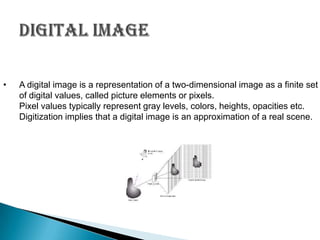
A digital image is a representation of a two-dimensional image as a finite set
of digital values, called picture elements or pixels.
Pixel values typically represent gray levels, colors, heights, opacities etc.
Digitization implies that a digital image is an approximation of a real scene.



1.
2.
3.

The process of receiving and analyzing visual
information by digital computer is called digital image
processing.

Important Stages of Digital image processing are,
Discretization and representation
Processing
Analysis
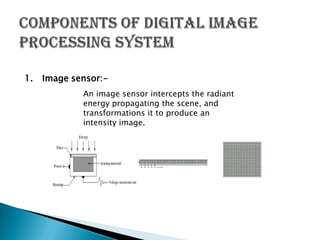
1.

Image sensor:An image sensor intercepts the radiant
energy propagating the scene, and
transformations it to produce an
intensity image.
2. Digitizer:- A digitizer is required input images to a digital
computer,
produces digital image composed of discrete
intensity
values at discrete positions.
3. Processor :- Systems ranging from microcomputers to
general purpose
large computers are used in image
processing.
4. Display unit :- A display device produces and shows a
visual form of numerical values stored in a computer as
image array. Principal display devices are printer, TV monitor
and CRT’s.
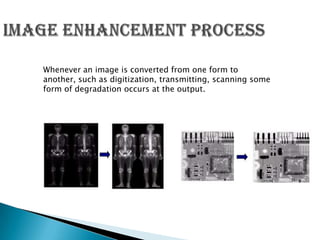
Whenever an image is converted from one form to
another, such as digitization, transmitting, scanning some
form of degradation occurs at the output.
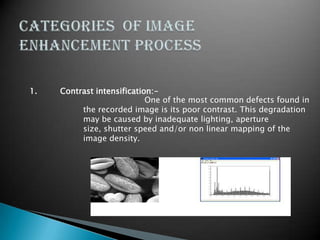
1.

Contrast intensification:One of the most common defects found in
the recorded image is its poor contrast. This degradation
may be caused by inadequate lighting, aperture
size, shutter speed and/or non linear mapping of the
image density.
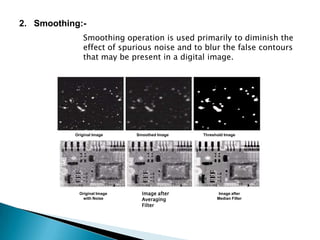
2. Smoothing:Smoothing operation is used primarily to diminish the
effect of spurious noise and to blur the false contours
that may be present in a digital image.

Original Image

Original Image
with Noise

Smoothed Image

Image after
Averaging
Filter

Threshold Image

Image after
Median Filter
3.

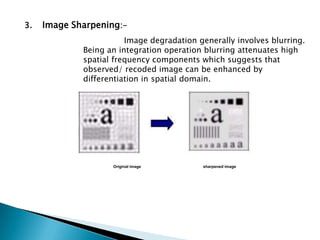
Image Sharpening:Image degradation generally involves blurring.
Being an integration operation blurring attenuates high
spatial frequency components which suggests that
observed/ recoded image can be enhanced by
differentiation in spatial domain.

Original image

sharpened image
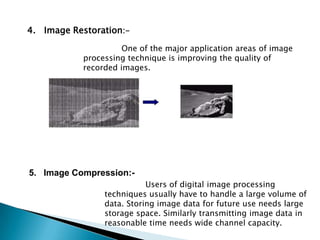
4. Image Restoration:One of the major application areas of image
processing technique is improving the quality of
recorded images.

5. Image Compression:Users of digital image processing
techniques usually have to handle a large volume of
data. Storing image data for future use needs large
storage space. Similarly transmitting image data in
reasonable time needs wide channel capacity.
1.
2.
3.
4.
5.
6.
7.
8.

Office automation.
Industrial automation.
Bio-medical.
Remote sensing.
Criminology.
Astronomy and space application.
Information technology.
Military applications






Digital image processing enables the enhancement of visibility for
detail in images using algorithms that apply arithmetic and
statistical procedures to stored pixel values, instead of the classical
darkroom manipulations for filtration of time-dependent voltages
necessary for analog images and video signals.
Even though many image processing algorithms are extremely
powerful, the average user often applies operations to digital images
without concern for the underlying principles behind these
manipulations.
The images that result from careless manipulation are often severely
degraded or otherwise compromised with respect to those that
could be produced if the power and versatility of the digital
processing software were correctly utilized






“Digital Image Processing”, Rafael C. Gonzalez &
Richard E. Woods, Addison-Wesley, 2002
homepages.inf.ed.ac.uk/rbf/BOOKS/VERNON/
http://www.comp.dit.ie/bmacnamee/gaip.htm
http://www.gisdevelopment.net/tutorials/tuman00
5pf.htm
Digital image processing

Digital image processing

  • 1.
    Tushar Bhanarkar ( Elect& Telecom 3rd Year)
  • 2.
         Digital image isrepresentation of image as a finite set of pixels. Digital image processing focuses on two major tasks, i.e., improvement of pictorial information for human interpretation and processing of image data for storage, transmission and representation for autonomous machine perception. Components of DIP consist of image sensor, digitizer, processor and display unit. The key stages of DIP consist of Image Enhancement, Image Restoration, Image Compression and Registration. Image Registration is a process of mapping between temporal sequences of image frames & covers Geometric Transformation & Stereo imaging.
  • 3.
    • A digital imageis a representation of a two-dimensional image as a finite set of digital values, called picture elements or pixels. Pixel values typically represent gray levels, colors, heights, opacities etc. Digitization implies that a digital image is an approximation of a real scene.
  • 4.
      1. 2. 3. The process ofreceiving and analyzing visual information by digital computer is called digital image processing. Important Stages of Digital image processing are, Discretization and representation Processing Analysis
  • 5.
    1. Image sensor:An imagesensor intercepts the radiant energy propagating the scene, and transformations it to produce an intensity image.
  • 6.
    2. Digitizer:- Adigitizer is required input images to a digital computer, produces digital image composed of discrete intensity values at discrete positions. 3. Processor :- Systems ranging from microcomputers to general purpose large computers are used in image processing. 4. Display unit :- A display device produces and shows a visual form of numerical values stored in a computer as image array. Principal display devices are printer, TV monitor and CRT’s.
  • 7.
    Whenever an imageis converted from one form to another, such as digitization, transmitting, scanning some form of degradation occurs at the output.
  • 8.
    1. Contrast intensification:One ofthe most common defects found in the recorded image is its poor contrast. This degradation may be caused by inadequate lighting, aperture size, shutter speed and/or non linear mapping of the image density.
  • 9.
    2. Smoothing:Smoothing operationis used primarily to diminish the effect of spurious noise and to blur the false contours that may be present in a digital image. Original Image Original Image with Noise Smoothed Image Image after Averaging Filter Threshold Image Image after Median Filter
  • 10.
    3. Image Sharpening:Image degradationgenerally involves blurring. Being an integration operation blurring attenuates high spatial frequency components which suggests that observed/ recoded image can be enhanced by differentiation in spatial domain. Original image sharpened image
  • 11.
    4. Image Restoration:Oneof the major application areas of image processing technique is improving the quality of recorded images. 5. Image Compression:Users of digital image processing techniques usually have to handle a large volume of data. Storing image data for future use needs large storage space. Similarly transmitting image data in reasonable time needs wide channel capacity.
  • 12.
    1. 2. 3. 4. 5. 6. 7. 8. Office automation. Industrial automation. Bio-medical. Remotesensing. Criminology. Astronomy and space application. Information technology. Military applications
  • 13.
       Digital image processingenables the enhancement of visibility for detail in images using algorithms that apply arithmetic and statistical procedures to stored pixel values, instead of the classical darkroom manipulations for filtration of time-dependent voltages necessary for analog images and video signals. Even though many image processing algorithms are extremely powerful, the average user often applies operations to digital images without concern for the underlying principles behind these manipulations. The images that result from careless manipulation are often severely degraded or otherwise compromised with respect to those that could be produced if the power and versatility of the digital processing software were correctly utilized
  • 14.
        “Digital Image Processing”,Rafael C. Gonzalez & Richard E. Woods, Addison-Wesley, 2002 homepages.inf.ed.ac.uk/rbf/BOOKS/VERNON/ http://www.comp.dit.ie/bmacnamee/gaip.htm http://www.gisdevelopment.net/tutorials/tuman00 5pf.htm