IMAGE
RECONSTRUCTION IN
COMPUTED
TOMOGRAPHY
SANTOSH OJHA
MSC. RADIO- IMAGING TECHNOLOGY (FINAL YEAR)
INTRODUCTION TO COMPUTED TOMOGRAPHY
 Computed tomography was invented in 1972 by British engineer Godfrey
Hounsfield of EMI laboratories, England and by South African born physicist
Allan Cormack of Tufts University, Massachusetts.
 The term “computed tomography” (CT) or Computed Axial Tomography (CAT),
refers to a computerized x-ray imaging procedure in which a narrow beam of
x-rays is aimed at a patient and quickly rotated around the body, producing
signals that are detected by series of detectors which are processed by
machine’s computer to generate cross sectional images or “slices” of the
body.
 CT is based on the fundamental principle that the density of tissue passed by
x-ray beam can be measured from calculation of attenuation coefficient.
 The first CT scanner was installed between 1974 and 1976.
 Over time many improvements are done in speed, patients comfort and
resolution.
GENERATIONS OF CT
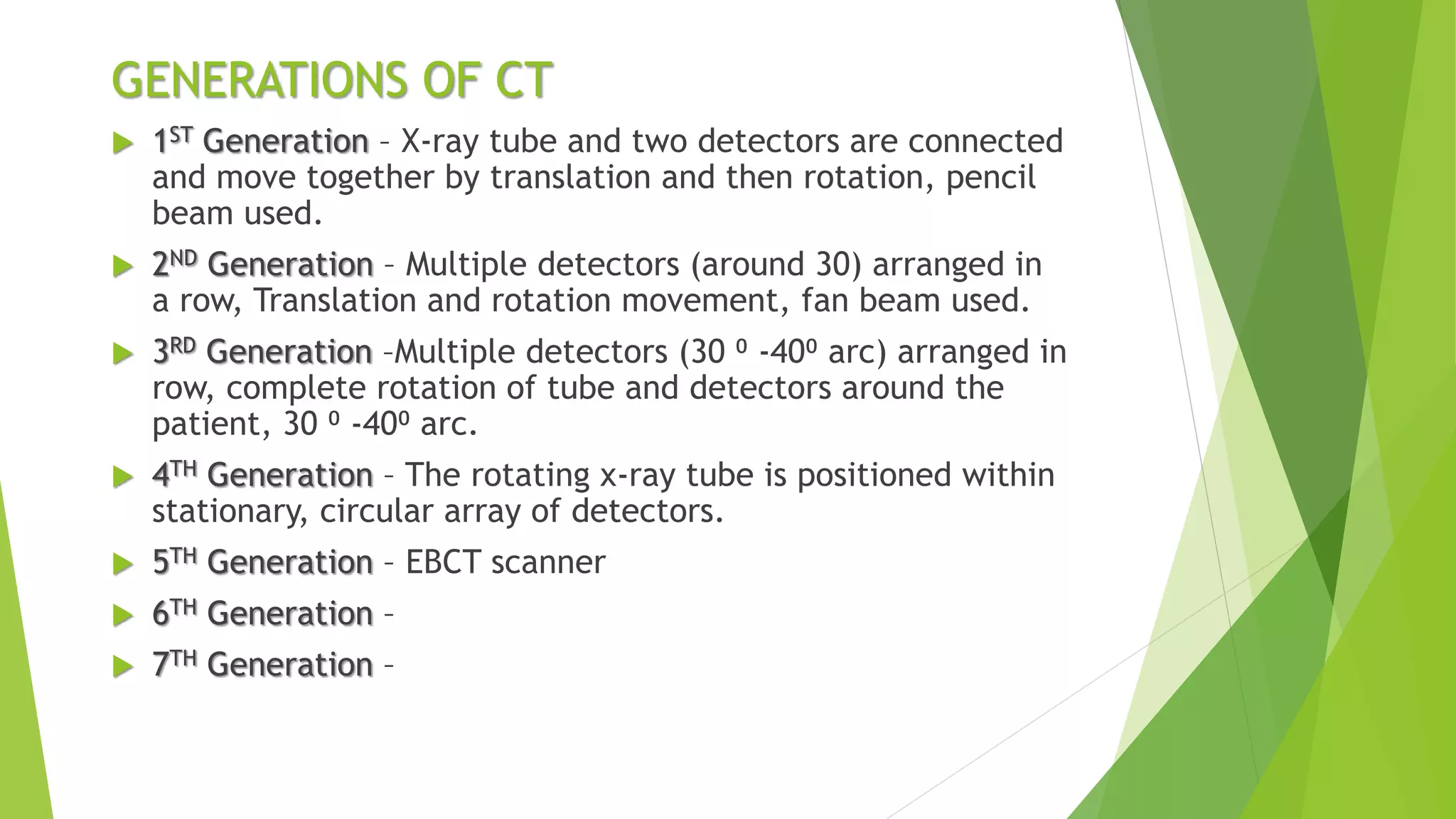
 1ST Generation – X-ray tube and two detectors are connected
and move together by translation and then rotation, pencil
beam used.
 2ND Generation – Multiple detectors (around 30) arranged in
a row, Translation and rotation movement, fan beam used.
 3RD Generation –Multiple detectors (30 ⁰ -40⁰ arc) arranged in
row, complete rotation of tube and detectors around the
patient, 30 ⁰ -40⁰ arc.
 4TH Generation – The rotating x-ray tube is positioned within
stationary, circular array of detectors.
 5TH Generation – EBCT scanner
 6TH Generation –
 7TH Generation –
STEPS FOR CT IMAGE FORMATION
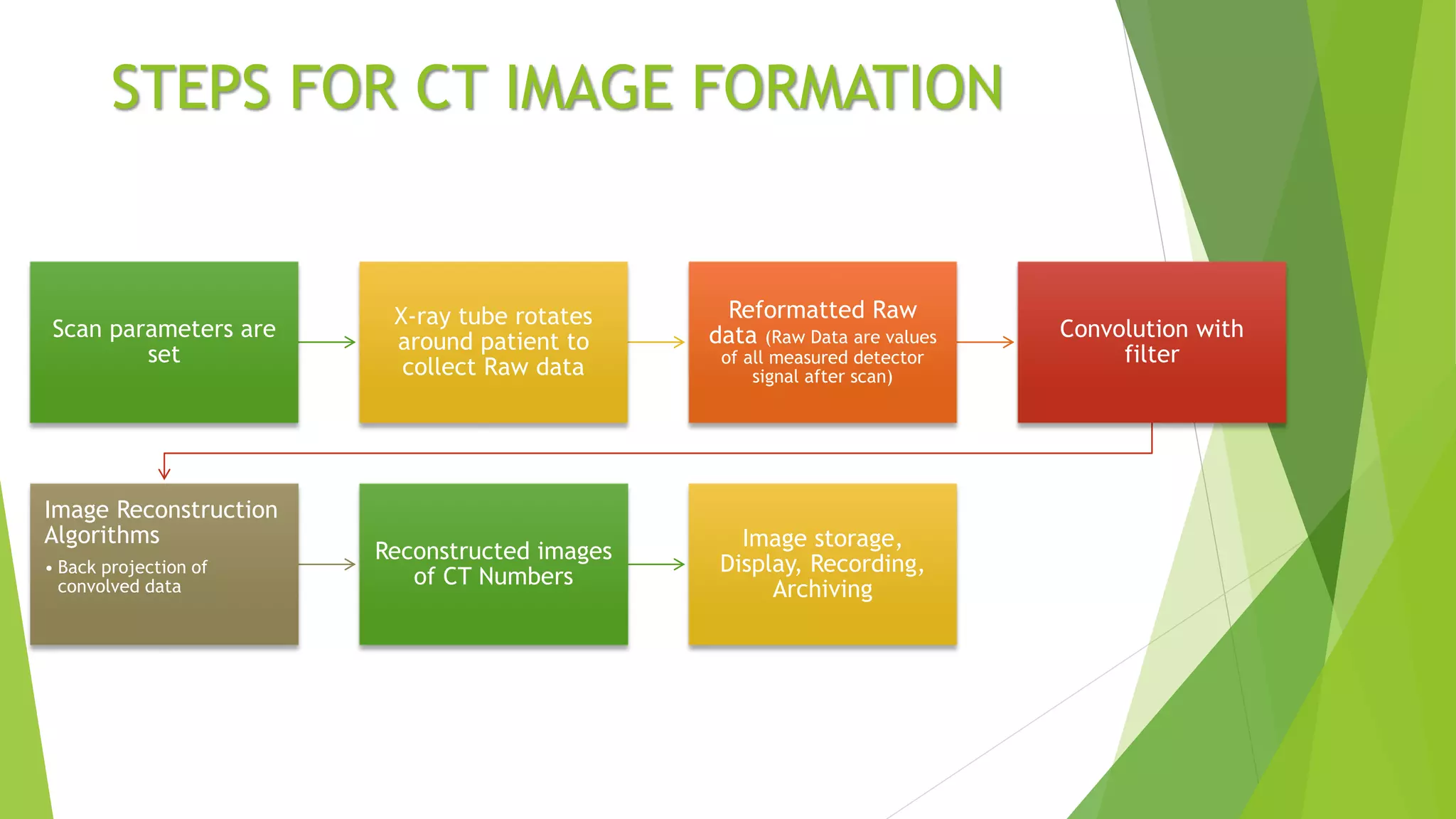
Scan parameters are
set
X-ray tube rotates
around patient to
collect Raw data
Reformatted Raw
data (Raw Data are values
of all measured detector
signal after scan)
Convolution with
filter
Image Reconstruction
Algorithms
• Back projection of
convolved data
Reconstructed images
of CT Numbers
Image storage,
Display, Recording,
Archiving
IMAGE RECONSTRUCTION
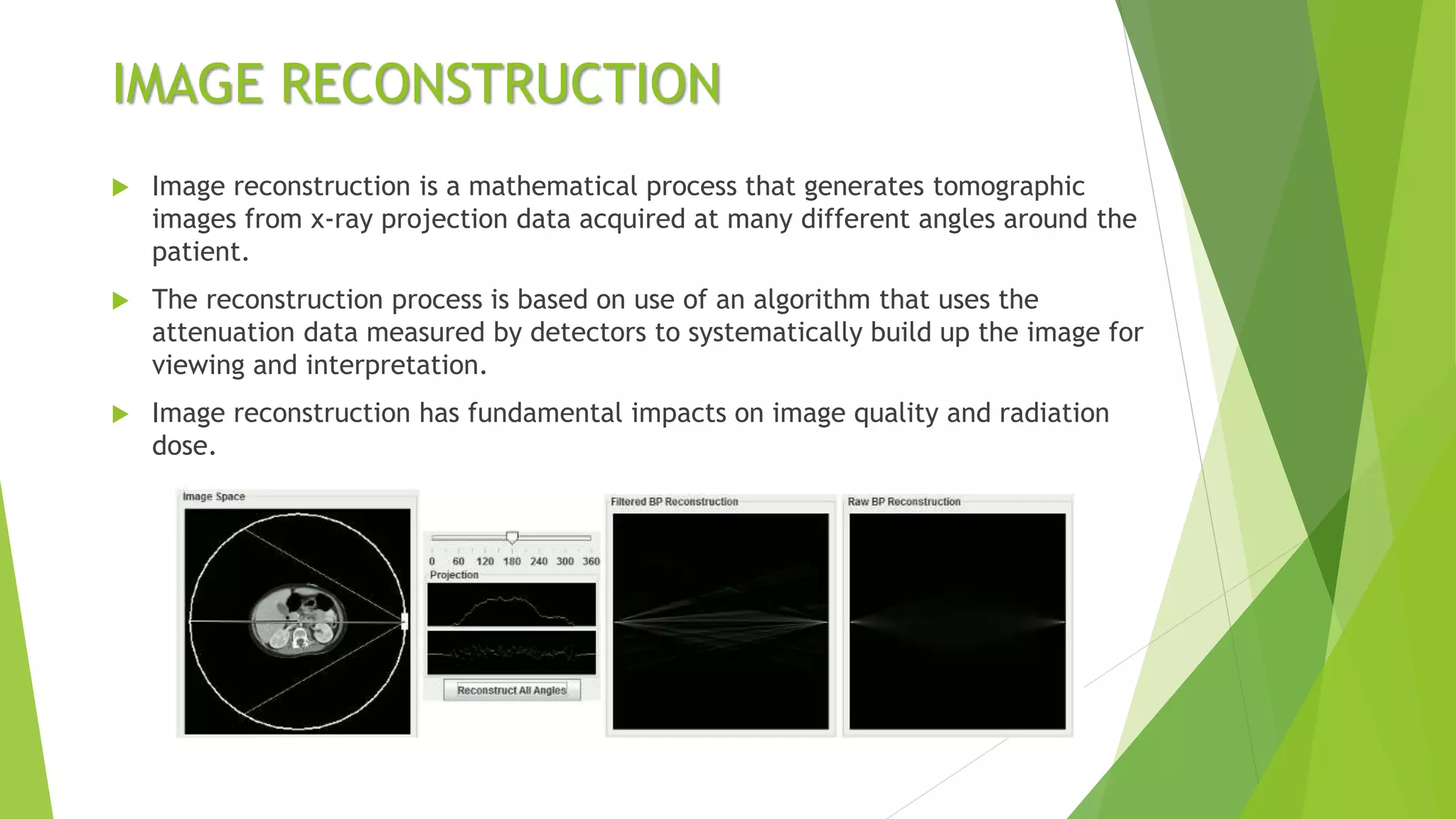
 Image reconstruction is a mathematical process that generates tomographic
images from x-ray projection data acquired at many different angles around the
patient.
 The reconstruction process is based on use of an algorithm that uses the
attenuation data measured by detectors to systematically build up the image for
viewing and interpretation.
 Image reconstruction has fundamental impacts on image quality and radiation
dose.
BASIC TERMS
ALGORITHMS
 Defined as “set of rules or directions for getting a specific output from
specific input”.
 Algorithm must always terminate after a finite number of steps.
 Algorithms can be represented in form of Flow chart, listing the series of
Steps combined altogether by programming language like C++, Java etc. to
form a software to do a specific job.
 CT reconstruction algorithms converts each attenuation coefficient values
obtained splits it into intensity and location at object, Forming an image with
specific grayscale.
IMAGE DOMAIN
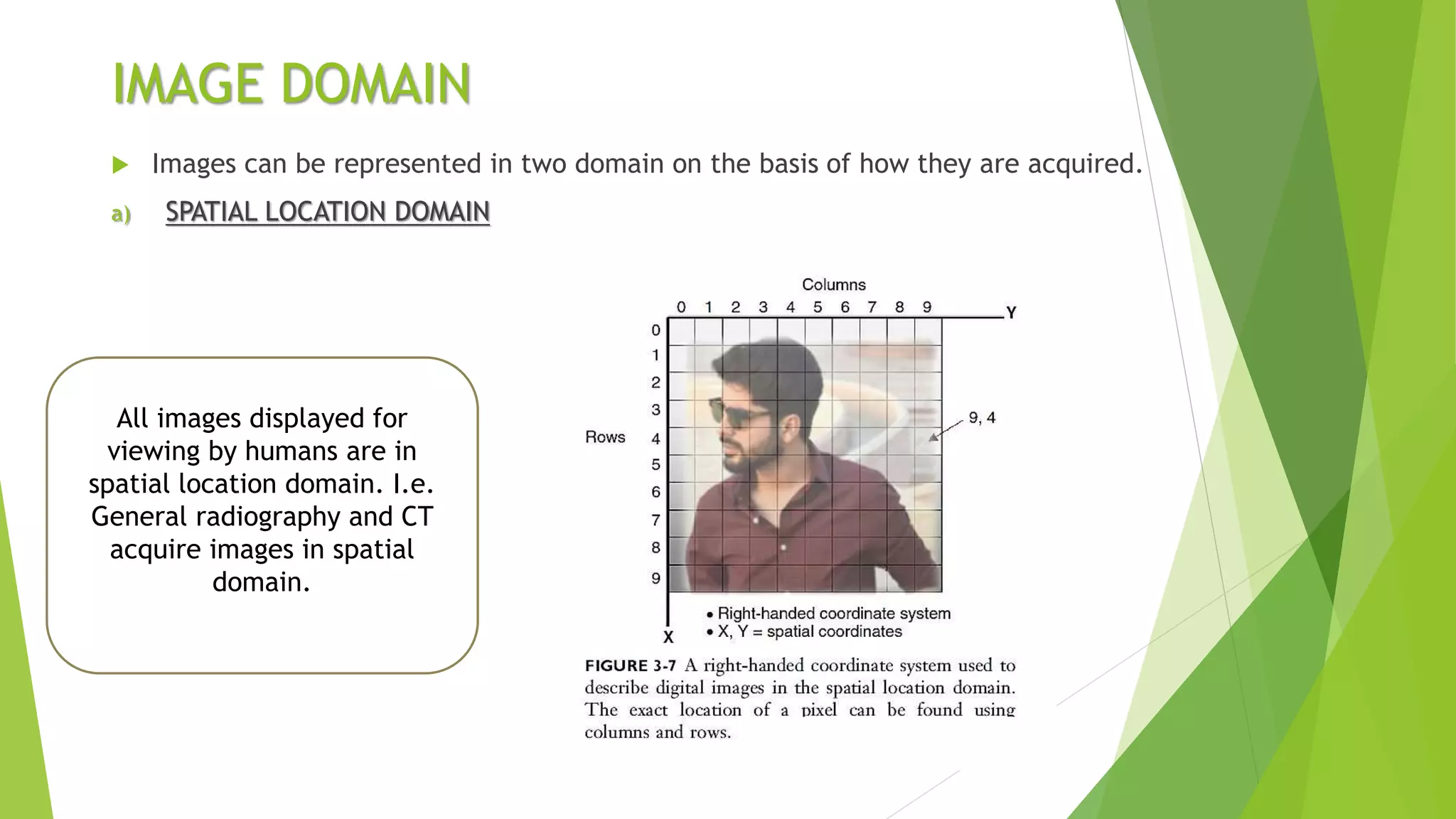
 Images can be represented in two domain on the basis of how they are acquired.
a) SPATIAL LOCATION DOMAIN
All images displayed for
viewing by humans are in
spatial location domain. I.e.
General radiography and CT
acquire images in spatial
domain.
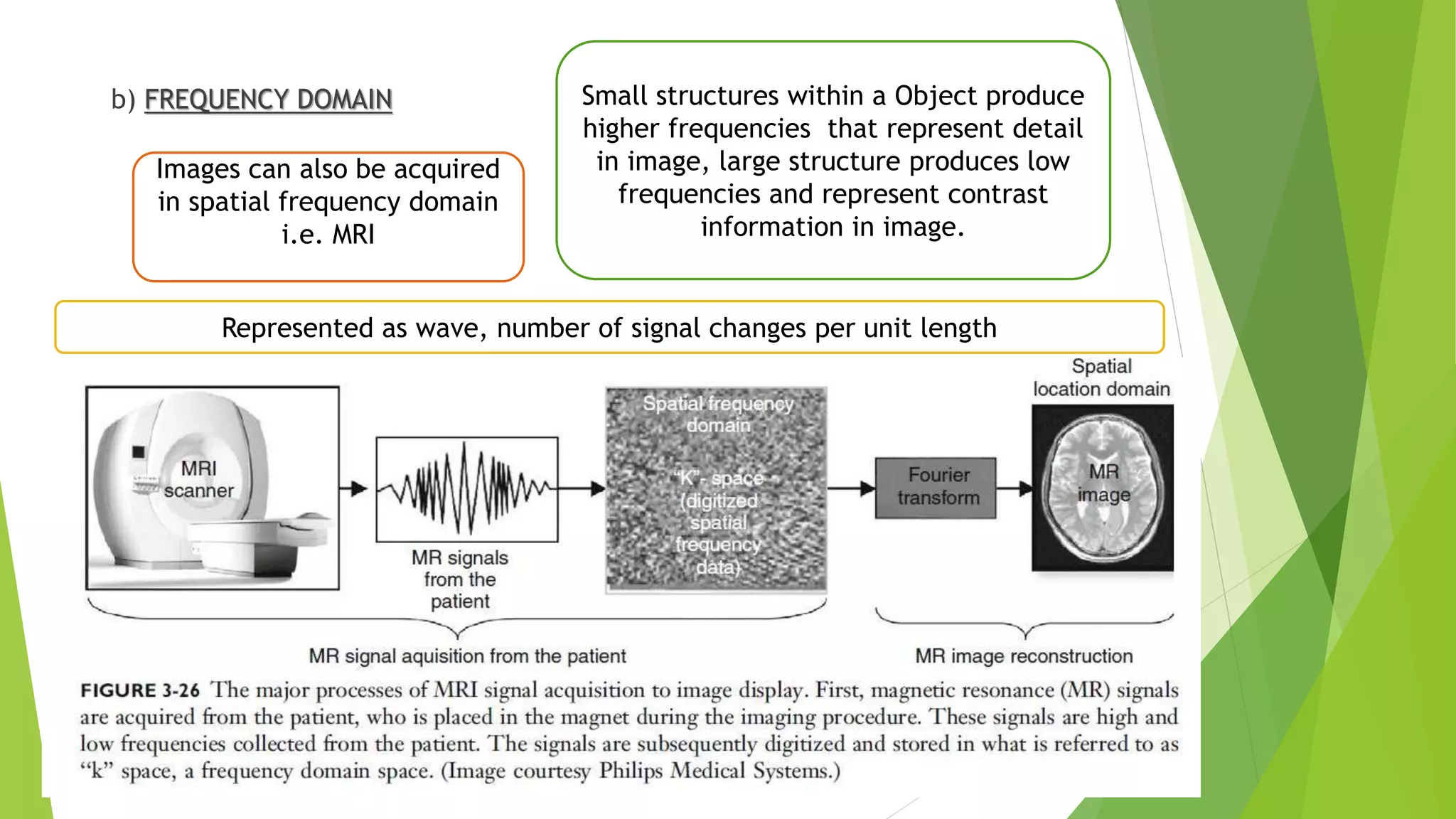
b) FREQUENCY DOMAIN
Images can also be acquired
in spatial frequency domain
i.e. MRI
Represented as wave, number of signal changes per unit length
Small structures within a Object produce
higher frequencies that represent detail
in image, large structure produces low
frequencies and represent contrast
information in image.
CONVOLUTION
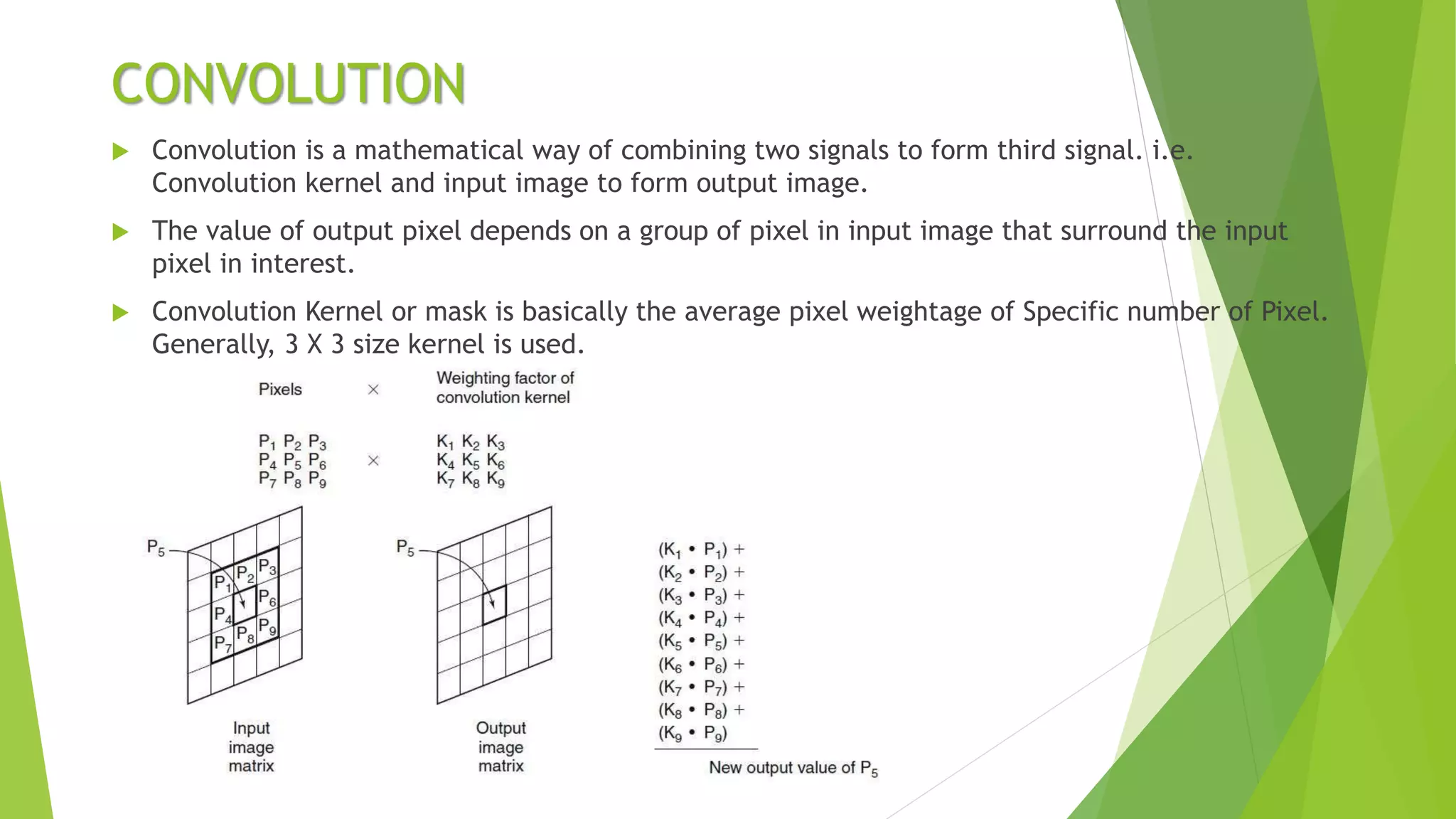
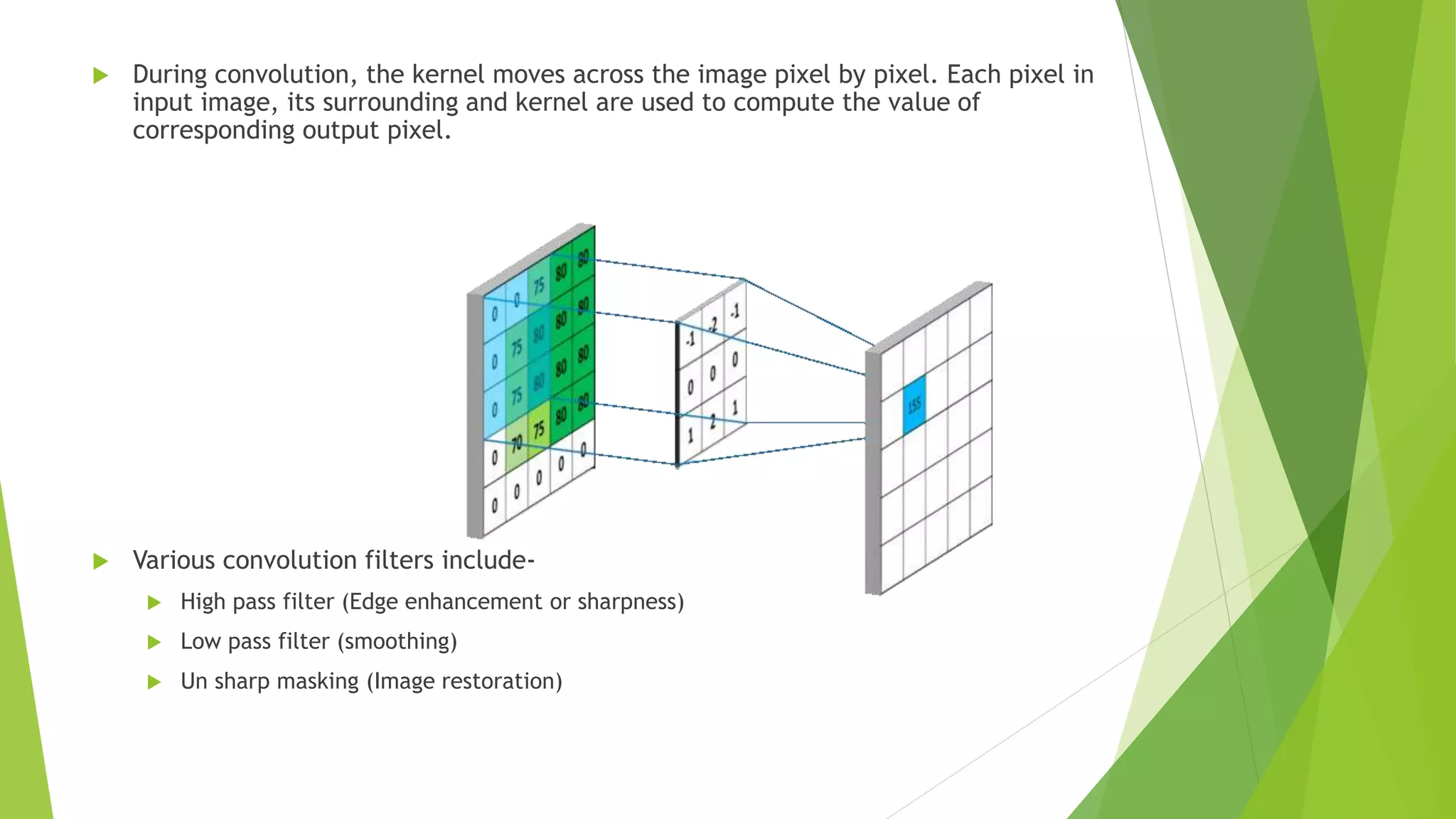
 Convolution is a mathematical way of combining two signals to form third signal. i.e.
Convolution kernel and input image to form output image.
 The value of output pixel depends on a group of pixel in input image that surround the input
pixel in interest.
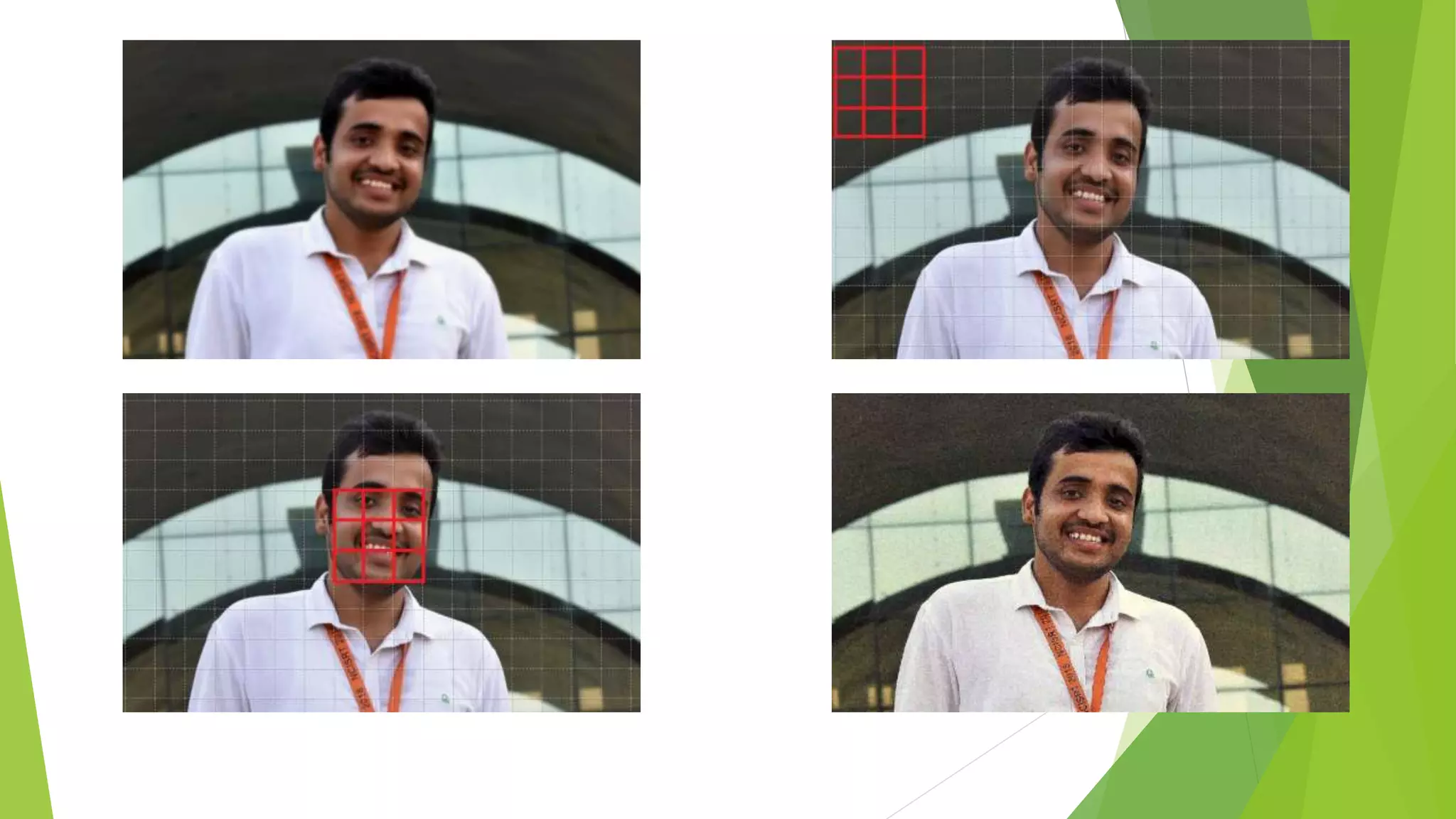
 Convolution Kernel or mask is basically the average pixel weightage of Specific number of Pixel.
Generally, 3 X 3 size kernel is used.
 During convolution, the kernel moves across the image pixel by pixel. Each pixel in
input image, its surrounding and kernel are used to compute the value of
corresponding output pixel.
 Various convolution filters include-
 High pass filter (Edge enhancement or sharpness)
 Low pass filter (smoothing)
 Un sharp masking (Image restoration)
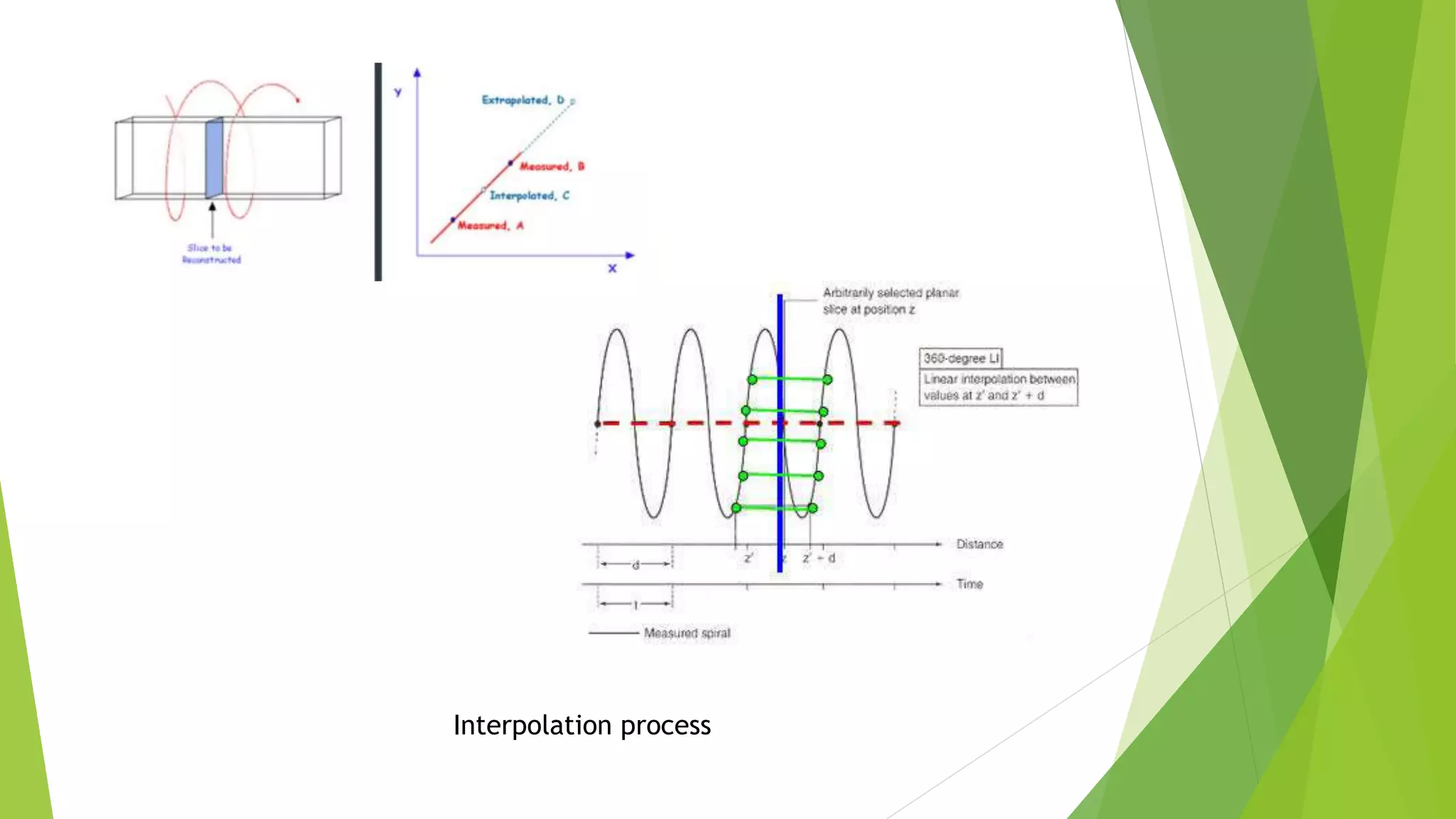
INTERPOLATION
 Estimation of unknown value between known values is called interpolation technique.
 Used in spiral CT images reconstruction.
 A transverse planer image can be reconstructed at any position along the axis of patient.
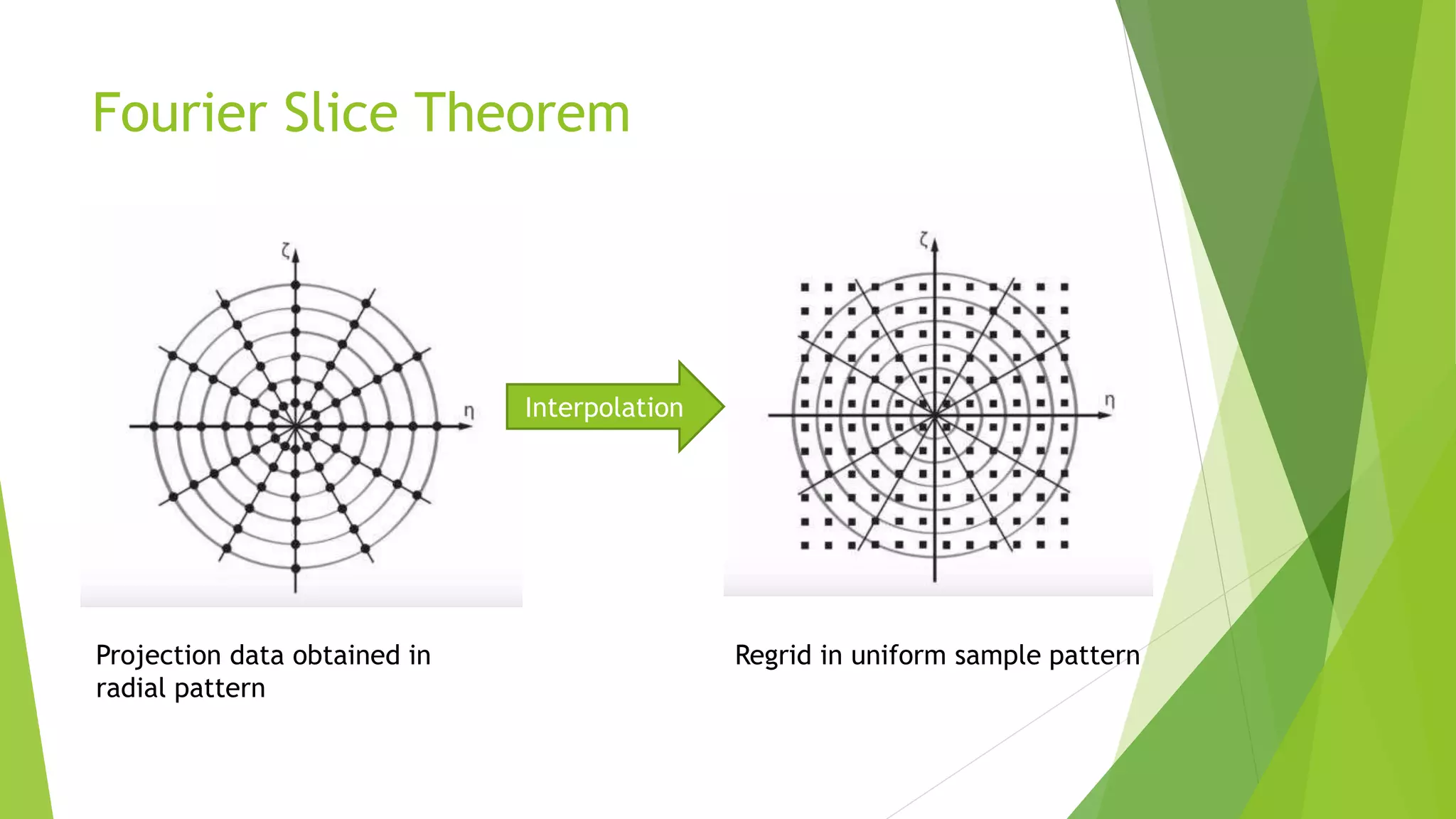
 Interpolation can be used in frequency domain to re-grid the radial sampling to uniform
sampling.
 Image interpolation creates a number of new slices between known slices in order to obtain
isotropic volume image.
Interpolation process
TYPES OF IMAGE RECONSTRUCTION
1. Simple Back projection
2. Iterative method
3. Analytic method
I. Fourier reconstruction algorithms
II. Filtered back projections
1. SIMPLE BACK PROJECTION METHOD
 Also called as “summation method” or “linear superposition method” first used by Oldendorf
(1961), Khul and Edwards (1963).
 Not used in commercial CT scanners.
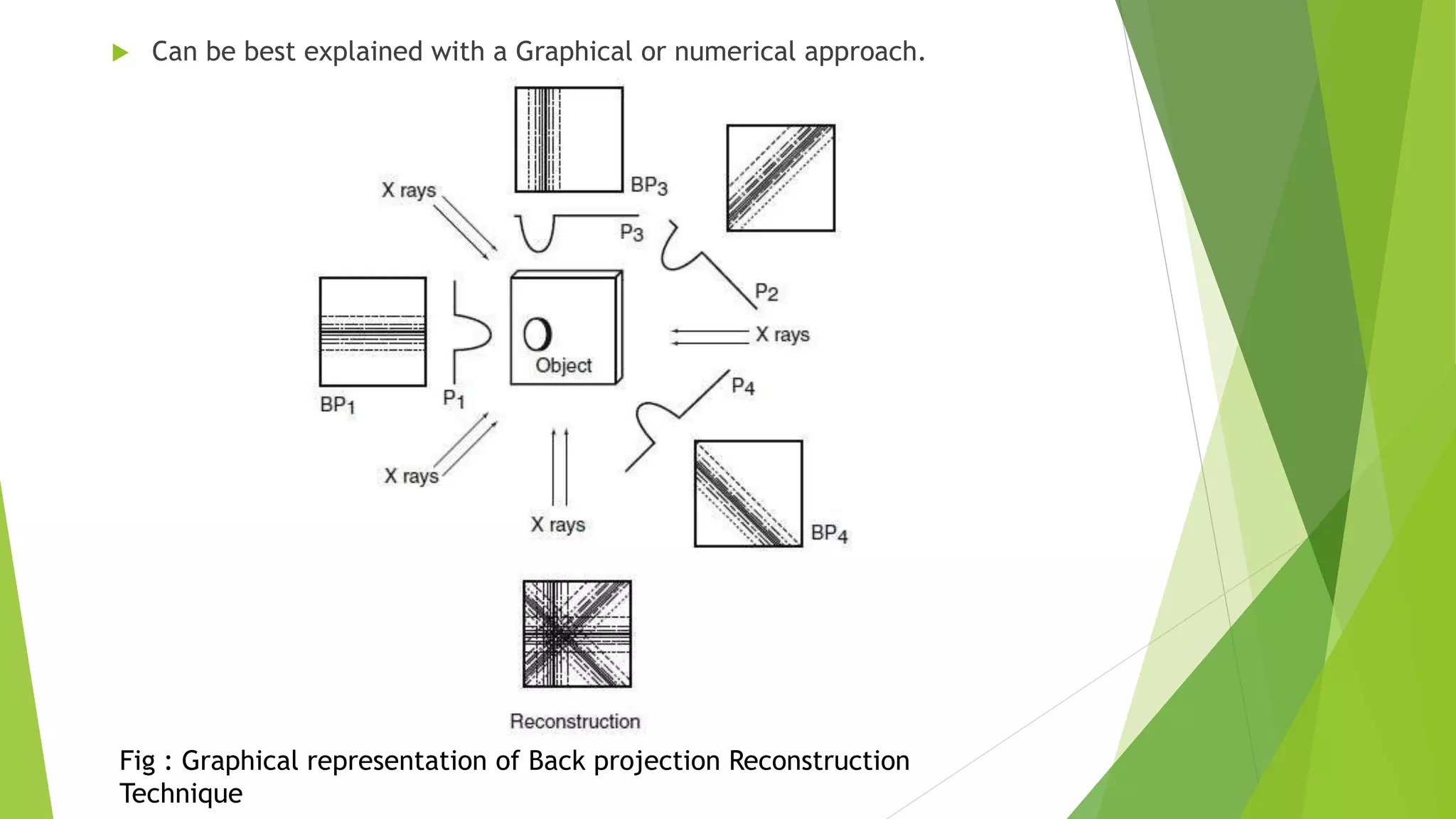
 This involves "smearing back" the projection across the image at the angle it was acquired.
 Rays from two or more projections are superimposed or back projected they produce a crude
reproduction of original object.
 Some produced images are ‘starred’ and ‘blurred’ that makes it unsuitable for medical
diagnosis.
 In order to reconstruct the image 180˚ data is required with fan beam angle. The remaining
180˚are the mirror of first. (It does not matter which way a photon travels through tissue, it will
be attenuated the same amount)
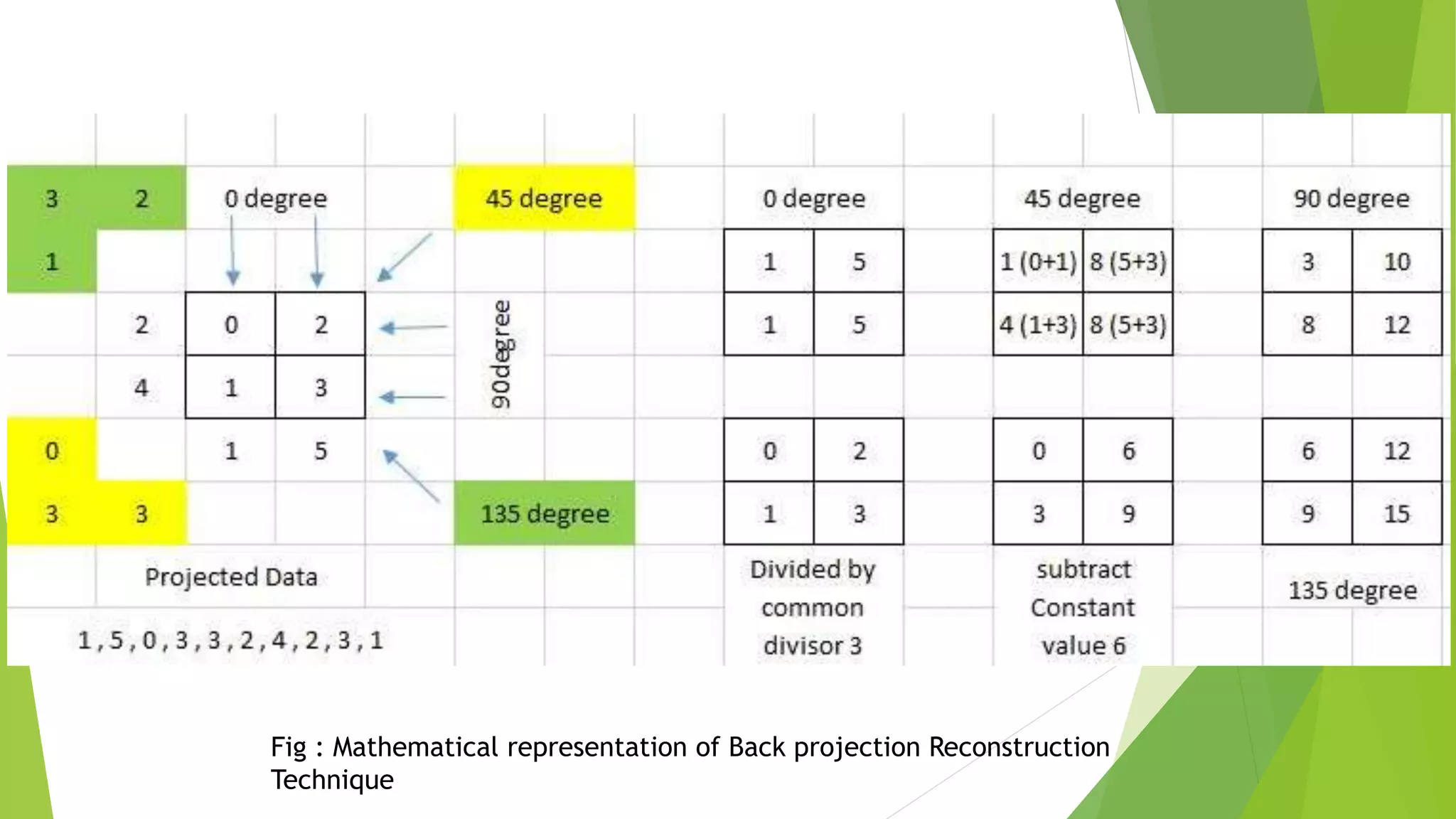
 Can be best explained with a Graphical or numerical approach.
Fig : Graphical representation of Back projection Reconstruction
Technique
Fig : Mathematical representation of Back projection Reconstruction
Technique
 Problem with back projection includes mainly severe blurring in computed images.
Appearance of star like structure
2. Iterative reconstruction
 Successful approximation method.
 An iterative reconstruction starts with an assumption ( all points in matrix
have same value) and compares this assumption with measured value, make
corrections to bring two into agreement and repeats the process over and
over again until assumed and measured value are same or within acceptable
limits’.
 Techniques includes:-
 Simultaneous iterative reconstruction technique
 Iterative least square technique
 Algebraic reconstruction technique.
Fig : Mathematical representation of Iterative Reconstruction
Technique
Limitations of iterative reconstruction method
 Difficult to obtain accurate ray sum because of quantum noise and
patient motion.
 Takes too long to generate the reconstructed image because the iteration
can be done only after all projection data sets have been obtained.
3. Analytical method
 Current commercial scanner uses this method
 A mathematical technique known as Convolution or filtering is used.
 Technique employs a spatial filter to remove blurring artifacts.
 Two major types-
1. Filtered back projection
2. Fourier Reconstruction Algorithms
1. Filtered back projection
 Filtered back projection is also referred as Convolution method.
 The projection profile is filtered to remove the typical star like blurring that is
characteristic of simple back projection.
All projection profiles are obtained.
Logarithm of data is obtained.
Logarithmic data are multiplied by digital filter
to generate a set of filtered profile.
Filtered profile are back projected.
Filtered projections are summed and –ve & +ve
components are then cancelled. Image free of
blurring obtained.
Fig : Flowchart showing steps in filtered back projection
 Filtering refers to altering the projection data before we do the back-
projections.
 This type of filter picks up sharp edges within the projection (and thus, in the
underlying slice) and tends to ignore flat areas. Because the high pass filter
actually creates negative pixels at the edges, it subtracts out the extra
smearing caused by back projection.
 The optimal way of eliminating the star like pattern is by use of Ramp filter.
 Ramp filter has the effect of filtering out low frequencies and passing high
frequencies, with a linear behaviour in between. Thus with this filter,
contrasting features (high-frequencies) are accentuated, while blurring (low-
frequencies) is minimized.
 The combination of ramp filter and back projection is filtered back projection.
2. Fourier Reconstruction Algorithms
 A property of Fourier transform.
 Relates the projection data in spatial location domain to spatial frequency
domain.
 Used in MRI image reconstruction.
 Unlike filtered back projection, this algorithm does not use any filtering as
interpolation does the work of rearranging the image components in rectangular
grid.
 Based on Fourier Slice Theorem.
Fourier Slice Theorem
 Fourier slice theorem states that “The Fourier transform of the projection of
an object at angle θ is equal to a slice of the Fourier transform of object
along angle θ”.
P(t)
f(x,y)
t

y
x
X-rays

F(u,v)
F[P(t)]
Fourier Slice Theorem
Projection data obtained in
radial pattern
Interpolation
Regrid in uniform sample pattern
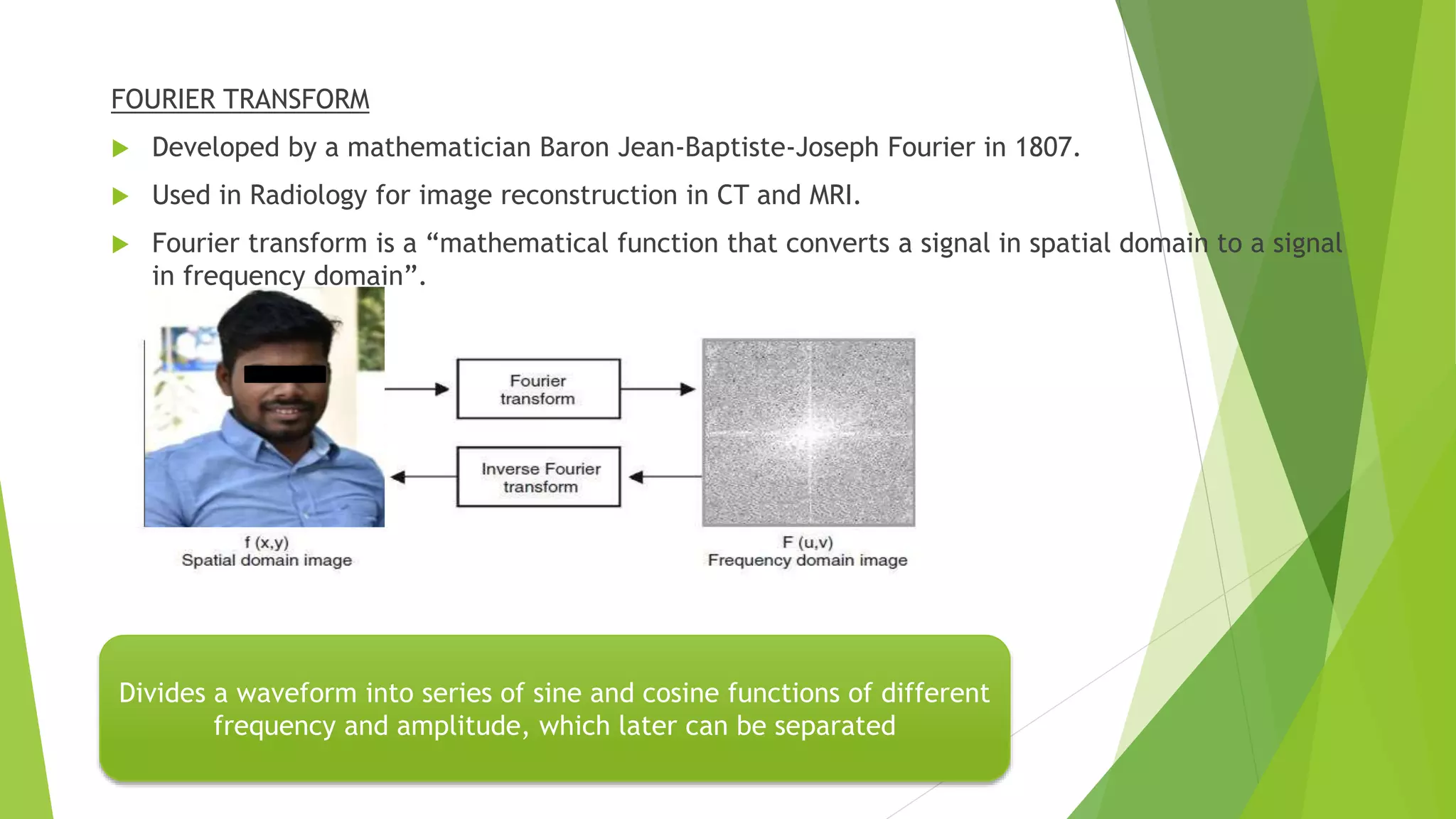
Divides a waveform into series of sine and cosine functions of different
frequency and amplitude, which later can be separated
FOURIER TRANSFORM
 Developed by a mathematician Baron Jean-Baptiste-Joseph Fourier in 1807.
 Used in Radiology for image reconstruction in CT and MRI.
 Fourier transform is a “mathematical function that converts a signal in spatial domain to a signal
in frequency domain”.
Fourier transform
Why ?
 The image in frequency domain can be manipulated (edge enhancement
or smoothing) by changing amplitude of frequency components without
losing the actual signal intensity.
 Computer can perform manipulations (digital image processing) i.e. MPR,
VRT, MIP etc.
 Frequency information can be used to measure image quality through the
point spread function, line spread function and modulation transfer
function.
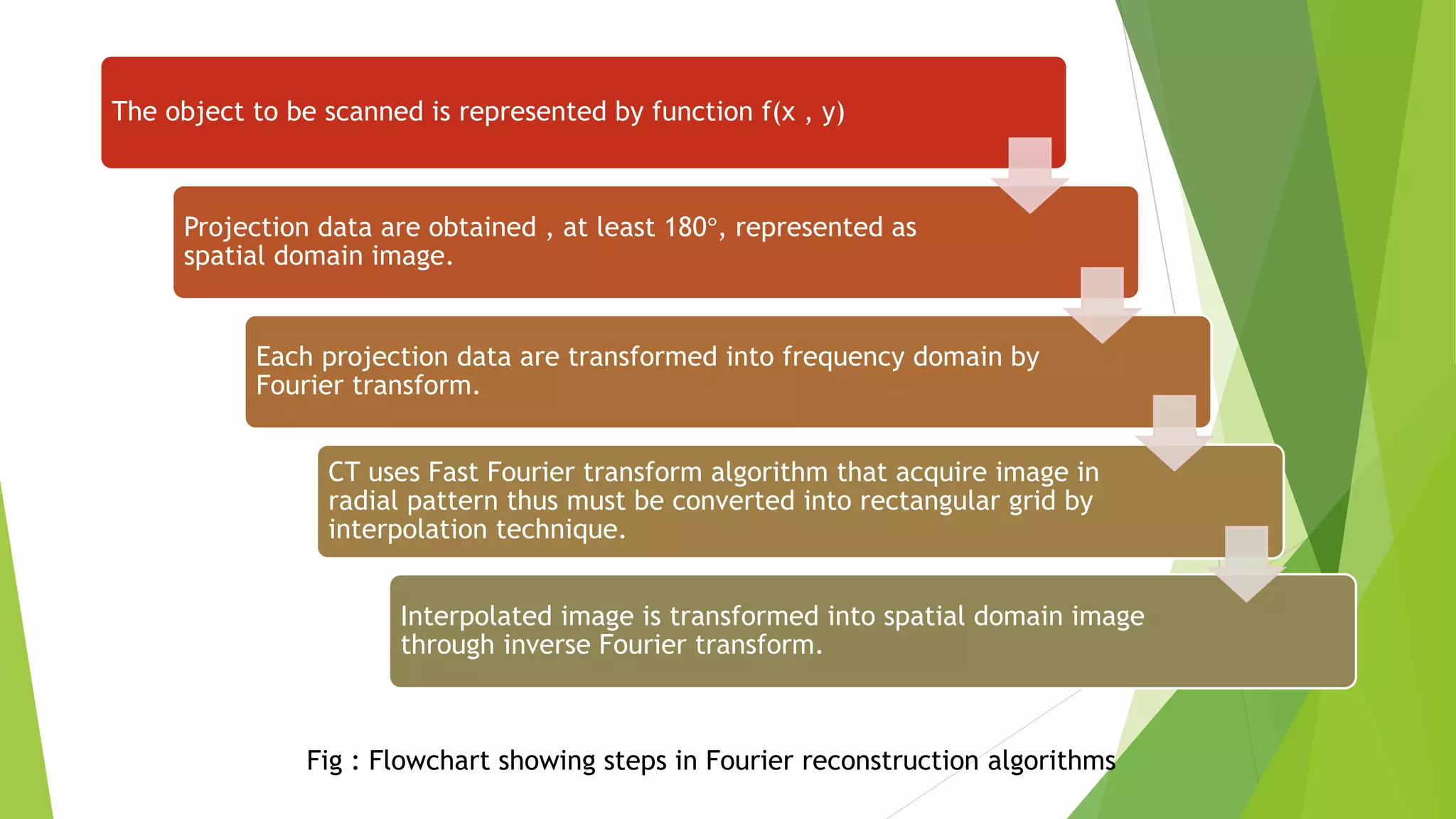
The object to be scanned is represented by function f(x , y)
Projection data are obtained , at least 180°, represented as
spatial domain image.
Each projection data are transformed into frequency domain by
Fourier transform.
CT uses Fast Fourier transform algorithm that acquire image in
radial pattern thus must be converted into rectangular grid by
interpolation technique.
Interpolated image is transformed into spatial domain image
through inverse Fourier transform.
Fig : Flowchart showing steps in Fourier reconstruction algorithms
Thank You

CT Image reconstruction

  • 1.
  • 2.
    INTRODUCTION TO COMPUTEDTOMOGRAPHY  Computed tomography was invented in 1972 by British engineer Godfrey Hounsfield of EMI laboratories, England and by South African born physicist Allan Cormack of Tufts University, Massachusetts.  The term “computed tomography” (CT) or Computed Axial Tomography (CAT), refers to a computerized x-ray imaging procedure in which a narrow beam of x-rays is aimed at a patient and quickly rotated around the body, producing signals that are detected by series of detectors which are processed by machine’s computer to generate cross sectional images or “slices” of the body.  CT is based on the fundamental principle that the density of tissue passed by x-ray beam can be measured from calculation of attenuation coefficient.  The first CT scanner was installed between 1974 and 1976.  Over time many improvements are done in speed, patients comfort and resolution.
  • 3.
    GENERATIONS OF CT 1ST Generation – X-ray tube and two detectors are connected and move together by translation and then rotation, pencil beam used.  2ND Generation – Multiple detectors (around 30) arranged in a row, Translation and rotation movement, fan beam used.  3RD Generation –Multiple detectors (30 ⁰ -40⁰ arc) arranged in row, complete rotation of tube and detectors around the patient, 30 ⁰ -40⁰ arc.  4TH Generation – The rotating x-ray tube is positioned within stationary, circular array of detectors.  5TH Generation – EBCT scanner  6TH Generation –  7TH Generation –
  • 4.
    STEPS FOR CTIMAGE FORMATION Scan parameters are set X-ray tube rotates around patient to collect Raw data Reformatted Raw data (Raw Data are values of all measured detector signal after scan) Convolution with filter Image Reconstruction Algorithms • Back projection of convolved data Reconstructed images of CT Numbers Image storage, Display, Recording, Archiving
  • 5.
    IMAGE RECONSTRUCTION  Imagereconstruction is a mathematical process that generates tomographic images from x-ray projection data acquired at many different angles around the patient.  The reconstruction process is based on use of an algorithm that uses the attenuation data measured by detectors to systematically build up the image for viewing and interpretation.  Image reconstruction has fundamental impacts on image quality and radiation dose.
  • 6.
    BASIC TERMS ALGORITHMS  Definedas “set of rules or directions for getting a specific output from specific input”.  Algorithm must always terminate after a finite number of steps.  Algorithms can be represented in form of Flow chart, listing the series of Steps combined altogether by programming language like C++, Java etc. to form a software to do a specific job.  CT reconstruction algorithms converts each attenuation coefficient values obtained splits it into intensity and location at object, Forming an image with specific grayscale.
  • 7.
    IMAGE DOMAIN  Imagescan be represented in two domain on the basis of how they are acquired. a) SPATIAL LOCATION DOMAIN All images displayed for viewing by humans are in spatial location domain. I.e. General radiography and CT acquire images in spatial domain.
  • 8.
    b) FREQUENCY DOMAIN Imagescan also be acquired in spatial frequency domain i.e. MRI Represented as wave, number of signal changes per unit length Small structures within a Object produce higher frequencies that represent detail in image, large structure produces low frequencies and represent contrast information in image.
  • 9.
    CONVOLUTION  Convolution isa mathematical way of combining two signals to form third signal. i.e. Convolution kernel and input image to form output image.  The value of output pixel depends on a group of pixel in input image that surround the input pixel in interest.  Convolution Kernel or mask is basically the average pixel weightage of Specific number of Pixel. Generally, 3 X 3 size kernel is used.
  • 10.
     During convolution,the kernel moves across the image pixel by pixel. Each pixel in input image, its surrounding and kernel are used to compute the value of corresponding output pixel.  Various convolution filters include-  High pass filter (Edge enhancement or sharpness)  Low pass filter (smoothing)  Un sharp masking (Image restoration)
  • 12.
    INTERPOLATION  Estimation ofunknown value between known values is called interpolation technique.  Used in spiral CT images reconstruction.  A transverse planer image can be reconstructed at any position along the axis of patient.  Interpolation can be used in frequency domain to re-grid the radial sampling to uniform sampling.  Image interpolation creates a number of new slices between known slices in order to obtain isotropic volume image.
  • 13.
  • 14.
    TYPES OF IMAGERECONSTRUCTION 1. Simple Back projection 2. Iterative method 3. Analytic method I. Fourier reconstruction algorithms II. Filtered back projections
  • 15.
    1. SIMPLE BACKPROJECTION METHOD  Also called as “summation method” or “linear superposition method” first used by Oldendorf (1961), Khul and Edwards (1963).  Not used in commercial CT scanners.  This involves "smearing back" the projection across the image at the angle it was acquired.  Rays from two or more projections are superimposed or back projected they produce a crude reproduction of original object.  Some produced images are ‘starred’ and ‘blurred’ that makes it unsuitable for medical diagnosis.  In order to reconstruct the image 180˚ data is required with fan beam angle. The remaining 180˚are the mirror of first. (It does not matter which way a photon travels through tissue, it will be attenuated the same amount)
  • 16.
     Can bebest explained with a Graphical or numerical approach. Fig : Graphical representation of Back projection Reconstruction Technique
  • 17.
    Fig : Mathematicalrepresentation of Back projection Reconstruction Technique
  • 18.
     Problem withback projection includes mainly severe blurring in computed images. Appearance of star like structure
  • 19.
    2. Iterative reconstruction Successful approximation method.  An iterative reconstruction starts with an assumption ( all points in matrix have same value) and compares this assumption with measured value, make corrections to bring two into agreement and repeats the process over and over again until assumed and measured value are same or within acceptable limits’.  Techniques includes:-  Simultaneous iterative reconstruction technique  Iterative least square technique  Algebraic reconstruction technique.
  • 20.
    Fig : Mathematicalrepresentation of Iterative Reconstruction Technique
  • 21.
    Limitations of iterativereconstruction method  Difficult to obtain accurate ray sum because of quantum noise and patient motion.  Takes too long to generate the reconstructed image because the iteration can be done only after all projection data sets have been obtained.
  • 22.
    3. Analytical method Current commercial scanner uses this method  A mathematical technique known as Convolution or filtering is used.  Technique employs a spatial filter to remove blurring artifacts.  Two major types- 1. Filtered back projection 2. Fourier Reconstruction Algorithms
  • 23.
    1. Filtered backprojection  Filtered back projection is also referred as Convolution method.  The projection profile is filtered to remove the typical star like blurring that is characteristic of simple back projection. All projection profiles are obtained. Logarithm of data is obtained. Logarithmic data are multiplied by digital filter to generate a set of filtered profile. Filtered profile are back projected. Filtered projections are summed and –ve & +ve components are then cancelled. Image free of blurring obtained. Fig : Flowchart showing steps in filtered back projection
  • 24.
     Filtering refersto altering the projection data before we do the back- projections.  This type of filter picks up sharp edges within the projection (and thus, in the underlying slice) and tends to ignore flat areas. Because the high pass filter actually creates negative pixels at the edges, it subtracts out the extra smearing caused by back projection.  The optimal way of eliminating the star like pattern is by use of Ramp filter.  Ramp filter has the effect of filtering out low frequencies and passing high frequencies, with a linear behaviour in between. Thus with this filter, contrasting features (high-frequencies) are accentuated, while blurring (low- frequencies) is minimized.  The combination of ramp filter and back projection is filtered back projection.
  • 25.
    2. Fourier ReconstructionAlgorithms  A property of Fourier transform.  Relates the projection data in spatial location domain to spatial frequency domain.  Used in MRI image reconstruction.  Unlike filtered back projection, this algorithm does not use any filtering as interpolation does the work of rearranging the image components in rectangular grid.  Based on Fourier Slice Theorem.
  • 26.
    Fourier Slice Theorem Fourier slice theorem states that “The Fourier transform of the projection of an object at angle θ is equal to a slice of the Fourier transform of object along angle θ”. P(t) f(x,y) t  y x X-rays  F(u,v) F[P(t)]
  • 27.
    Fourier Slice Theorem Projectiondata obtained in radial pattern Interpolation Regrid in uniform sample pattern
  • 28.
    Divides a waveforminto series of sine and cosine functions of different frequency and amplitude, which later can be separated FOURIER TRANSFORM  Developed by a mathematician Baron Jean-Baptiste-Joseph Fourier in 1807.  Used in Radiology for image reconstruction in CT and MRI.  Fourier transform is a “mathematical function that converts a signal in spatial domain to a signal in frequency domain”.
  • 29.
    Fourier transform Why ? The image in frequency domain can be manipulated (edge enhancement or smoothing) by changing amplitude of frequency components without losing the actual signal intensity.  Computer can perform manipulations (digital image processing) i.e. MPR, VRT, MIP etc.  Frequency information can be used to measure image quality through the point spread function, line spread function and modulation transfer function.
  • 30.
    The object tobe scanned is represented by function f(x , y) Projection data are obtained , at least 180°, represented as spatial domain image. Each projection data are transformed into frequency domain by Fourier transform. CT uses Fast Fourier transform algorithm that acquire image in radial pattern thus must be converted into rectangular grid by interpolation technique. Interpolated image is transformed into spatial domain image through inverse Fourier transform. Fig : Flowchart showing steps in Fourier reconstruction algorithms
  • 31.