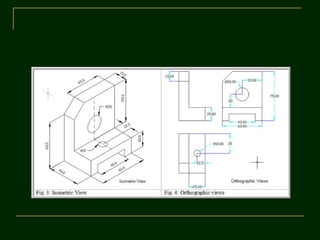
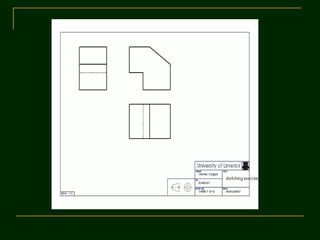
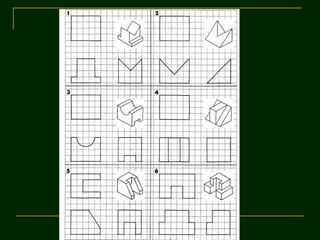

Isometric Views
Ar. Surashmie Kaalmegh
Asisstant Professor
LAD College , Nagpur
Assembly drawings
 An assembly drawing shows the
various parts of a product drawn to
show exactly how they fit together.
They are often used for products
such as construction and model kits
or flat-pack furniture, to show the
user how to assemble the parts.
 They can be drawn in two ways.
 A fitted assembly drawing shows
the parts put together, and can be
drawn in 2D or 3D.
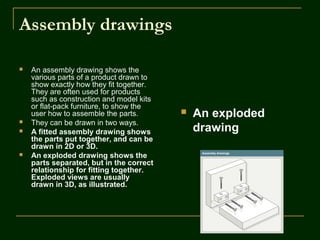
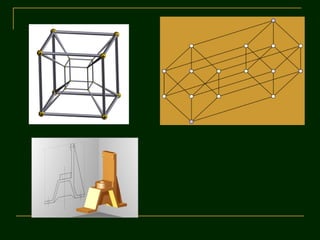
 An exploded drawing shows the
parts separated, but in the correct
relationship for fitting together.
Exploded views are usually
drawn in 3D, as illustrated.
 An exploded
drawing
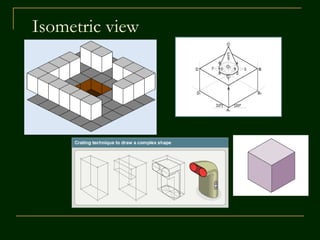
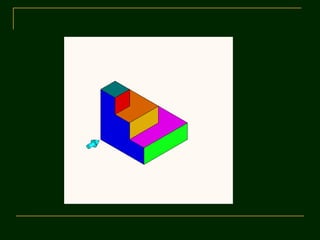
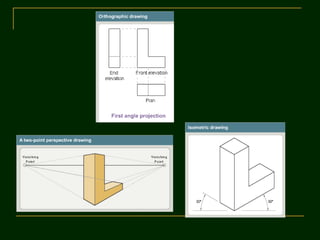
Isometric view
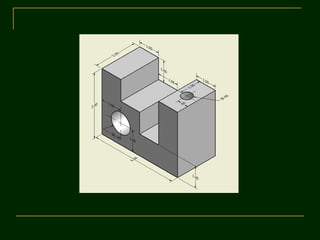
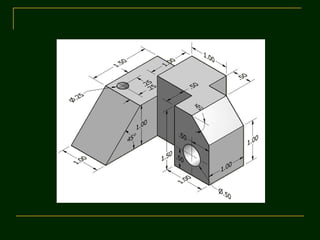
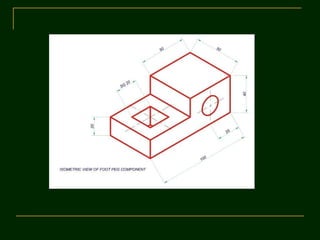
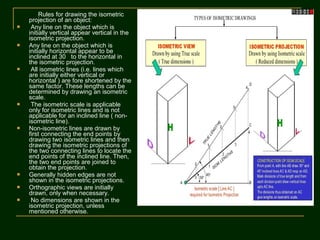
Rules for drawing the isometric
projection of an object:
 Any line on the object which is
initially vertical appear vertical in the
isometric projection.
 Any line on the object which is
initially horizontal appear to be
inclined at 30 to the horizontal in
the isometric projection.
 All isometric lines (i.e. lines which
are initially either vertical or
horizontal ) are fore shortened by the
same factor. These lengths can be
determined by drawing an isometric
scale.
 The isometric scale is applicable
only for isometric lines and is not
applicable for an inclined line ( non-
isometric line).
 Non-isometric lines are drawn by
first connecting the end points by
drawing two isometric lines and then
drawing the isometric projections of
the two connecting lines to locate the
end points of the inclined line. Then,
the two end points are joined to
obtain the projection.
 Generally hidden edges are not
shown in the isometric projections.
 Orthographic views are initially
drawn, only when necessary.
 No dimensions are shown in the
isometric projection, unless
mentioned otherwise.
Isometric views

Isometric views

  • 1.
    Isometric Views Ar. SurashmieKaalmegh Asisstant Professor LAD College , Nagpur
  • 4.
    Assembly drawings  Anassembly drawing shows the various parts of a product drawn to show exactly how they fit together. They are often used for products such as construction and model kits or flat-pack furniture, to show the user how to assemble the parts.  They can be drawn in two ways.  A fitted assembly drawing shows the parts put together, and can be drawn in 2D or 3D.  An exploded drawing shows the parts separated, but in the correct relationship for fitting together. Exploded views are usually drawn in 3D, as illustrated.  An exploded drawing
  • 5.
  • 23.
    Rules for drawingthe isometric projection of an object:  Any line on the object which is initially vertical appear vertical in the isometric projection.  Any line on the object which is initially horizontal appear to be inclined at 30 to the horizontal in the isometric projection.  All isometric lines (i.e. lines which are initially either vertical or horizontal ) are fore shortened by the same factor. These lengths can be determined by drawing an isometric scale.  The isometric scale is applicable only for isometric lines and is not applicable for an inclined line ( non- isometric line).  Non-isometric lines are drawn by first connecting the end points by drawing two isometric lines and then drawing the isometric projections of the two connecting lines to locate the end points of the inclined line. Then, the two end points are joined to obtain the projection.  Generally hidden edges are not shown in the isometric projections.  Orthographic views are initially drawn, only when necessary.  No dimensions are shown in the isometric projection, unless mentioned otherwise.