Orthographic Projections
Projections
Projections
Parallel/
Cylindrical
Perspective/
Conical
Oblique Orthographic One-Point Three-PointTwo-Point
Cabinet
Other
Cavalier
Multi-view
Axonometric
First-angle Fourth-angle Third-angle Second-angle
Isometric
(30°)
Di-metric Trimetric
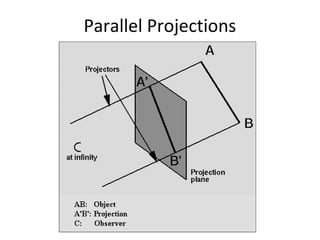
Parallel Projections
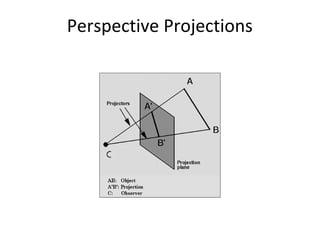
Perspective Projections
Oblique Projections
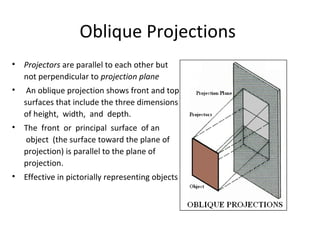
• Projectors are parallel to each other but
not perpendicular to projection plane
• An oblique projection shows front and top
surfaces that include the three dimensions
of height, width, and depth.
• The front or principal surface of an
object (the surface toward the plane of
projection) is parallel to the plane of
projection.
• Effective in pictorially representing objects
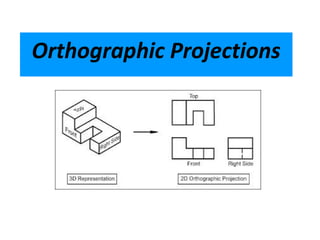
Orthographic Projections
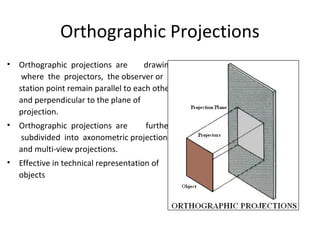
• Orthographic projections are drawings
where the projectors, the observer or
station point remain parallel to each other
and perpendicular to the plane of
projection.
• Orthographic projections are further
subdivided into axonometric projections
and multi-view projections.
• Effective in technical representation of
objects
Axonometric
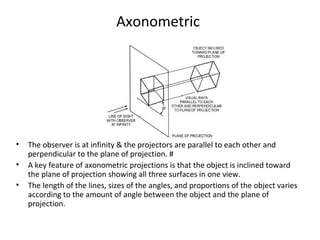
• The observer is at infinity & the projectors are parallel to each other and
perpendicular to the plane of projection. #
• A key feature of axonometric projections is that the object is inclined toward
the plane of projection showing all three surfaces in one view.
• The length of the lines, sizes of the angles, and proportions of the object varies
according to the amount of angle between the object and the plane of
projection.
Axonometric
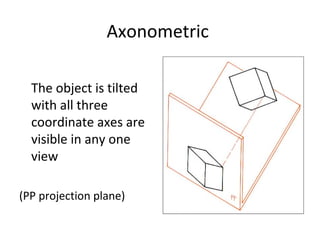
The object is tilted
with all three
coordinate axes are
visible in any one
view
(PP projection plane)
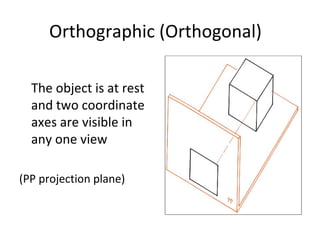
Orthographic (Orthogonal)
The object is at rest
and two coordinate
axes are visible in
any one view
(PP projection plane)
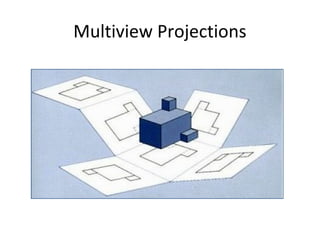
Multiview Projections
• Front surfaces of object is parallel to plane of
projection
• Projectors or line of sights are perpendicular to
projection plane
• Projectors are parallel to each other and
originate from any point on object
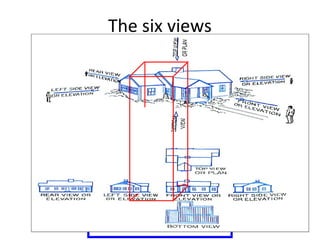
The six views
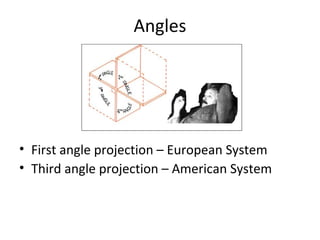
Angles
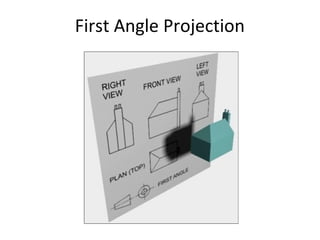
• First angle projection – European System
• Third angle projection – American System
First Angle Projection
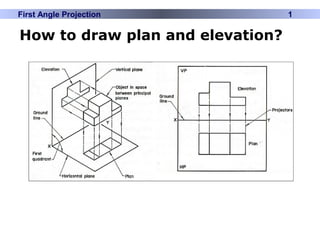
First Angle Projection 1
How to draw plan and elevation?
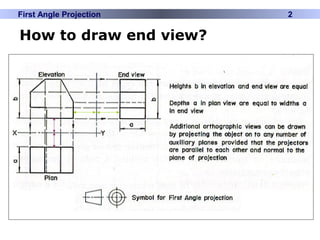
First Angle Projection 2
How to draw end view?
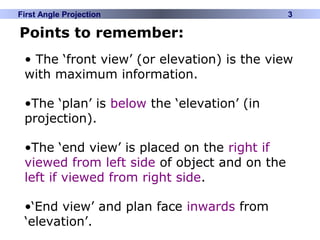
First Angle Projection 3
Points to remember:
• The ‘front view’ (or elevation) is the view
with maximum information.
•The ‘plan’ is below the ‘elevation’ (in
projection).
•The ‘end view’ is placed on the right if
viewed from left side of object and on the
left if viewed from right side.
•‘End view’ and plan face inwards from
‘elevation’.
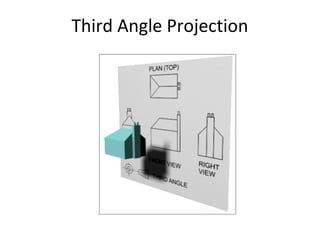
Third Angle Projection
Third Angle Projection 1
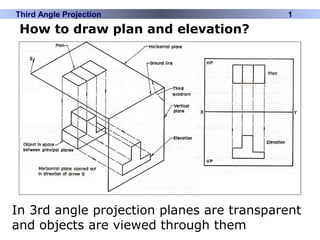
How to draw plan and elevation?
In 3rd angle projection planes are transparent
and objects are viewed through them
Third Angle Projection 2
How to draw end view?
Third Angle Projection 3
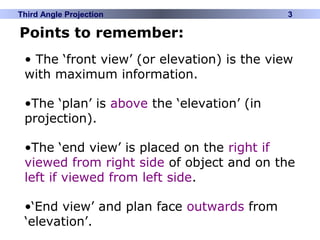
Points to remember:
• The ‘front view’ (or elevation) is the view
with maximum information.
•The ‘plan’ is above the ‘elevation’ (in
projection).
•The ‘end view’ is placed on the right if
viewed from right side of object and on the
left if viewed from left side.
•‘End view’ and plan face outwards from
‘elevation’.
STAY curious
MADHUR MAHAJAN

Orthographic projection by madhur

  • 1.
  • 2.
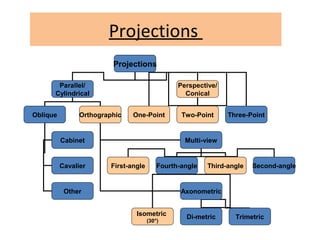
    Projections Projections Parallel/ Cylindrical Perspective/ Conical Oblique Orthographic One-PointThree-PointTwo-Point Cabinet Other Cavalier Multi-view Axonometric First-angle Fourth-angle Third-angle Second-angle Isometric (30°) Di-metric Trimetric
  • 3.
  • 4.
  • 5.
    Oblique Projections • Projectorsare parallel to each other but not perpendicular to projection plane • An oblique projection shows front and top surfaces that include the three dimensions of height, width, and depth. • The front or principal surface of an object (the surface toward the plane of projection) is parallel to the plane of projection. • Effective in pictorially representing objects
  • 6.
    Orthographic Projections • Orthographicprojections are drawings where the projectors, the observer or station point remain parallel to each other and perpendicular to the plane of projection. • Orthographic projections are further subdivided into axonometric projections and multi-view projections. • Effective in technical representation of objects
  • 7.
    Axonometric • The observeris at infinity & the projectors are parallel to each other and perpendicular to the plane of projection. # • A key feature of axonometric projections is that the object is inclined toward the plane of projection showing all three surfaces in one view. • The length of the lines, sizes of the angles, and proportions of the object varies according to the amount of angle between the object and the plane of projection.
  • 8.
    Axonometric The object istilted with all three coordinate axes are visible in any one view (PP projection plane)
  • 9.
    Orthographic (Orthogonal) The objectis at rest and two coordinate axes are visible in any one view (PP projection plane)
  • 10.
  • 11.
    Multiview Projections • Frontsurfaces of object is parallel to plane of projection • Projectors or line of sights are perpendicular to projection plane • Projectors are parallel to each other and originate from any point on object
  • 12.
  • 13.
    Angles • First angleprojection – European System • Third angle projection – American System
  • 14.
  • 15.
    First Angle Projection1 How to draw plan and elevation?
  • 16.
    First Angle Projection2 How to draw end view?
  • 17.
    First Angle Projection3 Points to remember: • The ‘front view’ (or elevation) is the view with maximum information. •The ‘plan’ is below the ‘elevation’ (in projection). •The ‘end view’ is placed on the right if viewed from left side of object and on the left if viewed from right side. •‘End view’ and plan face inwards from ‘elevation’.
  • 18.
  • 19.
    Third Angle Projection1 How to draw plan and elevation? In 3rd angle projection planes are transparent and objects are viewed through them
  • 20.
    Third Angle Projection2 How to draw end view?
  • 21.
    Third Angle Projection3 Points to remember: • The ‘front view’ (or elevation) is the view with maximum information. •The ‘plan’ is above the ‘elevation’ (in projection). •The ‘end view’ is placed on the right if viewed from right side of object and on the left if viewed from left side. •‘End view’ and plan face outwards from ‘elevation’.
  • 22.

Editor's Notes

  • #15 Front view is Elevation
  • #16 For drawing plan and elevation 3D visualisation of objects are essential
  • #17 Green arrows and purple arrows show equal distance
  • #18 Green arrows and purple arrows show equal distance
  • #19 Front view is Elevation
  • #20 For drawing plan and elevation 3D visualisation of objects are essential
  • #21 Green arrows and purple arrows show equal distance
  • #22 Green arrows and purple arrows show equal distance