Analysis : The basis for
better Design
Ar. Surashmie Kaalmegh
Associate Professor
BID ,LAD College , Nagpur
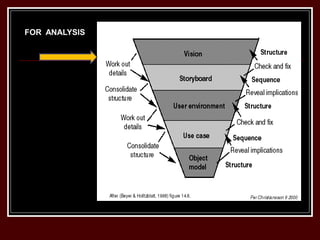
FOR ANALYSIS
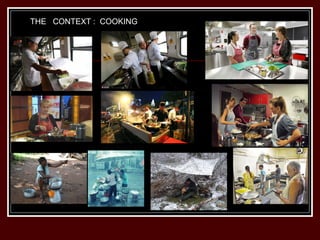
THE CONTEXT : COOKING
Task analysis may be of manual tasks, such as bricklaying, and
be analyzed as time and motion studies using concepts from
industrial engineering.
Information from a task
analysis can be used for
many purposes, such as:--
๏ฎ Personnel selection
and training,
๏ฎ Tool or equipment
design,
๏ฎ Procedure design
(e.G., Design of
checklists or decision
support systems) and
๏ฎ Automation.
๏ฎ Cognitive task analysis is
applied to modern work
environments such as
supervisory control where
little physical work occurs,
but the tasks are more
related to situation
assessment, decision
making, and response
planning and execution.
Task analysis
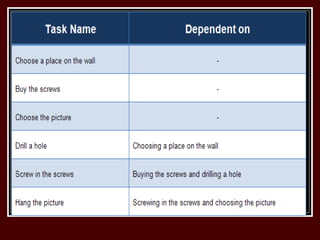
Task analysis is the process of
learning about ordinary users by
observing them in action to
understand in detail how they
perform their tasks and achieve
their intended goals.
โ€ขDEFINITION :
โ€ขIT IS A METHODOLOGY TO ASSESS AND REDUCE HUMAN
ERROR
โ€ขTHE TERM TASK ANALYSIS ( TA ) IS APPLIED TO
ENCOMPASS A WIDE VARIETY OF HUMAN FACTORS
TECHNIQUES.
โ€ขUSAGE :
โ€ขREDUCE POSSIBILE ERRORS / ISSUES / PROBLEMS
IN A TASK OR A COMBINATION OF TASKS.
โ€ขAID IN THE DESIGN STAGES OF A NEW SYSTEM
โ€ขTHE MODIFICATION OF AN EXISTING OR OLD SYSTEMS .
โ€ขAS A RETROSPECTIVE MODE DURING DETAILED
INVESTIGATION OF MAJOR INCIDENTS.
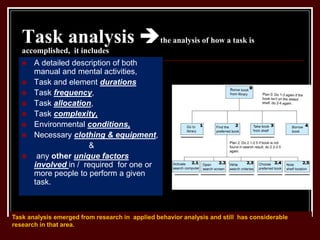
Task analysis ๏ƒจthe analysis of how a task is
accomplished, it includes
๏ฎ A detailed description of both
manual and mental activities,
๏ฎ Task and element durations
๏ฎ Task frequency,
๏ฎ Task allocation,
๏ฎ Task complexity,
๏ฎ Environmental conditions,
๏ฎ Necessary clothing & equipment,
&
๏ฎ any other unique factors
involved in / required for one or
more people to perform a given
task.
Task analysis emerged from research in applied behavior analysis and still has considerable
research in that area.
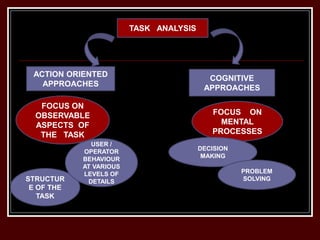
TASK ANALYSIS
ACTION ORIENTED
APPROACHES
COGNITIVE
APPROACHES
FOCUS ON
MENTAL
PROCESSES
FOCUS ON
OBSERVABLE
ASPECTS OF
THE TASK
DECISION
MAKING
PROBLEM
SOLVINGSTRUCTUR
E OF THE
TASK
USER /
OPERATOR
BEHAVIOUR
AT VARIOUS
LEVELS OF
DETAILS
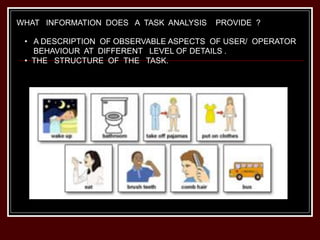
WHAT INFORMATION DOES A TASK ANALYSIS PROVIDE ?
โ€ข A DESCRIPTION OF OBSERVABLE ASPECTS OF USER/ OPERATOR
BEHAVIOUR AT DIFFERENT LEVEL OF DETAILS .
โ€ข THE STRUCTURE OF THE TASK.
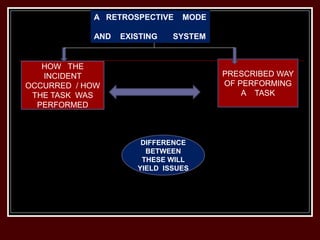
A RETROSPECTIVE MODE
AND EXISTING SYSTEM
HOW THE
INCIDENT
OCCURRED / HOW
THE TASK WAS
PERFORMED
PRESCRIBED WAY
OF PERFORMING
A TASK
DIFFERENCE
BETWEEN
THESE WILL
YIELD ISSUES
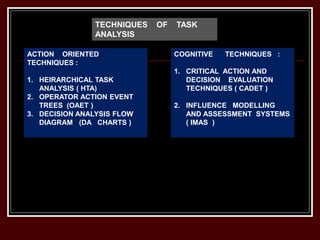
TECHNIQUES OF TASK
ANALYSIS
ACTION ORIENTED
TECHNIQUES :
1. HEIRARCHICAL TASK
ANALYSIS ( HTA)
2. OPERATOR ACTION EVENT
TREES (OAET )
3. DECISION ANALYSIS FLOW
DIAGRAM (DA CHARTS )
COGNITIVE TECHNIQUES :
1. CRITICAL ACTION AND
DECISION EVALUATION
TECHNIQUES ( CADET )
2. INFLUENCE MODELLING
AND ASSESSMENT SYSTEMS
( IMAS )
Task analysis
๏ฎ The term "task" is often used
interchangeably with activity or
process.
๏ฎ
๏ฎ Task analysis often results in a
hierarchical representation of
what steps it takes to perform a
task for which there is a goal
and for which there is some
lowest-level "action" that is
performed.
๏ฎ Task analysis is often
performed by human factors
professionals.
๏ฎ Task analysis means learning
about users' goals and users'
ways of working. Task analysis
can also mean figuring out
what more specific tasks users
must do to meet those goals
and what steps they must take
to accomplish those tasks.
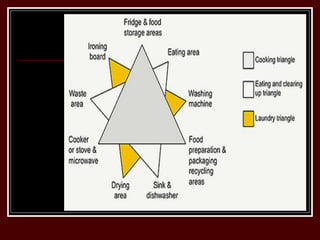
๏ฎ Along with user and task
analysis, we often do a third
analysis: understanding users'
environments (physical, social,
cultural, and technological
environments).
๏ฎ Task analysis is also used in education. It is a model that is
applied to classroom tasks to discover which curriculum
components are well matched to the capabilities of students
with learning disabilities and which task modification might
be necessary.
๏ฎ It discovers which tasks a person hasn't mastered, and the
information processing demands of tasks that are easy or
problematic.
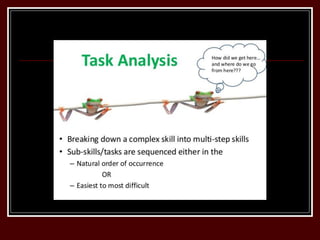
๏ฎ In behavior modification, it is a breakdown of a complex
behavioral sequence into steps. This often serves as the
basis for chaining.
๏ฎ If task analysis is
likened to a set of
instructions on how to
navigate from Point A
to Point B, then work
domain analysis (WDA)
is like having a map of
the terrain that
includes Point A and
Point B. WDA is
broader and focuses
on the environmental
constraints and
opportunities for
behavior, as in
Gibsonian ecological
psychology and
ecological interface
design.
๏ฎ Since the 1980s, a major change in
technical documentation has been to
emphasize the tasks performed with a
system rather than documenting the
system itself.
๏ฎ 1 In software documentation
particularly, long printed technical
manuals that exhaustively describe
every function of the software are being
replaced by online help organized into
tasks.
๏ฎ This is part of the new emphasis on
usability and user-centered design
rather than system/software/product
design.
๏ฎ This task orientation in
technical documentation
began with publishing
guidelines issued by IBM in
the late 1980s. Later IBM
studies led to John Carroll's
theory of minimalism in the
1990s.
๏ฎ With the development of XML as a
markup language suitable for both
print and online documentation
(replacing SGML with its focus on
print), IBM developed the Darwin
Information Typing Architecture XML
standard in 2000. Now an OASIS
standard, DITA has a strong emphasis
on task analysis. Its three basic
information types are Task, Concept,
and Reference. Tasks are analyzed
into steps, with a
Activity analysis
๏ฎ Identification and description of activities in an organization, and
evaluation of their impact on its operations.
๏ฎ Activity analysis determines
๏ฎ (1) what activities are executed,
๏ฎ (2) how many people perform the activities,
๏ฎ (3) how much time they spend on them,
๏ฎ (4) how much and which resources are consumed,
๏ฎ (5) what operational data best reflects the performance
of activities, and
๏ฎ (6) of what value the activities are to the
organization.
๏ฎ This analysis is accomplished through direct observation, interviews,
questionnaires, and review of the work records.
๏ƒจ job analysis, performance analysis and task analysis.
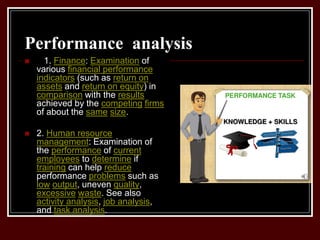
Performance analysis
๏ฎ 1. Finance: Examination of
various financial performance
indicators (such as return on
assets and return on equity) in
comparison with the results
achieved by the competing firms
of about the same size.
๏ฎ 2. Human resource
management: Examination of
the performance of current
employees to determine if
training can help reduce
performance problems such as
low output, uneven quality,
excessive waste. See also
activity analysis, job analysis,
and task analysis.
job analysis
๏ฎ Also called occupational analysis / human resource audit โ€ฆโ€ฆ.
๏ฎ Detailed examination of the (1) tasks (performance elements) that make up
a job (employee role), (2) conditions under which they are performed, and
(3) what the job requires in terms of aptitudes (potential for achievement),
attitudes (behavior characteristics), knowledge, skills, and the physical
condition of the employee. Its objectives include (a) determination of the
most efficient methods of doing a job, (b) enhancement of the employee's
job satisfaction, (c) improvement in training methods, (d) development of
performance measurement systems, and (e) matching of job-specifications
with the person-specifications in employee selection. Comprehensive job
analysis begins with the study of the organization itself: its purpose, design
and structure, inputs and outputs, internal and external environments, and
resource constraints. It is the first step in a thorough understanding of the
job and forms the basis of job description which leads to job specification.
Also called human resource audit, job study, or occupational analysis. See
also activity analysis, performance analysis, and task analysis.
๏ฎ The primary notion of usability
is that an object designed with
a generalized users'
psychology and physiology in
mind is, for example:
๏ฎ More efficient to useโ€”takes
less time to accomplish a
particular task
๏ฎ Easier to learnโ€”operation can
be learned by observing the
object
๏ฎ More satisfying to use
๏ฎ The Think aloud protocol
is a method of gathering
data that is used in both
usability and psychology
studies. It involves
getting a user to
verbalize their thought
processes as they
perform a task or set of
tasks.
๏ฎ A USE CASE describes the
interaction between an individual and
the rest of the world. Each use case
describes an event that may occur for
a short period of time in real life, but
may consist of intricate details and
interactions between the actor and
the world. It is represented as a series
of simple steps for the character to
achieve his or her goal, in the form of
a cause-and effect scheme.
๏ฎ Use cases are normally written in the
form of a chart with two columns: first
column labelled actor, second column
labelled world, and the actions
performed by each side written in
order in the respective columns.
๏ฎ User-centered
design (UCD) is
a process (not
restricted to
interfaces or
technologies) in
which the needs,
wants, and
limitations of
end users of a
product, service
or process are
given extensive
attention at each
stage of the
design process.
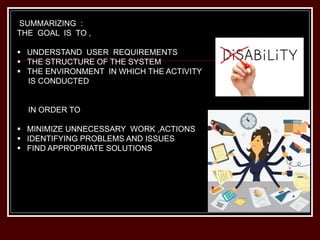
SUMMARIZING :
THE GOAL IS TO ,
๏‚ง UNDERSTAND USER REQUIREMENTS
๏‚ง THE STRUCTURE OF THE SYSTEM
๏‚ง THE ENVIRONMENT IN WHICH THE ACTIVITY
IS CONDUCTED
IN ORDER TO
๏‚ง MINIMIZE UNNECESSARY WORK ,ACTIONS
๏‚ง IDENTIFYING PROBLEMS AND ISSUES
๏‚ง FIND APPROPRIATE SOLUTIONS
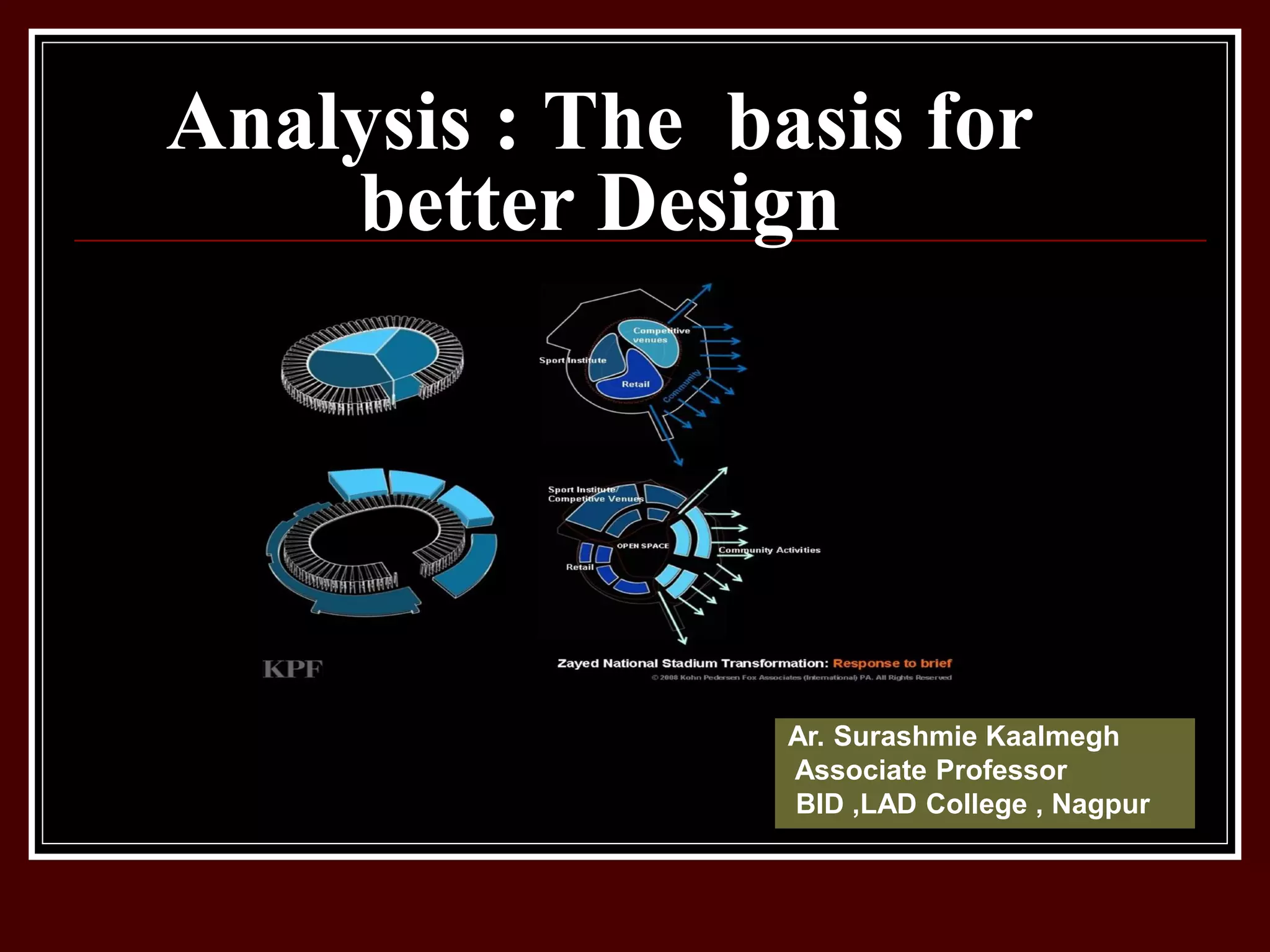
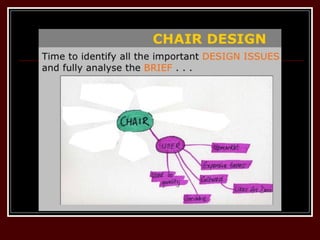
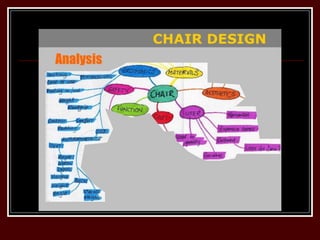
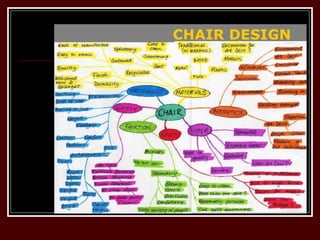
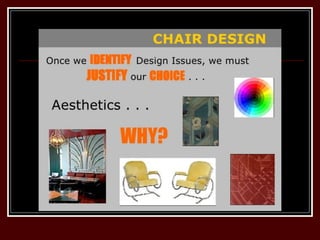
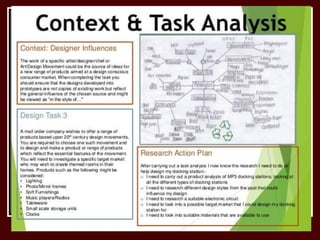
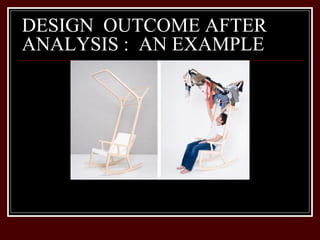
DESIGN OUTCOME AFTER
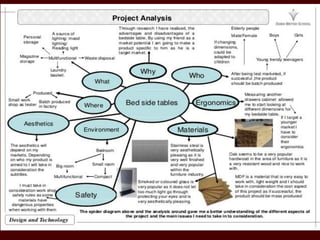
ANALYSIS : AN EXAMPLE
ANALYSIS IS THE BASIS OF DESIGN โ€ฆโ€ฆ.

Analysis, the basis of design

  • 1.
    Analysis : Thebasis for better Design Ar. Surashmie Kaalmegh Associate Professor BID ,LAD College , Nagpur
  • 3.
  • 7.
  • 17.
    Task analysis maybe of manual tasks, such as bricklaying, and be analyzed as time and motion studies using concepts from industrial engineering. Information from a task analysis can be used for many purposes, such as:-- ๏ฎ Personnel selection and training, ๏ฎ Tool or equipment design, ๏ฎ Procedure design (e.G., Design of checklists or decision support systems) and ๏ฎ Automation. ๏ฎ Cognitive task analysis is applied to modern work environments such as supervisory control where little physical work occurs, but the tasks are more related to situation assessment, decision making, and response planning and execution.
  • 18.
    Task analysis Task analysisis the process of learning about ordinary users by observing them in action to understand in detail how they perform their tasks and achieve their intended goals.
  • 19.
    โ€ขDEFINITION : โ€ขIT ISA METHODOLOGY TO ASSESS AND REDUCE HUMAN ERROR โ€ขTHE TERM TASK ANALYSIS ( TA ) IS APPLIED TO ENCOMPASS A WIDE VARIETY OF HUMAN FACTORS TECHNIQUES. โ€ขUSAGE : โ€ขREDUCE POSSIBILE ERRORS / ISSUES / PROBLEMS IN A TASK OR A COMBINATION OF TASKS. โ€ขAID IN THE DESIGN STAGES OF A NEW SYSTEM โ€ขTHE MODIFICATION OF AN EXISTING OR OLD SYSTEMS . โ€ขAS A RETROSPECTIVE MODE DURING DETAILED INVESTIGATION OF MAJOR INCIDENTS.
  • 22.
    Task analysis ๏ƒจtheanalysis of how a task is accomplished, it includes ๏ฎ A detailed description of both manual and mental activities, ๏ฎ Task and element durations ๏ฎ Task frequency, ๏ฎ Task allocation, ๏ฎ Task complexity, ๏ฎ Environmental conditions, ๏ฎ Necessary clothing & equipment, & ๏ฎ any other unique factors involved in / required for one or more people to perform a given task. Task analysis emerged from research in applied behavior analysis and still has considerable research in that area.
  • 23.
    TASK ANALYSIS ACTION ORIENTED APPROACHES COGNITIVE APPROACHES FOCUSON MENTAL PROCESSES FOCUS ON OBSERVABLE ASPECTS OF THE TASK DECISION MAKING PROBLEM SOLVINGSTRUCTUR E OF THE TASK USER / OPERATOR BEHAVIOUR AT VARIOUS LEVELS OF DETAILS
  • 24.
    WHAT INFORMATION DOESA TASK ANALYSIS PROVIDE ? โ€ข A DESCRIPTION OF OBSERVABLE ASPECTS OF USER/ OPERATOR BEHAVIOUR AT DIFFERENT LEVEL OF DETAILS . โ€ข THE STRUCTURE OF THE TASK.
  • 25.
    A RETROSPECTIVE MODE ANDEXISTING SYSTEM HOW THE INCIDENT OCCURRED / HOW THE TASK WAS PERFORMED PRESCRIBED WAY OF PERFORMING A TASK DIFFERENCE BETWEEN THESE WILL YIELD ISSUES
  • 26.
    TECHNIQUES OF TASK ANALYSIS ACTIONORIENTED TECHNIQUES : 1. HEIRARCHICAL TASK ANALYSIS ( HTA) 2. OPERATOR ACTION EVENT TREES (OAET ) 3. DECISION ANALYSIS FLOW DIAGRAM (DA CHARTS ) COGNITIVE TECHNIQUES : 1. CRITICAL ACTION AND DECISION EVALUATION TECHNIQUES ( CADET ) 2. INFLUENCE MODELLING AND ASSESSMENT SYSTEMS ( IMAS )
  • 27.
    Task analysis ๏ฎ Theterm "task" is often used interchangeably with activity or process. ๏ฎ ๏ฎ Task analysis often results in a hierarchical representation of what steps it takes to perform a task for which there is a goal and for which there is some lowest-level "action" that is performed. ๏ฎ Task analysis is often performed by human factors professionals. ๏ฎ Task analysis means learning about users' goals and users' ways of working. Task analysis can also mean figuring out what more specific tasks users must do to meet those goals and what steps they must take to accomplish those tasks. ๏ฎ Along with user and task analysis, we often do a third analysis: understanding users' environments (physical, social, cultural, and technological environments).
  • 28.
    ๏ฎ Task analysisis also used in education. It is a model that is applied to classroom tasks to discover which curriculum components are well matched to the capabilities of students with learning disabilities and which task modification might be necessary. ๏ฎ It discovers which tasks a person hasn't mastered, and the information processing demands of tasks that are easy or problematic. ๏ฎ In behavior modification, it is a breakdown of a complex behavioral sequence into steps. This often serves as the basis for chaining.
  • 29.
    ๏ฎ If taskanalysis is likened to a set of instructions on how to navigate from Point A to Point B, then work domain analysis (WDA) is like having a map of the terrain that includes Point A and Point B. WDA is broader and focuses on the environmental constraints and opportunities for behavior, as in Gibsonian ecological psychology and ecological interface design. ๏ฎ Since the 1980s, a major change in technical documentation has been to emphasize the tasks performed with a system rather than documenting the system itself. ๏ฎ 1 In software documentation particularly, long printed technical manuals that exhaustively describe every function of the software are being replaced by online help organized into tasks. ๏ฎ This is part of the new emphasis on usability and user-centered design rather than system/software/product design.
  • 30.
    ๏ฎ This taskorientation in technical documentation began with publishing guidelines issued by IBM in the late 1980s. Later IBM studies led to John Carroll's theory of minimalism in the 1990s. ๏ฎ With the development of XML as a markup language suitable for both print and online documentation (replacing SGML with its focus on print), IBM developed the Darwin Information Typing Architecture XML standard in 2000. Now an OASIS standard, DITA has a strong emphasis on task analysis. Its three basic information types are Task, Concept, and Reference. Tasks are analyzed into steps, with a
  • 31.
    Activity analysis ๏ฎ Identificationand description of activities in an organization, and evaluation of their impact on its operations. ๏ฎ Activity analysis determines ๏ฎ (1) what activities are executed, ๏ฎ (2) how many people perform the activities, ๏ฎ (3) how much time they spend on them, ๏ฎ (4) how much and which resources are consumed, ๏ฎ (5) what operational data best reflects the performance of activities, and ๏ฎ (6) of what value the activities are to the organization. ๏ฎ This analysis is accomplished through direct observation, interviews, questionnaires, and review of the work records. ๏ƒจ job analysis, performance analysis and task analysis.
  • 35.
    Performance analysis ๏ฎ 1.Finance: Examination of various financial performance indicators (such as return on assets and return on equity) in comparison with the results achieved by the competing firms of about the same size. ๏ฎ 2. Human resource management: Examination of the performance of current employees to determine if training can help reduce performance problems such as low output, uneven quality, excessive waste. See also activity analysis, job analysis, and task analysis.
  • 36.
    job analysis ๏ฎ Alsocalled occupational analysis / human resource audit โ€ฆโ€ฆ. ๏ฎ Detailed examination of the (1) tasks (performance elements) that make up a job (employee role), (2) conditions under which they are performed, and (3) what the job requires in terms of aptitudes (potential for achievement), attitudes (behavior characteristics), knowledge, skills, and the physical condition of the employee. Its objectives include (a) determination of the most efficient methods of doing a job, (b) enhancement of the employee's job satisfaction, (c) improvement in training methods, (d) development of performance measurement systems, and (e) matching of job-specifications with the person-specifications in employee selection. Comprehensive job analysis begins with the study of the organization itself: its purpose, design and structure, inputs and outputs, internal and external environments, and resource constraints. It is the first step in a thorough understanding of the job and forms the basis of job description which leads to job specification. Also called human resource audit, job study, or occupational analysis. See also activity analysis, performance analysis, and task analysis.
  • 37.
    ๏ฎ The primarynotion of usability is that an object designed with a generalized users' psychology and physiology in mind is, for example: ๏ฎ More efficient to useโ€”takes less time to accomplish a particular task ๏ฎ Easier to learnโ€”operation can be learned by observing the object ๏ฎ More satisfying to use ๏ฎ The Think aloud protocol is a method of gathering data that is used in both usability and psychology studies. It involves getting a user to verbalize their thought processes as they perform a task or set of tasks.
  • 38.
    ๏ฎ A USECASE describes the interaction between an individual and the rest of the world. Each use case describes an event that may occur for a short period of time in real life, but may consist of intricate details and interactions between the actor and the world. It is represented as a series of simple steps for the character to achieve his or her goal, in the form of a cause-and effect scheme. ๏ฎ Use cases are normally written in the form of a chart with two columns: first column labelled actor, second column labelled world, and the actions performed by each side written in order in the respective columns. ๏ฎ User-centered design (UCD) is a process (not restricted to interfaces or technologies) in which the needs, wants, and limitations of end users of a product, service or process are given extensive attention at each stage of the design process.
  • 39.
    SUMMARIZING : THE GOALIS TO , ๏‚ง UNDERSTAND USER REQUIREMENTS ๏‚ง THE STRUCTURE OF THE SYSTEM ๏‚ง THE ENVIRONMENT IN WHICH THE ACTIVITY IS CONDUCTED IN ORDER TO ๏‚ง MINIMIZE UNNECESSARY WORK ,ACTIONS ๏‚ง IDENTIFYING PROBLEMS AND ISSUES ๏‚ง FIND APPROPRIATE SOLUTIONS
  • 40.
  • 41.
    ANALYSIS IS THEBASIS OF DESIGN โ€ฆโ€ฆ.