AR SURASHMIE KAALMEGH
ASSOCIATE PROFFESSOR
LAD COLLEGE , NAGPUR
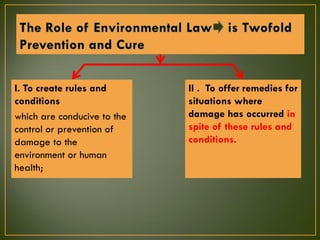
I. To create rules and
conditions
which are conducive to the
control or prevention of
damage to the
environment or human
health;
II . To offer remedies for
situations where
damage has occurred in
spite of these rules and
conditions.
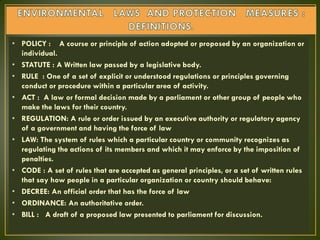
• POLICY : A course or principle of action adopted or proposed by an organization or
individual.
• STATUTE : A Written law passed by a legislative body.
• RULE : One of a set of explicit or understood regulations or principles governing
conduct or procedure within a particular area of activity.
• ACT : A law or formal decision made by a parliament or other group of people who
make the laws for their country.
• REGULATION: A rule or order issued by an executive authority or regulatory agency
of a government and having the force of law
• LAW: The system of rules which a particular country or community recognizes as
regulating the actions of its members and which it may enforce by the imposition of
penalties.
• CODE : A set of rules that are accepted as general principles, or a set of written rules
that say how people in a particular organization or country should behave:
• DECREE: An official order that has the force of law
• ORDINANCE: An authoritative order.
• BILL : A draft of a proposed law presented to parliament for discussion.
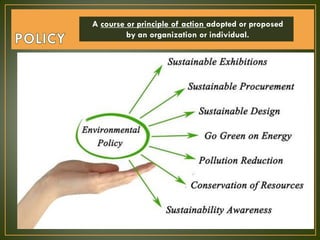
A course or principle of action adopted or proposed
by an organization or individual.
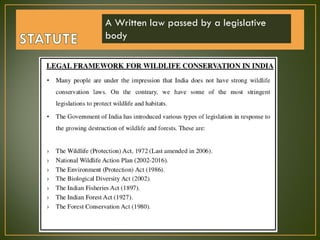
A Written law passed by a legislative
body
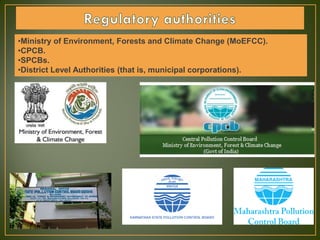
•Ministry of Environment, Forests and Climate Change (MoEFCC).
•CPCB.
•SPCBs.
•District Level Authorities (that is, municipal corporations).
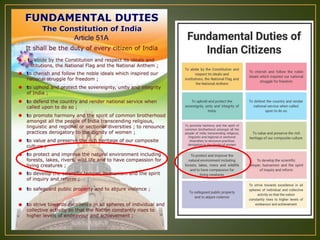
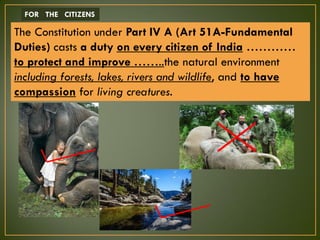
The Constitution under Part IV A (Art 51A-Fundamental
Duties) casts a duty on every citizen of India …………
to protect and improve ……..the natural environment
including forests, lakes, rivers and wildlife, and to have
compassion for living creatures.
FOR THE CITIZENS
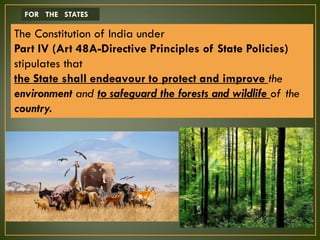
The Constitution of India under
Part IV (Art 48A-Directive Principles of State Policies)
stipulates that
the State shall endeavour to protect and improve the
environment and to safeguard the forests and wildlife of the
country.
FOR THE STATES
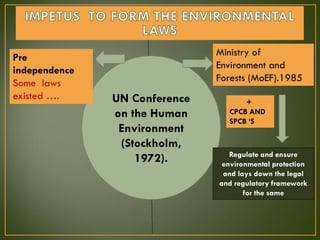
UN Conference
on the Human
Environment
(Stockholm,
1972).
Ministry of
Environment and
Forests (MoEF).1985
Pre
independence
Some laws
existed ….
Regulate and ensure
environmental protection
and lays down the legal
and regulatory framework
for the same
+
CPCB AND
SPCB ‘S
• The National Green Tribunal Act, 2010
• The Air (Prevention and Control of Pollution) Act,
1981
• The Water (Prevention and Control of Pollution) Act,
1974
• The Environment Protection Act, 1986
• The Hazardous Waste Management Regulations,
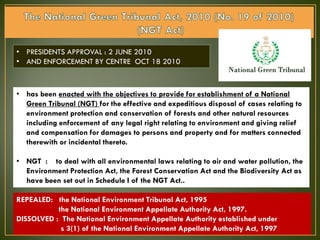
• has been enacted with the objectives to provide for establishment of a National
Green Tribunal (NGT) for the effective and expeditious disposal of cases relating to
environment protection and conservation of forests and other natural resources
including enforcement of any legal right relating to environment and giving relief
and compensation for damages to persons and property and for matters connected
therewith or incidental thereto.
• NGT : to deal with all environmental laws relating to air and water pollution, the
Environment Protection Act, the Forest Conservation Act and the Biodiversity Act as
have been set out in Schedule I of the NGT Act..
REPEALED: the National Environment Tribunal Act, 1995
the National Environment Appellate Authority Act, 1997.
DISSOLVED : The National Environment Appellate Authority established under
s 3(1) of the National Environment Appellate Authority Act, 1997
• PRESIDENTS APPROVAL : 2 JUNE 2010
• AND ENFORCEMENT BY CENTRE OCT 18 2010
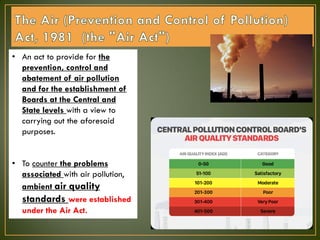
• An act to provide for the
prevention, control and
abatement of air pollution
and for the establishment of
Boards at the Central and
State levels with a view to
carrying out the aforesaid
purposes.
• To counter the problems
associated with air pollution,
ambient air quality
standards were established
under the Air Act.
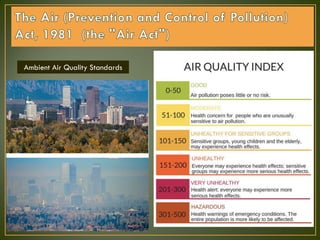
Ambient Air Quality Standards
• The Air Act seeks to
combat air pollution by
prohibiting the use of
polluting fuels and
substances, as well as
by regulating
appliances that give
rise to air pollution.
• The Air Act empowers
the State Government,
after consultation with
the SPCBs, to declare
any area or areas
within the State as air
pollution control area
or areas.
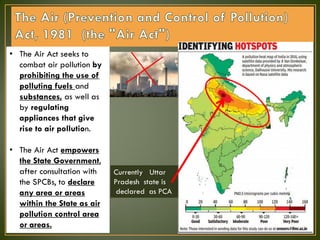
Currently Uttar
Pradesh state is
declared as PCA
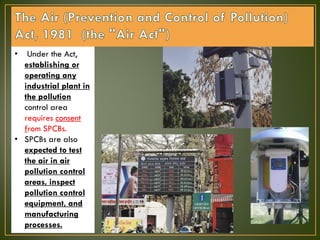
• Under the Act,
establishing or
operating any
industrial plant in
the pollution
control area
requires consent
from SPCBs.
• SPCBs are also
expected to test
the air in air
pollution control
areas, inspect
pollution control
equipment, and
manufacturing
processes.
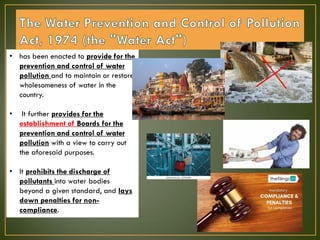
• has been enacted to provide for the
prevention and control of water
pollution and to maintain or restore
wholesomeness of water in the
country.
• It further provides for the
establishment of Boards for the
prevention and control of water
pollution with a view to carry out
the aforesaid purposes.
• It prohibits the discharge of
pollutants into water bodies
beyond a given standard, and lays
down penalties for non-
compliance.
 Further, the Water (Prevention and
Control of Pollution) Cess Act was
enacted in 1977 to provide for the
levy and collection of a cess on
water consumed by persons
operating and carrying on certain
types of industrial activities.
 This cess is collected with a view
to augment the resources of the
Central Board and the State Boards
for the prevention and control of
water pollution constituted under
the Water (Prevention and Control
of Pollution) Act, 1974.
 The Act was last amended in 2003.
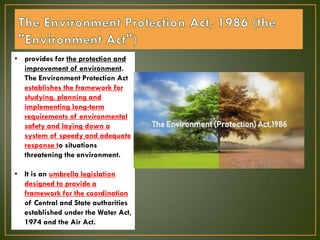
• provides for the protection and
improvement of environment.
The Environment Protection Act
establishes the framework for
studying, planning and
implementing long-term
requirements of environmental
safety and laying down a
system of speedy and adequate
response to situations
threatening the environment.
• It is an umbrella legislation
designed to provide a
framework for the coordination
of Central and State authorities
established under the Water Act,
1974 and the Air Act.
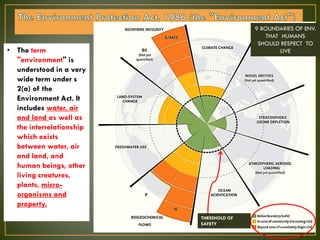
• The term
"environment" is
understood in a very
wide term under s
2(a) of the
Environment Act. It
includes water, air
and land as well as
the interrelationship
which exists
between water, air
and land, and
human beings, other
living creatures,
plants, micro-
organisms and
property.
9 BOUNDARIES OF ENV.
THAT HUMANS
SHOULD RESPECT TO
LIVE
THRESHOLD OF
SAFETY
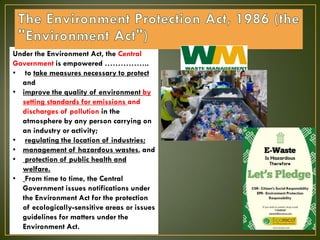
Under the Environment Act, the Central
Government is empowered ……………..
• to take measures necessary to protect
and
• improve the quality of environment by
setting standards for emissions and
discharges of pollution in the
atmosphere by any person carrying on
an industry or activity;
• regulating the location of industries;
• management of hazardous wastes, and
• protection of public health and
welfare.
• From time to time, the Central
Government issues notifications under
the Environment Act for the protection
of ecologically-sensitive areas or issues
guidelines for matters under the
Environment Act.
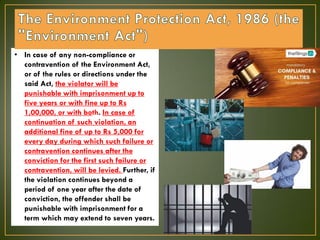
• In case of any non-compliance or
contravention of the Environment Act,
or of the rules or directions under the
said Act, the violator will be
punishable with imprisonment up to
five years or with fine up to Rs
1,00,000, or with both. In case of
continuation of such violation, an
additional fine of up to Rs 5,000 for
every day during which such failure or
contravention continues after the
conviction for the first such failure or
contravention, will be levied. Further, if
the violation continues beyond a
period of one year after the date of
conviction, the offender shall be
punishable with imprisonment for a
term which may extend to seven years.
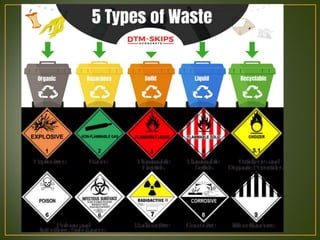
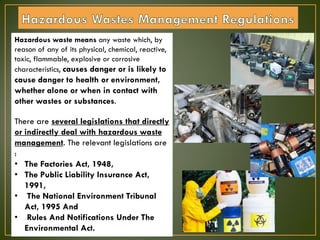
Hazardous waste means any waste which, by
reason of any of its physical, chemical, reactive,
toxic, flammable, explosive or corrosive
characteristics, causes danger or is likely to
cause danger to health or environment,
whether alone or when in contact with
other wastes or substances.
There are several legislations that directly
or indirectly deal with hazardous waste
management. The relevant legislations are
:
• The Factories Act, 1948,
• The Public Liability Insurance Act,
1991,
• The National Environment Tribunal
Act, 1995 And
• Rules And Notifications Under The
Environmental Act.
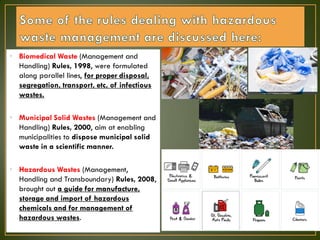
• Biomedical Waste (Management and
Handling) Rules, 1998, were formulated
along parallel lines, for proper disposal,
segregation, transport, etc, of infectious
wastes.
• Municipal Solid Wastes (Management and
Handling) Rules, 2000, aim at enabling
municipalities to dispose municipal solid
waste in a scientific manner.
• Hazardous Wastes (Management,
Handling and Transboundary) Rules, 2008,
brought out a guide for manufacture,
storage and import of hazardous
chemicals and for management of
hazardous wastes.
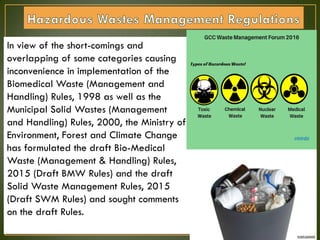
In view of the short-comings and
overlapping of some categories causing
inconvenience in implementation of the
Biomedical Waste (Management and
Handling) Rules, 1998 as well as the
Municipal Solid Wastes (Management
and Handling) Rules, 2000, the Ministry of
Environment, Forest and Climate Change
has formulated the draft Bio-Medical
Waste (Management & Handling) Rules,
2015 (Draft BMW Rules) and the draft
Solid Waste Management Rules, 2015
(Draft SWM Rules) and sought comments
on the draft Rules.
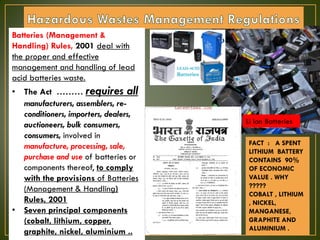
Batteries (Management &
Handling) Rules, 2001 deal with
the proper and effective
management and handling of lead
acid batteries waste.
• The Act ……… requires all
manufacturers, assemblers, re-
conditioners, importers, dealers,
auctioneers, bulk consumers,
consumers, involved in
manufacture, processing, sale,
purchase and use of batteries or
components thereof, to comply
with the provisions of Batteries
(Management & Handling)
Rules, 2001
• Seven principal components
(cobalt, lithium, copper,
graphite, nickel, aluminium ..
FACT : A SPENT
LITHIUM BATTERY
CONTAINS 90%
OF ECONOMIC
VALUE . WHY
?????
COBALT , LITHIUM
, NICKEL,
MANGANESE,
GRAPHITE AND
ALUMINIUM .
Li Ion Batteries
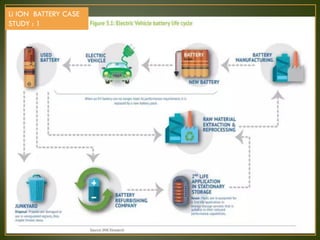
Li ION BATTERY CASE
STUDY : 1
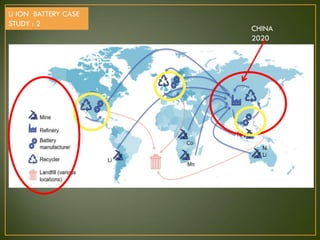
CHINA
2020
Li ION BATTERY CASE
STUDY : 2
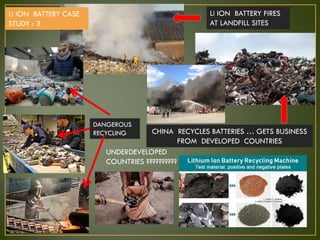
Li ION BATTERY FIRES
AT LANDFILL SITES
CHINA RECYCLES BATTERIES … GETS BUSINESS
FROM DEVELOPED COUNTRIES
DANGEROUS
RECYCLING
Li ION BATTERY CASE
STUDY : 3
UNDERDEVELOPED
COUNTRIES ??????????
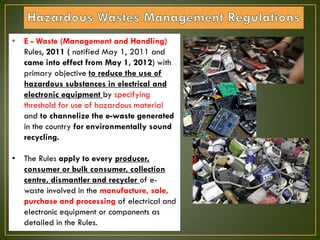
• E - Waste (Management and Handling)
Rules, 2011 ( notified May 1, 2011 and
came into effect from May 1, 2012) with
primary objective to reduce the use of
hazardous substances in electrical and
electronic equipment by specifying
threshold for use of hazardous material
and to channelize the e-waste generated
in the country for environmentally sound
recycling.
• The Rules apply to every producer,
consumer or bulk consumer, collection
centre, dismantler and recycler of e-
waste involved in the manufacture, sale,
purchase and processing of electrical and
electronic equipment or components as
detailed in the Rules.
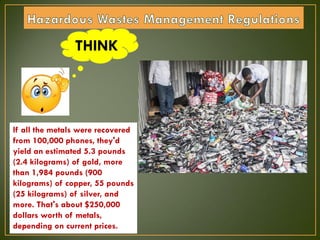
THINK
If all the metals were recovered
from 100,000 phones, they'd
yield an estimated 5.3 pounds
(2.4 kilograms) of gold, more
than 1,984 pounds (900
kilograms) of copper, 55 pounds
(25 kilograms) of silver, and
more. That's about $250,000
dollars worth of metals,
depending on current prices.
In addition, there are many
other laws relating to
environment………..
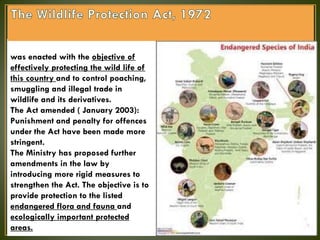
was enacted with the objective of
effectively protecting the wild life of
this country and to control poaching,
smuggling and illegal trade in
wildlife and its derivatives.
The Act amended ( January 2003):
Punishment and penalty for offences
under the Act have been made more
stringent.
The Ministry has proposed further
amendments in the law by
introducing more rigid measures to
strengthen the Act. The objective is to
provide protection to the listed
endangered flora and fauna and
ecologically important protected
areas.
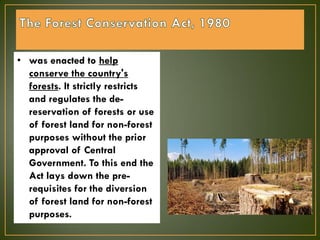
• was enacted to help
conserve the country's
forests. It strictly restricts
and regulates the de-
reservation of forests or use
of forest land for non-forest
purposes without the prior
approval of Central
Government. To this end the
Act lays down the pre-
requisites for the diversion
of forest land for non-forest
purposes.
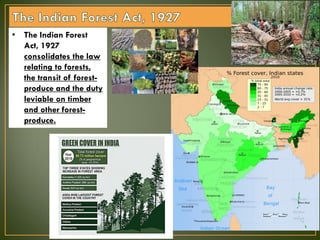
• The Indian Forest
Act, 1927
consolidates the law
relating to forests,
the transit of forest-
produce and the duty
leviable on timber
and other forest-
produce.
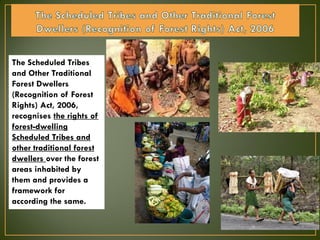
The Scheduled Tribes
and Other Traditional
Forest Dwellers
(Recognition of Forest
Rights) Act, 2006,
recognises the rights of
forest-dwelling
Scheduled Tribes and
other traditional forest
dwellers over the forest
areas inhabited by
them and provides a
framework for
according the same.
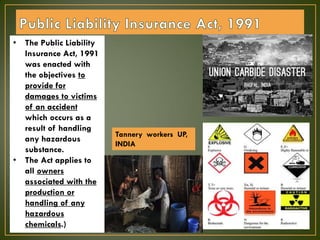
• The Public Liability
Insurance Act, 1991
was enacted with
the objectives to
provide for
damages to victims
of an accident
which occurs as a
result of handling
any hazardous
substance.
• The Act applies to
all owners
associated with the
production or
handling of any
hazardous
chemicals.)
Tannery workers UP,
INDIA
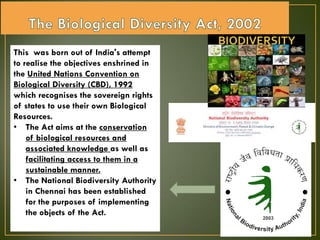
This was born out of India's attempt
to realise the objectives enshrined in
the United Nations Convention on
Biological Diversity (CBD), 1992
which recognises the sovereign rights
of states to use their own Biological
Resources.
• The Act aims at the conservation
of biological resources and
associated knowledge as well as
facilitating access to them in a
sustainable manner.
• The National Biodiversity Authority
in Chennai has been established
for the purposes of implementing
the objects of the Act.
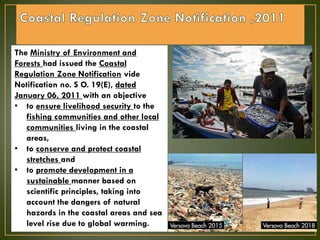
The Ministry of Environment and
Forests had issued the Coastal
Regulation Zone Notification vide
Notification no. S O. 19(E), dated
January 06, 2011 with an objective
• to ensure livelihood security to the
fishing communities and other local
communities living in the coastal
areas,
• to conserve and protect coastal
stretches and
• to promote development in a
sustainable manner based on
scientific principles, taking into
account the dangers of natural
hazards in the coastal areas and sea
level rise due to global warming.
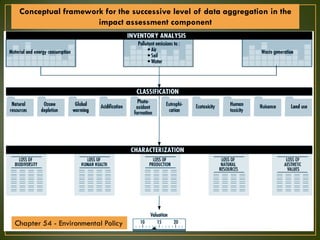
Conceptual framework for the successive level of data aggregation in the
impact assessment component
Chapter 54 - Environmental Policy
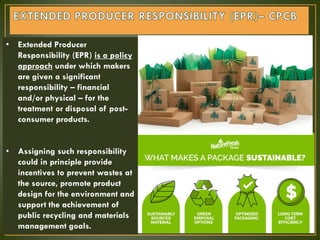
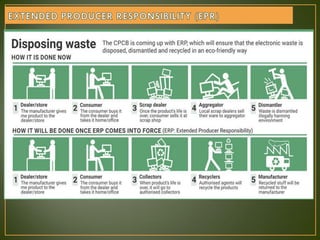
• Extended Producer
Responsibility (EPR) is a policy
approach under which makers
are given a significant
responsibility – financial
and/or physical – for the
treatment or disposal of post-
consumer products.
• Assigning such responsibility
could in principle provide
incentives to prevent wastes at
the source, promote product
design for the environment and
support the achievement of
public recycling and materials
management goals.
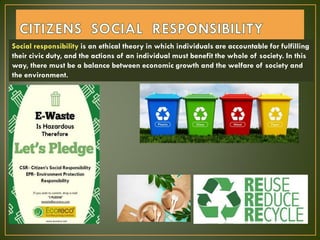
Social responsibility is an ethical theory in which individuals are accountable for fulfilling
their civic duty, and the actions of an individual must benefit the whole of society. In this
way, there must be a balance between economic growth and the welfare of society and
the environment.
ENVIRONMENTAL   LAWS  AND PROTECTION   MEASURES.pdf

ENVIRONMENTAL LAWS AND PROTECTION MEASURES.pdf

  • 1.
    AR SURASHMIE KAALMEGH ASSOCIATEPROFFESSOR LAD COLLEGE , NAGPUR
  • 5.
    I. To createrules and conditions which are conducive to the control or prevention of damage to the environment or human health; II . To offer remedies for situations where damage has occurred in spite of these rules and conditions.
  • 6.
    • POLICY :A course or principle of action adopted or proposed by an organization or individual. • STATUTE : A Written law passed by a legislative body. • RULE : One of a set of explicit or understood regulations or principles governing conduct or procedure within a particular area of activity. • ACT : A law or formal decision made by a parliament or other group of people who make the laws for their country. • REGULATION: A rule or order issued by an executive authority or regulatory agency of a government and having the force of law • LAW: The system of rules which a particular country or community recognizes as regulating the actions of its members and which it may enforce by the imposition of penalties. • CODE : A set of rules that are accepted as general principles, or a set of written rules that say how people in a particular organization or country should behave: • DECREE: An official order that has the force of law • ORDINANCE: An authoritative order. • BILL : A draft of a proposed law presented to parliament for discussion.
  • 7.
    A course orprinciple of action adopted or proposed by an organization or individual.
  • 8.
    A Written lawpassed by a legislative body
  • 9.
    •Ministry of Environment,Forests and Climate Change (MoEFCC). •CPCB. •SPCBs. •District Level Authorities (that is, municipal corporations).
  • 12.
    The Constitution underPart IV A (Art 51A-Fundamental Duties) casts a duty on every citizen of India ………… to protect and improve ……..the natural environment including forests, lakes, rivers and wildlife, and to have compassion for living creatures. FOR THE CITIZENS
  • 13.
    The Constitution ofIndia under Part IV (Art 48A-Directive Principles of State Policies) stipulates that the State shall endeavour to protect and improve the environment and to safeguard the forests and wildlife of the country. FOR THE STATES
  • 14.
    UN Conference on theHuman Environment (Stockholm, 1972). Ministry of Environment and Forests (MoEF).1985 Pre independence Some laws existed …. Regulate and ensure environmental protection and lays down the legal and regulatory framework for the same + CPCB AND SPCB ‘S
  • 15.
    • The NationalGreen Tribunal Act, 2010 • The Air (Prevention and Control of Pollution) Act, 1981 • The Water (Prevention and Control of Pollution) Act, 1974 • The Environment Protection Act, 1986 • The Hazardous Waste Management Regulations,
  • 16.
    • has beenenacted with the objectives to provide for establishment of a National Green Tribunal (NGT) for the effective and expeditious disposal of cases relating to environment protection and conservation of forests and other natural resources including enforcement of any legal right relating to environment and giving relief and compensation for damages to persons and property and for matters connected therewith or incidental thereto. • NGT : to deal with all environmental laws relating to air and water pollution, the Environment Protection Act, the Forest Conservation Act and the Biodiversity Act as have been set out in Schedule I of the NGT Act.. REPEALED: the National Environment Tribunal Act, 1995 the National Environment Appellate Authority Act, 1997. DISSOLVED : The National Environment Appellate Authority established under s 3(1) of the National Environment Appellate Authority Act, 1997 • PRESIDENTS APPROVAL : 2 JUNE 2010 • AND ENFORCEMENT BY CENTRE OCT 18 2010
  • 17.
    • An actto provide for the prevention, control and abatement of air pollution and for the establishment of Boards at the Central and State levels with a view to carrying out the aforesaid purposes. • To counter the problems associated with air pollution, ambient air quality standards were established under the Air Act.
  • 18.
  • 19.
    • The AirAct seeks to combat air pollution by prohibiting the use of polluting fuels and substances, as well as by regulating appliances that give rise to air pollution. • The Air Act empowers the State Government, after consultation with the SPCBs, to declare any area or areas within the State as air pollution control area or areas. Currently Uttar Pradesh state is declared as PCA
  • 20.
    • Under theAct, establishing or operating any industrial plant in the pollution control area requires consent from SPCBs. • SPCBs are also expected to test the air in air pollution control areas, inspect pollution control equipment, and manufacturing processes.
  • 21.
    • has beenenacted to provide for the prevention and control of water pollution and to maintain or restore wholesomeness of water in the country. • It further provides for the establishment of Boards for the prevention and control of water pollution with a view to carry out the aforesaid purposes. • It prohibits the discharge of pollutants into water bodies beyond a given standard, and lays down penalties for non- compliance.
  • 22.
     Further, theWater (Prevention and Control of Pollution) Cess Act was enacted in 1977 to provide for the levy and collection of a cess on water consumed by persons operating and carrying on certain types of industrial activities.  This cess is collected with a view to augment the resources of the Central Board and the State Boards for the prevention and control of water pollution constituted under the Water (Prevention and Control of Pollution) Act, 1974.  The Act was last amended in 2003.
  • 23.
    • provides forthe protection and improvement of environment. The Environment Protection Act establishes the framework for studying, planning and implementing long-term requirements of environmental safety and laying down a system of speedy and adequate response to situations threatening the environment. • It is an umbrella legislation designed to provide a framework for the coordination of Central and State authorities established under the Water Act, 1974 and the Air Act.
  • 24.
    • The term "environment"is understood in a very wide term under s 2(a) of the Environment Act. It includes water, air and land as well as the interrelationship which exists between water, air and land, and human beings, other living creatures, plants, micro- organisms and property. 9 BOUNDARIES OF ENV. THAT HUMANS SHOULD RESPECT TO LIVE THRESHOLD OF SAFETY
  • 27.
    Under the EnvironmentAct, the Central Government is empowered …………….. • to take measures necessary to protect and • improve the quality of environment by setting standards for emissions and discharges of pollution in the atmosphere by any person carrying on an industry or activity; • regulating the location of industries; • management of hazardous wastes, and • protection of public health and welfare. • From time to time, the Central Government issues notifications under the Environment Act for the protection of ecologically-sensitive areas or issues guidelines for matters under the Environment Act.
  • 28.
    • In caseof any non-compliance or contravention of the Environment Act, or of the rules or directions under the said Act, the violator will be punishable with imprisonment up to five years or with fine up to Rs 1,00,000, or with both. In case of continuation of such violation, an additional fine of up to Rs 5,000 for every day during which such failure or contravention continues after the conviction for the first such failure or contravention, will be levied. Further, if the violation continues beyond a period of one year after the date of conviction, the offender shall be punishable with imprisonment for a term which may extend to seven years.
  • 30.
    Hazardous waste meansany waste which, by reason of any of its physical, chemical, reactive, toxic, flammable, explosive or corrosive characteristics, causes danger or is likely to cause danger to health or environment, whether alone or when in contact with other wastes or substances. There are several legislations that directly or indirectly deal with hazardous waste management. The relevant legislations are : • The Factories Act, 1948, • The Public Liability Insurance Act, 1991, • The National Environment Tribunal Act, 1995 And • Rules And Notifications Under The Environmental Act.
  • 31.
    • Biomedical Waste(Management and Handling) Rules, 1998, were formulated along parallel lines, for proper disposal, segregation, transport, etc, of infectious wastes. • Municipal Solid Wastes (Management and Handling) Rules, 2000, aim at enabling municipalities to dispose municipal solid waste in a scientific manner. • Hazardous Wastes (Management, Handling and Transboundary) Rules, 2008, brought out a guide for manufacture, storage and import of hazardous chemicals and for management of hazardous wastes.
  • 32.
    In view ofthe short-comings and overlapping of some categories causing inconvenience in implementation of the Biomedical Waste (Management and Handling) Rules, 1998 as well as the Municipal Solid Wastes (Management and Handling) Rules, 2000, the Ministry of Environment, Forest and Climate Change has formulated the draft Bio-Medical Waste (Management & Handling) Rules, 2015 (Draft BMW Rules) and the draft Solid Waste Management Rules, 2015 (Draft SWM Rules) and sought comments on the draft Rules.
  • 33.
    Batteries (Management & Handling)Rules, 2001 deal with the proper and effective management and handling of lead acid batteries waste. • The Act ……… requires all manufacturers, assemblers, re- conditioners, importers, dealers, auctioneers, bulk consumers, consumers, involved in manufacture, processing, sale, purchase and use of batteries or components thereof, to comply with the provisions of Batteries (Management & Handling) Rules, 2001 • Seven principal components (cobalt, lithium, copper, graphite, nickel, aluminium .. FACT : A SPENT LITHIUM BATTERY CONTAINS 90% OF ECONOMIC VALUE . WHY ????? COBALT , LITHIUM , NICKEL, MANGANESE, GRAPHITE AND ALUMINIUM . Li Ion Batteries
  • 34.
    Li ION BATTERYCASE STUDY : 1
  • 35.
  • 36.
    Li ION BATTERYFIRES AT LANDFILL SITES CHINA RECYCLES BATTERIES … GETS BUSINESS FROM DEVELOPED COUNTRIES DANGEROUS RECYCLING Li ION BATTERY CASE STUDY : 3 UNDERDEVELOPED COUNTRIES ??????????
  • 37.
    • E -Waste (Management and Handling) Rules, 2011 ( notified May 1, 2011 and came into effect from May 1, 2012) with primary objective to reduce the use of hazardous substances in electrical and electronic equipment by specifying threshold for use of hazardous material and to channelize the e-waste generated in the country for environmentally sound recycling. • The Rules apply to every producer, consumer or bulk consumer, collection centre, dismantler and recycler of e- waste involved in the manufacture, sale, purchase and processing of electrical and electronic equipment or components as detailed in the Rules.
  • 38.
    THINK If all themetals were recovered from 100,000 phones, they'd yield an estimated 5.3 pounds (2.4 kilograms) of gold, more than 1,984 pounds (900 kilograms) of copper, 55 pounds (25 kilograms) of silver, and more. That's about $250,000 dollars worth of metals, depending on current prices.
  • 39.
    In addition, thereare many other laws relating to environment………..
  • 40.
    was enacted withthe objective of effectively protecting the wild life of this country and to control poaching, smuggling and illegal trade in wildlife and its derivatives. The Act amended ( January 2003): Punishment and penalty for offences under the Act have been made more stringent. The Ministry has proposed further amendments in the law by introducing more rigid measures to strengthen the Act. The objective is to provide protection to the listed endangered flora and fauna and ecologically important protected areas.
  • 41.
    • was enactedto help conserve the country's forests. It strictly restricts and regulates the de- reservation of forests or use of forest land for non-forest purposes without the prior approval of Central Government. To this end the Act lays down the pre- requisites for the diversion of forest land for non-forest purposes.
  • 42.
    • The IndianForest Act, 1927 consolidates the law relating to forests, the transit of forest- produce and the duty leviable on timber and other forest- produce.
  • 43.
    The Scheduled Tribes andOther Traditional Forest Dwellers (Recognition of Forest Rights) Act, 2006, recognises the rights of forest-dwelling Scheduled Tribes and other traditional forest dwellers over the forest areas inhabited by them and provides a framework for according the same.
  • 44.
    • The PublicLiability Insurance Act, 1991 was enacted with the objectives to provide for damages to victims of an accident which occurs as a result of handling any hazardous substance. • The Act applies to all owners associated with the production or handling of any hazardous chemicals.) Tannery workers UP, INDIA
  • 45.
    This was bornout of India's attempt to realise the objectives enshrined in the United Nations Convention on Biological Diversity (CBD), 1992 which recognises the sovereign rights of states to use their own Biological Resources. • The Act aims at the conservation of biological resources and associated knowledge as well as facilitating access to them in a sustainable manner. • The National Biodiversity Authority in Chennai has been established for the purposes of implementing the objects of the Act.
  • 46.
    The Ministry ofEnvironment and Forests had issued the Coastal Regulation Zone Notification vide Notification no. S O. 19(E), dated January 06, 2011 with an objective • to ensure livelihood security to the fishing communities and other local communities living in the coastal areas, • to conserve and protect coastal stretches and • to promote development in a sustainable manner based on scientific principles, taking into account the dangers of natural hazards in the coastal areas and sea level rise due to global warming.
  • 47.
    Conceptual framework forthe successive level of data aggregation in the impact assessment component Chapter 54 - Environmental Policy
  • 49.
    • Extended Producer Responsibility(EPR) is a policy approach under which makers are given a significant responsibility – financial and/or physical – for the treatment or disposal of post- consumer products. • Assigning such responsibility could in principle provide incentives to prevent wastes at the source, promote product design for the environment and support the achievement of public recycling and materials management goals.
  • 51.
    Social responsibility isan ethical theory in which individuals are accountable for fulfilling their civic duty, and the actions of an individual must benefit the whole of society. In this way, there must be a balance between economic growth and the welfare of society and the environment.