5. Sectional View
Complied By: Habtamu Geremew
Email: habti.geremew@gmail.com
Engineering Drawing.
Gondar institute of
Technology
Sectional view
There are objects with complicated interior details
and when represented by hidden lines, may not
effectively reveal the true interior details in MVD.
A sectional view is obtained by imagining the object, as
if cut by a cutting plane and the portion between the
observer and the section plane being removed.
The cut line is called a “cutting plane”, and can be done
in several ways.
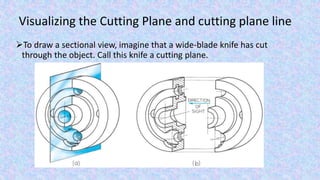
Visualizing the Cutting Plane and cutting plane line
To draw a sectional view, imagine that a wide-blade knife has cut
through the object. Call this knife a cutting plane.
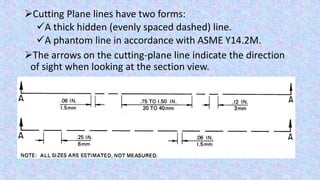
Cutting Plane lines have two forms:
A thick hidden (evenly spaced dashed) line.
A phantom line in accordance with ASME Y14.2M.
The arrows on the cutting-plane line indicate the direction
of sight when looking at the section view.
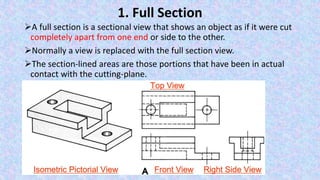
1. Full Section
A full section is a sectional view that shows an object as if it were cut
completely apart from one end or side to the other.
Normally a view is replaced with the full section view.
The section-lined areas are those portions that have been in actual
contact with the cutting-plane.
Replacing the normal view by sectional
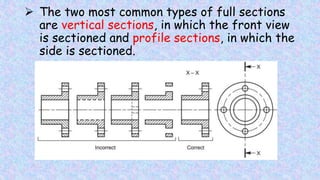
 The two most common types of full sections
are vertical sections, in which the front view
is sectioned and profile sections, in which the
side is sectioned.
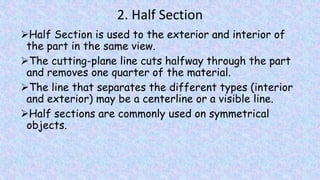
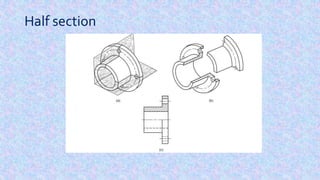
2. Half Section
Half Section is used to the exterior and interior of
the part in the same view.
The cutting-plane line cuts halfway through the part
and removes one quarter of the material.
The line that separates the different types (interior
and exterior) may be a centerline or a visible line.
Half sections are commonly used on symmetrical
objects.
Half section
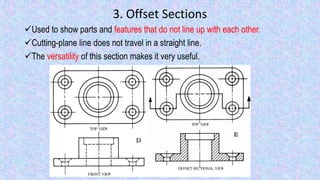
3. Offset Sections
Used to show parts and features that do not line up with each other.
Cutting-plane line does not travel in a straight line.
The versatility of this section makes it very useful.
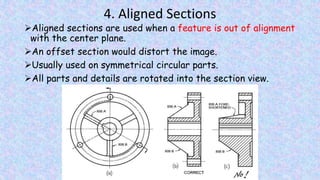
4. Aligned Sections
Aligned sections are used when a feature is out of alignment
with the center plane.
An offset section would distort the image.
Usually used on symmetrical circular parts.
All parts and details are rotated into the section view.
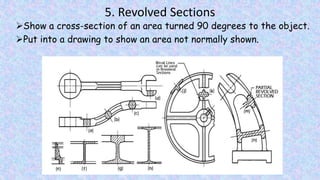
5. Revolved Sections
Show a cross-section of an area turned 90 degrees to the object.
Put into a drawing to show an area not normally shown.
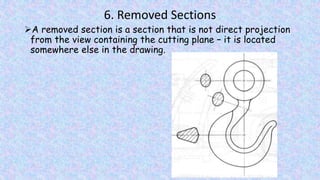
6. Removed Sections
A removed section is a section that is not direct projection
from the view containing the cutting plane – it is located
somewhere else in the drawing.
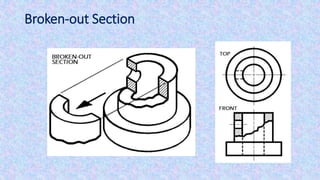
7. Broken-out Sections
A broken-out section shows an object as it would look if a
portion of it were cut partly away from the rest by a
cutting-plane and then “broken off” to reveal the cut
surface and insides.
Uses short break line.
Used to generate a section for a small area without using a
cutting-plane line.
Used to enhance the orthographic view by giving the viewer
a better look at key interior details.
Broken-out Section
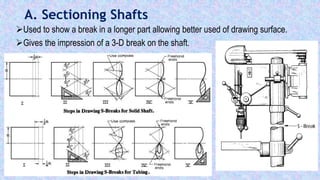
A. Sectioning Shafts
Used to show a break in a longer part allowing better used of drawing surface.
Gives the impression of a 3-D break on the shaft.
B. Assembly Sections
Shows how parts fit together
Allows better clarity with a complicated assembly of parts.
Shows how parts not only fit together, but allows for a
visual view of how they function.
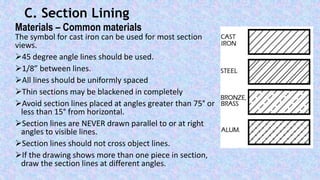
C. Section Lining
Materials – Common materials
The symbol for cast iron can be used for most section
views.
45 degree angle lines should be used.
1/8” between lines.
All lines should be uniformly spaced
Thin sections may be blackened in completely
Avoid section lines placed at angles greater than 75° or
less than 15° from horizontal.
Section lines are NEVER drawn parallel to or at right
angles to visible lines.
Section lines should not cross object lines.
If the drawing shows more than one piece in section,
draw the section lines at different angles.
Continued
Section lining/continued
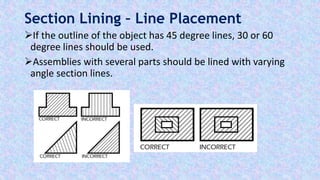
Section Lining – Line Placement
If the outline of the object has 45 degree lines, 30 or 60
degree lines should be used.
Assemblies with several parts should be lined with varying
angle section lines.
D. Special Cases
Certain exceptions are made to the general sectioning rules
for:
Ribs and Webs in Section.
Hidden and Visible Lines.
Alternate Section Lining.
Certain Parts usually not sectioned.
Rotated Features in Section.
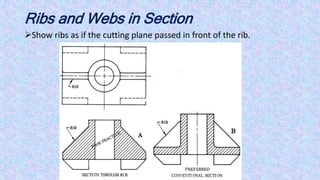
Ribs and Webs in Section
Show ribs as if the cutting plane passed in front of the rib.
Ribs and Webs in Section
Flat part, at right angles to the flat side, Show the section lines for
that part.
Hidden and Visible Lines
Do not draw hidden lines on sectional views unless they are needed.
Include all lines that would be visible on or beyond the plane of the section.
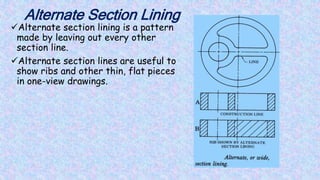
Alternate Section Lining
Alternate section lining is a pattern
made by leaving out every other
section line.
Alternate section lines are useful to
show ribs and other thin, flat pieces
in one-view drawings.
Other Parts NOT Sectioned
Do not draw section lines on
spokes, shafts, bolts, pins, rivets
and gear teeth when the cutting
plane passes through them.
Draw section lines when cut
across the axis
Th a n k You
Ver y M uc h
Comment/questionsession
So now what are you
going to do?
Department of Mechanical Engineering
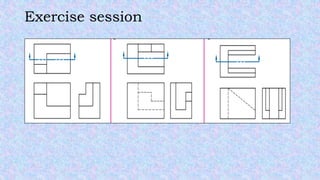
Exercise session
Sectional View
Sectional View

Sectional View

  • 1.
    5. Sectional View CompliedBy: Habtamu Geremew Email: habti.geremew@gmail.com Engineering Drawing. Gondar institute of Technology
  • 2.
    Sectional view There areobjects with complicated interior details and when represented by hidden lines, may not effectively reveal the true interior details in MVD. A sectional view is obtained by imagining the object, as if cut by a cutting plane and the portion between the observer and the section plane being removed. The cut line is called a “cutting plane”, and can be done in several ways.
  • 3.
    Visualizing the CuttingPlane and cutting plane line To draw a sectional view, imagine that a wide-blade knife has cut through the object. Call this knife a cutting plane.
  • 4.
    Cutting Plane lineshave two forms: A thick hidden (evenly spaced dashed) line. A phantom line in accordance with ASME Y14.2M. The arrows on the cutting-plane line indicate the direction of sight when looking at the section view.
  • 5.
    1. Full Section Afull section is a sectional view that shows an object as if it were cut completely apart from one end or side to the other. Normally a view is replaced with the full section view. The section-lined areas are those portions that have been in actual contact with the cutting-plane.
  • 6.
    Replacing the normalview by sectional
  • 7.
     The twomost common types of full sections are vertical sections, in which the front view is sectioned and profile sections, in which the side is sectioned.
  • 8.
    2. Half Section HalfSection is used to the exterior and interior of the part in the same view. The cutting-plane line cuts halfway through the part and removes one quarter of the material. The line that separates the different types (interior and exterior) may be a centerline or a visible line. Half sections are commonly used on symmetrical objects.
  • 9.
  • 10.
    3. Offset Sections Usedto show parts and features that do not line up with each other. Cutting-plane line does not travel in a straight line. The versatility of this section makes it very useful.
  • 11.
    4. Aligned Sections Alignedsections are used when a feature is out of alignment with the center plane. An offset section would distort the image. Usually used on symmetrical circular parts. All parts and details are rotated into the section view.
  • 12.
    5. Revolved Sections Showa cross-section of an area turned 90 degrees to the object. Put into a drawing to show an area not normally shown.
  • 13.
    6. Removed Sections Aremoved section is a section that is not direct projection from the view containing the cutting plane – it is located somewhere else in the drawing.
  • 14.
    7. Broken-out Sections Abroken-out section shows an object as it would look if a portion of it were cut partly away from the rest by a cutting-plane and then “broken off” to reveal the cut surface and insides. Uses short break line. Used to generate a section for a small area without using a cutting-plane line. Used to enhance the orthographic view by giving the viewer a better look at key interior details.
  • 15.
  • 16.
    A. Sectioning Shafts Usedto show a break in a longer part allowing better used of drawing surface. Gives the impression of a 3-D break on the shaft.
  • 17.
    B. Assembly Sections Showshow parts fit together Allows better clarity with a complicated assembly of parts. Shows how parts not only fit together, but allows for a visual view of how they function.
  • 19.
    C. Section Lining Materials– Common materials The symbol for cast iron can be used for most section views. 45 degree angle lines should be used. 1/8” between lines. All lines should be uniformly spaced Thin sections may be blackened in completely Avoid section lines placed at angles greater than 75° or less than 15° from horizontal. Section lines are NEVER drawn parallel to or at right angles to visible lines. Section lines should not cross object lines. If the drawing shows more than one piece in section, draw the section lines at different angles.
  • 20.
  • 21.
  • 22.
    Section Lining –Line Placement If the outline of the object has 45 degree lines, 30 or 60 degree lines should be used. Assemblies with several parts should be lined with varying angle section lines.
  • 23.
    D. Special Cases Certainexceptions are made to the general sectioning rules for: Ribs and Webs in Section. Hidden and Visible Lines. Alternate Section Lining. Certain Parts usually not sectioned. Rotated Features in Section.
  • 24.
    Ribs and Websin Section Show ribs as if the cutting plane passed in front of the rib.
  • 25.
    Ribs and Websin Section Flat part, at right angles to the flat side, Show the section lines for that part.
  • 26.
    Hidden and VisibleLines Do not draw hidden lines on sectional views unless they are needed. Include all lines that would be visible on or beyond the plane of the section.
  • 27.
    Alternate Section Lining Alternatesection lining is a pattern made by leaving out every other section line. Alternate section lines are useful to show ribs and other thin, flat pieces in one-view drawings.
  • 28.
    Other Parts NOTSectioned Do not draw section lines on spokes, shafts, bolts, pins, rivets and gear teeth when the cutting plane passes through them. Draw section lines when cut across the axis
  • 30.
    Th a nk You Ver y M uc h Comment/questionsession So now what are you going to do? Department of Mechanical Engineering
  • 31.