Chapter 4 Inventory Control Known Demand
Introduction Importance of inventory Types of inventories Motivation for holding inventories Characteristics of inventory systems Relevant costs
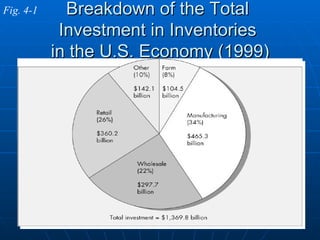
Importance of inventory Investment in inventories is enormous Companies that use scientific inventory control methods have a significant  competitive advantage  in the marketplace
Breakdown of the Total  Investment in Inventories  in the U.S. Economy (1999) Fig. 4-1
Types of inventories Raw materials Components WIP Finished goods Other (spare parts…)
Motivation for holding inventories Economies of scale ( setup cost ) Uncertainties:  (demand, lead time, supply) Speculation  (price increase) Transportation  (pipeline inventories) Smoothing  (seasonality) Logistics  (supply, production, distribution) Control costs  (large inv. Of inexpensive items)
Characteristics of inventory systems Demand Constant versus variable Known versus random Lead time Review time  (continuous review, periodic review) Excess demand Backordered lost Changing inventory  (perishability, obsolescence
Relevant costs Holding cost Warehousing  (Providing space, Material handling, Labor) Taxes and insurance Spoilage, deterioration, and obsolescence Opportunity cost of alternative investment Ordering cost (setup cost)
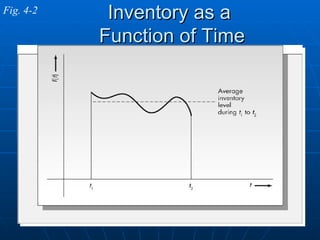
Inventory as a  Function of Time Fig. 4-2
Relevant costs (cont’d) Order cost Penalty cost (shortage cost)
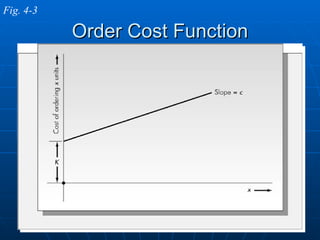
Order Cost Function Fig. 4-3
Inventory Control The EOQ Model
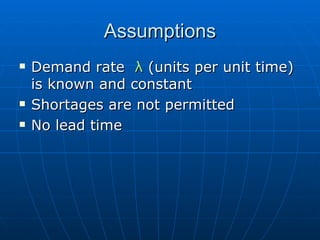
Assumptions Demand rate  λ  (units per unit time) is known and constant Shortages are not permitted No lead time
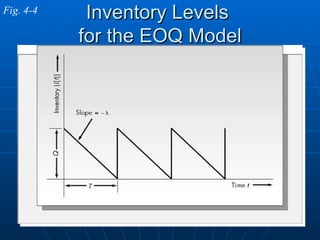
Inventory Levels  for the EOQ Model Fig. 4-4
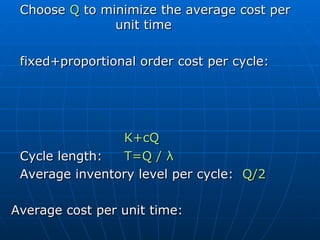
Choose  Q  to minimize the average cost per unit time fixed+proportional order cost per cycle:  K+cQ   Cycle length:  T=Q /  λ   Average inventory level per cycle:  Q/2 Average cost per unit time: G(Q) =  (K+cQ)/T + hQ/2 =  K  λ /Q+  λ c+hQ/2
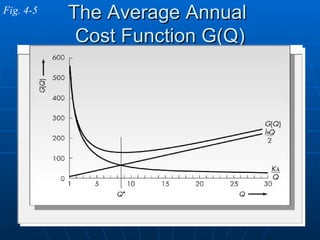
The Average Annual  Cost Function G(Q) Fig. 4-5
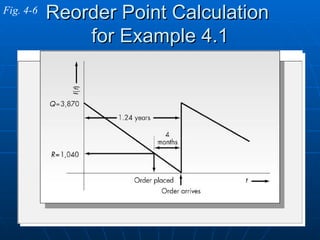
Reorder Point Calculation  for Example 4.1 Fig. 4-6
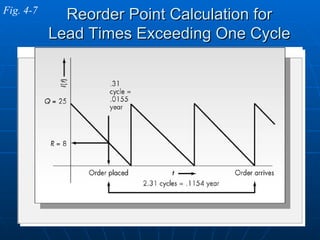
Reorder Point Calculation for Lead Times Exceeding One Cycle Fig. 4-7
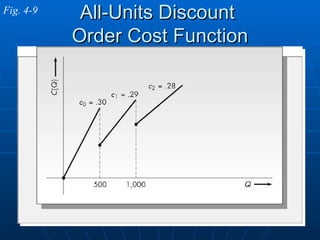
All-Units Discount  Order Cost Function Fig. 4-9
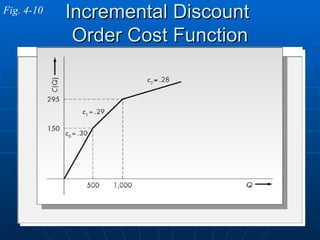
Incremental Discount  Order Cost Function Fig. 4-10
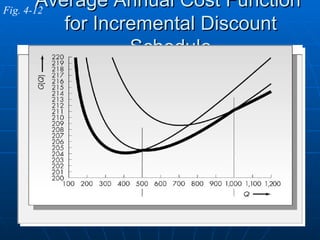
Average Annual Cost Function  for Incremental Discount Schedule Fig. 4-12

Inventory Control

  • 1.
    Chapter 4 InventoryControl Known Demand
  • 2.
    Introduction Importance ofinventory Types of inventories Motivation for holding inventories Characteristics of inventory systems Relevant costs
  • 3.
    Importance of inventoryInvestment in inventories is enormous Companies that use scientific inventory control methods have a significant competitive advantage in the marketplace
  • 4.
    Breakdown of theTotal Investment in Inventories in the U.S. Economy (1999) Fig. 4-1
  • 5.
    Types of inventoriesRaw materials Components WIP Finished goods Other (spare parts…)
  • 6.
    Motivation for holdinginventories Economies of scale ( setup cost ) Uncertainties: (demand, lead time, supply) Speculation (price increase) Transportation (pipeline inventories) Smoothing (seasonality) Logistics (supply, production, distribution) Control costs (large inv. Of inexpensive items)
  • 7.
    Characteristics of inventorysystems Demand Constant versus variable Known versus random Lead time Review time (continuous review, periodic review) Excess demand Backordered lost Changing inventory (perishability, obsolescence
  • 8.
    Relevant costs Holdingcost Warehousing (Providing space, Material handling, Labor) Taxes and insurance Spoilage, deterioration, and obsolescence Opportunity cost of alternative investment Ordering cost (setup cost)
  • 9.
    Inventory as a Function of Time Fig. 4-2
  • 10.
    Relevant costs (cont’d)Order cost Penalty cost (shortage cost)
  • 11.
  • 12.
  • 13.
    Assumptions Demand rate λ (units per unit time) is known and constant Shortages are not permitted No lead time
  • 14.
    Inventory Levels for the EOQ Model Fig. 4-4
  • 15.
    Choose Q to minimize the average cost per unit time fixed+proportional order cost per cycle: K+cQ Cycle length: T=Q / λ Average inventory level per cycle: Q/2 Average cost per unit time: G(Q) = (K+cQ)/T + hQ/2 = K λ /Q+ λ c+hQ/2
  • 16.
    The Average Annual Cost Function G(Q) Fig. 4-5
  • 17.
    Reorder Point Calculation for Example 4.1 Fig. 4-6
  • 18.
    Reorder Point Calculationfor Lead Times Exceeding One Cycle Fig. 4-7
  • 19.
    All-Units Discount Order Cost Function Fig. 4-9
  • 20.
    Incremental Discount Order Cost Function Fig. 4-10
  • 21.
    Average Annual CostFunction for Incremental Discount Schedule Fig. 4-12