BIA 674 - Supply Chain Analytics
12.
Inventory Management
Outline
 The Importance of Inventory
 Inventory Costs
 ABC Analysis
 EOQ Models
 Probabilistic Models and Safety Stock
 Inventory Control Systems
 Single-Period Model
 Using Simulation for Inventory Management
What isInventory?
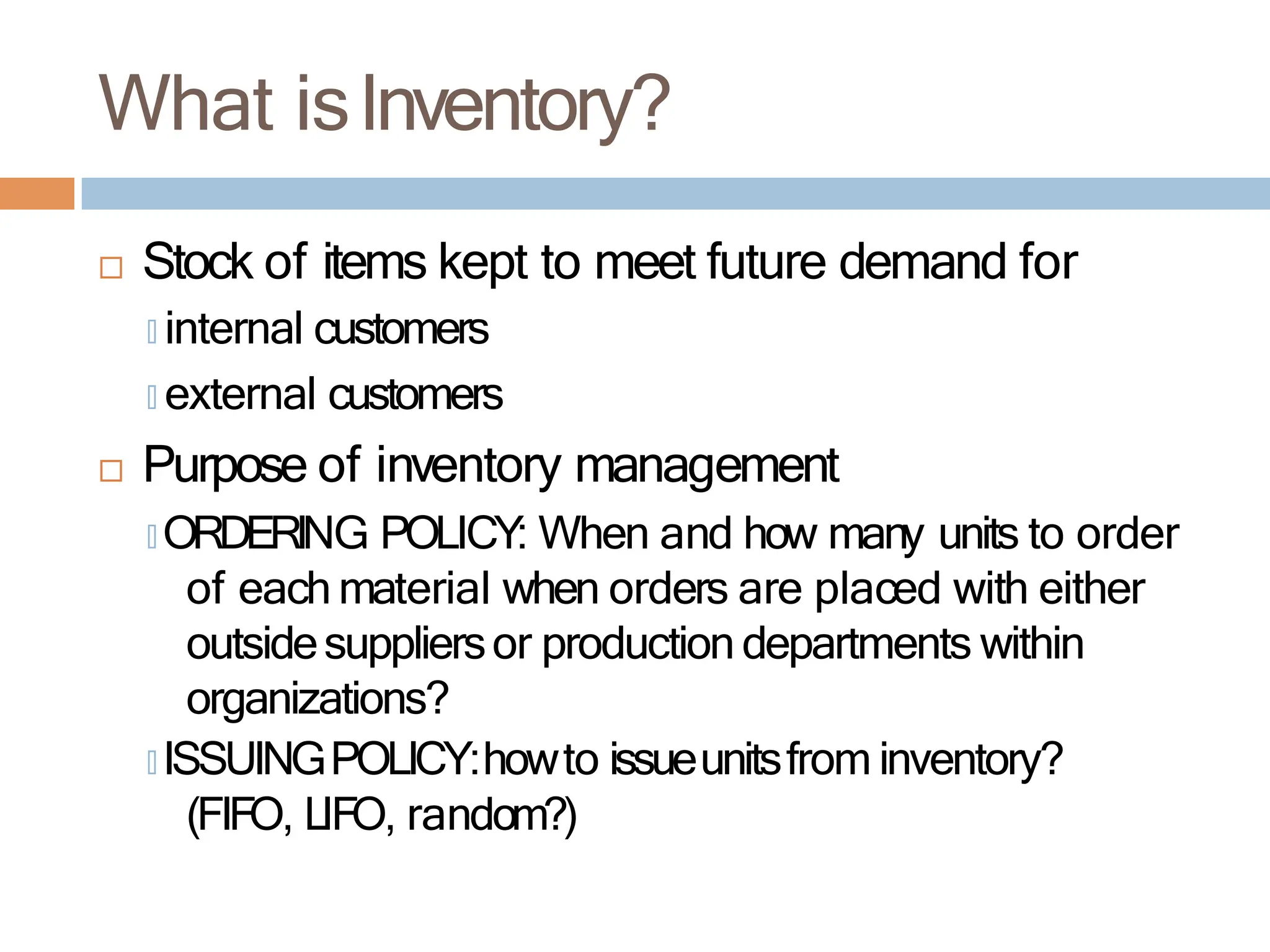
 Stock of items kept to meet future demand for
🞑 internal customers
🞑 external customers
 Purpose of inventory management
🞑 ORDERING POLICY: When and how many units to order
of each material when orders are placed with either
outsidesuppliersor production departments within
organizations?
🞑 ISSUINGPOLICY:howto issueunitsfrom inventory?
(FIFO, LIFO, random?)
Importance of Inventory
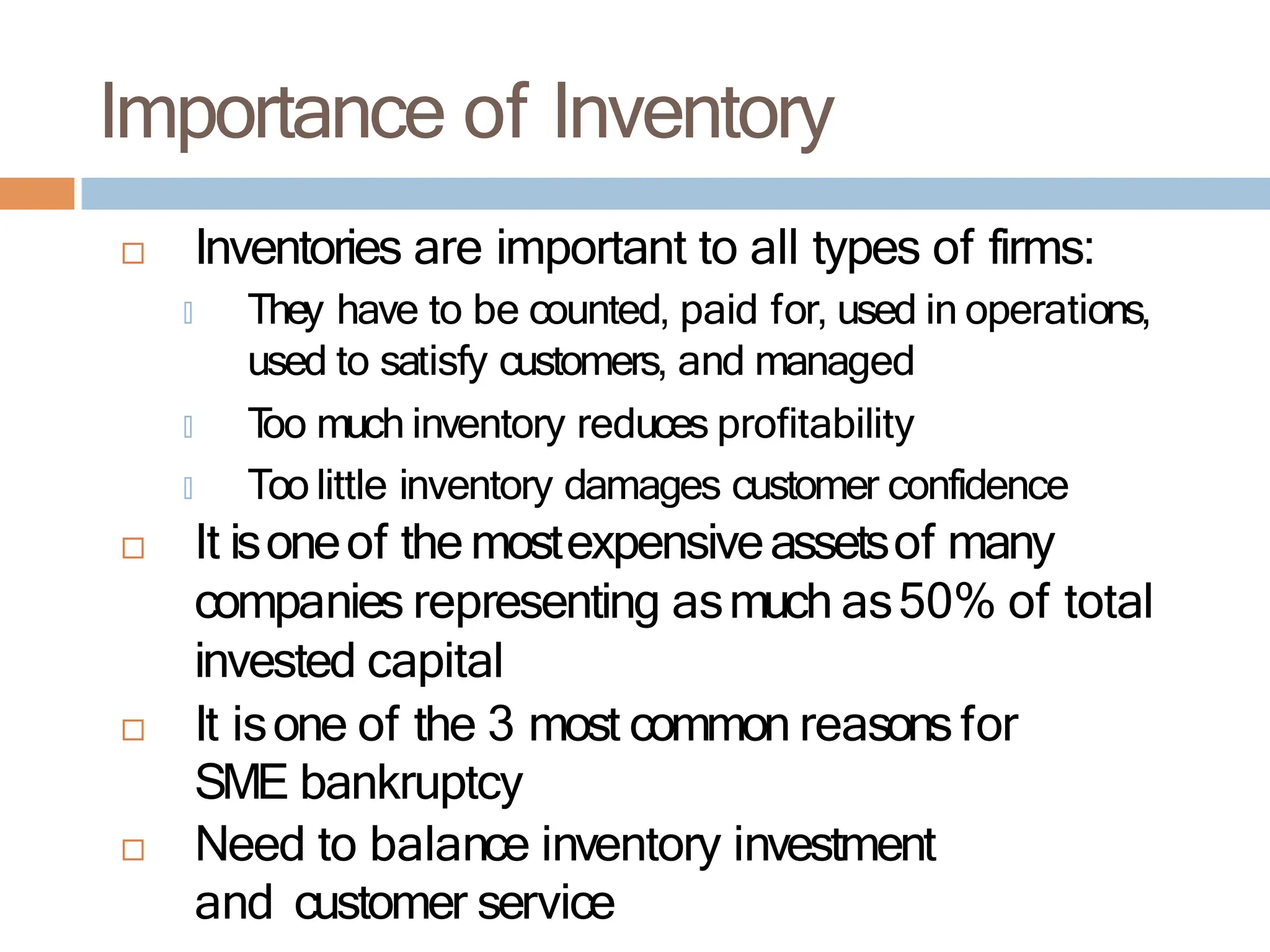
 Inventories are important to all types of firms:
🞑 They have to be counted, paid for, used in operations,
used to satisfy customers, and managed
🞑 T
oo much inventory reduces profitability
🞑 Too little inventory damages customer confidence
 It isoneof themostexpensiveassetsof many
companies representing asmuch as50% of total
invested capital
 It isone of the 3 most common reasons for
SME bankruptcy
 Need to balance inventory investment
and customer service
Why Do We Want to Hold Inventory
 Improve customer service
 Safe-guard to hazards in demand, supply, and delivery
that might cause stock-out
 T
ake advantage of economies of scale, & reduce:
🞑 ordering costs
🞑 Stock-out costs
🞑 acquisition costs
🞑 Fixed costs (e.g. fixed ordering costs)
 Contribute to the efficient and effective operation of
the production system, e.g.,
🞑 Reduces the number of costly set-ups and reschedulings
🞑 Smoothing and stabilizing resource utilization
Why We Do Not Want to Hold Inventory
 Certain costs increase such as
🞑 Storage costs
🞑 insurance costs
🞑 outdate costs
🞑 large-lot quality cost
🞑 cost of production problems
 Ties capital for which the company pays interest
 Hides productivity and quality problems
 Risk of getting stuck with unsalable goods
T
ypes of Inventory
▶ R
aw material
▶ Purchased but not processed
▶ Work-in-process (WIP)
▶ Undergone some change but not completed
▶ A function of cycle time for a product (e.g. items being
transported)
▶ Maintenance/repair/operating (MRO)
▶ Necessary to keep machinery and processes productive
▶ Finished goods
▶ Completed product awaiting shipment
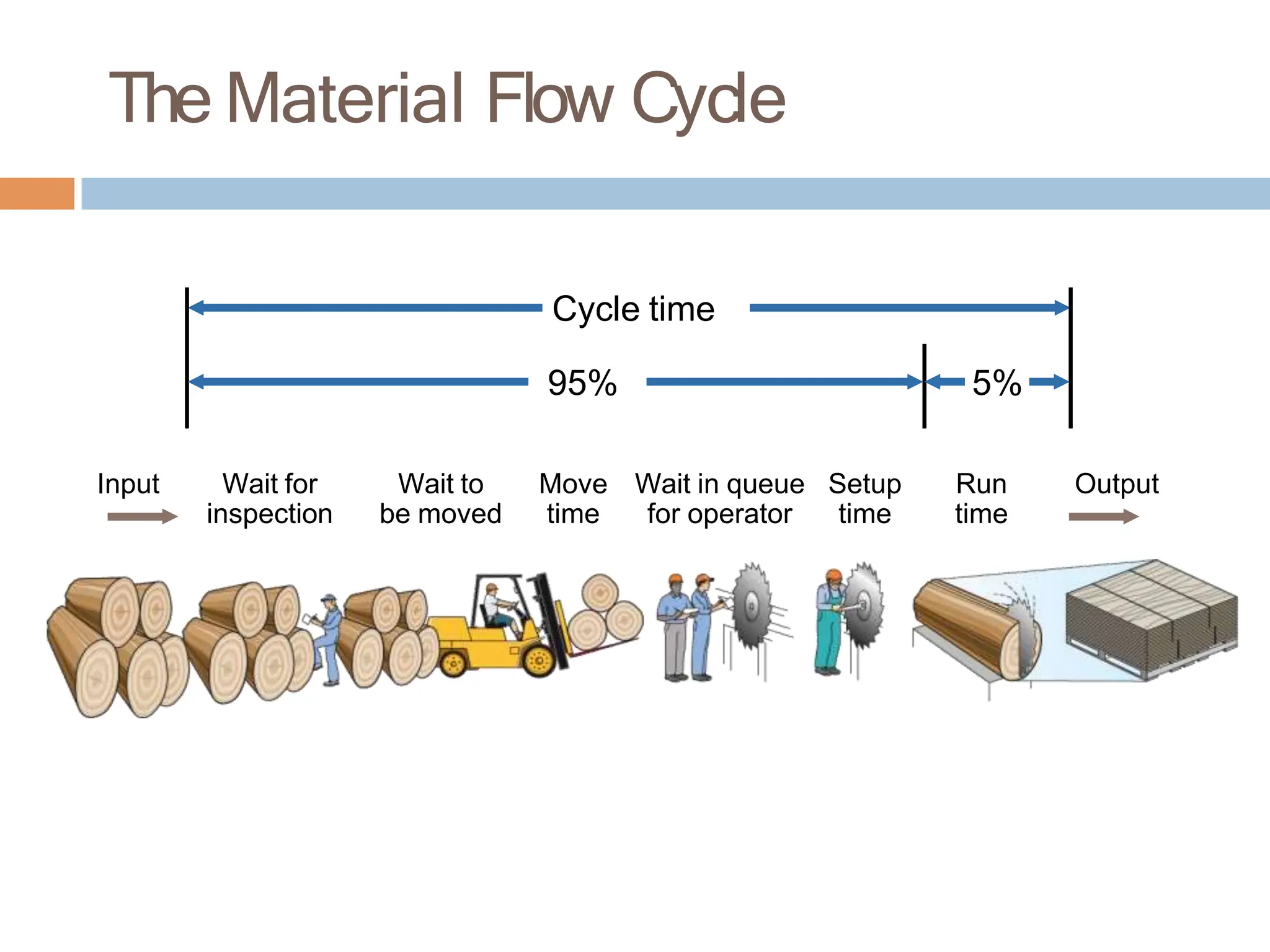
The Material Flow Cycle
Input Wait for Wait to Move Wait in queue Setup Run Output
inspection be moved time for operator time time
Cycle time
95% 5%
Inventory and Service Quality
 Customers usually perceive quality service as
availability of goods they want when they want
them
 Inventory must be sufficient to provide high-quality
customer service
Inventory Costs
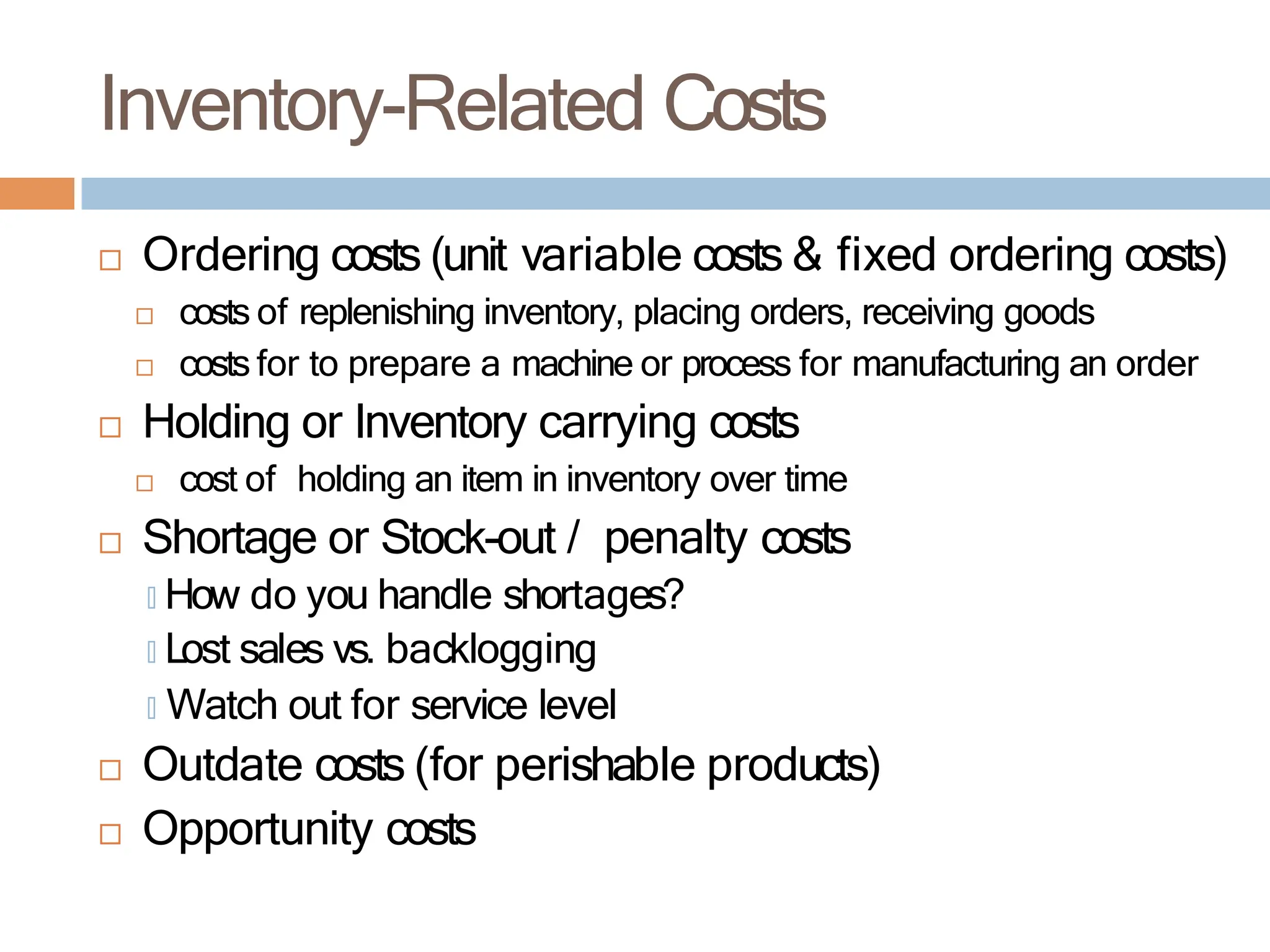
Inventory-Related Costs
 Ordering costs (unit variable costs & fixed ordering costs)
 costs of replenishing inventory, placing orders, receiving goods
 costs for to prepare a machine or process for manufacturing an order
 Holding or Inventory carrying costs
 cost of holding an item in inventory over time
 Shortage or Stock-out / penalty costs
🞑 How do you handle shortages?
🞑 Lost sales vs. backlogging
🞑 Watch out for service level
 Outdate costs (for perishable products)
 Opportunity costs
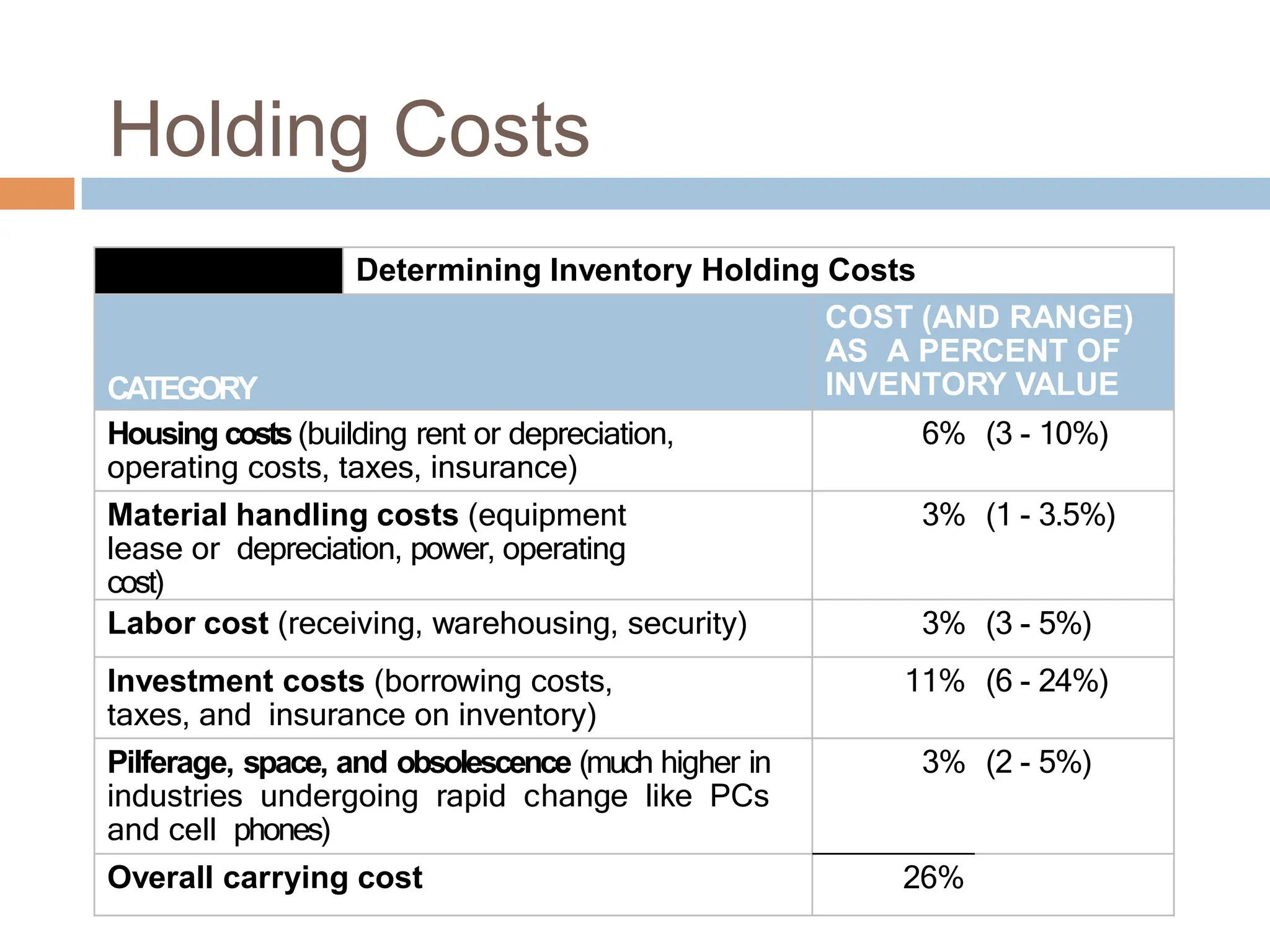
Holding Costs
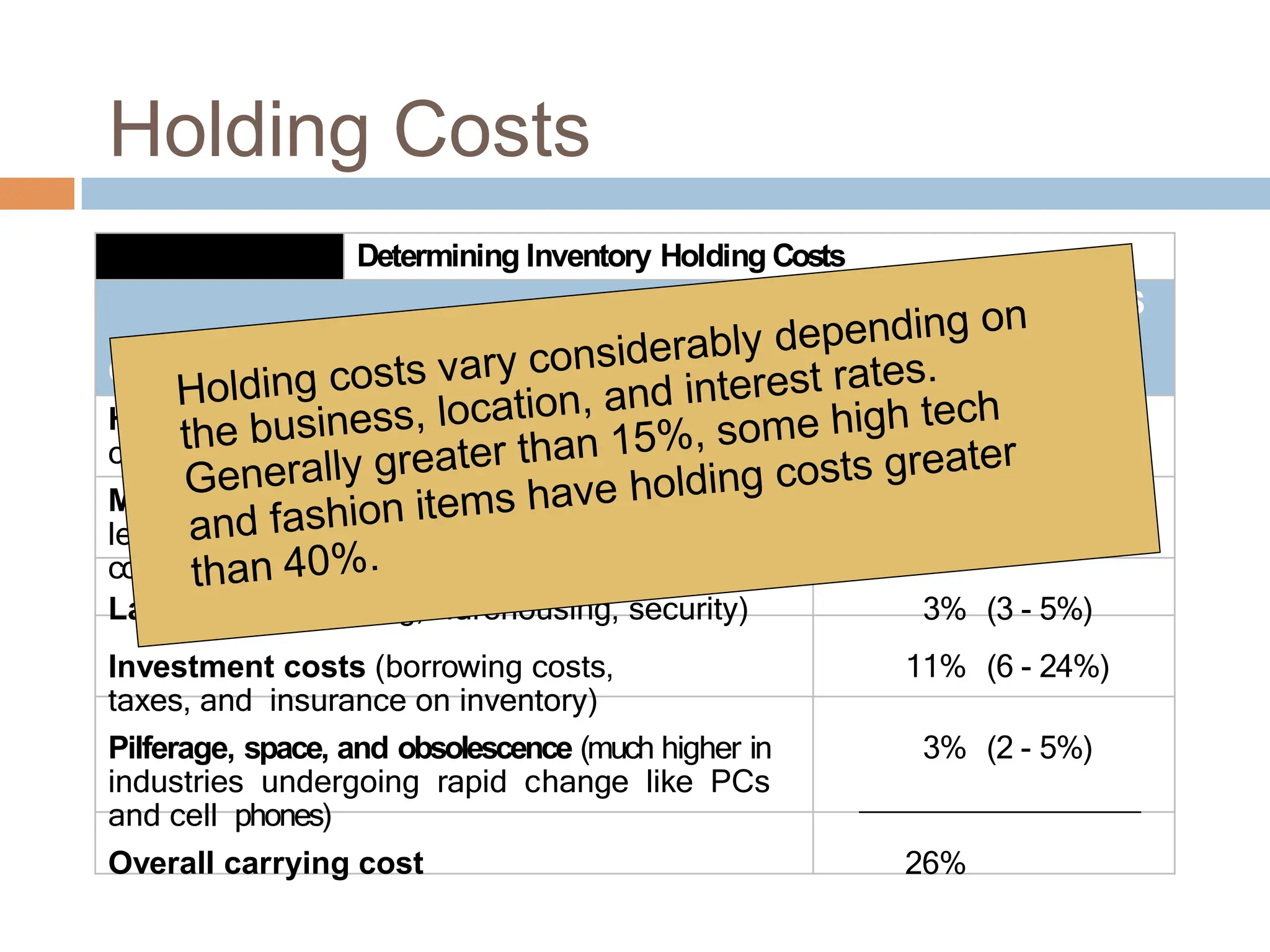
Determining Inventory Holding Costs
CATEGORY
COST (AND RANGE)
AS A PERCENT OF
INVENTORY VALUE
Housing costs (building rent or depreciation,
operating costs, taxes, insurance)
6% (3 - 10%)
Material handling costs (equipment
lease or depreciation, power, operating
cost)
3% (1 - 3.5%)
Labor cost (receiving, warehousing, security) 3% (3 - 5%)
Investment costs (borrowing costs,
taxes, and insurance on inventory)
11% (6 - 24%)
Pilferage, space, and obsolescence (much higher in
industries undergoing rapid change like PCs
and cell phones)
3% (2 - 5%)
Overall carrying cost 26%
Holding Costs
Determining Inventory Holding Costs
CA
TEGOR
Y
COST(AND RANGE) AS
A PER
CENTOF
INVENTOR
Y VALUE
Housing costs(building rent or depreciation,
operating costs, taxes, insurance)
6% (3 - 10%)
Material handling costs (equipment
lease or depreciation, power, operating
cost)
3% (1 - 3.5%)
Labor cost (receiving, warehousing, security) 3% (3 - 5%)
Investment costs (borrowing costs,
taxes, and insurance on inventory)
11% (6 - 24%)
Pilferage, space, and obsolescence (much higher in
industries undergoing rapid change like PCs
and cell phones)
3% (2 - 5%)
Overall carrying cost 26%
ABC Analysis
ABC Analysis
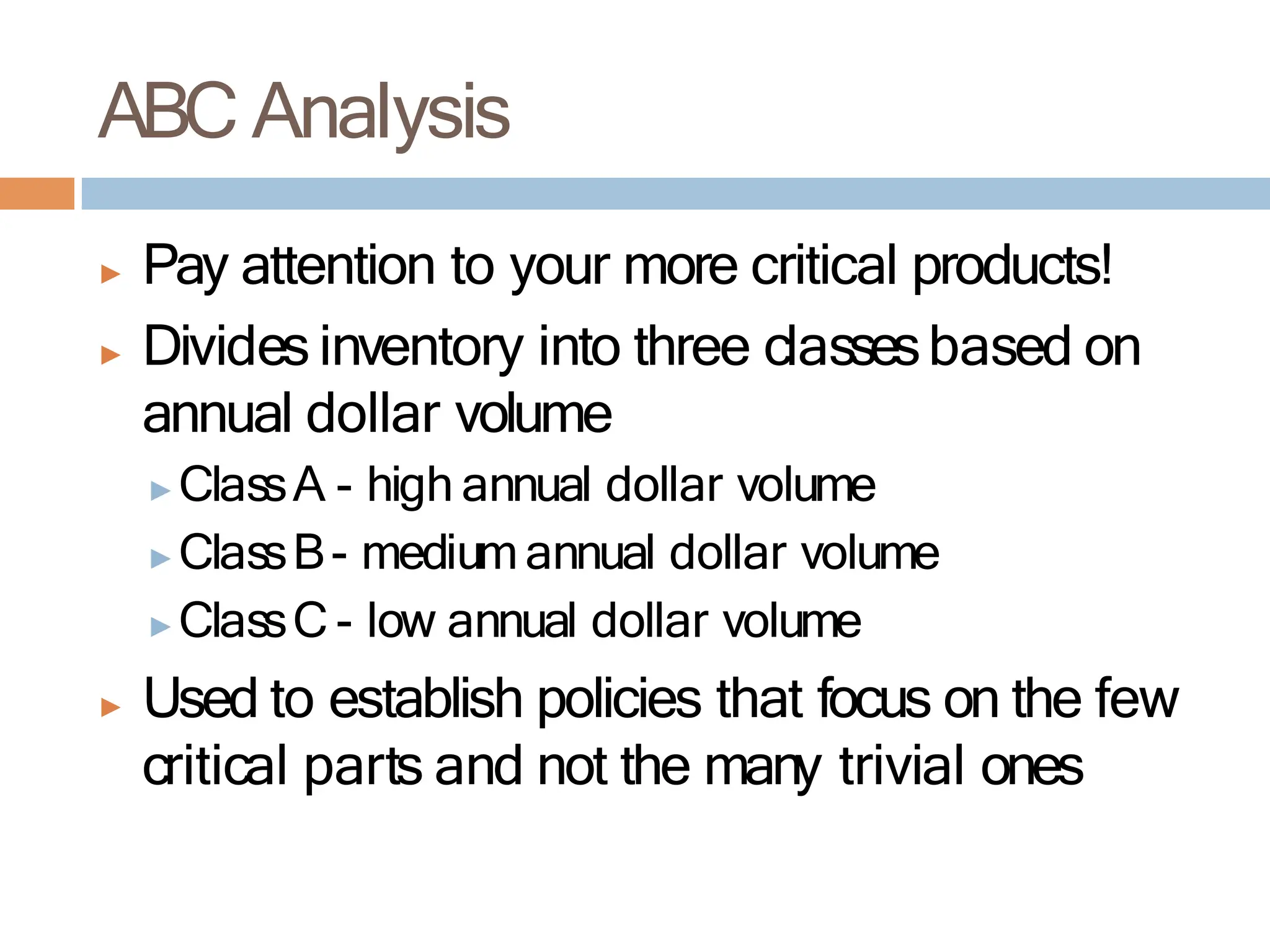
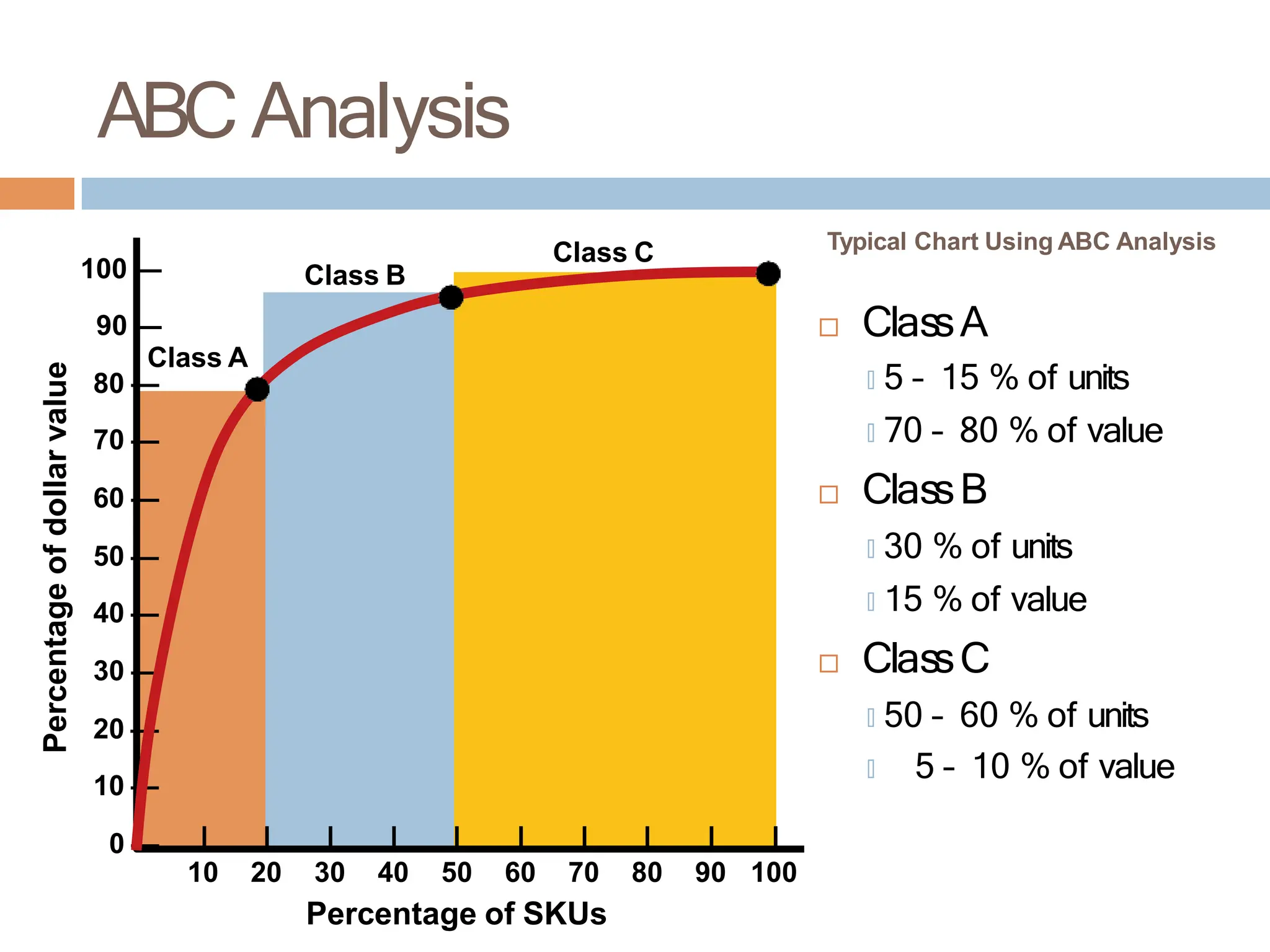
▶ Pay attention to your more critical products!
▶ Divides inventory into three classesbased on
annual dollar volume
▶ClassA - high annual dollar volume
▶ClassB- mediumannual dollar volume
▶ClassC - low annual dollar volume
▶ Used to establish policies that focus on the few
critical parts and not the many trivial ones
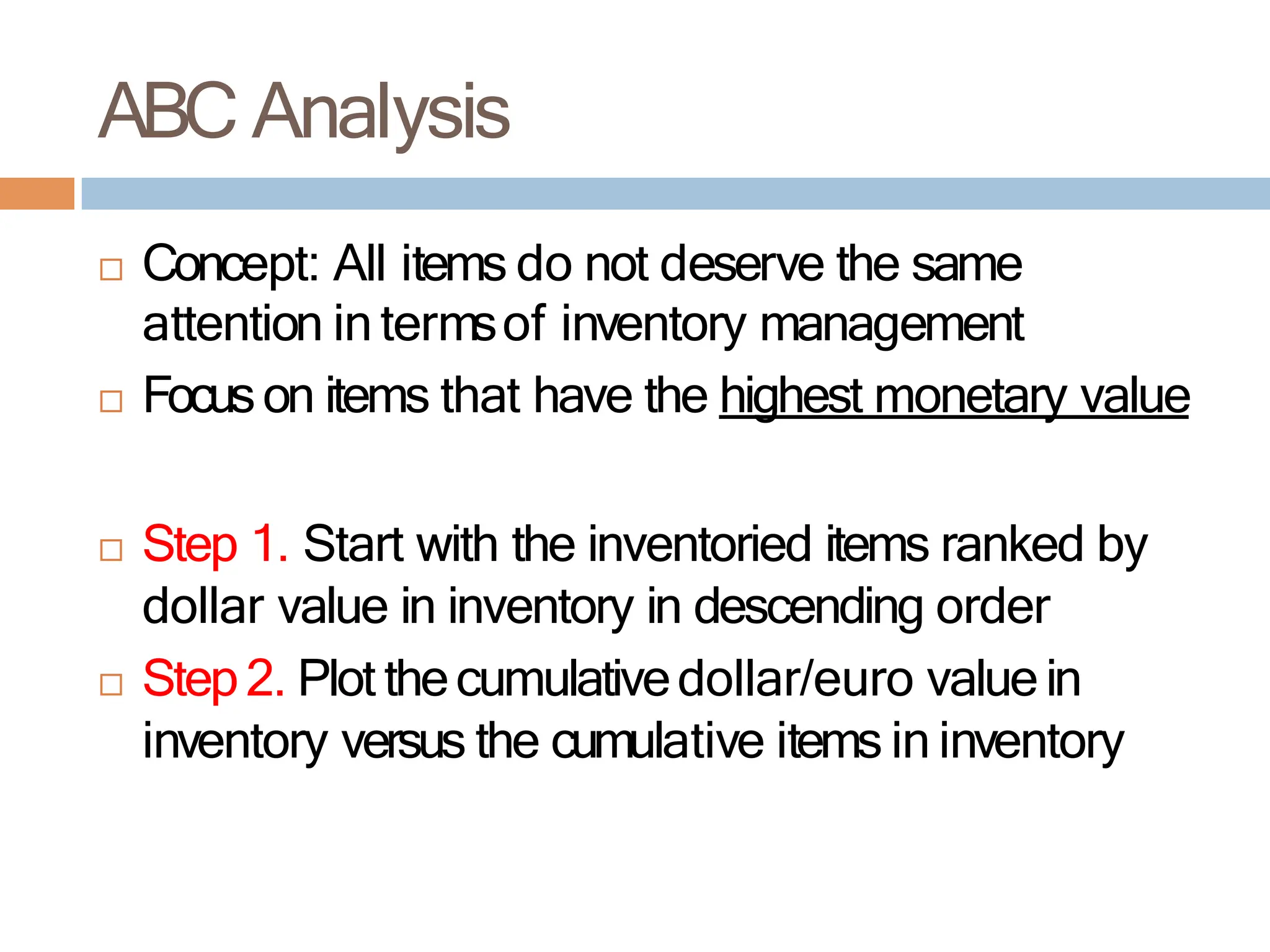
 Concept: All items do not deserve the same
attention in termsof inventory management
 Focuson items that have the highest monetary value
 Step 1. Start with the inventoried items ranked by
dollar value in inventory in descending order
 Step2. Plot thecumulativedollar/euro valuein
inventory versus the cumulative items in inventory
ABC Analysis
ABC Analysis
10 20 30 40 50 60 70 80 90 100
Percentage of SKUs
Percentage
of
dollar
value
100 —
90 —
80 —
70 —
60 —
50 —
40 —
30 —
20 —
10 —
0 —
Class C
Class A
Class B
Typical Chart Using ABC Analysis
 ClassA
🞑 5 – 15 % of units
🞑 70 – 80 % of value
 ClassB
🞑 30 % of units
🞑 15 % of value
 ClassC
🞑 50 – 60 % of units
🞑 5 – 10 % of value
ABC AnalysisExample
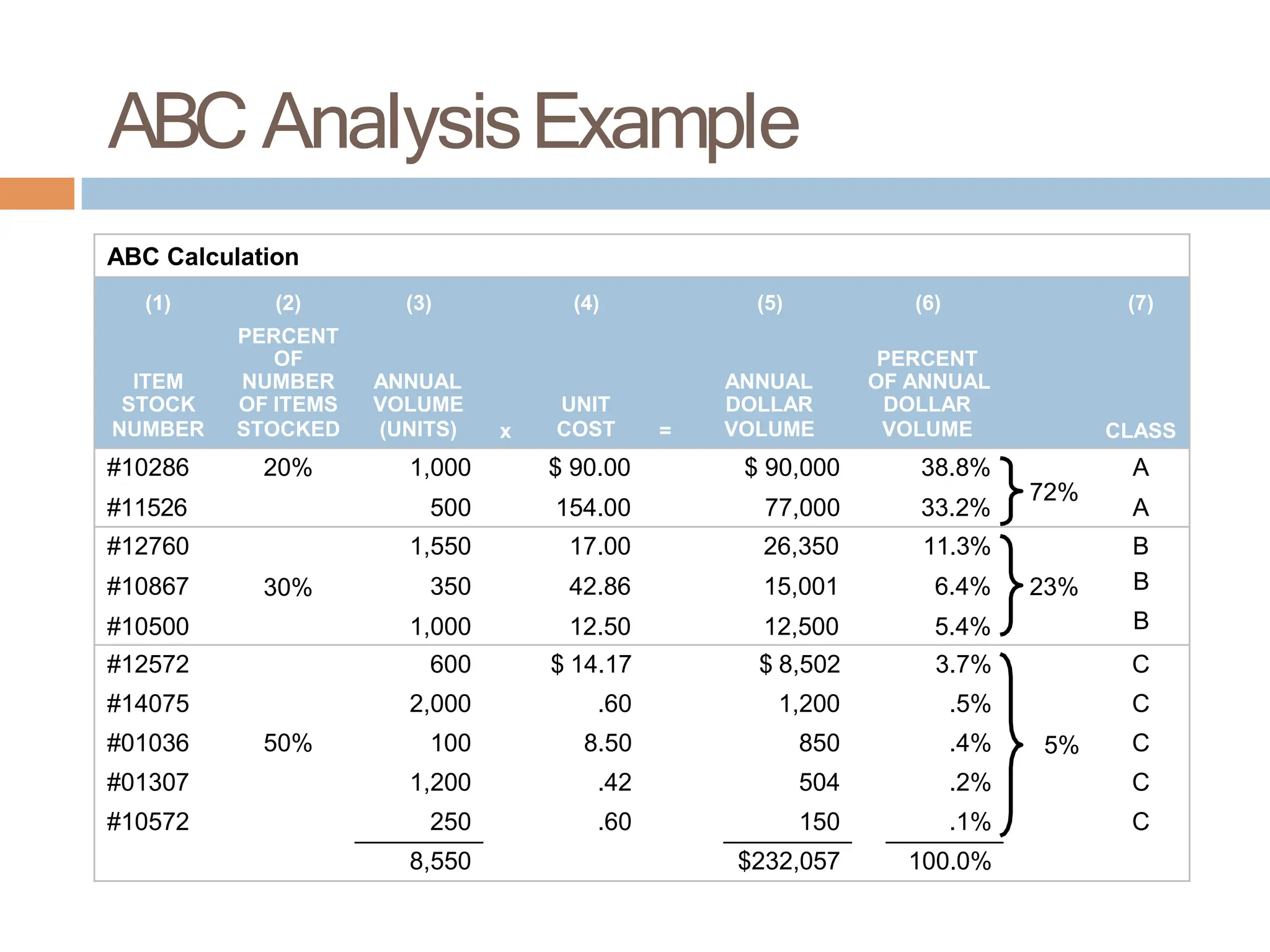
ABC Calculation
(1) (2) (3) (4) (5) (6) (7)
PERCENT
OF PERCENT
ITEM NUMBER ANNUAL ANNUAL OF ANNUAL
STOCK OF ITEMS VOLUME UNIT DOLLAR DOLLAR
NUMBER STOCKED (UNITS) x COST = VOLUME VOLUME CLASS
#10286
#11526
20% 1,000
500
$ 90.00
154.00
$ 90,000
77,000
38.8%
33.2%
72%
A
A
#12760
#10867
#10500
30%
1,550
350
1,000
17.00
42.86
12.50
26,350
15,001
12,500
11.3%
6.4%
5.4%
23%
B
B
B
#12572 600 $ 14.17 $ 8,502 3.7% C
#14075 2,000 .60 1,200 .5% C
#01036 50% 100 8.50 850 .4% 5% C
#01307 1,200 .42 504 .2% C
#10572 250 .60 150 .1% C
8,550 $232,057 100.0%
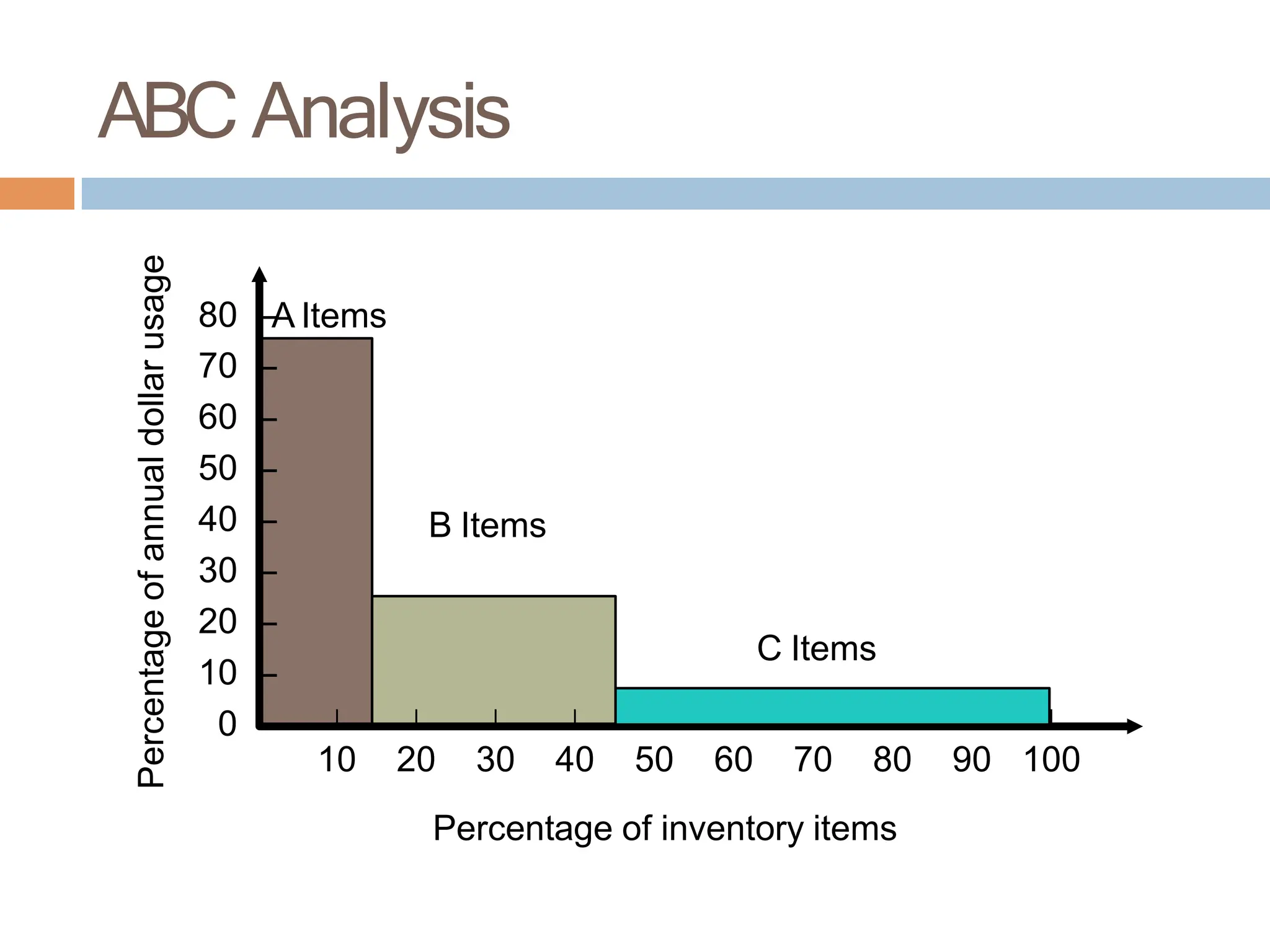
B Items
| | | | | | | | | |
10 20 30 40 50 60 70 80 90 100
Percentage of inventory items
Percentage
of
annual
dollar
usage
80 –A Items
70 –
60 –
50 –
40 –
30 –
20 –
10 –
0 –
C Items
ABC Analysis
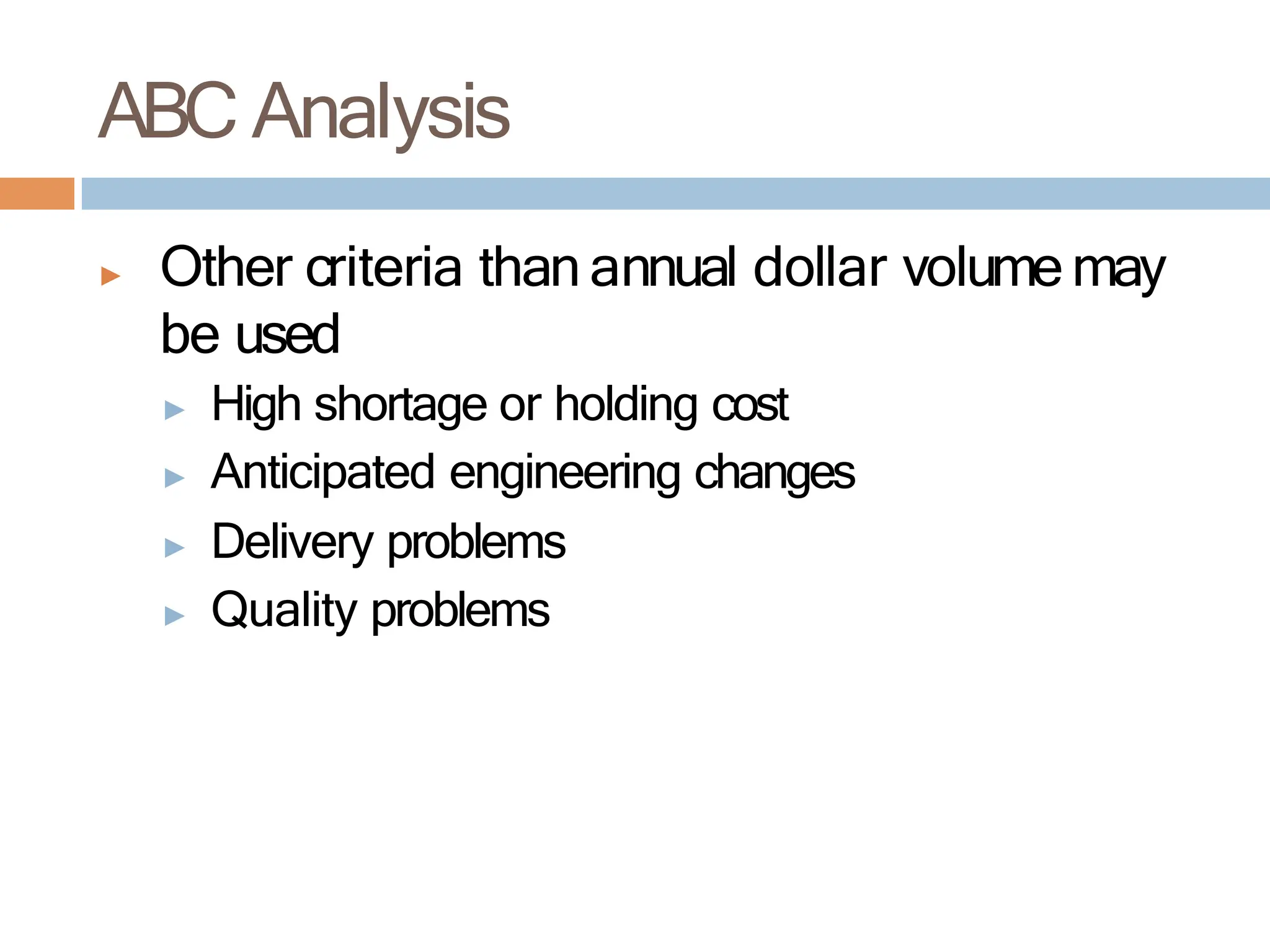
▶ Other criteria than annual dollar volume may
be used
▶ High shortage or holding cost
▶ Anticipated engineering changes
▶ Delivery problems
▶ Quality problems
ABC Analysis
▶ P
olicies employed may include
1. More emphasis on supplier development for A
items
2. Tighter physical inventory control for A items
3. More care in forecasting A items
ABC Analysis
EOQ Models
Ordering Policy under constant
demand
 Simple case
1. Demand rate is constant and known with certainty
2. Unit ordering cost = C
3. Every time an order is placed, there is a fixed cost = S
4. There isa unit holding cost = H
5. No constraints are placed on the size of each order
6
. The lead time iszero
t
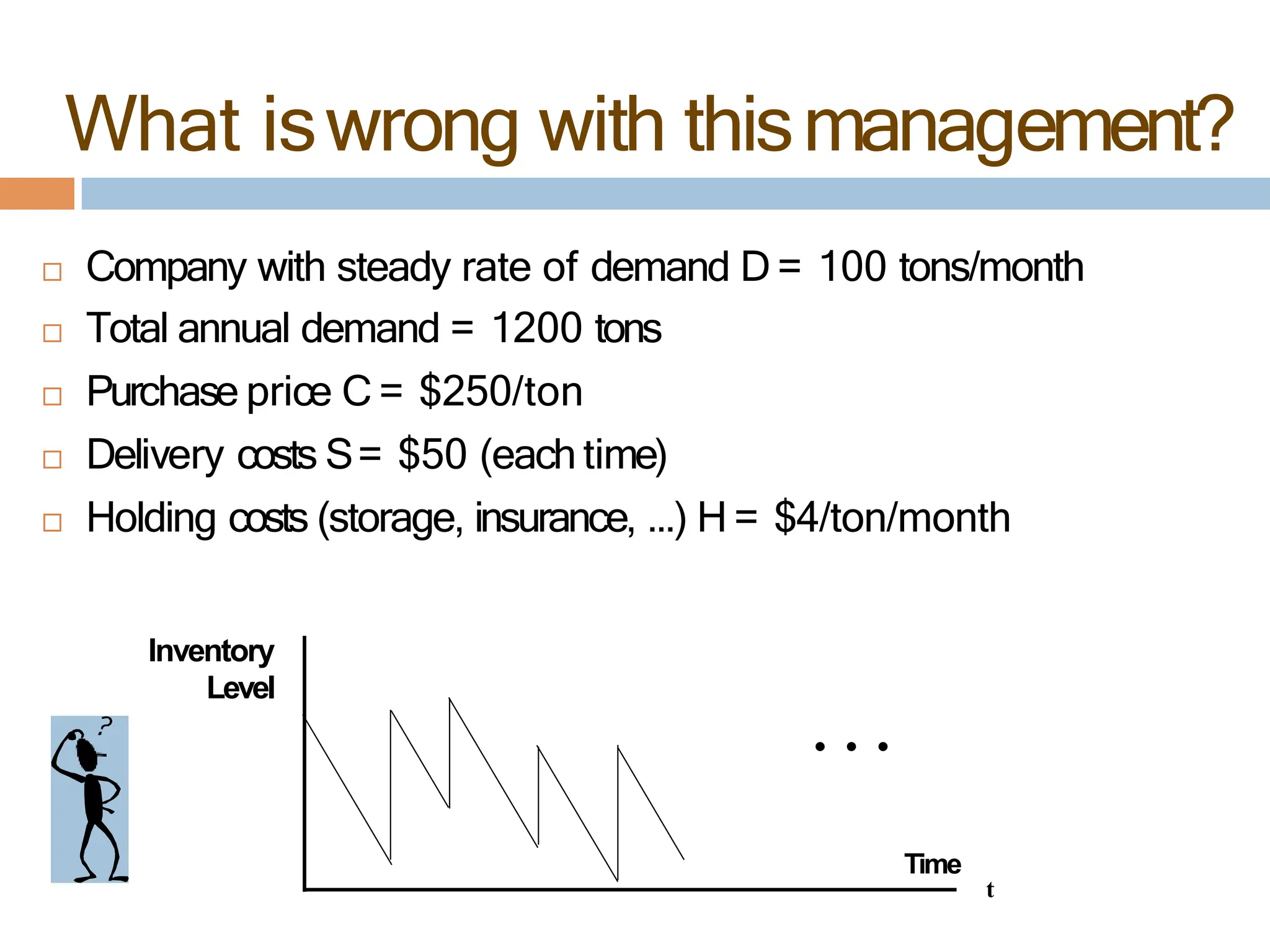
 Company with steady rate of demand D = 100 tons/month
 Total annual demand = 1200 tons
 Purchase price C = $250/ton
 Delivery costs S= $50 (each time)
 Holding costs (storage, insurance, ...) H = $4/ton/month
Inventory
Level
• • •
Time
What iswrong with thismanagement?
 Irrational Ordering (time, quantity) ... why?
 Safety stock ... why?
Q
T 2T
t
Get rid of pre-conceived ideas …
3T
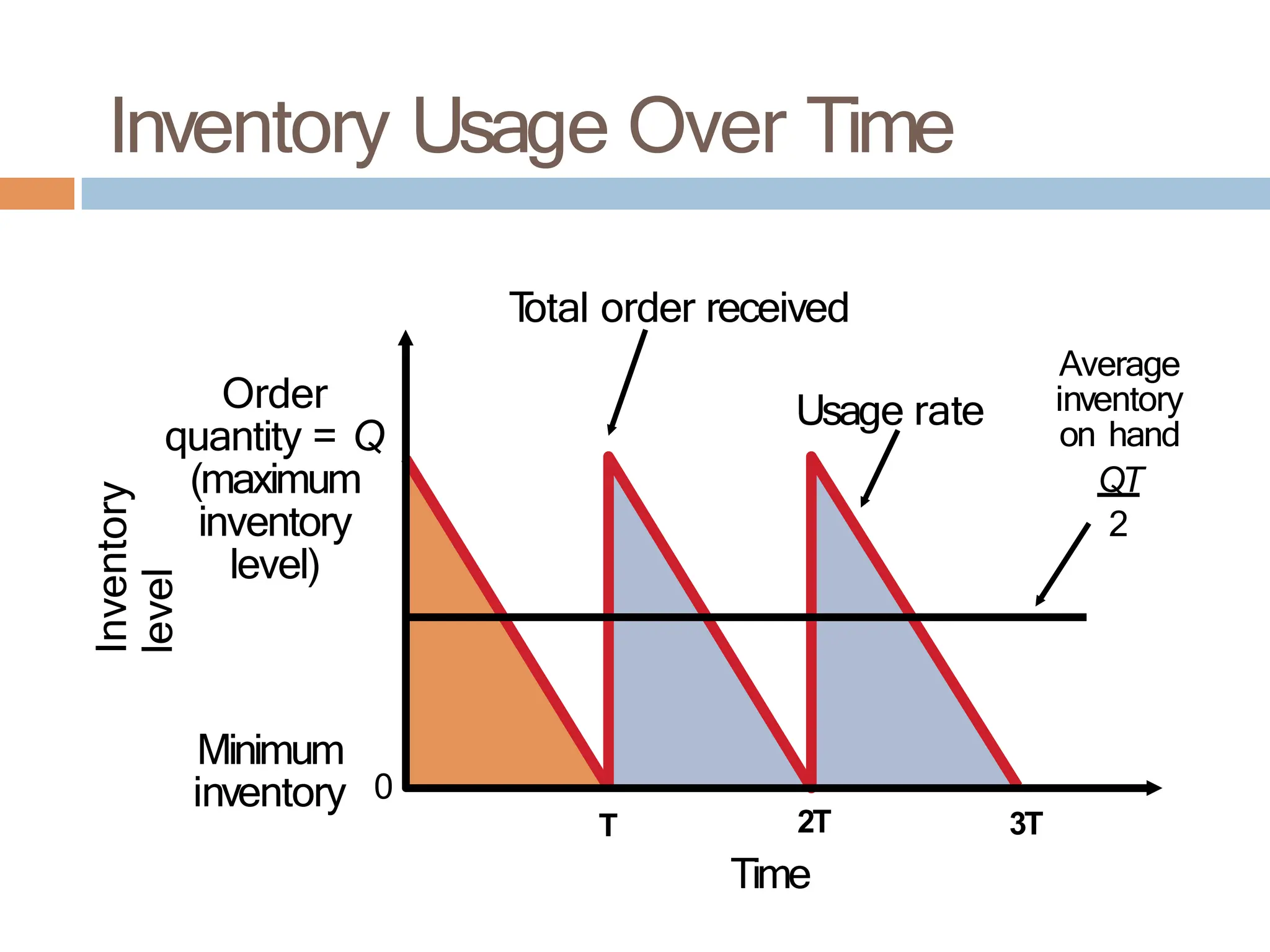
Inventory Usage Over Time
Order
quantity = Q
(maximum
inventory
level)
Usage rate
Average
inventory
on hand
QT
2
Minimum
inventory
Inventory
level
0
T
otal order received
2T
Time
T 3T
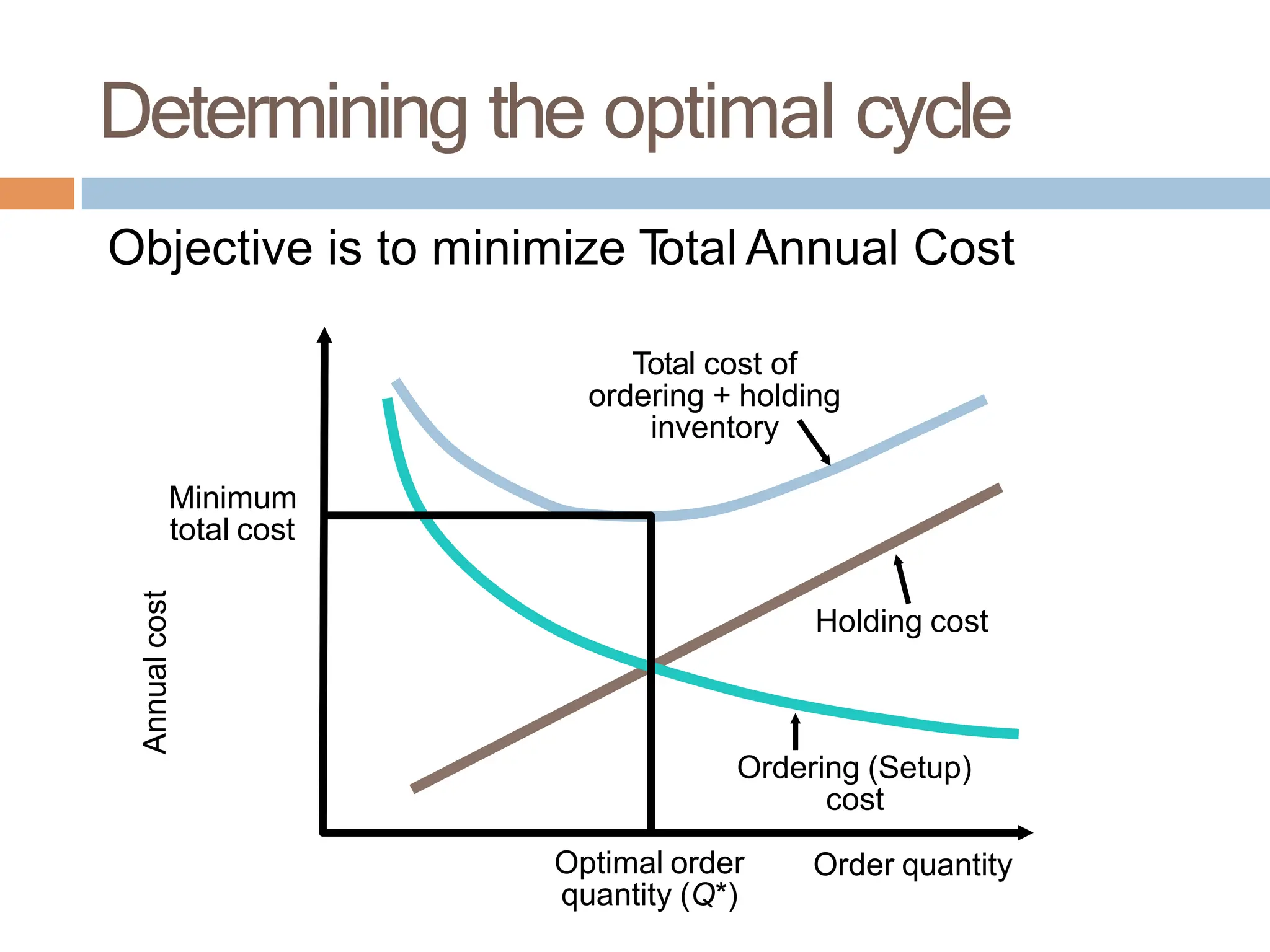
Objective is to minimize T
otal Annual Cost
Annual
cost
Order quantity
Total cost of
ordering + holding
inventory
Holding cost
Ordering (Setup)
cost
Minimum
total cost
Optimal order
quantity (Q*)
Determining the optimal cycle
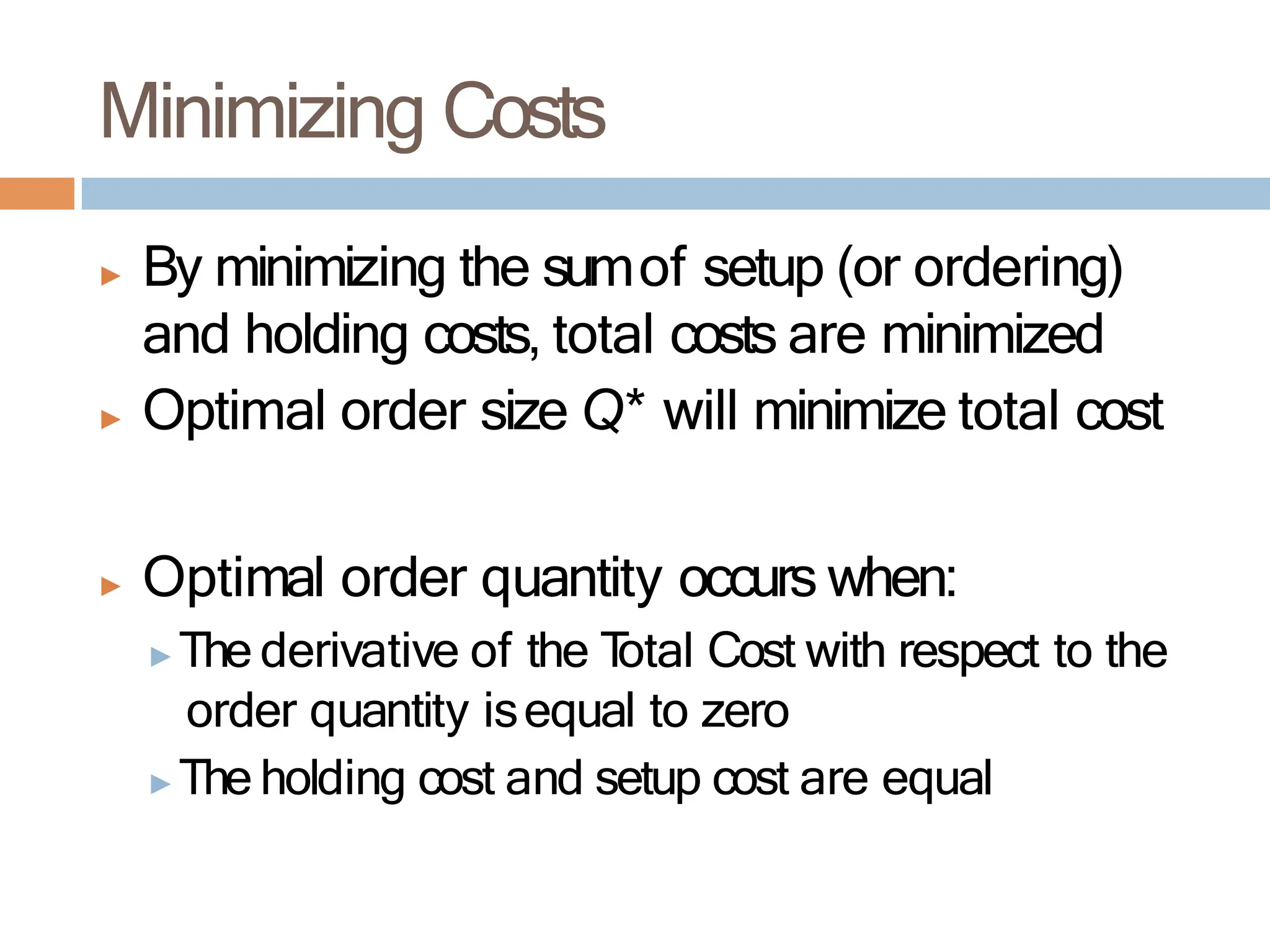
Minimizing Costs
▶ By minimizing the sumof setup (or ordering)
and holding costs, total costs are minimized
▶ Optimal order size Q* will minimize total cost
▶ Optimal order quantity occurs when:
▶The derivative of the T
otal Cost with respect to the
order quantity isequal to zero
▶The holding cost and setup cost are equal
Calculating the Annual Costs
 Annual holding cost
Annual holding cost = (Average cycle inventory)
 (Unit holding cost)
 No of orders placed / year
 Annual ordering cost
Annual ordering cost = (Ordering cost / order)
 No of orders placed / year
 Total annual cycle-inventory cost
Total Annual costs = Annual holding cost
+ Annual ordering cost
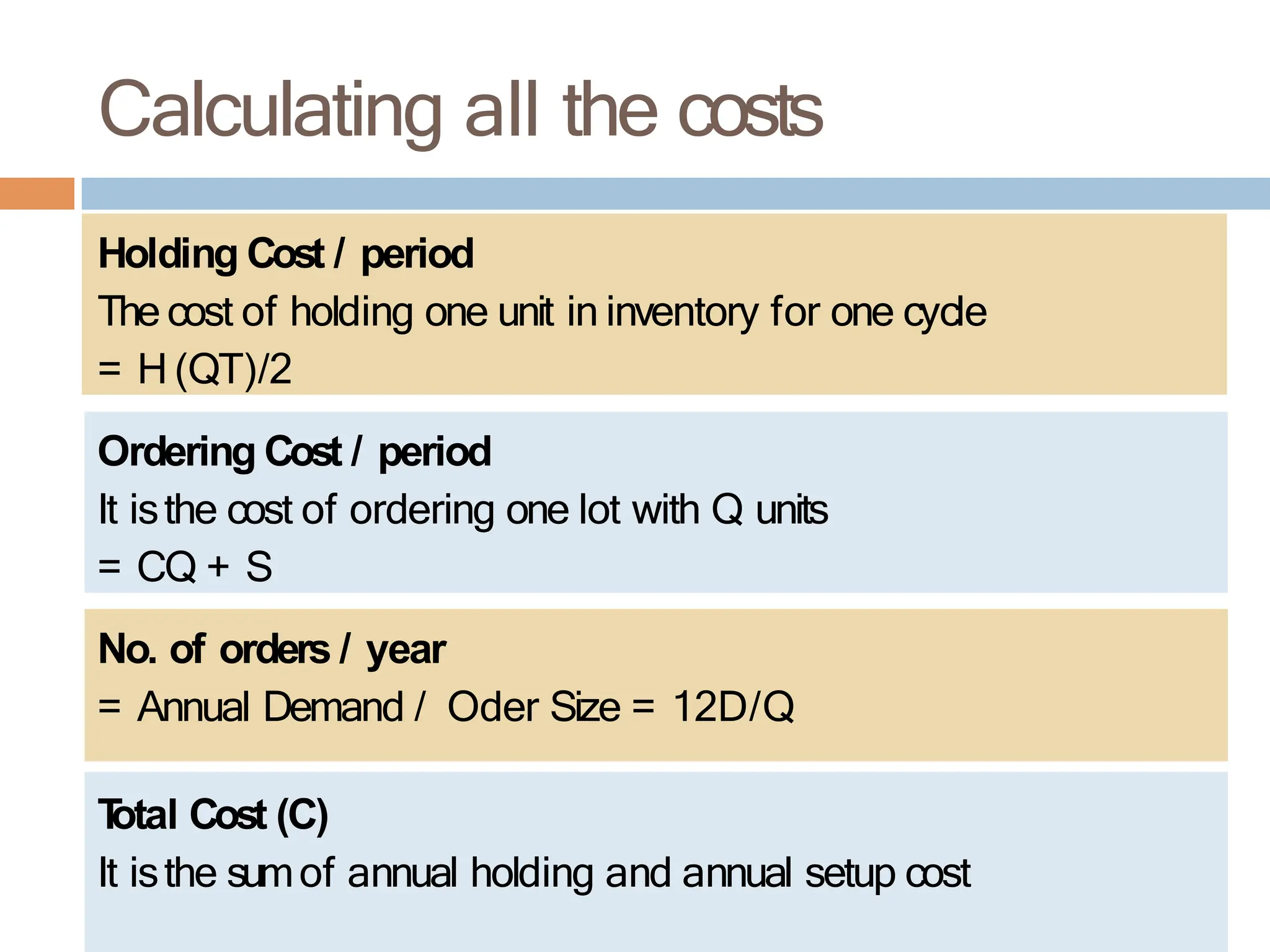
Holding Cost / period
The cost of holding one unit in inventory for one cycle
= H (QT)/2
Ordering Cost / period
It isthe cost of ordering one lot with Q units
= CQ + S
Calculating all the costs
No. of orders / year
= Annual Demand / Oder Size = 12D/Q
T
otal Cost (C)
It isthe sumof annual holding and annual setup cost
Calculating the EOQ
 T
otal annual cycle-inventory cost
Where
TC = total annual cost
C = unit ordering annual cycle-inventory cost
Q = lot size
H = holding cost per unit per period
D = demand per period
S = fixed ordering or setup costs per lot
T = re-order period
TC = N (S + CQ) + H
QT
2
Fixed ordering
cost
Variable
ordering cost
Holding cost
Calculating the EOQ
T
C = N[(S + CQ) + H(QT/2)]=
= (12DS/Q) + (12D/Q)CQ + (12D/Q)(HQ2/2D)=
=12DS/Q + 12DC + 6HQ
Tofind the optimal Quantity Q: Set derivative w.r.t Q = 0
Therefore,
-(12DS/Q2)+6H = 0 The optimal - order- quantity
Q* = 2SD/H = 50 tons
T = 0,5 month
Determine the optimal number of units to order
D = 1,000 units per year
S = $10 per order
H = $.50 per unit per year
Q*

2DS
H
Q*

0.50
2(1,000)(10)
 40,000  200 units
An EOQ Example
Determine expected number of orders
Q* = 200 units
D = 1,000 units
S = $10 per order
H = $.50 per unit per year
N = = 5 orders per year
1,000
200
= N =
Expected
number of
orders
Demand
Order quantity
D
=
Q*
An EOQ Example
An EOQ Example
Determine optimal time between orders
Q* = 200 units
N = 5 orders/year
D = 1,000 units
S = $10 per order
H = $.50 per unit per year
T = = 50 days between orders
250
5
= T =
Expected time
between
orders
Number of working days per year
Expected number of orders
Determine the total annual cost
D = 1,000 units
S= $10 per order
H = $.50 per unit per year
Q* = 200 units
N = 5 orders/year
T = 50 days
T
otal annual cost = Setup cost + Holding cost
TC  D S  Q H
Q 2
1,000

200
($10)
200
2
($.50)
 (5)($10)(100)($.50)
 $50$50  $100
Note: the cost of materials is not included, as it is assumed that the demand will
be satisfied and therefore it isa fixed cost
An EOQ Example
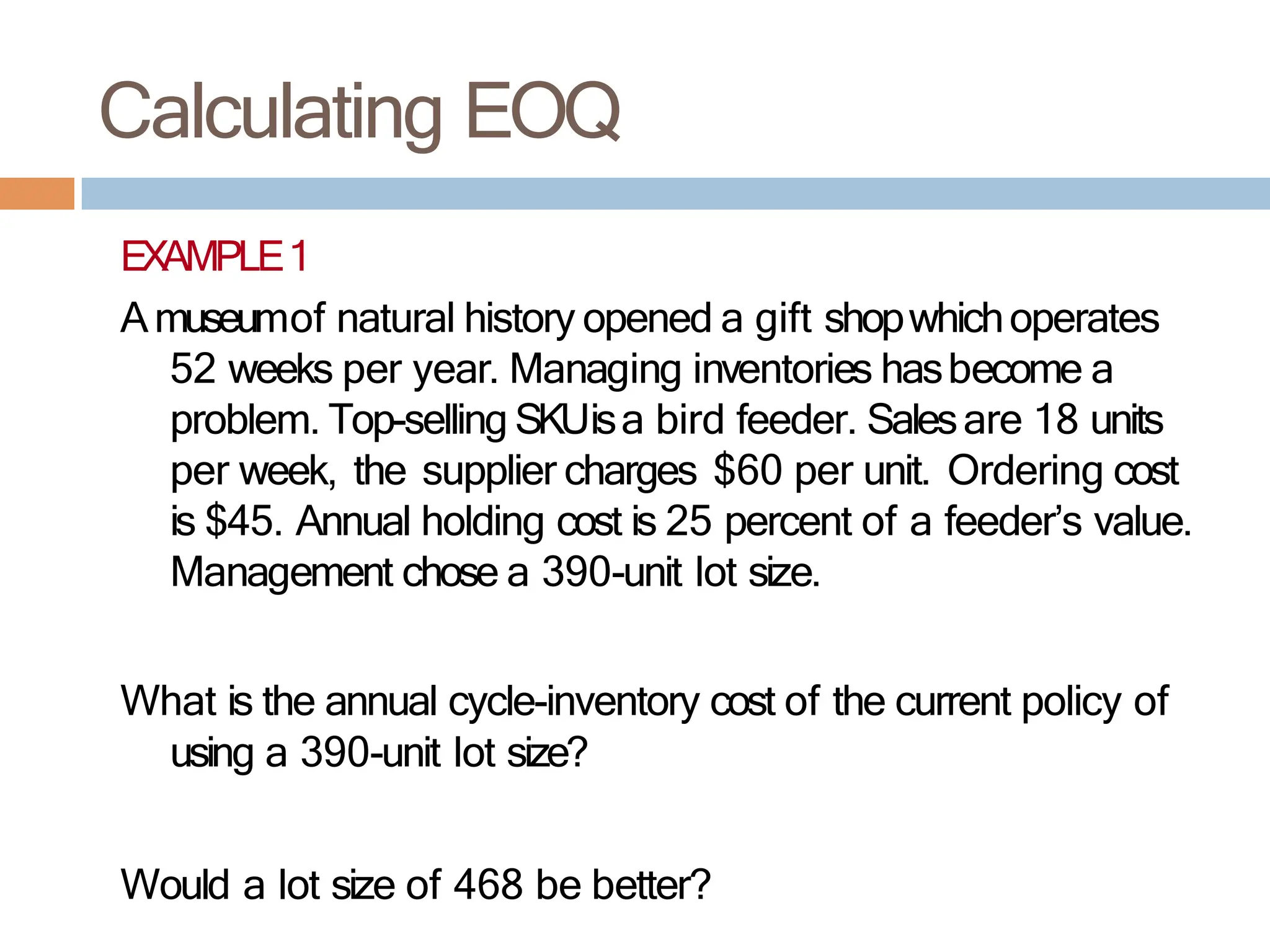
Calculating EOQ
EXAMPLE1
Amuseumof natural history opened a gift shopwhichoperates
52 weeks per year. Managing inventories hasbecome a
problem. Top-selling SKUisa bird feeder. Salesare 18 units
per week, the supplier charges $60 per unit. Ordering cost
is $45. Annual holding cost is 25 percent of a feeder’s value.
Management chose a 390-unit lot size.
What is the annual cycle-inventory cost of the current policy of
using a 390-unit lot size?
Would a lot size of 468 be better?
Calculating EOQ
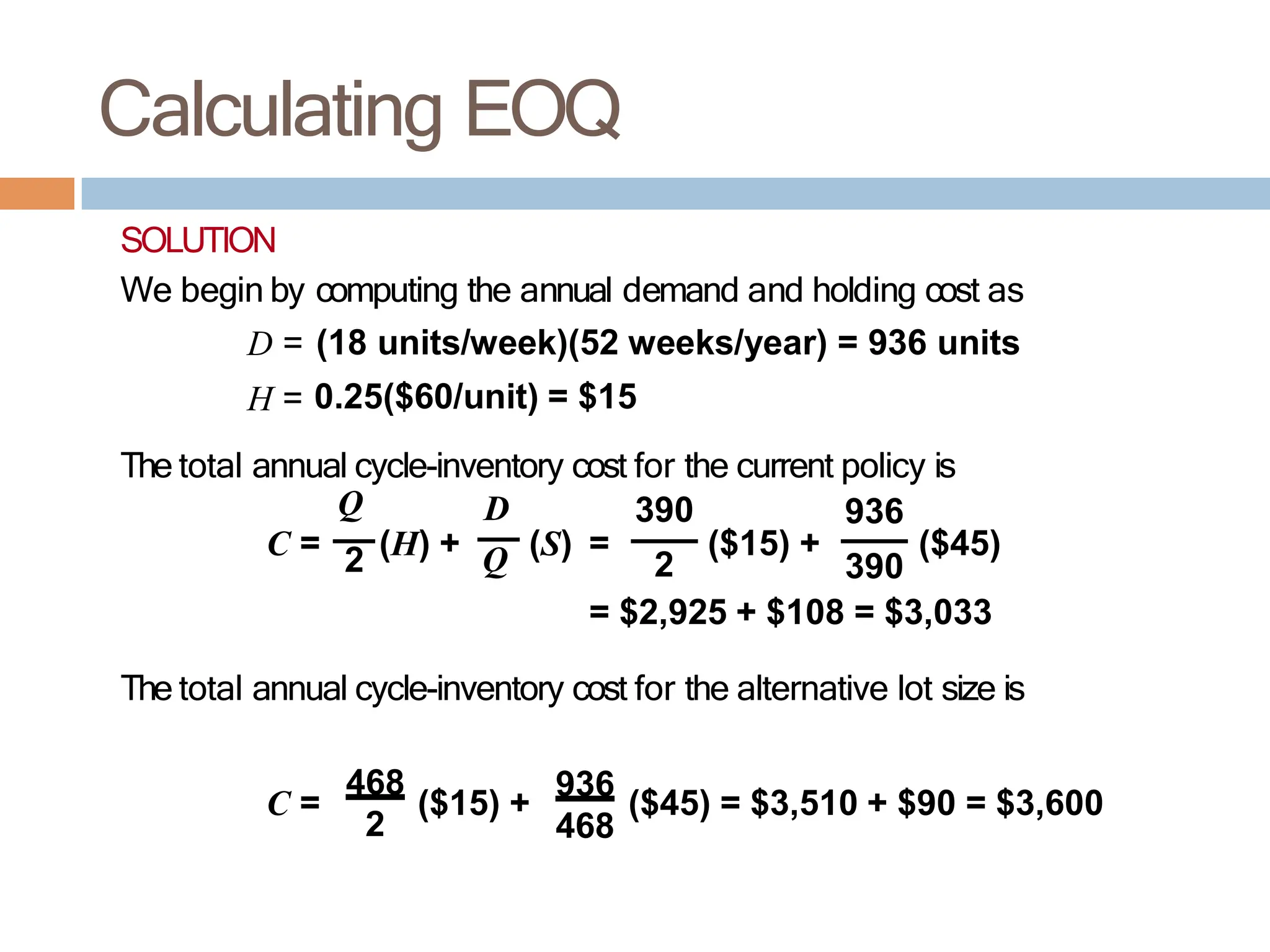
SOLUTION
We begin by computing the annual demand and holding cost as
D = (18 units/week)(52 weeks/year) = 936 units
H = 0.25($60/unit) = $15
The total annual cycle-inventory cost for the current policy is
2 Q
Q D 390 936
C = (H) + (S) = ($15) + ($45)
2 390
= $2,925 + $108 = $3,033
The total annual cycle-inventory cost for the alternative lot size is
C =
468
($15) +
936
($45) = $3,510 + $90 = $3,600
2 468
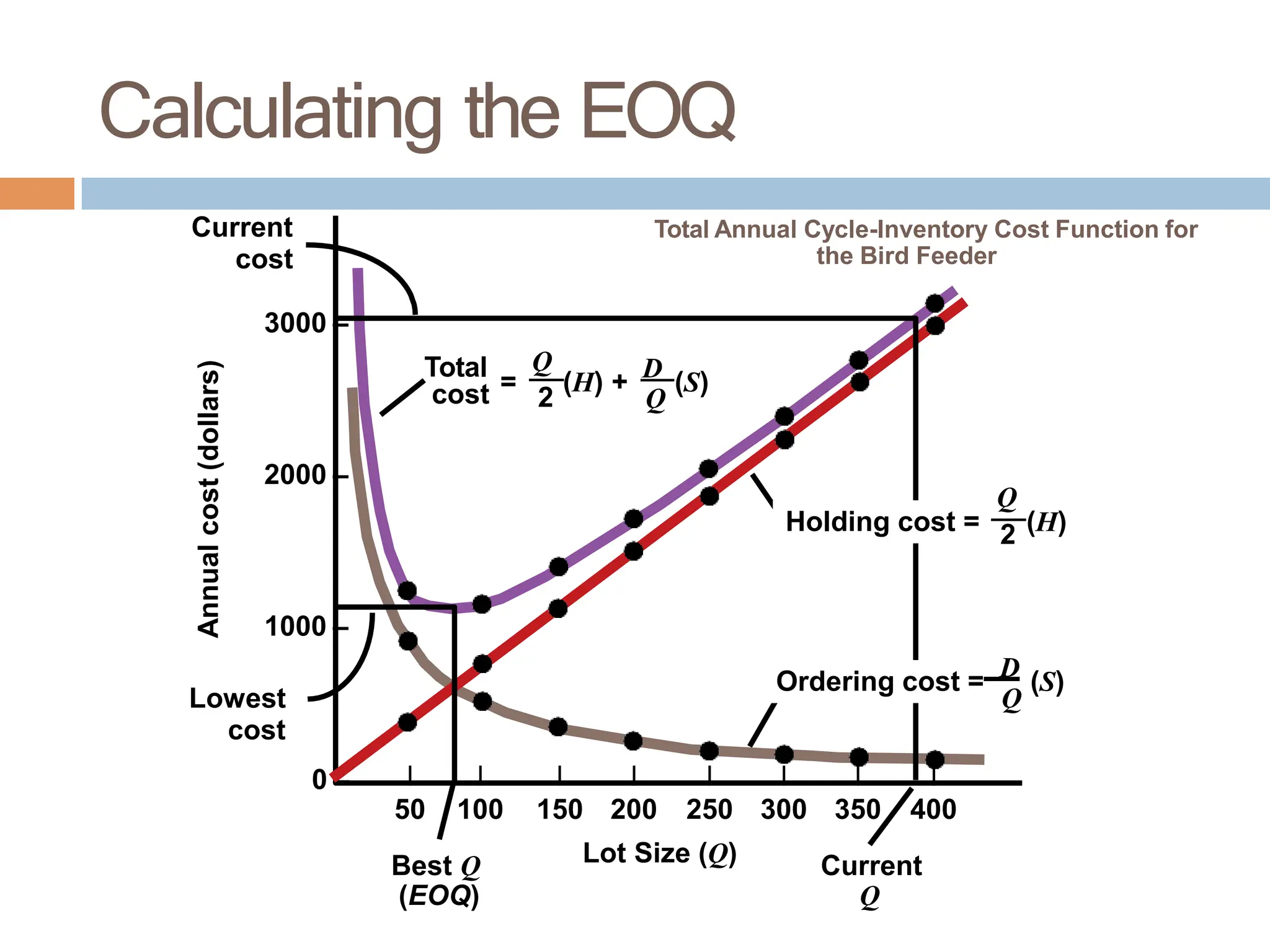
Calculating the EOQ
3000 –
2000 –
1000 –
0 – | | |
Annual
cost
(dollars)
Current
cost
Lowest
cost
| | | | |
50 100 150 200 250 300 350 400
Best Q Lot Size (Q) Current
(EOQ) Q
cost
Total
=
Q
(H) + D (S)
2 Q
Total Annual Cycle-Inventory Cost Function for
the Bird Feeder
Ordering cost = D (S)
Q
Q
Holding cost = 2 (H)
Finding the EOQ, T
otal Cost, TBO
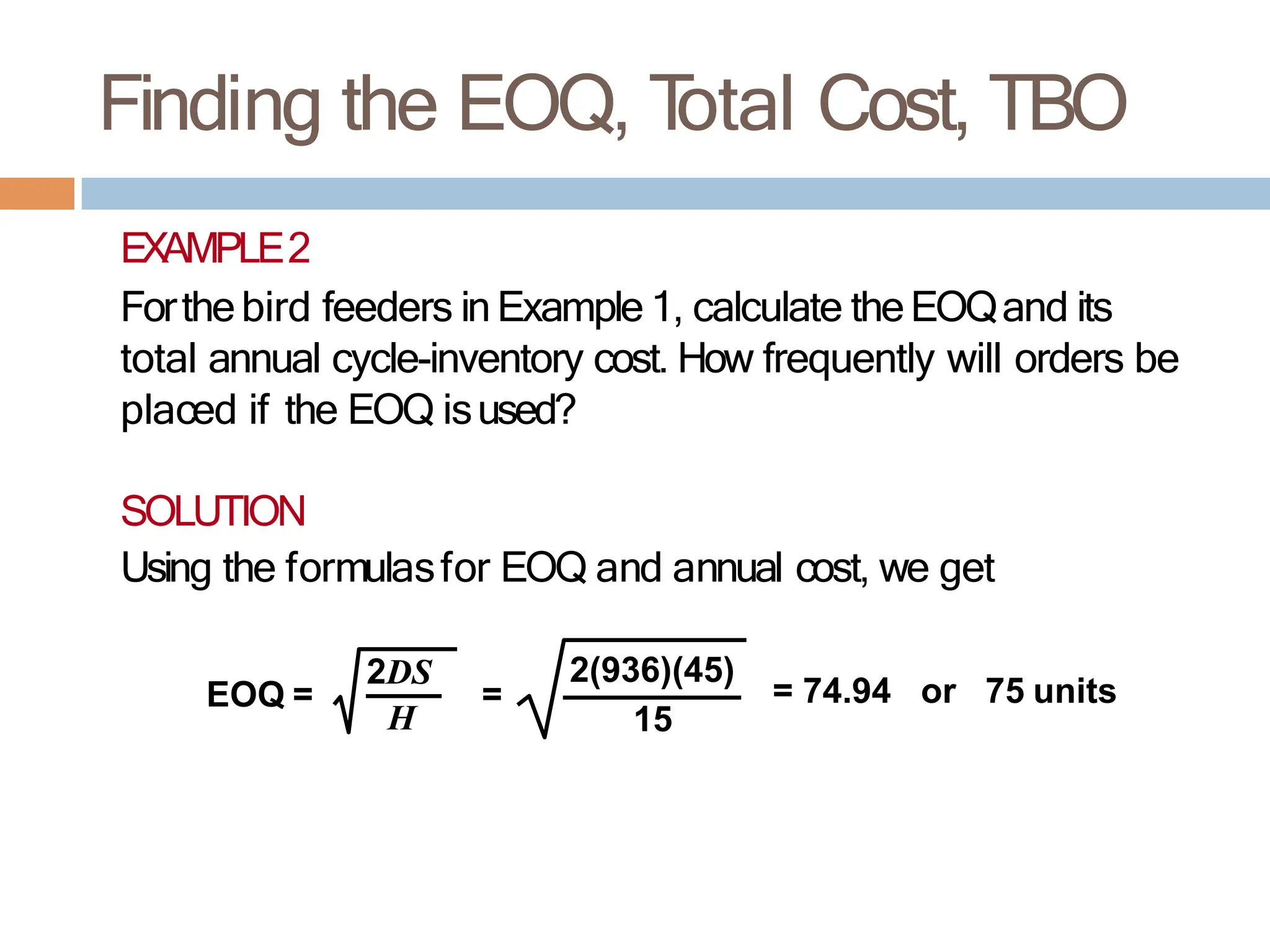
EXAMPLE2
Forthebird feeders inExample 1, calculate theEOQand its
total annual cycle-inventory cost. How frequently will orders be
placed if the EOQ isused?
SOLUTION
Using the formulasfor EOQ and annual cost, we get
EOQ = =
2DS
H
= 74.94 or 75 units
2(936)(45)
15
Finding the EOQ, T
otal Cost, TBO
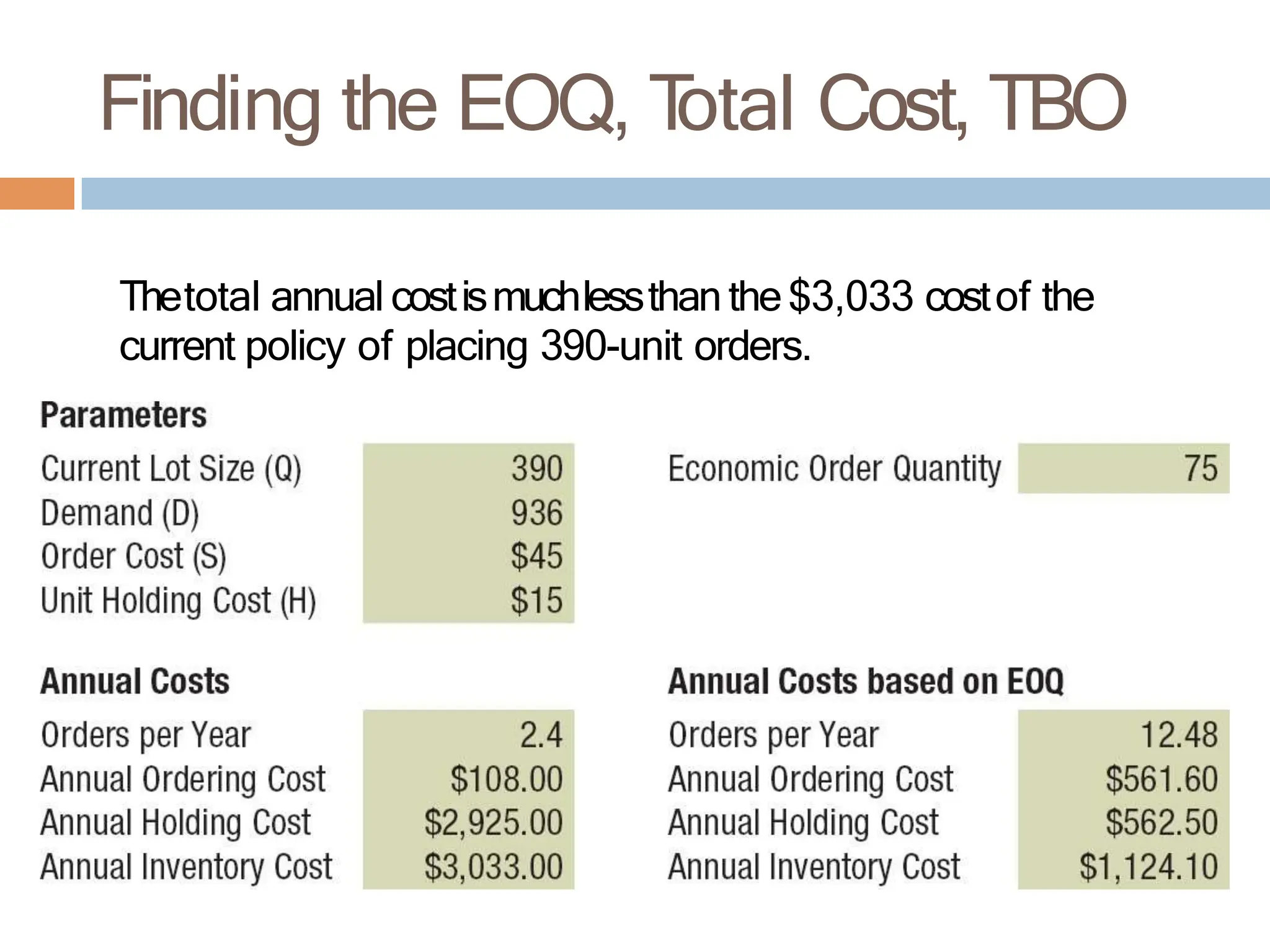
Thetotal annual costismuchlessthan the$3,033 costof the
current policy of placing 390-unit orders.
Finding the EOQ, T
otal Cost, TBO
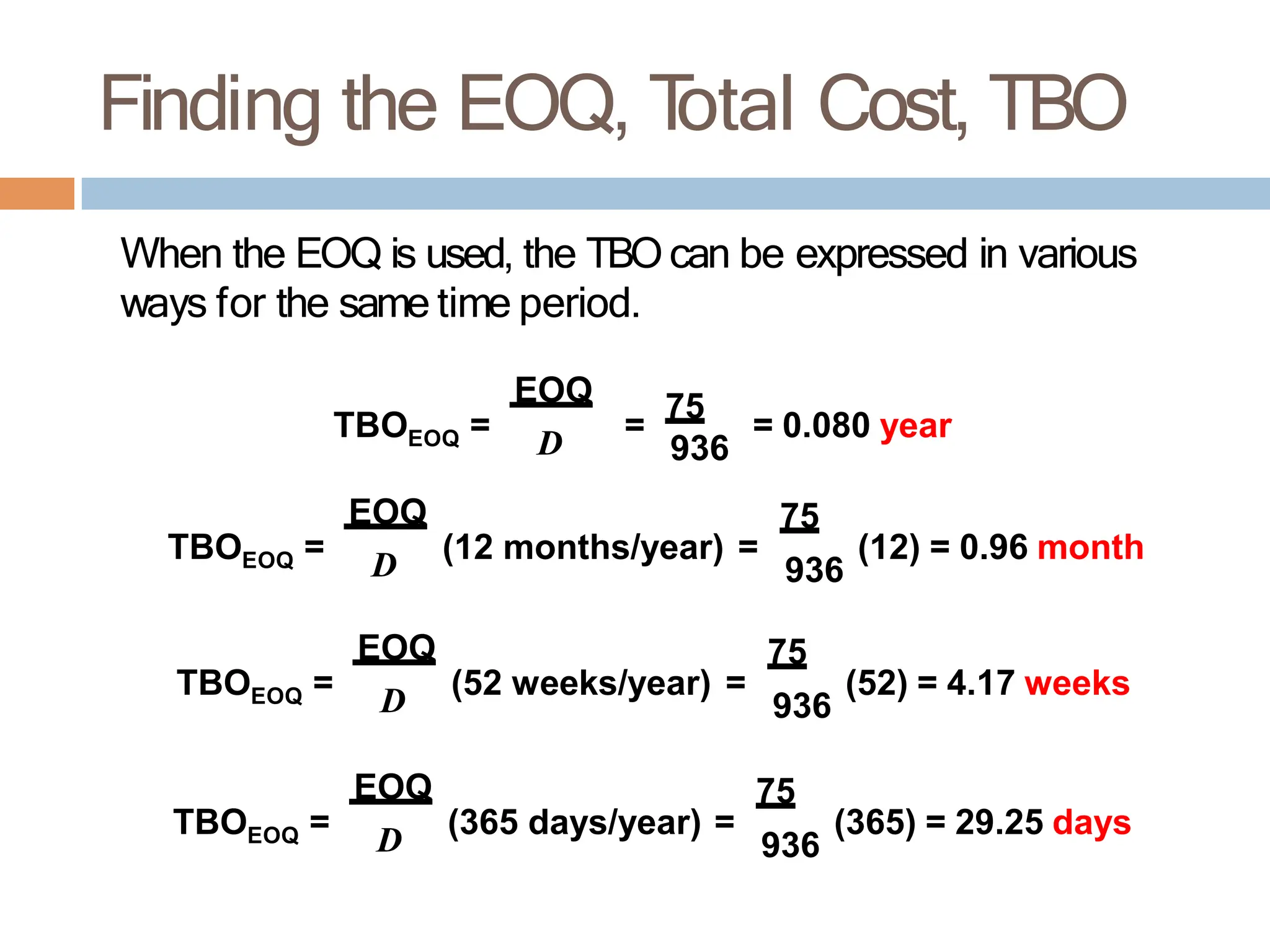
When the EOQ is used, the TBO can be expressed in various
ways for the same time period.
EOQ
EOQ
TBO = D =
75
= 0.080 year
936
EOQ D
EOQ 75
TBO = (12 months/year) = (12) = 0.96 month
EOQ D
EOQ 75
TBO = (52 weeks/year) = (52) = 4.17 weeks
EOQ D
EOQ 75
TBO = (365 days/year) = (365) = 29.25 days
936
936
936
Finding the EOQ, T
otal Cost, TBO
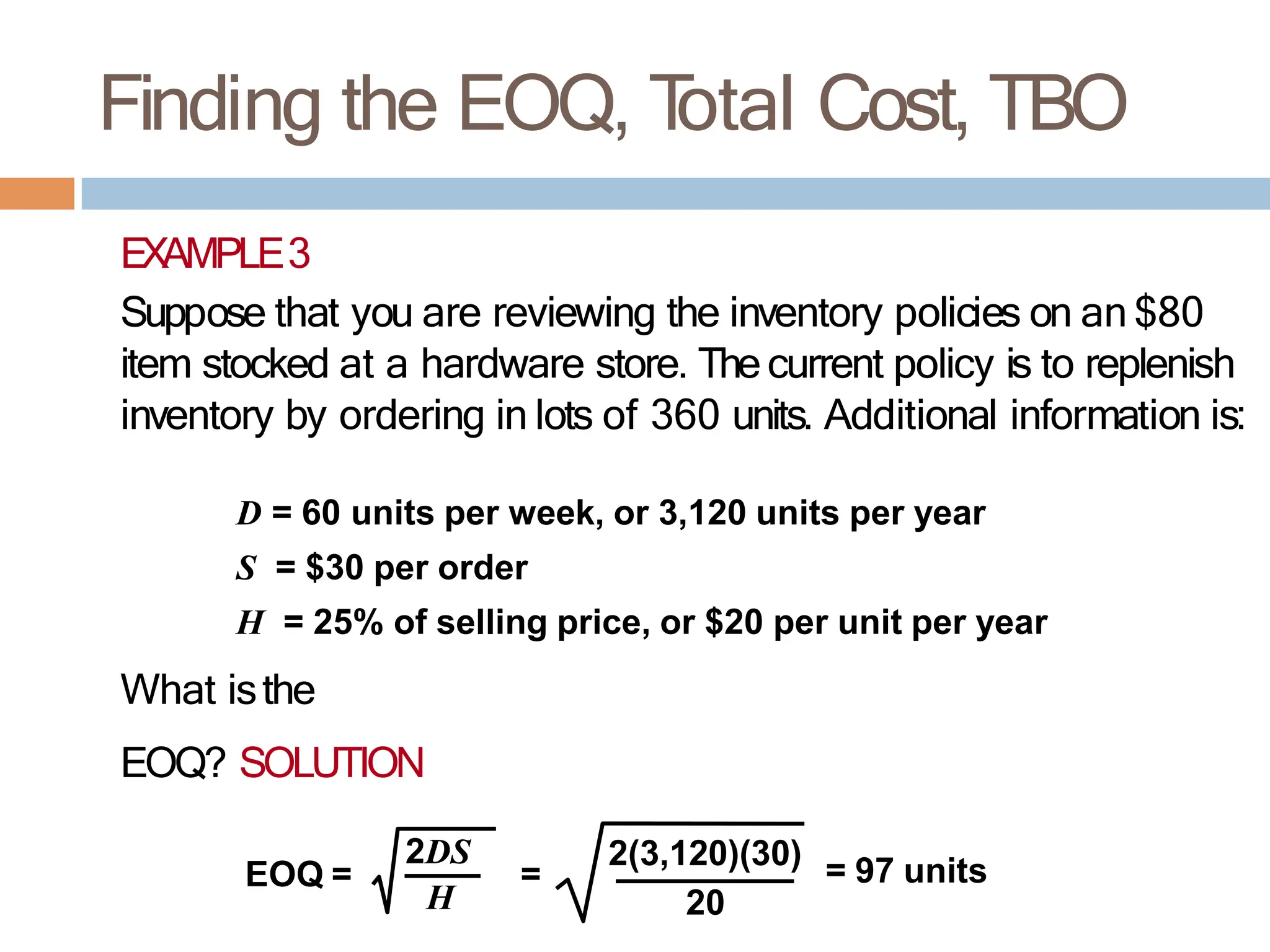
EXAMPLE3
Suppose that you are reviewing the inventory policies on an $80
item stocked at a hardware store. The current policy is to replenish
inventory by ordering in lots of 360 units. Additional information is:
D = 60 units per week, or 3,120 units per year
S = $30 per order
H = 25% of selling price, or $20 per unit per year
What isthe
EOQ? SOLUTION
EOQ = =
2DS
H
2(3,120)(30) = 97 units
20
Finding the EOQ, T
otal Cost, TBO
What is the total annual cost of the current policy (Q = 360),
and how does it compare with the cost with using the EOQ?
Current Policy EOQ Policy
Q = 360 units Q = 97 units
C = (360/2)(20) + (3,120/360)(30) C = (97/2)(20) + (3,120/97)(30)
C = 3,600 + 260 C = 970 + 965
C = $3,860 C = $1,935
Finding the EOQ, T
otal Cost, TBO
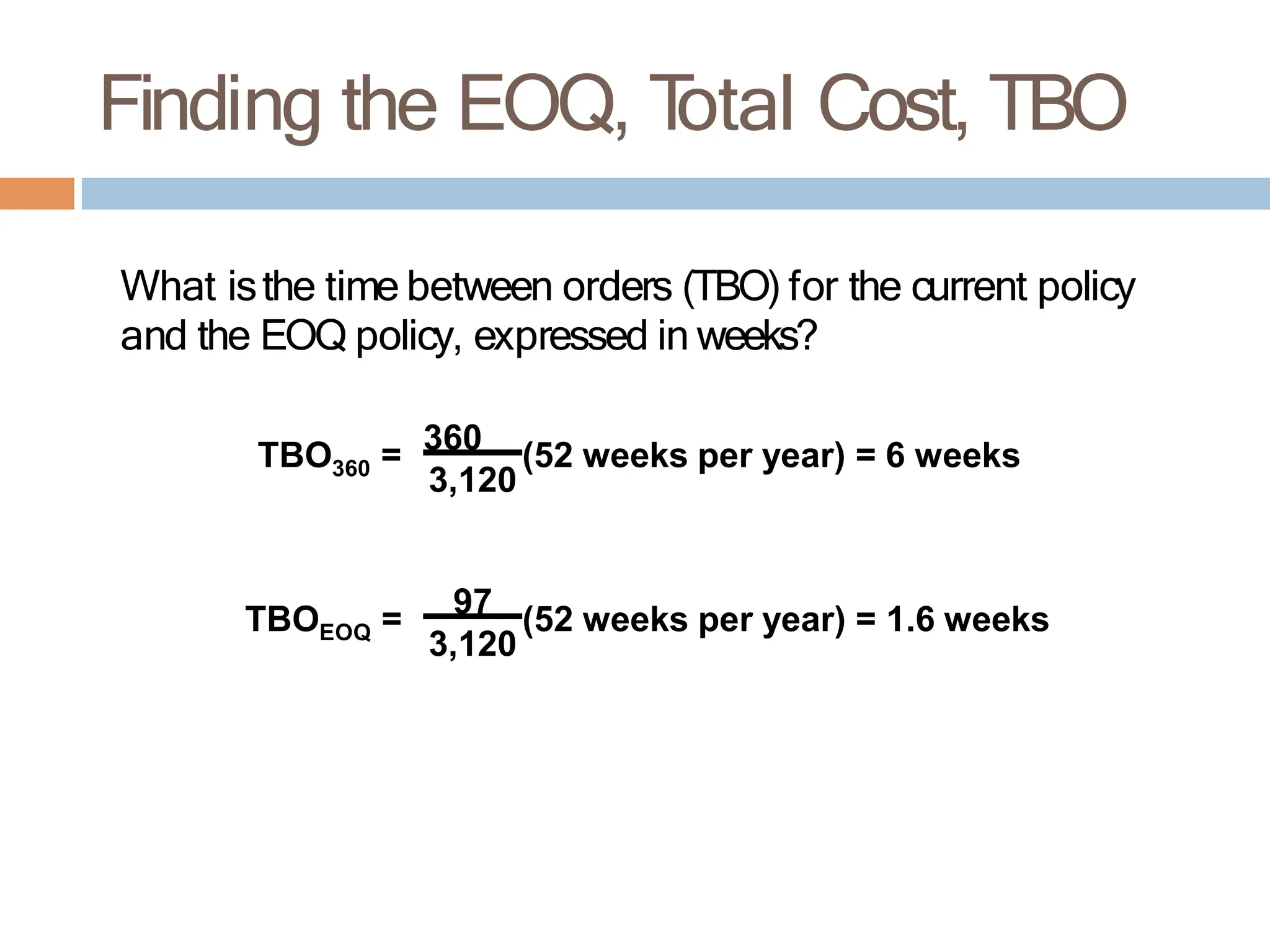
What isthe time between orders (TBO) for the current policy
and the EOQ policy, expressed in weeks?
360
TBO = 360 (52 weeks per year) = 6 weeks
EOQ
TBO = 97 (52 weeks per year) = 1.6 weeks
3,120
3,120
Managerial Insights
SENSITIVITY ANALYSIS OF THE EOQ
Parameter EOQ Parameter
Change
EOQ
Change
Comments
Demand 2DS
H
↑
↓
↓
↑
↓
↑
Increase in lot size is in proportion
to the square root of D.
Order/Setup
Costs
2DS
H
Weeks of supply decreases and
inventory turnover increases because
the lot size decreases.
Holding
Costs
2DS
H
Larger lots are justified when holding
costs decrease.
Robustness
▶ The EOQ model isrobust
▶ It works even if all parameters and
assumptionsare not met
▶ The total cost curve isrelatively flat in the
area of the EOQ
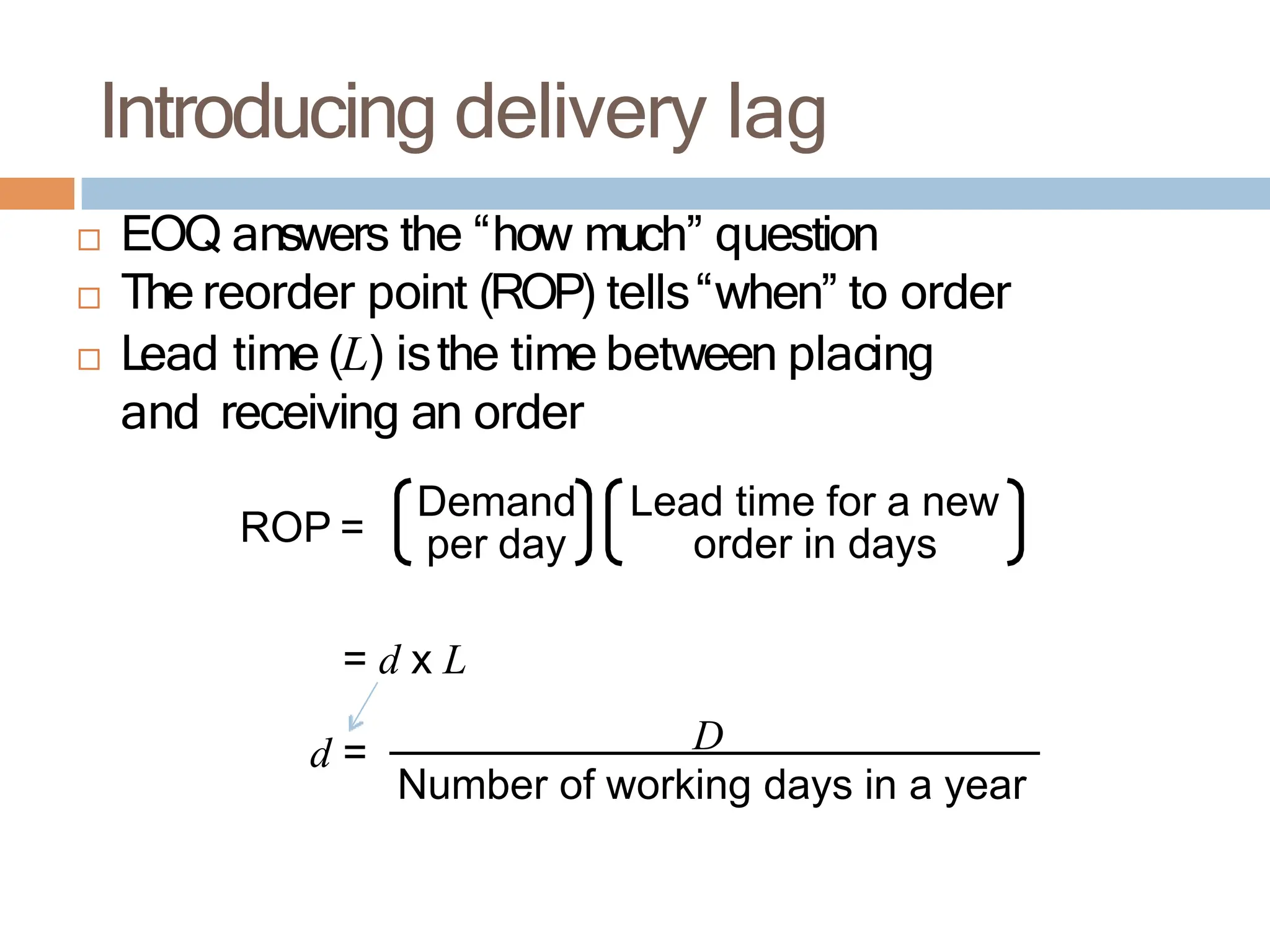
Introducing delivery lag
 EOQ answers the “how much” question
 The reorder point (ROP) tells“when” to order
 Lead time (L) isthe time between placing
and receiving an order
ROP =
Lead time for a new
order in days
Demand
per day
= d x L
d = D
Number of working days in a year
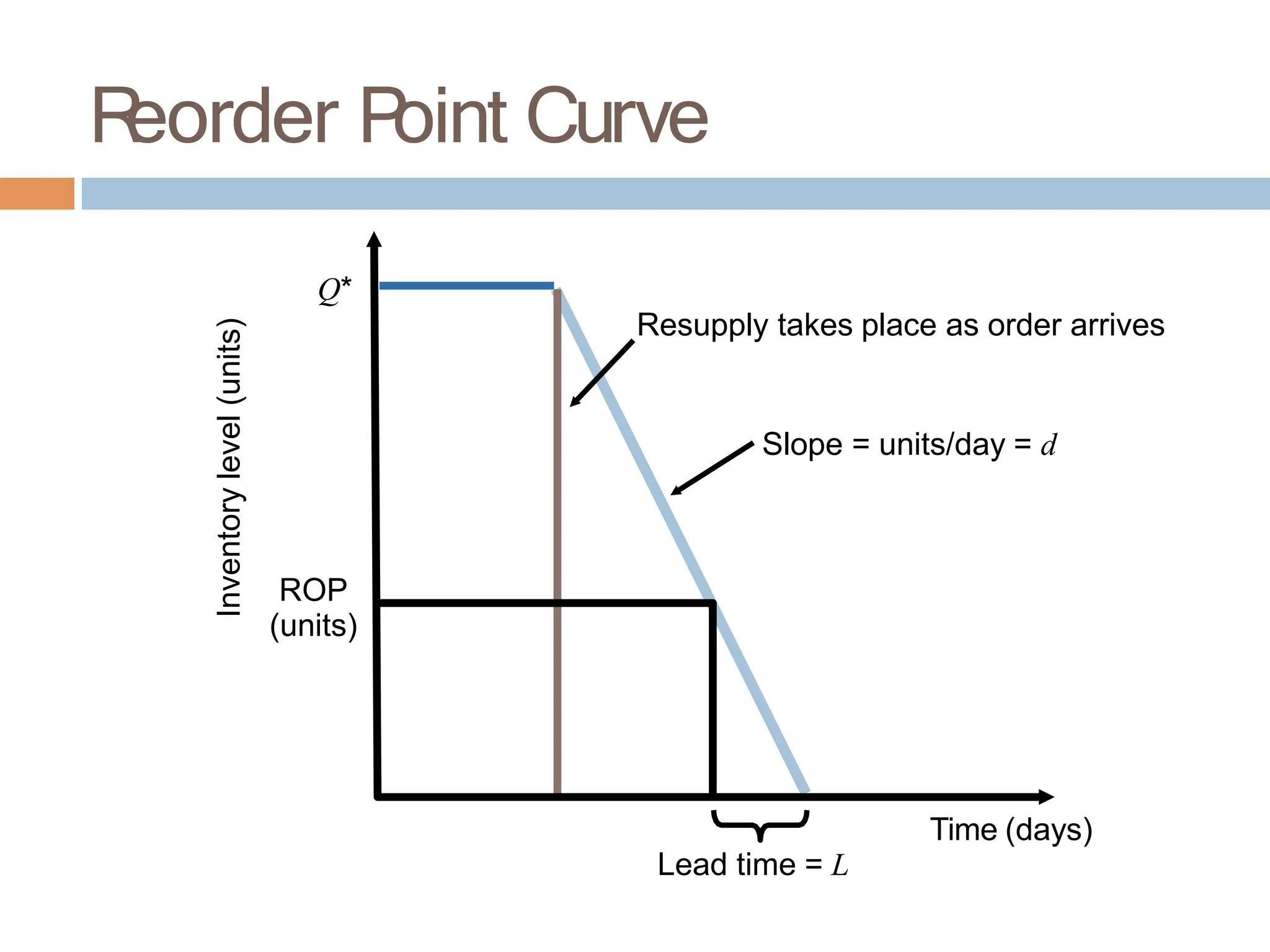
R
eorder P
oint Curve
Q*
ROP
(units)
Inventory
level
(units)
Time (days)
Lead time = L
Resupply takes place as order arrives
Slope = units/day = d
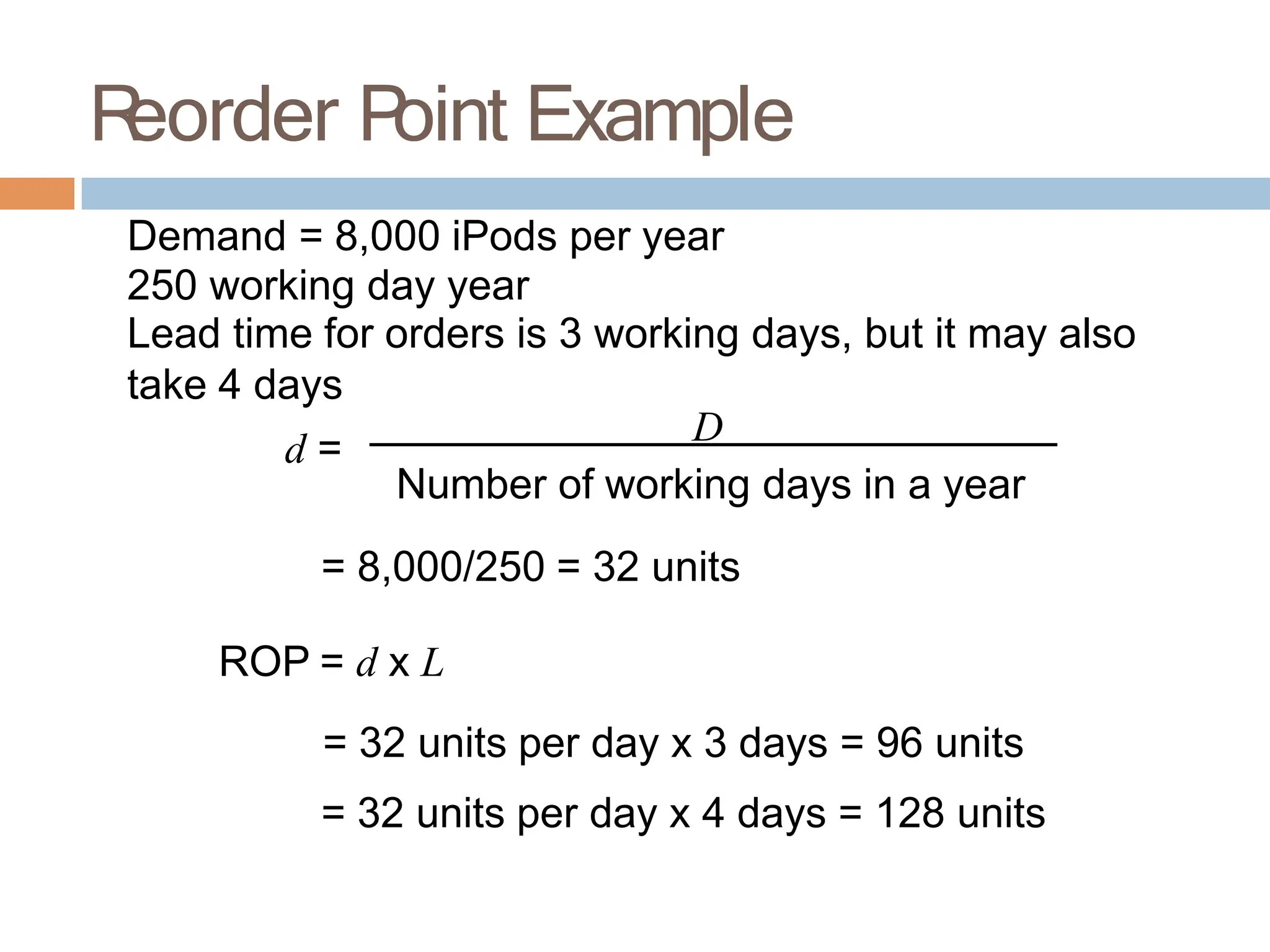
R
eorder P
oint Example
Demand = 8,000 iPods per year
250 working day year
Lead time for orders is 3 working days, but it may also
take 4 days
d =
D
Number of working days in a year
= 8,000/250 = 32 units
ROP = d x L
= 32 units per day x 3 days = 96 units
= 32 units per day x 4 days = 128 units
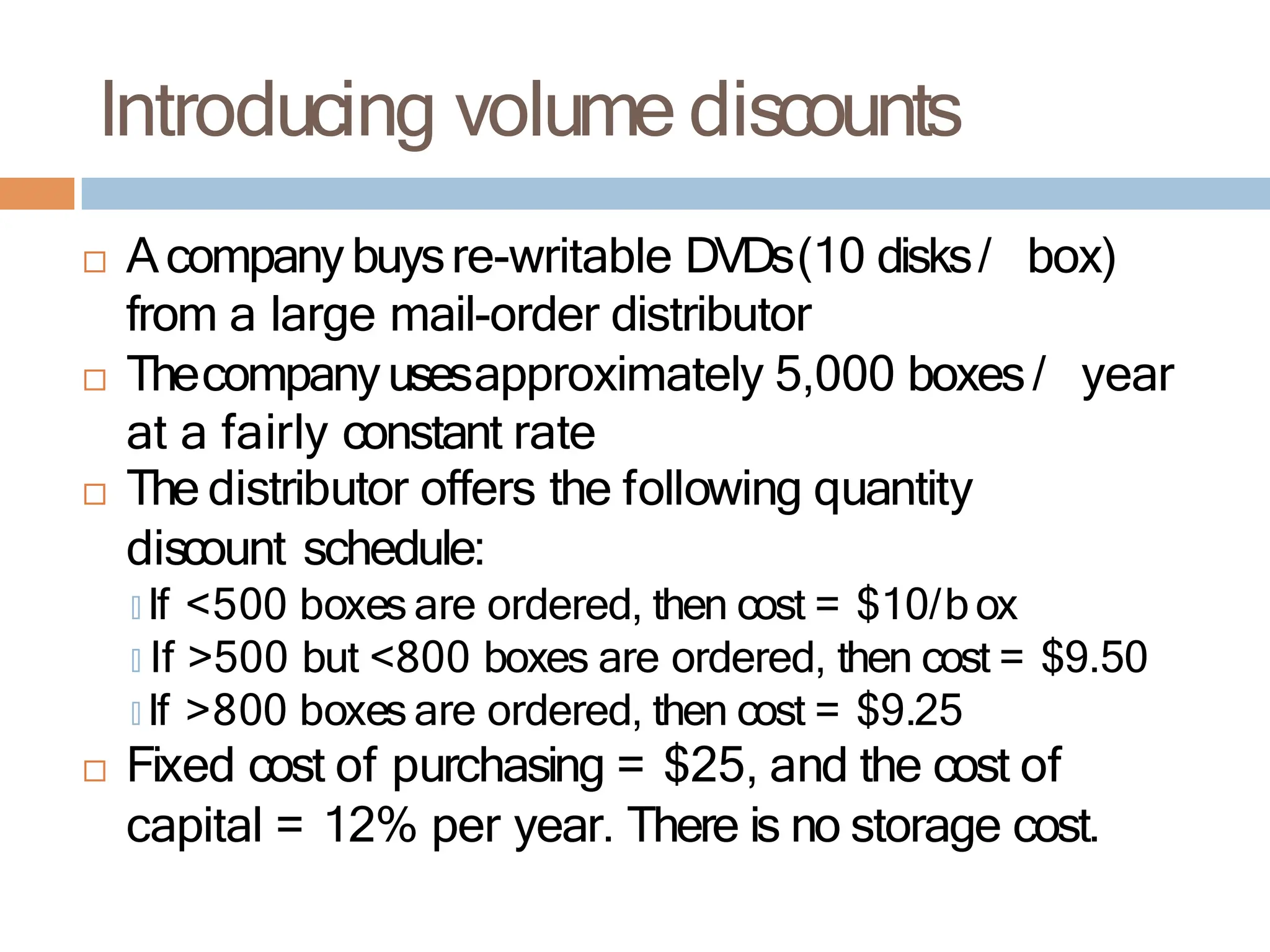
Introducing volume discounts
 Acompanybuysre-writable DVDs(10 disks/ box)
from a large mail-order distributor
 Thecompanyusesapproximately 5,000 boxes/ year
at a fairly constant rate
 The distributor offers the following quantity
discount schedule:
🞑 If <500 boxes are ordered, then cost = $10/box
🞑 If >500 but <800 boxes are ordered, then cost = $9.50
🞑 If >800 boxes are ordered, then cost = $9.25
 Fixed cost of purchasing = $25, and the cost of
capital = 12% per year. There is no storage cost.
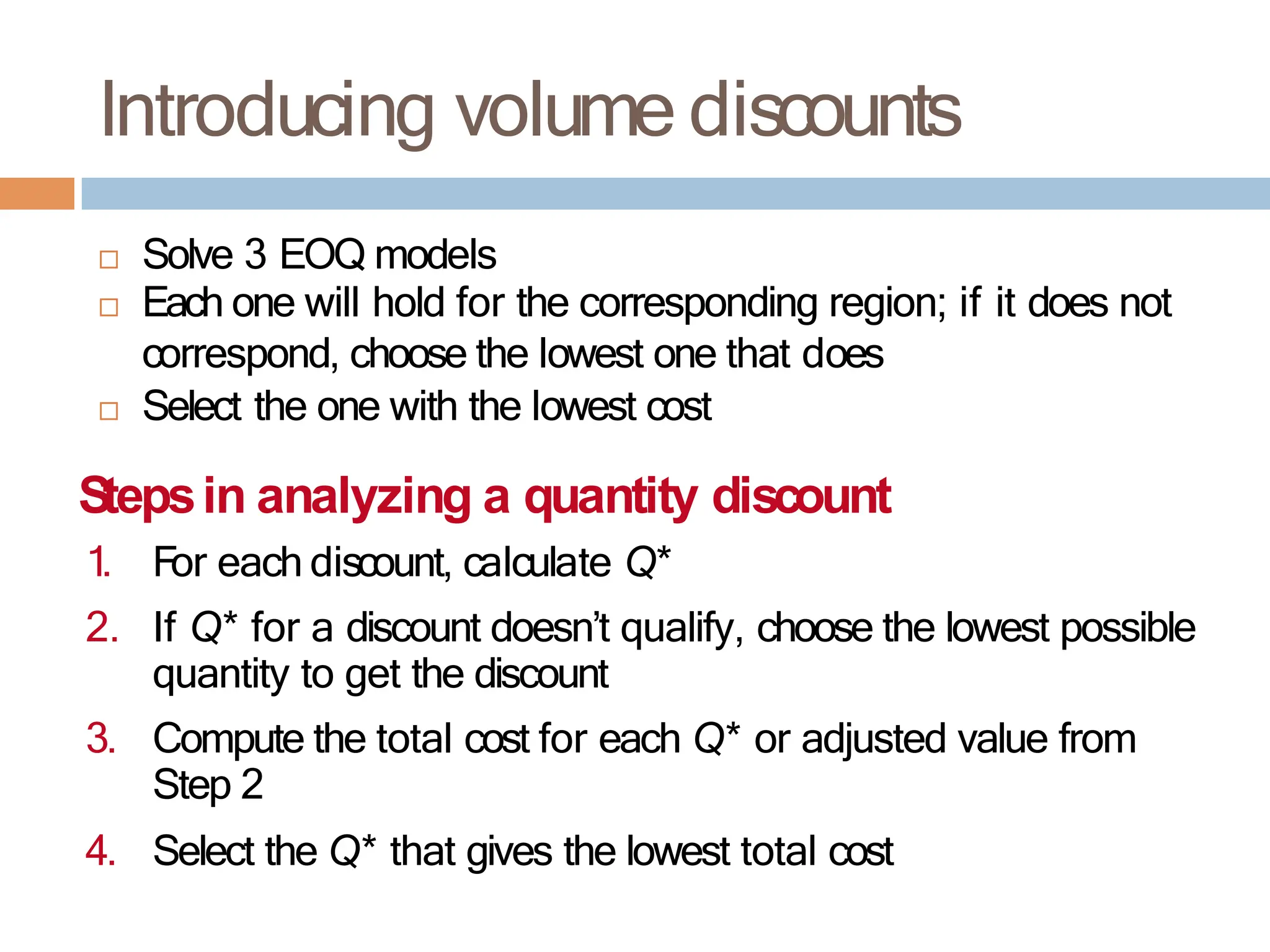
 Solve 3 EOQ models
 Each one will hold for the corresponding region; if it does not
correspond, choose the lowest one that does
 Select the one with the lowest cost
Stepsin analyzing a quantity discount
1. For each discount, calculate Q*
2. If Q* for a discount doesn’t qualify, choose the lowest possible
quantity to get the discount
3. Compute the total cost for each Q* or adjusted value from
Step 2
4. Select the Q* that gives the lowest total cost
Introducing volume discounts
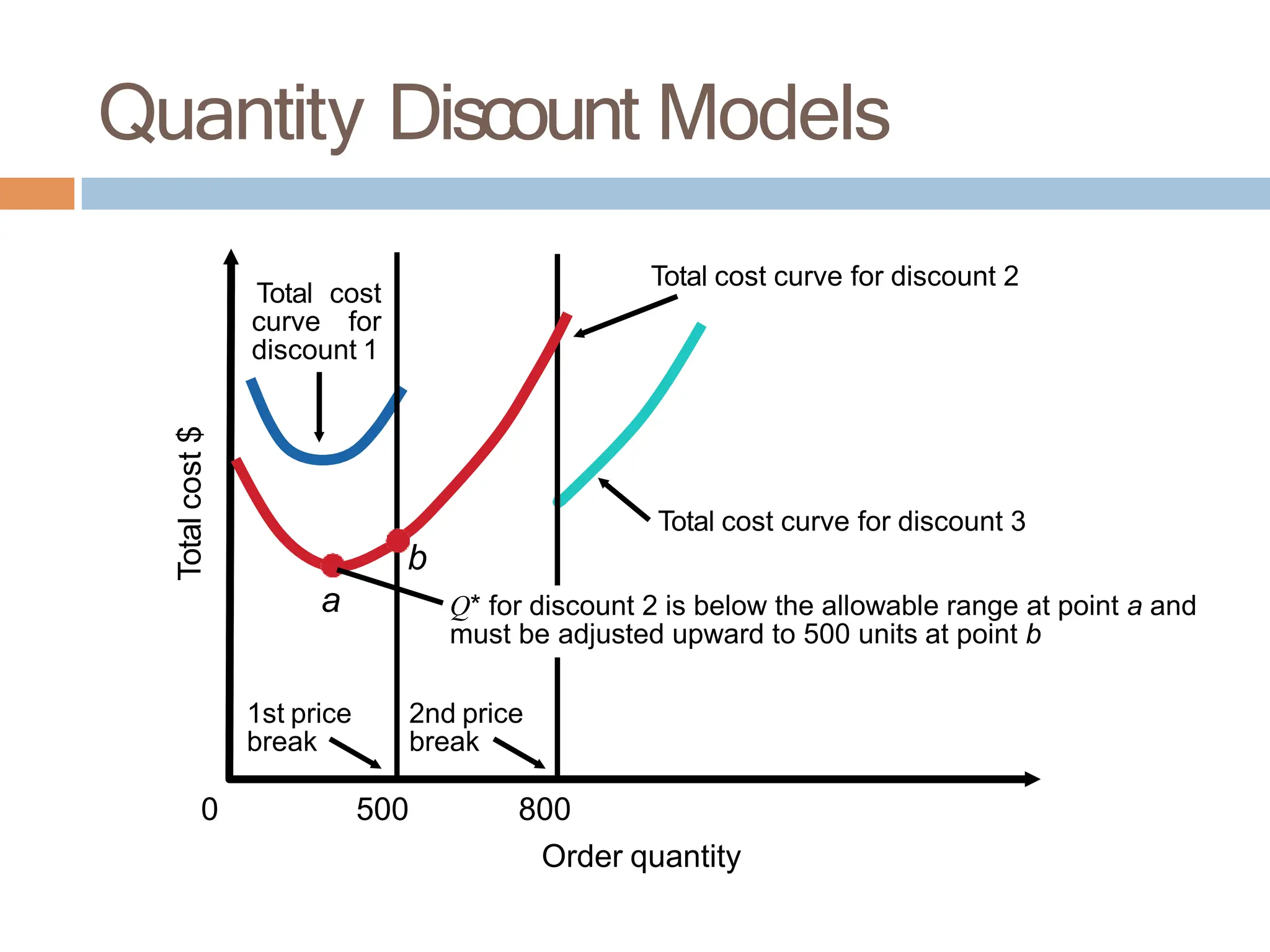
Quantity Discount Models
500 800
Order quantity
Total
cost
$
0
Q* for discount 2 is below the allowable range at point a and
must be adjusted upward to 500 units at point b
a
b
1st price
break
2nd price
break
Total cost
curve for
discount 1
Total cost curve for discount 2
Total cost curve for discount 3
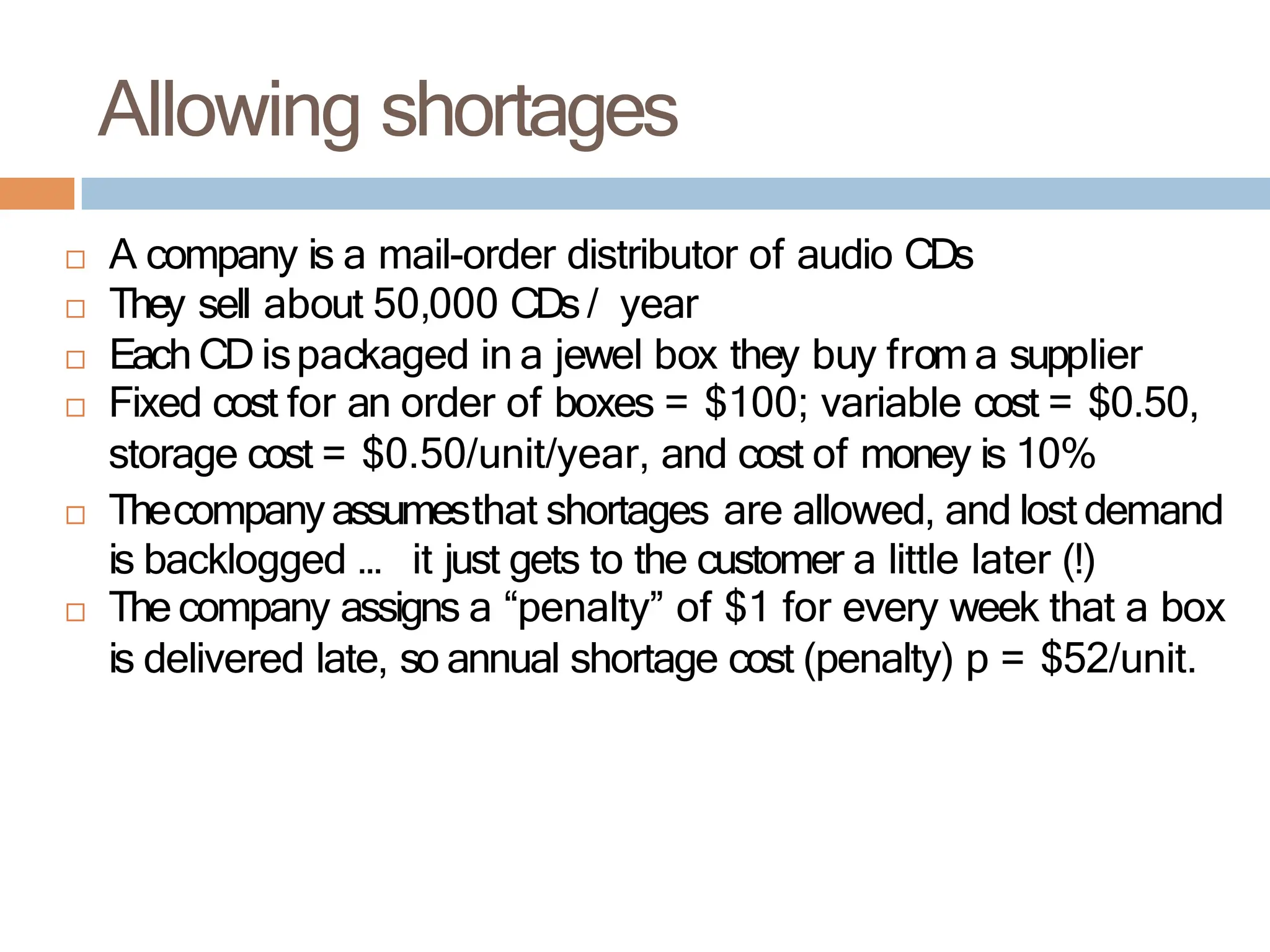
 A company is a mail-order distributor of audio CDs
 They sell about 50,000 CDs/ year
 Each CD ispackaged in a jewel box they buy from a supplier
 Fixed cost for an order of boxes = $100; variable cost = $0.50,
storage cost = $0.50/unit/year, and cost of money is 10%
 Thecompanyassumesthat shortages are allowed, and lost demand
is backlogged … it just gets to the customer a little later (!)
 The company assigns a “penalty” of $1 for every week that a box
is delivered late, so annual shortage cost (penalty) p = $52/unit.
Allowing shortages
Allowing shortages
Q/D
b
(Q-b)/D b/D
 Allow shortages up to b units
 Order quantity Q
 Order-up-to inventory = Q-b
 Reorder period = Q/D
 Period with I>0 = (Q-b)/D
 Period with I<0 = b/D
Time
Inventory Level
Q-b
 Total Annual Cost = Ordering + Shortage + Holding costs
 Ordering cost = N [(S+CQ) + (pb(b/D)/2) + H(Q-b)((Q-b)/D)/2]
 Since N = D/Q, we have
 T
otal Annual Cost = DS/Q + CD + (pb2/2Q) +H(Q-b)2/2D
 T
o minimize, take derivative = 0, and solve
 hQ2 – HbQ – (DS+pb2) = 0
Allowing shortages
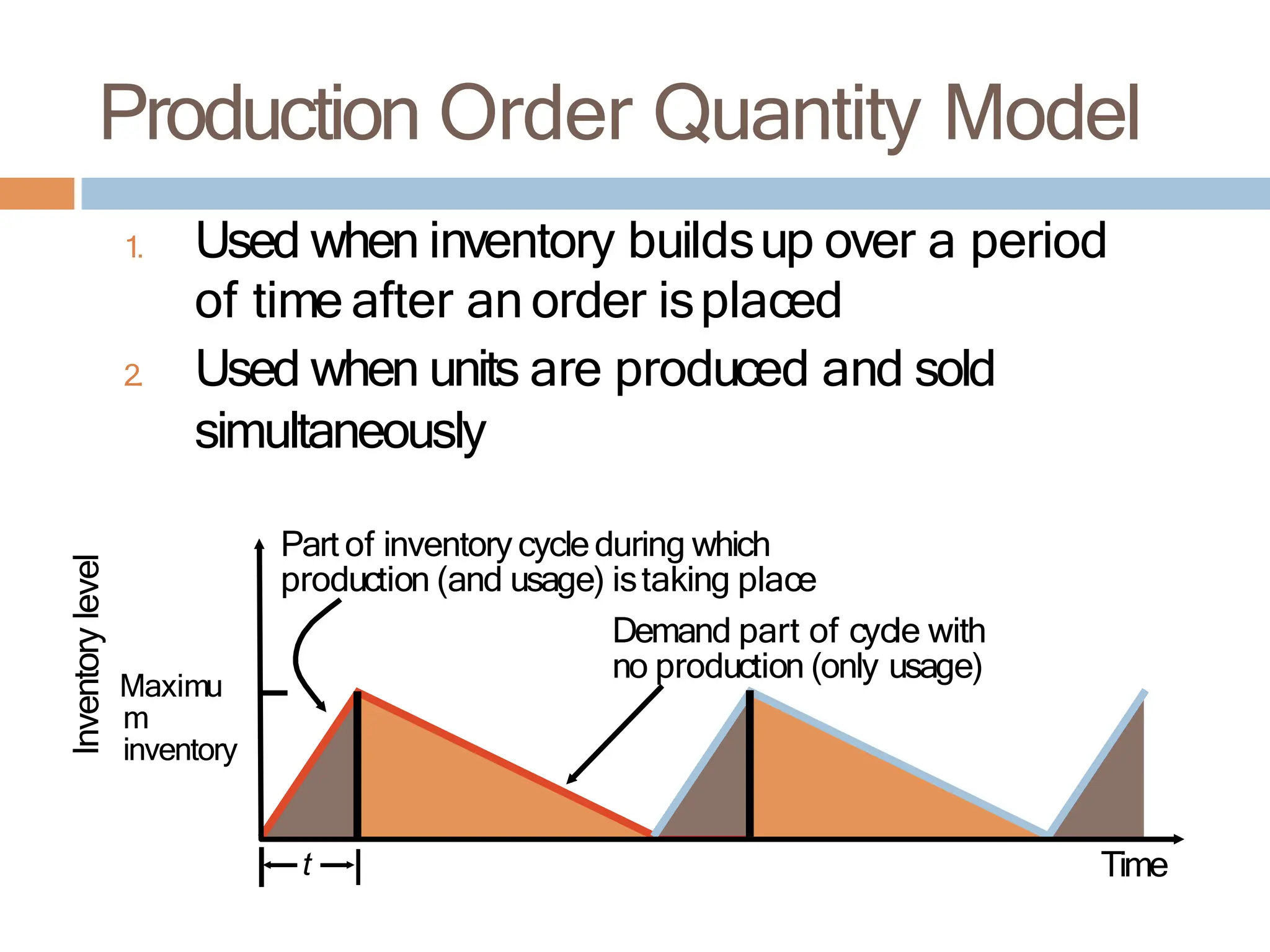
Production Order Quantity Model
1. Used when inventory buildsup over a period
of time after an order isplaced
2. Used when units are produced and sold
simultaneously
Inventory
level
Time
Part of inventorycycleduring which
production (and usage) istaking place
Demand part of cycle with
no production (only usage)
t
Maximu
m
inventory
Production Order Quantity Model
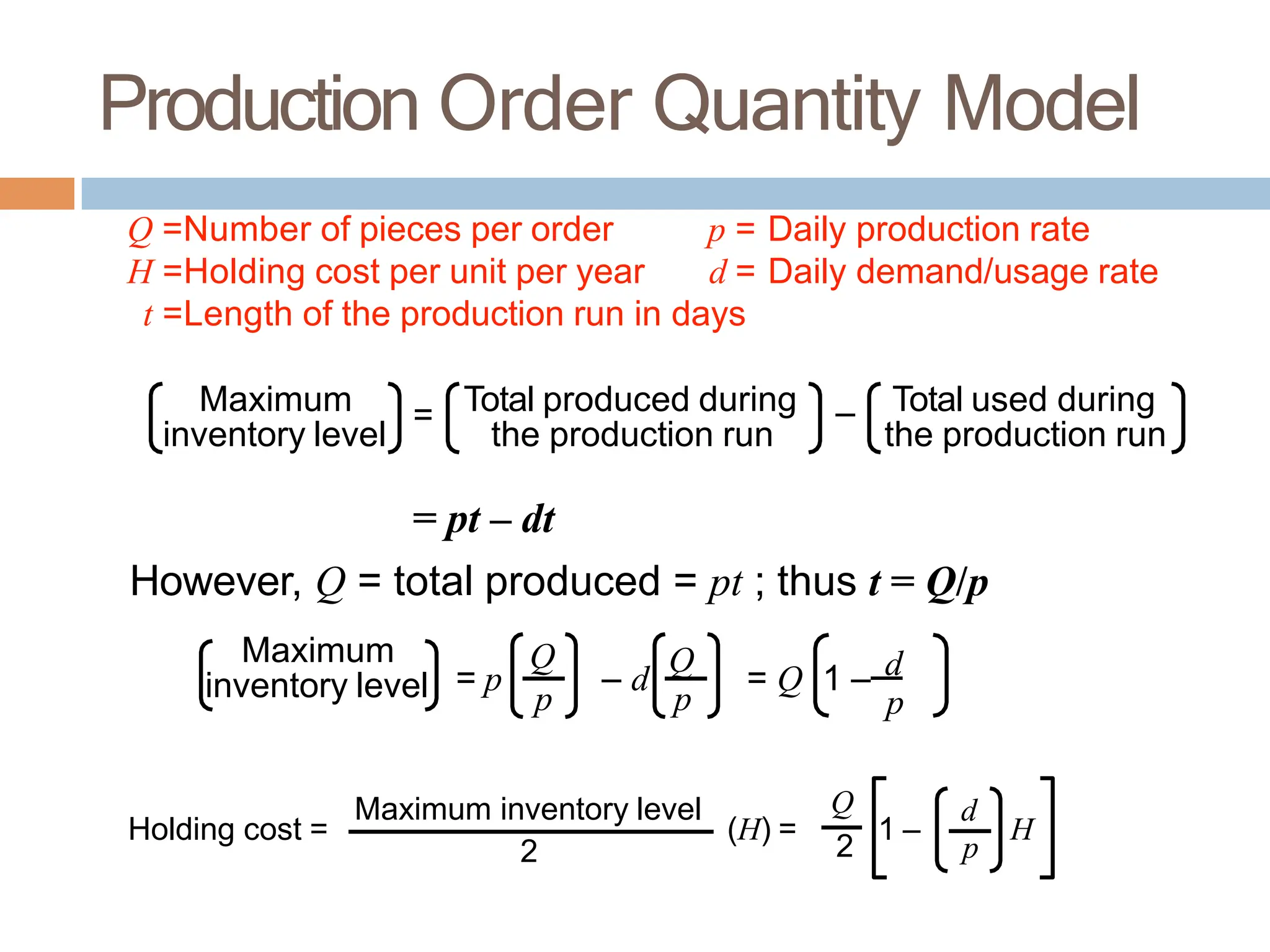
Q =Number of pieces per order
H =Holding cost per unit per year
p = Daily production rate
d = Daily demand/usage rate
t =Length of the production run in days
= (Average inventory level) x
Annual inventory
holding cost
Holding cost
per unit per year
= (Maximum inventory level)/2
Average
inventory level
= –
Maximum
inventory level
Total items produced
during the production
run
Total items used
during the
production run
= pt – dt
Production Order Quantity Model
Q =Number of pieces per order
H =Holding cost per unit per year
p = Daily production rate
d = Daily demand/usage rate
t =Length of the production run in days
= – Total used during
the production run
Maximum
inventory level
Total produced during
the production run
= pt – dt
However, Q = total produced = pt ; thus t = Q/p
Maximum
inventory level = p
p
– d
Q
= Q 1 – d
Q
p p
Holding cost = (H) = 1 – H
d
p
Q
2
Maximum inventory level
2
Production Order Quantity Model
Q =Number of pieces per order
H =Holding cost per unit per year
p = Daily production rate
d = Daily demand/usage rate
t =Length of the production run in days
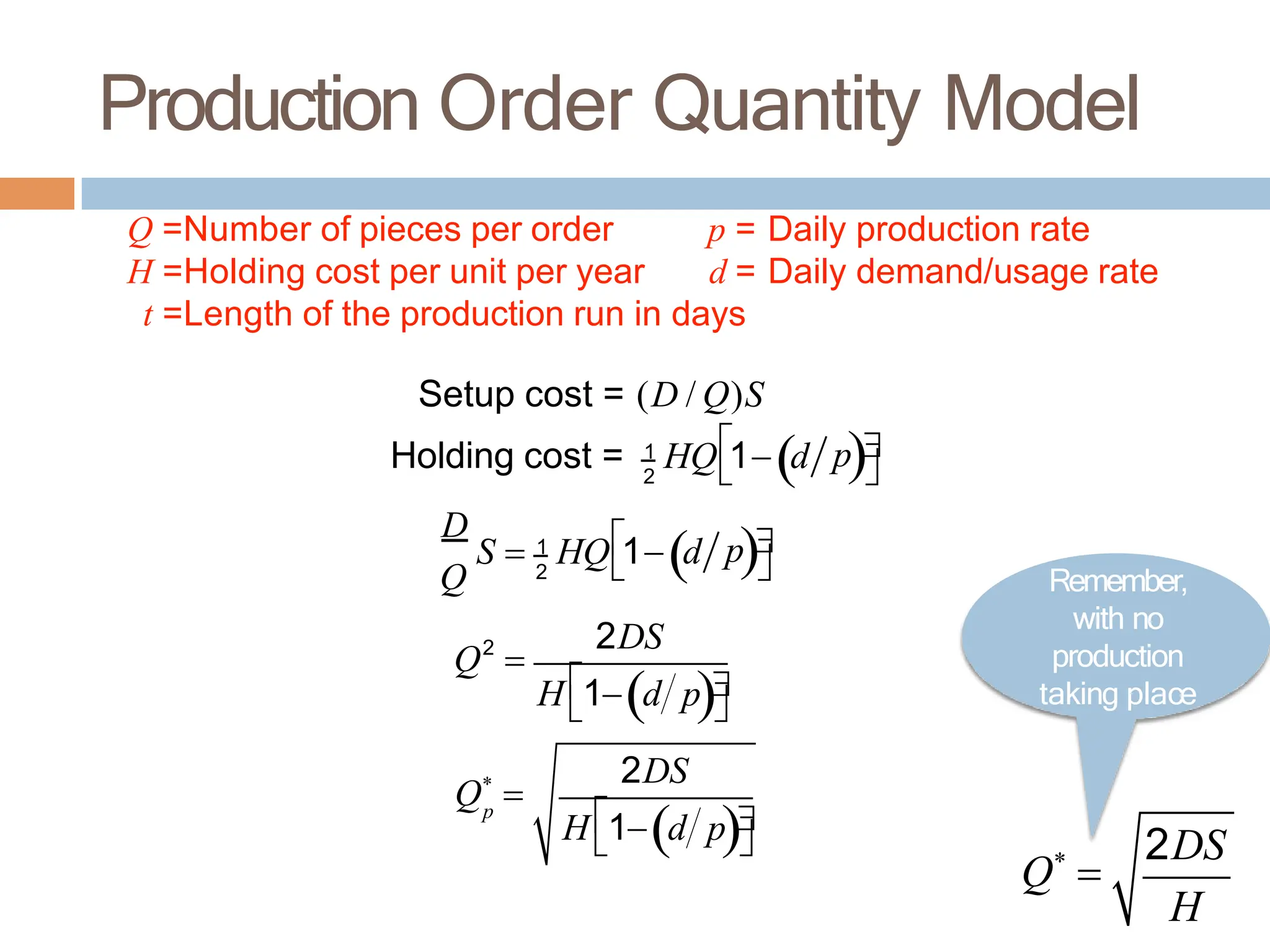
Setup cost = (D / Q)S
1
2
Holding cost = HQ 1 d p


 
D
Q
1
2
S  HQ 1 d p


 
2
Q 
2DS
H1d p
 
p
Q*

2DS
H1d p
 
Q*

2DS
H
Remember,
with no
production
taking place
Production Order Quantity Example
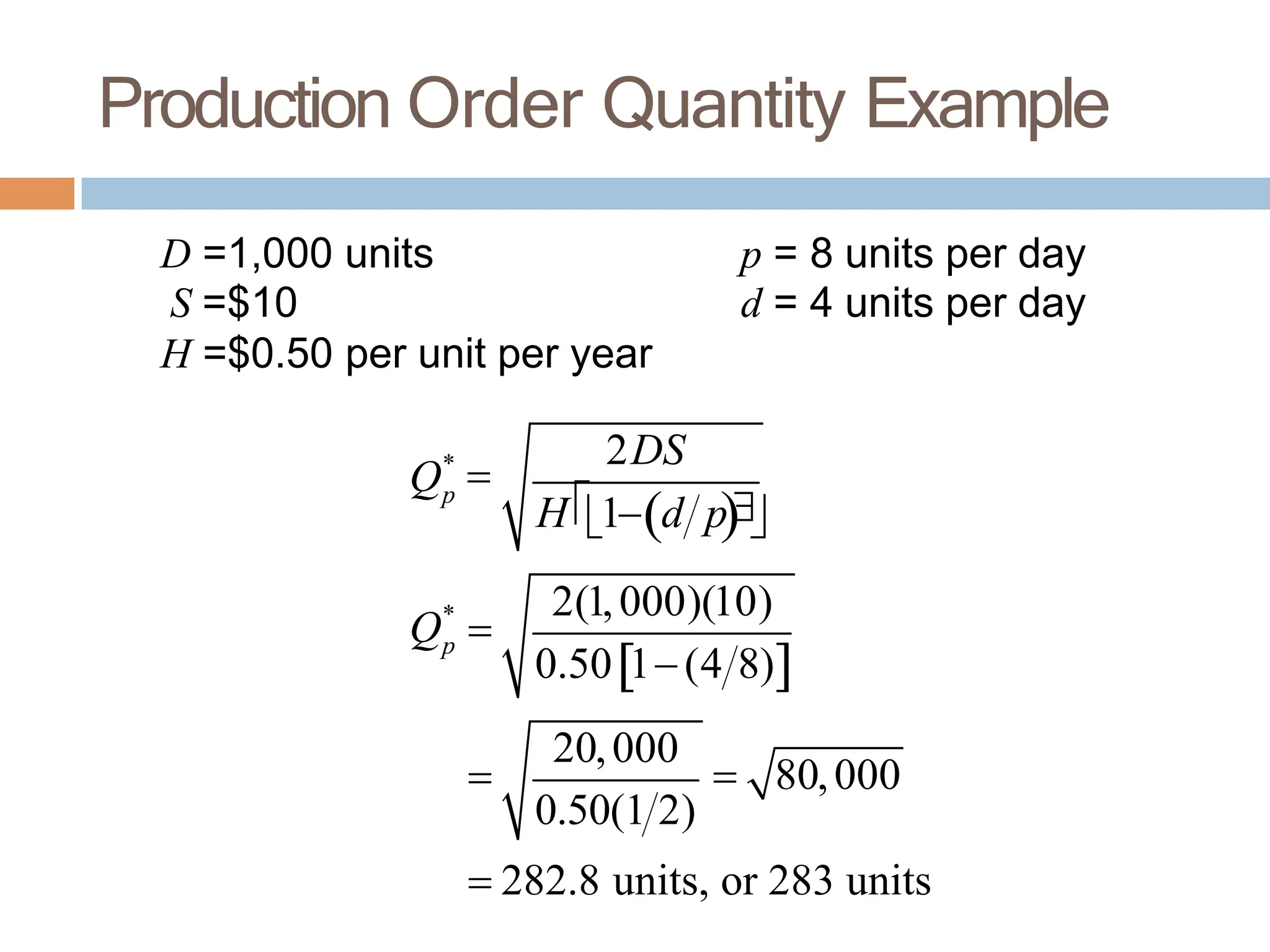
D =1,000 units
S =$10
H =$0.50 per unit per year
p = 8 units per day
d = 4 units per day
Qp
*

2DS
H1d p
2(1,000)(10)
Qp
*

0.501(4 8)

20,000
0.50(1 2)
 80,000
 282.8 units, or 283 units
Production Order Quantity Model
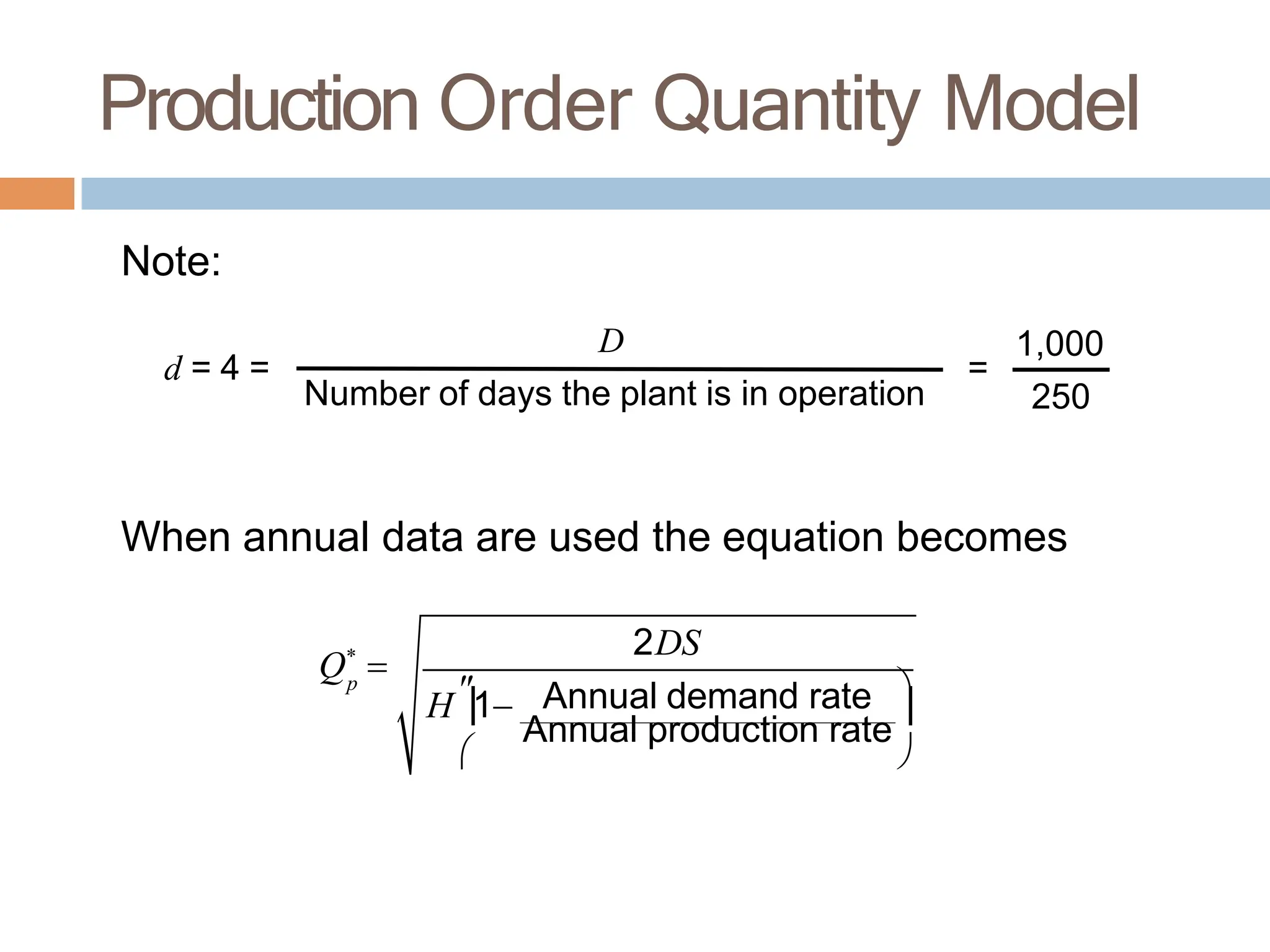
When annual data are used the equation becomes
Note:
d = 4 = =
D
Number of days the plant is in operation
1,000
250
p
Q*

2DS
Annual demand rate
 
H 
1
Annual production rate

 
Probabilistic Models and Safety Stock
Probabilistic Models and
Safety Stock
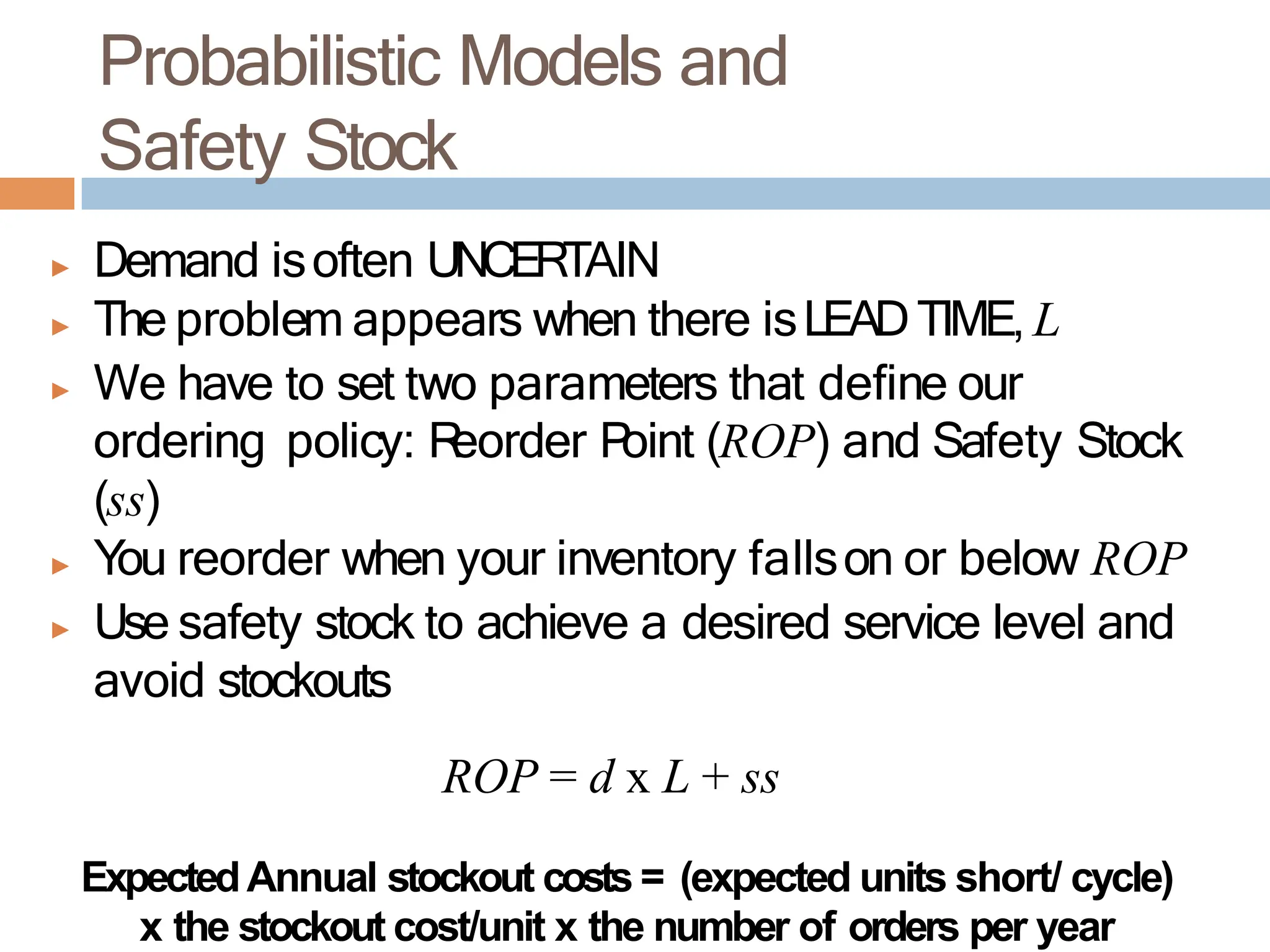
▶ Demand isoften UNCERTAIN
▶ The problem appears when there isLEADTIME, L
▶ We have to set two parameters that define our
ordering policy: R
eorder P
oint (ROP) and Safety Stock
(ss)
▶ You reorder when your inventory fallson or below ROP
▶ Use safety stock to achieve a desired service level and
avoid stockouts
ROP = d x L + ss
ExpectedAnnual stockout costs = (expected units short/ cycle)
x the stockout cost/unit x the number of orders per year
Safety Stock Example
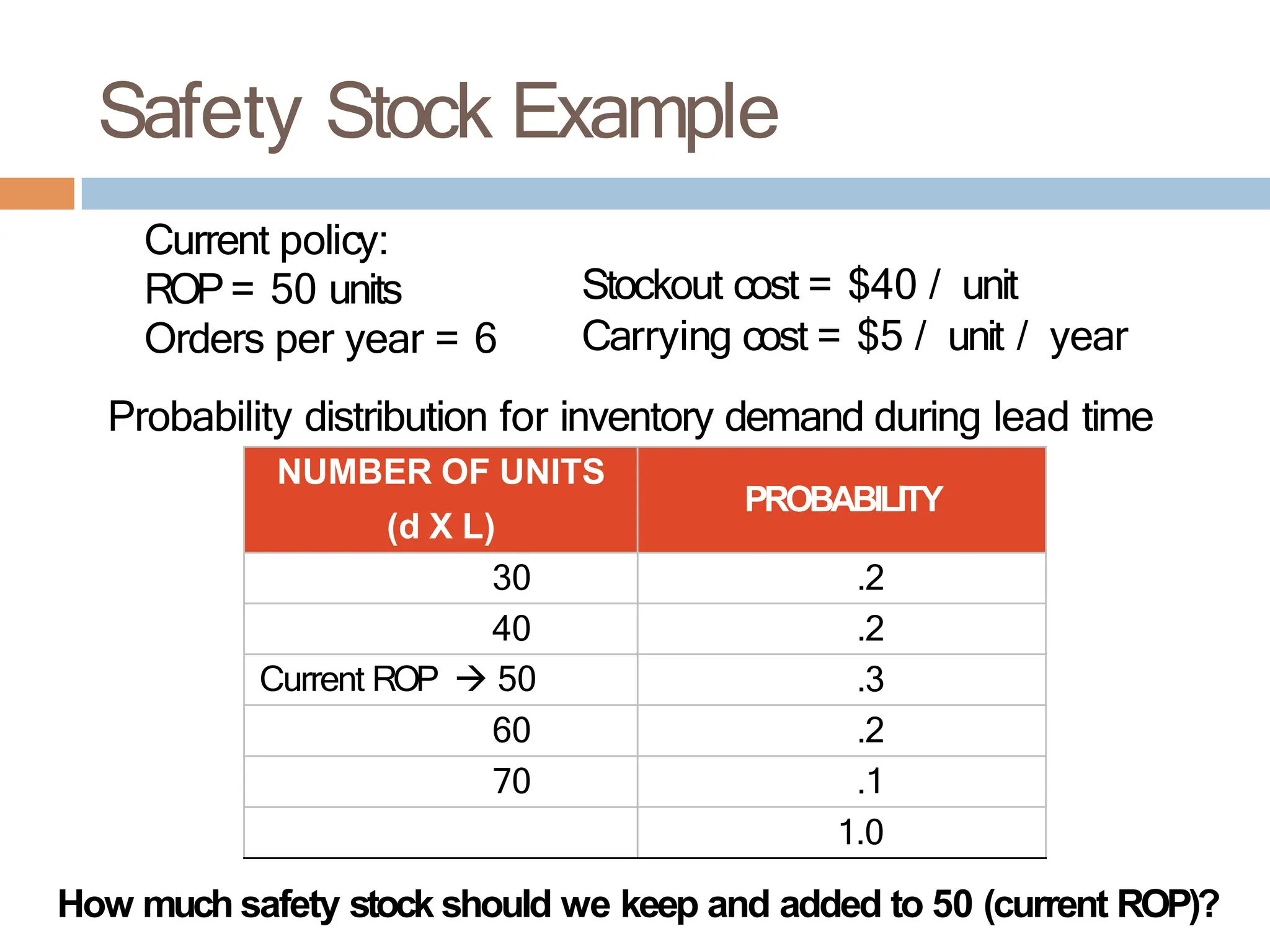
NUMBER OF UNITS
(d X L)
PROBABILITY
30 .2
40 .2
Current ROP  50 .3
60 .2
70 .1
1.0
Current policy:
ROP= 50 units
Orders per year = 6
Stockout cost = $40 / unit
Carrying cost = $5 / unit / year
Probability distribution for inventory demand during lead time
How much safety stock should we keep and added to 50 (current ROP)?
Safety Stock Example
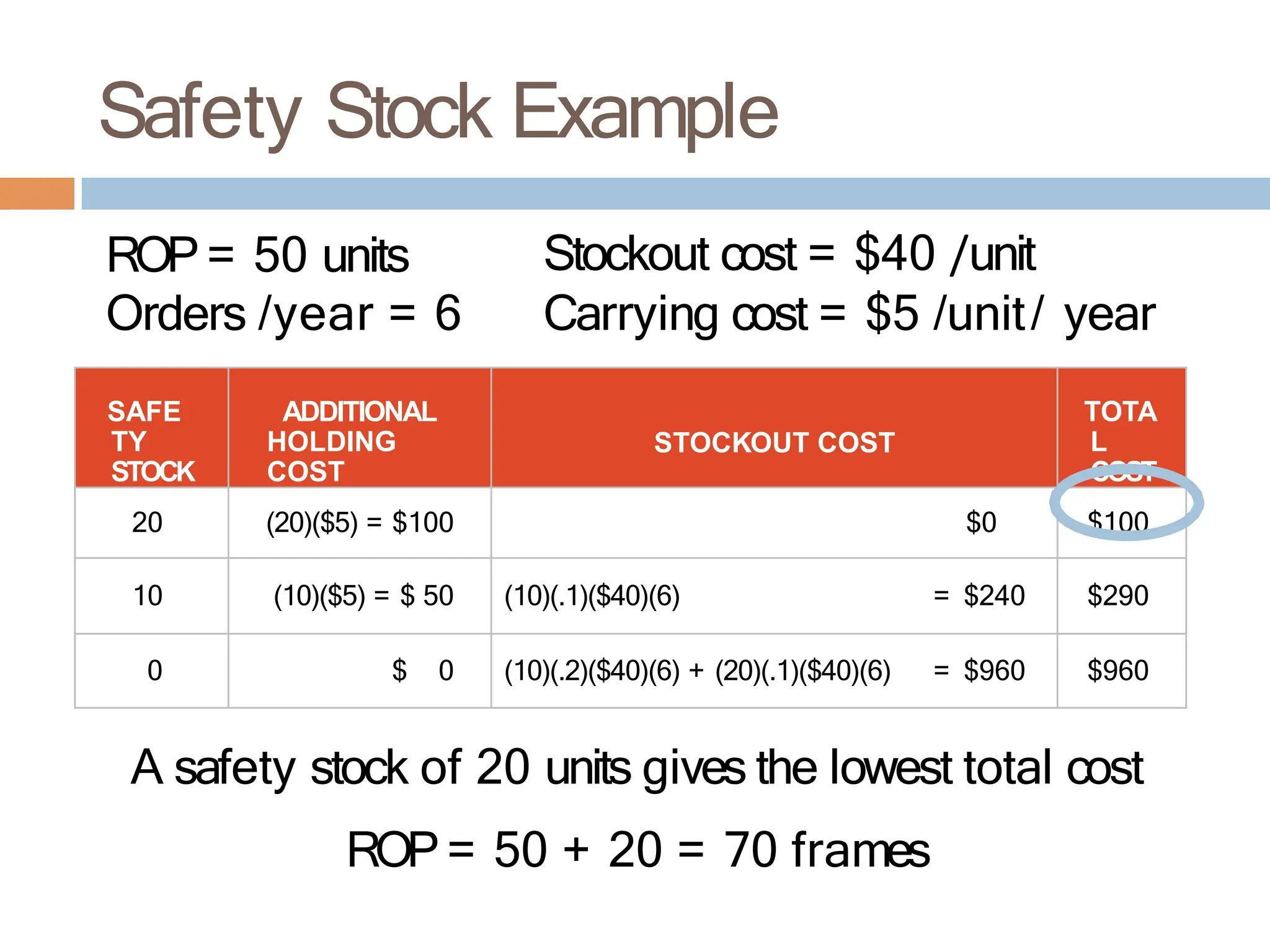
ROP= 50 units
Orders /year = 6
Stockout cost = $40 /unit
Carrying cost = $5 /unit/ year
SAFE
TY
STOCK
ADDITIONAL
HOLDING
COST
STOCKOUT COST
TOTA
L
COST
20 (20)($5) = $100 $0 $100
10 (10)($5) = $ 50 (10)(.1)($40)(6) = $240 $290
0 $ 0 (10)(.2)($40)(6) + (20)(.1)($40)(6) = $960 $960
A safety stock of 20 units gives the lowest total cost
ROP= 50 + 20 = 70 frames
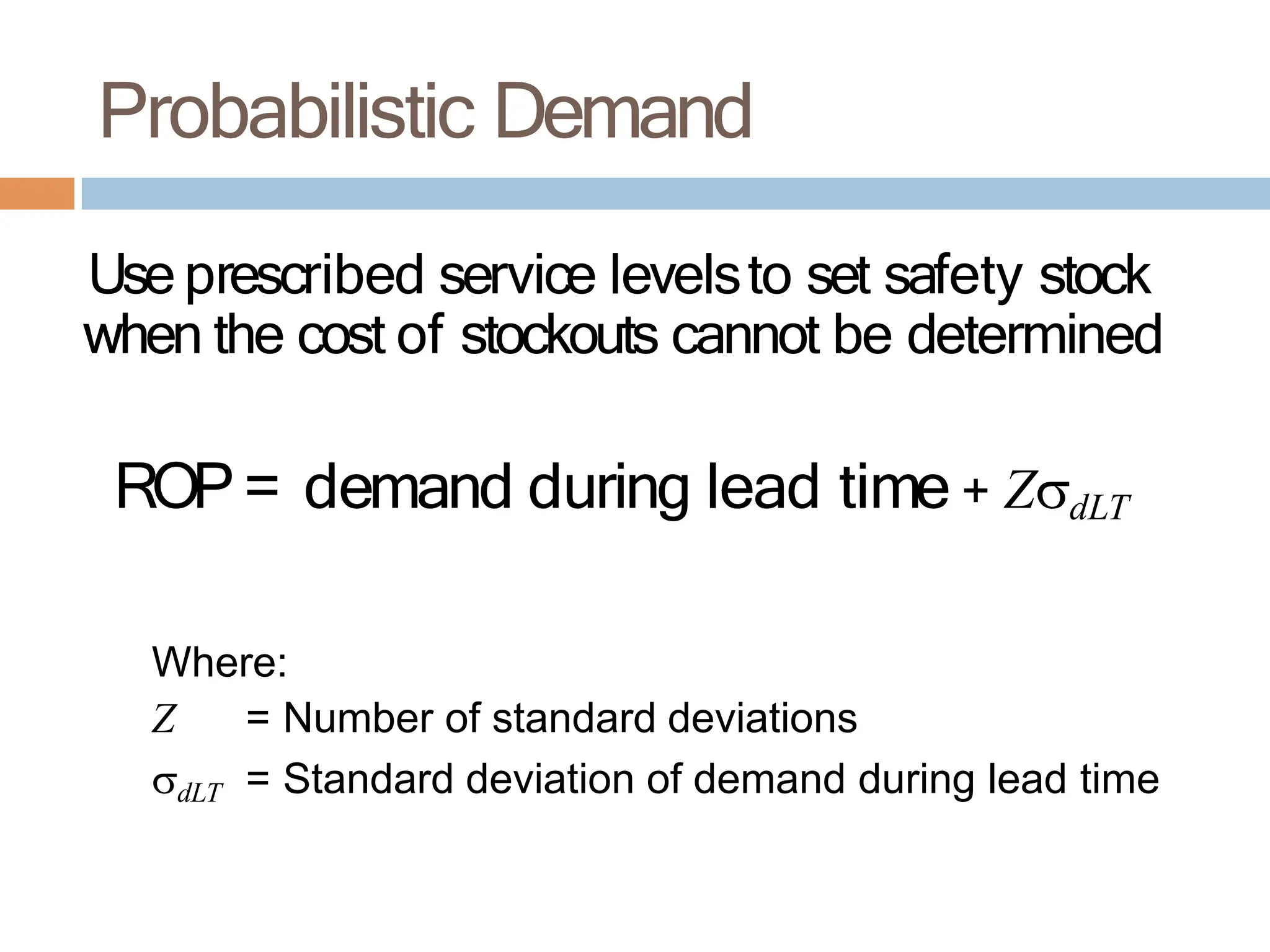
Probabilistic Demand
Use prescribed service levelsto set safety stock
when the cost of stockouts cannot be determined
ROP= demand during lead time + ZdLT
Where:
Z = Number of standard deviations
dLT = Standard deviation of demand during lead time
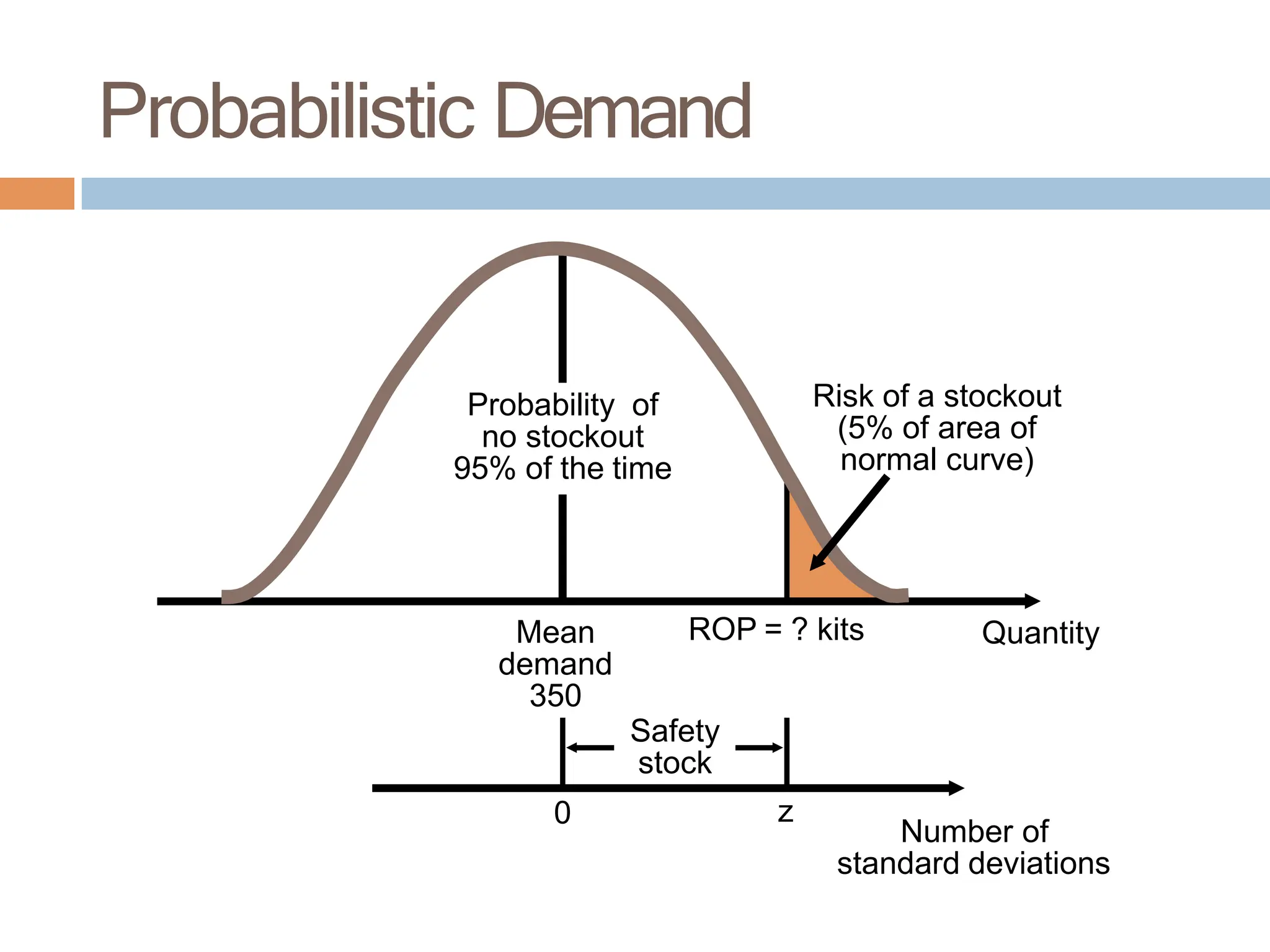
Safety
stock
Probability of
no stockout
95% of the time
Mean
demand
350
ROP = ? kits Quantity
Number of
standard deviations
0 z
Risk of a stockout
(5% of area of
normal curve)
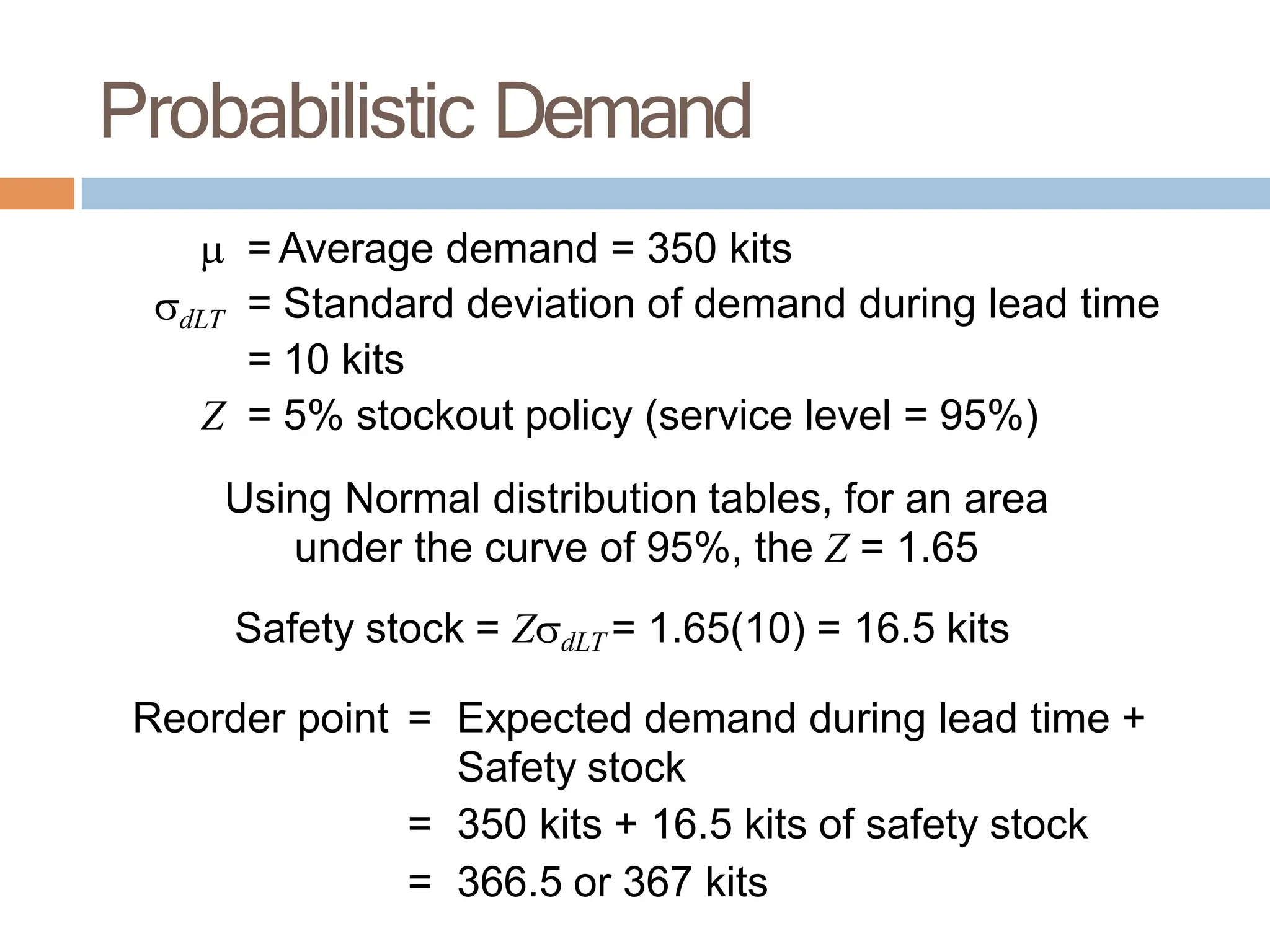
Probabilistic Demand
 = Average demand = 350 kits
dLT = Standard deviation of demand during lead time
= 10 kits
Z = 5% stockout policy (service level = 95%)
Using Normal distribution tables, for an area
under the curve of 95%, the Z = 1.65
Safety stock = ZdLT = 1.65(10) = 16.5 kits
Reorder point = Expected demand during lead time +
Safety stock
= 350 kits + 16.5 kits of safety stock
= 366.5 or 367 kits
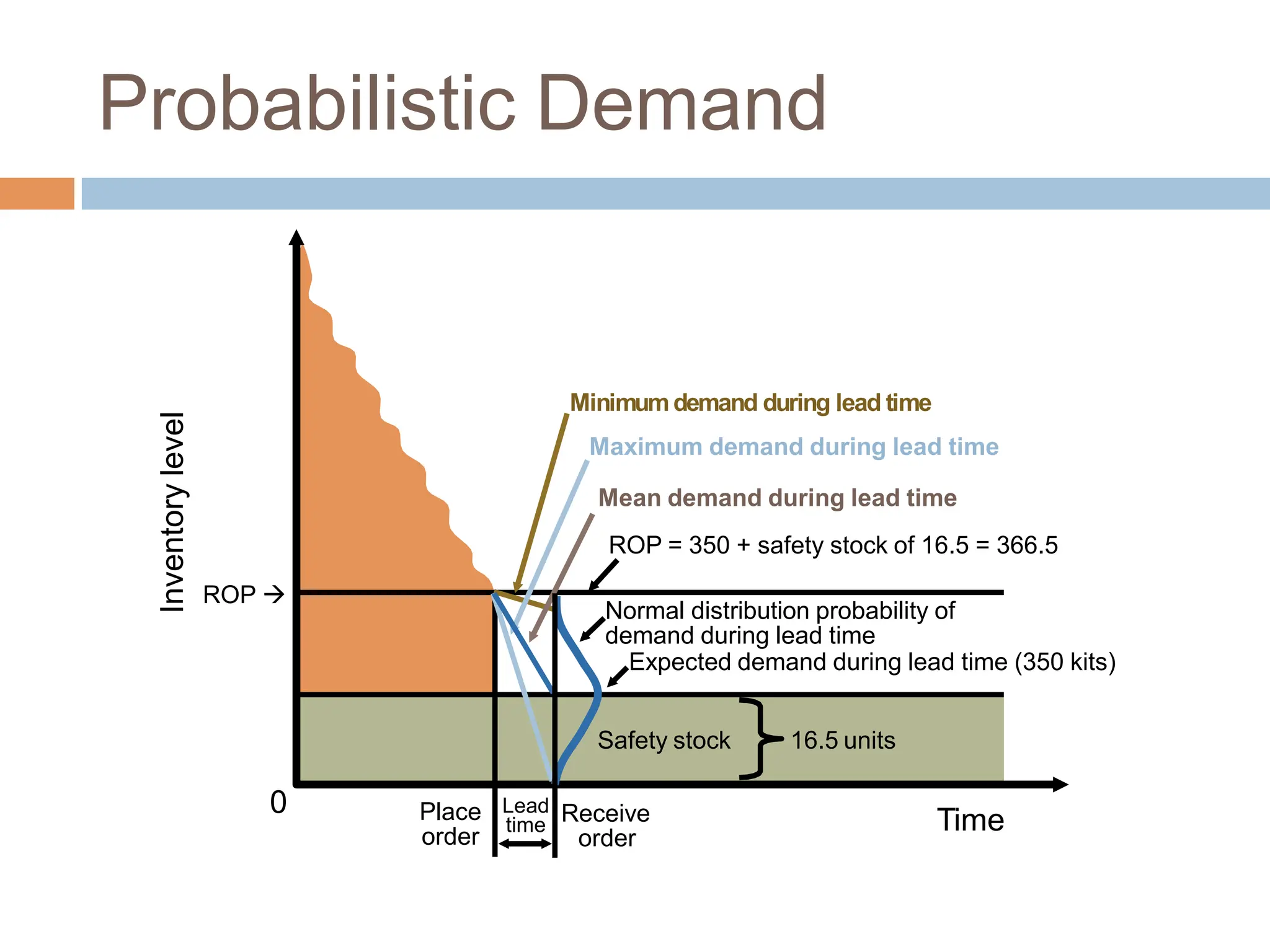
Probabilistic Demand
Safety stock 16.5 units
ROP 
Place
order
Probabilistic Demand
Inventory
level
Time
0
Normal distribution probability of
demand during lead time
Expected demand during lead time (350 kits)
Minimumdemand during lead time
Maximum demand during lead time
Mean demand during lead time
ROP = 350 + safety stock of 16.5 = 366.5
order
Lead Receive
time
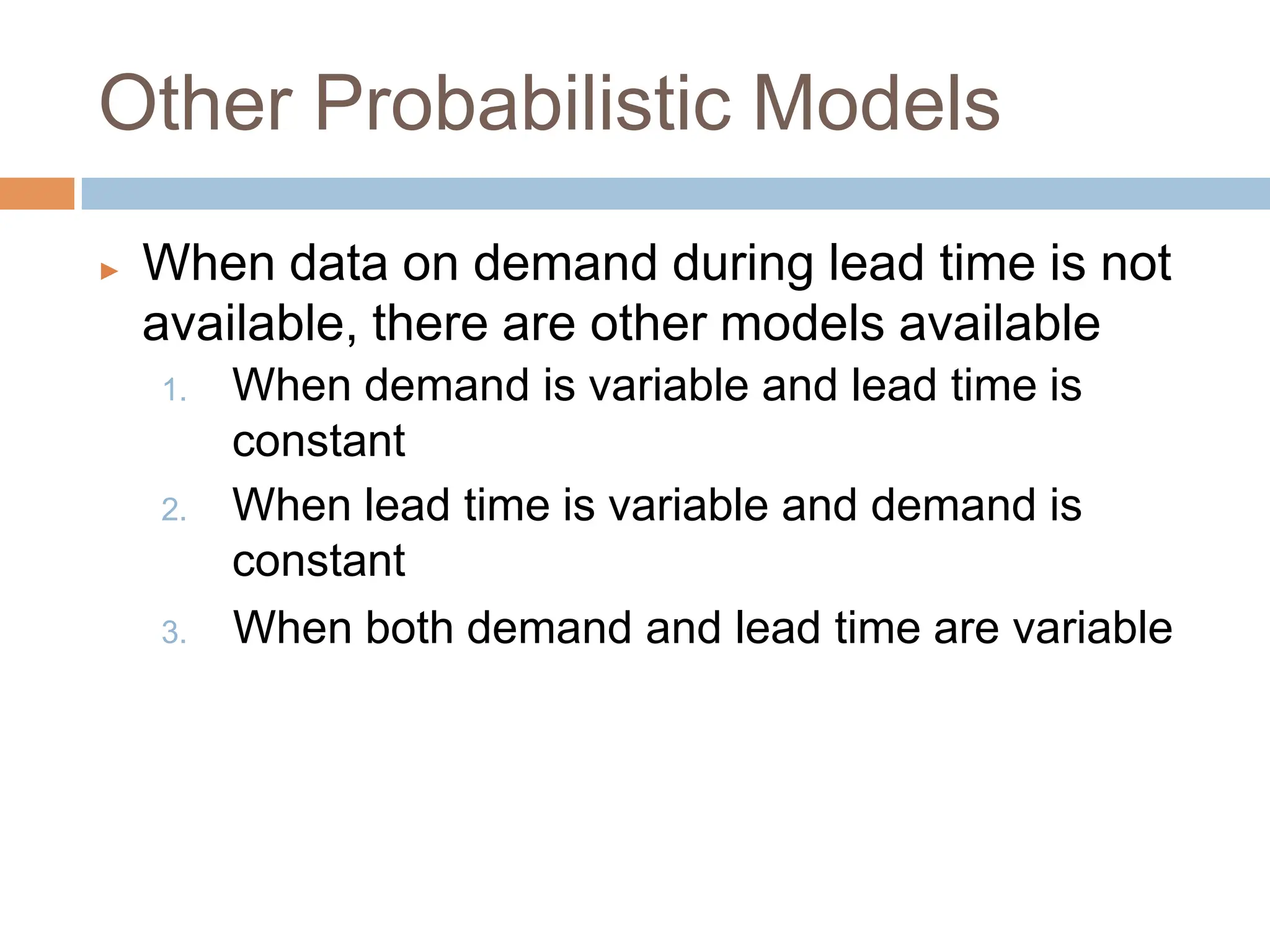
Other Probabilistic Models
▶ When data on demand during lead time is not
available, there are other models available
1. When demand is variable and lead time is
constant
2. When lead time is variable and demand is
constant
3. When both demand and lead time are variable
Other Probabilistic Models:
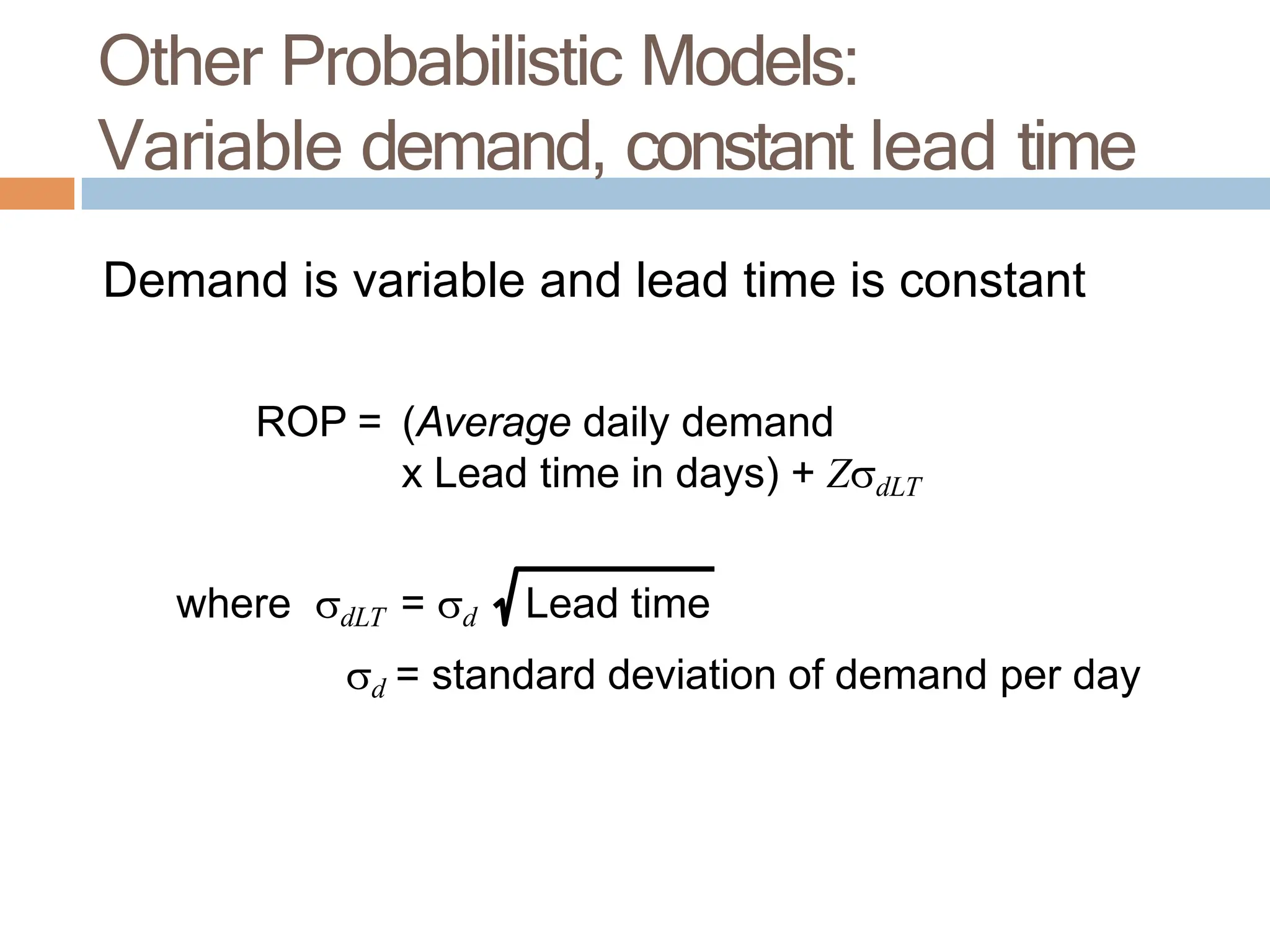
Variable demand, constant lead time
Demand is variable and lead time is constant
ROP = (Average daily demand
x Lead time in days) + ZdLT
where dLT = d Lead time
d = standard deviation of demand per day
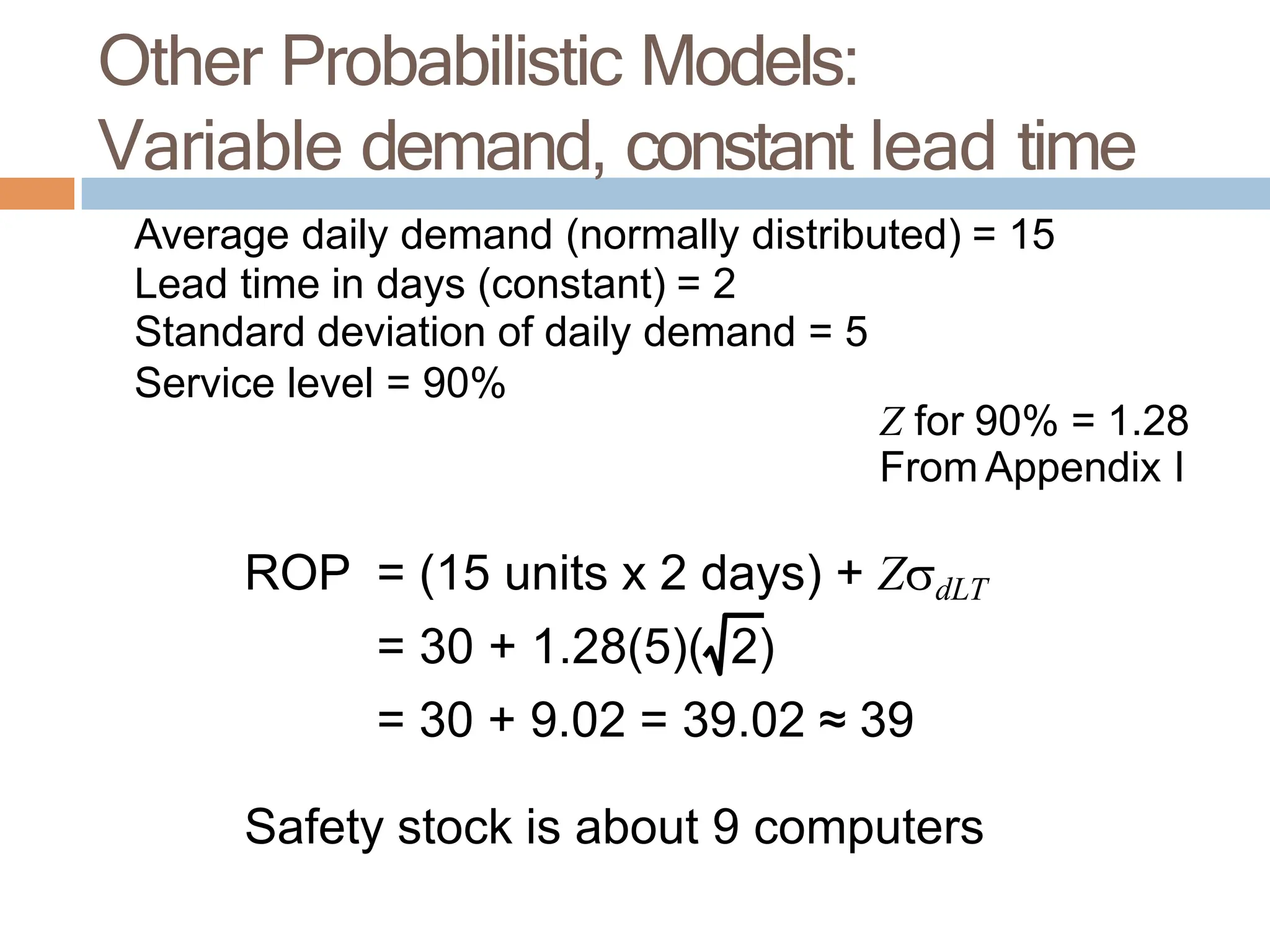
Average daily demand (normally distributed) = 15
Lead time in days (constant) = 2
Standard deviation of daily demand = 5
Service level = 90%
Z for 90% = 1.28
From Appendix I
ROP = (15 units x 2 days) + ZdLT
= 30 + 1.28(5)( 2)
= 30 + 9.02 = 39.02 ≈ 39
Safety stock is about 9 computers
Other Probabilistic Models:
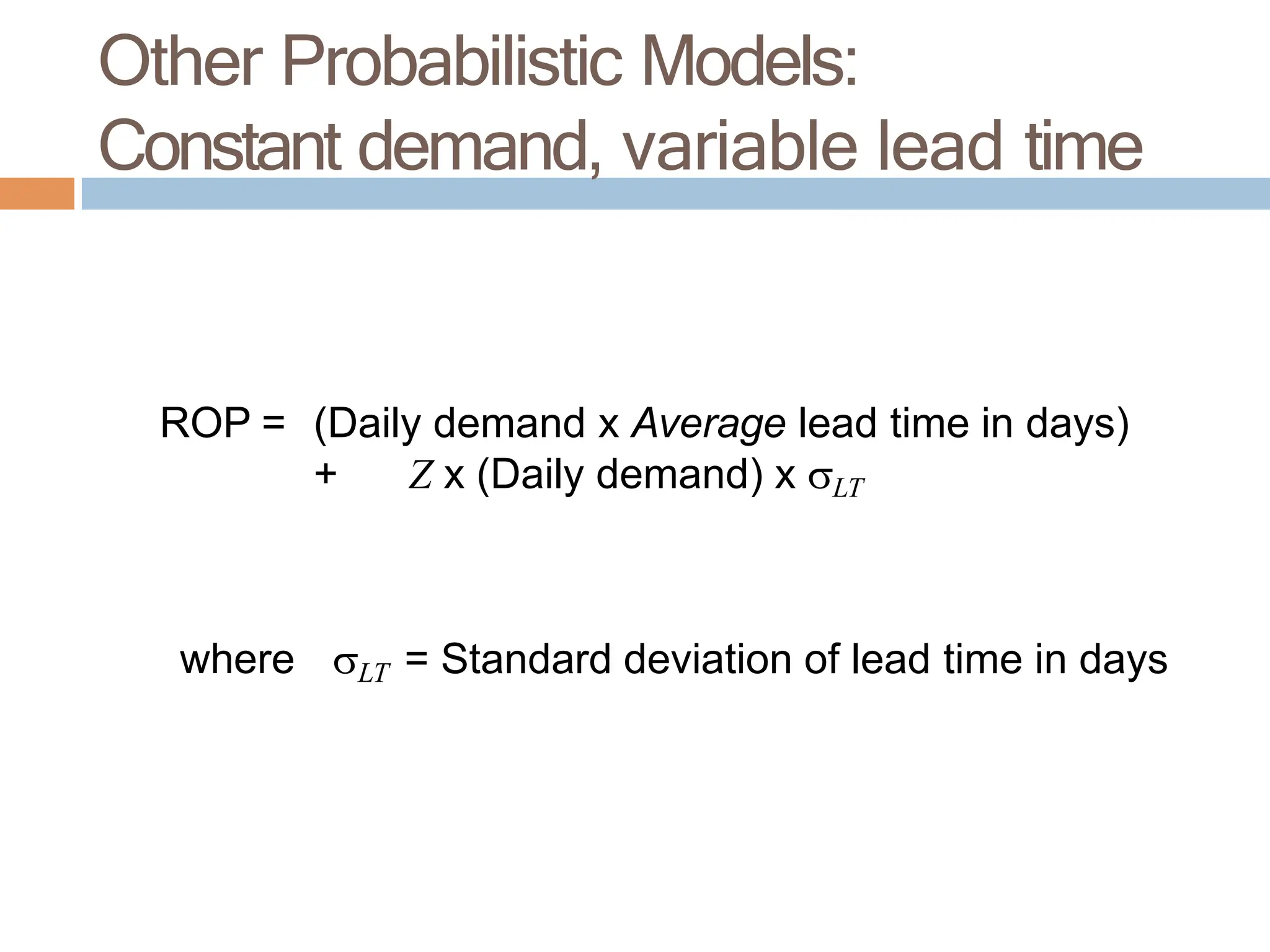
Variable demand, constant lead time
ROP = (Daily demand x Average lead time in days)
+ Z x (Daily demand) x LT
where LT = Standard deviation of lead time in days
Other Probabilistic Models:
Constant demand, variable lead time
Daily demand (constant) = 10
Average lead time = 6 days
Standard deviation of lead time = LT = 1
Service level = 98%, so Z (fromAppendix I) = 2.055
ROP = (10 units x 6 days) + 2.055(10 units)(1)
= 60 + 20.55 = 80.55
Reorder point is about 81 cameras
Other Probabilistic Models:
Constant demand, variable lead time
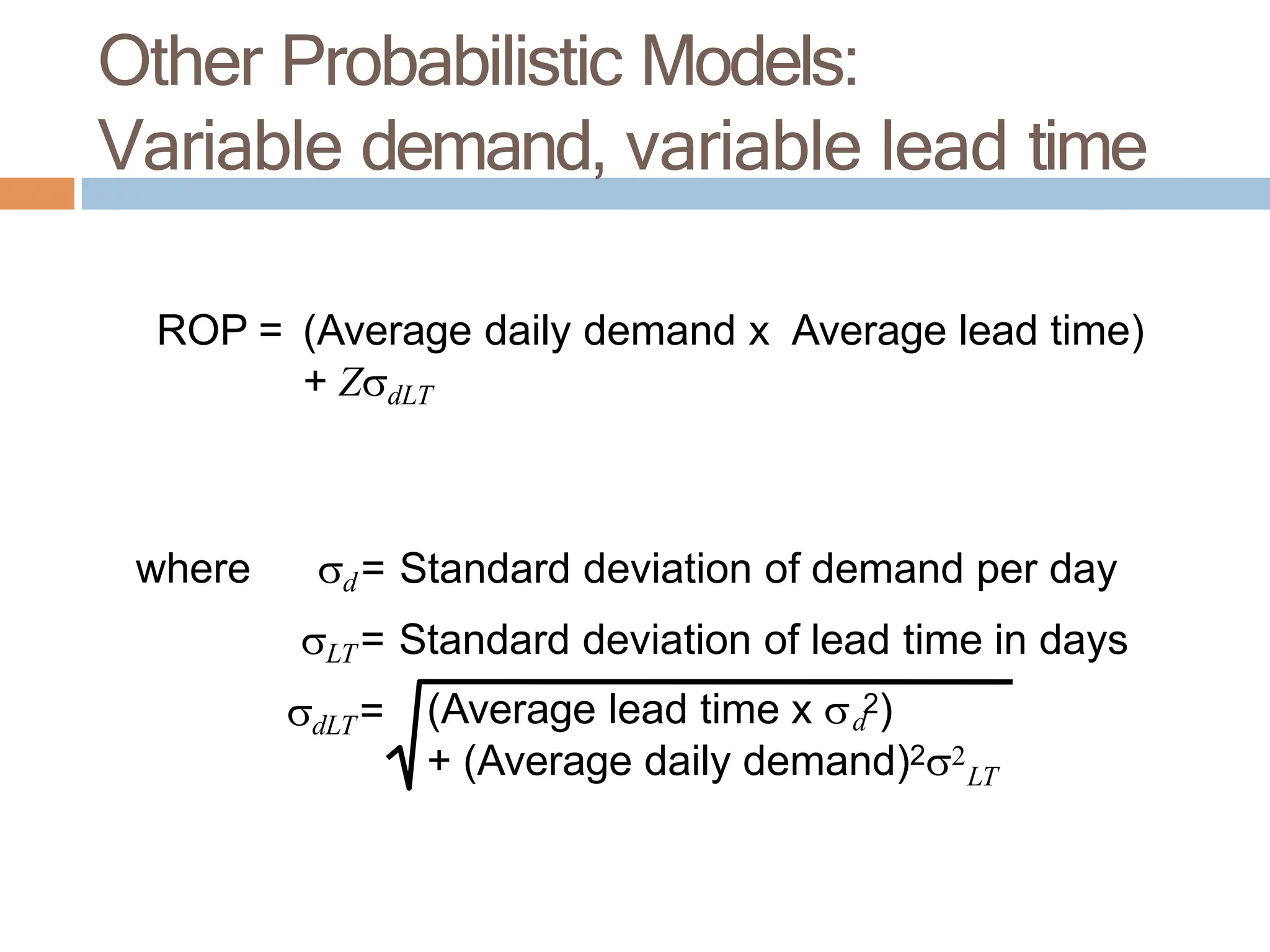
ROP = (Average daily demand x Average lead time)
+ ZdLT
where d= Standard deviation of demand per day
LT= Standard deviation of lead time in days
dLT= (Average lead time x  2)
d
+ (Average daily demand)2
LT
Other Probabilistic Models:
Variable demand, variable lead time
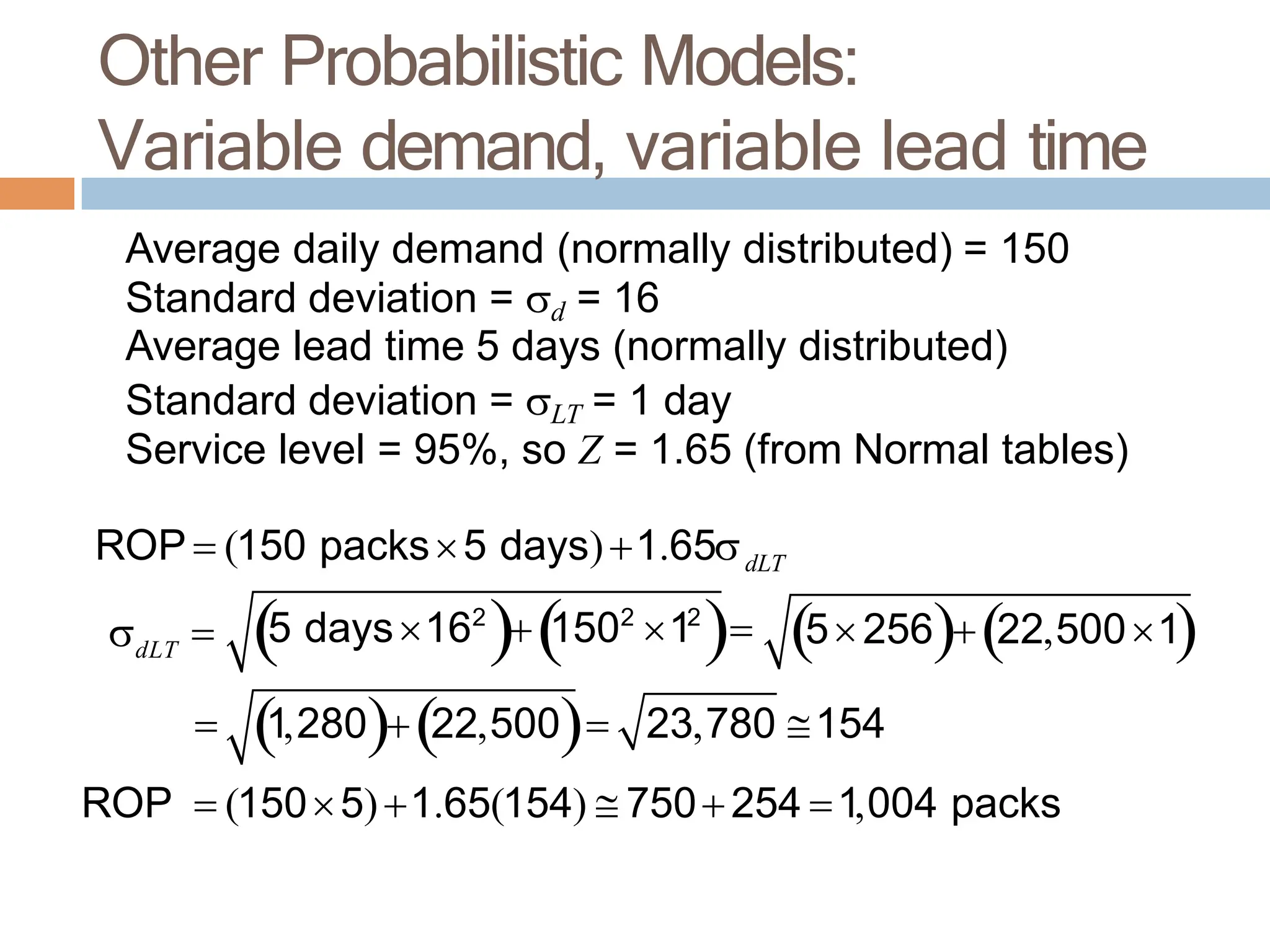
Average daily demand (normally distributed) = 150
Standard deviation = d = 16
Average lead time 5 days (normally distributed)
Standard deviation = LT = 1 day
Service level = 95%, so Z = 1.65 (from Normal tables)
ROP  (150 packs5 days)1.65dLT
dLT  5 days162
1502
12
 525622,5001
 1,28022,500 23,780 154
ROP  (1505)1.65(154)  750254 1,004 packs
Other Probabilistic Models:
Variable demand, variable lead time
Inventory Control Systems
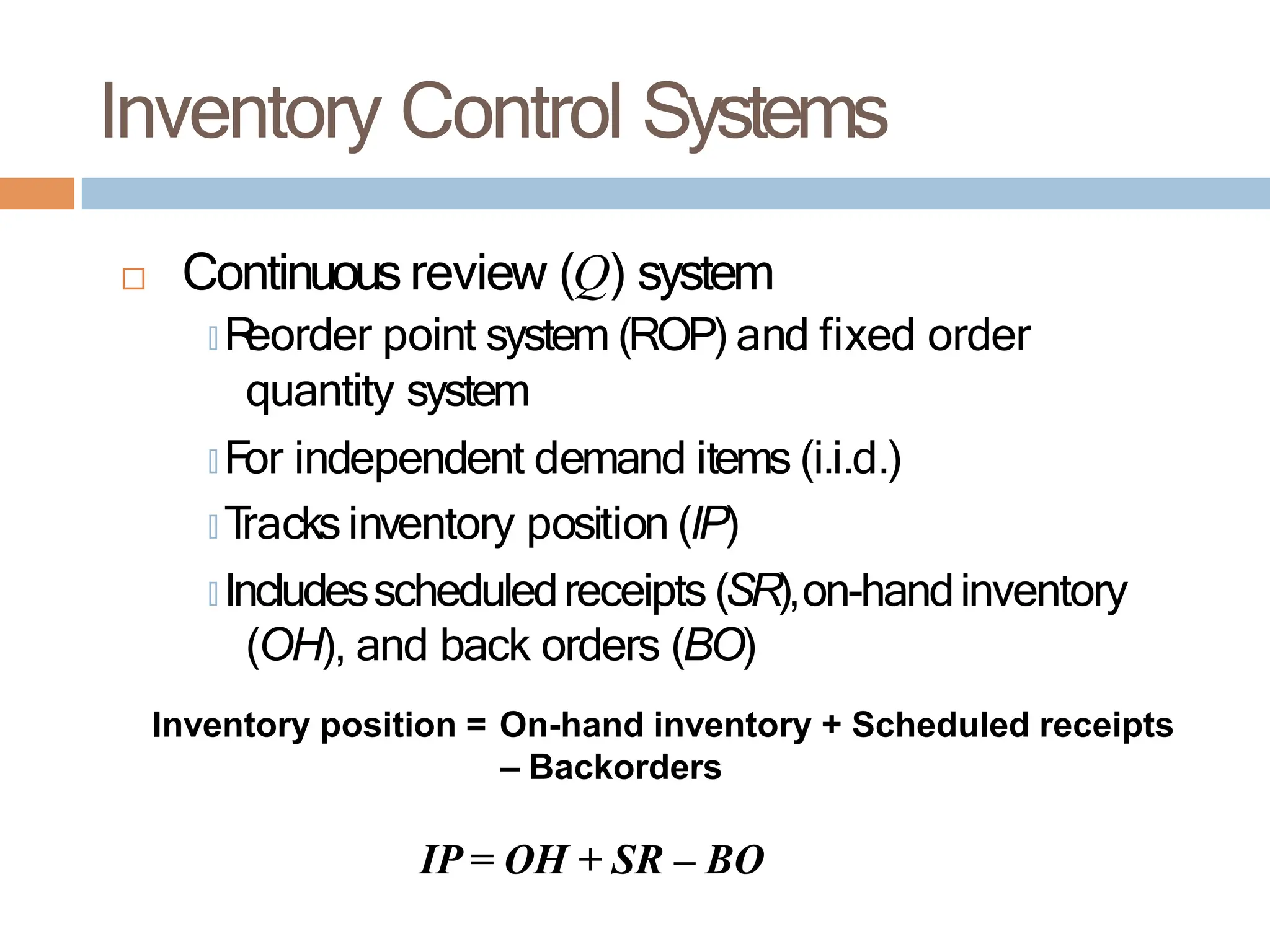
 Continuousreview (Q) system
🞑 R
eorder point system (ROP) and fixed order
quantity system
🞑 For independent demand items (i.i.d.)
🞑 T
racksinventory position (IP)
🞑 Includesscheduledreceipts (SR),on-handinventory
(OH), and back orders (BO)
Inventory position = On-hand inventory + Scheduled receipts
– Backorders
IP = OH + SR – BO
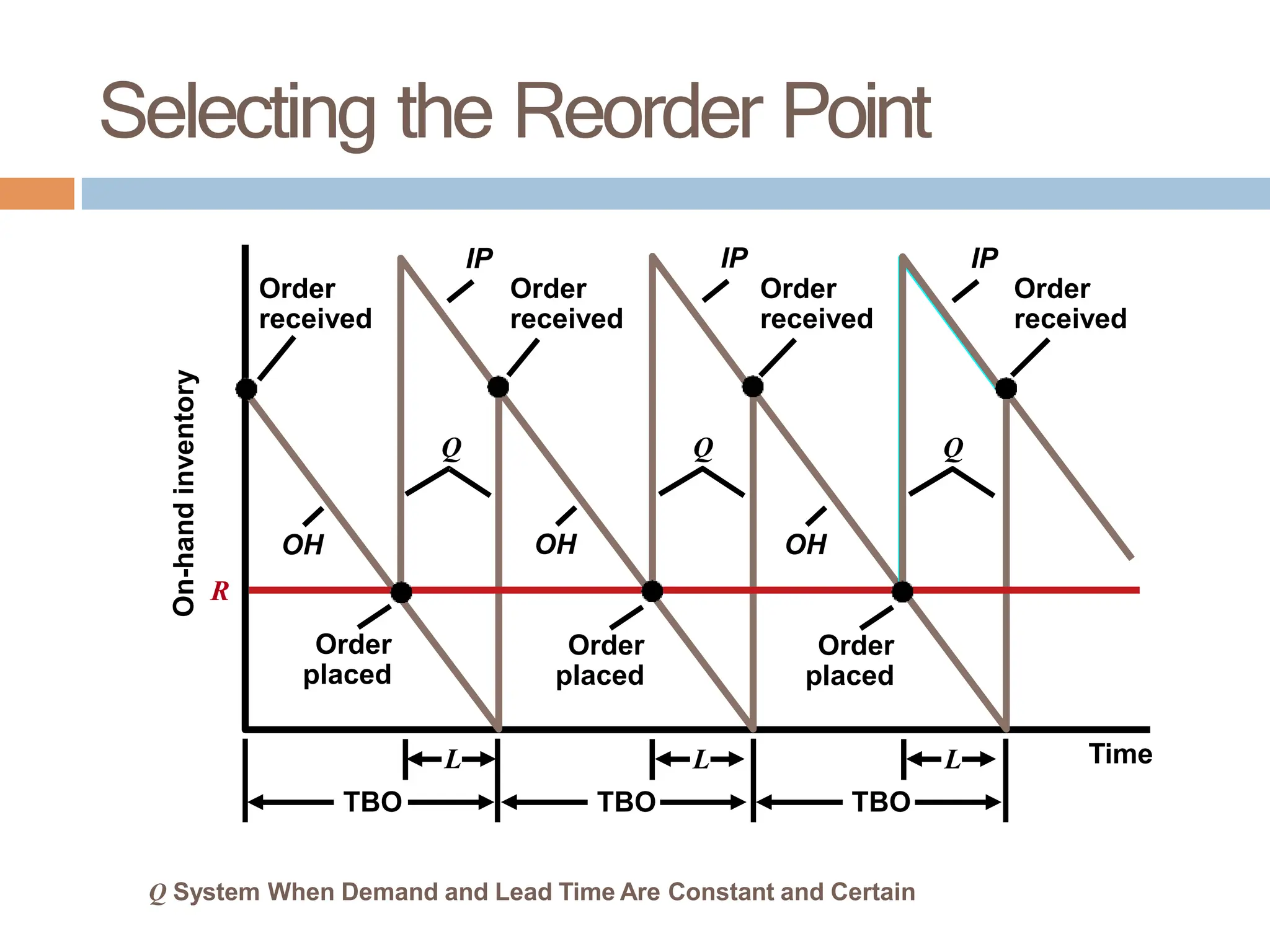
Selecting the Reorder Point
Time
On-hand
inventory
TBO TBO
L L
TBO
L
Order
placed
Order
placed
Order
placed
IP IP
IP
R
Q Q
Q
OH OH
OH
Order
received
Order
received
Order
received
Order
received
Q System When Demand and Lead Time Are Constant and Certain
Continuous R
eview Systems
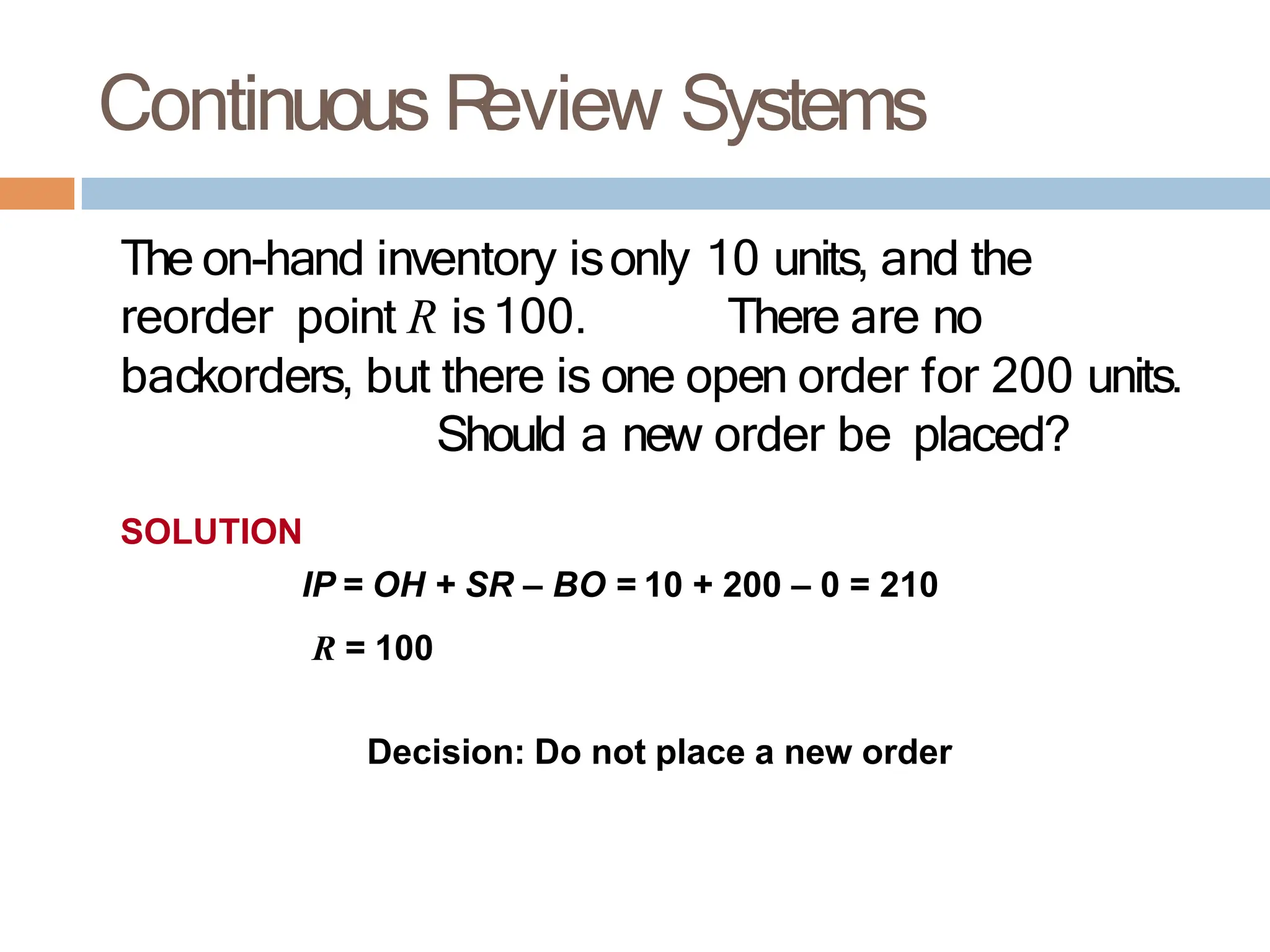
The on-hand inventory isonly 10 units, and the
reorder point R is100. There are no
backorders, but there is one open order for 200 units.
Should a new order be placed?
SOLUTION
IP = OH + SR – BO = 10 + 200 – 0 = 210
R = 100
Decision: Do not place a new order
Continuous R
eview Systems
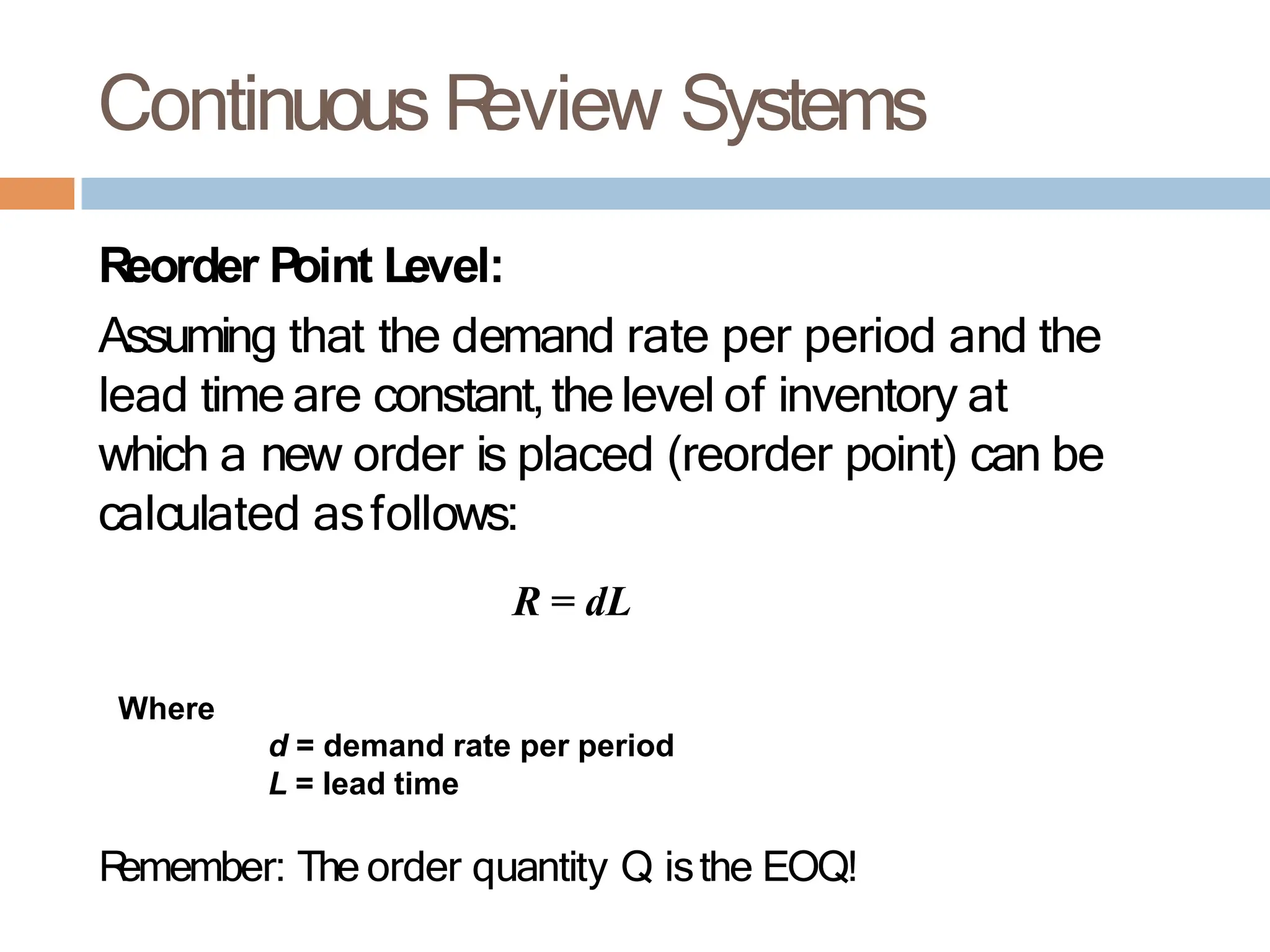
Reorder Point Level:
Assuming that the demand rate per period and the
lead time are constant,thelevel of inventory at
which a new order is placed (reorder point) can be
calculated asfollows:
R = dL
Where
d = demand rate per period
L = lead time
R
emember: The order quantity Q isthe EOQ!
Continuous R
eview Systems
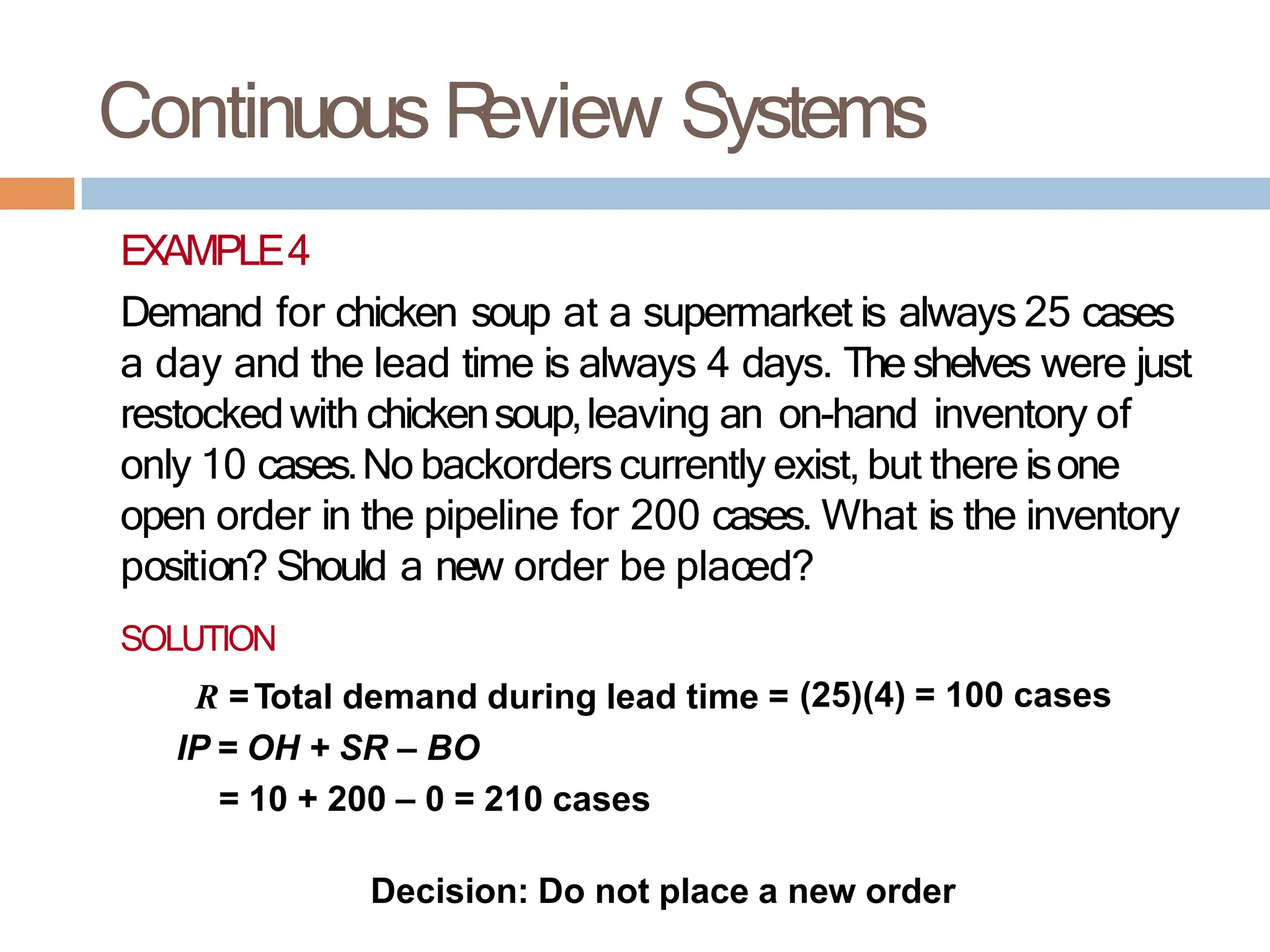
EXAMPLE4
Demand for chicken soup at a supermarket is always 25 cases
a day and the lead time is always 4 days. The shelves were just
restockedwith chickensoup,leaving an on-hand inventory of
only 10 cases.No backorders currently exist, but there isone
open order in the pipeline for 200 cases. What is the inventory
position? Should a new order be placed?
SOLUTION
R =Total demand during lead time = (25)(4) = 100 cases
IP = OH + SR – BO
= 10 + 200 – 0 = 210 cases
Decision: Do not place a new order
Continuous R
eview Systems
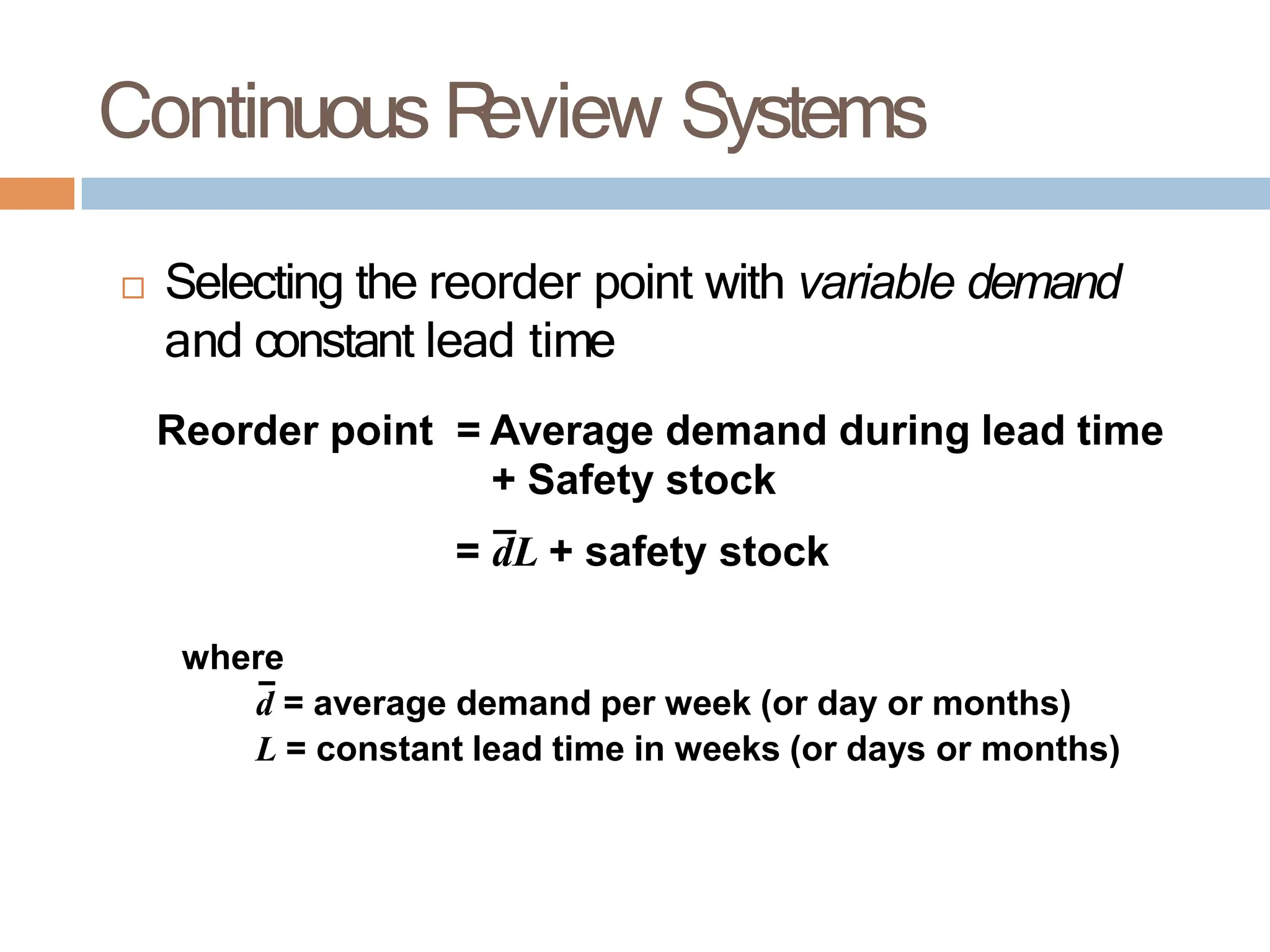
 Selecting the reorder point with variable demand
and constant lead time
Reorder point = Average demand during lead time
+ Safety stock
= dL + safety stock
where
d = average demand per week (or day or months)
L = constant lead time in weeks (or days or months)
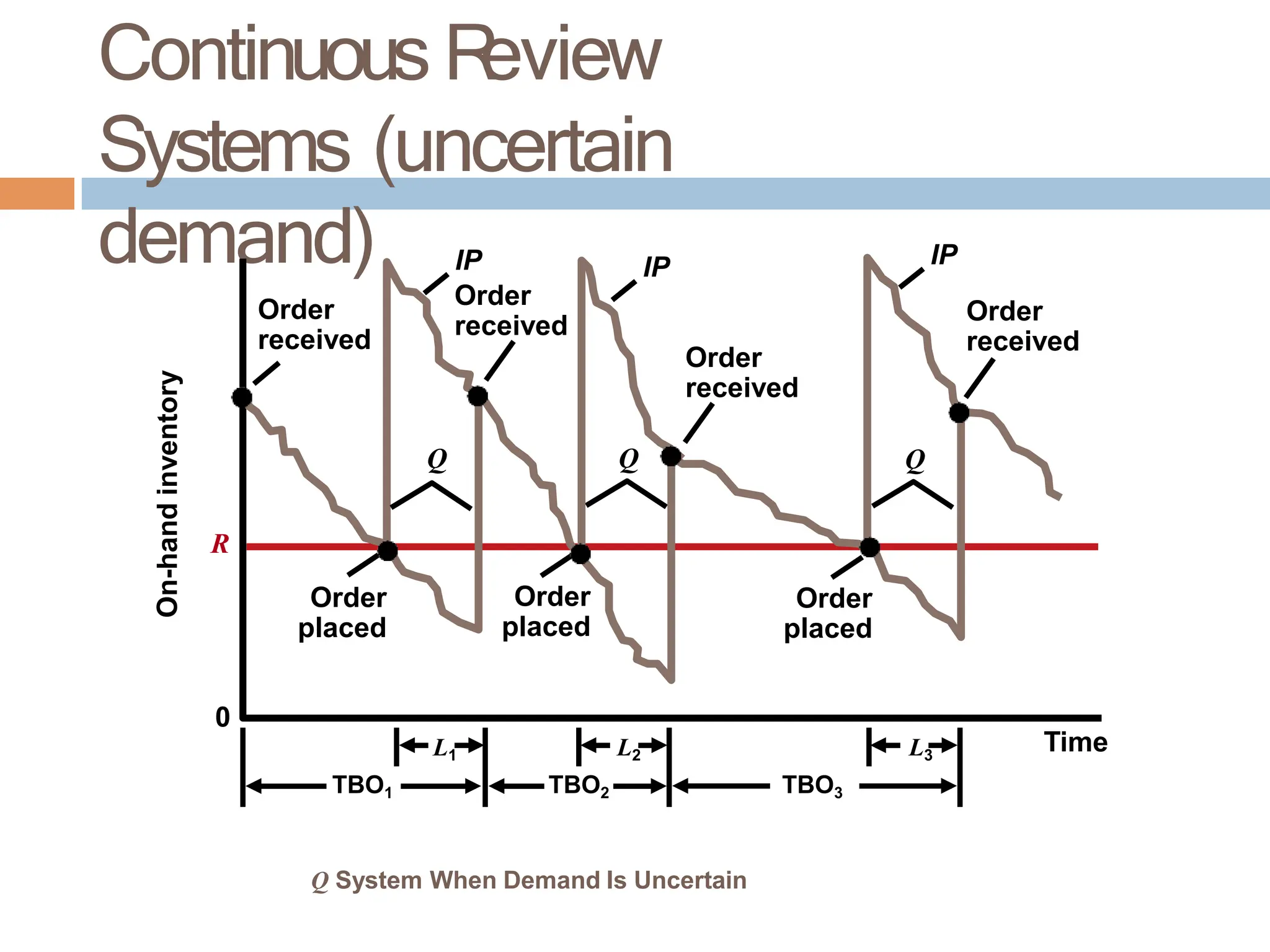
Continuous R
eview
Systems (uncertain
demand)
Time
On-hand
inventory
TBO1 TBO2 TBO3
L1 L2 L3
R
Order
received
Q
Order
placed
Order
placed
IP
Order
received
IP
Q
Order
placed
Q
Order
received
Order
received
0
IP
Q System When Demand Is Uncertain
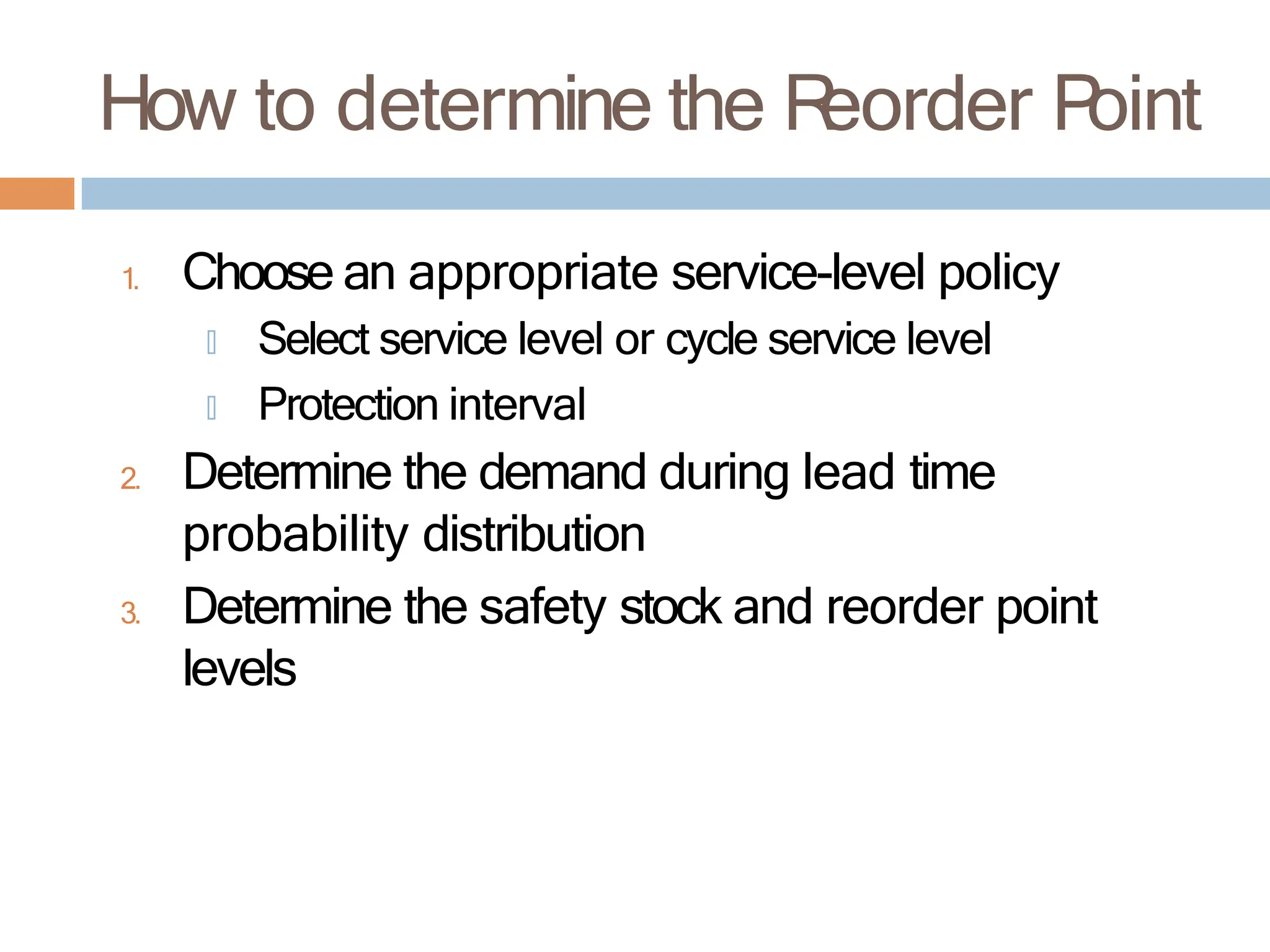
How to determine the R
eorder P
oint
1. Choose an appropriate service-level policy
🞑 Select service level or cycle service level
🞑 Protection interval
2. Determine the demand during lead time
probability distribution
3. Determine the safety stock and reorder point
levels
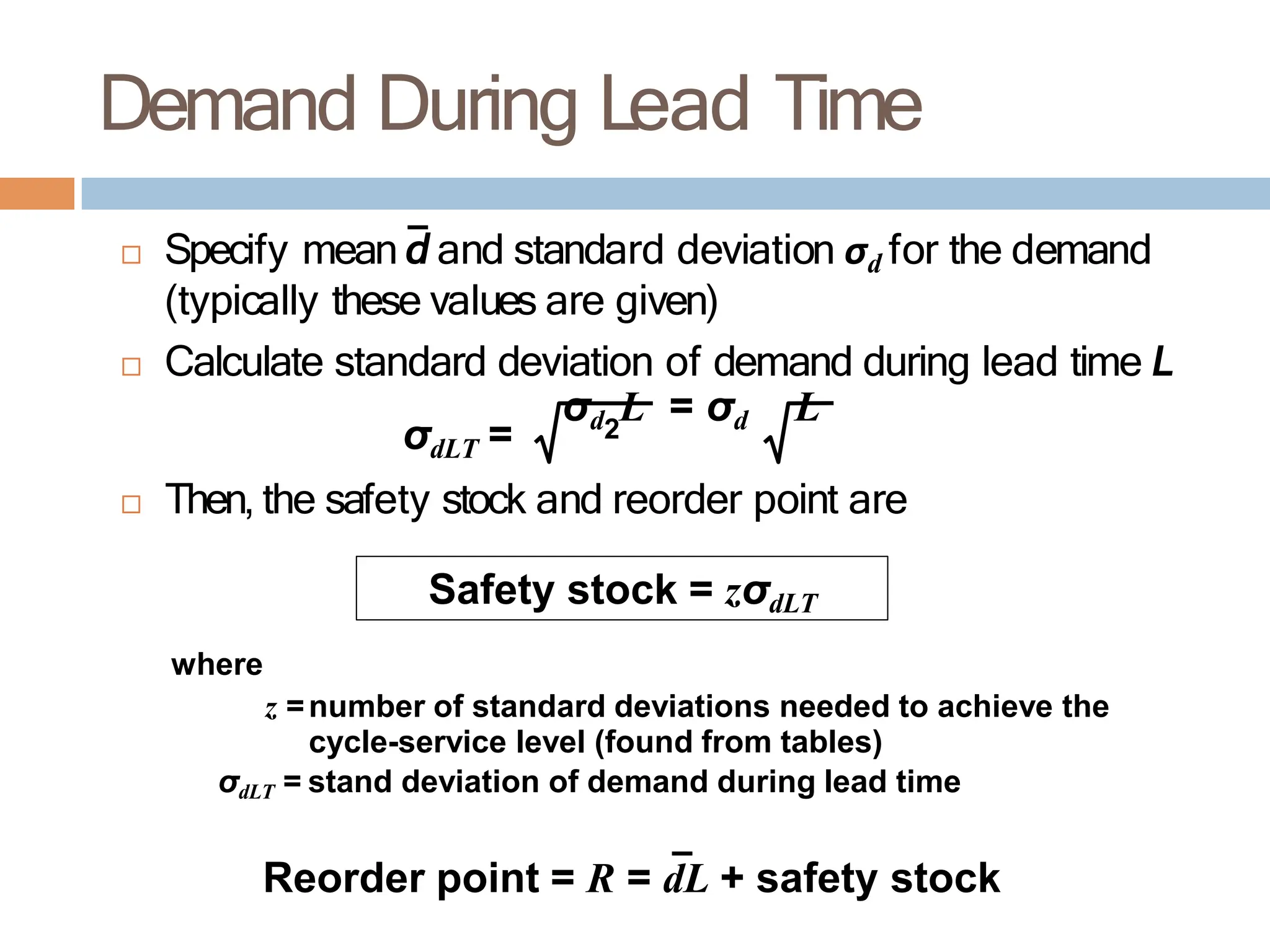
Demand During Lead Time
 Specify mean d and standard deviation σd for the demand
(typically these values are given)
 Calculate standard deviation of demand during lead time L
σdLT =
σd L = σd L
2
 Then, the safety stock and reorder point are
Safety stock = zσdLT
where
z =number of standard deviations needed to achieve the
cycle-service level (found from tables)
σdLT = stand deviation of demand during lead time
Reorder point = R = dL + safety stock
Demand During Lead Time
Average
demand
during
lead time
Cycle-service level = 85%
Probability of stockout
(1.0 – 0.85 = 0.15)
R
zσdLT
Finding Safety Stock with a Normal Probability Distribution for an 85 Percent
Cycle-Service Level
R
eorder P
oint for Variable Demand
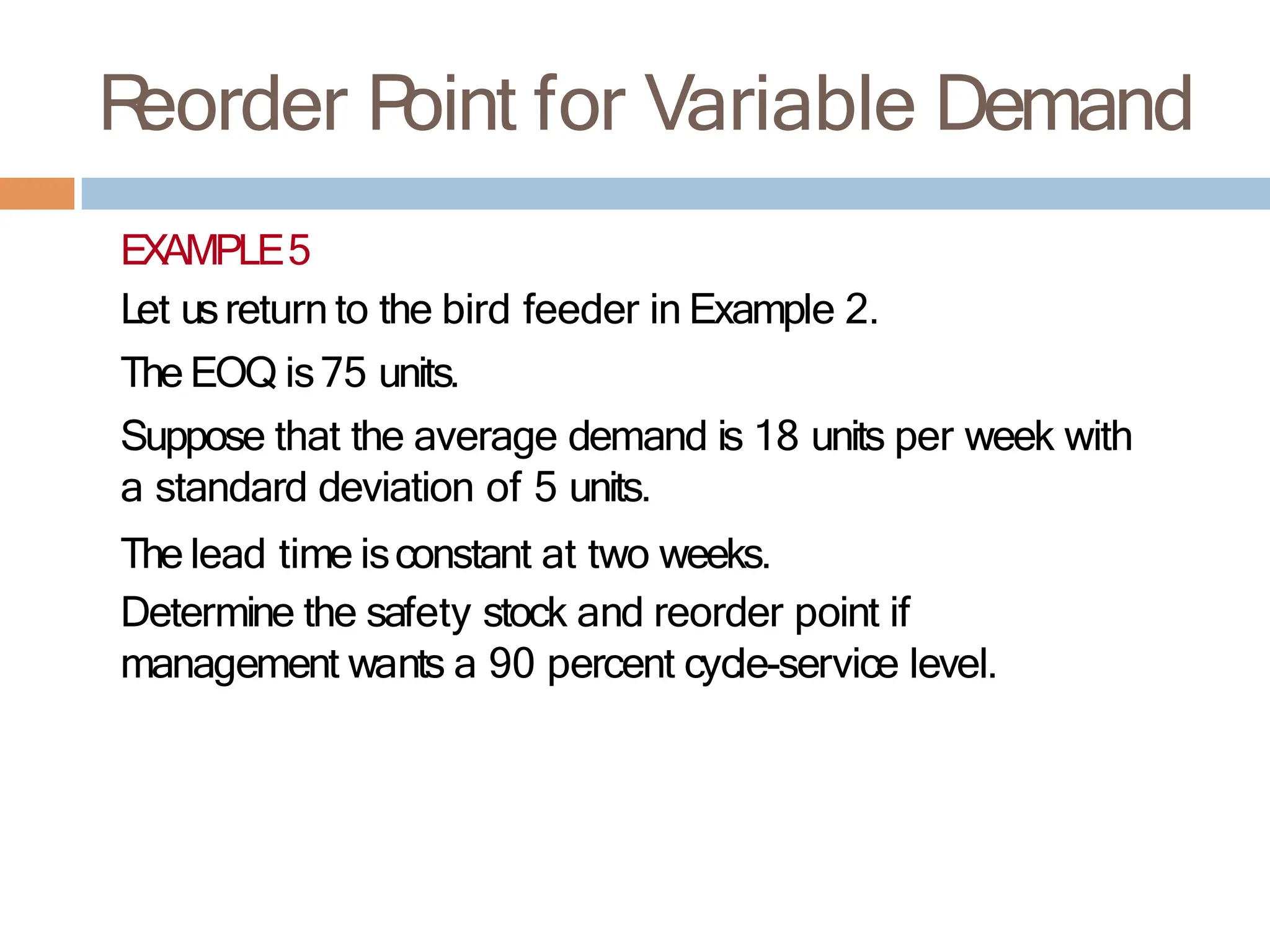
EXAMPLE5
Let usreturn to the bird feeder in Example 2.
The EOQ is75 units.
Suppose that the average demand is 18 units per week with
a standard deviation of 5 units.
The lead time isconstant at two weeks.
Determine the safety stock and reorder point if
management wants a 90 percent cycle-service level.
R
eorder P
oint for Variable Demand
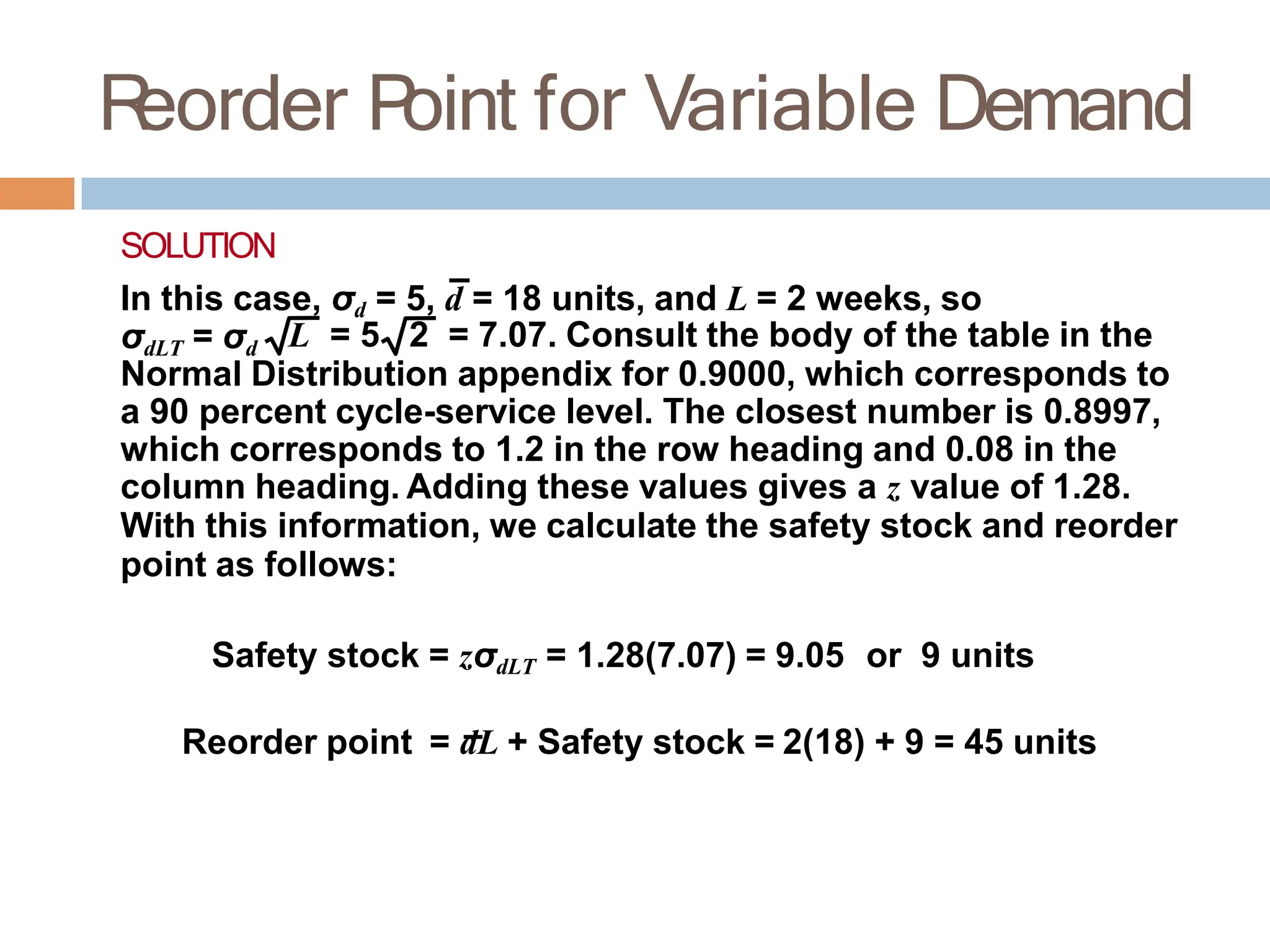
SOLUTION
In this case, σd = 5, d = 18 units, and L = 2 weeks, so
σdLT = σd L = 5 2 = 7.07. Consult the body of the table in the
Normal Distribution appendix for 0.9000, which corresponds to
a 90 percent cycle-service level. The closest number is 0.8997,
which corresponds to 1.2 in the row heading and 0.08 in the
column heading. Adding these values gives a z value of 1.28.
With this information, we calculate the safety stock and reorder
point as follows:
Safety stock = zσdLT = 1.28(7.07) = 9.05 or 9 units
Reorder point = dL + Safety stock = 2(18) + 9 = 45 units
R
eorder P
oint for Variable Demand
EXAMPLE6
Suppose that the demand during lead time is normally distributed with an
average of 85 and σdLT = 40. Find the safety stock, and reorder point R,
for a 95 and 85 percent cycle-service level.
SOLUTION
Safety stock = zσdLT = 1.645(40) = 65.8 or 66 units
R = Average demand during lead time + Safety stock
R = 85 + 66 = 151 units
Find the safety stock, and reorder point R, for an 85 percent
cycle-service level.
Safety stock = zσdLT = 1.04(40) = 41.6 or 42 units
R = Average demand during lead time + Safety stock
R = 85 + 42 = 127 units
R
eorder P
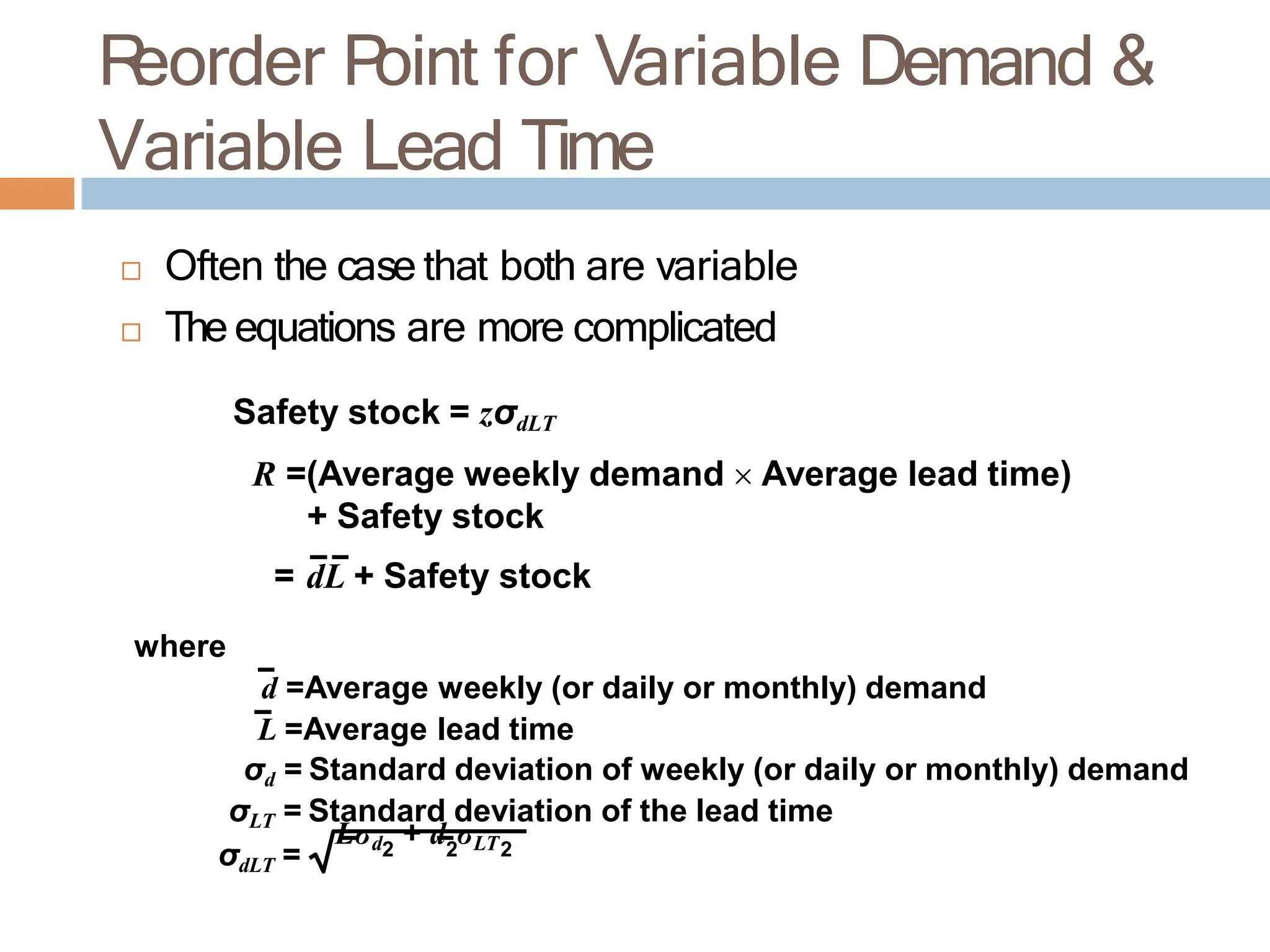
oint for Variable Demand &
Variable Lead Time
σdLT =
Lσd + d σLT
2 2 2
 Often the case that both are variable
 The equations are more complicated
Safety stock = zσdLT
R =(Average weekly demand  Average lead time)
+ Safety stock
= dL + Safety stock
where
d =Average weekly (or daily or monthly) demand
L =Average lead time
σd = Standard deviation of weekly (or daily or monthly) demand
σLT = Standard deviation of the lead time
R
eorder P
oint for Variable
Demand & Variable Lead Time
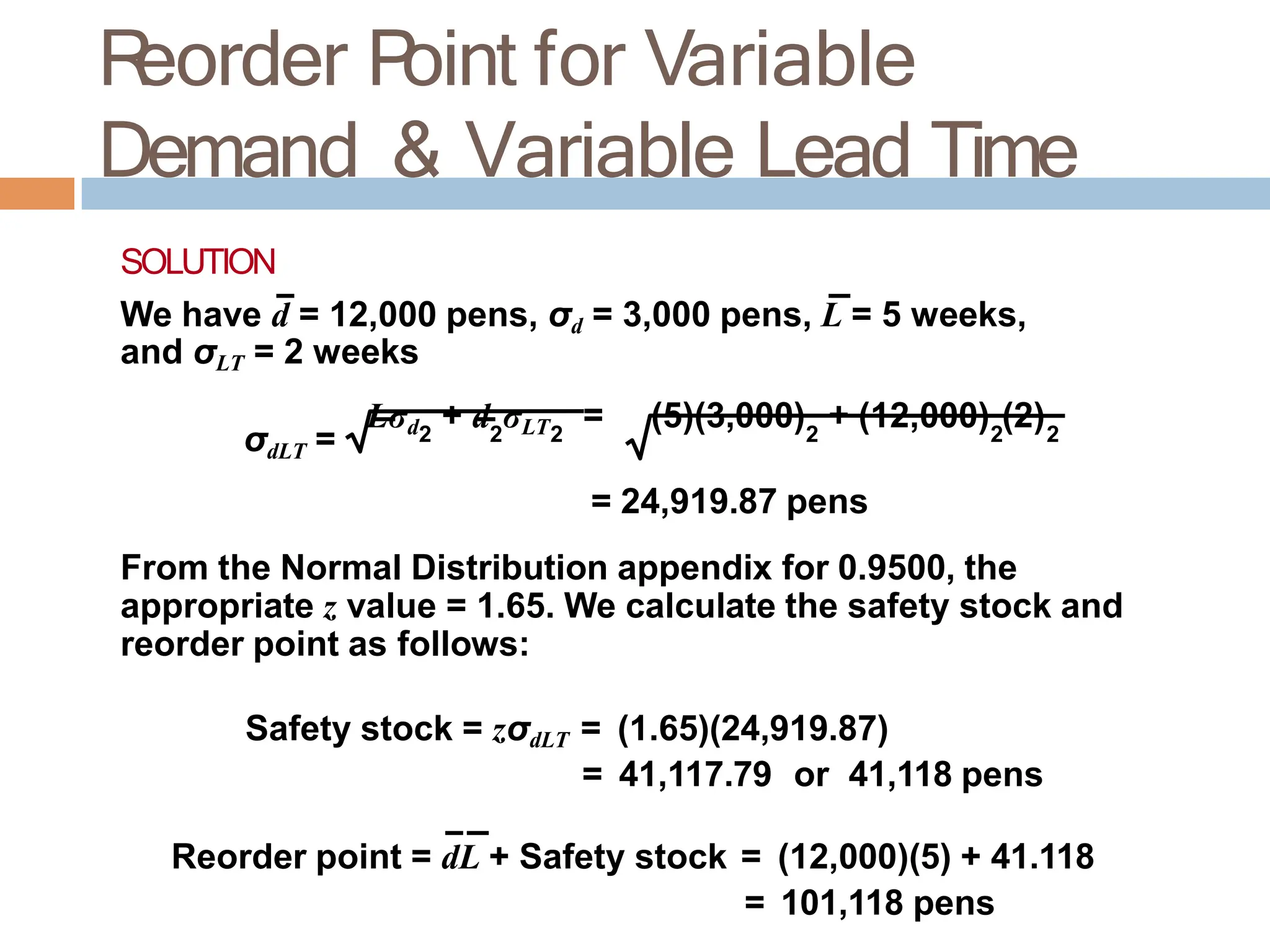
EXAMPLE7
The Office Supply Shop estimates that the average demand for
a popular ball-point pen is12,000 pens per week with a
standard deviation of 3,000 pens. The current inventory policy
callsfor replenishment orders of 156,000 pens. The average
lead time from the distributor is5 weeks, with a standard
deviation of 2 weeks. If management wants a 95 percent cycle-
service level, what should the reorder point be?
R
eorder P
oint for Variable
Demand & Variable Lead Time
SOLUTION
We have d = 12,000 pens, σd = 3,000 pens, L = 5 weeks,
and σLT = 2 weeks
σdLT =
Lσd + d σLT = (5)(3,000) + (12,000) (2)
2 2 2 2 2 2
= 24,919.87 pens
From the Normal Distribution appendix for 0.9500, the
appropriate z value = 1.65. We calculate the safety stock and
reorder point as follows:
Safety stock = zσdLT = (1.65)(24,919.87)
= 41,117.79 or 41,118 pens
Reorder point = dL + Safety stock = (12,000)(5) + 41.118
= 101,118 pens
R
eorder P
oint for Variable
Demand & Variable Lead Time
EXAMPLE8
Grey Wolf lodge isa popular 500-room hotel in the North
Woods. Managers need to keep close tabson all of the room
service items,including a special pint-scented bar soap. The
daily demand for the soap is275 bars, with a standard
deviation of 30 bars. Ordering costis$10 and theinventory
holding cost is $0.30/bar/year. The lead time from the supplier
is5 days, with a standard deviation of 1 day. The lodge is
open 365 days a year.
What should the reorder point be for the bar of soap if
management wants to have a 99 percent cycle-service?
R
eorder P
oint for Variable
Demand & Variable Lead Time
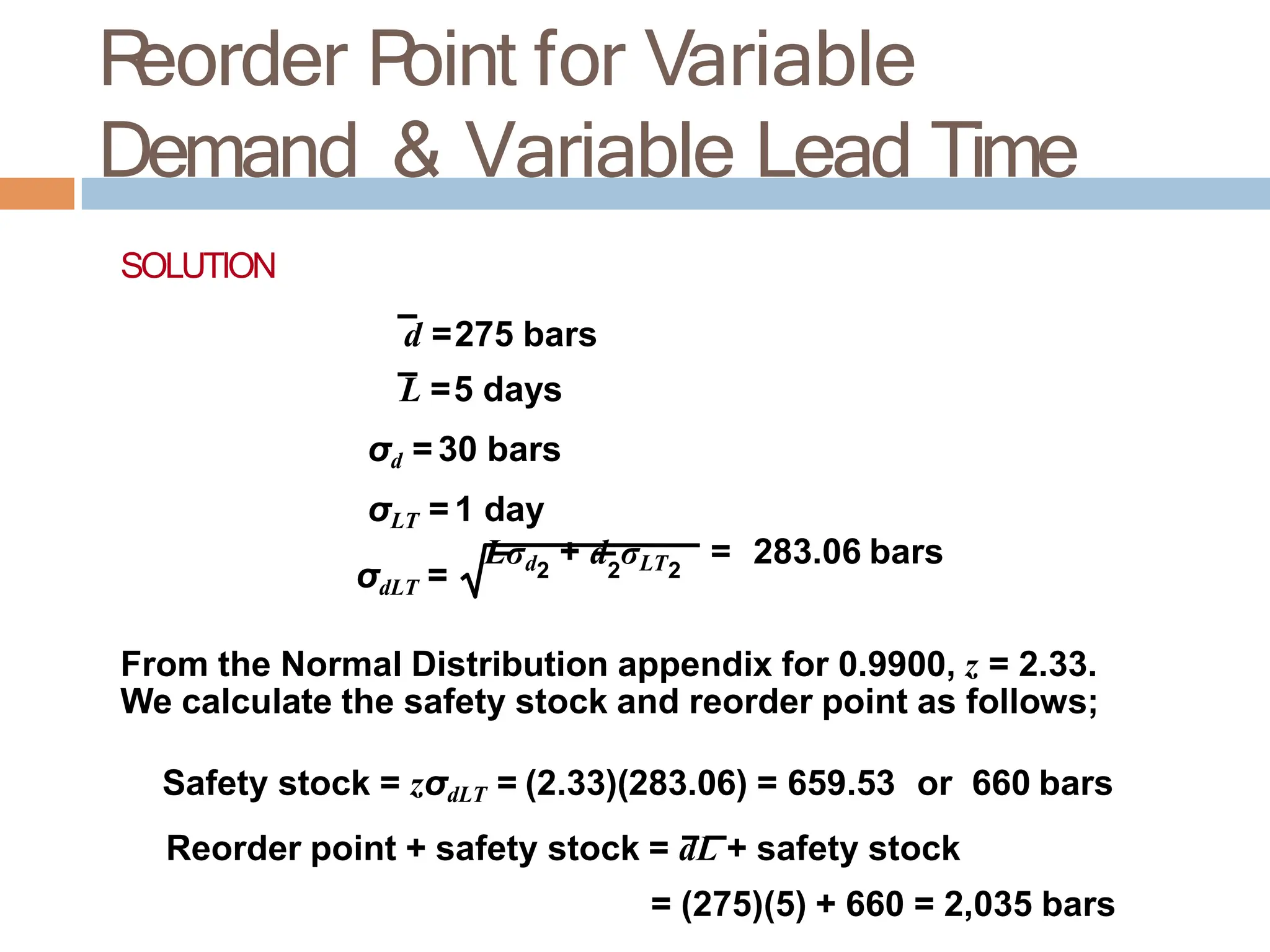
SOLUTION
d =275 bars
L =5 days
σd = 30 bars
σLT = 1 day
Lσd + d σLT = 283.06 bars
2 2 2
σdLT =
From the Normal Distribution appendix for 0.9900, z = 2.33.
We calculate the safety stock and reorder point as follows;
Safety stock = zσdLT = (2.33)(283.06) = 659.53 or 660 bars
Reorder point + safety stock = dL + safety stock
= (275)(5) + 660 = 2,035 bars
P
eriodic R
eview (or fixed period)
System (P)
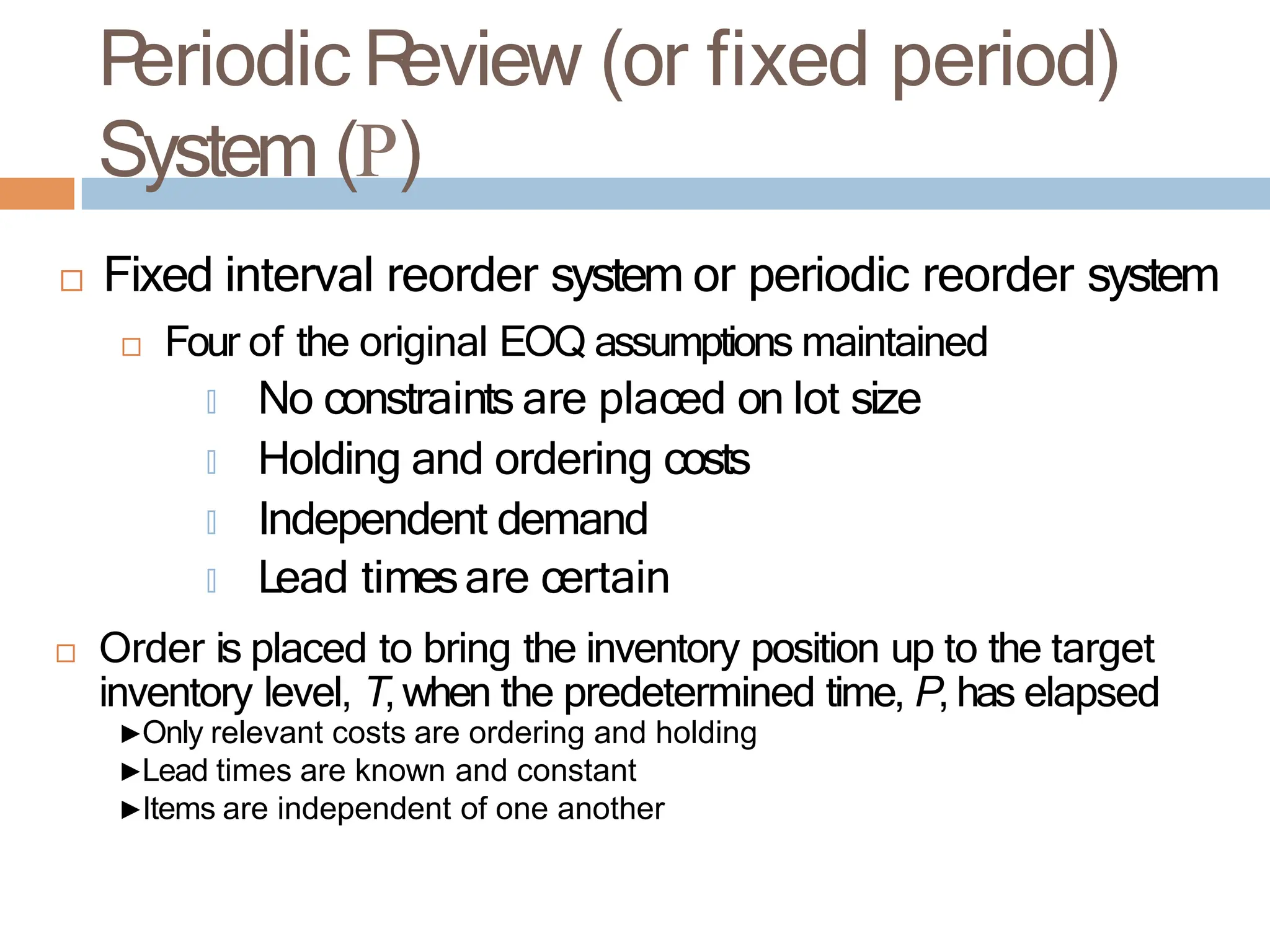
 Fixed interval reorder system or periodic reorder system
 Four of the original EOQ assumptions maintained
🞑 No constraints are placed on lot size
🞑 Holding and ordering costs
🞑 Independent demand
🞑 Lead timesare certain
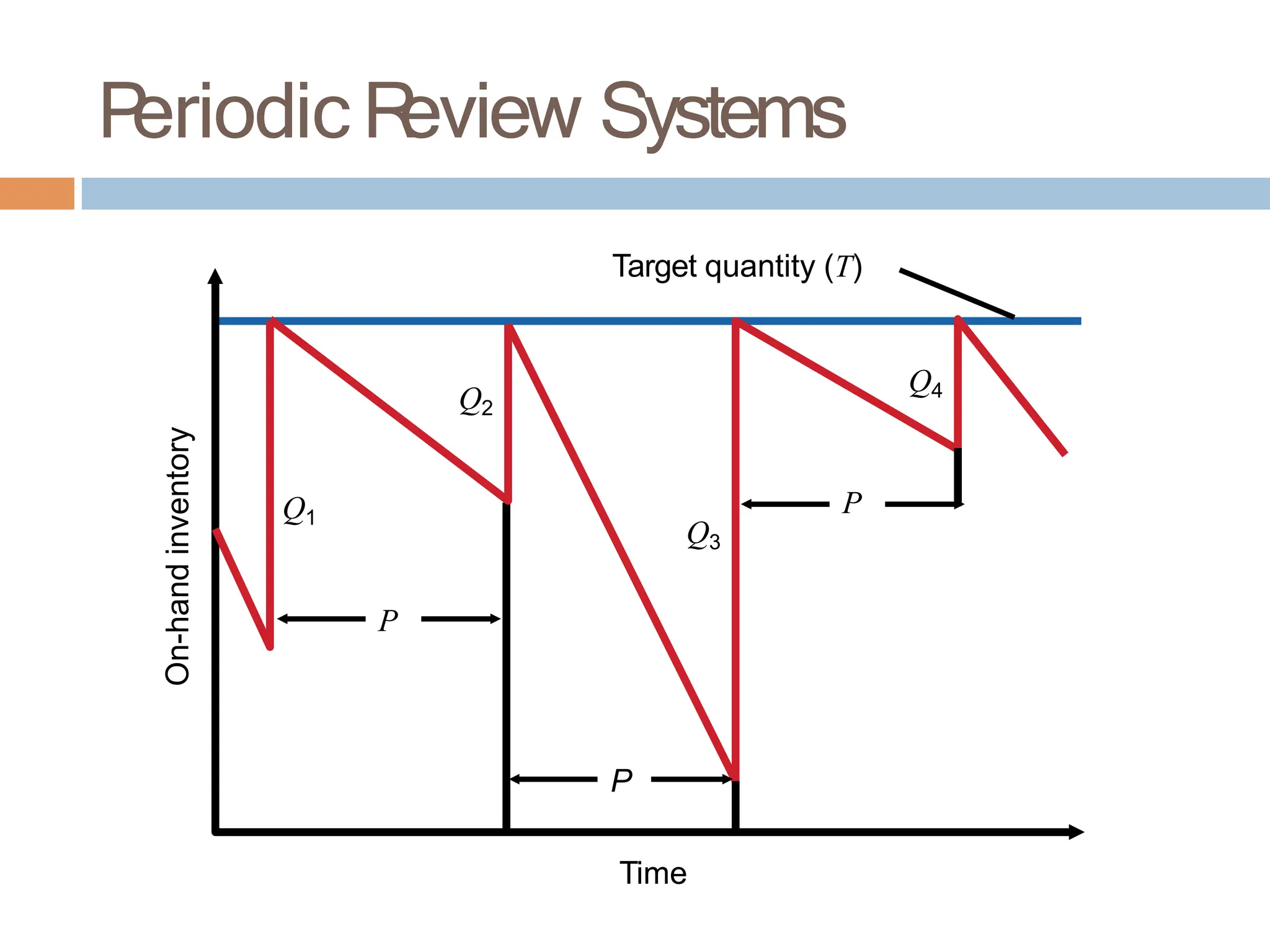
 Order is placed to bring the inventory position up to the target
inventory level, T, when the predetermined time, P, has elapsed
▶Only relevant costs are ordering and holding
▶Lead times are known and constant
▶Items are independent of one another
P
eriodic R
eview Systems
On-hand
inventory
Q1
Q2
Target quantity (T)
P
Q3
Q4
P
P
Time
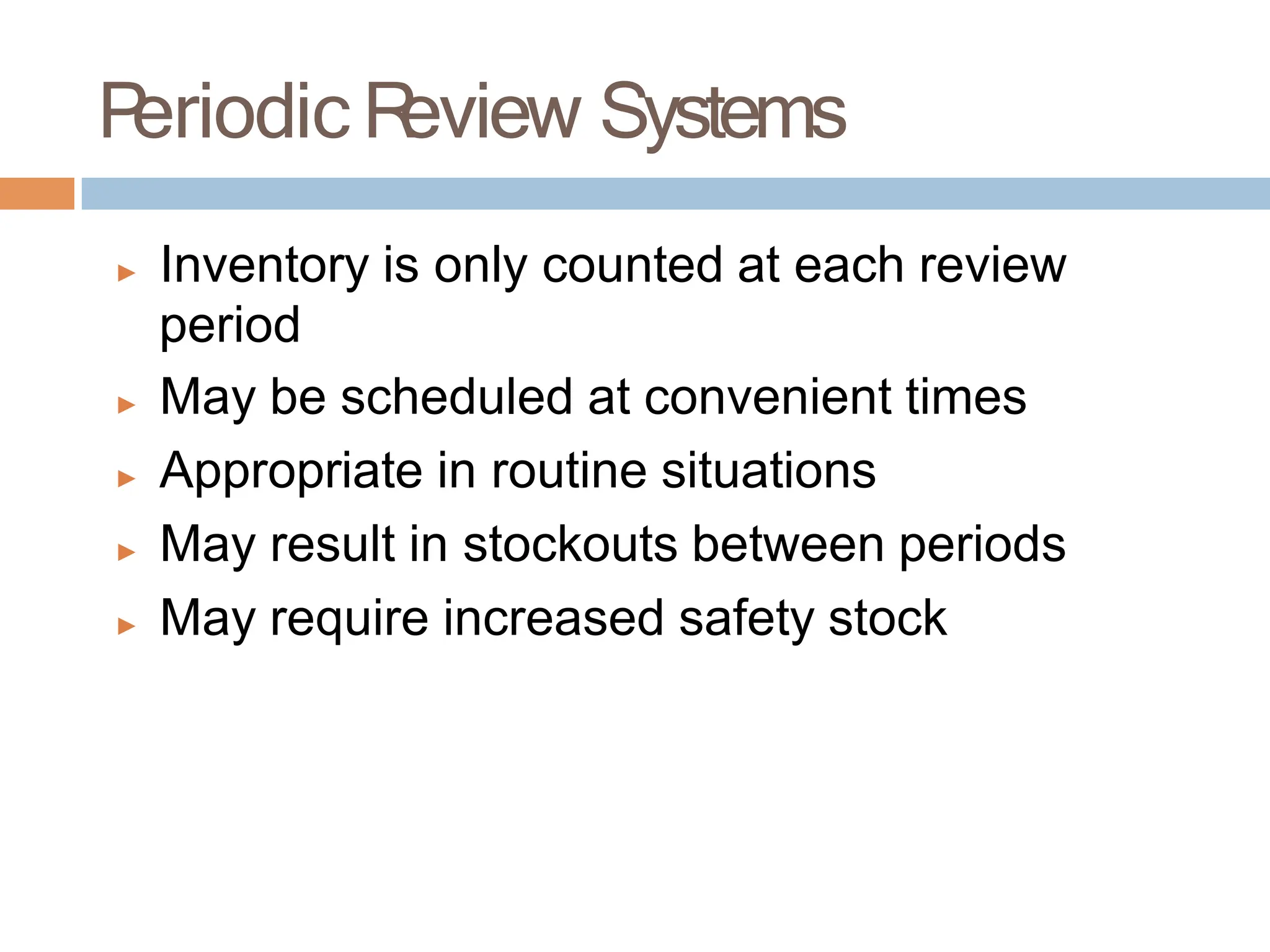
▶ Inventory is only counted at each review
period
▶ May be scheduled at convenient times
▶ Appropriate in routine situations
▶ May result in stockouts between periods
▶ May require increased safety stock
P
eriodic R
eview Systems
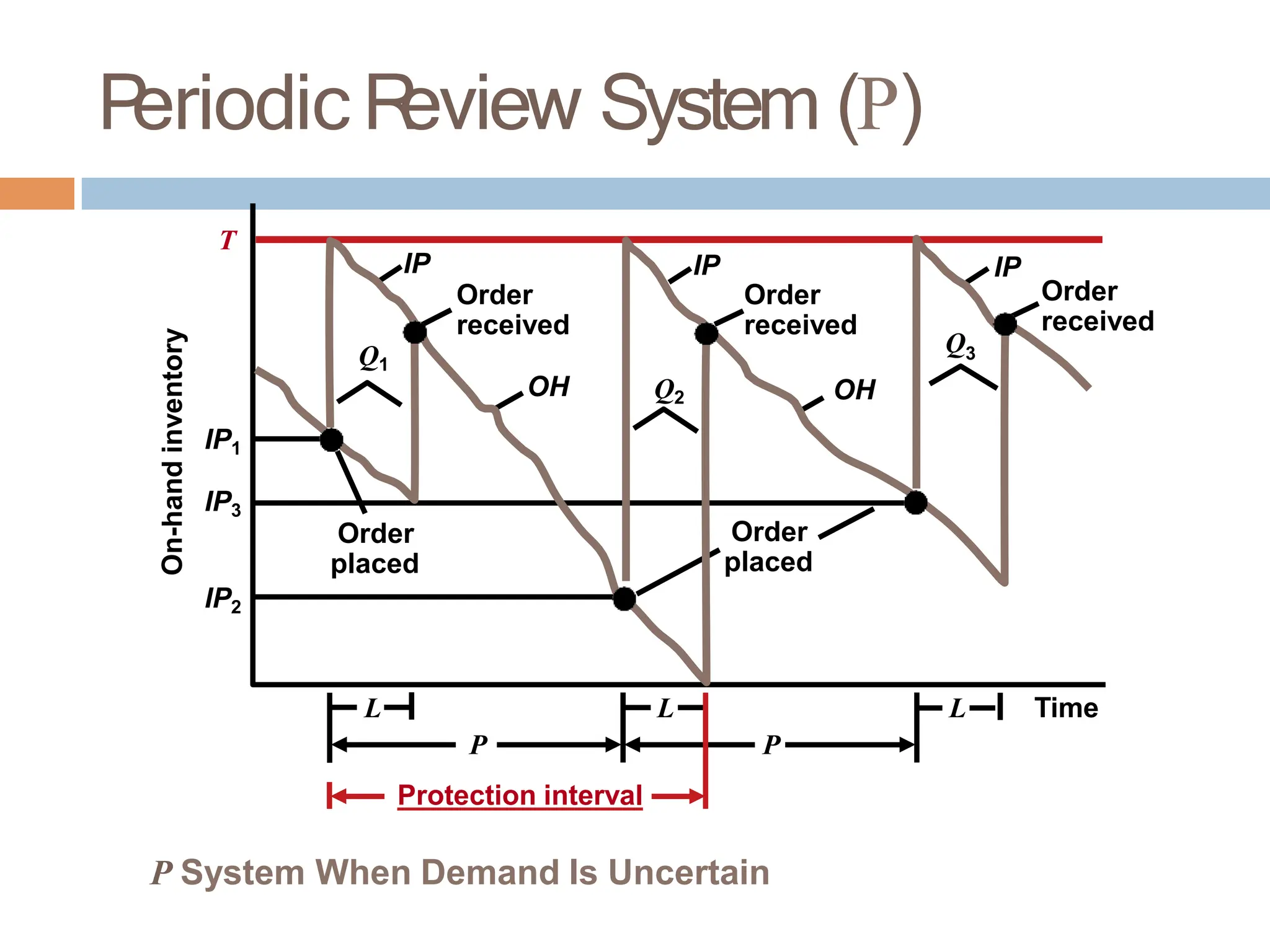
P
eriodic R
eview System (P)
P P
T
L L L Time
On-hand
inventory
IP1
IP3
IP2
Order
placed
Order
placed
Order
received
Order
received
Order
received
IP IP
IP
OH OH
Q1
Q2
Q3
Protection interval
P System When Demand Is Uncertain
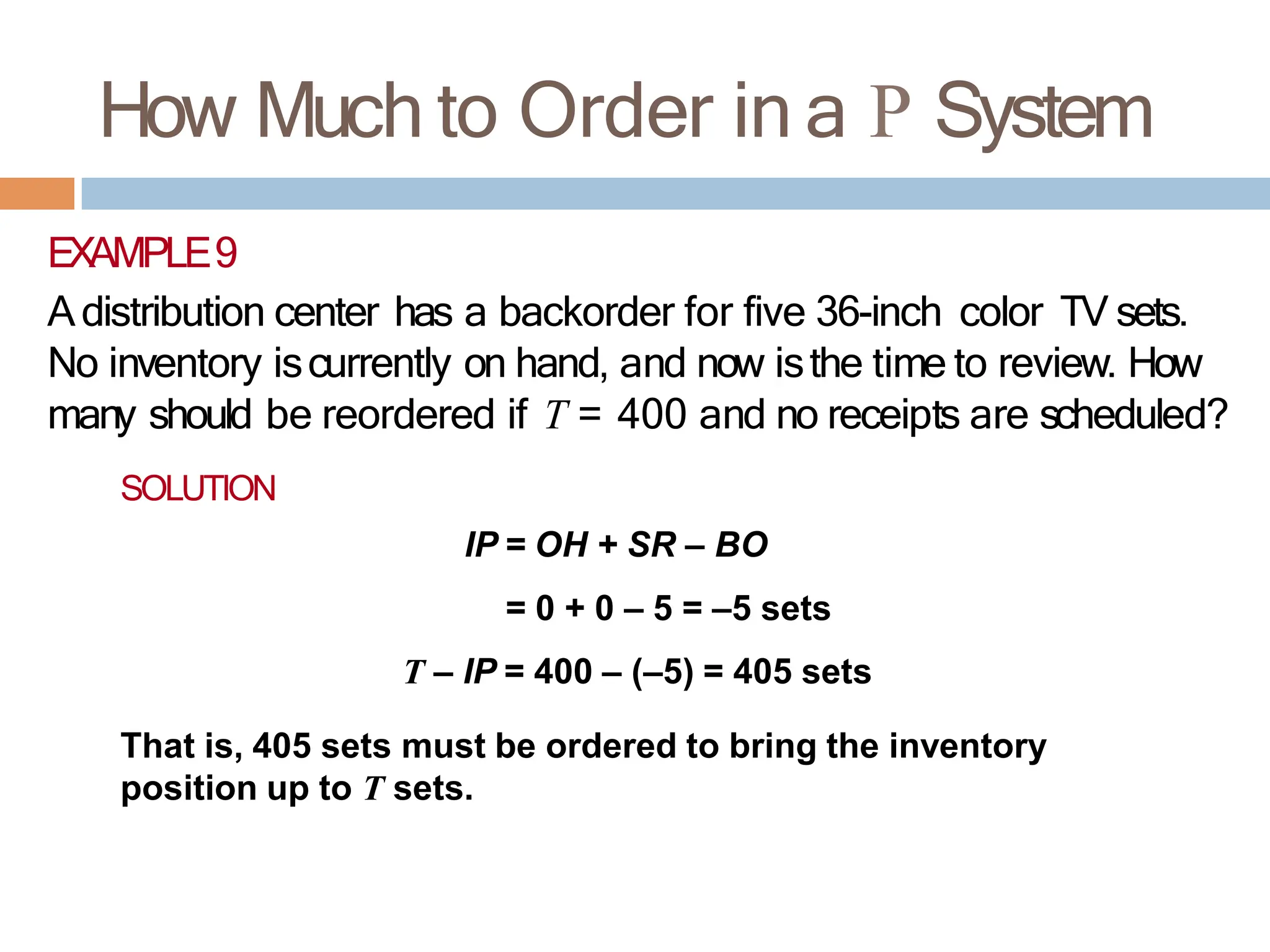
How Much to Order in a P System
EXAMPLE9
Adistribution center has a backorder for five 36-inch color TV sets.
No inventory iscurrently on hand, and now isthe time to review. How
many should be reordered if T = 400 and no receipts are scheduled?
SOLUTION
IP = OH + SR – BO
= 0 + 0 – 5 = –5 sets
T – IP = 400 – (–5) = 405 sets
That is, 405 sets must be ordered to bring the inventory
position up to T sets.
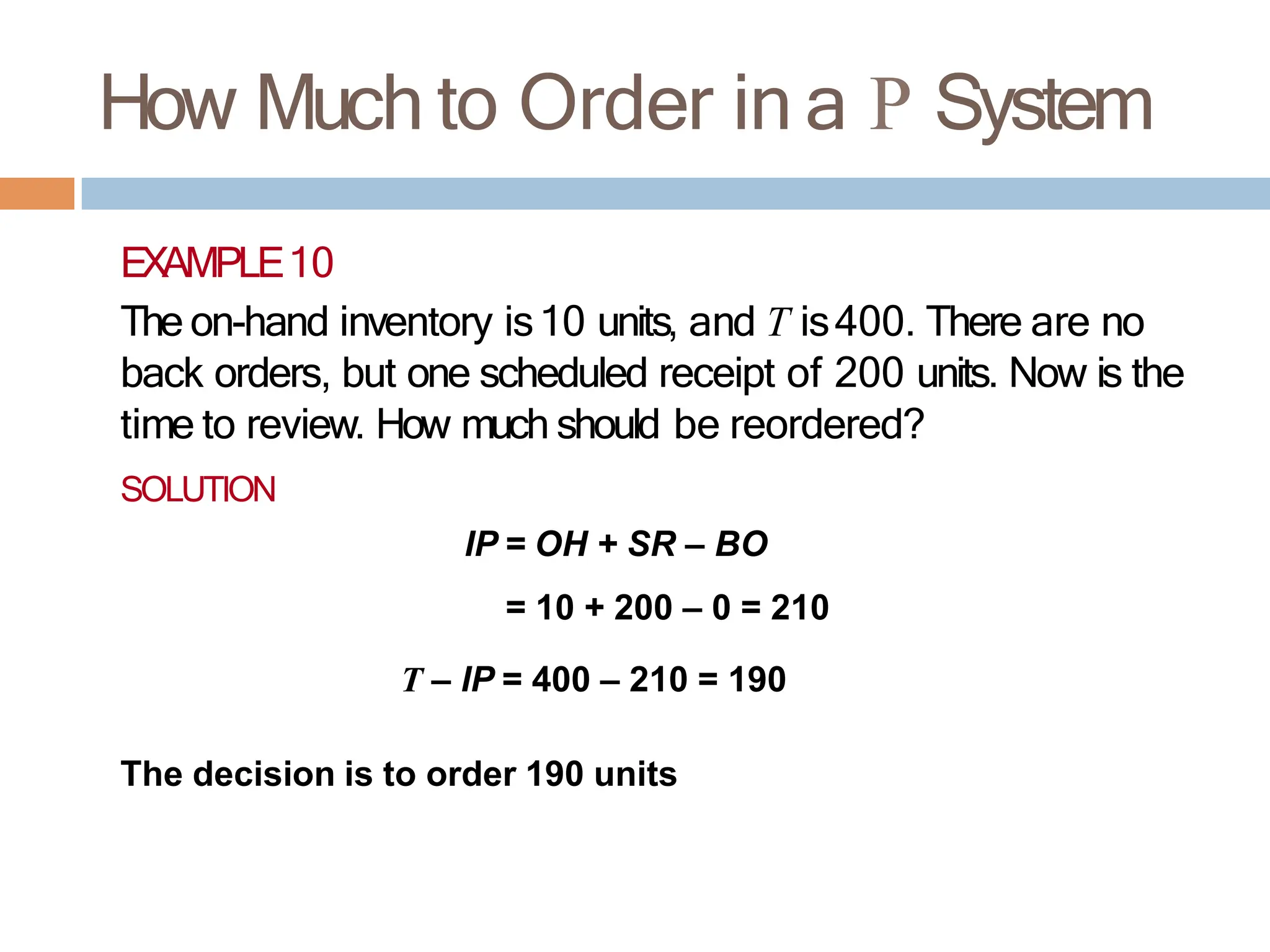
How Much to Order in a P System
EXAMPLE10
The on-hand inventory is10 units, and T is400. There are no
back orders, but one scheduled receipt of 200 units. Now is the
time to review. How much should be reordered?
SOLUTION
IP = OH + SR – BO
= 10 + 200 – 0 = 210
T – IP = 400 – 210 = 190
The decision is to order 190 units
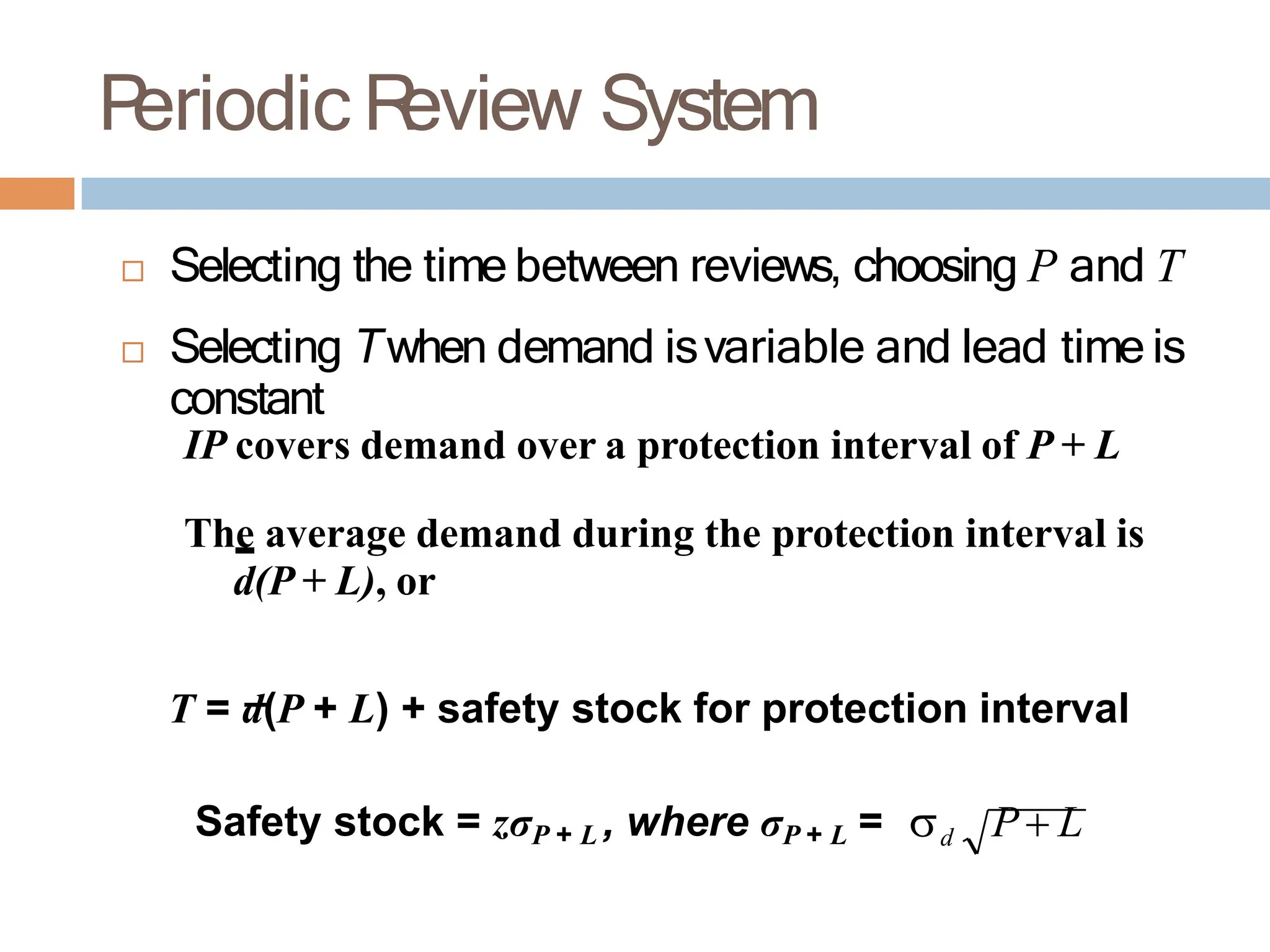
P
eriodic R
eview System
 Selecting the time between reviews, choosing P and T
 Selecting Twhen demand isvariable and lead time is
constant
IP covers demand over a protection interval of P + L
The average demand during the protection interval is
d(P + L), or
T = d(P + L) + safety stock for protection interval
Safety stock = zσP + L , where σP + L = d P L
Calculating P and T
EXAMPLE11
Again, let usreturn to the bird feeder example. Recall that
demand for the bird feeder isnormally distributed with a mean
of 18 unitsper weekand a standard deviation inweekly
demandof 5 units.Thelead timeis2 weeks,and thebusiness
operates 52 weeks per year. The Q system developed in
Example5 called for anEOQof 75 units and a safety stock of
9 unitsfor a cycle-service level of 90 percent. What isthe
equivalent P system?Answersare to be rounded to thenearest
integer.
Calculating P and T
SOLUTION
We first define D and thenP. Here,P isthetime between
reviews, expressed in weeks because the data are expressed
asdemand per week:
D = (18 units/week)(52 weeks/year) = 936 units
P =
EOQ
(52) = 75 (52) = 4.2 or 4 weeks
D 936
With d = 18 units per week, an alternative approach is to calculate P
by dividing the EOQ by d to get 75/18 = 4.2 or 4 weeks. Either way,
we would review the bird feeder inventory every 4 weeks.
Calculating P and T
We now find the standard deviation of demand over the protection
interval (P + L) = 6:
Before calculating T, we also need a z value. For a 90 percent
cycle-service level z = 1.28. The safety stock becomes
Safety stock = zσP + L = 1.28(12.25) = 15.68 or 16 units
We now solve for T:
T = Average demand during the protection interval + Safety stock
= d(P + L) + safety stock
= (18 units/week)(6 weeks) + 16 units = 124 units
P L  5 6 12.25 units
PL d
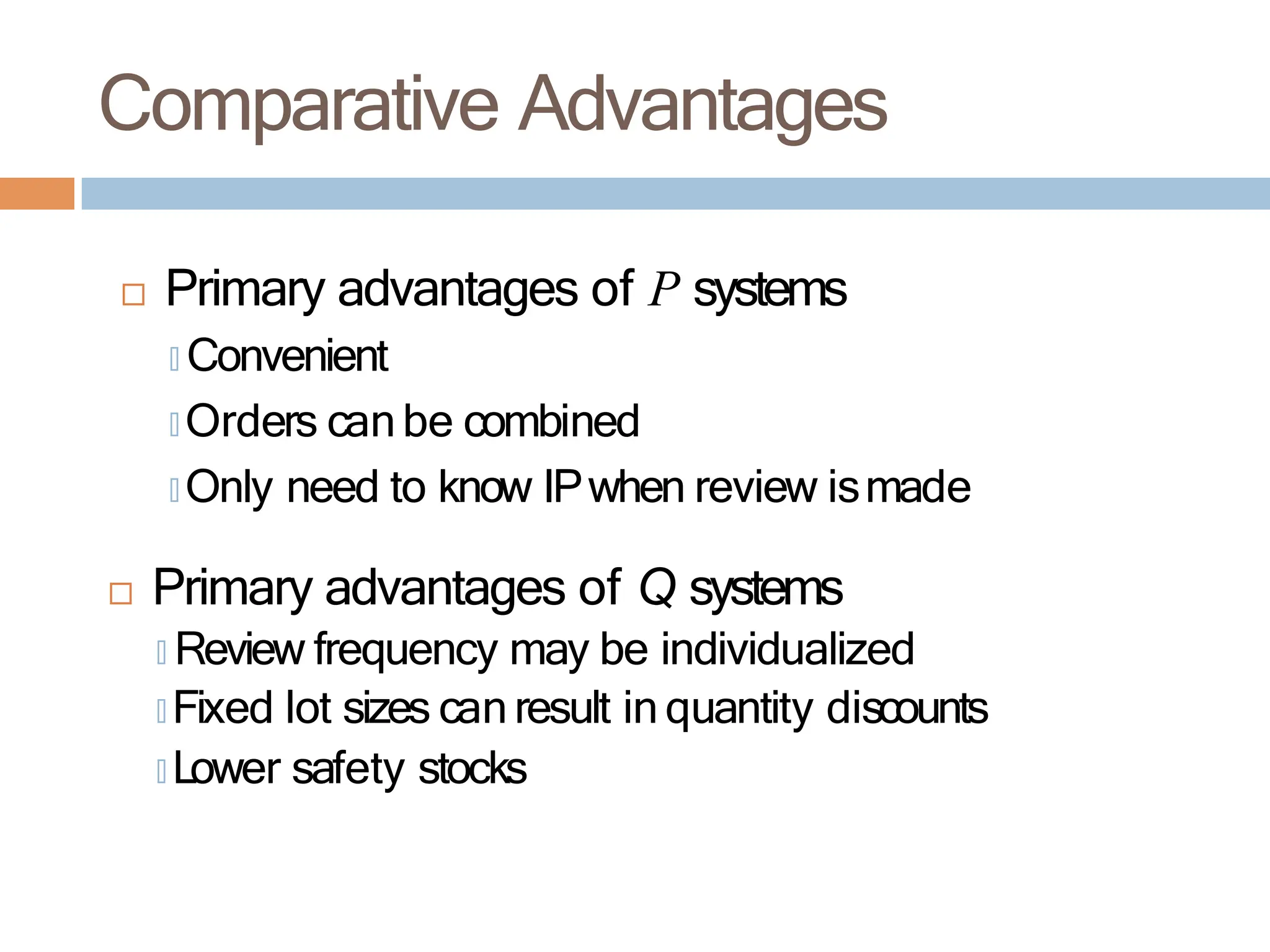
Comparative Advantages
 Primary advantages of P systems
🞑 Convenient
🞑 Orders canbe combined
🞑 Only need to know IPwhen review ismade
 Primary advantages of Q systems
🞑 Review frequency may be individualized
🞑 Fixed lot sizes canresult in quantity discounts
🞑 Lower safety stocks
Single Period Model
Single-Period Model
▶ Only one order is placed for a product
▶ Units have little or no value at the end of the
sales period
▶ Newsboy problem 1:
▶ Demand = 500 papers/day, σ = 100 paper
▶ Cost to newsboy = 10c, Sales price = 30c
▶ How many papers should he order?
The newsboy problem
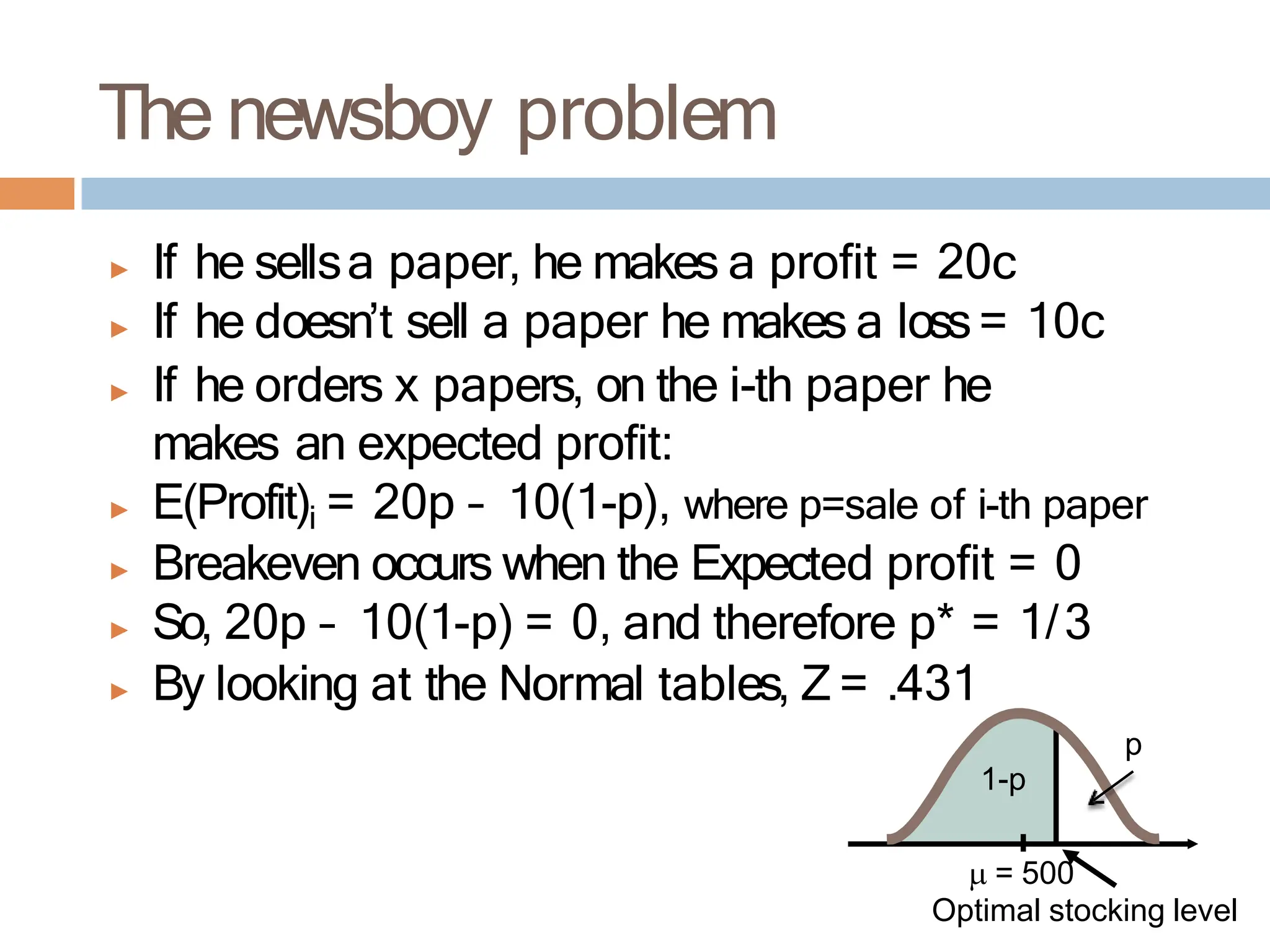
▶ If he sellsa paper, he makes a profit = 20c
▶ If he doesn’t sell a paper he makes a loss= 10c
▶ If he orders x papers, on the i-th paper he
makes an expected profit:
▶ E(Profit)i = 20p – 10(1-p), where p=sale of i-th paper
▶ Breakeven occurs when the Expected profit = 0
▶ So, 20p – 10(1-p) = 0, and therefore p* = 1/3
▶ By looking at the Normal tables, Z = .431
p
1-p
 = 500
Optimal stocking level
The newsboy problem
▶ Therefore:
▶ Z = .431 = (X*-μ)/σ = (X*-500)/100
▶ X* = 543
1-p
 = 500
Optimal stocking level
A small variation
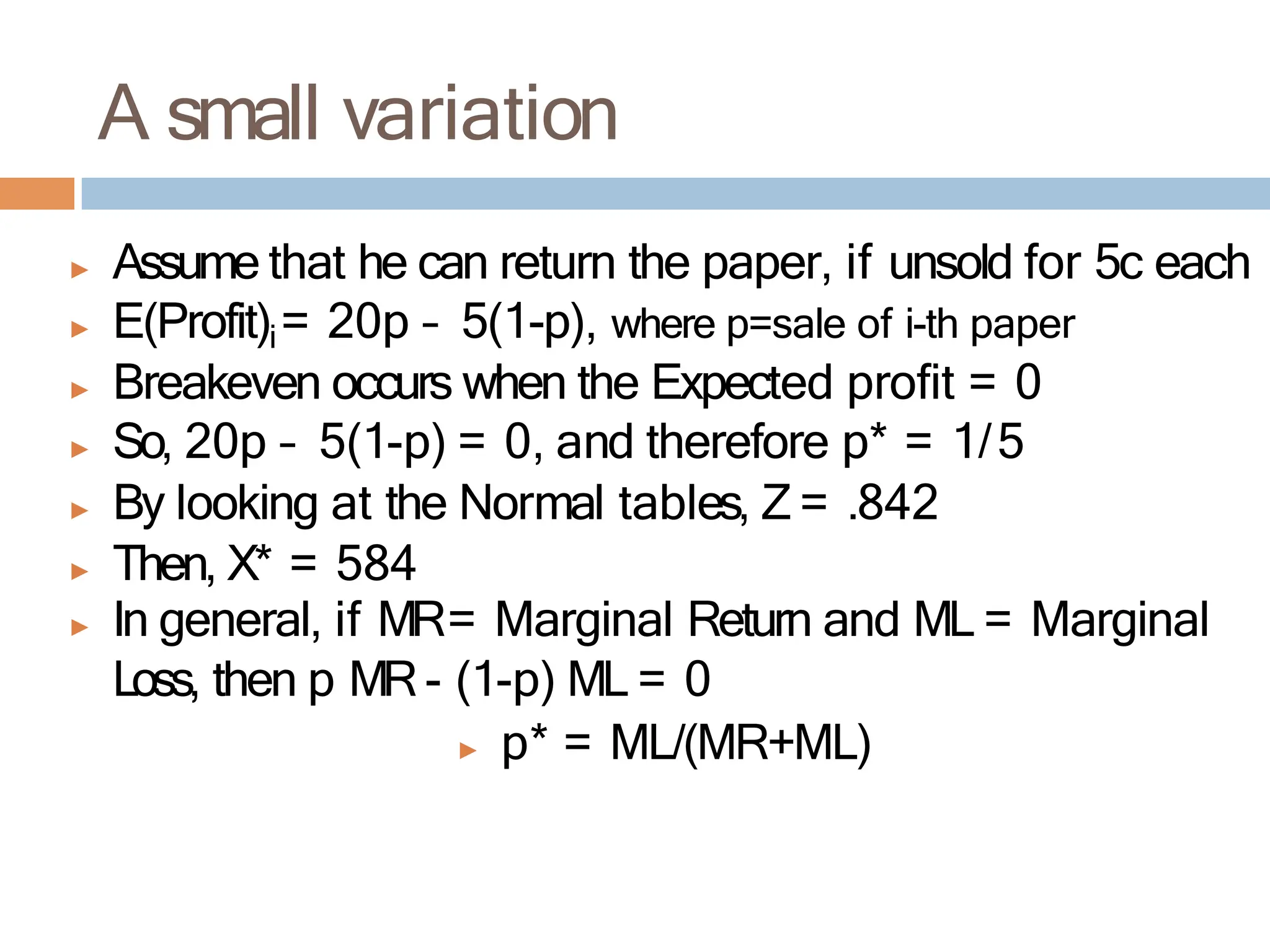
▶ Assume that he can return the paper, if unsold for 5c each
▶ E(Profit)i= 20p – 5(1-p), where p=sale of i-th paper
▶ Breakeven occurs when the Expected profit = 0
▶ So, 20p – 5(1-p) = 0, and therefore p* = 1/5
▶ By looking at the Normal tables, Z = .842
▶ Then, X* = 584
▶ In general, if MR= Marginal Return and ML = Marginal
Loss, then p MR- (1-p) ML = 0
▶ p* = ML/(MR+ML)
Using Simulation for stochastic inventory
management
What is Simulation ?
Simulation isa model – computer code – “imitating”
the operation of a real systemin the computer.
It consistsof:
a)A set of variables representing the basic features
of the real systemand
b)A set of logical commands in the computer that
modify these features as a function of time in
accordance with the rules (logical of physical)
regulating the real system.
 Thecapacity to "advance time" throughtheuseof a
simulation build-in clock that monitors and the events while
stepping up real time
 Thecapacity of drawing samplesthroughthecreation of
artificial observationsthat behave "like" random events in
the real system
🞑 a) Creation of random numbers (independent & uniformly
distributed) by the computer (according to an internal algorithm -
function)
🞑 Conversion in the observations’ distribution
Main Features of a Simulation
System
Examples of applications
Very important tool for
 Service management - Analysis of queuing systems
 Business Process Reengineering
 Strategic planning
 Financial planning
 Industrial design (e.g. chemical plants)
 Short term production planning
 Quality and reliability control,
 Training – business games, etc
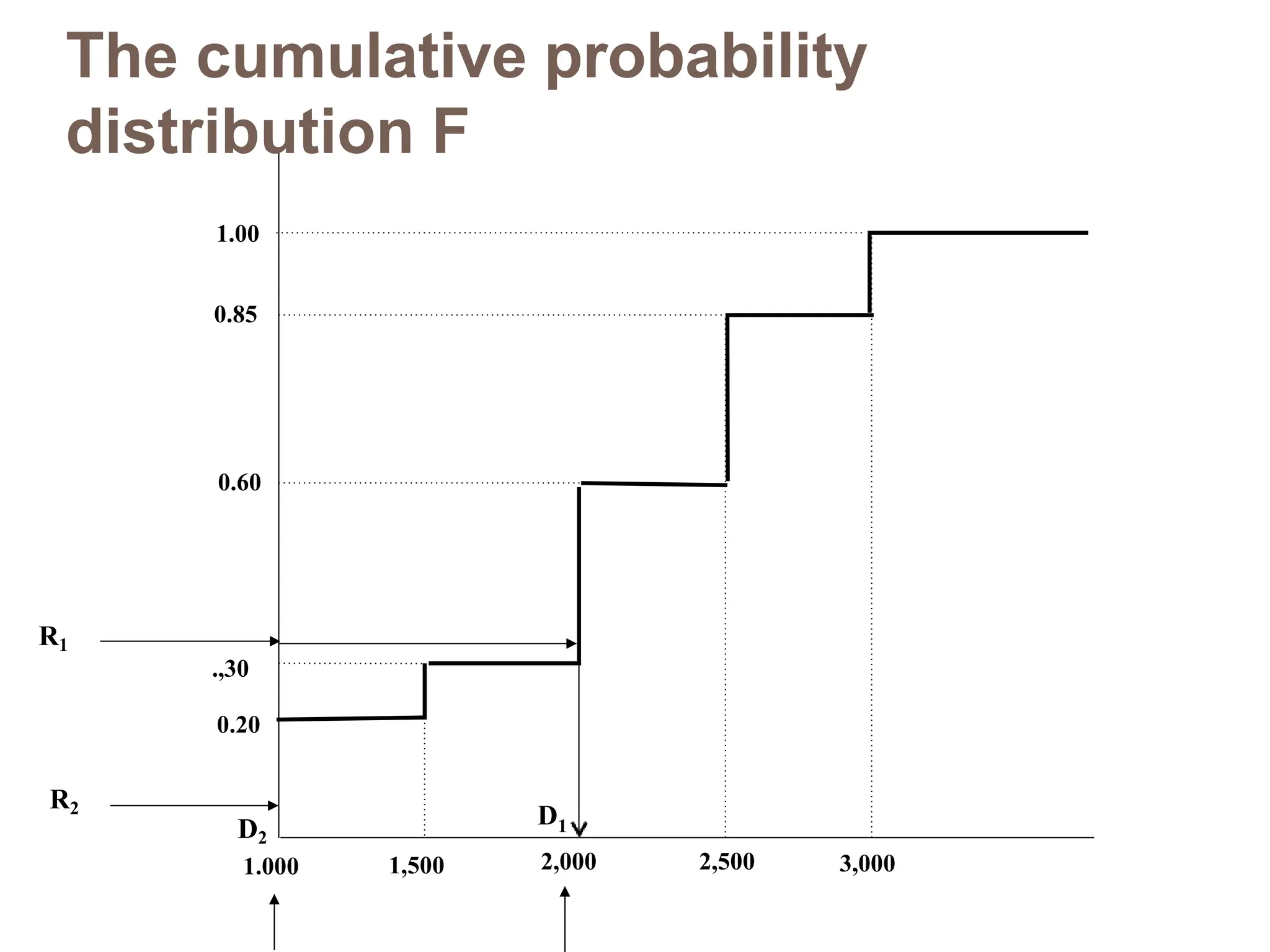
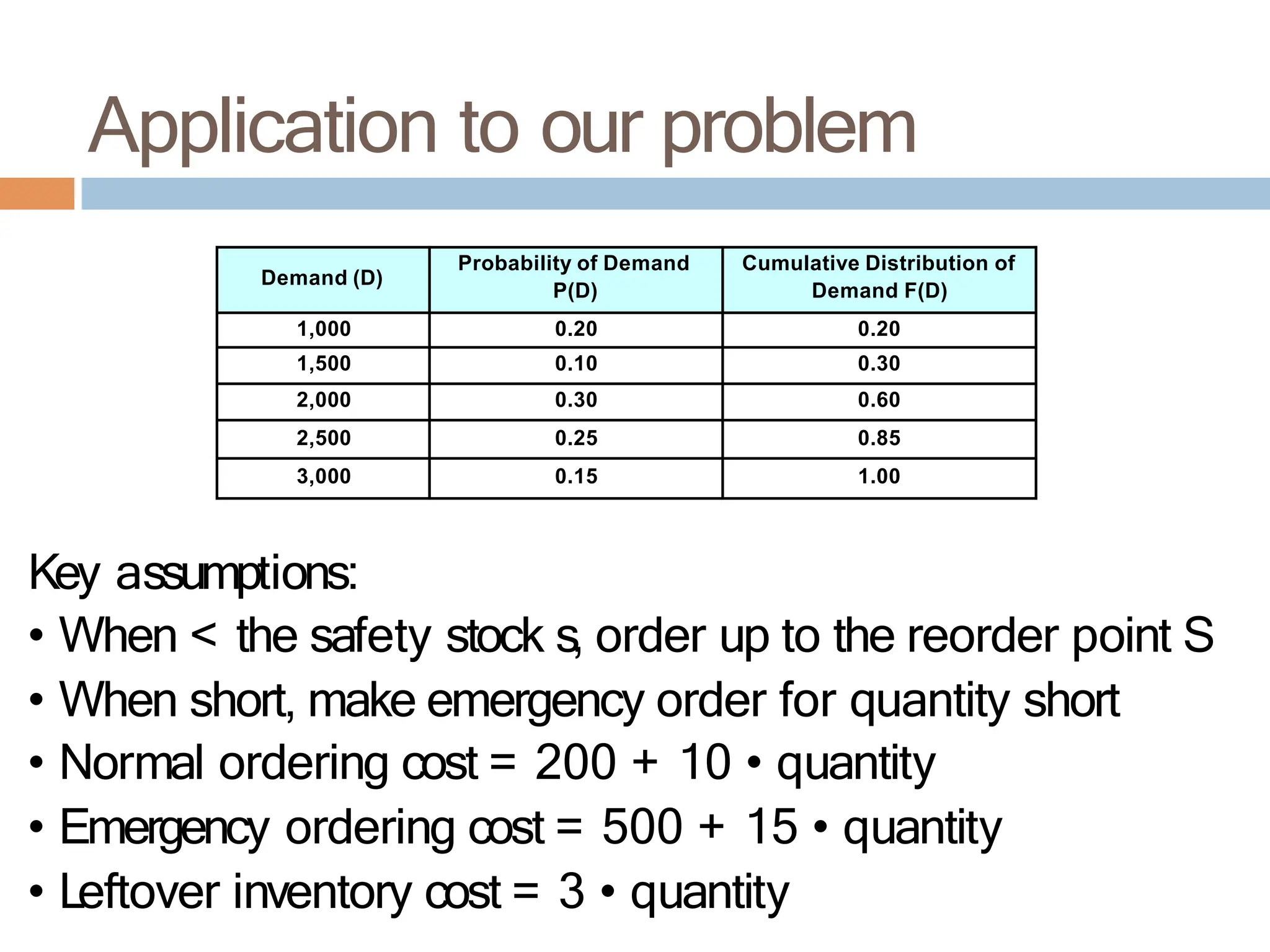
Let us suppose that the weekly demand of a
product can take the following values with the
respective probabilities:
Creating random numbers according
to a probability distribution
Demand (D)
Probability of Demand
P(D)
Cumulative Distribution of
Demand F(D)
1,000 0.20 0.20
1,500 0.10 0.30
2,000 0.30 0.60
2,500 0.25 0.85
3,000 0.15 1.00
D1
D2
.,30
0.20
0.60
1.00
0.85
1.000 1,500 2,000 2,500 3,000
R1
R2
The cumulative probability
distribution F
Example
Week
Unif.
Random
Number
Week's
Deman
d
1 32 2,000
2 8 1,000
3 46 2,000
4 92 3,000
5 69 2,500
6 71 2,500
7 29 1,500
8 46 2,000
9 80 2,500
10 14 1,000
Demand (D)
Cumulative Distribution of
Demand F(D)
1,000 0.20
1,500 0.30
2,000 0.60
2,500 0.85
3,000 1.00
Remember, the
Cumulative
Distribution F
Createa"demand
series“ corresponding
totherandomnumbers
generated
Using Simulation to define
an Inventory Policy
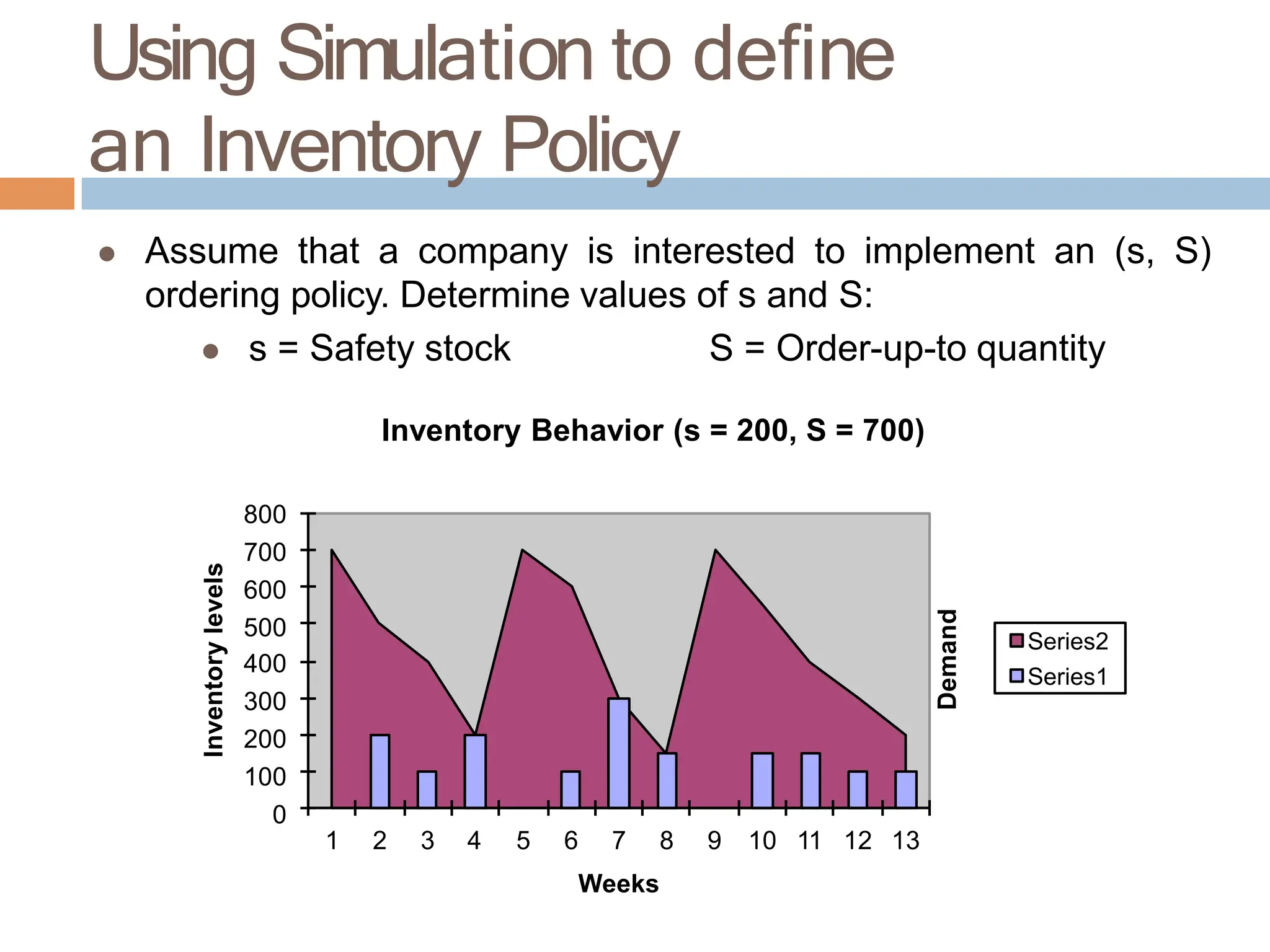
 Assume that a company is interested to implement an (s, S)
ordering policy. Determine values of s and S:
 s = Safety stock S = Order-up-to quantity
Inventory Behavior (s = 200, S = 700)
800
700
600
500
400
300
200
100
0
1 2 3 4 5 6 7 8 9 10 11 12 13
Weeks
Demand
Inventory
levels
Series2
Series1
Demand (D)
Probability of Demand
P(D)
Cumulative Distribution of
Demand F(D)
1,000 0.20 0.20
1,500 0.10 0.30
2,000 0.30 0.60
2,500 0.25 0.85
3,000 0.15 1.00
Key assumptions:
• When < the safety stock s, order up to the reorder point S
• When short, make emergency order for quantity short
• Normal ordering cost = 200 + 10 • quantity
• Emergency ordering cost = 500 + 15 • quantity
• Leftover inventory cost = 3 • quantity
Application to our problem
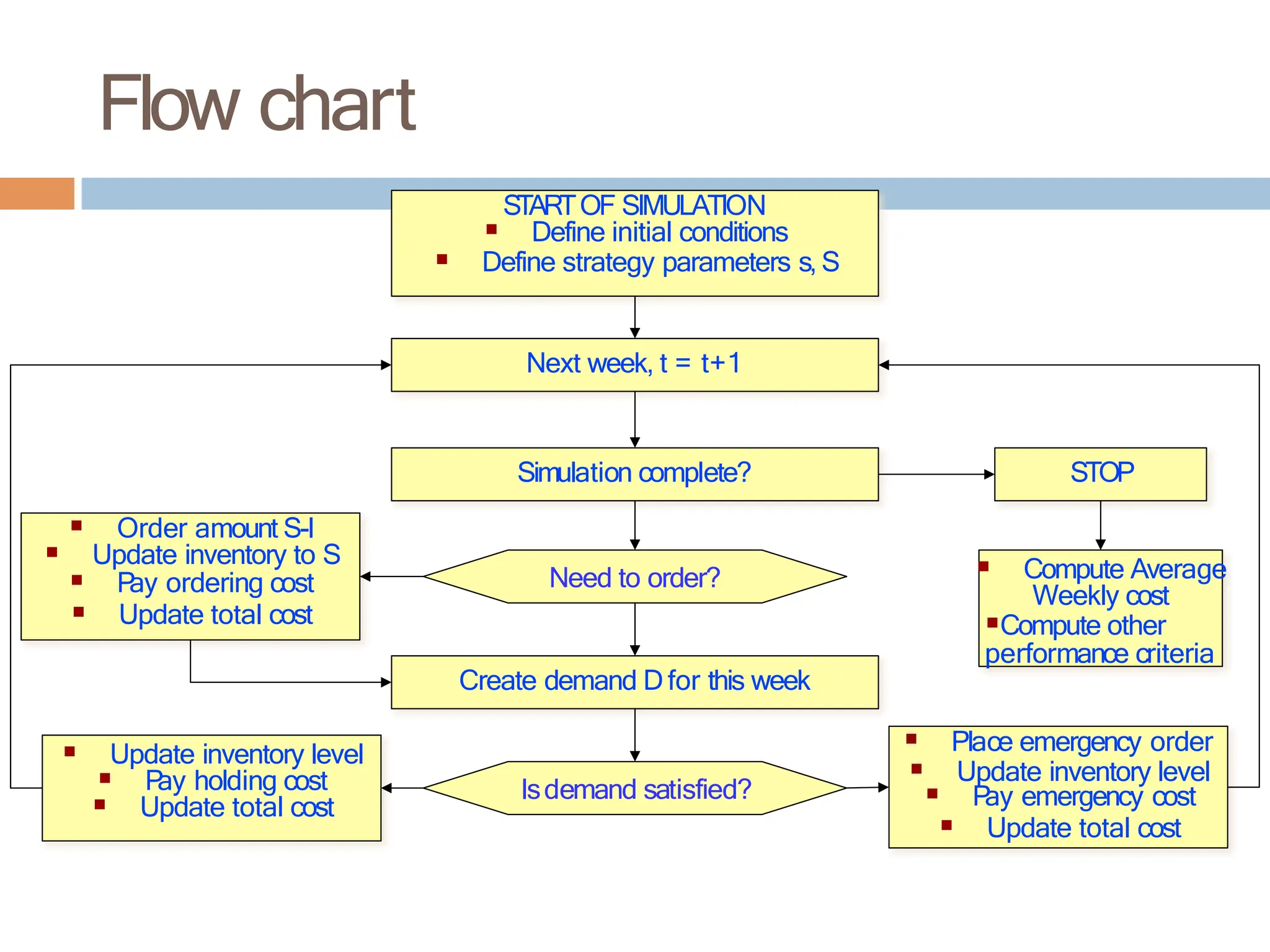
Flow chart
STARTOF SIMULATION
 Define initial conditions
 Define strategy parameters s, S
Next week, t = t+1
Simulation complete? STOP
 Compute Average
Weekly cost
Compute other
performance criteria
Need to order?
 Order amount S-I
 Update inventory to S
 P
ay ordering cost
 Update total cost
Create demand D for this week
Isdemand satisfied?
 Update inventory level
 P
ay holding cost
 Update total cost
 Place emergency order
 Update inventory level
 P
ay emergency cost
 Update total cost
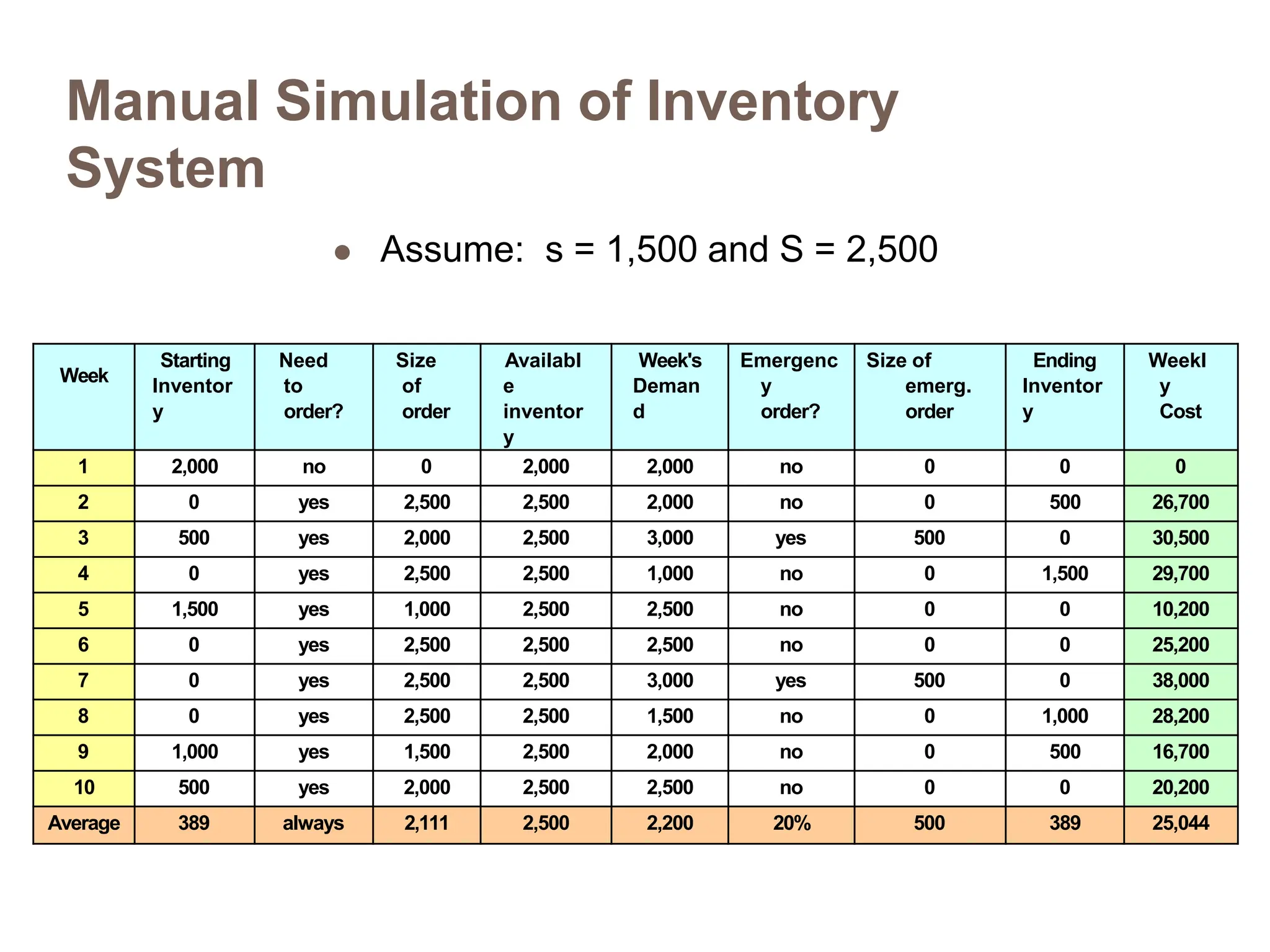
Manual Simulation of Inventory
System
 Assume: s = 1,500 and S = 2,500
Week
Starting
Inventor
y
Need
to
order?
Size
of
order
Availabl
e
inventor
y
Week's
Deman
d
Emergenc
y
order?
Size of
emerg.
order
Ending
Inventor
y
Weekl
y
Cost
1 2,000 no 0 2,000 2,000 no 0 0 0
2 0 yes 2,500 2,500 2,000 no 0 500 26,700
3 500 yes 2,000 2,500 3,000 yes 500 0 30,500
4 0 yes 2,500 2,500 1,000 no 0 1,500 29,700
5 1,500 yes 1,000 2,500 2,500 no 0 0 10,200
6 0 yes 2,500 2,500 2,500 no 0 0 25,200
7 0 yes 2,500 2,500 3,000 yes 500 0 38,000
8 0 yes 2,500 2,500 1,500 no 0 1,000 28,200
9 1,000 yes 1,500 2,500 2,000 no 0 500 16,700
10 500 yes 2,000 2,500 2,500 no 0 0 20,200
Average 389 always 2,111 2,500 2,200 20% 500 389 25,044

Inventory management course Material for All

  • 1.
    BIA 674 -Supply Chain Analytics 12. Inventory Management
  • 2.
    Outline  The Importanceof Inventory  Inventory Costs  ABC Analysis  EOQ Models  Probabilistic Models and Safety Stock  Inventory Control Systems  Single-Period Model  Using Simulation for Inventory Management
  • 3.
    What isInventory?  Stockof items kept to meet future demand for 🞑 internal customers 🞑 external customers  Purpose of inventory management 🞑 ORDERING POLICY: When and how many units to order of each material when orders are placed with either outsidesuppliersor production departments within organizations? 🞑 ISSUINGPOLICY:howto issueunitsfrom inventory? (FIFO, LIFO, random?)
  • 4.
    Importance of Inventory Inventories are important to all types of firms: 🞑 They have to be counted, paid for, used in operations, used to satisfy customers, and managed 🞑 T oo much inventory reduces profitability 🞑 Too little inventory damages customer confidence  It isoneof themostexpensiveassetsof many companies representing asmuch as50% of total invested capital  It isone of the 3 most common reasons for SME bankruptcy  Need to balance inventory investment and customer service
  • 5.
    Why Do WeWant to Hold Inventory  Improve customer service  Safe-guard to hazards in demand, supply, and delivery that might cause stock-out  T ake advantage of economies of scale, & reduce: 🞑 ordering costs 🞑 Stock-out costs 🞑 acquisition costs 🞑 Fixed costs (e.g. fixed ordering costs)  Contribute to the efficient and effective operation of the production system, e.g., 🞑 Reduces the number of costly set-ups and reschedulings 🞑 Smoothing and stabilizing resource utilization
  • 6.
    Why We DoNot Want to Hold Inventory  Certain costs increase such as 🞑 Storage costs 🞑 insurance costs 🞑 outdate costs 🞑 large-lot quality cost 🞑 cost of production problems  Ties capital for which the company pays interest  Hides productivity and quality problems  Risk of getting stuck with unsalable goods
  • 7.
    T ypes of Inventory ▶R aw material ▶ Purchased but not processed ▶ Work-in-process (WIP) ▶ Undergone some change but not completed ▶ A function of cycle time for a product (e.g. items being transported) ▶ Maintenance/repair/operating (MRO) ▶ Necessary to keep machinery and processes productive ▶ Finished goods ▶ Completed product awaiting shipment
  • 8.
    The Material FlowCycle Input Wait for Wait to Move Wait in queue Setup Run Output inspection be moved time for operator time time Cycle time 95% 5%
  • 9.
    Inventory and ServiceQuality  Customers usually perceive quality service as availability of goods they want when they want them  Inventory must be sufficient to provide high-quality customer service
  • 10.
  • 11.
    Inventory-Related Costs  Orderingcosts (unit variable costs & fixed ordering costs)  costs of replenishing inventory, placing orders, receiving goods  costs for to prepare a machine or process for manufacturing an order  Holding or Inventory carrying costs  cost of holding an item in inventory over time  Shortage or Stock-out / penalty costs 🞑 How do you handle shortages? 🞑 Lost sales vs. backlogging 🞑 Watch out for service level  Outdate costs (for perishable products)  Opportunity costs
  • 12.
    Holding Costs Determining InventoryHolding Costs CATEGORY COST (AND RANGE) AS A PERCENT OF INVENTORY VALUE Housing costs (building rent or depreciation, operating costs, taxes, insurance) 6% (3 - 10%) Material handling costs (equipment lease or depreciation, power, operating cost) 3% (1 - 3.5%) Labor cost (receiving, warehousing, security) 3% (3 - 5%) Investment costs (borrowing costs, taxes, and insurance on inventory) 11% (6 - 24%) Pilferage, space, and obsolescence (much higher in industries undergoing rapid change like PCs and cell phones) 3% (2 - 5%) Overall carrying cost 26%
  • 13.
    Holding Costs Determining InventoryHolding Costs CA TEGOR Y COST(AND RANGE) AS A PER CENTOF INVENTOR Y VALUE Housing costs(building rent or depreciation, operating costs, taxes, insurance) 6% (3 - 10%) Material handling costs (equipment lease or depreciation, power, operating cost) 3% (1 - 3.5%) Labor cost (receiving, warehousing, security) 3% (3 - 5%) Investment costs (borrowing costs, taxes, and insurance on inventory) 11% (6 - 24%) Pilferage, space, and obsolescence (much higher in industries undergoing rapid change like PCs and cell phones) 3% (2 - 5%) Overall carrying cost 26%
  • 14.
  • 15.
    ABC Analysis ▶ Payattention to your more critical products! ▶ Divides inventory into three classesbased on annual dollar volume ▶ClassA - high annual dollar volume ▶ClassB- mediumannual dollar volume ▶ClassC - low annual dollar volume ▶ Used to establish policies that focus on the few critical parts and not the many trivial ones
  • 16.
     Concept: Allitems do not deserve the same attention in termsof inventory management  Focuson items that have the highest monetary value  Step 1. Start with the inventoried items ranked by dollar value in inventory in descending order  Step2. Plot thecumulativedollar/euro valuein inventory versus the cumulative items in inventory ABC Analysis
  • 17.
    ABC Analysis 10 2030 40 50 60 70 80 90 100 Percentage of SKUs Percentage of dollar value 100 — 90 — 80 — 70 — 60 — 50 — 40 — 30 — 20 — 10 — 0 — Class C Class A Class B Typical Chart Using ABC Analysis  ClassA 🞑 5 – 15 % of units 🞑 70 – 80 % of value  ClassB 🞑 30 % of units 🞑 15 % of value  ClassC 🞑 50 – 60 % of units 🞑 5 – 10 % of value
  • 18.
    ABC AnalysisExample ABC Calculation (1)(2) (3) (4) (5) (6) (7) PERCENT OF PERCENT ITEM NUMBER ANNUAL ANNUAL OF ANNUAL STOCK OF ITEMS VOLUME UNIT DOLLAR DOLLAR NUMBER STOCKED (UNITS) x COST = VOLUME VOLUME CLASS #10286 #11526 20% 1,000 500 $ 90.00 154.00 $ 90,000 77,000 38.8% 33.2% 72% A A #12760 #10867 #10500 30% 1,550 350 1,000 17.00 42.86 12.50 26,350 15,001 12,500 11.3% 6.4% 5.4% 23% B B B #12572 600 $ 14.17 $ 8,502 3.7% C #14075 2,000 .60 1,200 .5% C #01036 50% 100 8.50 850 .4% 5% C #01307 1,200 .42 504 .2% C #10572 250 .60 150 .1% C 8,550 $232,057 100.0%
  • 19.
    B Items | || | | | | | | | 10 20 30 40 50 60 70 80 90 100 Percentage of inventory items Percentage of annual dollar usage 80 –A Items 70 – 60 – 50 – 40 – 30 – 20 – 10 – 0 – C Items ABC Analysis
  • 20.
    ▶ Other criteriathan annual dollar volume may be used ▶ High shortage or holding cost ▶ Anticipated engineering changes ▶ Delivery problems ▶ Quality problems ABC Analysis
  • 21.
    ▶ P olicies employedmay include 1. More emphasis on supplier development for A items 2. Tighter physical inventory control for A items 3. More care in forecasting A items ABC Analysis
  • 22.
  • 23.
    Ordering Policy underconstant demand  Simple case 1. Demand rate is constant and known with certainty 2. Unit ordering cost = C 3. Every time an order is placed, there is a fixed cost = S 4. There isa unit holding cost = H 5. No constraints are placed on the size of each order 6 . The lead time iszero
  • 24.
    t  Company withsteady rate of demand D = 100 tons/month  Total annual demand = 1200 tons  Purchase price C = $250/ton  Delivery costs S= $50 (each time)  Holding costs (storage, insurance, ...) H = $4/ton/month Inventory Level • • • Time What iswrong with thismanagement?
  • 25.
     Irrational Ordering(time, quantity) ... why?  Safety stock ... why? Q T 2T t Get rid of pre-conceived ideas … 3T
  • 26.
    Inventory Usage OverTime Order quantity = Q (maximum inventory level) Usage rate Average inventory on hand QT 2 Minimum inventory Inventory level 0 T otal order received 2T Time T 3T
  • 27.
    Objective is tominimize T otal Annual Cost Annual cost Order quantity Total cost of ordering + holding inventory Holding cost Ordering (Setup) cost Minimum total cost Optimal order quantity (Q*) Determining the optimal cycle
  • 28.
    Minimizing Costs ▶ Byminimizing the sumof setup (or ordering) and holding costs, total costs are minimized ▶ Optimal order size Q* will minimize total cost ▶ Optimal order quantity occurs when: ▶The derivative of the T otal Cost with respect to the order quantity isequal to zero ▶The holding cost and setup cost are equal
  • 29.
    Calculating the AnnualCosts  Annual holding cost Annual holding cost = (Average cycle inventory)  (Unit holding cost)  No of orders placed / year  Annual ordering cost Annual ordering cost = (Ordering cost / order)  No of orders placed / year  Total annual cycle-inventory cost Total Annual costs = Annual holding cost + Annual ordering cost
  • 30.
    Holding Cost /period The cost of holding one unit in inventory for one cycle = H (QT)/2 Ordering Cost / period It isthe cost of ordering one lot with Q units = CQ + S Calculating all the costs No. of orders / year = Annual Demand / Oder Size = 12D/Q T otal Cost (C) It isthe sumof annual holding and annual setup cost
  • 31.
    Calculating the EOQ T otal annual cycle-inventory cost Where TC = total annual cost C = unit ordering annual cycle-inventory cost Q = lot size H = holding cost per unit per period D = demand per period S = fixed ordering or setup costs per lot T = re-order period TC = N (S + CQ) + H QT 2 Fixed ordering cost Variable ordering cost Holding cost
  • 32.
    Calculating the EOQ T C= N[(S + CQ) + H(QT/2)]= = (12DS/Q) + (12D/Q)CQ + (12D/Q)(HQ2/2D)= =12DS/Q + 12DC + 6HQ Tofind the optimal Quantity Q: Set derivative w.r.t Q = 0 Therefore, -(12DS/Q2)+6H = 0 The optimal - order- quantity Q* = 2SD/H = 50 tons T = 0,5 month
  • 33.
    Determine the optimalnumber of units to order D = 1,000 units per year S = $10 per order H = $.50 per unit per year Q*  2DS H Q*  0.50 2(1,000)(10)  40,000  200 units An EOQ Example
  • 34.
    Determine expected numberof orders Q* = 200 units D = 1,000 units S = $10 per order H = $.50 per unit per year N = = 5 orders per year 1,000 200 = N = Expected number of orders Demand Order quantity D = Q* An EOQ Example
  • 35.
    An EOQ Example Determineoptimal time between orders Q* = 200 units N = 5 orders/year D = 1,000 units S = $10 per order H = $.50 per unit per year T = = 50 days between orders 250 5 = T = Expected time between orders Number of working days per year Expected number of orders
  • 36.
    Determine the totalannual cost D = 1,000 units S= $10 per order H = $.50 per unit per year Q* = 200 units N = 5 orders/year T = 50 days T otal annual cost = Setup cost + Holding cost TC  D S  Q H Q 2 1,000  200 ($10) 200 2 ($.50)  (5)($10)(100)($.50)  $50$50  $100 Note: the cost of materials is not included, as it is assumed that the demand will be satisfied and therefore it isa fixed cost An EOQ Example
  • 37.
    Calculating EOQ EXAMPLE1 Amuseumof naturalhistory opened a gift shopwhichoperates 52 weeks per year. Managing inventories hasbecome a problem. Top-selling SKUisa bird feeder. Salesare 18 units per week, the supplier charges $60 per unit. Ordering cost is $45. Annual holding cost is 25 percent of a feeder’s value. Management chose a 390-unit lot size. What is the annual cycle-inventory cost of the current policy of using a 390-unit lot size? Would a lot size of 468 be better?
  • 38.
    Calculating EOQ SOLUTION We beginby computing the annual demand and holding cost as D = (18 units/week)(52 weeks/year) = 936 units H = 0.25($60/unit) = $15 The total annual cycle-inventory cost for the current policy is 2 Q Q D 390 936 C = (H) + (S) = ($15) + ($45) 2 390 = $2,925 + $108 = $3,033 The total annual cycle-inventory cost for the alternative lot size is C = 468 ($15) + 936 ($45) = $3,510 + $90 = $3,600 2 468
  • 39.
    Calculating the EOQ 3000– 2000 – 1000 – 0 – | | | Annual cost (dollars) Current cost Lowest cost | | | | | 50 100 150 200 250 300 350 400 Best Q Lot Size (Q) Current (EOQ) Q cost Total = Q (H) + D (S) 2 Q Total Annual Cycle-Inventory Cost Function for the Bird Feeder Ordering cost = D (S) Q Q Holding cost = 2 (H)
  • 40.
    Finding the EOQ,T otal Cost, TBO EXAMPLE2 Forthebird feeders inExample 1, calculate theEOQand its total annual cycle-inventory cost. How frequently will orders be placed if the EOQ isused? SOLUTION Using the formulasfor EOQ and annual cost, we get EOQ = = 2DS H = 74.94 or 75 units 2(936)(45) 15
  • 41.
    Finding the EOQ,T otal Cost, TBO Thetotal annual costismuchlessthan the$3,033 costof the current policy of placing 390-unit orders.
  • 42.
    Finding the EOQ,T otal Cost, TBO When the EOQ is used, the TBO can be expressed in various ways for the same time period. EOQ EOQ TBO = D = 75 = 0.080 year 936 EOQ D EOQ 75 TBO = (12 months/year) = (12) = 0.96 month EOQ D EOQ 75 TBO = (52 weeks/year) = (52) = 4.17 weeks EOQ D EOQ 75 TBO = (365 days/year) = (365) = 29.25 days 936 936 936
  • 43.
    Finding the EOQ,T otal Cost, TBO EXAMPLE3 Suppose that you are reviewing the inventory policies on an $80 item stocked at a hardware store. The current policy is to replenish inventory by ordering in lots of 360 units. Additional information is: D = 60 units per week, or 3,120 units per year S = $30 per order H = 25% of selling price, or $20 per unit per year What isthe EOQ? SOLUTION EOQ = = 2DS H 2(3,120)(30) = 97 units 20
  • 44.
    Finding the EOQ,T otal Cost, TBO What is the total annual cost of the current policy (Q = 360), and how does it compare with the cost with using the EOQ? Current Policy EOQ Policy Q = 360 units Q = 97 units C = (360/2)(20) + (3,120/360)(30) C = (97/2)(20) + (3,120/97)(30) C = 3,600 + 260 C = 970 + 965 C = $3,860 C = $1,935
  • 45.
    Finding the EOQ,T otal Cost, TBO What isthe time between orders (TBO) for the current policy and the EOQ policy, expressed in weeks? 360 TBO = 360 (52 weeks per year) = 6 weeks EOQ TBO = 97 (52 weeks per year) = 1.6 weeks 3,120 3,120
  • 46.
    Managerial Insights SENSITIVITY ANALYSISOF THE EOQ Parameter EOQ Parameter Change EOQ Change Comments Demand 2DS H ↑ ↓ ↓ ↑ ↓ ↑ Increase in lot size is in proportion to the square root of D. Order/Setup Costs 2DS H Weeks of supply decreases and inventory turnover increases because the lot size decreases. Holding Costs 2DS H Larger lots are justified when holding costs decrease.
  • 47.
    Robustness ▶ The EOQmodel isrobust ▶ It works even if all parameters and assumptionsare not met ▶ The total cost curve isrelatively flat in the area of the EOQ
  • 48.
    Introducing delivery lag EOQ answers the “how much” question  The reorder point (ROP) tells“when” to order  Lead time (L) isthe time between placing and receiving an order ROP = Lead time for a new order in days Demand per day = d x L d = D Number of working days in a year
  • 49.
    R eorder P oint Curve Q* ROP (units) Inventory level (units) Time(days) Lead time = L Resupply takes place as order arrives Slope = units/day = d
  • 50.
    R eorder P oint Example Demand= 8,000 iPods per year 250 working day year Lead time for orders is 3 working days, but it may also take 4 days d = D Number of working days in a year = 8,000/250 = 32 units ROP = d x L = 32 units per day x 3 days = 96 units = 32 units per day x 4 days = 128 units
  • 51.
    Introducing volume discounts Acompanybuysre-writable DVDs(10 disks/ box) from a large mail-order distributor  Thecompanyusesapproximately 5,000 boxes/ year at a fairly constant rate  The distributor offers the following quantity discount schedule: 🞑 If <500 boxes are ordered, then cost = $10/box 🞑 If >500 but <800 boxes are ordered, then cost = $9.50 🞑 If >800 boxes are ordered, then cost = $9.25  Fixed cost of purchasing = $25, and the cost of capital = 12% per year. There is no storage cost.
  • 52.
     Solve 3EOQ models  Each one will hold for the corresponding region; if it does not correspond, choose the lowest one that does  Select the one with the lowest cost Stepsin analyzing a quantity discount 1. For each discount, calculate Q* 2. If Q* for a discount doesn’t qualify, choose the lowest possible quantity to get the discount 3. Compute the total cost for each Q* or adjusted value from Step 2 4. Select the Q* that gives the lowest total cost Introducing volume discounts
  • 53.
    Quantity Discount Models 500800 Order quantity Total cost $ 0 Q* for discount 2 is below the allowable range at point a and must be adjusted upward to 500 units at point b a b 1st price break 2nd price break Total cost curve for discount 1 Total cost curve for discount 2 Total cost curve for discount 3
  • 54.
     A companyis a mail-order distributor of audio CDs  They sell about 50,000 CDs/ year  Each CD ispackaged in a jewel box they buy from a supplier  Fixed cost for an order of boxes = $100; variable cost = $0.50, storage cost = $0.50/unit/year, and cost of money is 10%  Thecompanyassumesthat shortages are allowed, and lost demand is backlogged … it just gets to the customer a little later (!)  The company assigns a “penalty” of $1 for every week that a box is delivered late, so annual shortage cost (penalty) p = $52/unit. Allowing shortages
  • 55.
    Allowing shortages Q/D b (Q-b)/D b/D Allow shortages up to b units  Order quantity Q  Order-up-to inventory = Q-b  Reorder period = Q/D  Period with I>0 = (Q-b)/D  Period with I<0 = b/D Time Inventory Level Q-b
  • 56.
     Total AnnualCost = Ordering + Shortage + Holding costs  Ordering cost = N [(S+CQ) + (pb(b/D)/2) + H(Q-b)((Q-b)/D)/2]  Since N = D/Q, we have  T otal Annual Cost = DS/Q + CD + (pb2/2Q) +H(Q-b)2/2D  T o minimize, take derivative = 0, and solve  hQ2 – HbQ – (DS+pb2) = 0 Allowing shortages
  • 57.
    Production Order QuantityModel 1. Used when inventory buildsup over a period of time after an order isplaced 2. Used when units are produced and sold simultaneously Inventory level Time Part of inventorycycleduring which production (and usage) istaking place Demand part of cycle with no production (only usage) t Maximu m inventory
  • 58.
    Production Order QuantityModel Q =Number of pieces per order H =Holding cost per unit per year p = Daily production rate d = Daily demand/usage rate t =Length of the production run in days = (Average inventory level) x Annual inventory holding cost Holding cost per unit per year = (Maximum inventory level)/2 Average inventory level = – Maximum inventory level Total items produced during the production run Total items used during the production run = pt – dt
  • 59.
    Production Order QuantityModel Q =Number of pieces per order H =Holding cost per unit per year p = Daily production rate d = Daily demand/usage rate t =Length of the production run in days = – Total used during the production run Maximum inventory level Total produced during the production run = pt – dt However, Q = total produced = pt ; thus t = Q/p Maximum inventory level = p p – d Q = Q 1 – d Q p p Holding cost = (H) = 1 – H d p Q 2 Maximum inventory level 2
  • 60.
    Production Order QuantityModel Q =Number of pieces per order H =Holding cost per unit per year p = Daily production rate d = Daily demand/usage rate t =Length of the production run in days Setup cost = (D / Q)S 1 2 Holding cost = HQ 1 d p     D Q 1 2 S  HQ 1 d p     2 Q  2DS H1d p   p Q*  2DS H1d p   Q*  2DS H Remember, with no production taking place
  • 61.
    Production Order QuantityExample D =1,000 units S =$10 H =$0.50 per unit per year p = 8 units per day d = 4 units per day Qp *  2DS H1d p 2(1,000)(10) Qp *  0.501(4 8)  20,000 0.50(1 2)  80,000  282.8 units, or 283 units
  • 62.
    Production Order QuantityModel When annual data are used the equation becomes Note: d = 4 = = D Number of days the plant is in operation 1,000 250 p Q*  2DS Annual demand rate   H  1 Annual production rate   
  • 63.
  • 64.
    Probabilistic Models and SafetyStock ▶ Demand isoften UNCERTAIN ▶ The problem appears when there isLEADTIME, L ▶ We have to set two parameters that define our ordering policy: R eorder P oint (ROP) and Safety Stock (ss) ▶ You reorder when your inventory fallson or below ROP ▶ Use safety stock to achieve a desired service level and avoid stockouts ROP = d x L + ss ExpectedAnnual stockout costs = (expected units short/ cycle) x the stockout cost/unit x the number of orders per year
  • 65.
    Safety Stock Example NUMBEROF UNITS (d X L) PROBABILITY 30 .2 40 .2 Current ROP  50 .3 60 .2 70 .1 1.0 Current policy: ROP= 50 units Orders per year = 6 Stockout cost = $40 / unit Carrying cost = $5 / unit / year Probability distribution for inventory demand during lead time How much safety stock should we keep and added to 50 (current ROP)?
  • 66.
    Safety Stock Example ROP=50 units Orders /year = 6 Stockout cost = $40 /unit Carrying cost = $5 /unit/ year SAFE TY STOCK ADDITIONAL HOLDING COST STOCKOUT COST TOTA L COST 20 (20)($5) = $100 $0 $100 10 (10)($5) = $ 50 (10)(.1)($40)(6) = $240 $290 0 $ 0 (10)(.2)($40)(6) + (20)(.1)($40)(6) = $960 $960 A safety stock of 20 units gives the lowest total cost ROP= 50 + 20 = 70 frames
  • 67.
    Probabilistic Demand Use prescribedservice levelsto set safety stock when the cost of stockouts cannot be determined ROP= demand during lead time + ZdLT Where: Z = Number of standard deviations dLT = Standard deviation of demand during lead time
  • 68.
    Safety stock Probability of no stockout 95%of the time Mean demand 350 ROP = ? kits Quantity Number of standard deviations 0 z Risk of a stockout (5% of area of normal curve) Probabilistic Demand
  • 69.
     = Averagedemand = 350 kits dLT = Standard deviation of demand during lead time = 10 kits Z = 5% stockout policy (service level = 95%) Using Normal distribution tables, for an area under the curve of 95%, the Z = 1.65 Safety stock = ZdLT = 1.65(10) = 16.5 kits Reorder point = Expected demand during lead time + Safety stock = 350 kits + 16.5 kits of safety stock = 366.5 or 367 kits Probabilistic Demand
  • 70.
    Safety stock 16.5units ROP  Place order Probabilistic Demand Inventory level Time 0 Normal distribution probability of demand during lead time Expected demand during lead time (350 kits) Minimumdemand during lead time Maximum demand during lead time Mean demand during lead time ROP = 350 + safety stock of 16.5 = 366.5 order Lead Receive time
  • 71.
    Other Probabilistic Models ▶When data on demand during lead time is not available, there are other models available 1. When demand is variable and lead time is constant 2. When lead time is variable and demand is constant 3. When both demand and lead time are variable
  • 72.
    Other Probabilistic Models: Variabledemand, constant lead time Demand is variable and lead time is constant ROP = (Average daily demand x Lead time in days) + ZdLT where dLT = d Lead time d = standard deviation of demand per day
  • 73.
    Average daily demand(normally distributed) = 15 Lead time in days (constant) = 2 Standard deviation of daily demand = 5 Service level = 90% Z for 90% = 1.28 From Appendix I ROP = (15 units x 2 days) + ZdLT = 30 + 1.28(5)( 2) = 30 + 9.02 = 39.02 ≈ 39 Safety stock is about 9 computers Other Probabilistic Models: Variable demand, constant lead time
  • 74.
    ROP = (Dailydemand x Average lead time in days) + Z x (Daily demand) x LT where LT = Standard deviation of lead time in days Other Probabilistic Models: Constant demand, variable lead time
  • 75.
    Daily demand (constant)= 10 Average lead time = 6 days Standard deviation of lead time = LT = 1 Service level = 98%, so Z (fromAppendix I) = 2.055 ROP = (10 units x 6 days) + 2.055(10 units)(1) = 60 + 20.55 = 80.55 Reorder point is about 81 cameras Other Probabilistic Models: Constant demand, variable lead time
  • 76.
    ROP = (Averagedaily demand x Average lead time) + ZdLT where d= Standard deviation of demand per day LT= Standard deviation of lead time in days dLT= (Average lead time x  2) d + (Average daily demand)2 LT Other Probabilistic Models: Variable demand, variable lead time
  • 77.
    Average daily demand(normally distributed) = 150 Standard deviation = d = 16 Average lead time 5 days (normally distributed) Standard deviation = LT = 1 day Service level = 95%, so Z = 1.65 (from Normal tables) ROP  (150 packs5 days)1.65dLT dLT  5 days162 1502 12  525622,5001  1,28022,500 23,780 154 ROP  (1505)1.65(154)  750254 1,004 packs Other Probabilistic Models: Variable demand, variable lead time
  • 78.
  • 79.
    Inventory Control Systems Continuousreview (Q) system 🞑 R eorder point system (ROP) and fixed order quantity system 🞑 For independent demand items (i.i.d.) 🞑 T racksinventory position (IP) 🞑 Includesscheduledreceipts (SR),on-handinventory (OH), and back orders (BO) Inventory position = On-hand inventory + Scheduled receipts – Backorders IP = OH + SR – BO
  • 80.
    Selecting the ReorderPoint Time On-hand inventory TBO TBO L L TBO L Order placed Order placed Order placed IP IP IP R Q Q Q OH OH OH Order received Order received Order received Order received Q System When Demand and Lead Time Are Constant and Certain
  • 81.
    Continuous R eview Systems Theon-hand inventory isonly 10 units, and the reorder point R is100. There are no backorders, but there is one open order for 200 units. Should a new order be placed? SOLUTION IP = OH + SR – BO = 10 + 200 – 0 = 210 R = 100 Decision: Do not place a new order
  • 82.
    Continuous R eview Systems ReorderPoint Level: Assuming that the demand rate per period and the lead time are constant,thelevel of inventory at which a new order is placed (reorder point) can be calculated asfollows: R = dL Where d = demand rate per period L = lead time R emember: The order quantity Q isthe EOQ!
  • 83.
    Continuous R eview Systems EXAMPLE4 Demandfor chicken soup at a supermarket is always 25 cases a day and the lead time is always 4 days. The shelves were just restockedwith chickensoup,leaving an on-hand inventory of only 10 cases.No backorders currently exist, but there isone open order in the pipeline for 200 cases. What is the inventory position? Should a new order be placed? SOLUTION R =Total demand during lead time = (25)(4) = 100 cases IP = OH + SR – BO = 10 + 200 – 0 = 210 cases Decision: Do not place a new order
  • 84.
    Continuous R eview Systems Selecting the reorder point with variable demand and constant lead time Reorder point = Average demand during lead time + Safety stock = dL + safety stock where d = average demand per week (or day or months) L = constant lead time in weeks (or days or months)
  • 85.
    Continuous R eview Systems (uncertain demand) Time On-hand inventory TBO1TBO2 TBO3 L1 L2 L3 R Order received Q Order placed Order placed IP Order received IP Q Order placed Q Order received Order received 0 IP Q System When Demand Is Uncertain
  • 86.
    How to determinethe R eorder P oint 1. Choose an appropriate service-level policy 🞑 Select service level or cycle service level 🞑 Protection interval 2. Determine the demand during lead time probability distribution 3. Determine the safety stock and reorder point levels
  • 87.
    Demand During LeadTime  Specify mean d and standard deviation σd for the demand (typically these values are given)  Calculate standard deviation of demand during lead time L σdLT = σd L = σd L 2  Then, the safety stock and reorder point are Safety stock = zσdLT where z =number of standard deviations needed to achieve the cycle-service level (found from tables) σdLT = stand deviation of demand during lead time Reorder point = R = dL + safety stock
  • 88.
    Demand During LeadTime Average demand during lead time Cycle-service level = 85% Probability of stockout (1.0 – 0.85 = 0.15) R zσdLT Finding Safety Stock with a Normal Probability Distribution for an 85 Percent Cycle-Service Level
  • 89.
    R eorder P oint forVariable Demand EXAMPLE5 Let usreturn to the bird feeder in Example 2. The EOQ is75 units. Suppose that the average demand is 18 units per week with a standard deviation of 5 units. The lead time isconstant at two weeks. Determine the safety stock and reorder point if management wants a 90 percent cycle-service level.
  • 90.
    R eorder P oint forVariable Demand SOLUTION In this case, σd = 5, d = 18 units, and L = 2 weeks, so σdLT = σd L = 5 2 = 7.07. Consult the body of the table in the Normal Distribution appendix for 0.9000, which corresponds to a 90 percent cycle-service level. The closest number is 0.8997, which corresponds to 1.2 in the row heading and 0.08 in the column heading. Adding these values gives a z value of 1.28. With this information, we calculate the safety stock and reorder point as follows: Safety stock = zσdLT = 1.28(7.07) = 9.05 or 9 units Reorder point = dL + Safety stock = 2(18) + 9 = 45 units
  • 91.
    R eorder P oint forVariable Demand EXAMPLE6 Suppose that the demand during lead time is normally distributed with an average of 85 and σdLT = 40. Find the safety stock, and reorder point R, for a 95 and 85 percent cycle-service level. SOLUTION Safety stock = zσdLT = 1.645(40) = 65.8 or 66 units R = Average demand during lead time + Safety stock R = 85 + 66 = 151 units Find the safety stock, and reorder point R, for an 85 percent cycle-service level. Safety stock = zσdLT = 1.04(40) = 41.6 or 42 units R = Average demand during lead time + Safety stock R = 85 + 42 = 127 units
  • 92.
    R eorder P oint forVariable Demand & Variable Lead Time σdLT = Lσd + d σLT 2 2 2  Often the case that both are variable  The equations are more complicated Safety stock = zσdLT R =(Average weekly demand  Average lead time) + Safety stock = dL + Safety stock where d =Average weekly (or daily or monthly) demand L =Average lead time σd = Standard deviation of weekly (or daily or monthly) demand σLT = Standard deviation of the lead time
  • 93.
    R eorder P oint forVariable Demand & Variable Lead Time EXAMPLE7 The Office Supply Shop estimates that the average demand for a popular ball-point pen is12,000 pens per week with a standard deviation of 3,000 pens. The current inventory policy callsfor replenishment orders of 156,000 pens. The average lead time from the distributor is5 weeks, with a standard deviation of 2 weeks. If management wants a 95 percent cycle- service level, what should the reorder point be?
  • 94.
    R eorder P oint forVariable Demand & Variable Lead Time SOLUTION We have d = 12,000 pens, σd = 3,000 pens, L = 5 weeks, and σLT = 2 weeks σdLT = Lσd + d σLT = (5)(3,000) + (12,000) (2) 2 2 2 2 2 2 = 24,919.87 pens From the Normal Distribution appendix for 0.9500, the appropriate z value = 1.65. We calculate the safety stock and reorder point as follows: Safety stock = zσdLT = (1.65)(24,919.87) = 41,117.79 or 41,118 pens Reorder point = dL + Safety stock = (12,000)(5) + 41.118 = 101,118 pens
  • 95.
    R eorder P oint forVariable Demand & Variable Lead Time EXAMPLE8 Grey Wolf lodge isa popular 500-room hotel in the North Woods. Managers need to keep close tabson all of the room service items,including a special pint-scented bar soap. The daily demand for the soap is275 bars, with a standard deviation of 30 bars. Ordering costis$10 and theinventory holding cost is $0.30/bar/year. The lead time from the supplier is5 days, with a standard deviation of 1 day. The lodge is open 365 days a year. What should the reorder point be for the bar of soap if management wants to have a 99 percent cycle-service?
  • 96.
    R eorder P oint forVariable Demand & Variable Lead Time SOLUTION d =275 bars L =5 days σd = 30 bars σLT = 1 day Lσd + d σLT = 283.06 bars 2 2 2 σdLT = From the Normal Distribution appendix for 0.9900, z = 2.33. We calculate the safety stock and reorder point as follows; Safety stock = zσdLT = (2.33)(283.06) = 659.53 or 660 bars Reorder point + safety stock = dL + safety stock = (275)(5) + 660 = 2,035 bars
  • 97.
    P eriodic R eview (orfixed period) System (P)  Fixed interval reorder system or periodic reorder system  Four of the original EOQ assumptions maintained 🞑 No constraints are placed on lot size 🞑 Holding and ordering costs 🞑 Independent demand 🞑 Lead timesare certain  Order is placed to bring the inventory position up to the target inventory level, T, when the predetermined time, P, has elapsed ▶Only relevant costs are ordering and holding ▶Lead times are known and constant ▶Items are independent of one another
  • 98.
  • 99.
    ▶ Inventory isonly counted at each review period ▶ May be scheduled at convenient times ▶ Appropriate in routine situations ▶ May result in stockouts between periods ▶ May require increased safety stock P eriodic R eview Systems
  • 100.
    P eriodic R eview System(P) P P T L L L Time On-hand inventory IP1 IP3 IP2 Order placed Order placed Order received Order received Order received IP IP IP OH OH Q1 Q2 Q3 Protection interval P System When Demand Is Uncertain
  • 101.
    How Much toOrder in a P System EXAMPLE9 Adistribution center has a backorder for five 36-inch color TV sets. No inventory iscurrently on hand, and now isthe time to review. How many should be reordered if T = 400 and no receipts are scheduled? SOLUTION IP = OH + SR – BO = 0 + 0 – 5 = –5 sets T – IP = 400 – (–5) = 405 sets That is, 405 sets must be ordered to bring the inventory position up to T sets.
  • 102.
    How Much toOrder in a P System EXAMPLE10 The on-hand inventory is10 units, and T is400. There are no back orders, but one scheduled receipt of 200 units. Now is the time to review. How much should be reordered? SOLUTION IP = OH + SR – BO = 10 + 200 – 0 = 210 T – IP = 400 – 210 = 190 The decision is to order 190 units
  • 103.
    P eriodic R eview System Selecting the time between reviews, choosing P and T  Selecting Twhen demand isvariable and lead time is constant IP covers demand over a protection interval of P + L The average demand during the protection interval is d(P + L), or T = d(P + L) + safety stock for protection interval Safety stock = zσP + L , where σP + L = d P L
  • 104.
    Calculating P andT EXAMPLE11 Again, let usreturn to the bird feeder example. Recall that demand for the bird feeder isnormally distributed with a mean of 18 unitsper weekand a standard deviation inweekly demandof 5 units.Thelead timeis2 weeks,and thebusiness operates 52 weeks per year. The Q system developed in Example5 called for anEOQof 75 units and a safety stock of 9 unitsfor a cycle-service level of 90 percent. What isthe equivalent P system?Answersare to be rounded to thenearest integer.
  • 105.
    Calculating P andT SOLUTION We first define D and thenP. Here,P isthetime between reviews, expressed in weeks because the data are expressed asdemand per week: D = (18 units/week)(52 weeks/year) = 936 units P = EOQ (52) = 75 (52) = 4.2 or 4 weeks D 936 With d = 18 units per week, an alternative approach is to calculate P by dividing the EOQ by d to get 75/18 = 4.2 or 4 weeks. Either way, we would review the bird feeder inventory every 4 weeks.
  • 106.
    Calculating P andT We now find the standard deviation of demand over the protection interval (P + L) = 6: Before calculating T, we also need a z value. For a 90 percent cycle-service level z = 1.28. The safety stock becomes Safety stock = zσP + L = 1.28(12.25) = 15.68 or 16 units We now solve for T: T = Average demand during the protection interval + Safety stock = d(P + L) + safety stock = (18 units/week)(6 weeks) + 16 units = 124 units P L  5 6 12.25 units PL d
  • 107.
    Comparative Advantages  Primaryadvantages of P systems 🞑 Convenient 🞑 Orders canbe combined 🞑 Only need to know IPwhen review ismade  Primary advantages of Q systems 🞑 Review frequency may be individualized 🞑 Fixed lot sizes canresult in quantity discounts 🞑 Lower safety stocks
  • 108.
  • 109.
    Single-Period Model ▶ Onlyone order is placed for a product ▶ Units have little or no value at the end of the sales period ▶ Newsboy problem 1: ▶ Demand = 500 papers/day, σ = 100 paper ▶ Cost to newsboy = 10c, Sales price = 30c ▶ How many papers should he order?
  • 110.
    The newsboy problem ▶If he sellsa paper, he makes a profit = 20c ▶ If he doesn’t sell a paper he makes a loss= 10c ▶ If he orders x papers, on the i-th paper he makes an expected profit: ▶ E(Profit)i = 20p – 10(1-p), where p=sale of i-th paper ▶ Breakeven occurs when the Expected profit = 0 ▶ So, 20p – 10(1-p) = 0, and therefore p* = 1/3 ▶ By looking at the Normal tables, Z = .431 p 1-p  = 500 Optimal stocking level
  • 111.
    The newsboy problem ▶Therefore: ▶ Z = .431 = (X*-μ)/σ = (X*-500)/100 ▶ X* = 543 1-p  = 500 Optimal stocking level
  • 112.
    A small variation ▶Assume that he can return the paper, if unsold for 5c each ▶ E(Profit)i= 20p – 5(1-p), where p=sale of i-th paper ▶ Breakeven occurs when the Expected profit = 0 ▶ So, 20p – 5(1-p) = 0, and therefore p* = 1/5 ▶ By looking at the Normal tables, Z = .842 ▶ Then, X* = 584 ▶ In general, if MR= Marginal Return and ML = Marginal Loss, then p MR- (1-p) ML = 0 ▶ p* = ML/(MR+ML)
  • 113.
    Using Simulation forstochastic inventory management
  • 114.
    What is Simulation? Simulation isa model – computer code – “imitating” the operation of a real systemin the computer. It consistsof: a)A set of variables representing the basic features of the real systemand b)A set of logical commands in the computer that modify these features as a function of time in accordance with the rules (logical of physical) regulating the real system.
  • 115.
     Thecapacity to"advance time" throughtheuseof a simulation build-in clock that monitors and the events while stepping up real time  Thecapacity of drawing samplesthroughthecreation of artificial observationsthat behave "like" random events in the real system 🞑 a) Creation of random numbers (independent & uniformly distributed) by the computer (according to an internal algorithm - function) 🞑 Conversion in the observations’ distribution Main Features of a Simulation System
  • 116.
    Examples of applications Veryimportant tool for  Service management - Analysis of queuing systems  Business Process Reengineering  Strategic planning  Financial planning  Industrial design (e.g. chemical plants)  Short term production planning  Quality and reliability control,  Training – business games, etc
  • 117.
    Let us supposethat the weekly demand of a product can take the following values with the respective probabilities: Creating random numbers according to a probability distribution Demand (D) Probability of Demand P(D) Cumulative Distribution of Demand F(D) 1,000 0.20 0.20 1,500 0.10 0.30 2,000 0.30 0.60 2,500 0.25 0.85 3,000 0.15 1.00
  • 118.
    D1 D2 .,30 0.20 0.60 1.00 0.85 1.000 1,500 2,0002,500 3,000 R1 R2 The cumulative probability distribution F
  • 119.
    Example Week Unif. Random Number Week's Deman d 1 32 2,000 28 1,000 3 46 2,000 4 92 3,000 5 69 2,500 6 71 2,500 7 29 1,500 8 46 2,000 9 80 2,500 10 14 1,000 Demand (D) Cumulative Distribution of Demand F(D) 1,000 0.20 1,500 0.30 2,000 0.60 2,500 0.85 3,000 1.00 Remember, the Cumulative Distribution F Createa"demand series“ corresponding totherandomnumbers generated
  • 120.
    Using Simulation todefine an Inventory Policy  Assume that a company is interested to implement an (s, S) ordering policy. Determine values of s and S:  s = Safety stock S = Order-up-to quantity Inventory Behavior (s = 200, S = 700) 800 700 600 500 400 300 200 100 0 1 2 3 4 5 6 7 8 9 10 11 12 13 Weeks Demand Inventory levels Series2 Series1
  • 121.
    Demand (D) Probability ofDemand P(D) Cumulative Distribution of Demand F(D) 1,000 0.20 0.20 1,500 0.10 0.30 2,000 0.30 0.60 2,500 0.25 0.85 3,000 0.15 1.00 Key assumptions: • When < the safety stock s, order up to the reorder point S • When short, make emergency order for quantity short • Normal ordering cost = 200 + 10 • quantity • Emergency ordering cost = 500 + 15 • quantity • Leftover inventory cost = 3 • quantity Application to our problem
  • 122.
    Flow chart STARTOF SIMULATION Define initial conditions  Define strategy parameters s, S Next week, t = t+1 Simulation complete? STOP  Compute Average Weekly cost Compute other performance criteria Need to order?  Order amount S-I  Update inventory to S  P ay ordering cost  Update total cost Create demand D for this week Isdemand satisfied?  Update inventory level  P ay holding cost  Update total cost  Place emergency order  Update inventory level  P ay emergency cost  Update total cost
  • 123.
    Manual Simulation ofInventory System  Assume: s = 1,500 and S = 2,500 Week Starting Inventor y Need to order? Size of order Availabl e inventor y Week's Deman d Emergenc y order? Size of emerg. order Ending Inventor y Weekl y Cost 1 2,000 no 0 2,000 2,000 no 0 0 0 2 0 yes 2,500 2,500 2,000 no 0 500 26,700 3 500 yes 2,000 2,500 3,000 yes 500 0 30,500 4 0 yes 2,500 2,500 1,000 no 0 1,500 29,700 5 1,500 yes 1,000 2,500 2,500 no 0 0 10,200 6 0 yes 2,500 2,500 2,500 no 0 0 25,200 7 0 yes 2,500 2,500 3,000 yes 500 0 38,000 8 0 yes 2,500 2,500 1,500 no 0 1,000 28,200 9 1,000 yes 1,500 2,500 2,000 no 0 500 16,700 10 500 yes 2,000 2,500 2,500 no 0 0 20,200 Average 389 always 2,111 2,500 2,200 20% 500 389 25,044