Chapter 7 Push and Pull  Production Control Systems MRP  and  JIT
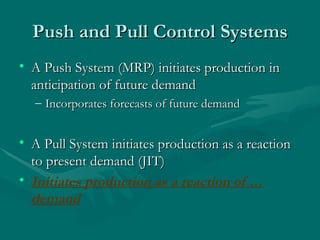
Push and Pull Control Systems A Push System (MRP) initiates production in anticipation of future demand Incorporates forecasts of future demand A Pull System initiates production as a reaction to present demand (JIT) Initiates production as a reaction of … demand
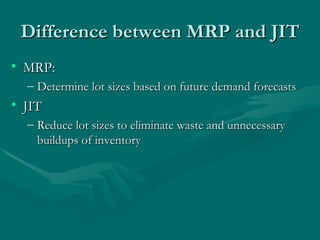
Difference between MRP and JIT MRP: Determine lot sizes based on future demand forecasts JIT Reduce lot sizes to eliminate waste and unnecessary buildups of inventory
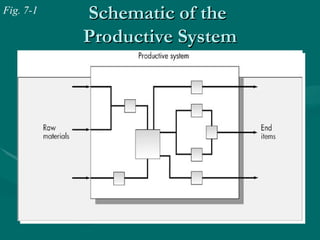
MRP Basics Production Plan M aster  P roduction  S chedule (MPS) MRP system Job shop Schedule At the heart of the production plan are the  demand forecasts of end items End item: Components Raw materials Figure 7-1
Schematic of the  Productive System Fig. 7-1
Production Plan MPS : specification of the exact amounts and timing of production of each of the end items MRP  is the means by which MPS is broken down into a detailed schedule of production for each component that comprises an end item MRP results are translated into specific  shop floor schedules
Data sources for determining the MPS Firm customer orders Forecasts of future demand by item Safety stock requirements Seasonal plans Internal orders from other parts of the organization
Success of MRP Integrity and timeliness of the data The information system that supports MRP receives input from: Production Marketing And Finance Departments A smooth flow of information among these three functional areas is a key ingredient to a  successful production planning system
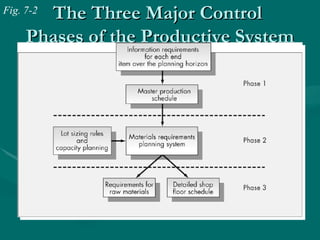
Major phases of the control system Phase 1: Gathering and coordinating of the information require to develop the MPS Phase 2: Determination of planned order releases using MRP Phase 3: Development of detailed shop floor schedules and resource requirements from the MRP planned order releases
The Three Major Control  Phases of the Productive System Fig. 7-2
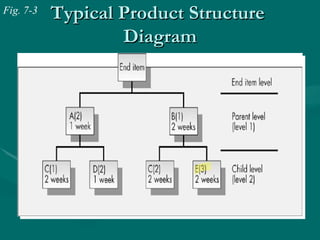
Explosion Calculus Bill of Material (BOM) explosion Set of rules by which  gross requirements  at one level of  the product structure  are translated into a production schedule at that level and requirements at lower levels At the heart of the MRP system is the product structure  (figure 7-3): The method is best illustrated with an example:
Typical Product Structure  Diagram Fig. 7-3
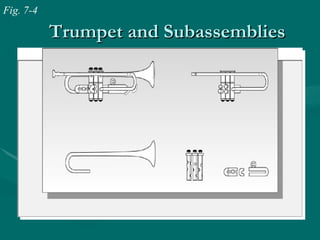
Trumpet and Subassemblies Fig. 7-4
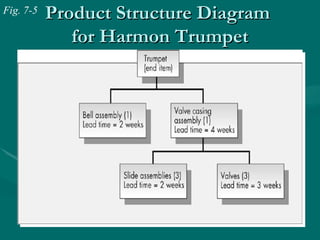
Product Structure Diagram  for Harmon Trumpet Fig. 7-5
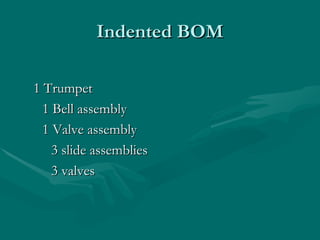
Indented BOM 1 Trumpet 1 Bell assembly 1 Valve assembly 3 slide assemblies 3 valves
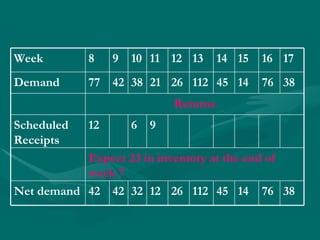
38 76 14 45 112 26 12 32 42 42 Net demand Expect 23 in inventory at the end of week 7 9 6 12 Scheduled Receipts Returns 38 76 14 45 112 26 21 38 42 77 Demand 17 16 15 14 13 12 11 10 9 8 Week
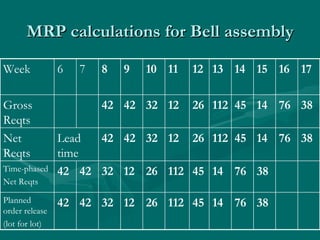
MRP calculations for Bell assembly 38 76 14 45 112 26 12 32 42 42 Planned order release (lot for lot) 38 76 14 45 112 26 12 32 42 42 Time-phased Net Reqts 38 76 14 45 112 26 12 32 42 42 Lead time Net Reqts 38 76 14 45 112 26 12 32 42 42 Gross Reqts 17 16 15 14 13 12 11 10 9 8 7 6 Week
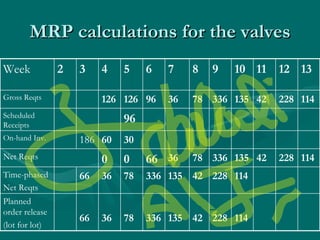
MRP calculations for the valves 30 60 186 On-hand Inv. 96 Scheduled Receipts 114 228 42 135 336 78 36 66 Planned order release (lot for lot) 114 228 42 135 336 78 36 66 Time-phased Net Reqts 114 228 42 135 336 78 36 66 0 0 Net Reqts 114 228 42 135 336 78 36 96 126 126 Gross Reqts 13 12 11 10 9 8 7 6 5 4 3 2 Week
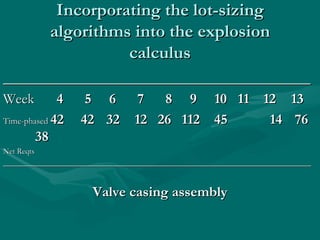
Incorporating the lot-sizing algorithms into the explosion calculus ___________________________________________ Week   4  5  6  7  8  9  10   11  12 13 Time-phased  42  42   32  12  26  112  45   14  76 38 Net Reqts _____________________________________________________________________________ Valve casing assembly
Starting in week 4 C(1)=132 C(2)=[132+0.6(42)]/2=78.6 C(3)=[132+0.6(42+2(32))]/3=65.2 C(4)=[132+0.6(42+2(32)+3(12))]/4=54.3 C(5)=[132+0.6(42+2(32)+3(12)+4(26))]/5=55.92      y 4 = 42+42+32+12=128 38 76 14 45 112 26 12 32 42 42 Time-phased net reqts . 13 12 11 10 9 8 7 6 5 4 Week
Starting in week 8: C(1)=132 C(2)=[132+0.6(112)]/2=99.6 C(3)=[112+0.6(112+2(45))]/3=84.4 C(4)=[112+0.6(112+2(45)+3(14))]/4=69.6 C(5)=[112+0.6(112+2(45)+3(14)+4(76))]/5=92.16    y 8 = 26+112+45+14=197 38 76 14 45 112 26 12 32 42 42 Time-phased net reqts. 13 12 11 10 9 8 7 6 5 4 Week
Starting in week 12: C(1)=132 C(2)=[132+0.6(38)]/2=77.4    y 12 = 76+38=114 Week 4  5  6   7  8   9  10  11   12   13 Pon  128   0  0   0  197   0   0  0   114   0 38 76 14 45 112 26 12 32 42 42 Time-phased net reqts. 13 12 11 10 9 8 7 6 5 4 Week
Part Period Balancing Set the order horizon = the number of periods that most closely matches the total  holding cost  with the  set up cost  over that period
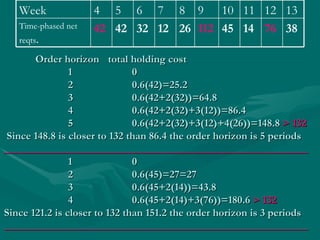
Order horizon   total holding cost 1 0 2 0.6(42)=25.2 3 0.6(42+2(32))=64.8 4 0.6(42+2(32)+3(12))=86.4 5 0.6(42+2(32)+3(12)+4(26))=148.8  > 132   Since 148.8 is closer to 132 than 86.4 the order horizon is 5 periods  _________________________________________________________  1 0 2 0.6(45)=27=27 3 0.6(45+2(14))=43.8 4 0.6(45+2(14)+3(76))=180.6  > 132   Since 121.2 is closer to 132 than 151.2 the order horizon is 3 periods _________________________________________________________ 38 76 14 45 112 26 12 32 42 42 Time-phased net reqts . 13 12 11 10 9 8 7 6 5 4 Week
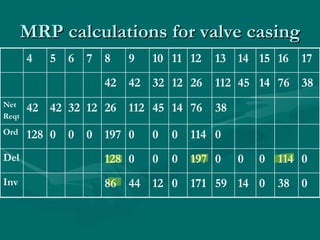
MRP calculations for valve casing Inv Del Ord Net Reqt 0 38 0 14 59 171 0 12 44 86 128 42 4 12 0 114 0 0 0 197 0 0 0 128 0 114 0 0 0 197 0 0 0 38 76 14 45 112 26 32 42 38 76 14 45 112 26 12 32 42 42 17 16 15 14 13 12 11 10 9 8 7 6 5
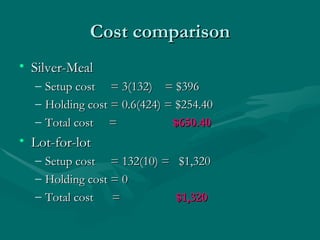
Cost comparison Silver-Meal Setup cost  = 3(132)  = $396 Holding cost = 0.6(424) = $254.40 Total cost  =  $650.40 Lot-for-lot Setup cost  = 132(10) =  $1,320 Holding cost = 0 Total cost  =  $1,320
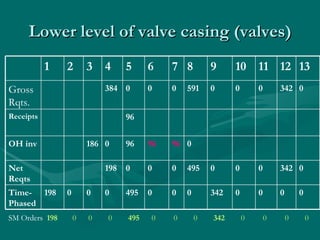
Lower level of valve casing (valves) SM Orders  198 0  0  0  495   0  0  0  342   0  0  0  0 Time-Phased Net Reqts OH inv Receipts Gross Rqts. 0 0 0 0 342 0 0 0 495 0 0 0 198 1 0 342 0 0 0 495 0 0 0 198 0 96 96 96 0 186 96 0 342 0 0 0 591 0 0 0 384 13 12 11 10 9 8 7 6 5 4 3 2
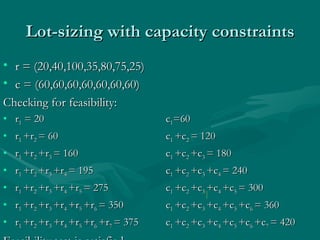
Lot-sizing with capacity constraints r = (20,40,100,35,80,75,25) c = (60,60,60,60,60,60,60) Checking for feasibility: r 1  = 20  c 1 =60 r 1  +r 2  = 60  c 1  +c 2  = 120 r 1  +r 2  +r 3  = 160  c 1  +c 2  +c 3  = 180 r 1  +r 2  +r 3  +r 4  = 195    c 1  +c 2  +c 3  +c 4  = 240 r 1  +r 2  +r 3  +r 4  +r 5  = 275  c 1  +c 2  +c 3  +c 4  +c 5  = 300 r 1  +r 2  +r 3  +r 4  +r 5  +r 6  = 350    c 1  +c 2  +c 3  +c 4  +c 5  +c 6  = 360 r 1  +r 2  +r 3  +r 4  +r 5  +r 6  +r 7  = 375  c 1  +c 2  +c 3  +c 4  +c 5  +c 6  +c 7  = 420 Feasibility test is satisfied
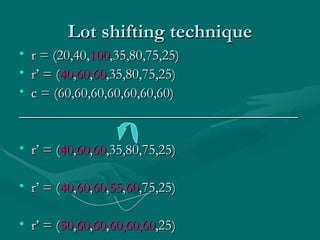
Lot shifting technique r = (20,40, 100 ,35,80,75,25) r’ = ( 40 , 60 , 60 ,35,80,75,25) c = (60,60,60,60,60,60,60) _______________________________________ r’ = ( 40 , 60 , 60 ,35,80,75,25) r’ = ( 40 , 60 , 60 , 55 , 60 ,75,25) r’ = ( 50 , 60 , 60 , 60,60,60 ,25)
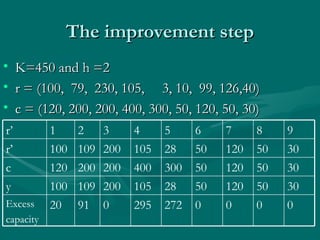
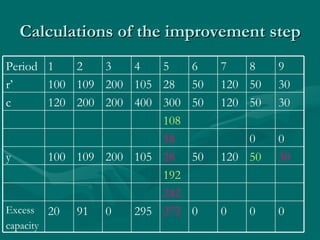
The improvement step K=450 and h =2 r = (100,  79,  230, 105,  3, 10,  99, 126,40) c = (120, 200, 200, 400, 300, 50, 120, 50, 30) 0 0 0 0 272 295 0 91 20 Excess capacity 30 50 120 50 28 105 200 109 100 y 30 50 120 50 300 400 200 200 120 c 30 50 120 50 28 105 200 109 100 r’ 9 8 7 6 5 4 3 2 1 r’
Calculations of the improvement step 0 0 0 0 272 295 0 91 20 Excess capacity 242 192 30 50 120 50 28 105 200 109 100 y 0 0 58 108 30 50 120 50 300 400 200 200 120 c 30 50 120 50 28 105 200 109 100 r’ 9 8 7 6 5 4 3 2 1 Period
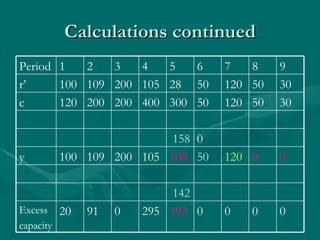
Calculations continued 0 0 0 0 192 295 0 91 20 Excess capacity 142 0 0 120 50 108 105 200 109 100 y 0 158 30 50 120 50 300 400 200 200 120 c 30 50 120 50 28 105 200 109 100 r’ 9 8 7 6 5 4 3 2 1 Period
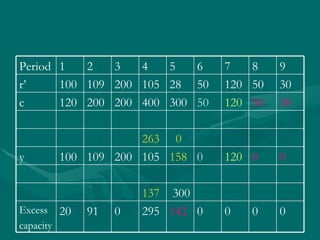
0 0 0 0 142 295 0 91 20 Excess capacity 300 137 0 0 120 0 158 105 200 109 100 y 0 263 30 50 120 50 300 400 200 200 120 c 30 50 120 50 28 105 200 109 100 r’ 9 8 7 6 5 4 3 2 1 Period
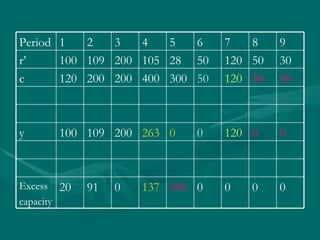
0 0 0 0 300 137 0 91 20 Excess capacity 0 0 120 0 0 263 200 109 100 y 30 50 120 50 300 400 200 200 120 c 30 50 120 50 28 105 200 109 100 r’ 9 8 7 6 5 4 3 2 1 Period
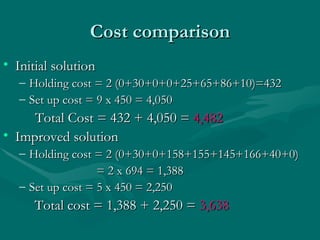
Cost comparison Initial solution Holding cost = 2 (0+30+0+0+25+65+86+10)=432 Set up cost = 9 x 450 = 4,050 Total Cost = 432 + 4,050 =  4,482 Improved solution Holding cost = 2 (0+30+0+158+155+145+166+40+0) = 2 x 694 = 1,388 Set up cost = 5 x 450 = 2,250 Total cost = 1,388 + 2,250 =  3,638

Push And Pull Production Systems Chap7 Ppt)

  • 1.
    Chapter 7 Pushand Pull Production Control Systems MRP and JIT
  • 2.
    Push and PullControl Systems A Push System (MRP) initiates production in anticipation of future demand Incorporates forecasts of future demand A Pull System initiates production as a reaction to present demand (JIT) Initiates production as a reaction of … demand
  • 3.
    Difference between MRPand JIT MRP: Determine lot sizes based on future demand forecasts JIT Reduce lot sizes to eliminate waste and unnecessary buildups of inventory
  • 4.
    MRP Basics ProductionPlan M aster P roduction S chedule (MPS) MRP system Job shop Schedule At the heart of the production plan are the demand forecasts of end items End item: Components Raw materials Figure 7-1
  • 5.
    Schematic of the Productive System Fig. 7-1
  • 6.
    Production Plan MPS: specification of the exact amounts and timing of production of each of the end items MRP is the means by which MPS is broken down into a detailed schedule of production for each component that comprises an end item MRP results are translated into specific shop floor schedules
  • 7.
    Data sources fordetermining the MPS Firm customer orders Forecasts of future demand by item Safety stock requirements Seasonal plans Internal orders from other parts of the organization
  • 8.
    Success of MRPIntegrity and timeliness of the data The information system that supports MRP receives input from: Production Marketing And Finance Departments A smooth flow of information among these three functional areas is a key ingredient to a successful production planning system
  • 9.
    Major phases ofthe control system Phase 1: Gathering and coordinating of the information require to develop the MPS Phase 2: Determination of planned order releases using MRP Phase 3: Development of detailed shop floor schedules and resource requirements from the MRP planned order releases
  • 10.
    The Three MajorControl Phases of the Productive System Fig. 7-2
  • 11.
    Explosion Calculus Billof Material (BOM) explosion Set of rules by which gross requirements at one level of the product structure are translated into a production schedule at that level and requirements at lower levels At the heart of the MRP system is the product structure (figure 7-3): The method is best illustrated with an example:
  • 12.
    Typical Product Structure Diagram Fig. 7-3
  • 13.
  • 14.
    Product Structure Diagram for Harmon Trumpet Fig. 7-5
  • 15.
    Indented BOM 1Trumpet 1 Bell assembly 1 Valve assembly 3 slide assemblies 3 valves
  • 16.
    38 76 1445 112 26 12 32 42 42 Net demand Expect 23 in inventory at the end of week 7 9 6 12 Scheduled Receipts Returns 38 76 14 45 112 26 21 38 42 77 Demand 17 16 15 14 13 12 11 10 9 8 Week
  • 17.
    MRP calculations forBell assembly 38 76 14 45 112 26 12 32 42 42 Planned order release (lot for lot) 38 76 14 45 112 26 12 32 42 42 Time-phased Net Reqts 38 76 14 45 112 26 12 32 42 42 Lead time Net Reqts 38 76 14 45 112 26 12 32 42 42 Gross Reqts 17 16 15 14 13 12 11 10 9 8 7 6 Week
  • 18.
    MRP calculations forthe valves 30 60 186 On-hand Inv. 96 Scheduled Receipts 114 228 42 135 336 78 36 66 Planned order release (lot for lot) 114 228 42 135 336 78 36 66 Time-phased Net Reqts 114 228 42 135 336 78 36 66 0 0 Net Reqts 114 228 42 135 336 78 36 96 126 126 Gross Reqts 13 12 11 10 9 8 7 6 5 4 3 2 Week
  • 19.
    Incorporating the lot-sizingalgorithms into the explosion calculus ___________________________________________ Week 4 5 6 7 8 9 10 11 12 13 Time-phased 42 42 32 12 26 112 45 14 76 38 Net Reqts _____________________________________________________________________________ Valve casing assembly
  • 20.
    Starting in week4 C(1)=132 C(2)=[132+0.6(42)]/2=78.6 C(3)=[132+0.6(42+2(32))]/3=65.2 C(4)=[132+0.6(42+2(32)+3(12))]/4=54.3 C(5)=[132+0.6(42+2(32)+3(12)+4(26))]/5=55.92  y 4 = 42+42+32+12=128 38 76 14 45 112 26 12 32 42 42 Time-phased net reqts . 13 12 11 10 9 8 7 6 5 4 Week
  • 21.
    Starting in week8: C(1)=132 C(2)=[132+0.6(112)]/2=99.6 C(3)=[112+0.6(112+2(45))]/3=84.4 C(4)=[112+0.6(112+2(45)+3(14))]/4=69.6 C(5)=[112+0.6(112+2(45)+3(14)+4(76))]/5=92.16  y 8 = 26+112+45+14=197 38 76 14 45 112 26 12 32 42 42 Time-phased net reqts. 13 12 11 10 9 8 7 6 5 4 Week
  • 22.
    Starting in week12: C(1)=132 C(2)=[132+0.6(38)]/2=77.4  y 12 = 76+38=114 Week 4 5 6 7 8 9 10 11 12 13 Pon 128 0 0 0 197 0 0 0 114 0 38 76 14 45 112 26 12 32 42 42 Time-phased net reqts. 13 12 11 10 9 8 7 6 5 4 Week
  • 23.
    Part Period BalancingSet the order horizon = the number of periods that most closely matches the total holding cost with the set up cost over that period
  • 24.
    Order horizon total holding cost 1 0 2 0.6(42)=25.2 3 0.6(42+2(32))=64.8 4 0.6(42+2(32)+3(12))=86.4 5 0.6(42+2(32)+3(12)+4(26))=148.8 > 132 Since 148.8 is closer to 132 than 86.4 the order horizon is 5 periods _________________________________________________________ 1 0 2 0.6(45)=27=27 3 0.6(45+2(14))=43.8 4 0.6(45+2(14)+3(76))=180.6 > 132 Since 121.2 is closer to 132 than 151.2 the order horizon is 3 periods _________________________________________________________ 38 76 14 45 112 26 12 32 42 42 Time-phased net reqts . 13 12 11 10 9 8 7 6 5 4 Week
  • 25.
    MRP calculations forvalve casing Inv Del Ord Net Reqt 0 38 0 14 59 171 0 12 44 86 128 42 4 12 0 114 0 0 0 197 0 0 0 128 0 114 0 0 0 197 0 0 0 38 76 14 45 112 26 32 42 38 76 14 45 112 26 12 32 42 42 17 16 15 14 13 12 11 10 9 8 7 6 5
  • 26.
    Cost comparison Silver-MealSetup cost = 3(132) = $396 Holding cost = 0.6(424) = $254.40 Total cost = $650.40 Lot-for-lot Setup cost = 132(10) = $1,320 Holding cost = 0 Total cost = $1,320
  • 27.
    Lower level ofvalve casing (valves) SM Orders 198 0 0 0 495 0 0 0 342 0 0 0 0 Time-Phased Net Reqts OH inv Receipts Gross Rqts. 0 0 0 0 342 0 0 0 495 0 0 0 198 1 0 342 0 0 0 495 0 0 0 198 0 96 96 96 0 186 96 0 342 0 0 0 591 0 0 0 384 13 12 11 10 9 8 7 6 5 4 3 2
  • 28.
    Lot-sizing with capacityconstraints r = (20,40,100,35,80,75,25) c = (60,60,60,60,60,60,60) Checking for feasibility: r 1 = 20 c 1 =60 r 1 +r 2 = 60 c 1 +c 2 = 120 r 1 +r 2 +r 3 = 160 c 1 +c 2 +c 3 = 180 r 1 +r 2 +r 3 +r 4 = 195 c 1 +c 2 +c 3 +c 4 = 240 r 1 +r 2 +r 3 +r 4 +r 5 = 275 c 1 +c 2 +c 3 +c 4 +c 5 = 300 r 1 +r 2 +r 3 +r 4 +r 5 +r 6 = 350 c 1 +c 2 +c 3 +c 4 +c 5 +c 6 = 360 r 1 +r 2 +r 3 +r 4 +r 5 +r 6 +r 7 = 375 c 1 +c 2 +c 3 +c 4 +c 5 +c 6 +c 7 = 420 Feasibility test is satisfied
  • 29.
    Lot shifting techniquer = (20,40, 100 ,35,80,75,25) r’ = ( 40 , 60 , 60 ,35,80,75,25) c = (60,60,60,60,60,60,60) _______________________________________ r’ = ( 40 , 60 , 60 ,35,80,75,25) r’ = ( 40 , 60 , 60 , 55 , 60 ,75,25) r’ = ( 50 , 60 , 60 , 60,60,60 ,25)
  • 30.
    The improvement stepK=450 and h =2 r = (100, 79, 230, 105, 3, 10, 99, 126,40) c = (120, 200, 200, 400, 300, 50, 120, 50, 30) 0 0 0 0 272 295 0 91 20 Excess capacity 30 50 120 50 28 105 200 109 100 y 30 50 120 50 300 400 200 200 120 c 30 50 120 50 28 105 200 109 100 r’ 9 8 7 6 5 4 3 2 1 r’
  • 31.
    Calculations of theimprovement step 0 0 0 0 272 295 0 91 20 Excess capacity 242 192 30 50 120 50 28 105 200 109 100 y 0 0 58 108 30 50 120 50 300 400 200 200 120 c 30 50 120 50 28 105 200 109 100 r’ 9 8 7 6 5 4 3 2 1 Period
  • 32.
    Calculations continued 00 0 0 192 295 0 91 20 Excess capacity 142 0 0 120 50 108 105 200 109 100 y 0 158 30 50 120 50 300 400 200 200 120 c 30 50 120 50 28 105 200 109 100 r’ 9 8 7 6 5 4 3 2 1 Period
  • 33.
    0 0 00 142 295 0 91 20 Excess capacity 300 137 0 0 120 0 158 105 200 109 100 y 0 263 30 50 120 50 300 400 200 200 120 c 30 50 120 50 28 105 200 109 100 r’ 9 8 7 6 5 4 3 2 1 Period
  • 34.
    0 0 00 300 137 0 91 20 Excess capacity 0 0 120 0 0 263 200 109 100 y 30 50 120 50 300 400 200 200 120 c 30 50 120 50 28 105 200 109 100 r’ 9 8 7 6 5 4 3 2 1 Period
  • 35.
    Cost comparison Initialsolution Holding cost = 2 (0+30+0+0+25+65+86+10)=432 Set up cost = 9 x 450 = 4,050 Total Cost = 432 + 4,050 = 4,482 Improved solution Holding cost = 2 (0+30+0+158+155+145+166+40+0) = 2 x 694 = 1,388 Set up cost = 5 x 450 = 2,250 Total cost = 1,388 + 2,250 = 3,638