 Help to decide
 How much to order
 When to order
 Basic EOQ model
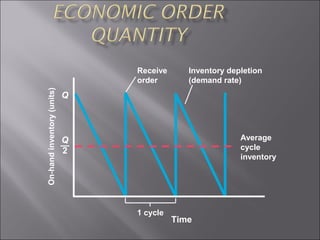
 Receive an order
 Use the inventory at a constant rate
 Reorder same amount
 Instantaneously receive the order
On-handinventory(units)
Time
Average
cycle
inventory
Q
Q
—
2
1 cycle
Receive
order
Inventory depletion
(demand rate)
Total Cost = Holding Cost + Order CostTotal Cost = Holding Cost + Order Cost
Annualcost(dollars)
Lot Size (Q)
Holding cost (HC)
Annualcost(dollars)
Lot Size (Q)
Holding cost (HC)
Ordering cost (OC)
H
Q
ingCostAnnualHold 





=
2
)//)(( yearunittHoldingCosryAveInvento
ingCostAnnualHold =
| | | | | | | |
50 100 150 200 250 300 350 400
Lot Size (Q)
3000 —
2000 —
1000 —
0 —
Holding cost = (H)
Q
2
Annualcost(dollars)
)(OrderCost
ityOrderQuant
ndAnnualDema
rCostAnnualOrde =
S
Q
D
rCostAnnualOrde =
| | | | | | | |
50 100 150 200 250 300 350 400
Lot Size (Q)
3000 —
2000 —
1000 —
0 —
Holding cost = (H)
Q
2
Ordering cost = (S)
D
Q
Annualcost(dollars)
| | | | | | | |
50 100 150 200 250 300 350 400
Lot Size (Q)
3000 —
2000 —
1000 —
0 —
Total cost = (H) + (S)
D
Q
Q
2
Holding cost = (H)
Q
2
Ordering cost = (S)
D
Q
Annualcost(dollars)
H
Q
S
Q
D
TC
2
+=
ngCostTotalHoldiCostTotalOrderTotalCost +=
H
Q
S
Q
D
TC
2
+=D – Total demand
Q – Order quantity
S – Setup/order cost
H – Holding cost
 Reorder point (ROP)
 Lead time – amount of time from order placement to
receipt of goods
 Lead time demand – the demand the occurs during
the lead time
Abstract
•In this paper, we study periodic inventory systems with long review
periods.
•We develop dynamic programming models for these systems in which
regular orders as well as emergency orders can be placed periodically.
•We identify two cases depending on whether or not a fixed cost for
placing an emergency order is present.
•We show that if the emergency supply mode can be used, there exists
a critical inventory level such that if the inventory position at a review
epoch falls below this critical level, an emergency order is placed.
•We also develop simple procedures for computing the
optimal policy parameters. In all cases, the optimal
order-up-to level is obtained by solving a myopic cost
function.
•
•Thus, the proposed ordering policies are easy to
implement
 we develop dynamic programming models for an inventory
system where regular orders as well as emergency orders can
be placed periodically.
 We identify two important cases depending on whether or not
a fixed cost for placing an emergency order is present.
 We show that if the emergency supply channel can be used,
there exists a critical inventory level such that if the inventory
position at a review epoch falls below this level, an emergency
order is placed.
 We also develop simple procedures for computing the optimal
policy parameters. In all cases, the optimal order-up-to level is
obtained by solving a myopic cost function.
 Thus, the proposed ordering policies are easy to implement.
Inventory models with two supply models

Inventory models with two supply models

  • 2.
     Help todecide  How much to order  When to order  Basic EOQ model
  • 3.
     Receive anorder  Use the inventory at a constant rate  Reorder same amount  Instantaneously receive the order
  • 4.
  • 5.
    Total Cost =Holding Cost + Order CostTotal Cost = Holding Cost + Order Cost
  • 6.
  • 7.
    Annualcost(dollars) Lot Size (Q) Holdingcost (HC) Ordering cost (OC)
  • 8.
  • 9.
    | | || | | | | 50 100 150 200 250 300 350 400 Lot Size (Q) 3000 — 2000 — 1000 — 0 — Holding cost = (H) Q 2 Annualcost(dollars)
  • 10.
  • 11.
    | | || | | | | 50 100 150 200 250 300 350 400 Lot Size (Q) 3000 — 2000 — 1000 — 0 — Holding cost = (H) Q 2 Ordering cost = (S) D Q Annualcost(dollars)
  • 12.
    | | || | | | | 50 100 150 200 250 300 350 400 Lot Size (Q) 3000 — 2000 — 1000 — 0 — Total cost = (H) + (S) D Q Q 2 Holding cost = (H) Q 2 Ordering cost = (S) D Q Annualcost(dollars)
  • 13.
  • 14.
    H Q S Q D TC 2 +=D – Totaldemand Q – Order quantity S – Setup/order cost H – Holding cost
  • 15.
     Reorder point(ROP)  Lead time – amount of time from order placement to receipt of goods  Lead time demand – the demand the occurs during the lead time
  • 16.
    Abstract •In this paper,we study periodic inventory systems with long review periods. •We develop dynamic programming models for these systems in which regular orders as well as emergency orders can be placed periodically. •We identify two cases depending on whether or not a fixed cost for placing an emergency order is present. •We show that if the emergency supply mode can be used, there exists a critical inventory level such that if the inventory position at a review epoch falls below this critical level, an emergency order is placed.
  • 17.
    •We also developsimple procedures for computing the optimal policy parameters. In all cases, the optimal order-up-to level is obtained by solving a myopic cost function. • •Thus, the proposed ordering policies are easy to implement
  • 23.
     we developdynamic programming models for an inventory system where regular orders as well as emergency orders can be placed periodically.  We identify two important cases depending on whether or not a fixed cost for placing an emergency order is present.  We show that if the emergency supply channel can be used, there exists a critical inventory level such that if the inventory position at a review epoch falls below this level, an emergency order is placed.  We also develop simple procedures for computing the optimal policy parameters. In all cases, the optimal order-up-to level is obtained by solving a myopic cost function.  Thus, the proposed ordering policies are easy to implement.

Editor's Notes

  • #6 The next series of slides presents Figure 13.4. The series builds in steps to the final Figure. This slide advances automatically.
  • #7 To improve legibility, this Figure is presented in three parts.