INVENTORY CONTROL
TECHNIQUES
PRESENTED BY
ANJALI RARICHAN
M.PHARM, FIRST YEAR
PHARMACY PRACTICE
The term inventory is defined as the
itemised list of goods with their estimated
worth specifically annual account of stock
taken in any business.
 All the materials , parts, suppliers,
expenses and in process or finished
products recorded on the books by an
organization and kept in its stocks,
warehouses or plant for some period of
time.
Inventory means…
Definition of inventory control
Inventory control is the technique
of maintaining the size of the
inventory at some desired level
keeping in view the best economic
interest of an organization.
OBJECTIVES OF INVENTORY CONTROL
 To reduce investment in inventories and made
effective use of capital investments.
 To supply drugs in time.
 Efforts are made to procure goods at minimum price
without bargaining the quality.
 To avoid stock out and shortages.
 Wastages are avoided.
 Inventory management is essential to maintain a
large size inventory for efficient and smooth
production and also for sales operation.
Benefits of Inventory Control
 Ensures an adequate supply of materials
 Minimizes inventory costs
 Facilitates purchasing economies
 Eliminates duplication in ordering
 Better utilization of available stocks
 Provides a check against the loss of materials
 Facilitates cost accounting activities
 Enables management in cost comparison
 Locates & disposes inactive & obsolete store items
 Consistent & reliable basis for financial statements
Techniques of inventory control
 Inventory control techniques are the tool
available for smooth running of the
business enterprises.
 The inventories should be maintained at
a level lying between the excessive and
the inadequate. This level is known as
the “OPTIMUM LEVEL” of inventories.
The common and widely used techniques are:
 ABC ANALYSIS (Always Better Control)
 VED ANALYSIS (Vital, Essential, Desirable)
 EOQ (Economic Order Quantity)
 Lead Time
 Buffer stock
 Perpetual inventory control system
 SDE classification
 HML Classification
 FSN Classification
 SOS classification
 XYZ Classification
ABC ANALYSIS
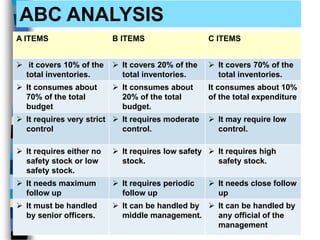
 In this technique the materials are divided
into 3 groups. A,B,C according to the cost of
the materials and money value.
 A items - A few costly items come under this
category these items require proper storage
and handling, overstock is avoided.
 B items - These are neither costly nor cheap.
 C items - Cheaper in cost.
 It is also known as Selective Inventory
Control Method (SIM).
A ITEMS B ITEMS C ITEMS
 it covers 10% of the
total inventories.
 It covers 20% of the
total inventories.
 It covers 70% of the
total inventories.
 It consumes about
70% of the total
budget
 It consumes about
20% of the total
budget.
It consumes about 10%
of the total expenditure
 It requires very strict
control
 It requires moderate
control.
 It may require low
control.
 It requires either no
safety stock or low
safety stock.
 It requires low safety
stock.
 It requires high
safety stock.
 It needs maximum
follow up
 It requires periodic
follow up
 It needs close follow
up
 It must be handled
by senior officers.
 It can be handled by
middle management.
 It can be handled by
any official of the
management
ABC ANALYSIS
Procedure for ABC Analysis
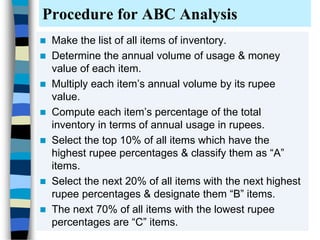
 Make the list of all items of inventory.
 Determine the annual volume of usage & money
value of each item.
 Multiply each item’s annual volume by its rupee
value.
 Compute each item’s percentage of the total
inventory in terms of annual usage in rupees.
 Select the top 10% of all items which have the
highest rupee percentages & classify them as “A”
items.
 Select the next 20% of all items with the next highest
rupee percentages & designate them “B” items.
 The next 70% of all items with the lowest rupee
percentages are “C” items.
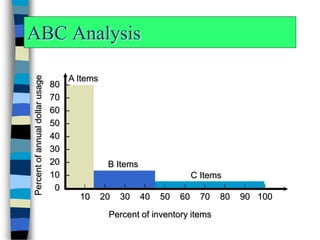
ABC Analysis
A Items
B Items
C Items
Percentofannualdollarusage
80 –
70 –
60 –
50 –
40 –
30 –
20 –
10 –
0 – | | | | | | | | | |
10 20 30 40 50 60 70 80 90 100
Percent of inventory items
VED ANALYSIS
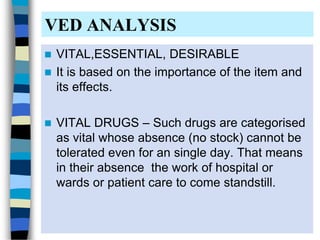
 VITAL,ESSENTIAL, DESIRABLE
 It is based on the importance of the item and
its effects.
 VITAL DRUGS – Such drugs are categorised
as vital whose absence (no stock) cannot be
tolerated even for an single day. That means
in their absence the work of hospital or
wards or patient care to come standstill.
VED ANALYSIS
 ESSENTIAL Drugs – These are the drugs
without which a hospital can function but may
affect the quality of service to some extent but
not to a very serious extent.
 DESIRABLE Drugs - These are the drugs
whose absence will not affect the functioning
of hospital or ward or department or patient
care.
VED ANALYSIS
 The motive of this system is to reduce
investment in inventories. The drugs
which are fast moving , ie which are in
great demand should be stocked more
than drugs occasionally demanded and
lastly the drugs which are rarely
demanded should be stocked in
minimum quantity.
ECONOMIC ORDER QUANTITY
 It is the most effective technique for
determination of the quantity.
 It is defined as the quantity of materials to
be ordered at one time which minimises
the lost.
 The basic objective of EOQ is to have an
ideal order quantity for any item and to
economise on the cost of the purchase.
Computation of EOQ
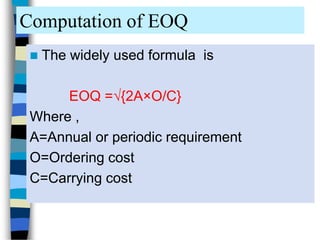
 The widely used formula is
EOQ =√{2A×O/C}
Where ,
A=Annual or periodic requirement
O=Ordering cost
C=Carrying cost
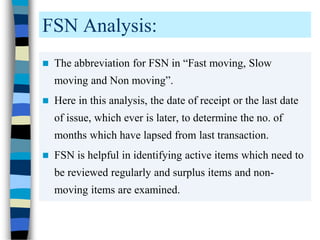
FSN Analysis:
 The abbreviation for FSN in “Fast moving, Slow
moving and Non moving”.
 Here in this analysis, the date of receipt or the last date
of issue, which ever is later, to determine the no. of
months which have lapsed from last transaction.
 FSN is helpful in identifying active items which need to
be reviewed regularly and surplus items and non-
moving items are examined.
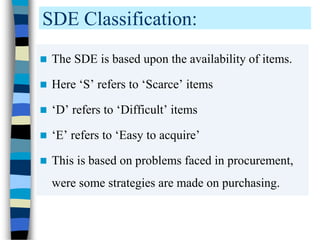
SDE Classification:
 The SDE is based upon the availability of items.
 Here ‘S’ refers to ‘Scarce’ items
 ‘D’ refers to ‘Difficult’ items
 ‘E’ refers to ‘Easy to acquire’
 This is based on problems faced in procurement,
were some strategies are made on purchasing.
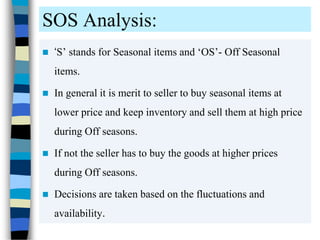
SOS Analysis:
 ‘S’ stands for Seasonal items and ‘OS’- Off Seasonal
items.
 In general it is merit to seller to buy seasonal items at
lower price and keep inventory and sell them at high price
during Off seasons.
 If not the seller has to buy the goods at higher prices
during Off seasons.
 Decisions are taken based on the fluctuations and
availability.
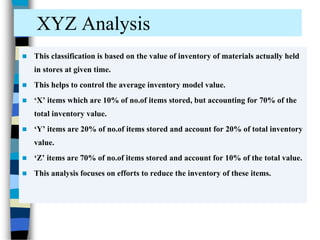
XYZ Analysis
 This classification is based on the value of inventory of materials actually held
in stores at given time.
 This helps to control the average inventory model value.
 ‘X’ items which are 10% of no.of items stored, but accounting for 70% of the
total inventory value.
 ‘Y’ items are 20% of no.of items stored and account for 20% of total inventory
value.
 ‘Z’ items are 70% of no.of items stored and account for 10% of the total value.
 This analysis focuses on efforts to reduce the inventory of these items.
 LEAD TIME : It is the time taken between the
placing of order and receipt of drug to the
department. The longer the lead time the larger
is the safety stock, resulting in excess of
investment in inventories.
 BUFFER STOCK : The quantity of stock kept
as reserve to guarantee against un fore seen
demands is known as buffer stock. This stock
protects against variation in demand and
procurement period. It is used in emergencies.
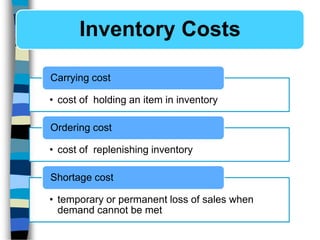
Inventory Costs
• cost of holding an item in inventory
Carrying cost
• cost of replenishing inventory
Ordering cost
• temporary or permanent loss of sales when
demand cannot be met
Shortage cost
REFERENCE
 Text book of hospital and clinical
pharmacy by Dr. Pratibha nand,
Dr.Roop.k.khar.
 Text book of hospital pharmacy by H.P
Tipnis.
• V
COMMENT ON THERAPY

Inventory controltechniques ppt by ann

  • 1.
    INVENTORY CONTROL TECHNIQUES PRESENTED BY ANJALIRARICHAN M.PHARM, FIRST YEAR PHARMACY PRACTICE
  • 2.
    The term inventoryis defined as the itemised list of goods with their estimated worth specifically annual account of stock taken in any business.  All the materials , parts, suppliers, expenses and in process or finished products recorded on the books by an organization and kept in its stocks, warehouses or plant for some period of time. Inventory means…
  • 3.
    Definition of inventorycontrol Inventory control is the technique of maintaining the size of the inventory at some desired level keeping in view the best economic interest of an organization.
  • 4.
    OBJECTIVES OF INVENTORYCONTROL  To reduce investment in inventories and made effective use of capital investments.  To supply drugs in time.  Efforts are made to procure goods at minimum price without bargaining the quality.  To avoid stock out and shortages.  Wastages are avoided.  Inventory management is essential to maintain a large size inventory for efficient and smooth production and also for sales operation.
  • 5.
    Benefits of InventoryControl  Ensures an adequate supply of materials  Minimizes inventory costs  Facilitates purchasing economies  Eliminates duplication in ordering  Better utilization of available stocks  Provides a check against the loss of materials  Facilitates cost accounting activities  Enables management in cost comparison  Locates & disposes inactive & obsolete store items  Consistent & reliable basis for financial statements
  • 6.
    Techniques of inventorycontrol  Inventory control techniques are the tool available for smooth running of the business enterprises.  The inventories should be maintained at a level lying between the excessive and the inadequate. This level is known as the “OPTIMUM LEVEL” of inventories.
  • 7.
    The common andwidely used techniques are:  ABC ANALYSIS (Always Better Control)  VED ANALYSIS (Vital, Essential, Desirable)  EOQ (Economic Order Quantity)  Lead Time  Buffer stock  Perpetual inventory control system  SDE classification  HML Classification  FSN Classification  SOS classification  XYZ Classification
  • 8.
    ABC ANALYSIS  Inthis technique the materials are divided into 3 groups. A,B,C according to the cost of the materials and money value.  A items - A few costly items come under this category these items require proper storage and handling, overstock is avoided.  B items - These are neither costly nor cheap.  C items - Cheaper in cost.  It is also known as Selective Inventory Control Method (SIM).
  • 9.
    A ITEMS BITEMS C ITEMS  it covers 10% of the total inventories.  It covers 20% of the total inventories.  It covers 70% of the total inventories.  It consumes about 70% of the total budget  It consumes about 20% of the total budget. It consumes about 10% of the total expenditure  It requires very strict control  It requires moderate control.  It may require low control.  It requires either no safety stock or low safety stock.  It requires low safety stock.  It requires high safety stock.  It needs maximum follow up  It requires periodic follow up  It needs close follow up  It must be handled by senior officers.  It can be handled by middle management.  It can be handled by any official of the management ABC ANALYSIS
  • 10.
    Procedure for ABCAnalysis  Make the list of all items of inventory.  Determine the annual volume of usage & money value of each item.  Multiply each item’s annual volume by its rupee value.  Compute each item’s percentage of the total inventory in terms of annual usage in rupees.  Select the top 10% of all items which have the highest rupee percentages & classify them as “A” items.  Select the next 20% of all items with the next highest rupee percentages & designate them “B” items.  The next 70% of all items with the lowest rupee percentages are “C” items.
  • 11.
    ABC Analysis A Items BItems C Items Percentofannualdollarusage 80 – 70 – 60 – 50 – 40 – 30 – 20 – 10 – 0 – | | | | | | | | | | 10 20 30 40 50 60 70 80 90 100 Percent of inventory items
  • 12.
    VED ANALYSIS  VITAL,ESSENTIAL,DESIRABLE  It is based on the importance of the item and its effects.  VITAL DRUGS – Such drugs are categorised as vital whose absence (no stock) cannot be tolerated even for an single day. That means in their absence the work of hospital or wards or patient care to come standstill.
  • 13.
    VED ANALYSIS  ESSENTIALDrugs – These are the drugs without which a hospital can function but may affect the quality of service to some extent but not to a very serious extent.  DESIRABLE Drugs - These are the drugs whose absence will not affect the functioning of hospital or ward or department or patient care.
  • 14.
    VED ANALYSIS  Themotive of this system is to reduce investment in inventories. The drugs which are fast moving , ie which are in great demand should be stocked more than drugs occasionally demanded and lastly the drugs which are rarely demanded should be stocked in minimum quantity.
  • 15.
    ECONOMIC ORDER QUANTITY It is the most effective technique for determination of the quantity.  It is defined as the quantity of materials to be ordered at one time which minimises the lost.  The basic objective of EOQ is to have an ideal order quantity for any item and to economise on the cost of the purchase.
  • 16.
    Computation of EOQ The widely used formula is EOQ =√{2A×O/C} Where , A=Annual or periodic requirement O=Ordering cost C=Carrying cost
  • 17.
    FSN Analysis:  Theabbreviation for FSN in “Fast moving, Slow moving and Non moving”.  Here in this analysis, the date of receipt or the last date of issue, which ever is later, to determine the no. of months which have lapsed from last transaction.  FSN is helpful in identifying active items which need to be reviewed regularly and surplus items and non- moving items are examined.
  • 18.
    SDE Classification:  TheSDE is based upon the availability of items.  Here ‘S’ refers to ‘Scarce’ items  ‘D’ refers to ‘Difficult’ items  ‘E’ refers to ‘Easy to acquire’  This is based on problems faced in procurement, were some strategies are made on purchasing.
  • 19.
    SOS Analysis:  ‘S’stands for Seasonal items and ‘OS’- Off Seasonal items.  In general it is merit to seller to buy seasonal items at lower price and keep inventory and sell them at high price during Off seasons.  If not the seller has to buy the goods at higher prices during Off seasons.  Decisions are taken based on the fluctuations and availability.
  • 20.
    XYZ Analysis  Thisclassification is based on the value of inventory of materials actually held in stores at given time.  This helps to control the average inventory model value.  ‘X’ items which are 10% of no.of items stored, but accounting for 70% of the total inventory value.  ‘Y’ items are 20% of no.of items stored and account for 20% of total inventory value.  ‘Z’ items are 70% of no.of items stored and account for 10% of the total value.  This analysis focuses on efforts to reduce the inventory of these items.
  • 21.
     LEAD TIME: It is the time taken between the placing of order and receipt of drug to the department. The longer the lead time the larger is the safety stock, resulting in excess of investment in inventories.  BUFFER STOCK : The quantity of stock kept as reserve to guarantee against un fore seen demands is known as buffer stock. This stock protects against variation in demand and procurement period. It is used in emergencies.
  • 22.
    Inventory Costs • costof holding an item in inventory Carrying cost • cost of replenishing inventory Ordering cost • temporary or permanent loss of sales when demand cannot be met Shortage cost
  • 23.
    REFERENCE  Text bookof hospital and clinical pharmacy by Dr. Pratibha nand, Dr.Roop.k.khar.  Text book of hospital pharmacy by H.P Tipnis.
  • 24.