Construction Materials
Management
(COTM 5202)
5. Inventory Control
by
Tadesse Ayalew
Lecturer , EiABC, AAU
BSc. IN CONSTRUCTION TECH. & MANAGEMENT, EiABC,
MARCH 2014
1
5. 1 Inventory cost Components
 The general objective of inventory control is to minimize the
total cost of keeping the inventory while making tradeoffs
among the major categories of costs:
(A) purchase costs,
(B) order cost,
(C) holding costs, and
(D) unavailable cost.
 These cost categories are interrelated since reducing cost in
one category may increase cost in others.
 The costs in all categories generally are subject to
considerable uncertainty.
A) Purchase Costs
 The purchase cost of an item is the unit purchase price
from an external source including transportation and
freight costs.
 For construction materials, it is common to receive
discounts for bulk purchases, so the unit purchase cost
declines as quantity increases.
 Because of this, organizations may consolidate small orders
from a number of different projects to capture such bulk
discounts, in some cases; this is a basic saving to be
derived from a central purchasing office
B) Order Cost
 The order cost reflects the administrative expense of
issuing a purchase order to an outside supplier.
 Order costs are usually only a small portion of total costs
for material management in construction projects,
although ordering may require substantial time.
C) Holding Costs
 The holding costs or carrying costs are primarily the
result of capital costs, handling, storage, obsolescence,
shrinkage and deterioration.
 Capital cost results from the opportunity cost or
financial expense of capital tied up in inventory.
 Handling and storage represent the movement and
protection charges incurred for materials.
C) Holding Costs (Cont….)
 Storage costs also include the disruption caused to other
project activities by large inventories of materials that
get in the way. Obsolescence is the risk that an item will
lose value because of changes in specifications.
 Shrinkage is the decrease in inventory over time due to
theft or loss. Deterioration reflects a change in material
quality due to age or environmental degradation.
D) Unavailability Cost
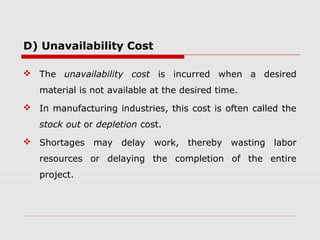
 The unavailability cost is incurred when a desired
material is not available at the desired time.
 In manufacturing industries, this cost is often called the
stock out or depletion cost.
 Shortages may delay work, thereby wasting labor
resources or delaying the completion of the entire
project.
5.2 Tradeoffs of Costs in Materials Management.
 To illustrate the type of trade-offs encountered in materials
management, suppose that a particular item is to be ordered
for a project. The amount of time required for processing the
order and shipping the item is uncertain.
 Consequently, the project manager must decide how much
lead time to provide in ordering the item. Ordering early and
thereby providing a long lead time will increase the chance
that the item is available when needed but it increases the
cost of inventory and chance of spoilage on site.
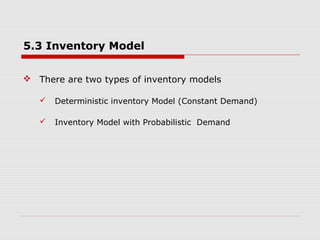
5.3 Inventory Model
 There are two types of inventory models
 Deterministic inventory Model (Constant Demand)
 Inventory Model with Probabilistic Demand
The objectives of this model is to determine an optimum
order quantity (EOQ) denoted by Q* such that total
inventory cost is minimized.
TVC= Ordering cost + carrying (holding cost)
Ch
Q
Co
Q
D
2
+TVC =
5.3.1 Deterministic inventory models
Economic order quantity (EOQ) model with constant rate of demand
Minimizing CostsMinimizing Costs
Objective is to minimize total costsObjective is to minimize total costs
Table 11.5Table 11.5
AnnualcostAnnualcost
Order quantityOrder quantity
Curve for totalCurve for total
cost of holdingcost of holding
and setupand setup
Holding costHolding cost
curvecurve
Setup (or order)Setup (or order)
cost curvecost curve
MinimumMinimum
total costtotal cost
OptimalOptimal
orderorder
quantityquantity
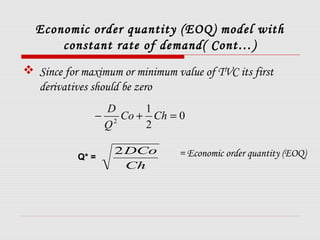
Economic order quantity (EOQ) model with
constant rate of demand( Cont…)
 Since for maximum or minimum value of TVC its first
derivatives should be zero
0
2
1
2
=+− ChCo
Q
D
Q* =
Ch
DCo2 = Economic order quantity (EOQ)
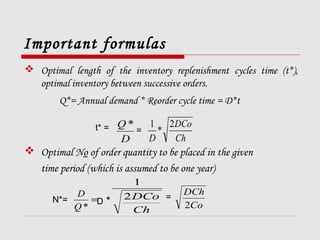
 Optimal length of the inventory replenishment cycles time (t*),
optimal inventory between successive orders.
Q*= Annual demand * Reorder cycle time = D*t
 Optimal No of order quantity to be placed in the given
time period (which is assumed to be one year)
Important formulas
D
Q *
Ch
DCo
D
2
*
1t* = =
=
*Q
D
Ch
DCo2
1
N*= D * =
Co
DCh
2
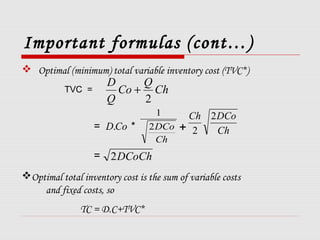
Important formulas (cont…)
 Optimal (minimum) total variable inventory cost (TVC*)
TVC = Ch
Q
Co
Q
D
2
+
CoD.
Ch
DCo2
1
Ch
DCoCh 2
2= * +
Optimal total inventory cost is the sum of variable costs
and fixed costs, so
TC = D.C+TVC*
DCoCh2=
Economic order quantity (EOQ) model
with ware house space constraint
Steps
Step1: for λ=1, compute EOQ for each item separately
by using the formula
Where fi = the storage space required per unit item i and λ
is a non negative Lagrange multiplier
Q*=
fiChi
DiCoi
λ2
2
+
; i =1, 2,
3….n
Step 2: if Qi* (i=1, 2, 3…n) is satisfied the condition,
(Total warehouse space available) then
stops, otherwise go to step three,
Step 3: Increase the value of λ if value of left hand side of
∑fiQi = W is More than available storage space
other wise decrease the value of λ.
 Continue iteration until the condition is satisfied
WfiQi =Σ
Economic order quantity (EOQ) model
with ware house space constraint
(cont…)
Economic order quantity (EOQ) model with
quantity discount
 EOQ model with one price break
 Suppose the following price discount schedule is quoted by
the suppliers in which a price (quantity discount) occurs at
b1 this means,
Quantity Price per unit
0<Q1<b1 C1
b1<Q2 C2
Economic order quantity (EOQ) model with
quantity discount (cont…)
 The optimal purchase quantity can be determined by the procedure
given below
 Step1: consider the lowest price (i.e. C2 ) and determine
Q2* by the basic EOQ formula
Q2*=
 If Q2* lies with in the prescribed range b1<Q2*, then Q2*
is EOQ i.e. Q*= Q2*
rC
DCo
*
2
2
Economic order quantity (EOQ) model with
quantity discount (cont…)
 And the optimal cost TC* associated with Q2* is calculated as
follows:
TC* (=TC2*) = D.C2+
Step2: If Q2* is not equal to or more than b1, then Calculate Q1*
with C1 and corresponding total cost at Q1*. Compare
TC(b1) and TC (Q1*), If TC(b1)>TC(Q1*),then EOQ is
Q*= Q1*.Otherwise Q*= b1 is the required EOQ
)*(
2
2
1
1
rC
b
Co
b
D
+
Economic order quantity (EOQ) model with
quantity discount (cont…)
EOQ model with two price break
 Suppose the following price discount schedule is quoted
by the suppliers in which a price (quantity discount)
occurs at b1 this means,
Quantity Price per unit
0<Q1< b1 C1
b1<Q2< b2 C2
b2< Q3 C3
Economic order quantity (EOQ) model with
quantity discount (cont…)
Notice that C3< C2< C1
The optimal purchase quantity can be determined by the procedure
given below
Step1: a) Consider the lowest price (i.e. C3) and determine Q3* by
the basic EOQ formula
b) If Q3* > b2 , then EOQ (Q*) = Q3* and the optimal cost
TC (Q3*) is the cost associated with Q3*
c) If Q3*< b2, then go to step 2
Economic order quantity (EOQ) model with quantity
discount (cont…)
Step2: a) Calculate Q2* is based on price C2.
b) Compare Q2* with b1and if b1< Q2* < b2 then compare TC (Q2*) and TC
(b2). If TC (Q2*)> TC (b2), then EOQ= b2. Otherwise EOQ = (Q2*)
c) If Q3*< b1as well as b2then go to step three.
Step3: Calculate Q1* is based on price C1and compare, TC (b1), TC (b2) and
TC (Q1*) to find EOQ the quantity with lowest cost will naturally
be the required EOQ
An EOQ ExampleAn EOQ Example
Determine optimal number of units to orderDetermine optimal number of units to order
D = 1,000 unitsD = 1,000 units
Co = $10 per orderCo = $10 per order
H = $.50 per unit per yearH = $.50 per unit per year
Q* =Q* =
2DCo2DCo
HH
Q* =Q* =
2(1,000)(10)2(1,000)(10)
0.500.50
= 40,000 = 200 units= 40,000 = 200 units
An EOQ ExampleAn EOQ Example
Determine optimal number of needles to orderDetermine optimal number of needles to order
D = 1,000 unitsD = 1,000 units Q*Q* = 200 units= 200 units
Co = $10 per orderCo = $10 per order
H = $.50 per unit per yearH = $.50 per unit per year
= N = == N = =
ExpectedExpected
number ofnumber of
ordersorders
DemandDemand
Order quantityOrder quantity
DD
Q*Q*
N = = 5 orders per yearN = = 5 orders per year
1,0001,000
200200
An EOQ ExampleAn EOQ Example
Determine optimal number of needles to orderDetermine optimal number of needles to order
D = 1,000 unitsD = 1,000 units Q*Q* = 200 units= 200 units
S = $10 per orderS = $10 per order NN = 5 orders per year= 5 orders per year
H = $.50 per unit per yearH = $.50 per unit per year
= T == T =
Expected timeExpected time
between ordersbetween orders
Number of workingNumber of working
days per yeardays per year
NN
T = = 50 days between ordersT = = 50 days between orders250250
55
An EOQ ExampleAn EOQ Example
Determine optimal number of needles to orderDetermine optimal number of needles to order
D = 1,000 unitsD = 1,000 units Q*Q* = 200 units= 200 units
S = $10 per orderS = $10 per order NN = 5 orders per year= 5 orders per year
H = $.50 per unit per yearH = $.50 per unit per year TT = 50 days= 50 days
Total annual cost = Setup cost + Holding costTotal annual cost = Setup cost + Holding cost
TC = S + HTC = S + H
DD
QQ
QQ
22
TC = ($10) + ($.50)TC = ($10) + ($.50)
1,0001,000
200200
200200
22
TC = (5)($10) + (100)($.50) = $50 + $50 = $100TC = (5)($10) + (100)($.50) = $50 + $50 = $100
Reorder PointsReorder Points
 EOQ answers the “how much” questionEOQ answers the “how much” question
 The reorder point (ROP) tells when to orderThe reorder point (ROP) tells when to order
ROP =ROP =
Lead time for a newLead time for a new
order in daysorder in days
DemandDemand
per dayper day
= d x L= d x L
d =d =
DD
Number of working days in a yearNumber of working days in a year
Reorder Point CurveReorder Point Curve
Q*Q*
ROPROP
(units)(units)
Inventorylevel(units)Inventorylevel(units)
Time (days)Time (days)
Figure 12.5Figure 12.5 Lead time = LLead time = L
Slope = units/day = dSlope = units/day = d
Reorder Point ExampleReorder Point Example
Demand = 8,000 DVDs per yearDemand = 8,000 DVDs per year
250 working day year250 working day year
Lead time for orders is 3 working daysLead time for orders is 3 working days
ROP = d x LROP = d x L
d =d =
DD
Number of working days in a yearNumber of working days in a year
= 8,000/250 = 32 units= 8,000/250 = 32 units
= 32 units per day x 3 days = 96 units= 32 units per day x 3 days = 96 units
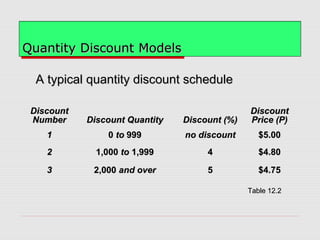
Quantity Discount ModelsQuantity Discount Models
DiscountDiscount
NumberNumber Discount QuantityDiscount Quantity Discount (%)Discount (%)
DiscountDiscount
Price (P)Price (P)
11 00 toto 999999 no discountno discount $5.00$5.00
22 1,0001,000 toto 1,9991,999 44 $4.80$4.80
33 2,0002,000 and overand over 55 $4.75$4.75
Table 12.2Table 12.2
A typical quantity discount scheduleA typical quantity discount schedule
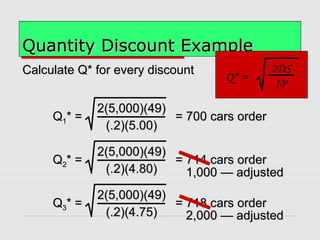
Quantity Discount ExampleQuantity Discount Example
Calculate Q* for every discountCalculate Q* for every discount
Q* =
2DS
IP
QQ11* = = 700 cars order* = = 700 cars order
2(5,000)(49)2(5,000)(49)
(.2)(5.00)(.2)(5.00)
QQ22* = = 714 cars order* = = 714 cars order
2(5,000)(49)2(5,000)(49)
(.2)(4.80)(.2)(4.80)
QQ33* = = 718 cars order* = = 718 cars order
2(5,000)(49)2(5,000)(49)
(.2)(4.75)(.2)(4.75)
1,000 — adjusted1,000 — adjusted
2,000 — adjusted2,000 — adjusted
Quantity Discount ExampleQuantity Discount Example
DiscountDiscount
NumberNumber
UnitUnit
PricePrice
OrderOrder
QuantityQuantity
AnnualAnnual
ProductProduct
CostCost
AnnualAnnual
OrderingOrdering
CostCost
AnnualAnnual
HoldingHolding
CostCost TotalTotal
11 $5.00$5.00 700700 $25,000$25,000 $350$350 $350$350 $25,700$25,700
22 $4.80$4.80 1,0001,000 $24,000$24,000 $245$245 $480$480 $24,725$24,725
33 $4.75$4.75 2,0002,000 $23.750$23.750 $122.50$122.50 $950$950 $24,822.50$24,822.50
Table 12.3Table 12.3
Choose the price and quantity that gives the lowest totalChoose the price and quantity that gives the lowest total
costcost
Buy 1,000 units at $4.80 per unitBuy 1,000 units at $4.80 per unit
Try the following
Exercises
Exercise 1
The production department of a company requires
3600kg of raw materials for manufacturing of particular
item per year. It has been estimated that cost of
placing an order is 36 birr and the cost of carrying
inventories is 25% of the investment in the inventories.
The price is 10 birr per kg. The purchase manager
whishes to determine an ordering policy for raw
materials.
Exercise 2
A small shop produces three machines part I,II and III in
lots. The shop has only 650m2
of storage space the
appropriate data for three items are given in the following
table
Item I II III
Demand (unit per year) 5000 2000 10000
Procurement cost per order 100 200 75
Cost per unit 10 15 5
Floor space requirements 0.7 0.8 0.4
The shop uses an inventory charge of 20% of average
inventories valuation per year. If no stock out is allowed,
determine the optimal lot size for each item under a given
storage constraints.
Exercise 3
A shopkeeper estimates annual requirement of an item
as 2000 units. He buys from supplier 10 per item and
the cost of ordering is 50 birr each time. If the stock
holding costs are 25% per year of stock value how
frequently should replenish his stock? Further, suppose
the supplier offer 10% discount on order between 400
and 699 item, a 20% discount on order exceeding or
equal to 700 can the shopkeeper reduce his cost by
taking advantages from either of the discount ?
Thank You

inventory control for construction

  • 1.
    Construction Materials Management (COTM 5202) 5.Inventory Control by Tadesse Ayalew Lecturer , EiABC, AAU BSc. IN CONSTRUCTION TECH. & MANAGEMENT, EiABC, MARCH 2014 1
  • 2.
    5. 1 Inventorycost Components  The general objective of inventory control is to minimize the total cost of keeping the inventory while making tradeoffs among the major categories of costs: (A) purchase costs, (B) order cost, (C) holding costs, and (D) unavailable cost.  These cost categories are interrelated since reducing cost in one category may increase cost in others.  The costs in all categories generally are subject to considerable uncertainty.
  • 3.
    A) Purchase Costs The purchase cost of an item is the unit purchase price from an external source including transportation and freight costs.  For construction materials, it is common to receive discounts for bulk purchases, so the unit purchase cost declines as quantity increases.  Because of this, organizations may consolidate small orders from a number of different projects to capture such bulk discounts, in some cases; this is a basic saving to be derived from a central purchasing office
  • 4.
    B) Order Cost The order cost reflects the administrative expense of issuing a purchase order to an outside supplier.  Order costs are usually only a small portion of total costs for material management in construction projects, although ordering may require substantial time.
  • 5.
    C) Holding Costs The holding costs or carrying costs are primarily the result of capital costs, handling, storage, obsolescence, shrinkage and deterioration.  Capital cost results from the opportunity cost or financial expense of capital tied up in inventory.  Handling and storage represent the movement and protection charges incurred for materials.
  • 6.
    C) Holding Costs(Cont….)  Storage costs also include the disruption caused to other project activities by large inventories of materials that get in the way. Obsolescence is the risk that an item will lose value because of changes in specifications.  Shrinkage is the decrease in inventory over time due to theft or loss. Deterioration reflects a change in material quality due to age or environmental degradation.
  • 7.
    D) Unavailability Cost The unavailability cost is incurred when a desired material is not available at the desired time.  In manufacturing industries, this cost is often called the stock out or depletion cost.  Shortages may delay work, thereby wasting labor resources or delaying the completion of the entire project.
  • 8.
    5.2 Tradeoffs ofCosts in Materials Management.  To illustrate the type of trade-offs encountered in materials management, suppose that a particular item is to be ordered for a project. The amount of time required for processing the order and shipping the item is uncertain.  Consequently, the project manager must decide how much lead time to provide in ordering the item. Ordering early and thereby providing a long lead time will increase the chance that the item is available when needed but it increases the cost of inventory and chance of spoilage on site.
  • 9.
    5.3 Inventory Model There are two types of inventory models  Deterministic inventory Model (Constant Demand)  Inventory Model with Probabilistic Demand
  • 10.
    The objectives ofthis model is to determine an optimum order quantity (EOQ) denoted by Q* such that total inventory cost is minimized. TVC= Ordering cost + carrying (holding cost) Ch Q Co Q D 2 +TVC = 5.3.1 Deterministic inventory models Economic order quantity (EOQ) model with constant rate of demand
  • 11.
    Minimizing CostsMinimizing Costs Objectiveis to minimize total costsObjective is to minimize total costs Table 11.5Table 11.5 AnnualcostAnnualcost Order quantityOrder quantity Curve for totalCurve for total cost of holdingcost of holding and setupand setup Holding costHolding cost curvecurve Setup (or order)Setup (or order) cost curvecost curve MinimumMinimum total costtotal cost OptimalOptimal orderorder quantityquantity
  • 12.
    Economic order quantity(EOQ) model with constant rate of demand( Cont…)  Since for maximum or minimum value of TVC its first derivatives should be zero 0 2 1 2 =+− ChCo Q D Q* = Ch DCo2 = Economic order quantity (EOQ)
  • 13.
     Optimal lengthof the inventory replenishment cycles time (t*), optimal inventory between successive orders. Q*= Annual demand * Reorder cycle time = D*t  Optimal No of order quantity to be placed in the given time period (which is assumed to be one year) Important formulas D Q * Ch DCo D 2 * 1t* = = = *Q D Ch DCo2 1 N*= D * = Co DCh 2
  • 14.
    Important formulas (cont…) Optimal (minimum) total variable inventory cost (TVC*) TVC = Ch Q Co Q D 2 + CoD. Ch DCo2 1 Ch DCoCh 2 2= * + Optimal total inventory cost is the sum of variable costs and fixed costs, so TC = D.C+TVC* DCoCh2=
  • 15.
    Economic order quantity(EOQ) model with ware house space constraint Steps Step1: for λ=1, compute EOQ for each item separately by using the formula Where fi = the storage space required per unit item i and λ is a non negative Lagrange multiplier Q*= fiChi DiCoi λ2 2 + ; i =1, 2, 3….n
  • 16.
    Step 2: ifQi* (i=1, 2, 3…n) is satisfied the condition, (Total warehouse space available) then stops, otherwise go to step three, Step 3: Increase the value of λ if value of left hand side of ∑fiQi = W is More than available storage space other wise decrease the value of λ.  Continue iteration until the condition is satisfied WfiQi =Σ Economic order quantity (EOQ) model with ware house space constraint (cont…)
  • 17.
    Economic order quantity(EOQ) model with quantity discount  EOQ model with one price break  Suppose the following price discount schedule is quoted by the suppliers in which a price (quantity discount) occurs at b1 this means, Quantity Price per unit 0<Q1<b1 C1 b1<Q2 C2
  • 18.
    Economic order quantity(EOQ) model with quantity discount (cont…)  The optimal purchase quantity can be determined by the procedure given below  Step1: consider the lowest price (i.e. C2 ) and determine Q2* by the basic EOQ formula Q2*=  If Q2* lies with in the prescribed range b1<Q2*, then Q2* is EOQ i.e. Q*= Q2* rC DCo * 2 2
  • 19.
    Economic order quantity(EOQ) model with quantity discount (cont…)  And the optimal cost TC* associated with Q2* is calculated as follows: TC* (=TC2*) = D.C2+ Step2: If Q2* is not equal to or more than b1, then Calculate Q1* with C1 and corresponding total cost at Q1*. Compare TC(b1) and TC (Q1*), If TC(b1)>TC(Q1*),then EOQ is Q*= Q1*.Otherwise Q*= b1 is the required EOQ )*( 2 2 1 1 rC b Co b D +
  • 20.
    Economic order quantity(EOQ) model with quantity discount (cont…) EOQ model with two price break  Suppose the following price discount schedule is quoted by the suppliers in which a price (quantity discount) occurs at b1 this means, Quantity Price per unit 0<Q1< b1 C1 b1<Q2< b2 C2 b2< Q3 C3
  • 21.
    Economic order quantity(EOQ) model with quantity discount (cont…) Notice that C3< C2< C1 The optimal purchase quantity can be determined by the procedure given below Step1: a) Consider the lowest price (i.e. C3) and determine Q3* by the basic EOQ formula b) If Q3* > b2 , then EOQ (Q*) = Q3* and the optimal cost TC (Q3*) is the cost associated with Q3* c) If Q3*< b2, then go to step 2
  • 22.
    Economic order quantity(EOQ) model with quantity discount (cont…) Step2: a) Calculate Q2* is based on price C2. b) Compare Q2* with b1and if b1< Q2* < b2 then compare TC (Q2*) and TC (b2). If TC (Q2*)> TC (b2), then EOQ= b2. Otherwise EOQ = (Q2*) c) If Q3*< b1as well as b2then go to step three. Step3: Calculate Q1* is based on price C1and compare, TC (b1), TC (b2) and TC (Q1*) to find EOQ the quantity with lowest cost will naturally be the required EOQ
  • 23.
    An EOQ ExampleAnEOQ Example Determine optimal number of units to orderDetermine optimal number of units to order D = 1,000 unitsD = 1,000 units Co = $10 per orderCo = $10 per order H = $.50 per unit per yearH = $.50 per unit per year Q* =Q* = 2DCo2DCo HH Q* =Q* = 2(1,000)(10)2(1,000)(10) 0.500.50 = 40,000 = 200 units= 40,000 = 200 units
  • 24.
    An EOQ ExampleAnEOQ Example Determine optimal number of needles to orderDetermine optimal number of needles to order D = 1,000 unitsD = 1,000 units Q*Q* = 200 units= 200 units Co = $10 per orderCo = $10 per order H = $.50 per unit per yearH = $.50 per unit per year = N = == N = = ExpectedExpected number ofnumber of ordersorders DemandDemand Order quantityOrder quantity DD Q*Q* N = = 5 orders per yearN = = 5 orders per year 1,0001,000 200200
  • 25.
    An EOQ ExampleAnEOQ Example Determine optimal number of needles to orderDetermine optimal number of needles to order D = 1,000 unitsD = 1,000 units Q*Q* = 200 units= 200 units S = $10 per orderS = $10 per order NN = 5 orders per year= 5 orders per year H = $.50 per unit per yearH = $.50 per unit per year = T == T = Expected timeExpected time between ordersbetween orders Number of workingNumber of working days per yeardays per year NN T = = 50 days between ordersT = = 50 days between orders250250 55
  • 26.
    An EOQ ExampleAnEOQ Example Determine optimal number of needles to orderDetermine optimal number of needles to order D = 1,000 unitsD = 1,000 units Q*Q* = 200 units= 200 units S = $10 per orderS = $10 per order NN = 5 orders per year= 5 orders per year H = $.50 per unit per yearH = $.50 per unit per year TT = 50 days= 50 days Total annual cost = Setup cost + Holding costTotal annual cost = Setup cost + Holding cost TC = S + HTC = S + H DD QQ QQ 22 TC = ($10) + ($.50)TC = ($10) + ($.50) 1,0001,000 200200 200200 22 TC = (5)($10) + (100)($.50) = $50 + $50 = $100TC = (5)($10) + (100)($.50) = $50 + $50 = $100
  • 27.
    Reorder PointsReorder Points EOQ answers the “how much” questionEOQ answers the “how much” question  The reorder point (ROP) tells when to orderThe reorder point (ROP) tells when to order ROP =ROP = Lead time for a newLead time for a new order in daysorder in days DemandDemand per dayper day = d x L= d x L d =d = DD Number of working days in a yearNumber of working days in a year
  • 28.
    Reorder Point CurveReorderPoint Curve Q*Q* ROPROP (units)(units) Inventorylevel(units)Inventorylevel(units) Time (days)Time (days) Figure 12.5Figure 12.5 Lead time = LLead time = L Slope = units/day = dSlope = units/day = d
  • 29.
    Reorder Point ExampleReorderPoint Example Demand = 8,000 DVDs per yearDemand = 8,000 DVDs per year 250 working day year250 working day year Lead time for orders is 3 working daysLead time for orders is 3 working days ROP = d x LROP = d x L d =d = DD Number of working days in a yearNumber of working days in a year = 8,000/250 = 32 units= 8,000/250 = 32 units = 32 units per day x 3 days = 96 units= 32 units per day x 3 days = 96 units
  • 30.
    Quantity Discount ModelsQuantityDiscount Models DiscountDiscount NumberNumber Discount QuantityDiscount Quantity Discount (%)Discount (%) DiscountDiscount Price (P)Price (P) 11 00 toto 999999 no discountno discount $5.00$5.00 22 1,0001,000 toto 1,9991,999 44 $4.80$4.80 33 2,0002,000 and overand over 55 $4.75$4.75 Table 12.2Table 12.2 A typical quantity discount scheduleA typical quantity discount schedule
  • 31.
    Quantity Discount ExampleQuantityDiscount Example Calculate Q* for every discountCalculate Q* for every discount Q* = 2DS IP QQ11* = = 700 cars order* = = 700 cars order 2(5,000)(49)2(5,000)(49) (.2)(5.00)(.2)(5.00) QQ22* = = 714 cars order* = = 714 cars order 2(5,000)(49)2(5,000)(49) (.2)(4.80)(.2)(4.80) QQ33* = = 718 cars order* = = 718 cars order 2(5,000)(49)2(5,000)(49) (.2)(4.75)(.2)(4.75) 1,000 — adjusted1,000 — adjusted 2,000 — adjusted2,000 — adjusted
  • 32.
    Quantity Discount ExampleQuantityDiscount Example DiscountDiscount NumberNumber UnitUnit PricePrice OrderOrder QuantityQuantity AnnualAnnual ProductProduct CostCost AnnualAnnual OrderingOrdering CostCost AnnualAnnual HoldingHolding CostCost TotalTotal 11 $5.00$5.00 700700 $25,000$25,000 $350$350 $350$350 $25,700$25,700 22 $4.80$4.80 1,0001,000 $24,000$24,000 $245$245 $480$480 $24,725$24,725 33 $4.75$4.75 2,0002,000 $23.750$23.750 $122.50$122.50 $950$950 $24,822.50$24,822.50 Table 12.3Table 12.3 Choose the price and quantity that gives the lowest totalChoose the price and quantity that gives the lowest total costcost Buy 1,000 units at $4.80 per unitBuy 1,000 units at $4.80 per unit
  • 33.
  • 34.
    Exercise 1 The productiondepartment of a company requires 3600kg of raw materials for manufacturing of particular item per year. It has been estimated that cost of placing an order is 36 birr and the cost of carrying inventories is 25% of the investment in the inventories. The price is 10 birr per kg. The purchase manager whishes to determine an ordering policy for raw materials.
  • 35.
    Exercise 2 A smallshop produces three machines part I,II and III in lots. The shop has only 650m2 of storage space the appropriate data for three items are given in the following table Item I II III Demand (unit per year) 5000 2000 10000 Procurement cost per order 100 200 75 Cost per unit 10 15 5 Floor space requirements 0.7 0.8 0.4 The shop uses an inventory charge of 20% of average inventories valuation per year. If no stock out is allowed, determine the optimal lot size for each item under a given storage constraints.
  • 36.
    Exercise 3 A shopkeeperestimates annual requirement of an item as 2000 units. He buys from supplier 10 per item and the cost of ordering is 50 birr each time. If the stock holding costs are 25% per year of stock value how frequently should replenish his stock? Further, suppose the supplier offer 10% discount on order between 400 and 699 item, a 20% discount on order exceeding or equal to 700 can the shopkeeper reduce his cost by taking advantages from either of the discount ?
  • 37.