EOQ MODELS
  Presentation By:
     Shashank Shekhar
Economic Ordering Quantity
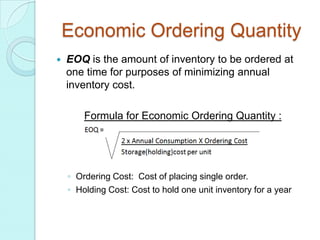
   EOQ is the amount of inventory to be ordered at
    one time for purposes of minimizing annual
    inventory cost.

        Formula for Economic Ordering Quantity :


    ◦ Ordering Cost: Cost of placing single order.
    ◦ Holding Cost: Cost to hold one unit inventory for a year
EOQ ASSUMPTIONS
   Known & constant demand
   Known & constant lead time
   Instantaneous receipt of material
   No quantity discounts
   Only order (setup) cost & holding cost
   No stockouts
Various EOQ Models


 Economic Production Quantity (EPQ)
 Quantity Discount Model
 Planned Shortage With Backorders
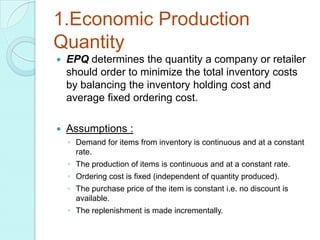
1.Economic Production
Quantity
   EPQ determines the quantity a company or retailer
    should order to minimize the total inventory costs
    by balancing the inventory holding cost and
    average fixed ordering cost.

   Assumptions :
    ◦ Demand for items from inventory is continuous and at a constant
      rate.
    ◦ The production of items is continuous and at a constant rate.
    ◦ Ordering cost is fixed (independent of quantity produced).
    ◦ The purchase price of the item is constant i.e. no discount is
      available.
    ◦ The replenishment is made incrementally.
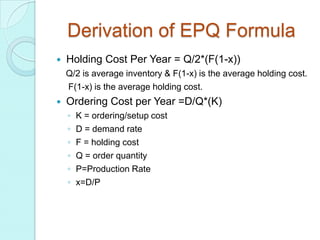
Derivation of EPQ Formula
   Holding Cost Per Year = Q/2*(F(1-x))
    Q/2 is average inventory & F(1-x) is the average holding cost.
    F(1-x) is the average holding cost.
   Ordering Cost per Year =D/Q*(K)
    ◦   K = ordering/setup cost
    ◦   D = demand rate
    ◦   F = holding cost
    ◦   Q = order quantity
    ◦   P=Production Rate
    ◦   x=D/P
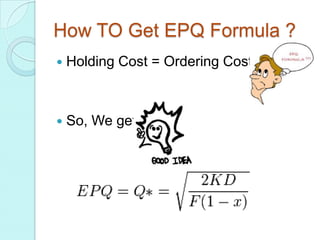
How TO Get EPQ Formula ?
   Holding Cost = Ordering Cost


   So, We get:
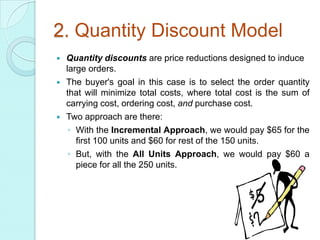
2. Quantity Discount Model
   Quantity discounts are price reductions designed to induce
    large orders.
   The buyer's goal in this case is to select the order quantity
    that will minimize total costs, where total cost is the sum of
    carrying cost, ordering cost, and purchase cost.
   Two approach are there:
     ◦ With the Incremental Approach, we would pay $65 for the
       first 100 units and $60 for rest of the 150 units.
     ◦ But, with the All Units Approach, we would pay $60 a
       piece for all the 250 units.
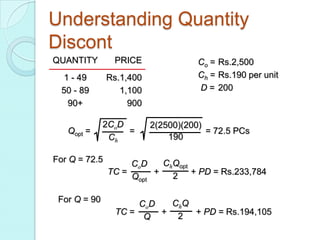
Understanding Quantity
Discont
QUANTITY        PRICE                Co = Rs.2,500
   1 - 49      Rs.1,400              Ch = Rs.190 per unit
  50 - 89         1,100              D = 200
    90+             900

              2CoD        2(2500)(200)
   Qopt =          =                   = 72.5 PCs
               Ch             190

For Q = 72.5        Co D   ChQopt
               TC =      +   2 + PD = Rs.233,784
                    Qopt

 For Q = 90           CoD  ChQ
                 TC =     + 2 + PD = Rs.194,105
                       Q
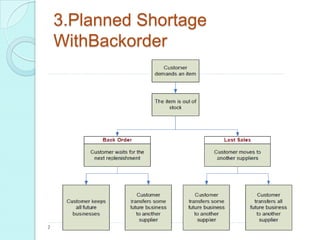
3.Planned Shortage
WithBackorder
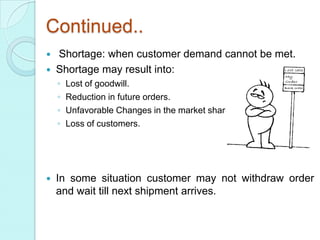
Continued..
   Shortage: when customer demand cannot be met.
   Shortage may result into:
    ◦   Lost of goodwill.
    ◦   Reduction in future orders.
    ◦   Unfavorable Changes in the market share.
    ◦   Loss of customers.


   In some situation customer may not withdraw order
    and wait till next shipment arrives.
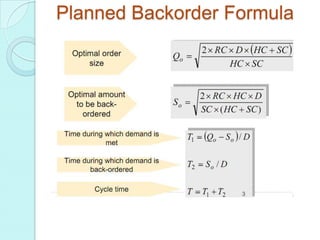
Planned Backorder Formula
Economic Order Quantity Models

Economic Order Quantity Models

  • 1.
    EOQ MODELS Presentation By: Shashank Shekhar
  • 2.
    Economic Ordering Quantity  EOQ is the amount of inventory to be ordered at one time for purposes of minimizing annual inventory cost. Formula for Economic Ordering Quantity : ◦ Ordering Cost: Cost of placing single order. ◦ Holding Cost: Cost to hold one unit inventory for a year
  • 3.
    EOQ ASSUMPTIONS  Known & constant demand  Known & constant lead time  Instantaneous receipt of material  No quantity discounts  Only order (setup) cost & holding cost  No stockouts
  • 4.
    Various EOQ Models Economic Production Quantity (EPQ)  Quantity Discount Model  Planned Shortage With Backorders
  • 5.
    1.Economic Production Quantity  EPQ determines the quantity a company or retailer should order to minimize the total inventory costs by balancing the inventory holding cost and average fixed ordering cost.  Assumptions : ◦ Demand for items from inventory is continuous and at a constant rate. ◦ The production of items is continuous and at a constant rate. ◦ Ordering cost is fixed (independent of quantity produced). ◦ The purchase price of the item is constant i.e. no discount is available. ◦ The replenishment is made incrementally.
  • 6.
    Derivation of EPQFormula  Holding Cost Per Year = Q/2*(F(1-x)) Q/2 is average inventory & F(1-x) is the average holding cost. F(1-x) is the average holding cost.  Ordering Cost per Year =D/Q*(K) ◦ K = ordering/setup cost ◦ D = demand rate ◦ F = holding cost ◦ Q = order quantity ◦ P=Production Rate ◦ x=D/P
  • 7.
    How TO GetEPQ Formula ?  Holding Cost = Ordering Cost  So, We get:
  • 8.
    2. Quantity DiscountModel  Quantity discounts are price reductions designed to induce large orders.  The buyer's goal in this case is to select the order quantity that will minimize total costs, where total cost is the sum of carrying cost, ordering cost, and purchase cost.  Two approach are there: ◦ With the Incremental Approach, we would pay $65 for the first 100 units and $60 for rest of the 150 units. ◦ But, with the All Units Approach, we would pay $60 a piece for all the 250 units.
  • 9.
    Understanding Quantity Discont QUANTITY PRICE Co = Rs.2,500 1 - 49 Rs.1,400 Ch = Rs.190 per unit 50 - 89 1,100 D = 200 90+ 900 2CoD 2(2500)(200) Qopt = = = 72.5 PCs Ch 190 For Q = 72.5 Co D ChQopt TC = + 2 + PD = Rs.233,784 Qopt For Q = 90 CoD ChQ TC = + 2 + PD = Rs.194,105 Q
  • 10.
  • 11.
    Continued..  Shortage: when customer demand cannot be met.  Shortage may result into: ◦ Lost of goodwill. ◦ Reduction in future orders. ◦ Unfavorable Changes in the market share. ◦ Loss of customers.  In some situation customer may not withdraw order and wait till next shipment arrives.
  • 12.