Inventory ManagmentInventory Managment
By-
Poornima Singh Pawar
12-1
Inventory managementInventory management
 Inventory management is a science
primarily about specifying the shape and
percentage of stocked goods. It is required at
different locations within a facility or within
many locations of a supply network to
precede the regular and planned course of
production and stock of materials.
12-2
12-3
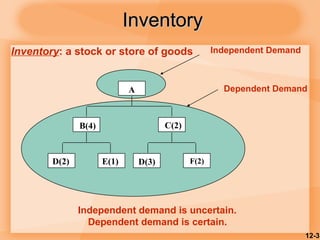
Independent Demand
A
B(4) C(2)
D(2) E(1) D(3) F(2)
Dependent Demand
Independent demand is uncertain.
Dependent demand is certain.
Inventory: a stock or store of goods
InventoryInventory
12-4
Inventory ModelsInventory Models
 Independent demand – finished goods, items
that are ready to be sold
 E.g. a computer
 Dependent demand – components of
finished products
 E.g. parts that make up the computer
12-5
Types of InventoriesTypes of Inventories
 Raw materials & purchased parts
 Partially completed goods called
work in progress
 Finished-goods inventories
 (manufacturing firms)
or merchandise
(retail stores)
12-6
Types of Inventories (Cont’d)Types of Inventories (Cont’d)
 Replacement parts, tools, & supplies
 Goods-in-transit to warehouses or
customers
12-7
Functions of InventoryFunctions of Inventory
 To meet anticipated demand
 To smooth production requirements
 To decouple operations
 To protect against stock-outs
12-8
Functions of Inventory (Cont’d)Functions of Inventory (Cont’d)
 To take advantage of order cycles
 To help hedge against price increases
 To permit operations
 To take advantage of quantity
discounts
12-9
Objective of Inventory ControlObjective of Inventory Control
 To achieve satisfactory levels of
customer service while keeping
inventory costs within reasonable
bounds
 Level of customer service
 Costs of ordering and carrying inventory
Inventory turnover is the ratio of
average cost of goods sold to
average inventory investment.
12-10
 A system to keep track of inventory
 A reliable forecast of demand
 Knowledge of lead times
 Reasonable estimates of
 Holding costs
 Ordering costs
 Shortage costs
 A classification system
Effective Inventory ManagementEffective Inventory Management
12-11
Inventory Counting SystemsInventory Counting Systems
 Periodic System
Physical count of items made at periodic
intervals
 Perpetual Inventory System
System that keeps track
of removals from inventory
continuously, thus
monitoring
current levels of
each item
12-12
Inventory Counting SystemsInventory Counting Systems
(Cont’d)(Cont’d)
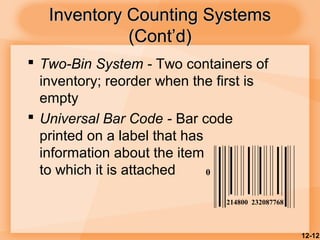
 Two-Bin System - Two containers of
inventory; reorder when the first is
empty
 Universal Bar Code - Bar code
printed on a label that has
information about the item
to which it is attached 0
214800 232087768
12-13
 Lead time: time interval between
ordering and receiving the order
 Holding (carrying) costs: cost to carry
an item in inventory for a length of time,
usually a year
 Ordering costs: costs of ordering and
receiving inventory
 Shortage costs: costs when demand
exceeds supply
Key Inventory TermsKey Inventory Terms
12-14
Deriving the EOQDeriving the EOQ
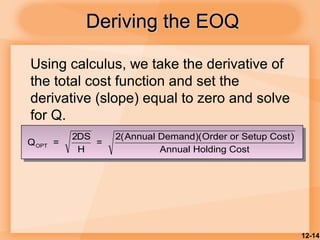
Using calculus, we take the derivative of
the total cost function and set the
derivative (slope) equal to zero and solve
for Q.
Q =
2DS
H
=
2(Annual Demand)(Order or Setup Cost)
Annual Holding Cost
OPT
12-15
 Production done in batches or lots
 Capacity to produce a part exceeds the
part’s usage or demand rate
 Assumptions of EPQ are similar to EOQ
except orders are received
incrementally during production
Economic Production Quantity (EPQ)Economic Production Quantity (EPQ)
12-16
 Only one item is involved
 Annual demand is known
 Usage rate is constant
 Usage occurs continually
 Production rate is constant
 Lead time does not vary
 No quantity discounts
Economic Production QuantityEconomic Production Quantity
AssumptionsAssumptions
12-17
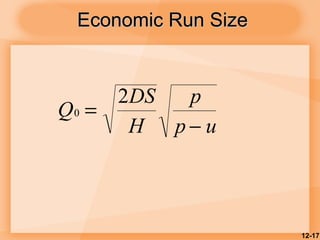
Economic Run SizeEconomic Run Size
Q
DS
H
p
p u
0
2
=
−
12-18
Total Costs with Purchasing CostTotal Costs with Purchasing Cost
Annual
carrying
cost
Purchasing
costTC = +
Q
2
H
D
Q
STC = +
+
Annual
ordering
cost
PD+
12-19
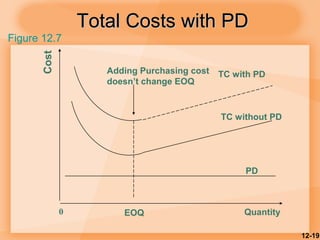
Total Costs with PDTotal Costs with PD
Cost
EOQ
TC with PD
TC without PD
PD
0 Quantity
Adding Purchasing cost
doesn’t change EOQ
Figure 12.7
12-20
When to Reorder with EOQWhen to Reorder with EOQ
OrderingOrdering
 Reorder Point - When the quantity on
hand of an item drops to this amount,
the item is reordered
 Safety Stock - Stock that is held in
excess of expected demand due to
variable demand rate and/or lead time.
 Service Level - Probability that demand
will not exceed supply during lead time.
 Too much inventory
 Tends to hide problems
 Easier to live with problems than to
eliminate them
 Costly to maintain
 Wise strategy
 Reduce lot sizes
 Reduce safety stock
Operations StrategyOperations Strategy
Inventory managment

Inventory managment

  • 1.
  • 2.
    Inventory managementInventory management Inventory management is a science primarily about specifying the shape and percentage of stocked goods. It is required at different locations within a facility or within many locations of a supply network to precede the regular and planned course of production and stock of materials. 12-2
  • 3.
    12-3 Independent Demand A B(4) C(2) D(2)E(1) D(3) F(2) Dependent Demand Independent demand is uncertain. Dependent demand is certain. Inventory: a stock or store of goods InventoryInventory
  • 4.
    12-4 Inventory ModelsInventory Models Independent demand – finished goods, items that are ready to be sold  E.g. a computer  Dependent demand – components of finished products  E.g. parts that make up the computer
  • 5.
    12-5 Types of InventoriesTypesof Inventories  Raw materials & purchased parts  Partially completed goods called work in progress  Finished-goods inventories  (manufacturing firms) or merchandise (retail stores)
  • 6.
    12-6 Types of Inventories(Cont’d)Types of Inventories (Cont’d)  Replacement parts, tools, & supplies  Goods-in-transit to warehouses or customers
  • 7.
    12-7 Functions of InventoryFunctionsof Inventory  To meet anticipated demand  To smooth production requirements  To decouple operations  To protect against stock-outs
  • 8.
    12-8 Functions of Inventory(Cont’d)Functions of Inventory (Cont’d)  To take advantage of order cycles  To help hedge against price increases  To permit operations  To take advantage of quantity discounts
  • 9.
    12-9 Objective of InventoryControlObjective of Inventory Control  To achieve satisfactory levels of customer service while keeping inventory costs within reasonable bounds  Level of customer service  Costs of ordering and carrying inventory Inventory turnover is the ratio of average cost of goods sold to average inventory investment.
  • 10.
    12-10  A systemto keep track of inventory  A reliable forecast of demand  Knowledge of lead times  Reasonable estimates of  Holding costs  Ordering costs  Shortage costs  A classification system Effective Inventory ManagementEffective Inventory Management
  • 11.
    12-11 Inventory Counting SystemsInventoryCounting Systems  Periodic System Physical count of items made at periodic intervals  Perpetual Inventory System System that keeps track of removals from inventory continuously, thus monitoring current levels of each item
  • 12.
    12-12 Inventory Counting SystemsInventoryCounting Systems (Cont’d)(Cont’d)  Two-Bin System - Two containers of inventory; reorder when the first is empty  Universal Bar Code - Bar code printed on a label that has information about the item to which it is attached 0 214800 232087768
  • 13.
    12-13  Lead time:time interval between ordering and receiving the order  Holding (carrying) costs: cost to carry an item in inventory for a length of time, usually a year  Ordering costs: costs of ordering and receiving inventory  Shortage costs: costs when demand exceeds supply Key Inventory TermsKey Inventory Terms
  • 14.
    12-14 Deriving the EOQDerivingthe EOQ Using calculus, we take the derivative of the total cost function and set the derivative (slope) equal to zero and solve for Q. Q = 2DS H = 2(Annual Demand)(Order or Setup Cost) Annual Holding Cost OPT
  • 15.
    12-15  Production donein batches or lots  Capacity to produce a part exceeds the part’s usage or demand rate  Assumptions of EPQ are similar to EOQ except orders are received incrementally during production Economic Production Quantity (EPQ)Economic Production Quantity (EPQ)
  • 16.
    12-16  Only oneitem is involved  Annual demand is known  Usage rate is constant  Usage occurs continually  Production rate is constant  Lead time does not vary  No quantity discounts Economic Production QuantityEconomic Production Quantity AssumptionsAssumptions
  • 17.
    12-17 Economic Run SizeEconomicRun Size Q DS H p p u 0 2 = −
  • 18.
    12-18 Total Costs withPurchasing CostTotal Costs with Purchasing Cost Annual carrying cost Purchasing costTC = + Q 2 H D Q STC = + + Annual ordering cost PD+
  • 19.
    12-19 Total Costs withPDTotal Costs with PD Cost EOQ TC with PD TC without PD PD 0 Quantity Adding Purchasing cost doesn’t change EOQ Figure 12.7
  • 20.
    12-20 When to Reorderwith EOQWhen to Reorder with EOQ OrderingOrdering  Reorder Point - When the quantity on hand of an item drops to this amount, the item is reordered  Safety Stock - Stock that is held in excess of expected demand due to variable demand rate and/or lead time.  Service Level - Probability that demand will not exceed supply during lead time.
  • 21.
     Too muchinventory  Tends to hide problems  Easier to live with problems than to eliminate them  Costly to maintain  Wise strategy  Reduce lot sizes  Reduce safety stock Operations StrategyOperations Strategy