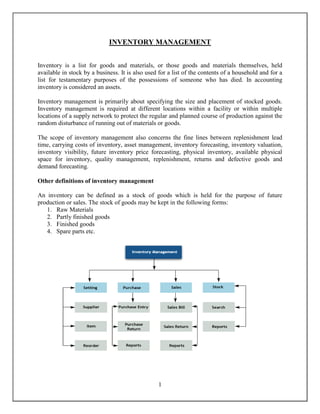
aCCMAN INSTITUTE OF MANAGEMENT Project on Inventory Management[Type the document subtitle]SUBMITTED BY: MOHD.ARISH<br />INVENTORY MANAGEMENT<br />Inventory is a list for goods and materials, or those goods and materials themselves, held available in stock by a business. It is also used for a list of the contents of a household and for a list for testamentary purposes of the possessions of someone who has died. In accounting inventory is considered an assets.<br />Inventory management is primarily about specifying the size and placement of stocked goods. Inventory management is required at different locations within a facility or within multiple locations of a supply network to protect the regular and planned course of production against the random disturbance of running out of materials or goods. <br />The scope of inventory management also concerns the fine lines between replenishment lead time, carrying costs of inventory, asset management, inventory forecasting, inventory valuation, inventory visibility, future inventory price forecasting, physical inventory, available physical space for inventory, quality management, replenishment, returns and defective goods and demand forecasting.<br />Other definitions of inventory management <br />An inventory can be defined as a stock of goods which is held for the purpose of future production or sales. The stock of goods may be kept in the following forms:<br />Raw Materials<br />Partly finished goods<br />Finished goods <br />Spare parts etc.<br />The objective of an inventory problem is to minimize the total (actual or expected) cost or to maximize (actual or expected) profit.<br />Involves a retailer seeking to acquire and maintain a proper merchandise assortment while ordering, shipping, handling, and related costs are kept in check.<br />Systems and processes that identify inventory requirements, set targets, provide replenishment techniques and report actual and projected inventory status.<br />Handles all functions related to the tracking and management of material. This would include the monitoring of material moved into and out of stockroom locations and the reconciling of the inventory balances. Also may include ABC analysis, lot tracking, cycle counting support etc.<br />Management of the inventories, with the primary objective of determining. Controlling stock levels within the physical distribution function to balance the need for product availability against the need for minimizing stock holding and handling costs. See inventory proportionality.<br />TYPES OF INVENTORY<br />Raw materials
Purchased parts and supplies
Labor
In-process (partially completed) products (WIP – work in progress)
Component parts
Tools, machinery, and equipment
Finished goods etc.The reasons for keeping stock<br />There are three basic reasons for keeping an inventory:<br />Time - The time lags present in the supply chain, from supplier to user at every stage, requires that you maintain certain amount of inventory to use in this "lead time"
Uncertainty - Inventories are maintained as buffers to meet uncertainties in demand, supply and movements of goods.
Economies of scale - Ideal condition of "one unit at a time at a place where user needs it, when he needs it" principle tends to incur lots of costs in terms of logistics. So bulk buying, movement and storing brings in economies of scale, thus inventory. All these stock reasons can apply to any owner or product stage.<br />Buffer stock is held in individual workstations against the possibility that the upstream workstation may be a little delayed in long setup or change-over time. This stock is then used while that change-over is happening. This stock can be eliminated by tools like SMED<br />These classifications apply along the whole Supply chain not just within a facility or plant. <br />Advantages: <br />The economics of production with the large run sizes.<br />The smooth and efficient running of the business.<br />The economics in transportation.<br />The advantage of price discounts by bulk purchasing.<br />Faster and adequate service to the customers and,<br />Profit from speculation in the market where price are expected to rise.<br />Disadvantages: <br />Ware house rent.<br />Interest on invested capital.<br />Physical handling.<br />Accounting.<br />Depreciation and determination. <br />Strategic inventory analysis<br />914400top<br />VARIABLE IN AN INVENTORY PROBLEM<br />The variables associated with the inventory problems are classified into two categories.<br />The Controlled variables<br />The uncontrolled variables<br />The Controlled variable -<br />The quantity acquired – By purchase, production, or some other means. The decision maker may have a control over the production or purchase level.<br />The frequency of timing of acquisition – The decision maker may have control over how often or when the inventory should be replenished.<br />The stage of completion of stocked items – The decision maker may have a control over the stage at which the unfinished items be held so that there is no delay in supplying customers.<br /> The uncontrolled variables –<br /> The variables that may not be controlled in an inventory problem are divisible into cost variables and others.<br />Cost Variables (or the costs) involved in Inventory Problems: <br />The main cost variables involved in inventory problems are as follows:<br />Holding or storage cost – The costs associated with the storage of the inventory until it is or used are known as the holding or storage costs. This cost is directly proportional to the various components of the holding costs are as follows:
Handling costs – Which include the cost of labour, transportation charges etc.
Rent of the space or interest and the cost of depreciation on owned space.
Cost of the staff to keep records.
Insurance and taxes.
Interest on the money locked for inventory.
Deterioration cost etc. Which arises in the case of fashion items or items that changes chemically during storage such as medicines, foods etc.
Set up (or replacement or ordering) costs – This is the cost associated with the placing of an order for purchasing goods, or it is the cost of setting a machine before it starts production. This cost may depend on the quantity of goods purchased because of price breaks or quantity discounts.Besides these cost variables there are other variables that may not be controlled in an inventory problem<br />Demand – Demand is the number of items required per period which is not necessarily equal to the amount sold as some demand may go unfulfilled because of storage or delays.           The demand may be of two types:<br />Deterministic Demands – If the number of items required (i.e. demand) in a subsequent period of time is known exactly then such demand are called deterministic demands.<br />Non deterministic Demands – If the demands over a subsequent period of time are not known with certainty then such demands are called non – deterministic or probabilistic demands.

Inventory Management

  • 1.
    aCCMAN INSTITUTE OFMANAGEMENT Project on Inventory Management[Type the document subtitle]SUBMITTED BY: MOHD.ARISH<br />INVENTORY MANAGEMENT<br />Inventory is a list for goods and materials, or those goods and materials themselves, held available in stock by a business. It is also used for a list of the contents of a household and for a list for testamentary purposes of the possessions of someone who has died. In accounting inventory is considered an assets.<br />Inventory management is primarily about specifying the size and placement of stocked goods. Inventory management is required at different locations within a facility or within multiple locations of a supply network to protect the regular and planned course of production against the random disturbance of running out of materials or goods. <br />The scope of inventory management also concerns the fine lines between replenishment lead time, carrying costs of inventory, asset management, inventory forecasting, inventory valuation, inventory visibility, future inventory price forecasting, physical inventory, available physical space for inventory, quality management, replenishment, returns and defective goods and demand forecasting.<br />Other definitions of inventory management <br />An inventory can be defined as a stock of goods which is held for the purpose of future production or sales. The stock of goods may be kept in the following forms:<br />Raw Materials<br />Partly finished goods<br />Finished goods <br />Spare parts etc.<br />The objective of an inventory problem is to minimize the total (actual or expected) cost or to maximize (actual or expected) profit.<br />Involves a retailer seeking to acquire and maintain a proper merchandise assortment while ordering, shipping, handling, and related costs are kept in check.<br />Systems and processes that identify inventory requirements, set targets, provide replenishment techniques and report actual and projected inventory status.<br />Handles all functions related to the tracking and management of material. This would include the monitoring of material moved into and out of stockroom locations and the reconciling of the inventory balances. Also may include ABC analysis, lot tracking, cycle counting support etc.<br />Management of the inventories, with the primary objective of determining. Controlling stock levels within the physical distribution function to balance the need for product availability against the need for minimizing stock holding and handling costs. See inventory proportionality.<br />TYPES OF INVENTORY<br />Raw materials
  • 2.
  • 3.
  • 4.
    In-process (partially completed)products (WIP – work in progress)
  • 5.
  • 6.
  • 7.
    Finished goods etc.Thereasons for keeping stock<br />There are three basic reasons for keeping an inventory:<br />Time - The time lags present in the supply chain, from supplier to user at every stage, requires that you maintain certain amount of inventory to use in this "lead time"
  • 8.
    Uncertainty - Inventoriesare maintained as buffers to meet uncertainties in demand, supply and movements of goods.
  • 9.
    Economies of scale- Ideal condition of "one unit at a time at a place where user needs it, when he needs it" principle tends to incur lots of costs in terms of logistics. So bulk buying, movement and storing brings in economies of scale, thus inventory. All these stock reasons can apply to any owner or product stage.<br />Buffer stock is held in individual workstations against the possibility that the upstream workstation may be a little delayed in long setup or change-over time. This stock is then used while that change-over is happening. This stock can be eliminated by tools like SMED<br />These classifications apply along the whole Supply chain not just within a facility or plant. <br />Advantages: <br />The economics of production with the large run sizes.<br />The smooth and efficient running of the business.<br />The economics in transportation.<br />The advantage of price discounts by bulk purchasing.<br />Faster and adequate service to the customers and,<br />Profit from speculation in the market where price are expected to rise.<br />Disadvantages: <br />Ware house rent.<br />Interest on invested capital.<br />Physical handling.<br />Accounting.<br />Depreciation and determination. <br />Strategic inventory analysis<br />914400top<br />VARIABLE IN AN INVENTORY PROBLEM<br />The variables associated with the inventory problems are classified into two categories.<br />The Controlled variables<br />The uncontrolled variables<br />The Controlled variable -<br />The quantity acquired – By purchase, production, or some other means. The decision maker may have a control over the production or purchase level.<br />The frequency of timing of acquisition – The decision maker may have control over how often or when the inventory should be replenished.<br />The stage of completion of stocked items – The decision maker may have a control over the stage at which the unfinished items be held so that there is no delay in supplying customers.<br /> The uncontrolled variables –<br /> The variables that may not be controlled in an inventory problem are divisible into cost variables and others.<br />Cost Variables (or the costs) involved in Inventory Problems: <br />The main cost variables involved in inventory problems are as follows:<br />Holding or storage cost – The costs associated with the storage of the inventory until it is or used are known as the holding or storage costs. This cost is directly proportional to the various components of the holding costs are as follows:
  • 10.
    Handling costs –Which include the cost of labour, transportation charges etc.
  • 11.
    Rent of thespace or interest and the cost of depreciation on owned space.
  • 12.
    Cost of thestaff to keep records.
  • 13.
  • 14.
    Interest on themoney locked for inventory.
  • 15.
    Deterioration cost etc.Which arises in the case of fashion items or items that changes chemically during storage such as medicines, foods etc.
  • 16.
    Set up (orreplacement or ordering) costs – This is the cost associated with the placing of an order for purchasing goods, or it is the cost of setting a machine before it starts production. This cost may depend on the quantity of goods purchased because of price breaks or quantity discounts.Besides these cost variables there are other variables that may not be controlled in an inventory problem<br />Demand – Demand is the number of items required per period which is not necessarily equal to the amount sold as some demand may go unfulfilled because of storage or delays. The demand may be of two types:<br />Deterministic Demands – If the number of items required (i.e. demand) in a subsequent period of time is known exactly then such demand are called deterministic demands.<br />Non deterministic Demands – If the demands over a subsequent period of time are not known with certainty then such demands are called non – deterministic or probabilistic demands.