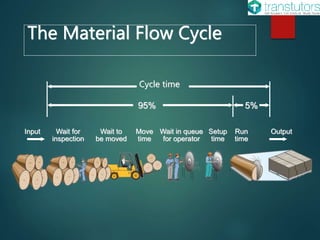
The Material Flow Cycle
Input Wait for Wait to Move Wait in queue Setup Run Output
inspection be moved time for operator time time
Cycle time
95% 5%
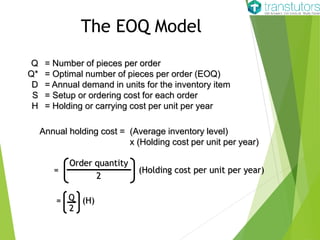
The EOQ Model
Q = Number of pieces per order
Q* = Optimal number of pieces per order (EOQ)
D = Annual demand in units for the inventory item
S = Setup or ordering cost for each order
H = Holding or carrying cost per unit per year
Annual holding cost = (Average inventory level)
x (Holding cost per unit per year)
Order quantity
2
= (Holding cost per unit per year)
= (H)Q
2
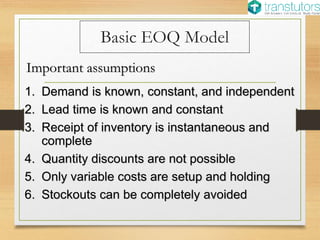
Basic EOQ Model
1. Demand is known, constant, and independent
2. Lead time is known and constant
3. Receipt of inventory is instantaneous and
complete
4. Quantity discounts are not possible
5. Only variable costs are setup and holding
6. Stockouts can be completely avoided
Important assumptions
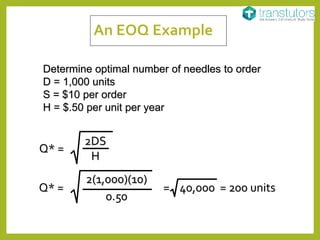
Determine optimal number of needles to order
D = 1,000 units
S = $10 per order
H = $.50 per unit per year
Q* =
2DS
H
Q* =
2(1,000)(10)
0.50
= 40,000 = 200 units
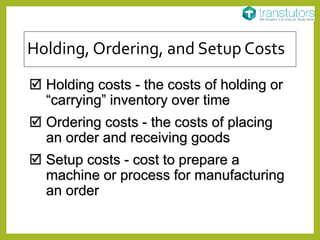
Holding, Ordering, and Setup Costs
 Holding costs - the costs of holding or
“carrying” inventory over time
 Ordering costs - the costs of placing
an order and receiving goods
 Setup costs - cost to prepare a
machine or process for manufacturing
an order
Hey Friend,
This was just a summary on Inventory Management
For more detailed information on this topic, please type the
link given below or copy it from the description of this PPT
and open it in a new browser window.
www.transtutors.com/homework-help/finance/inventory-management-system.aspx

Inventory Management System | Finance

  • 6.
    The Material FlowCycle Input Wait for Wait to Move Wait in queue Setup Run Output inspection be moved time for operator time time Cycle time 95% 5%
  • 9.
    The EOQ Model Q= Number of pieces per order Q* = Optimal number of pieces per order (EOQ) D = Annual demand in units for the inventory item S = Setup or ordering cost for each order H = Holding or carrying cost per unit per year Annual holding cost = (Average inventory level) x (Holding cost per unit per year) Order quantity 2 = (Holding cost per unit per year) = (H)Q 2
  • 10.
    Basic EOQ Model 1.Demand is known, constant, and independent 2. Lead time is known and constant 3. Receipt of inventory is instantaneous and complete 4. Quantity discounts are not possible 5. Only variable costs are setup and holding 6. Stockouts can be completely avoided Important assumptions
  • 11.
    Determine optimal numberof needles to order D = 1,000 units S = $10 per order H = $.50 per unit per year Q* = 2DS H Q* = 2(1,000)(10) 0.50 = 40,000 = 200 units
  • 12.
    Holding, Ordering, andSetup Costs  Holding costs - the costs of holding or “carrying” inventory over time  Ordering costs - the costs of placing an order and receiving goods  Setup costs - cost to prepare a machine or process for manufacturing an order
  • 13.
    Hey Friend, This wasjust a summary on Inventory Management For more detailed information on this topic, please type the link given below or copy it from the description of this PPT and open it in a new browser window. www.transtutors.com/homework-help/finance/inventory-management-system.aspx