What Is Inventory?
Stock of items kept to meet future demand
Purpose of inventory management
o how many units to order
o when to order
3.
Quality Management inthe Supply Chain
• Customers usually perceive quality service as availability of
goods they want when they want them
• Inventory must be sufficient to provide high-quality
customer service in QM
4.
Types of Inventory
•Raw materials
• Purchased parts and supplies
• Work-in-process (partially completed) products
(WIP)
• Items being transported
• Tools and equipment
5.
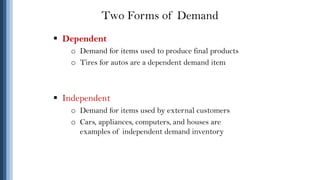
Two Forms ofDemand
Dependent
o Demand for items used to produce final products
o Tires for autos are a dependent demand item
Independent
o Demand for items used by external customers
o Cars, appliances, computers, and houses are
examples of independent demand inventory
6.
Inventory Costs
Carrying(or holding) cost
• cost of holding an item in inventory
Examples:
o Warehouse rent or storage space cost
o Insurance and security expenses
o Cost of obsolescence or spoilage
o Interest on capital tied up in inventory
Numerical Example:
A firm keeps an average inventory of 2,000 units in a year.
Cost per unit = ₹100
Annual carrying cost rate = 15% of item value (i.e., it covers rent, insurance, and capital cost)
Carrying cost per unit per year = 15% × ₹100 = ₹15
Annual carrying Cost = ₹15 × 2,000 = ₹30,000
7.
Inventory Costs
Orderingcost
• cost of replenishing inventory
Examples:
o Cost of preparing purchase orders
o Transportation or delivery charges
o Inspection and quality check costs on receipt of materials
o Machine setup cost before starting production
Numerical Example:
A manufacturing firm orders raw material from a supplier.
Cost of preparing a purchase order: ₹300
Delivery and inspection cost per order: ₹200
Total cost per order = ₹300 + ₹200 = ₹500
The firm places 12 orders per year
Annual Ordering Cost = ₹500 × 12 = ₹6,000
8.
Inventory Costs
Shortagecost
• temporary or permanent loss of sales when demand cannot be met
Examples:
o Lost profit due to unfulfilled orders
o Penalty for late delivery
o Cost of expedited shipping or emergency purchase
o Loss of goodwill or customer trust
Numerical Example:
During peak demand, the firm faces a shortage of 100 units.
Each unit sells for ₹500, with a profit margin of ₹80 per unit.
Each lost sale causes a profit loss and a ₹20 penalty for late delivery.
Stockout Cost per unit = ₹80 + ₹20 = ₹100
Total Stockout Cost = ₹100 × 100 = ₹10,000
9.
Inventory Control Systems
Continuous / Perpetual system(fixed-
order-quantity)
o Keeps a continuous, real-time
record of inventory levels.
o Every purchase and sale updates
the stock record immediately.
o Often computerized using barcode
o constant amount ordered when
inventory declines to a
predetermined level
Example: Supermarkets and e-
commerce warehouses use ERP or
POS systems to update stock instantly.
Periodic system (fixed-time-
period)
o Inventory levels are checked at
fixed intervals (weekly, monthly,
quarterly).
o Physical counting is done to
determine stock position.
o order placed for variable amount
after fixed passage of tie
Example: Small retail shops
counting stock at month-end.
10.
Benefits of anInventory Control System
Enhances customer satisfaction (on-time delivery)
Provides accurate data for planning and forecasting
Enables cost-effective operations
Reduces waste and obsolescence
Improves cash flow and working capital
11.
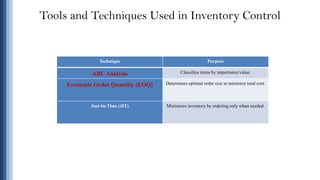
Tools and TechniquesUsed in Inventory Control
Technique Purpose
ABC Analysis Classifies items by importance/value.
Economic Order Quantity (EOQ) Determines optimal order size to minimize total cost.
Just-In-Time (JIT) Minimizes inventory by ordering only when needed.
12.
ABC Inventory Classification
ABCInventory Classification is a selective inventory control
technique that classifies inventory items into three categories — A, B,
and C - based on their annual consumption value (i.e., annual usage × unit
cost).
ABC Analysis Categories
Category% of Items
% of Annual
Consumption Value
Control Level Example
A-items ~5–15% ~70–80% Very tight control
High-value items
(e.g., microchips,
engines)
B-items ~20–30% ~15–25% Moderate control
Medium-value items
(e.g., bearings,
fasteners)
C-items ~50–70% ~5–10%
Simple or loose
control
Low-value items
(e.g., screws, nuts,
stationery)
15.
Part Unit CostANNUAL USAGE Total Value
1 60 90 5400
2 350 40 14000
3 30 130 3900
4 80 60 4800
5 30 100 3000
6 20 180 3600
7 10 170 1700
8 320 50 16000
9 510 60 30600
10 20 120 2400
Do the ABC Analysis?
16.
Part Unit Cost
ANNUAL
USAGETotal Value
% of Total
Value
1 60 90 5400 6.3%
2 350 40 14000 16.4%
3 30 130 3900 4.6%
4 80 60 4800 5.6%
5 30 100 3000 3.5%
6 20 180 3600 4.2%
7 10 170 1700 2.0%
8 320 50 16000 18.7%
9 510 60 30600 35.8%
10 20 120 2400 2.8%
Do the ABC Analysis?
17.
Total Value 24001700
30600 16000 14000 5400 4800 3900 3600 3000
Percent 2.8 2.0
35.8 18.7 16.4 6.3 5.6 4.6 4.2 3.5
Cum % 98.0 100.0
35.8 54.6 71.0 77.3 82.9 87.5 91.7 95.2
Part 7
10
5
6
3
4
1
2
8
9
90000
80000
70000
60000
50000
40000
30000
20000
10000
0
100
80
60
40
20
0
Total
Value
Percent
Pareto Chart of Part
18.
Rank Part
Total
Value (₹)
%of Value
Cumulative
Value (₹)
Cumulative
% of Value
% of Items
Cumulative
% of Items
ABC Class
1 9 30,600 35.9 30,600 33.9% 6 6% A
2 8 16,000 18.7 46,600 51.7% 5 11% A
3 2 14,000 16.4 60,600 67.3% 4 15% A
4 1 5,400 6.3 66,000 73.3% 9 24% B
5 4 4,800 5.6 70,800 78.6% 6 30% B
6 3 3,900 4.6 74,700 82.9% 13 43% B
7 6 3,600 4.2 78,300 86.8% 18 61% C
8 5 3,000 3.5 81,300 90.1% 13 71% C
9 10 2,400 2.8 83,700 92.8% 12 83% C
10 7 1,700 2 85,400 100.0% 17 100% C
Note: Mistake in calculation…see the shared excel
19.
Economic Order Quantity
(EOQ)Models
• EOQ
• continuous inventory system
• optimal order quantity that will minimize total
inventory costs
• Basic EOQ model
• Production quantity model
• Order cycle
• the time between receipt of orders in an inventory
system
20.
Assumptions of BasicEOQ Model
• Demand is known with certainty and is constant
over time
• No shortages are allowed
• Lead time for the receipt of orders is constant
• Order quantity is received all at once
Example
The ePaint Storestocks paint in its warehouse and sells it
online on its Internet Web site. The store stocks several
brands of paint; however, its biggest seller is Sharman-
Wilson Ironcoat paint.
The company wants to determine the optimal order size and
total inventory cost for Ironcoat paint given an estimated
annual demand of 10,000 gallons of paint, an annual
carrying cost of $0.75 per gallon, and an ordering cost of
$150 per order. They would also like to know the number of
orders that will be made annually and the time between
orders (i.e., the order cycle).
26.
EOQ Example
Cc =$0.75 per gallon Co = $150 D = 10,000 gallons
Qopt =
2CoD
Cc
Qopt =
Qopt =
TCmin = +
CoD
Q
CcQ
2
TCmin =
TCmin =
Orders per year = D/Qopt Order cycle time =
27.
EOQ Example
Cc =$0.75 per gallon Co = $150 D = 10,000 gallons
Qopt =
2CoD
Cc
Qopt =
2(150)(10,000)
(0.75)
Qopt = 2,000 gallons
TCmin = +
CoD
Q
CcQ
2
TCmin = +
(150)(10,000)
2,000
(0.75)(2,000)
2
TCmin = $750 + $750 = $1,500
Orders per year = D/Qopt
= 10,000/2,000
= 5 orders/year
Order cycle time = 311 days/(D/Qopt)
= 311/5
= 62.2 store days
Reorder Point
Level ofinventory at which a new order is placed
R = dL
where
d = demand rate per period
L = lead time
30.
Reorder Point: Example
Demand= 10,000 gallons/year
Store is open 311 days/year
Daily demand = 10,000 / 311 = 32.154
gallons/day
Lead time = L = 10 days
R = dL = (32.154)(10) = 321.54 gallons