Inventory
Chapter 6
 Inventory - a stock or store of goods
- a list of goods on hand
Kinds of Inventory:
Inventory
 Inventory Functionality and
Definitions
 Inventory Carrying Cost
 Planning Inventory
 Managing Uncertainty
 Inventory Management Policies
 Inventory Management Practices
Inventory Functionality and
Definitions
 Inventory management is risky.
 Typical measures of inventory exposure:
 Time duration
 Depth
 Width of commitment
 For manufacturer
 long-term risk
 For wholesaler
 Assortment of merchandise
 For retailer
 velocity of buying and selling
 Emphasis on inventory turnover
Functions of Inventory
 To meet the anticipated customer demand
 To smooth production requirements
 To decouple operations
 To protect against stockouts
 To hedge against price increases
 To permit operations
 To take advantage of quantity discounts
4 Prime Functions of Inventory
 Inventory policy
 Service level
 Average inventory
 Average inventory across multiple
performance cycles
Inventory Definitions
Inventory Policy
 Consists of guidelines concerning what to
purchase or manufacture, when to take
action, and in what quantity
 Concerns inventory management practice
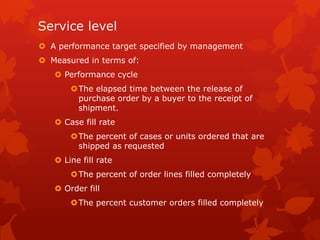
Service level
 A performance target specified by management
 Measured in terms of:
 Performance cycle
The elapsed time between the release of
purchase order by a buyer to the receipt of
shipment.
 Case fill rate
The percent of cases or units ordered that are
shipped as requested
 Line fill rate
The percent of order lines filled completely
 Order fill
The percent customer orders filled completely
Service level
Average inventory
 The materials, components, WIP, and fnished product
typically stocked in the logistical system is called
inventory and the typical amount across time is
average inventory.
 Order quantity
 The amount ordered for replenishment
 The difference between the maximum and minimum
inventory levels.
 Cycle inventory/base stock
 Portion of average inventory that results from
replenishment.
 Average cycle inventory or base stock
 The portion of average inventory that resullts from
replinishment
 Equals one-half order quantity
 Stock level
 At a maximum following stock receipt from the
supplier.
 Safety stock
 The majority of inventory in the typical logistics
system
 Ave. Inventory = ½ order quantity plus safety stock
 Transit inventory -amount typically in transit between
facilities or on order but not received.
 Obsolete inventory -stock that is out-of-date or that
has not experienced recent demand. Eventually
donated, destroyed, or sold at a loss.
 Speculative inventory - bought prior to need to hedge
a currency exchange or to take advantage of a
discount.
Average inventory (continuation...)
Inventory Definitions:
Inventory Cycle for Typical Product
Average Inventory
½ order quantity ($40,000/2 or
$20,000) + Safety Stock
($30,000) =
$50,000
$30,000
Transit/Obsolete/Speculative/
Safety stock
1 2
$70,000
Maximum Inventory
Inventory Definitions:
Average inventory across
multiple performance cycles
 Reorder point
Defines when a replenishment order is
initiated
 Inventory turns
Total sales divided by the average inventory
 Economic Order Quantity (EOQ)
Provides a specific quantity balacing the
cost of orderingand the cost of maintaining
average inventory
Inventory Definitions:
Inventory Cycle with No Demand
Uncertainty
Average
Inventory (Q/2)
= 100
0
200
Order Arrives
Days 40
60
Order Placed
for 200
products
10
Reorder Point
If sales occur at the rate of 10
products/day, it takes 20 days to sell 200
products
Inventoryon
hand
0
200
60
Order Arrives
20 40
Order Placed for
200 products
10
Reorder Point
Order Placed for
200 products
30
Reorder Point
Inventory Definitions:
Inventory Cycle with No Demand
Uncertainty
Assuming a work year of 240 days,12(240/20) purchases
will be req. during the year. Therefore, over a period of 1
year 2400 (200*12) unit will be purchased. Inventory
turnover will be 24 (2400 unit/100 units of ave. inventory)
times.
Order Arrives
20 40 50
Order Placed
for 100
products
10
Reorder
Point
30
Average
Inventory
50 products
Reorder
Point
Reorder
Point
Reorder
Point
Reorder
Point
0
100
Inventory Definitions:
More Frequent Orders, Smaller Order Quantity
Will have 24(240 days/10 days) purchases. Inventory turnover
will be 48( 2400/50)times.
Ave. Inventory
= 300
0
600
40 8020 60 100 120
Order Arrives
Order Placed
for 600
products
Order Placed
for 600
products
Inventory Definitions:
Less Frequent Orders, Larger Order Quantity
Inventory Carrying Cost
 The expense associated with maintaining inventory
 Calculated by multiplying annual inventory carrying
cost percent by average inventory value.
 Capital
 Ranges from the prime interest rate to a higher
managerially-determined percent
 Taxes
 A direct levy based on inventory level on a
specific day of the year or average inventory level
over a period of time
 Insurance
An expense based upon estimated risk or
loss over time
Risks depends on the product and the
facility storing the product.
 Obsolescence
Results from deterioration of product during
storage
Percent of ave. inventory value declared
obsolete each year
 Storage
Facility expense related to product holding
rather than product handling
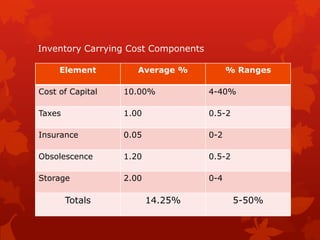
Inventory Carrying Cost Components
Element Average % % Ranges
Cost of Capital 10.00% 4-40%
Taxes 1.00 0.5-2
Insurance 0.05 0-2
Obsolescence 1.20 0.5-2
Storage 2.00 0-4
Totals 14.25% 5-50%
Planning Inventory
 Inventory Planning consist of determining
when and how much to order.
 When to order is determined by average
and variation in demand and replenishment.
 How much to order is determined by the
order quantity.
 Inventory Control – the process of
monitoring inventory status
When to Order
(When No Demand/Performance Cycle Uncertainty)
Reorder Point Formula:
R = D X T
R = Reorder Point in Units (of product)
D = Average Daily Demand in Units (of
product)
T =Average Performance Cycle in Days (i.e.,
order cycle time, or the number of days
between placing an order and receiving
the order)
Reorder Point Formula
R = D X T
D = 20 products/day
T = 10 days (time between placing order
and receiving order)
R = 20 X 10
Reorder Point = 200 products
That is, an order is initiated whenever there
are 200 products left in inventory
 Safety stock is necessary to accommodate
uncertainty
Reorder Point Formula
R = D X T + SS
 SS = Safety stock in units
D = 20 products/day
T = 10 days (time between placing order and
receiving order)
SS = 100 products
R = 20 X 10 + 100
Reorder Point = 300 products
That is, an order is initiated whenever there are 300
products left in inventory
When to Order
(When Demand/Performance Cycle is Uncertain)
How much to Order
 The objective is to identify the ordering quantity
that minimizes the total inventory carrying and
ordering cost.
 Significant cost are setup cost and holding cost, all
other cost s, such as the inventory itself, is
constant so minimizing the sum of setup and
holding costs will also minimize total cost (TC).
 Holding ( Carrying ) cost – the cost to keep or
carry inventory over time.
 Ordering ( Set Up ) cost – cost of the ordering
process
 EOQ – the replenishment practice that minimizes
the combined inventory carrying and ordering cost
 EOQ = Economic Order Quantity
 Co = Cost per Order (Ordering Cost)
 Ci = Annual Inventory Carrying Cost %
 D = Annual Product Sales (in units)
 U = Cost per Product
EOQ =
2Co D
Ci U
How Much to Order
Economic Order Quantity (EOQ)
Alternate formula based on Heizer book
 Q* = optimum number of units per order (EOQ)
 D = Annual demand in units for the inventory items
 S =Setup/Ordering cost for each order
= Co
 H = Holding/Carrying cost per unit per year
= Ci * U
Total Ordering cost = (D/Q) * S
Total Carrying/Holding cost = (Q/2) * H
(D/Q) * S = (Q/2) * H
Q* = 2DS/H
EOQ =
2 * $19.00 * 2400
20% * $5.00
 EOQ = Economic Order Quantity
 Co = $19.00 (ordering cost)
 Ci = 20% (annual carrying cost %)
 D = 2400 (annual number of products
sold)
 U = $5.00 (cost of each product)
302 rounded to 300 =
2 * $19.00 * 2400
20% * $5.00
How Much to Order
Considering Transportation Rates
 Order Quantity = 300 products per order
 Number of orders placed per year = 2400/300 or 8
 Ordering Cost per year = {( D/Q)*S} (2400 / 300)*
$19 = $152.00
 Inventory Carrying Costs per year = {(Q/2) * H}
(300/2) * ($5.00 * 20%) = $150.00
 Transportation Costs (per year) for Small Shipments:
 $1.00 (per product) * 2400 (products purchased per
year) = $2400.00
 TOTAL COSTS = $150.00 + $152.00 + $2400.00
= $2702.00
 Order Quantity = 480 products per order
 Number of orders placed per year = 2400/480 or 5
 Ordering Cost per year = 5 orders * $19.00 = $95.00
 Inventory Carrying Costs per year = 240 * $5.00 * 20% =
$240.00
 Transportation Costs (per year) for Large Shipments:
 $0.75 (per product) * 2400 (products purchased per year)
= $1800.00
 TOTAL COSTS = $95.00 + $240.00 + $1800.00 =
$2135.00
How Much to Order
Considering Transportation Rates
Alternative 1
 TOTAL COSTS (300 product order size)
 $150.00 + $152.00 + $2400.00 = $2702.00
Alternative 2
 TOTAL COSTS (480 product order size)
 $95.00 + $240.00 + $1800.00 = $2135.00
How Much to Order
Considering Transportation Rates
How Much to Order
Considering Transportation Rates &
Price/Quantity Discounts
How Much to Order
Considering Transportation Rates &
Price/Quantity Discounts
 Order Quantity = 300 products per order
 Number of orders placed per year = 2400/300 or 8
 Ordering Cost per year = 8 orders * $19.00 = $152.00
 Inventory Carrying Costs per year = 150 * $4.00 * 20% =
$120.00
 Transportation Costs (per year) for Small Shipments:
 $1.00 (per product) * 2400 (products purchased per year) =
$2400.00
 Product Cost per year = 2400 * $4.00 = $9600.00
 TOTAL COSTS = $120.00 + $152.00 + $2400.00 +
$9600.00 = $12,272.00
How Much to Order
Considering Transportation Rates & Price/Quantity
Discounts
 Order Quantity = 480 products per order
 Number of orders placed per year = 2400/480 or 5
 Ordering Cost per year = 5 orders * $19.00 = $95.00
 Inventory Carrying Costs per year = 240 * $3.00 * 20% =
$144.00
 Transportation Costs (per year) for Large Shipments:
 $0.75 (per product) * 2400 (products purchased per year)
= $1800.00
 Product Cost per year = 2400 * $3.00 = $7200.00
 TOTAL COSTS = $95.00 + $144.00 + $1800.00 +
$7200.00 = $9239.00
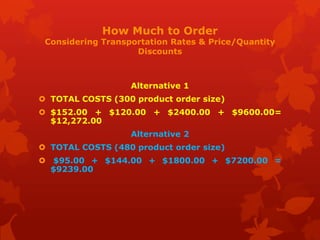
Alternative 1
 TOTAL COSTS (300 product order size)
 $152.00 + $120.00 + $2400.00 + $9600.00=
$12,272.00
Alternative 2
 TOTAL COSTS (480 product order size)
 $95.00 + $144.00 + $1800.00 + $7200.00 =
$9239.00
How Much to Order
Considering Transportation Rates & Price/Quantity
Discounts

Inventory

  • 1.
  • 2.
     Inventory -a stock or store of goods - a list of goods on hand Kinds of Inventory:
  • 3.
    Inventory  Inventory Functionalityand Definitions  Inventory Carrying Cost  Planning Inventory  Managing Uncertainty  Inventory Management Policies  Inventory Management Practices
  • 4.
    Inventory Functionality and Definitions Inventory management is risky.  Typical measures of inventory exposure:  Time duration  Depth  Width of commitment  For manufacturer  long-term risk  For wholesaler  Assortment of merchandise  For retailer  velocity of buying and selling  Emphasis on inventory turnover
  • 5.
    Functions of Inventory To meet the anticipated customer demand  To smooth production requirements  To decouple operations  To protect against stockouts  To hedge against price increases  To permit operations  To take advantage of quantity discounts
  • 6.
    4 Prime Functionsof Inventory
  • 7.
     Inventory policy Service level  Average inventory  Average inventory across multiple performance cycles Inventory Definitions
  • 8.
    Inventory Policy  Consistsof guidelines concerning what to purchase or manufacture, when to take action, and in what quantity  Concerns inventory management practice
  • 9.
    Service level  Aperformance target specified by management  Measured in terms of:  Performance cycle The elapsed time between the release of purchase order by a buyer to the receipt of shipment.  Case fill rate The percent of cases or units ordered that are shipped as requested  Line fill rate The percent of order lines filled completely  Order fill The percent customer orders filled completely
  • 10.
  • 11.
    Average inventory  Thematerials, components, WIP, and fnished product typically stocked in the logistical system is called inventory and the typical amount across time is average inventory.  Order quantity  The amount ordered for replenishment  The difference between the maximum and minimum inventory levels.  Cycle inventory/base stock  Portion of average inventory that results from replenishment.  Average cycle inventory or base stock  The portion of average inventory that resullts from replinishment  Equals one-half order quantity
  • 12.
     Stock level At a maximum following stock receipt from the supplier.  Safety stock  The majority of inventory in the typical logistics system  Ave. Inventory = ½ order quantity plus safety stock  Transit inventory -amount typically in transit between facilities or on order but not received.  Obsolete inventory -stock that is out-of-date or that has not experienced recent demand. Eventually donated, destroyed, or sold at a loss.  Speculative inventory - bought prior to need to hedge a currency exchange or to take advantage of a discount. Average inventory (continuation...)
  • 13.
    Inventory Definitions: Inventory Cyclefor Typical Product Average Inventory ½ order quantity ($40,000/2 or $20,000) + Safety Stock ($30,000) = $50,000 $30,000 Transit/Obsolete/Speculative/ Safety stock 1 2 $70,000 Maximum Inventory
  • 14.
    Inventory Definitions: Average inventoryacross multiple performance cycles  Reorder point Defines when a replenishment order is initiated  Inventory turns Total sales divided by the average inventory  Economic Order Quantity (EOQ) Provides a specific quantity balacing the cost of orderingand the cost of maintaining average inventory
  • 15.
    Inventory Definitions: Inventory Cyclewith No Demand Uncertainty Average Inventory (Q/2) = 100 0 200 Order Arrives Days 40 60 Order Placed for 200 products 10 Reorder Point If sales occur at the rate of 10 products/day, it takes 20 days to sell 200 products Inventoryon hand
  • 16.
    0 200 60 Order Arrives 20 40 OrderPlaced for 200 products 10 Reorder Point Order Placed for 200 products 30 Reorder Point Inventory Definitions: Inventory Cycle with No Demand Uncertainty Assuming a work year of 240 days,12(240/20) purchases will be req. during the year. Therefore, over a period of 1 year 2400 (200*12) unit will be purchased. Inventory turnover will be 24 (2400 unit/100 units of ave. inventory) times.
  • 17.
    Order Arrives 20 4050 Order Placed for 100 products 10 Reorder Point 30 Average Inventory 50 products Reorder Point Reorder Point Reorder Point Reorder Point 0 100 Inventory Definitions: More Frequent Orders, Smaller Order Quantity Will have 24(240 days/10 days) purchases. Inventory turnover will be 48( 2400/50)times.
  • 18.
    Ave. Inventory = 300 0 600 408020 60 100 120 Order Arrives Order Placed for 600 products Order Placed for 600 products Inventory Definitions: Less Frequent Orders, Larger Order Quantity
  • 19.
    Inventory Carrying Cost The expense associated with maintaining inventory  Calculated by multiplying annual inventory carrying cost percent by average inventory value.  Capital  Ranges from the prime interest rate to a higher managerially-determined percent  Taxes  A direct levy based on inventory level on a specific day of the year or average inventory level over a period of time
  • 20.
     Insurance An expensebased upon estimated risk or loss over time Risks depends on the product and the facility storing the product.  Obsolescence Results from deterioration of product during storage Percent of ave. inventory value declared obsolete each year  Storage Facility expense related to product holding rather than product handling
  • 21.
    Inventory Carrying CostComponents Element Average % % Ranges Cost of Capital 10.00% 4-40% Taxes 1.00 0.5-2 Insurance 0.05 0-2 Obsolescence 1.20 0.5-2 Storage 2.00 0-4 Totals 14.25% 5-50%
  • 22.
    Planning Inventory  InventoryPlanning consist of determining when and how much to order.  When to order is determined by average and variation in demand and replenishment.  How much to order is determined by the order quantity.  Inventory Control – the process of monitoring inventory status
  • 23.
    When to Order (WhenNo Demand/Performance Cycle Uncertainty) Reorder Point Formula: R = D X T R = Reorder Point in Units (of product) D = Average Daily Demand in Units (of product) T =Average Performance Cycle in Days (i.e., order cycle time, or the number of days between placing an order and receiving the order)
  • 24.
    Reorder Point Formula R= D X T D = 20 products/day T = 10 days (time between placing order and receiving order) R = 20 X 10 Reorder Point = 200 products That is, an order is initiated whenever there are 200 products left in inventory
  • 25.
     Safety stockis necessary to accommodate uncertainty Reorder Point Formula R = D X T + SS  SS = Safety stock in units D = 20 products/day T = 10 days (time between placing order and receiving order) SS = 100 products R = 20 X 10 + 100 Reorder Point = 300 products That is, an order is initiated whenever there are 300 products left in inventory When to Order (When Demand/Performance Cycle is Uncertain)
  • 26.
    How much toOrder  The objective is to identify the ordering quantity that minimizes the total inventory carrying and ordering cost.  Significant cost are setup cost and holding cost, all other cost s, such as the inventory itself, is constant so minimizing the sum of setup and holding costs will also minimize total cost (TC).  Holding ( Carrying ) cost – the cost to keep or carry inventory over time.  Ordering ( Set Up ) cost – cost of the ordering process  EOQ – the replenishment practice that minimizes the combined inventory carrying and ordering cost
  • 29.
     EOQ =Economic Order Quantity  Co = Cost per Order (Ordering Cost)  Ci = Annual Inventory Carrying Cost %  D = Annual Product Sales (in units)  U = Cost per Product EOQ = 2Co D Ci U How Much to Order Economic Order Quantity (EOQ)
  • 30.
    Alternate formula basedon Heizer book  Q* = optimum number of units per order (EOQ)  D = Annual demand in units for the inventory items  S =Setup/Ordering cost for each order = Co  H = Holding/Carrying cost per unit per year = Ci * U Total Ordering cost = (D/Q) * S Total Carrying/Holding cost = (Q/2) * H (D/Q) * S = (Q/2) * H Q* = 2DS/H
  • 31.
    EOQ = 2 *$19.00 * 2400 20% * $5.00
  • 32.
     EOQ =Economic Order Quantity  Co = $19.00 (ordering cost)  Ci = 20% (annual carrying cost %)  D = 2400 (annual number of products sold)  U = $5.00 (cost of each product) 302 rounded to 300 = 2 * $19.00 * 2400 20% * $5.00
  • 34.
    How Much toOrder Considering Transportation Rates  Order Quantity = 300 products per order  Number of orders placed per year = 2400/300 or 8  Ordering Cost per year = {( D/Q)*S} (2400 / 300)* $19 = $152.00  Inventory Carrying Costs per year = {(Q/2) * H} (300/2) * ($5.00 * 20%) = $150.00  Transportation Costs (per year) for Small Shipments:  $1.00 (per product) * 2400 (products purchased per year) = $2400.00  TOTAL COSTS = $150.00 + $152.00 + $2400.00 = $2702.00
  • 35.
     Order Quantity= 480 products per order  Number of orders placed per year = 2400/480 or 5  Ordering Cost per year = 5 orders * $19.00 = $95.00  Inventory Carrying Costs per year = 240 * $5.00 * 20% = $240.00  Transportation Costs (per year) for Large Shipments:  $0.75 (per product) * 2400 (products purchased per year) = $1800.00  TOTAL COSTS = $95.00 + $240.00 + $1800.00 = $2135.00 How Much to Order Considering Transportation Rates
  • 36.
    Alternative 1  TOTALCOSTS (300 product order size)  $150.00 + $152.00 + $2400.00 = $2702.00 Alternative 2  TOTAL COSTS (480 product order size)  $95.00 + $240.00 + $1800.00 = $2135.00 How Much to Order Considering Transportation Rates
  • 37.
    How Much toOrder Considering Transportation Rates & Price/Quantity Discounts
  • 38.
    How Much toOrder Considering Transportation Rates & Price/Quantity Discounts  Order Quantity = 300 products per order  Number of orders placed per year = 2400/300 or 8  Ordering Cost per year = 8 orders * $19.00 = $152.00  Inventory Carrying Costs per year = 150 * $4.00 * 20% = $120.00  Transportation Costs (per year) for Small Shipments:  $1.00 (per product) * 2400 (products purchased per year) = $2400.00  Product Cost per year = 2400 * $4.00 = $9600.00  TOTAL COSTS = $120.00 + $152.00 + $2400.00 + $9600.00 = $12,272.00
  • 39.
    How Much toOrder Considering Transportation Rates & Price/Quantity Discounts  Order Quantity = 480 products per order  Number of orders placed per year = 2400/480 or 5  Ordering Cost per year = 5 orders * $19.00 = $95.00  Inventory Carrying Costs per year = 240 * $3.00 * 20% = $144.00  Transportation Costs (per year) for Large Shipments:  $0.75 (per product) * 2400 (products purchased per year) = $1800.00  Product Cost per year = 2400 * $3.00 = $7200.00  TOTAL COSTS = $95.00 + $144.00 + $1800.00 + $7200.00 = $9239.00
  • 40.
    Alternative 1  TOTALCOSTS (300 product order size)  $152.00 + $120.00 + $2400.00 + $9600.00= $12,272.00 Alternative 2  TOTAL COSTS (480 product order size)  $95.00 + $144.00 + $1800.00 + $7200.00 = $9239.00 How Much to Order Considering Transportation Rates & Price/Quantity Discounts