CONFLICT
MANAGEMENT
© Adaptive US Inc.
December 2021
www.AdaptiveUS.com
Conflicts are part of life and
are inevitable. We should not
avoid them.
Sometimes even conflicts can
be helpful to identify scenarios
that we did not anticipate in the
beginning.
As business analysts, we
should have some techniques
in our armor which would help
us to resolve conflicts.
Why Manage
Conflicts?
ADAPTIVE US INC. - THINK BA.
THINK ADAPTIVE.
2
CONFLICT
MANAGE
MENT
What is Conflict?
Conflict Styles
Techniques for
Managing
Conflicts
ADAPTIVE US INC. - THINK BA.
THINK ADAPTIVE.
3
WHAT IS CONFLICT?
What is
conflict?
Conflict is a struggle
between stakeholders
who perceive they have
incompatible goals.
ADAPTIVE US INC. - THINK BA.
THINK ADAPTIVE.
4
CONFLICTS
Negative
Wasted resources
and energy spent
dealing with the
conflict
Decreased
productivity
Lowered
motivation
Decreased
morale
Poor decision-
making
Trust Issues
Toxic culture
Positive
Better
information
Better choices
Reduces anxiety
Encourages
collaboration
Increases
understanding
Speeds decision
making
ADAPTIVE US INC. - THINK BA.
THINK ADAPTIVE.
5
CONFLICT
MANAGEMENT
The tools, process and
procedure for managing
conflict
ADAPTIVE US INC. - THINK BA.
THINK ADAPTIVE.
6
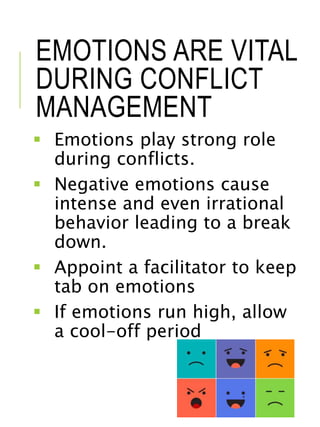
EMOTIONS ARE VITAL
DURING CONFLICT
MANAGEMENT
 Emotions play strong role
during conflicts.
 Negative emotions cause
intense and even irrational
behavior leading to a break
down.
 Appoint a facilitator to keep
tab on emotions
 If emotions run high, allow
a cool-off period
CONFLICT
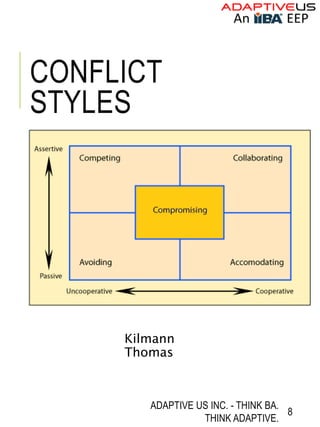
STYLES
Kilmann
Thomas
ADAPTIVE US INC. - THINK BA.
THINK ADAPTIVE.
8
CONFLICT STYLES
Competing
Accommodating
Avoiding
Compromising
Collaborating
ADAPTIVE US INC. - THINK BA.
THINK ADAPTIVE.
9
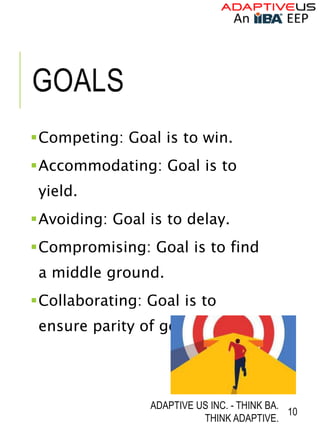
GOALS
Competing: Goal is to win.
Accommodating: Goal is to
yield.
Avoiding: Goal is to delay.
Compromising: Goal is to find
a middle ground.
Collaborating: Goal is to
ensure parity of goals.
ADAPTIVE US INC. - THINK BA.
THINK ADAPTIVE.
10
COMPETING
Quick, decisive action is vital-e.g.,
emergencies
Unpopular courses of action need
implementing-e.g., cost cutting,
enforcing unpopular rules, discipline
When you know you're right
To protect against people who take
advantage of noncompetitive behavior.
ADAPTIVE US INC. - THINK BA.
THINK ADAPTIVE.
11
ACCOMMODATING
The issue is much more important to
the other person than to you, As a
goodwill gesture to help maintain a
relationship;
To build up social credits for later
issues which are important to you;
Continued competition would only
damage your cause-when you are
outmatched and losing.
Preserving harmony and avoiding
disruption are especially important.
This is courting behavior.
You realize that you are wrong. To
allow a better position to be heard, to
learn from others, and to show that
ADAPTIVE US INC. - THINK BA.
THINK ADAPTIVE.
12
AVOIDING
An issue is trivial, or when other
more important issues are pressing.
You perceive no chance of satisfying
your concerns-e.g., when you have
low power, or you are frustrated by
something which would be very
difficult to change
The potential damage of
confronting a conflict outweighs the
benefits of its resolution.
Gathering more information
outweighs the advantages of an
immediate decision.
To let people cool-down. To reduce
tensions to a productive level and to
ADAPTIVE US INC. - THINK BA.
THINK ADAPTIVE.
13
COMPROMISING
Goals are moderately important,
but not worth the effort or
potential disruption of more
assertive modes.
Each side has equal power, and
both are strongly committed to
mutually exclusive goals-are in
labor-management bargaining.
To achieve temporary
settlements to complex issues.
To arrive an expedient solution
under time pressure.
As a backup mode when
collaboration or competition fails
ADAPTIVE US INC. - THINK BA.
THINK ADAPTIVE.
14
COLLABORATING
To find an integrative solution.
Your objective is to learn-e.g., test
your own assumptions, understand
the views of others.
To merge insights from people with
different perspectives on a problem.
To gain commitment by
incorporating other's concerns into
a consensual decision.
To work through hard feelings
which have been interfering with an
interpersonal relationship.
ADAPTIVE US INC. - THINK BA.
THINK ADAPTIVE.
15
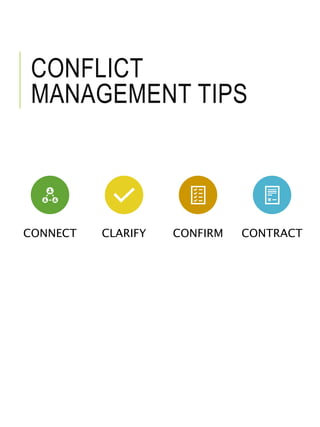
CONFLICT
MANAGEMENT TIPS
CONNECT CLARIFY CONFIRM CONTRACT
CONFLICT
MANAGEMENT
TIPS
Listen Actively
Have Empathy
Watch Body Language
Have patience
Think from other stakeholder’s point of
view
ADAPTIVE US INC. - THINK BA.
THINK ADAPTIVE.
17
CONFLICT
RESOLUTION
TECHNIQUES
ADAPTIVE US INC. - THINK BA.
THINK ADAPTIVE.
18
RATIONALE INVESTIGATION
Often stakeholders state
something as their need.
The real need can be quite
different from the stated need.
Investigate the rationale behind
the conflict.
Use this information to resolve the
conflict.
ADAPTIVE US INC. - THINK BA.
THINK ADAPTIVE.
19
DISCUSSION / NEGOTIATION
Make all conflicting parties
discuss and negotiate a solution
to the conflict.
Encourage conflicting parties to
exchange information, arguments,
and opinions.
Try to convince one another of
each other’s viewpoints in order
to reach an agreeable solution.
ADAPTIVE US INC. - THINK BA.
THINK ADAPTIVE.
20
COMPROMISE
Encourage conflicting parties to
find a compromise between
alternative solutions.
In contrast to an agreement, a
compromise consists of an
amalgamation of different parts of
alternative solutions.
Also, a compromise can mean that
all alternative solutions as
proposed so far are discarded and
entirely new solutions are
creatively developed.
ADAPTIVE US INC. - THINK BA.
THINK ADAPTIVE.
21
VOTING
Conduct voting among all
conflict parties on solution
alternatives.
Present alternatives up for
voting to all relevant
stakeholders.
Each stakeholder casts her
vote for an alternative and
the alternative with the
most votes is accepted as
the resolution for the
ADAPTIVE US INC. - THINK BA.
THINK ADAPTIVE.
22
DEFINITION OF VARIANTS
Find a way to develop the
system in a way that
permits
variants/alternatives.
This way, the system can
satisfy the different
interests of stakeholders.
This is indeed a great
method that can be
considered a win-win.
ADAPTIVE US INC. - THINK BA.
THINK ADAPTIVE.
23
EXPERT OPINION / MEDIATION
Allow an external expert to
choose the right option.
Ensure the expert is
unbiased with respect to
the decision.
ADAPTIVE US INC. - THINK BA.
THINK ADAPTIVE.
24
DECISION MATRIX
Create a table that contains
solution alternatives in
columns and all relevant
decision criteria in rows.
Provide weight to evaluation
criteria. Multiply weight
with alternative
performance rating.
Calculate sums of columns
in order to find a solution.
Accept solution alternative
with the highest score.
ADAPTIVE US INC. - THINK BA.
THINK ADAPTIVE.
25
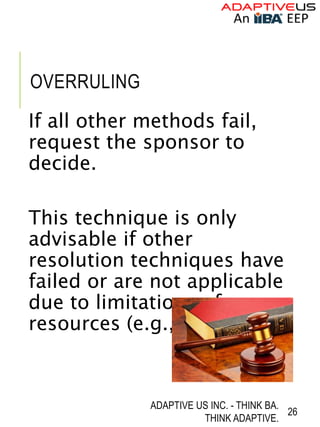
OVERRULING
If all other methods fail,
request the sponsor to
decide.
This technique is only
advisable if other
resolution techniques have
failed or are not applicable
due to limitations of
resources (e.g., time).
ADAPTIVE US INC. - THINK BA.
THINK ADAPTIVE.
26
RESOURCES
National Institute of Advanced
Conflict Resolution
http://www.niacr.org/
Art of Facilitation, by Dale Hunter
Thomas/Kilmann Conflict Style
Instrument
http://www.kilmanndiagnostics.co
m/catalog/thomas-kilmann-
conflict-mode-instrument
ADAPTIVE US INC. - THINK BA.
THINK ADAPTIVE.
27
THANK YOU!
WWW.ADAPTIVEUS.COM

Adaptive us conflict management potrait

  • 1.
    CONFLICT MANAGEMENT © Adaptive USInc. December 2021 www.AdaptiveUS.com
  • 2.
    Conflicts are partof life and are inevitable. We should not avoid them. Sometimes even conflicts can be helpful to identify scenarios that we did not anticipate in the beginning. As business analysts, we should have some techniques in our armor which would help us to resolve conflicts. Why Manage Conflicts? ADAPTIVE US INC. - THINK BA. THINK ADAPTIVE. 2
  • 3.
    CONFLICT MANAGE MENT What is Conflict? ConflictStyles Techniques for Managing Conflicts ADAPTIVE US INC. - THINK BA. THINK ADAPTIVE. 3
  • 4.
    WHAT IS CONFLICT? Whatis conflict? Conflict is a struggle between stakeholders who perceive they have incompatible goals. ADAPTIVE US INC. - THINK BA. THINK ADAPTIVE. 4
  • 5.
    CONFLICTS Negative Wasted resources and energyspent dealing with the conflict Decreased productivity Lowered motivation Decreased morale Poor decision- making Trust Issues Toxic culture Positive Better information Better choices Reduces anxiety Encourages collaboration Increases understanding Speeds decision making ADAPTIVE US INC. - THINK BA. THINK ADAPTIVE. 5
  • 6.
    CONFLICT MANAGEMENT The tools, processand procedure for managing conflict ADAPTIVE US INC. - THINK BA. THINK ADAPTIVE. 6
  • 7.
    EMOTIONS ARE VITAL DURINGCONFLICT MANAGEMENT  Emotions play strong role during conflicts.  Negative emotions cause intense and even irrational behavior leading to a break down.  Appoint a facilitator to keep tab on emotions  If emotions run high, allow a cool-off period
  • 8.
  • 9.
  • 10.
    GOALS Competing: Goal isto win. Accommodating: Goal is to yield. Avoiding: Goal is to delay. Compromising: Goal is to find a middle ground. Collaborating: Goal is to ensure parity of goals. ADAPTIVE US INC. - THINK BA. THINK ADAPTIVE. 10
  • 11.
    COMPETING Quick, decisive actionis vital-e.g., emergencies Unpopular courses of action need implementing-e.g., cost cutting, enforcing unpopular rules, discipline When you know you're right To protect against people who take advantage of noncompetitive behavior. ADAPTIVE US INC. - THINK BA. THINK ADAPTIVE. 11
  • 12.
    ACCOMMODATING The issue ismuch more important to the other person than to you, As a goodwill gesture to help maintain a relationship; To build up social credits for later issues which are important to you; Continued competition would only damage your cause-when you are outmatched and losing. Preserving harmony and avoiding disruption are especially important. This is courting behavior. You realize that you are wrong. To allow a better position to be heard, to learn from others, and to show that ADAPTIVE US INC. - THINK BA. THINK ADAPTIVE. 12
  • 13.
    AVOIDING An issue istrivial, or when other more important issues are pressing. You perceive no chance of satisfying your concerns-e.g., when you have low power, or you are frustrated by something which would be very difficult to change The potential damage of confronting a conflict outweighs the benefits of its resolution. Gathering more information outweighs the advantages of an immediate decision. To let people cool-down. To reduce tensions to a productive level and to ADAPTIVE US INC. - THINK BA. THINK ADAPTIVE. 13
  • 14.
    COMPROMISING Goals are moderatelyimportant, but not worth the effort or potential disruption of more assertive modes. Each side has equal power, and both are strongly committed to mutually exclusive goals-are in labor-management bargaining. To achieve temporary settlements to complex issues. To arrive an expedient solution under time pressure. As a backup mode when collaboration or competition fails ADAPTIVE US INC. - THINK BA. THINK ADAPTIVE. 14
  • 15.
    COLLABORATING To find anintegrative solution. Your objective is to learn-e.g., test your own assumptions, understand the views of others. To merge insights from people with different perspectives on a problem. To gain commitment by incorporating other's concerns into a consensual decision. To work through hard feelings which have been interfering with an interpersonal relationship. ADAPTIVE US INC. - THINK BA. THINK ADAPTIVE. 15
  • 16.
  • 17.
    CONFLICT MANAGEMENT TIPS Listen Actively Have Empathy WatchBody Language Have patience Think from other stakeholder’s point of view ADAPTIVE US INC. - THINK BA. THINK ADAPTIVE. 17
  • 18.
  • 19.
    RATIONALE INVESTIGATION Often stakeholdersstate something as their need. The real need can be quite different from the stated need. Investigate the rationale behind the conflict. Use this information to resolve the conflict. ADAPTIVE US INC. - THINK BA. THINK ADAPTIVE. 19
  • 20.
    DISCUSSION / NEGOTIATION Makeall conflicting parties discuss and negotiate a solution to the conflict. Encourage conflicting parties to exchange information, arguments, and opinions. Try to convince one another of each other’s viewpoints in order to reach an agreeable solution. ADAPTIVE US INC. - THINK BA. THINK ADAPTIVE. 20
  • 21.
    COMPROMISE Encourage conflicting partiesto find a compromise between alternative solutions. In contrast to an agreement, a compromise consists of an amalgamation of different parts of alternative solutions. Also, a compromise can mean that all alternative solutions as proposed so far are discarded and entirely new solutions are creatively developed. ADAPTIVE US INC. - THINK BA. THINK ADAPTIVE. 21
  • 22.
    VOTING Conduct voting amongall conflict parties on solution alternatives. Present alternatives up for voting to all relevant stakeholders. Each stakeholder casts her vote for an alternative and the alternative with the most votes is accepted as the resolution for the ADAPTIVE US INC. - THINK BA. THINK ADAPTIVE. 22
  • 23.
    DEFINITION OF VARIANTS Finda way to develop the system in a way that permits variants/alternatives. This way, the system can satisfy the different interests of stakeholders. This is indeed a great method that can be considered a win-win. ADAPTIVE US INC. - THINK BA. THINK ADAPTIVE. 23
  • 24.
    EXPERT OPINION /MEDIATION Allow an external expert to choose the right option. Ensure the expert is unbiased with respect to the decision. ADAPTIVE US INC. - THINK BA. THINK ADAPTIVE. 24
  • 25.
    DECISION MATRIX Create atable that contains solution alternatives in columns and all relevant decision criteria in rows. Provide weight to evaluation criteria. Multiply weight with alternative performance rating. Calculate sums of columns in order to find a solution. Accept solution alternative with the highest score. ADAPTIVE US INC. - THINK BA. THINK ADAPTIVE. 25
  • 26.
    OVERRULING If all othermethods fail, request the sponsor to decide. This technique is only advisable if other resolution techniques have failed or are not applicable due to limitations of resources (e.g., time). ADAPTIVE US INC. - THINK BA. THINK ADAPTIVE. 26
  • 27.
    RESOURCES National Institute ofAdvanced Conflict Resolution http://www.niacr.org/ Art of Facilitation, by Dale Hunter Thomas/Kilmann Conflict Style Instrument http://www.kilmanndiagnostics.co m/catalog/thomas-kilmann- conflict-mode-instrument ADAPTIVE US INC. - THINK BA. THINK ADAPTIVE. 27
  • 28.

Editor's Notes

  • #10 Competing - need to satisfy own needs high, need to satisfy other's needs low; Accommodating - need to satisfy own needs low, need to satisfy other's needs high; Avoiding - need to satisfy own needs low, need to satisfy other's needs low; Compromising - need to satisfy own needs about 50%, need to satisfy other's needs about 50%. This is the split the difference approach. Collaborating - need to satisfy own needs high, need to satisfy other's needs high.
  • #11 Competing - need to satisfy own needs high, need to satisfy other's needs low; Accommodating - need to satisfy own needs low, need to satisfy other's needs high; Avoiding - need to satisfy own needs low, need to satisfy other's needs low; Compromising - need to satisfy own needs about 50%, need to satisfy other's needs about 50%. This is the split the difference approach. Collaborating - need to satisfy own needs high, need to satisfy other's needs high.