SIX SIGMA"Delivering Tomorrow's Performance Today"
Sir Bill Smith
“ the Father of six sigma”
MBAPM07
TheIIHMRUniversity, Jaipur.
WHAT’S IN A NAME?
• Business Definition
 A break through strategy to significantly
improve customer satisfaction and
shareholder value by reducing
variability in every aspect of business.
• Technical Definition
 A statistical term signifying 3.4 defects
per million opportunities.
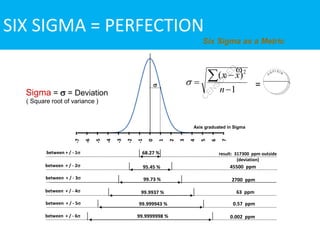
SIX SIGMA = PERFECTION
1
)( 2




n
xxi


Sigma =  = Deviation
( Square root of variance )
-7
-6
-5
-4
-3
-2
-1
0
1
2
3
4
5
6
7
Axis graduated in Sigma
68.27 %
95.45 %
99.73 %
99.9937 %
99.999943 %
99.9999998 %
result: 317300 ppm outside
(deviation)
45500 ppm
2700 ppm
63 ppm
0.57 ppm
0.002 ppm
between + / - 1
between + / - 2
between + / - 3
between + / - 4
between + / - 5
between + / - 6
 =
Six Sigma as a Metric
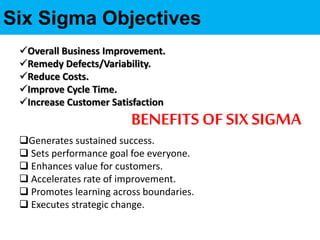
Overall Business Improvement.
Remedy Defects/Variability.
Reduce Costs.
Improve Cycle Time.
Increase Customer Satisfaction
BENEFITS OF SIXSIGMA
Generates sustained success.
 Sets performance goal foe everyone.
 Enhances value for customers.
 Accelerates rate of improvement.
 Promotes learning across boundaries.
 Executes strategic change.
Six Sigma Objectives
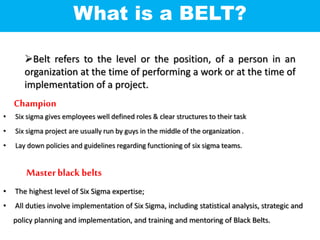
Belt refers to the level or the position, of a person in an
organization at the time of performing a work or at the time of
implementation of a project.
What is a BELT?
• Six sigma gives employees well defined roles & clear structures to their task
• Six sigma project are usually run by guys in the middle of the organization .
• Lay down policies and guidelines regarding functioning of six sigma teams.
Champion
Masterblack belts
• The highest level of Six Sigma expertise;
• All duties involve implementation of Six Sigma, including statistical analysis, strategic and
policy planning and implementation, and training and mentoring of Black Belts.
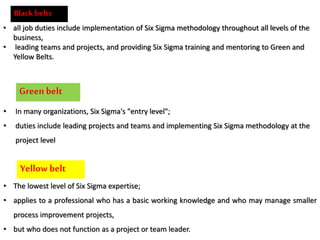
Black belts
• all job duties include implementation of Six Sigma methodology throughout all levels of the
business,
• leading teams and projects, and providing Six Sigma training and mentoring to Green and
Yellow Belts.
Greenbelt
• In many organizations, Six Sigma's "entry level";
• duties include leading projects and teams and implementing Six Sigma methodology at the
project level
Yellow belt
• The lowest level of Six Sigma expertise;
• applies to a professional who has a basic working knowledge and who may manage smaller
process improvement projects,
• but who does not function as a project or team leader.
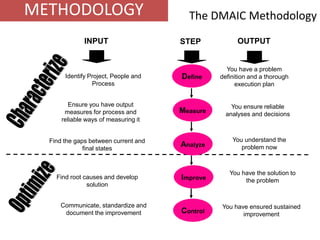
The DMAIC Methodology
Improve
You have a problem
definition and a thorough
execution plan
Ensure you have output
measures for process and
reliable ways of measuring it
You ensure reliable
analyses and decisions
Identify Project, People and
Process
Find the gaps between current and
final states
Find root causes and develop
solution
You have the solution to
the problem
You understand the
problem now
Communicate, standardize and
document the improvement
You have ensured sustained
improvement
Analyze
Control
Measure
Define
STEP OUTPUTINPUT
METHODOLOGY
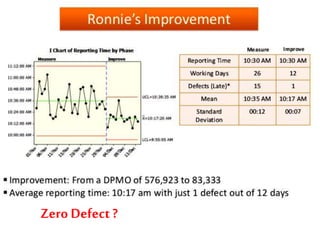
Zero Defect?
Basics of Six Sigma
Basics of Six Sigma
Basics of Six Sigma

Basics of Six Sigma

  • 1.
    SIX SIGMA"Delivering Tomorrow'sPerformance Today" Sir Bill Smith “ the Father of six sigma” MBAPM07 TheIIHMRUniversity, Jaipur.
  • 2.
    WHAT’S IN ANAME? • Business Definition  A break through strategy to significantly improve customer satisfaction and shareholder value by reducing variability in every aspect of business. • Technical Definition  A statistical term signifying 3.4 defects per million opportunities.
  • 3.
    SIX SIGMA =PERFECTION 1 )( 2     n xxi   Sigma =  = Deviation ( Square root of variance ) -7 -6 -5 -4 -3 -2 -1 0 1 2 3 4 5 6 7 Axis graduated in Sigma 68.27 % 95.45 % 99.73 % 99.9937 % 99.999943 % 99.9999998 % result: 317300 ppm outside (deviation) 45500 ppm 2700 ppm 63 ppm 0.57 ppm 0.002 ppm between + / - 1 between + / - 2 between + / - 3 between + / - 4 between + / - 5 between + / - 6  = Six Sigma as a Metric
  • 4.
    Overall Business Improvement. RemedyDefects/Variability. Reduce Costs. Improve Cycle Time. Increase Customer Satisfaction BENEFITS OF SIXSIGMA Generates sustained success.  Sets performance goal foe everyone.  Enhances value for customers.  Accelerates rate of improvement.  Promotes learning across boundaries.  Executes strategic change. Six Sigma Objectives
  • 5.
    Belt refers tothe level or the position, of a person in an organization at the time of performing a work or at the time of implementation of a project. What is a BELT? • Six sigma gives employees well defined roles & clear structures to their task • Six sigma project are usually run by guys in the middle of the organization . • Lay down policies and guidelines regarding functioning of six sigma teams. Champion Masterblack belts • The highest level of Six Sigma expertise; • All duties involve implementation of Six Sigma, including statistical analysis, strategic and policy planning and implementation, and training and mentoring of Black Belts.
  • 6.
    Black belts • alljob duties include implementation of Six Sigma methodology throughout all levels of the business, • leading teams and projects, and providing Six Sigma training and mentoring to Green and Yellow Belts. Greenbelt • In many organizations, Six Sigma's "entry level"; • duties include leading projects and teams and implementing Six Sigma methodology at the project level Yellow belt • The lowest level of Six Sigma expertise; • applies to a professional who has a basic working knowledge and who may manage smaller process improvement projects, • but who does not function as a project or team leader.
  • 7.
    The DMAIC Methodology Improve Youhave a problem definition and a thorough execution plan Ensure you have output measures for process and reliable ways of measuring it You ensure reliable analyses and decisions Identify Project, People and Process Find the gaps between current and final states Find root causes and develop solution You have the solution to the problem You understand the problem now Communicate, standardize and document the improvement You have ensured sustained improvement Analyze Control Measure Define STEP OUTPUTINPUT METHODOLOGY
  • 18.

Editor's Notes

  • #8 Instructor note: Explain how the process can be used at all levels. At a 50,000 feet level (the Corporate executives), Broadly the process can be divided into the Characterize and Optimize parts. The aim of Characterize is to understand the nature of the problem. The Optimize part is the solution to the problem and its implementation. The Six Sigma process is Characterize heavy. At a 500 feet level (the Plant Management level) the process can be viewed as DMAIC. At the 5 feet level (Project Leaders) this process is a 15 step process which we will go through in the example. At the ground level, it is a bunch of tools both statistical and information synthesis tools.