





Scrum Guide 2020
A Definitive Guide to Scrum: Rules of the Game
Definition
 Lightweight framework that
helps people, teams and
organizations generate
value through adaptive
solutions for complex
problems
Scrum is Simple
 Try it as is and determine if its
philosophy, theory, and
structure help to achieve goals
and create value
Scrum Theory
 Founded on empiricism and
lean thinking
Scrum Theory
 Empiricism asserts that
knowledge comes from
experience and making
decisions based on what is
observed
Scrum Theory
 Lean thinking reduces waste
and focuses on the essentials
Scrum Theory
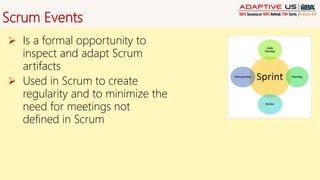
 Combines four formal events for
inspection and adaptation within
a containing event, the Sprint
 Events implement the empirical
Scrum pillars of transparency,
inspection, and adaptation
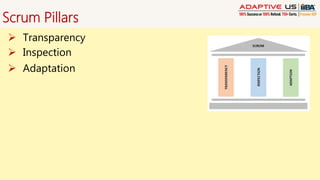
Scrum Pillars
 Transparency
 Inspection
 Adaptation
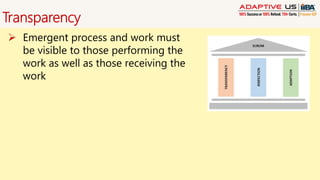
Transparency
 Emergent process and work must
be visible to those performing the
work as well as those receiving the
work
Transparency
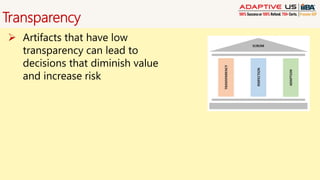
 Artifacts that have low
transparency can lead to
decisions that diminish value
and increase risk
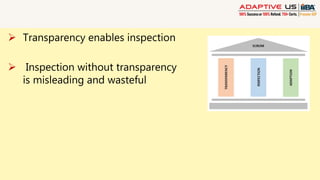
 Transparency enables inspection
 Inspection without transparency
is misleading and wasteful
Inspection
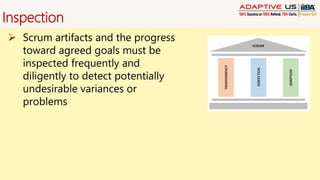
 Scrum artifacts and the progress
toward agreed goals must be
inspected frequently and
diligently to detect potentially
undesirable variances or
problems
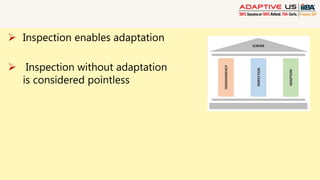
 Inspection enables adaptation
 Inspection without adaptation
is considered pointless
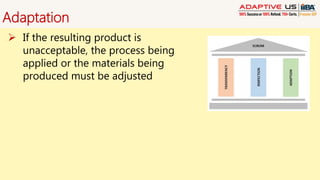
Adaptation
 If the resulting product is
unacceptable, the process being
applied or the materials being
produced must be adjusted
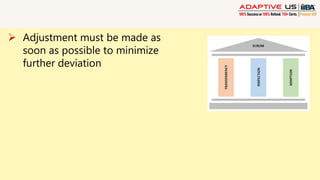
 Adjustment must be made as
soon as possible to minimize
further deviation
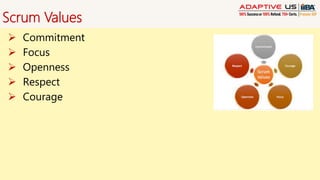
Scrum Values
 Commitment
 Focus
 Openness
 Respect
 Courage
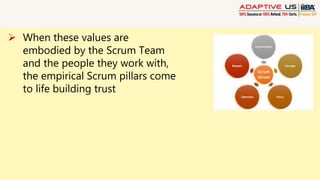
 When these values are
embodied by the Scrum Team
and the people they work with,
the empirical Scrum pillars come
to life building trust
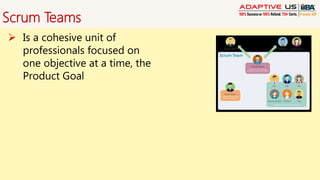
Scrum Teams
 Is a cohesive unit of
professionals focused on
one objective at a time, the
Product Goal
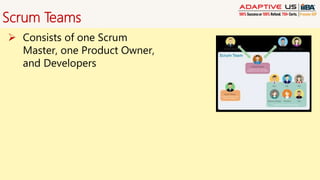
Scrum Teams
 Consists of one Scrum
Master, one Product Owner,
and Developers
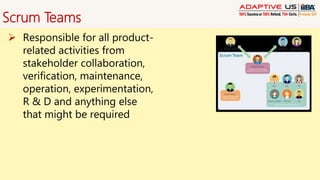
Scrum Teams
 Responsible for all product-
related activities from
stakeholder collaboration,
verification, maintenance,
operation, experimentation,
R & D and anything else
that might be required
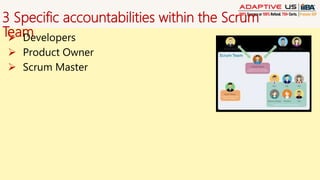
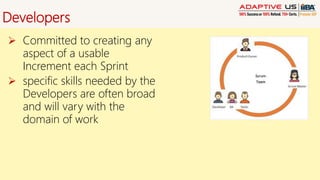
3 Specific accountabilities within the Scrum
Team
 Developers
 Product Owner
 Scrum Master
Developers
 Committed to creating any
aspect of a usable
Increment each Sprint
 specific skills needed by the
Developers are often broad
and will vary with the
domain of work
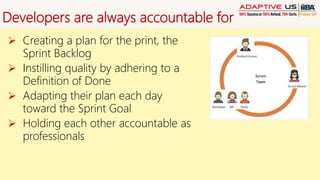
Developers are always accountable for
 Creating a plan for the print, the
Sprint Backlog
 Instilling quality by adhering to a
Definition of Done
 Adapting their plan each day
toward the Sprint Goal
 Holding each other accountable as
professionals
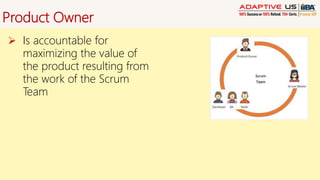
Product Owner
 Is accountable for
maximizing the value of
the product resulting from
the work of the Scrum
Team
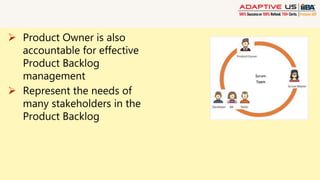
 Product Owner is also
accountable for effective
Product Backlog
management
 Represent the needs of
many stakeholders in the
Product Backlog
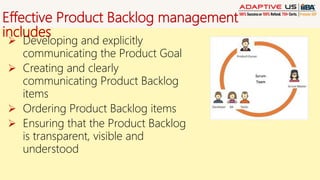
Effective Product Backlog management
includes
 Developing and explicitly
communicating the Product Goal
 Creating and clearly
communicating Product Backlog
items
 Ordering Product Backlog items
 Ensuring that the Product Backlog
is transparent, visible and
understood
Scrum Master
 Accountable for the Scrum
Team’s effectiveness by
enabling the Scrum Team to
improve its practices, within
the Scrum framework
Scrum Master serves the product owner by
helping
 To find techniques for effective
Product Goal definition
 The Scrum Team understand the
need for clear and concise
Product Backlog items
 Establish empirical product
planning
 Facilitating stakeholder
collaboration as requested
Scrum Master serves the Organization by helping
 Leading, training, and
coaching the organization in
its Scrum adoption
 Planning and advising Scrum
implementations
 Helping employees and
stakeholders
 Removing barriers between
stakeholders and Scrum
Teams
Scrum Events
 Is a formal opportunity to
inspect and adapt Scrum
artifacts
 Used in Scrum to create
regularity and to minimize the
need for meetings not
defined in Scrum
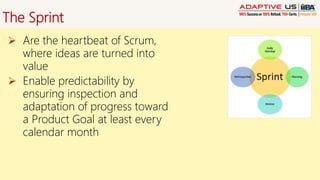
The Sprint
 Are the heartbeat of Scrum,
where ideas are turned into
value
 Enable predictability by
ensuring inspection and
adaptation of progress toward
a Product Goal at least every
calendar month
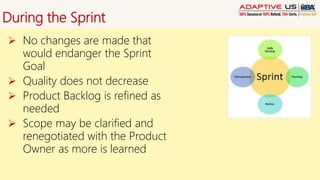
During the Sprint
 No changes are made that
would endanger the Sprint
Goal
 Quality does not decrease
 Product Backlog is refined as
needed
 Scope may be clarified and
renegotiated with the Product
Owner as more is learned
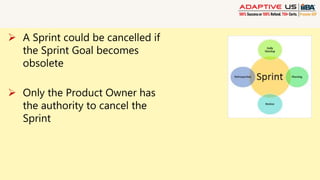
 A Sprint could be cancelled if
the Sprint Goal becomes
obsolete
 Only the Product Owner has
the authority to cancel the
Sprint
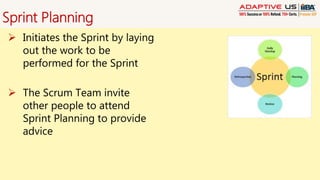
Sprint Planning
 Initiates the Sprint by laying
out the work to be
performed for the Sprint
 The Scrum Team invite
other people to attend
Sprint Planning to provide
advice
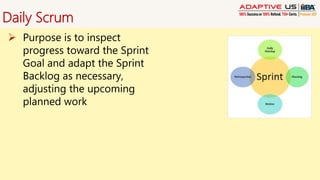
Daily Scrum
 Purpose is to inspect
progress toward the Sprint
Goal and adapt the Sprint
Backlog as necessary,
adjusting the upcoming
planned work
Daily Scrum
 Daily Scrums improve
communications, identify
impediments, promote
quick decision-making, and
consequently eliminate the
need for other meetings
Sprint Review
 Purpose is to inspect the
outcome of the Sprint and
determine future
adaptations
 It is a working session and
the Scrum Team should
avoid limiting it to a
presentation
Sprint Review
 It is the second to last event
of the Sprint and is
timeboxed to a maximum of
four hours for a one-month
Sprint
Sprint Retrospective
 Purpose is to plan ways to
increase quality and
effectiveness
 It concludes the Sprint
 It is timeboxed to a
maximum of three hours for
a one- month Sprint
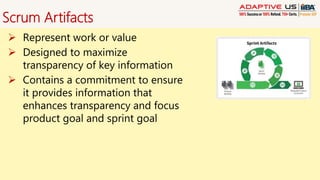
Scrum Artifacts
 Represent work or value
 Designed to maximize
transparency of key information
 Contains a commitment to ensure
it provides information that
enhances transparency and focus
product goal and sprint goal
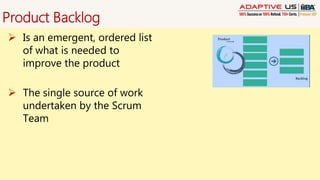
Product Backlog
 Is an emergent, ordered list
of what is needed to
improve the product
 The single source of work
undertaken by the Scrum
Team
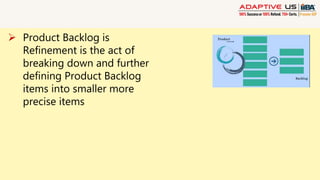
 Product Backlog is
Refinement is the act of
breaking down and further
defining Product Backlog
items into smaller more
precise items
Commitment: Product Goal
 Describes a future state of
the product which can serve
as a target for the Scrum
Team to plan against
 The Product Goal is the
long-term objective for the
Scrum Team
Sprint Backlog
 Is composed of the Sprint
Goal (why), the set of
Product Backlog items
selected for the Sprint
(what), as well as an
actionable plan for
delivering the Increment
(how)
Commitment: Sprint Goal
 Is a commitment by the
Developers, it provides
flexibility in terms of the
exact work needed to
achieve it
 Is created during the Sprint
Planning event and then
added to the Sprint Backlog
Increment
 Is a concrete stepping stone
toward the Product Goal
 Each Increment is additive
to all prior Increments and
thoroughly verified,
ensuring that all Increments
work together
Commitment: Definition of Done
 Is a formal description of the
state of the Increment when it
meets the quality measures
required for the product
 Creates transparency by
providing everyone a shared
understanding of what work
was completed as part of the
Increment
Thank you

The Scrum Guide 2020.pptx

  • 1.
    Scrum Guide 2020 ADefinitive Guide to Scrum: Rules of the Game
  • 2.
    Definition  Lightweight frameworkthat helps people, teams and organizations generate value through adaptive solutions for complex problems
  • 3.
    Scrum is Simple Try it as is and determine if its philosophy, theory, and structure help to achieve goals and create value
  • 4.
    Scrum Theory  Foundedon empiricism and lean thinking
  • 5.
    Scrum Theory  Empiricismasserts that knowledge comes from experience and making decisions based on what is observed
  • 6.
    Scrum Theory  Leanthinking reduces waste and focuses on the essentials
  • 7.
    Scrum Theory  Combinesfour formal events for inspection and adaptation within a containing event, the Sprint  Events implement the empirical Scrum pillars of transparency, inspection, and adaptation
  • 8.
    Scrum Pillars  Transparency Inspection  Adaptation
  • 9.
    Transparency  Emergent processand work must be visible to those performing the work as well as those receiving the work
  • 10.
    Transparency  Artifacts thathave low transparency can lead to decisions that diminish value and increase risk
  • 11.
     Transparency enablesinspection  Inspection without transparency is misleading and wasteful
  • 12.
    Inspection  Scrum artifactsand the progress toward agreed goals must be inspected frequently and diligently to detect potentially undesirable variances or problems
  • 13.
     Inspection enablesadaptation  Inspection without adaptation is considered pointless
  • 14.
    Adaptation  If theresulting product is unacceptable, the process being applied or the materials being produced must be adjusted
  • 15.
     Adjustment mustbe made as soon as possible to minimize further deviation
  • 16.
    Scrum Values  Commitment Focus  Openness  Respect  Courage
  • 17.
     When thesevalues are embodied by the Scrum Team and the people they work with, the empirical Scrum pillars come to life building trust
  • 18.
    Scrum Teams  Isa cohesive unit of professionals focused on one objective at a time, the Product Goal
  • 19.
    Scrum Teams  Consistsof one Scrum Master, one Product Owner, and Developers
  • 20.
    Scrum Teams  Responsiblefor all product- related activities from stakeholder collaboration, verification, maintenance, operation, experimentation, R & D and anything else that might be required
  • 21.
    3 Specific accountabilitieswithin the Scrum Team  Developers  Product Owner  Scrum Master
  • 22.
    Developers  Committed tocreating any aspect of a usable Increment each Sprint  specific skills needed by the Developers are often broad and will vary with the domain of work
  • 23.
    Developers are alwaysaccountable for  Creating a plan for the print, the Sprint Backlog  Instilling quality by adhering to a Definition of Done  Adapting their plan each day toward the Sprint Goal  Holding each other accountable as professionals
  • 24.
    Product Owner  Isaccountable for maximizing the value of the product resulting from the work of the Scrum Team
  • 25.
     Product Owneris also accountable for effective Product Backlog management  Represent the needs of many stakeholders in the Product Backlog
  • 26.
    Effective Product Backlogmanagement includes  Developing and explicitly communicating the Product Goal  Creating and clearly communicating Product Backlog items  Ordering Product Backlog items  Ensuring that the Product Backlog is transparent, visible and understood
  • 27.
    Scrum Master  Accountablefor the Scrum Team’s effectiveness by enabling the Scrum Team to improve its practices, within the Scrum framework
  • 28.
    Scrum Master servesthe product owner by helping  To find techniques for effective Product Goal definition  The Scrum Team understand the need for clear and concise Product Backlog items  Establish empirical product planning  Facilitating stakeholder collaboration as requested
  • 29.
    Scrum Master servesthe Organization by helping  Leading, training, and coaching the organization in its Scrum adoption  Planning and advising Scrum implementations  Helping employees and stakeholders  Removing barriers between stakeholders and Scrum Teams
  • 30.
    Scrum Events  Isa formal opportunity to inspect and adapt Scrum artifacts  Used in Scrum to create regularity and to minimize the need for meetings not defined in Scrum
  • 31.
    The Sprint  Arethe heartbeat of Scrum, where ideas are turned into value  Enable predictability by ensuring inspection and adaptation of progress toward a Product Goal at least every calendar month
  • 32.
    During the Sprint No changes are made that would endanger the Sprint Goal  Quality does not decrease  Product Backlog is refined as needed  Scope may be clarified and renegotiated with the Product Owner as more is learned
  • 33.
     A Sprintcould be cancelled if the Sprint Goal becomes obsolete  Only the Product Owner has the authority to cancel the Sprint
  • 34.
    Sprint Planning  Initiatesthe Sprint by laying out the work to be performed for the Sprint  The Scrum Team invite other people to attend Sprint Planning to provide advice
  • 35.
    Daily Scrum  Purposeis to inspect progress toward the Sprint Goal and adapt the Sprint Backlog as necessary, adjusting the upcoming planned work
  • 36.
    Daily Scrum  DailyScrums improve communications, identify impediments, promote quick decision-making, and consequently eliminate the need for other meetings
  • 37.
    Sprint Review  Purposeis to inspect the outcome of the Sprint and determine future adaptations  It is a working session and the Scrum Team should avoid limiting it to a presentation
  • 38.
    Sprint Review  Itis the second to last event of the Sprint and is timeboxed to a maximum of four hours for a one-month Sprint
  • 39.
    Sprint Retrospective  Purposeis to plan ways to increase quality and effectiveness  It concludes the Sprint  It is timeboxed to a maximum of three hours for a one- month Sprint
  • 40.
    Scrum Artifacts  Representwork or value  Designed to maximize transparency of key information  Contains a commitment to ensure it provides information that enhances transparency and focus product goal and sprint goal
  • 41.
    Product Backlog  Isan emergent, ordered list of what is needed to improve the product  The single source of work undertaken by the Scrum Team
  • 42.
     Product Backlogis Refinement is the act of breaking down and further defining Product Backlog items into smaller more precise items
  • 43.
    Commitment: Product Goal Describes a future state of the product which can serve as a target for the Scrum Team to plan against  The Product Goal is the long-term objective for the Scrum Team
  • 44.
    Sprint Backlog  Iscomposed of the Sprint Goal (why), the set of Product Backlog items selected for the Sprint (what), as well as an actionable plan for delivering the Increment (how)
  • 45.
    Commitment: Sprint Goal Is a commitment by the Developers, it provides flexibility in terms of the exact work needed to achieve it  Is created during the Sprint Planning event and then added to the Sprint Backlog
  • 46.
    Increment  Is aconcrete stepping stone toward the Product Goal  Each Increment is additive to all prior Increments and thoroughly verified, ensuring that all Increments work together
  • 47.
    Commitment: Definition ofDone  Is a formal description of the state of the Increment when it meets the quality measures required for the product  Creates transparency by providing everyone a shared understanding of what work was completed as part of the Increment
  • 48.