
R.D.SIVAKUMAR,M.Sc.,M.Phil.,M.Tech.,
Assistant Professor of Computer Science &
Assistant Professor and Head, Department of M.Com.(CA),
Ayya Nadar Janaki Ammal College,
Sivakasi – 626 124.
Mobile: 099440-42243
e-mail : sivamsccsit@gmail.com
website: www.rdsivakumar.blogspot.in
POWERPOINT
POWERPOINT
• PowerPoint is the slide show presentation software
developed by Microsoft.
• It is part of the Microsoft Office Suite.
• PowerPoint presentations consist of a number of
individual pages or “slides”.
• Slides may contain text, graphics, movies, and other
objects, which may be arranged freely on the slide.
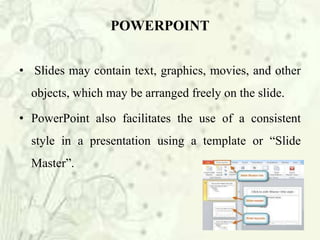
• PowerPoint also facilitates the use of a consistent
style in a presentation using a template or “Slide
Master”.
POWERPOINT
• The presentation can be printed, displayed live on a
computer, or navigated through at the command of
the presenter.
• For larger audiences the computer display is often
projected using a video projector.
POWERPOINT
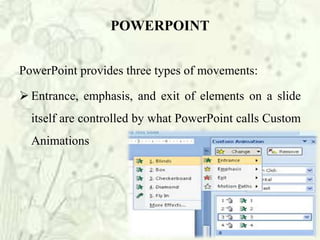
PowerPoint provides three types of movements:
 Entrance, emphasis, and exit of elements on a slide
itself are controlled by what PowerPoint calls Custom
Animations
POWERPOINT
 Transitions are movements between slides. These can
be animated in a variety of ways.
 Custom animation can be used to create small story
boards by animating pictures to enter, exit or move
POWERPOINT
• The MS Office PowerPoint Viewer is a software used
to run presentations on computers that do not have
Microsoft PowerPoint installed.
POWERPOINT
• Presentations password-protected for opening or
modifying can be opened by the PowerPoint Viewer.
• The PowerPoint Viewer supports opening
Presentations created using PowerPoint 97 and later.
POWERPOINT
• In addition, it supports all file content except OLE
objects and scripting.
• In Microsoft Office 2007, the binary file formats were
replaced as the default format by the new XML
based Office Open XML formats, which are
published as an open standard.
POWERPOINT
POWERPOINT - R.D.Sivakumar

POWERPOINT - R.D.Sivakumar

  • 1.
    R.D.SIVAKUMAR,M.Sc.,M.Phil.,M.Tech., Assistant Professor ofComputer Science & Assistant Professor and Head, Department of M.Com.(CA), Ayya Nadar Janaki Ammal College, Sivakasi – 626 124. Mobile: 099440-42243 e-mail : sivamsccsit@gmail.com website: www.rdsivakumar.blogspot.in POWERPOINT
  • 2.
    POWERPOINT • PowerPoint isthe slide show presentation software developed by Microsoft. • It is part of the Microsoft Office Suite. • PowerPoint presentations consist of a number of individual pages or “slides”.
  • 3.
    • Slides maycontain text, graphics, movies, and other objects, which may be arranged freely on the slide. • PowerPoint also facilitates the use of a consistent style in a presentation using a template or “Slide Master”. POWERPOINT
  • 4.
    • The presentationcan be printed, displayed live on a computer, or navigated through at the command of the presenter. • For larger audiences the computer display is often projected using a video projector. POWERPOINT
  • 5.
    PowerPoint provides threetypes of movements:  Entrance, emphasis, and exit of elements on a slide itself are controlled by what PowerPoint calls Custom Animations POWERPOINT
  • 6.
     Transitions aremovements between slides. These can be animated in a variety of ways.  Custom animation can be used to create small story boards by animating pictures to enter, exit or move POWERPOINT
  • 7.
    • The MSOffice PowerPoint Viewer is a software used to run presentations on computers that do not have Microsoft PowerPoint installed. POWERPOINT
  • 8.
    • Presentations password-protectedfor opening or modifying can be opened by the PowerPoint Viewer. • The PowerPoint Viewer supports opening Presentations created using PowerPoint 97 and later. POWERPOINT
  • 9.
    • In addition,it supports all file content except OLE objects and scripting. • In Microsoft Office 2007, the binary file formats were replaced as the default format by the new XML based Office Open XML formats, which are published as an open standard. POWERPOINT