Session 1
Microsoft Word 2010
Muhammad Yasir Bhutta
yasirbhutta@gmail.com
Word Processor
● Word processor is a type of application
software that used to create all kinds of text
documents.
● It can also be used to add images, sound,
charts in documents.
Advantages of Word Processor
Over Typewriter
● A document can be changed without retyping
the entire document.
● If there is a typing mistake, it can be
corrected easily.
● It is easy to insert word, sentence or
paragraph in the middle of a document.
● The text can be duplicated easily without type
it again.
● A document can be save for future use.
Microsoft Word
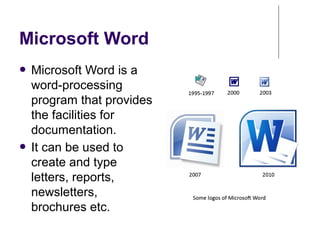
● Microsoft Word is a
word-processing
program that provides
the facilities for
documentation.
● It can be used to
create and type
letters, reports,
newsletters,
brochures etc.
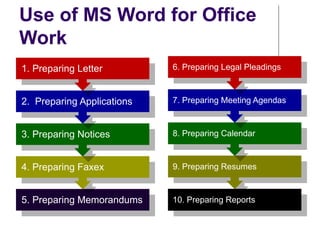
Use of MS Word for Office
Work
5. Preparing Memorandums
4. Preparing Faxex
3. Preparing Notices
2. Preparing Applications
1. Preparing Letter
10. Preparing Reports
9. Preparing Resumes
8. Preparing Calendar
7. Preparing Meeting Agendas
6. Preparing Legal Pleadings
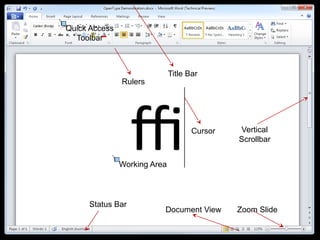
PARTS OF WORD INTERFACE
Quick Access
Toolbar
Cursor
Rulers
Title Bar
Vertical
Scrollbar
Status Bar
Document View Zoom Slide
Working Area
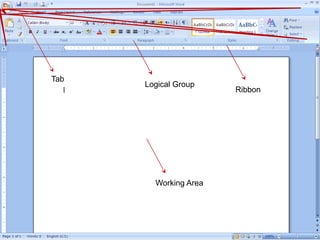
Ribbon
Logical Group
Tab
Working Area
Ribbon
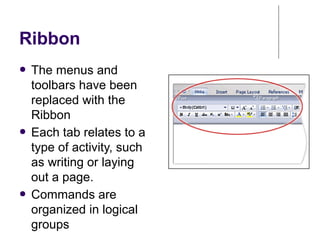
● The menus and
toolbars have been
replaced with the
Ribbon
● Each tab relates to a
type of activity, such
as writing or laying
out a page.
● Commands are
organized in logical
groups
Title Bar
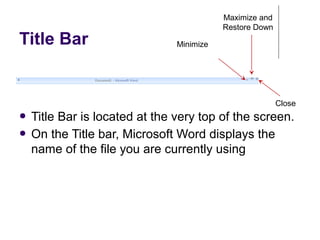
● Title Bar is located at the very top of the screen.
● On the Title bar, Microsoft Word displays the
name of the file you are currently using
Minimize
Maximize and
Restore Down
Close
Rulers
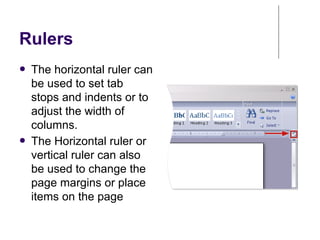
● The horizontal ruler can
be used to set tab
stops and indents or to
adjust the width of
columns.
● The Horizontal ruler or
vertical ruler can also
be used to change the
page margins or place
items on the page
Scroll Bars
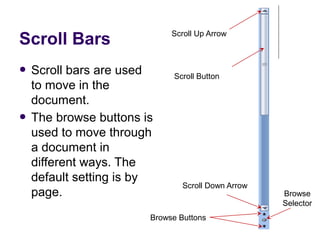
● Scroll bars are used
to move in the
document.
● The browse buttons is
used to move through
a document in
different ways. The
default setting is by
page.
Scroll Up Arrow
Scroll Button
Scroll Down Arrow
Browse Buttons
Browse
Selector
Status Bar
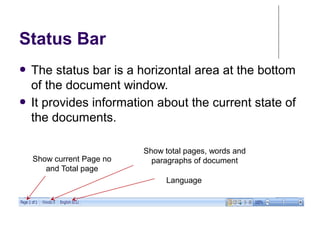
● The status bar is a horizontal area at the bottom
of the document window.
● It provides information about the current state of
the documents.
Show current Page no
and Total page
Language
Show total pages, words and
paragraphs of document
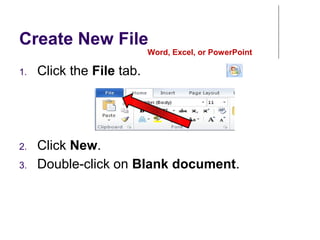
Create New File
Word, Excel, or PowerPoint
1. Click the File tab.
2. Click New.
3. Double-click on Blank document.
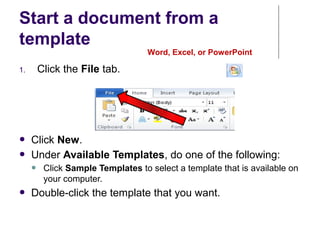
Start a document from a
template
Word, Excel, or PowerPoint
1. Click the File tab.
● Click New.
● Under Available Templates, do one of the following:
● Click Sample Templates to select a template that is available on
your computer.
● Double-click the template that you want.
Saving a file
● Save command is used to store a
word document in a file on the
disk.
Word, Excel, or PowerPoint
Saving a file cont.
● Click the File tab and then click Save.
● Keyboard shortcut
Word, Excel, or PowerPoint
CTRL+S
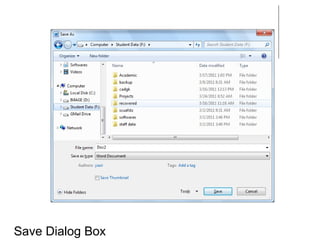
Save Dialog Box
Save a copy of file
Save as command is used to:
● Store another copy of an existing
document with a different name or
at different location.
Word, Excel, or PowerPoint
Save a copy of file
● Click the File tab and then click Save as.
● Keyboard shortcut
Word, Excel, or PowerPoint
F12
Save a file to another format
1. Click the Microsoft Office Button , and
then click Save as.
2. In the File name box, enter a new name for the
file.
3. In the Save as type list, click the file format that
you want to save the file in.
4. Click Save.
Word, Excel, or PowerPoint
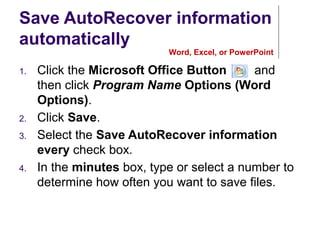
Save AutoRecover information
automatically
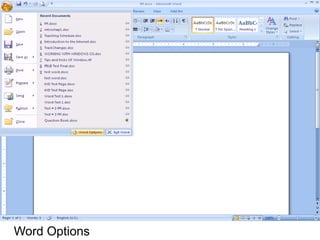
1. Click the Microsoft Office Button , and
then click Program Name Options (Word
Options).
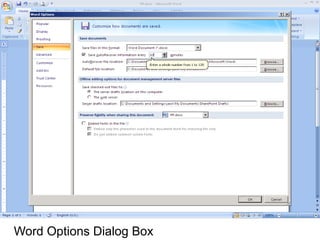
2. Click Save.
3. Select the Save AutoRecover information
every check box.
4. In the minutes box, type or select a number to
determine how often you want to save files.
Word, Excel, or PowerPoint
Word Options
Word Options Dialog Box
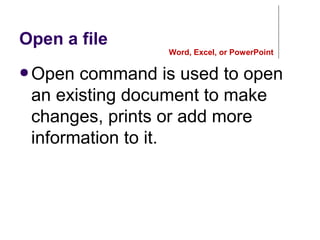
Open a file
● Open command is used to open
an existing document to make
changes, prints or add more
information to it.
Word, Excel, or PowerPoint
Open a file cont.
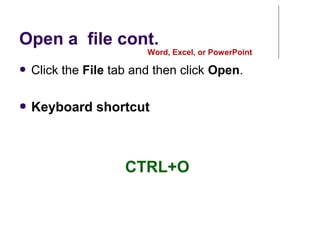
● Click the File tab and then click Open.
● Keyboard shortcut
Word, Excel, or PowerPoint
CTRL+O
Open a file cont.
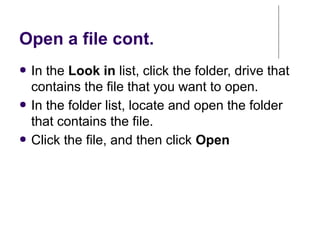
● In the Look in list, click the folder, drive that
contains the file that you want to open.
● In the folder list, locate and open the folder
that contains the file.
● Click the file, and then click Open
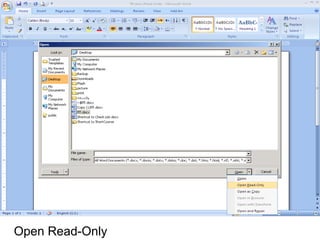
Open a file as a copy
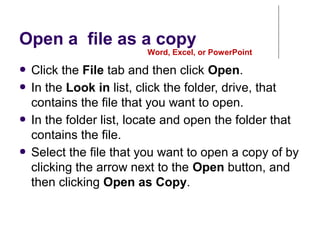
● Click the File tab and then click Open.
● In the Look in list, click the folder, drive, that
contains the file that you want to open.
● In the folder list, locate and open the folder that
contains the file.
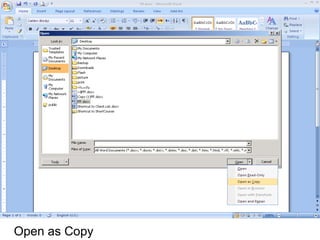
● Select the file that you want to open a copy of by
clicking the arrow next to the Open button, and
then clicking Open as Copy.
Word, Excel, or PowerPoint
Open as Copy
Open Read-Only
Rename file
● Click the File tab and then click Open.
● In the Look in list, click the folder, drive, that
contains the file that you want to rename.
● In the folder list, locate and open the folder that
contains the file that you want to rename.
● Right-click the file that you want to rename, and
then click Rename on the shortcut menu (right-
click an item or press SHIFT+F10).
● Type the new name, and then press ENTER.
Word, Excel, or PowerPoint
Select multiple files
● Do one of the following:
● To select nonadjacent files in the Open dialog
box, click one file, hold down CTRL, and then
click each additional file.
● To select adjacent files in the Open dialog box,
click the first file in the sequence, hold down
SHIFT, and then click the last file.
● Mouse can be used to select multiple files.
Tip If you select a file that you don't want, hold
down CTRL, and then click the file again.
Word, Excel, or PowerPoint
Closing a file
● The process of unloading a document
from computer memory is called closing
document.
● When a word document is closed, it is only
unloaded from memory. It remains stored
in the file on the disk.
Word, Excel, or PowerPoint
Close a File
● Click the File tab and then click Close.
OR
● Keyboard shortcut
Word, Excel, or PowerPoint
CTRL+F4
Exiting Word
● The process of closing MS Word is called
exiting Word.
● When the user exits word, all open files
are closed.
● For unsaved files, word will ask the user to
save them before exiting.
Word, Excel, or PowerPoint
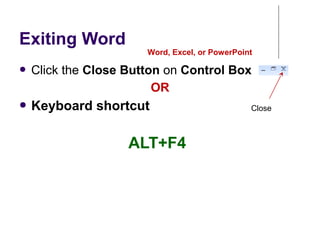
Exiting Word
● Click the Close Button on Control Box
OR
● Keyboard shortcut
Word, Excel, or PowerPoint
ALT+F4
Close
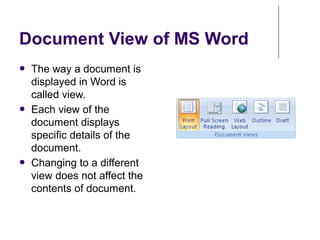
Document View of MS Word
● The way a document is
displayed in Word is
called view.
● Each view of the
document displays
specific details of the
document.
● Changing to a different
view does not affect the
contents of document.
•Documents Views
•Print Layout
•Full Screen Reading
•Web Layout
•Outline
•Draft
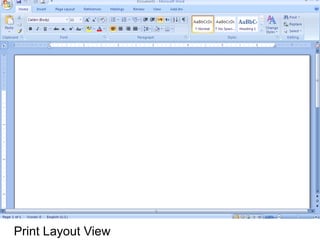
•1. Print Layout
•View the document as it will be appear
on printed Page.
•It displays all formatting, columns,
header, footers etc.
•It takes more memory.
Print Layout View
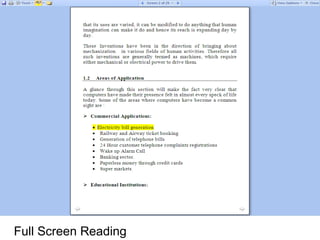
•1. Full Screen Reading
•View the document in full screen
reading view in order to maximize the
space available for reading or
commenting on document.
Full Screen Reading
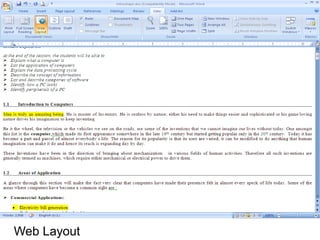
•3. Web Layout
•View the document as it would look as
web page.
•All pages are displayed as one page.
•In this view, the user can see
backgrounds.
Web Layout
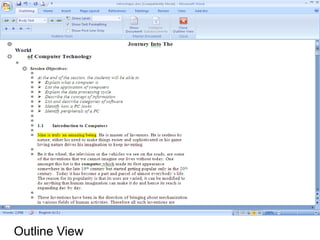
•4. Outline View
•View the document as an outline and
show the outlining tools.
•It does not display the boundaries,
headers, footers etc.
•It can be used to move, copy and
reorganize text by dragging headings.
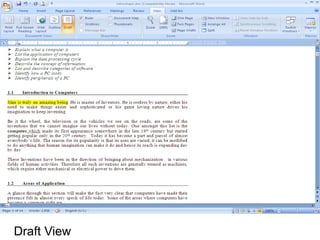
•5. Draft View
•View the document as a draft to quickly
edit the text.
•Certain elements of document such as
Headers and Footers will not be visible
in this view.
•The process of typing in this mode is
quicker and easier.
•The normal view takes less memory.
Outline View
Draft View
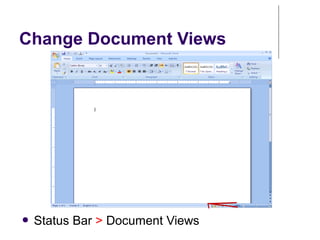
Change Document Views
● Status Bar > Document Views
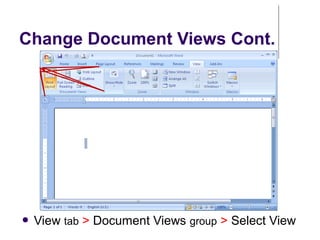
Change Document Views Cont.
● View tab > Document Views group > Select View
THANKS

MS Word Basics

  • 1.
    Session 1 Microsoft Word2010 Muhammad Yasir Bhutta yasirbhutta@gmail.com
  • 2.
    Word Processor ● Wordprocessor is a type of application software that used to create all kinds of text documents. ● It can also be used to add images, sound, charts in documents.
  • 3.
    Advantages of WordProcessor Over Typewriter ● A document can be changed without retyping the entire document. ● If there is a typing mistake, it can be corrected easily. ● It is easy to insert word, sentence or paragraph in the middle of a document. ● The text can be duplicated easily without type it again. ● A document can be save for future use.
  • 4.
    Microsoft Word ● MicrosoftWord is a word-processing program that provides the facilities for documentation. ● It can be used to create and type letters, reports, newsletters, brochures etc.
  • 5.
    Use of MSWord for Office Work 5. Preparing Memorandums 4. Preparing Faxex 3. Preparing Notices 2. Preparing Applications 1. Preparing Letter 10. Preparing Reports 9. Preparing Resumes 8. Preparing Calendar 7. Preparing Meeting Agendas 6. Preparing Legal Pleadings
  • 6.
    PARTS OF WORDINTERFACE
  • 7.
  • 8.
  • 9.
    Ribbon ● The menusand toolbars have been replaced with the Ribbon ● Each tab relates to a type of activity, such as writing or laying out a page. ● Commands are organized in logical groups
  • 10.
    Title Bar ● TitleBar is located at the very top of the screen. ● On the Title bar, Microsoft Word displays the name of the file you are currently using Minimize Maximize and Restore Down Close
  • 11.
    Rulers ● The horizontalruler can be used to set tab stops and indents or to adjust the width of columns. ● The Horizontal ruler or vertical ruler can also be used to change the page margins or place items on the page
  • 12.
    Scroll Bars ● Scrollbars are used to move in the document. ● The browse buttons is used to move through a document in different ways. The default setting is by page. Scroll Up Arrow Scroll Button Scroll Down Arrow Browse Buttons Browse Selector
  • 13.
    Status Bar ● Thestatus bar is a horizontal area at the bottom of the document window. ● It provides information about the current state of the documents. Show current Page no and Total page Language Show total pages, words and paragraphs of document
  • 14.
    Create New File Word,Excel, or PowerPoint 1. Click the File tab. 2. Click New. 3. Double-click on Blank document.
  • 15.
    Start a documentfrom a template Word, Excel, or PowerPoint 1. Click the File tab. ● Click New. ● Under Available Templates, do one of the following: ● Click Sample Templates to select a template that is available on your computer. ● Double-click the template that you want.
  • 16.
    Saving a file ●Save command is used to store a word document in a file on the disk. Word, Excel, or PowerPoint
  • 17.
    Saving a filecont. ● Click the File tab and then click Save. ● Keyboard shortcut Word, Excel, or PowerPoint CTRL+S
  • 18.
  • 19.
    Save a copyof file Save as command is used to: ● Store another copy of an existing document with a different name or at different location. Word, Excel, or PowerPoint
  • 20.
    Save a copyof file ● Click the File tab and then click Save as. ● Keyboard shortcut Word, Excel, or PowerPoint F12
  • 21.
    Save a fileto another format 1. Click the Microsoft Office Button , and then click Save as. 2. In the File name box, enter a new name for the file. 3. In the Save as type list, click the file format that you want to save the file in. 4. Click Save. Word, Excel, or PowerPoint
  • 22.
    Save AutoRecover information automatically 1.Click the Microsoft Office Button , and then click Program Name Options (Word Options). 2. Click Save. 3. Select the Save AutoRecover information every check box. 4. In the minutes box, type or select a number to determine how often you want to save files. Word, Excel, or PowerPoint
  • 23.
  • 24.
  • 25.
    Open a file ●Open command is used to open an existing document to make changes, prints or add more information to it. Word, Excel, or PowerPoint
  • 26.
    Open a filecont. ● Click the File tab and then click Open. ● Keyboard shortcut Word, Excel, or PowerPoint CTRL+O
  • 27.
    Open a filecont. ● In the Look in list, click the folder, drive that contains the file that you want to open. ● In the folder list, locate and open the folder that contains the file. ● Click the file, and then click Open
  • 28.
    Open a fileas a copy ● Click the File tab and then click Open. ● In the Look in list, click the folder, drive, that contains the file that you want to open. ● In the folder list, locate and open the folder that contains the file. ● Select the file that you want to open a copy of by clicking the arrow next to the Open button, and then clicking Open as Copy. Word, Excel, or PowerPoint
  • 29.
  • 30.
  • 31.
    Rename file ● Clickthe File tab and then click Open. ● In the Look in list, click the folder, drive, that contains the file that you want to rename. ● In the folder list, locate and open the folder that contains the file that you want to rename. ● Right-click the file that you want to rename, and then click Rename on the shortcut menu (right- click an item or press SHIFT+F10). ● Type the new name, and then press ENTER. Word, Excel, or PowerPoint
  • 32.
    Select multiple files ●Do one of the following: ● To select nonadjacent files in the Open dialog box, click one file, hold down CTRL, and then click each additional file. ● To select adjacent files in the Open dialog box, click the first file in the sequence, hold down SHIFT, and then click the last file. ● Mouse can be used to select multiple files. Tip If you select a file that you don't want, hold down CTRL, and then click the file again. Word, Excel, or PowerPoint
  • 33.
    Closing a file ●The process of unloading a document from computer memory is called closing document. ● When a word document is closed, it is only unloaded from memory. It remains stored in the file on the disk. Word, Excel, or PowerPoint
  • 34.
    Close a File ●Click the File tab and then click Close. OR ● Keyboard shortcut Word, Excel, or PowerPoint CTRL+F4
  • 35.
    Exiting Word ● Theprocess of closing MS Word is called exiting Word. ● When the user exits word, all open files are closed. ● For unsaved files, word will ask the user to save them before exiting. Word, Excel, or PowerPoint
  • 36.
    Exiting Word ● Clickthe Close Button on Control Box OR ● Keyboard shortcut Word, Excel, or PowerPoint ALT+F4 Close
  • 37.
    Document View ofMS Word ● The way a document is displayed in Word is called view. ● Each view of the document displays specific details of the document. ● Changing to a different view does not affect the contents of document.
  • 38.
    •Documents Views •Print Layout •FullScreen Reading •Web Layout •Outline •Draft
  • 39.
    •1. Print Layout •Viewthe document as it will be appear on printed Page. •It displays all formatting, columns, header, footers etc. •It takes more memory.
  • 40.
  • 41.
    •1. Full ScreenReading •View the document in full screen reading view in order to maximize the space available for reading or commenting on document.
  • 42.
  • 43.
    •3. Web Layout •Viewthe document as it would look as web page. •All pages are displayed as one page. •In this view, the user can see backgrounds.
  • 44.
  • 45.
    •4. Outline View •Viewthe document as an outline and show the outlining tools. •It does not display the boundaries, headers, footers etc. •It can be used to move, copy and reorganize text by dragging headings.
  • 46.
    •5. Draft View •Viewthe document as a draft to quickly edit the text. •Certain elements of document such as Headers and Footers will not be visible in this view. •The process of typing in this mode is quicker and easier. •The normal view takes less memory.
  • 47.
  • 48.
  • 49.
    Change Document Views ●Status Bar > Document Views
  • 50.
    Change Document ViewsCont. ● View tab > Document Views group > Select View
  • 51.

Editor's Notes

  • #2 <number> [email_address]
  • #3 [email_address] <number>
  • #4 [email_address] <number>
  • #5 [email_address] <number>
  • #6 [email_address] <number>
  • #7 [email_address] <number>
  • #8 [email_address] <number>
  • #9 [email_address] <number>
  • #10 [email_address] <number>
  • #11 [email_address] <number>
  • #12 [email_address] <number>
  • #13 [email_address] <number>
  • #14 [email_address] <number>
  • #15 [email_address] <number>
  • #16 [email_address] <number>
  • #17 [email_address] <number>
  • #18 [email_address] <number>
  • #19 [email_address] <number>
  • #20 [email_address] <number>
  • #21 [email_address] <number>
  • #22 [email_address] <number>
  • #23 [email_address] <number>
  • #24 [email_address] <number>
  • #25 [email_address] <number>
  • #26 [email_address] <number>
  • #27 <number> [email_address]
  • #28 [email_address] <number>
  • #29 [email_address] <number>
  • #30 [email_address] <number>
  • #31 [email_address] <number>
  • #32 [email_address] <number>
  • #33 [email_address] <number>
  • #34 [email_address] <number>
  • #35 [email_address] <number>
  • #36 [email_address] <number>
  • #37 [email_address] <number>
  • #38 [email_address] <number>
  • #39 [email_address] <number>
  • #40 [email_address] <number>
  • #41 [email_address] <number>
  • #42 [email_address] <number>
  • #43 [email_address] <number>
  • #44 [email_address] <number>
  • #45 [email_address] <number>
  • #46 [email_address] <number>
  • #47 [email_address] <number>
  • #48 [email_address] <number>
  • #49 [email_address] <number>
  • #50 [email_address] <number>
  • #51 [email_address] <number>