Introduction to
Operating
Systems
Dr. C.V. Suresh Babu
• Definition
• Objectives of Operating
System
• Structure of Operating
System
• Need for Operating Systems
• OS Components and
Functions
• OS Services
Discussio
n
Definition
An Operating System is
an interface between a
computer user and
computer hardware.
Objectives
1. The operating system attempts to schedule
computational activities to ensure good
performance of the computing system.
2. It provides a convenient environment for the
development and execution of programs.
3. OS has been developed for increasing CPU
utilization e.g. Multiprogramming and time
sharing.
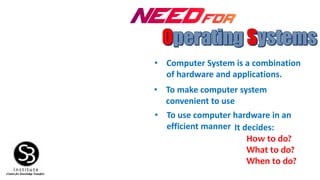
• Computer System is a combination
of hardware and applications.
• To make computer system
convenient to use
• To use computer hardware in an
efficient manner It decides:
How to do?
What to do?
When to do?
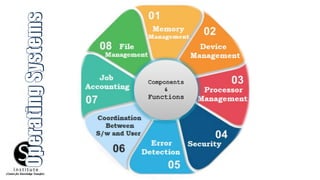
Components
&
Functions
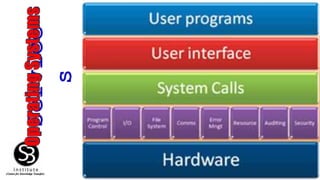
Service
s
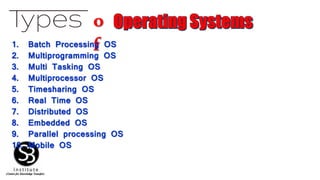
o
f
1. Batch Processing OS
2. Multiprogramming OS
3. Multi Tasking OS
4. Multiprocessor OS
5. Timesharing OS
6. Real Time OS
7. Distributed OS
8. Embedded OS
9. Parallel processing OS
10. Mobile OS
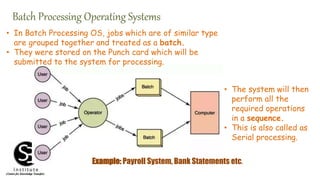
Batch Processing Operating Systems
• In Batch Processing OS, jobs which are of similar type
are grouped together and treated as a batch.
• They were stored on the Punch card which will be
submitted to the system for processing.
Example: Payroll System, Bank Statements etc.
• The system will then
perform all the
required operations
in a sequence.
• This is also called as
Serial processing.
Multiprogramming Operating Systems
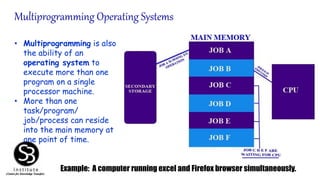
• Multiprogramming is also
the ability of an
operating system to
execute more than one
program on a single
processor machine.
• More than one
task/program/
job/process can reside
into the main memory at
one point of time.
Example: A computer running excel and Firefox browser simultaneously.
Multitasking Operating Systems
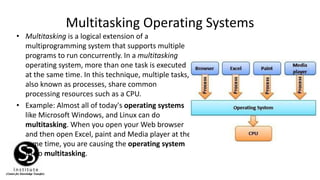
• Multitasking is a logical extension of a
multiprogramming system that supports multiple
programs to run concurrently. In a multitasking
operating system, more than one task is executed
at the same time. In this technique, multiple tasks,
also known as processes, share common
processing resources such as a CPU.
• Example: Almost all of today's operating systems
like Microsoft Windows, and Linux can do
multitasking. When you open your Web browser
and then open Excel, paint and Media player at the
same time, you are causing the operating system
to do multitasking.
Multiprocessor Operating System
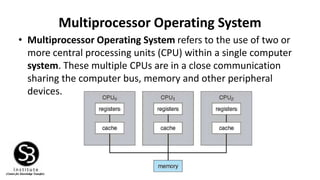
• Multiprocessor Operating System refers to the use of two or
more central processing units (CPU) within a single computer
system. These multiple CPUs are in a close communication
sharing the computer bus, memory and other peripheral
devices.
Time sharing operating system
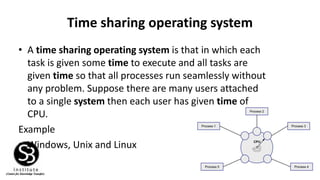
• A time sharing operating system is that in which each
task is given some time to execute and all tasks are
given time so that all processes run seamlessly without
any problem. Suppose there are many users attached
to a single system then each user has given time of
CPU.
Example
• Windows, Unix and Linux
Real-time operating system
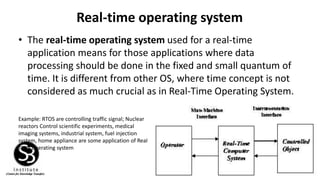
• The real-time operating system used for a real-time
application means for those applications where data
processing should be done in the fixed and small quantum of
time. It is different from other OS, where time concept is not
considered as much crucial as in Real-Time Operating System.
15
Example: RTOS are controlling traffic signal; Nuclear
reactors Control scientific experiments, medical
imaging systems, industrial system, fuel injection
system, home appliance are some application of Real
Time operating system
Distributed operating system
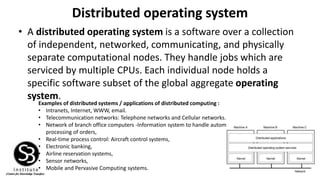
• A distributed operating system is a software over a collection
of independent, networked, communicating, and physically
separate computational nodes. They handle jobs which are
serviced by multiple CPUs. Each individual node holds a
specific software subset of the global aggregate operating
system.
Examples of distributed systems / applications of distributed computing :
• Intranets, Internet, WWW, email.
• Telecommunication networks: Telephone networks and Cellular networks.
• Network of branch office computers -Information system to handle automatic
processing of orders,
• Real-time process control: Aircraft control systems,
• Electronic banking,
• Airline reservation systems,
• Sensor networks,
• Mobile and Pervasive Computing systems.
Embedded operating system
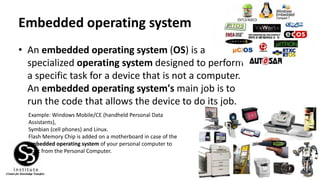
• An embedded operating system (OS) is a
specialized operating system designed to perform
a specific task for a device that is not a computer.
An embedded operating system's main job is to
run the code that allows the device to do its job.
Example: Windows Mobile/CE (handheld Personal Data
Assistants),
Symbian (cell phones) and Linux.
Flash Memory Chip is added on a motherboard in case of the
embedded operating system of your personal computer to
boot from the Personal Computer.
Parallel operating systems
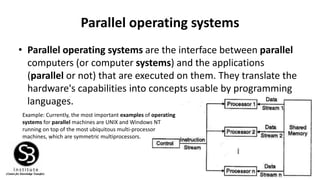
• Parallel operating systems are the interface between parallel
computers (or computer systems) and the applications
(parallel or not) that are executed on them. They translate the
hardware's capabilities into concepts usable by programming
languages.
Example: Currently, the most important examples of operating
systems for parallel machines are UNIX and Windows NT
running on top of the most ubiquitous multi-processor
machines, which are symmetric multiprocessors.
Mobile operating system
• A mobile operating system, also called a mobile OS, is an
operating system that is specifically designed to run on mobile
devices such as mobile phones, smartphones, PDAs, tablet
computers and other handheld devices.
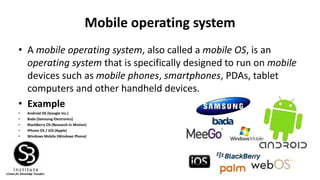
• Example
• Android OS (Google Inc.)
• Bada (Samsung Electronics)
• BlackBerry OS (Research In Motion)
• iPhone OS / iOS (Apple)
• Windows Mobile (Windows Phone)
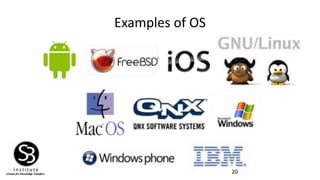
Examples of OS
20
The most popular OS are

Introduction to Operating Systems

  • 1.
  • 2.
    • Definition • Objectivesof Operating System • Structure of Operating System • Need for Operating Systems • OS Components and Functions • OS Services Discussio n
  • 3.
    Definition An Operating Systemis an interface between a computer user and computer hardware.
  • 4.
    Objectives 1. The operatingsystem attempts to schedule computational activities to ensure good performance of the computing system. 2. It provides a convenient environment for the development and execution of programs. 3. OS has been developed for increasing CPU utilization e.g. Multiprogramming and time sharing.
  • 5.
    • Computer Systemis a combination of hardware and applications. • To make computer system convenient to use • To use computer hardware in an efficient manner It decides: How to do? What to do? When to do?
  • 7.
  • 8.
  • 9.
    o f 1. Batch ProcessingOS 2. Multiprogramming OS 3. Multi Tasking OS 4. Multiprocessor OS 5. Timesharing OS 6. Real Time OS 7. Distributed OS 8. Embedded OS 9. Parallel processing OS 10. Mobile OS
  • 10.
    Batch Processing OperatingSystems • In Batch Processing OS, jobs which are of similar type are grouped together and treated as a batch. • They were stored on the Punch card which will be submitted to the system for processing. Example: Payroll System, Bank Statements etc. • The system will then perform all the required operations in a sequence. • This is also called as Serial processing.
  • 11.
    Multiprogramming Operating Systems •Multiprogramming is also the ability of an operating system to execute more than one program on a single processor machine. • More than one task/program/ job/process can reside into the main memory at one point of time. Example: A computer running excel and Firefox browser simultaneously.
  • 12.
    Multitasking Operating Systems •Multitasking is a logical extension of a multiprogramming system that supports multiple programs to run concurrently. In a multitasking operating system, more than one task is executed at the same time. In this technique, multiple tasks, also known as processes, share common processing resources such as a CPU. • Example: Almost all of today's operating systems like Microsoft Windows, and Linux can do multitasking. When you open your Web browser and then open Excel, paint and Media player at the same time, you are causing the operating system to do multitasking.
  • 13.
    Multiprocessor Operating System •Multiprocessor Operating System refers to the use of two or more central processing units (CPU) within a single computer system. These multiple CPUs are in a close communication sharing the computer bus, memory and other peripheral devices.
  • 14.
    Time sharing operatingsystem • A time sharing operating system is that in which each task is given some time to execute and all tasks are given time so that all processes run seamlessly without any problem. Suppose there are many users attached to a single system then each user has given time of CPU. Example • Windows, Unix and Linux
  • 15.
    Real-time operating system •The real-time operating system used for a real-time application means for those applications where data processing should be done in the fixed and small quantum of time. It is different from other OS, where time concept is not considered as much crucial as in Real-Time Operating System. 15 Example: RTOS are controlling traffic signal; Nuclear reactors Control scientific experiments, medical imaging systems, industrial system, fuel injection system, home appliance are some application of Real Time operating system
  • 16.
    Distributed operating system •A distributed operating system is a software over a collection of independent, networked, communicating, and physically separate computational nodes. They handle jobs which are serviced by multiple CPUs. Each individual node holds a specific software subset of the global aggregate operating system. Examples of distributed systems / applications of distributed computing : • Intranets, Internet, WWW, email. • Telecommunication networks: Telephone networks and Cellular networks. • Network of branch office computers -Information system to handle automatic processing of orders, • Real-time process control: Aircraft control systems, • Electronic banking, • Airline reservation systems, • Sensor networks, • Mobile and Pervasive Computing systems.
  • 17.
    Embedded operating system •An embedded operating system (OS) is a specialized operating system designed to perform a specific task for a device that is not a computer. An embedded operating system's main job is to run the code that allows the device to do its job. Example: Windows Mobile/CE (handheld Personal Data Assistants), Symbian (cell phones) and Linux. Flash Memory Chip is added on a motherboard in case of the embedded operating system of your personal computer to boot from the Personal Computer.
  • 18.
    Parallel operating systems •Parallel operating systems are the interface between parallel computers (or computer systems) and the applications (parallel or not) that are executed on them. They translate the hardware's capabilities into concepts usable by programming languages. Example: Currently, the most important examples of operating systems for parallel machines are UNIX and Windows NT running on top of the most ubiquitous multi-processor machines, which are symmetric multiprocessors.
  • 19.
    Mobile operating system •A mobile operating system, also called a mobile OS, is an operating system that is specifically designed to run on mobile devices such as mobile phones, smartphones, PDAs, tablet computers and other handheld devices. • Example • Android OS (Google Inc.) • Bada (Samsung Electronics) • BlackBerry OS (Research In Motion) • iPhone OS / iOS (Apple) • Windows Mobile (Windows Phone)
  • 20.
  • 21.