UNDERSTANDING THE
PRINCIPLES OF OPERATING
SYSTEM
UNIT 1: UNDERSTANDINGTHE PRINCIPLES OF OPERATING SYSTEM
• Operation system
• Computer Structures
• Operating System Structures
What is an Operating System?
• An operating System (OS) is an intermediary between users and
computer hardware.
• OS provides users an environment in which a user can execute
programs conveniently and efficiently.
• In technical terms, it is software which manages hardware. An
operating System controls the allocation of resources and services
such as memory, processors, devices and information.
• An operating system is a program that acts as an interface between
the user and the computer hardware and controls the execution of all
kinds of programs.
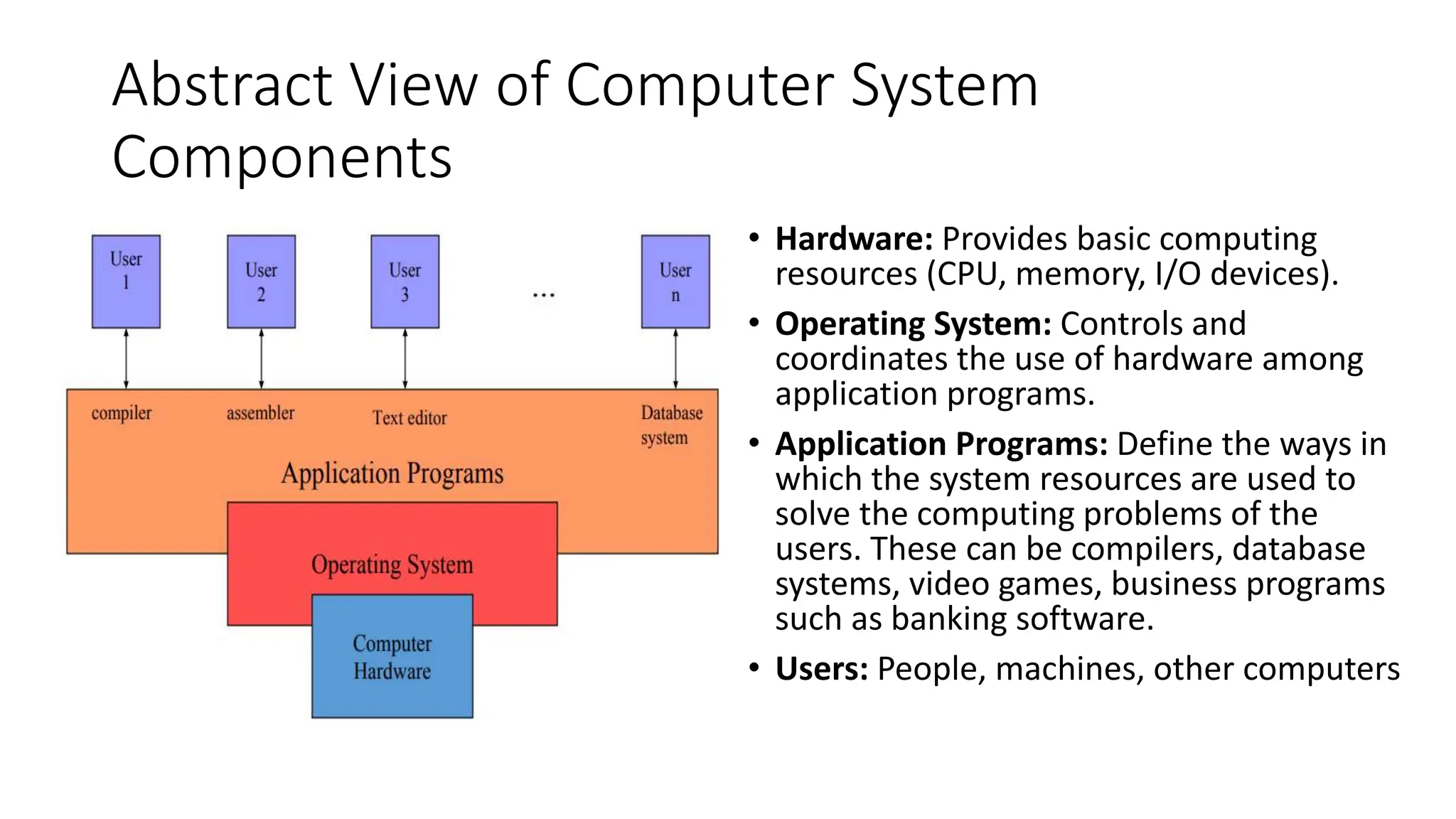
Abstract View of Computer System
Components
• Hardware: Provides basic computing
resources (CPU, memory, I/O devices).
• Operating System: Controls and
coordinates the use of hardware among
application programs.
• Application Programs: Define the ways in
which the system resources are used to
solve the computing problems of the
users. These can be compilers, database
systems, video games, business programs
such as banking software.
• Users: People, machines, other computers
Functions of Operating System
• Following are some of important functions of an operating System.
• Memory Management
• Processor Management
• Device Management
• File Management
• Security
• Control over system performance
• Job accounting
• Error detecting aids
• Coordination between other software and users
Memory Management
• Memory management refers to management of Primary Memory or Main
Memory. Main memory is a large array of words or bytes where each word
or byte has its own address.
• Main memory provides a fast storage that can be access directly by the
CPU. So for a program to be executed, it must in the main memory.
Operating System does the following activities for memory management.
• Keeps tracks of primary memory i.e. what part of it are in use by whom, what part
are not in use.
• In multiprogramming, OS decides which process will get memory when and how
much.
• Allocates the memory when the process requests it to do so.
• De-allocates the memory when the process no longer needs it or has been
terminated.
Processor Management
• In multiprogramming environment, OS decides which process gets
the processor when and how much time. This function is called
process scheduling.
• Operating System does the following activities for processor
management.
• Keeps tracks of processor and status of process. Program responsible for this
task is known as traffic controller.
• Allocates the processor (CPU) to a process.
• De-allocates processor when processor is no longer required.
Device Management
• OS manages device communication via their respective drivers.
• Operating System does the following activities for device
management.
• Keeps tracks of all devices. Program responsible for this task is known as the
I/O controller.
• Decides which process gets the device when and for how much time.
• Allocates the device in the efficient way.
• De-allocates devices
File Management
• A file system is normally organized into directories for easy navigation
and usage. These directories may contain files and other directions.
• Operating System does the following activities for file management.
• Keeps track of information, location, uses, status etc. The collective facilities
are often known as file system.
• Decides who gets the resources.
• Allocates the resources.
• De-allocates the resources.
Other Important OS funcctions
• Following are some of the important activities that Operating System does.
• Security: By means of password and similar other techniques, preventing
unauthorized access to programs and data.
• Control over system performance: Recording delays between request for a
service and response from the system.
• Job accounting: Keeping track of time and resources used by various jobs
and users.
• Error detecting aids: Production of dumps, traces, error messages and
other debugging and error detecting aids.
• Coordination between other software and users: Coordination and
assignment of compilers, interpreters, assemblers and other software to
the various users of the computer systems.
Types of Operating Systems
• Operating systems are there from the very first computer generation.
Operating systems keep evolving over the period of time. Following
are few of the important types of operating system which are most
commonly used.
• Batch operating system
• Time-sharing operating systems
• Distributed operating system
• Network operating system
• Real time operating system
Batch operating system
• The users of batch operating system
do not interact with the computer
directly.
• Each user prepares his job on an off-
line device like punch cards and
submits it to the computer operator.
• To speed up processing, jobs with
similar needs are batched together
and run as a group. Thus, the
programmers left their programs with
the operator.
• The operator then sorts programs into
batches with similar requirements.
• The problems with Batch Systems are
following.
• Lack of interaction between the user and
job.
• CPU is often idle, because the speeds of
the mechanical I/O devices are slower
than CPU.
• Difficult to provide the desired priority.
Time-sharing operating systems
• Time sharing is a technique which enables many
people, located at various terminals, to use a
particular computer system at the same time.
• Time-sharing or multitasking is a logical extension
of multiprogramming.
• Processor's time which is shared among multiple
users simultaneously is termed as time-sharing.
• The main difference between multi-programmed
Batch Systems and Time-Sharing
• Systems is that in case of multi-programmed
batch systems, objective is to maximize processor
use, whereas in Time-Sharing Systems objective
is to minimize response time.
• Multiple jobs are executed by the CPU by
switching between them, but the switches occur
so frequently.
• Thus, the user can receive an immediate response.
For example, in a transaction processing, processor
execute each user program in a short burst or
quantum of computation.
• That is if n users are present, each user can get
time quantum. When the user submits the
command, the response time is in few seconds at
most.
• Operating system uses CPU scheduling and
multiprogramming to provide each user with a
small portion of a time.
• Computer systems that were designed primarily as
batch systems have been modified to time-sharing
systems.
Time-sharing operating systems…
Advantages of Timesharing operating systems
are following
• Provide advantage of quick
response.
• Avoids duplication of software.
• Reduces CPU idle time.
Disadvantages of Timesharing operating
systems are following.
• Problem of reliability.
• Question of security and
integrity of user programs and
data.
• Problem of data communication.
Distributed operating System
• Distributed systems use multiple central processors to serve multiple
real time application and multiple users.
• Data processing jobs are distributed among the processors
accordingly to which one can perform each job most efficiently.
• The processors communicate with one another through various
communication lines (such as high-speed buses or telephone lines).
These are referred as loosely coupled systems or distributed systems.
• Processors in a distributed system may vary in size and function.
These processors are referred as sites, nodes, and computers and so
on.
The advantages of distributed systems are
following.
• With resource sharing facility user at one site may be able to use the
resources available at another.
• Speedup the exchange of data with one another via electronic mail.
• If one site fails in a distributed system, the remaining sites can
potentially continue operating.
• Better service to the customers.
• Reduction of the load on the host computer.
• Reduction of delays in data processing.
Network operating System
• Network Operating System runs on a server and provides server the
capability to manage data, users, groups, security, applications, and
other networking functions.
• The primary purpose of the network operating system is to allow
shared file and printer access among multiple computers in a
network, typically a local area network (LAN), a private network or to
other networks.
• Examples of network operating systems are Microsoft Windows
Server 2003, Microsoft Windows Server 2008, UNIX, Linux, Mac OS X,
Novell NetWare, and BSD.
Network operating System
The advantages of network
operating systems are following.
• Centralized servers are highly
stable.
• Security is server managed.
• Upgrades to new technologies
and hardware can be easily
integrated into the system.
• Remote access to servers is
possible from different locations
and types of systems.
The disadvantages of network operating
systems are following.
• High cost of buying and running
a server.
• Dependency on a central
location for most operations.
• Regular maintenance and
updates are required.
Real Time operating System
• Real time system is defines as a data processing system in which the time interval
required to process and respond to inputs is so small that it controls the
environment.
• Real time processing is always on line whereas on line system need not be real
time.
• The time taken by the system to respond to an input and display of required
updated information is termed as response time. So in this method response time
is very less as compared to the online processing.
• Real-time systems are used when there are rigid time requirements on the
operation of a processor or the flow of data and real-time systems can be used as
a control device in a dedicated application.
• Real-time operating system has well-defined, fixed time constraints otherwise
system will fail. For example Scientific experiments, medical imaging systems,
industrial control systems, weapon systems, robots, and home-appliance
controllers, Air traffic control system etc.
Types of real-time operating systems.
Hard real-time systems
• Hard real-time systems guarantee that
critical tasks complete on time.
• In hard real-time systems secondary
storage is limited or missing with data
stored in ROM.
• In these systems virtual memory is
almost never found.
Soft real-time systems
• Soft real time systems are less
restrictive.
• Critical real-time task gets priority
over other tasks and retains the
priority until it completes.
• Soft real-time systems have limited
utility than hard real-time systems.
• For example, Multimedia, virtual
reality, Advanced Scientific Projects
like undersea exploration and
planetary rovers etc
Operating System Services
• An Operating System provides services to both the users and to the
programs.
• It provides programs, an environment to execute.
• It provides users, services to execute the programs in a convenient manner.
• Following are few common services provided by operating systems.
• Program execution
• I/O operations
• File System manipulation
• Communication
• Error Detection
• Resource Allocation
Program execution
• Operating system handles many kinds of activities from user programs to
system programs like printer spooler, name servers, file server etc. Each of
these activities is encapsulated as a process.
• A process includes the complete execution context (code to execute, data
to manipulate, registers, OS resources in use).
• Following are the major activities of an operating system with respect to
program management.
• Loads a program into memory.
• Executes the program.
• Handles program's execution.
• Provides a mechanism for process synchronization.
• Provides a mechanism for process communication.
• Provides a mechanism for deadlock handling.
I/O Operation
• I/O subsystem comprised of I/O devices and their corresponding driver
software.
• Drivers hides the peculiarities of specific hardware devices from the user as
the device driver knows the peculiarities of the specific device.
• Operating System manages the communication between user and device
drivers.
• Following are the major activities of an operating system with respect to
I/O Operation.
• I/O operation means read or write operation with any file or any specific I/O device.
• Program may require any I/O device while running.
• Operating system provides the access to the required I/O device when required.
File system manipulation
• A file represents a collection of related information.
• Computer can store files on the disk (secondary storage), for long term storage
purpose.
• Few examples of storage media are magnetic tape, magnetic disk and optical disk
drives like CD, DVD.
• Each of these media has its own properties like speed, capacity, data transfer rate
and data access methods.
• A file system is normally organized into directories for easy navigation and usage.
These directories may contain files and other directions.
• Following are the major activities of an operating system with respect to file
management.
• Program needs to read a file or write a file.
• The operating system gives the permission to the program for operation on file.
• Permission varies from read-only, read-write, denied and so on.
• Operating System provides an interface to the user to create/delete files.
• Operating System provides an interface to the user to create/delete directories.
• Operating System provides an interface to create the backup of file system.
Communication
• In case of distributed systems which are a collection of processors that do not
share memory, peripheral devices, or a clock, operating system manages
communications between processes.
• Multiple processes with one another through communication lines in the
network.
• OS handles routing and connection strategies, and the problems of contention
and security.
• Following are the major activities of an operating system with respect to
communication.
• Two processes often require data to be transferred between them.
• Both processes can be on the one computer or on different computer but are connected
through computer network.
• Communication may be implemented by two methods either by Shared Memory or by
Message Passing.
Error handling
• Error can occur anytime and anywhere.
• Error may occur in CPU, in I/O devices or in the memory hardware.
• Following are the major activities of an operating system with respect
to error handling.
• OS constantly remains aware of possible errors.
• OS takes the appropriate action to ensure correct and consistent computing.
Resource Management
• In case of multi-user or multi-tasking environment, resources such as
main memory, CPU cycles and files storage are to be allocated to each
user or job.
• Following are the major activities of an operating system with respect
to resource management.
• OS manages all kind of resources using schedulers.
• CPU scheduling algorithms are used for better utilization of CPU.
Protection
• Considering computer systems having multiple users the concurrent
execution of multiple processes, then the various processes must be
protected from each another's activities.
• Protection refers to mechanism or a way to control the access of programs,
processes, or users to the resources defined by computer systems.
• Following are the major activities of an operating system with respect to
protection.
• OS ensures that all access to system resources is controlled.
• OS ensures that external I/O devices are protected from invalid access attempts.
• OS provides authentication feature for each user by means of a password.
Computer Structures
Operating System Structures

UNIT 1 - UNDERSTANDINGTHE PRINCIPLES OF OPERATING SYSTEM.pptx

  • 1.
  • 2.
    UNIT 1: UNDERSTANDINGTHEPRINCIPLES OF OPERATING SYSTEM • Operation system • Computer Structures • Operating System Structures
  • 3.
    What is anOperating System? • An operating System (OS) is an intermediary between users and computer hardware. • OS provides users an environment in which a user can execute programs conveniently and efficiently. • In technical terms, it is software which manages hardware. An operating System controls the allocation of resources and services such as memory, processors, devices and information. • An operating system is a program that acts as an interface between the user and the computer hardware and controls the execution of all kinds of programs.
  • 4.
    Abstract View ofComputer System Components • Hardware: Provides basic computing resources (CPU, memory, I/O devices). • Operating System: Controls and coordinates the use of hardware among application programs. • Application Programs: Define the ways in which the system resources are used to solve the computing problems of the users. These can be compilers, database systems, video games, business programs such as banking software. • Users: People, machines, other computers
  • 5.
    Functions of OperatingSystem • Following are some of important functions of an operating System. • Memory Management • Processor Management • Device Management • File Management • Security • Control over system performance • Job accounting • Error detecting aids • Coordination between other software and users
  • 6.
    Memory Management • Memorymanagement refers to management of Primary Memory or Main Memory. Main memory is a large array of words or bytes where each word or byte has its own address. • Main memory provides a fast storage that can be access directly by the CPU. So for a program to be executed, it must in the main memory. Operating System does the following activities for memory management. • Keeps tracks of primary memory i.e. what part of it are in use by whom, what part are not in use. • In multiprogramming, OS decides which process will get memory when and how much. • Allocates the memory when the process requests it to do so. • De-allocates the memory when the process no longer needs it or has been terminated.
  • 7.
    Processor Management • Inmultiprogramming environment, OS decides which process gets the processor when and how much time. This function is called process scheduling. • Operating System does the following activities for processor management. • Keeps tracks of processor and status of process. Program responsible for this task is known as traffic controller. • Allocates the processor (CPU) to a process. • De-allocates processor when processor is no longer required.
  • 8.
    Device Management • OSmanages device communication via their respective drivers. • Operating System does the following activities for device management. • Keeps tracks of all devices. Program responsible for this task is known as the I/O controller. • Decides which process gets the device when and for how much time. • Allocates the device in the efficient way. • De-allocates devices
  • 9.
    File Management • Afile system is normally organized into directories for easy navigation and usage. These directories may contain files and other directions. • Operating System does the following activities for file management. • Keeps track of information, location, uses, status etc. The collective facilities are often known as file system. • Decides who gets the resources. • Allocates the resources. • De-allocates the resources.
  • 10.
    Other Important OSfuncctions • Following are some of the important activities that Operating System does. • Security: By means of password and similar other techniques, preventing unauthorized access to programs and data. • Control over system performance: Recording delays between request for a service and response from the system. • Job accounting: Keeping track of time and resources used by various jobs and users. • Error detecting aids: Production of dumps, traces, error messages and other debugging and error detecting aids. • Coordination between other software and users: Coordination and assignment of compilers, interpreters, assemblers and other software to the various users of the computer systems.
  • 11.
    Types of OperatingSystems • Operating systems are there from the very first computer generation. Operating systems keep evolving over the period of time. Following are few of the important types of operating system which are most commonly used. • Batch operating system • Time-sharing operating systems • Distributed operating system • Network operating system • Real time operating system
  • 12.
    Batch operating system •The users of batch operating system do not interact with the computer directly. • Each user prepares his job on an off- line device like punch cards and submits it to the computer operator. • To speed up processing, jobs with similar needs are batched together and run as a group. Thus, the programmers left their programs with the operator. • The operator then sorts programs into batches with similar requirements. • The problems with Batch Systems are following. • Lack of interaction between the user and job. • CPU is often idle, because the speeds of the mechanical I/O devices are slower than CPU. • Difficult to provide the desired priority.
  • 13.
    Time-sharing operating systems •Time sharing is a technique which enables many people, located at various terminals, to use a particular computer system at the same time. • Time-sharing or multitasking is a logical extension of multiprogramming. • Processor's time which is shared among multiple users simultaneously is termed as time-sharing. • The main difference between multi-programmed Batch Systems and Time-Sharing • Systems is that in case of multi-programmed batch systems, objective is to maximize processor use, whereas in Time-Sharing Systems objective is to minimize response time. • Multiple jobs are executed by the CPU by switching between them, but the switches occur so frequently. • Thus, the user can receive an immediate response. For example, in a transaction processing, processor execute each user program in a short burst or quantum of computation. • That is if n users are present, each user can get time quantum. When the user submits the command, the response time is in few seconds at most. • Operating system uses CPU scheduling and multiprogramming to provide each user with a small portion of a time. • Computer systems that were designed primarily as batch systems have been modified to time-sharing systems.
  • 14.
    Time-sharing operating systems… Advantagesof Timesharing operating systems are following • Provide advantage of quick response. • Avoids duplication of software. • Reduces CPU idle time. Disadvantages of Timesharing operating systems are following. • Problem of reliability. • Question of security and integrity of user programs and data. • Problem of data communication.
  • 15.
    Distributed operating System •Distributed systems use multiple central processors to serve multiple real time application and multiple users. • Data processing jobs are distributed among the processors accordingly to which one can perform each job most efficiently. • The processors communicate with one another through various communication lines (such as high-speed buses or telephone lines). These are referred as loosely coupled systems or distributed systems. • Processors in a distributed system may vary in size and function. These processors are referred as sites, nodes, and computers and so on.
  • 16.
    The advantages ofdistributed systems are following. • With resource sharing facility user at one site may be able to use the resources available at another. • Speedup the exchange of data with one another via electronic mail. • If one site fails in a distributed system, the remaining sites can potentially continue operating. • Better service to the customers. • Reduction of the load on the host computer. • Reduction of delays in data processing.
  • 17.
    Network operating System •Network Operating System runs on a server and provides server the capability to manage data, users, groups, security, applications, and other networking functions. • The primary purpose of the network operating system is to allow shared file and printer access among multiple computers in a network, typically a local area network (LAN), a private network or to other networks. • Examples of network operating systems are Microsoft Windows Server 2003, Microsoft Windows Server 2008, UNIX, Linux, Mac OS X, Novell NetWare, and BSD.
  • 18.
    Network operating System Theadvantages of network operating systems are following. • Centralized servers are highly stable. • Security is server managed. • Upgrades to new technologies and hardware can be easily integrated into the system. • Remote access to servers is possible from different locations and types of systems. The disadvantages of network operating systems are following. • High cost of buying and running a server. • Dependency on a central location for most operations. • Regular maintenance and updates are required.
  • 19.
    Real Time operatingSystem • Real time system is defines as a data processing system in which the time interval required to process and respond to inputs is so small that it controls the environment. • Real time processing is always on line whereas on line system need not be real time. • The time taken by the system to respond to an input and display of required updated information is termed as response time. So in this method response time is very less as compared to the online processing. • Real-time systems are used when there are rigid time requirements on the operation of a processor or the flow of data and real-time systems can be used as a control device in a dedicated application. • Real-time operating system has well-defined, fixed time constraints otherwise system will fail. For example Scientific experiments, medical imaging systems, industrial control systems, weapon systems, robots, and home-appliance controllers, Air traffic control system etc.
  • 20.
    Types of real-timeoperating systems. Hard real-time systems • Hard real-time systems guarantee that critical tasks complete on time. • In hard real-time systems secondary storage is limited or missing with data stored in ROM. • In these systems virtual memory is almost never found. Soft real-time systems • Soft real time systems are less restrictive. • Critical real-time task gets priority over other tasks and retains the priority until it completes. • Soft real-time systems have limited utility than hard real-time systems. • For example, Multimedia, virtual reality, Advanced Scientific Projects like undersea exploration and planetary rovers etc
  • 21.
    Operating System Services •An Operating System provides services to both the users and to the programs. • It provides programs, an environment to execute. • It provides users, services to execute the programs in a convenient manner. • Following are few common services provided by operating systems. • Program execution • I/O operations • File System manipulation • Communication • Error Detection • Resource Allocation
  • 22.
    Program execution • Operatingsystem handles many kinds of activities from user programs to system programs like printer spooler, name servers, file server etc. Each of these activities is encapsulated as a process. • A process includes the complete execution context (code to execute, data to manipulate, registers, OS resources in use). • Following are the major activities of an operating system with respect to program management. • Loads a program into memory. • Executes the program. • Handles program's execution. • Provides a mechanism for process synchronization. • Provides a mechanism for process communication. • Provides a mechanism for deadlock handling.
  • 23.
    I/O Operation • I/Osubsystem comprised of I/O devices and their corresponding driver software. • Drivers hides the peculiarities of specific hardware devices from the user as the device driver knows the peculiarities of the specific device. • Operating System manages the communication between user and device drivers. • Following are the major activities of an operating system with respect to I/O Operation. • I/O operation means read or write operation with any file or any specific I/O device. • Program may require any I/O device while running. • Operating system provides the access to the required I/O device when required.
  • 24.
    File system manipulation •A file represents a collection of related information. • Computer can store files on the disk (secondary storage), for long term storage purpose. • Few examples of storage media are magnetic tape, magnetic disk and optical disk drives like CD, DVD. • Each of these media has its own properties like speed, capacity, data transfer rate and data access methods. • A file system is normally organized into directories for easy navigation and usage. These directories may contain files and other directions. • Following are the major activities of an operating system with respect to file management. • Program needs to read a file or write a file. • The operating system gives the permission to the program for operation on file. • Permission varies from read-only, read-write, denied and so on. • Operating System provides an interface to the user to create/delete files. • Operating System provides an interface to the user to create/delete directories. • Operating System provides an interface to create the backup of file system.
  • 25.
    Communication • In caseof distributed systems which are a collection of processors that do not share memory, peripheral devices, or a clock, operating system manages communications between processes. • Multiple processes with one another through communication lines in the network. • OS handles routing and connection strategies, and the problems of contention and security. • Following are the major activities of an operating system with respect to communication. • Two processes often require data to be transferred between them. • Both processes can be on the one computer or on different computer but are connected through computer network. • Communication may be implemented by two methods either by Shared Memory or by Message Passing.
  • 26.
    Error handling • Errorcan occur anytime and anywhere. • Error may occur in CPU, in I/O devices or in the memory hardware. • Following are the major activities of an operating system with respect to error handling. • OS constantly remains aware of possible errors. • OS takes the appropriate action to ensure correct and consistent computing.
  • 27.
    Resource Management • Incase of multi-user or multi-tasking environment, resources such as main memory, CPU cycles and files storage are to be allocated to each user or job. • Following are the major activities of an operating system with respect to resource management. • OS manages all kind of resources using schedulers. • CPU scheduling algorithms are used for better utilization of CPU.
  • 28.
    Protection • Considering computersystems having multiple users the concurrent execution of multiple processes, then the various processes must be protected from each another's activities. • Protection refers to mechanism or a way to control the access of programs, processes, or users to the resources defined by computer systems. • Following are the major activities of an operating system with respect to protection. • OS ensures that all access to system resources is controlled. • OS ensures that external I/O devices are protected from invalid access attempts. • OS provides authentication feature for each user by means of a password.
  • 29.
  • 30.