Knowledge-Based
Agent inArtificial
intelligence
Dr. C.V. Suresh Babu
(CentreforKnowledgeTransfer)
institute
(CentreforKnowledgeTransfer)
institute
Introduction
• An intelligent agent needs knowledge about the real
world for taking decisions and reasoning to act
efficiently.
https://www.youtube.com/watch?v=E8Ox6H64yu8
(CentreforKnowledgeTransfer)
institute
Introduction
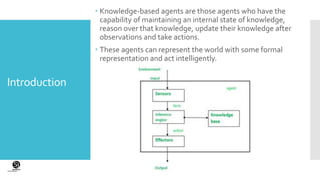
 Knowledge-based agents are those agents who have the
capability of maintaining an internal state of knowledge,
reason over that knowledge, update their knowledge after
observations and take actions.
 These agents can represent the world with some formal
representation and act intelligently.
(CentreforKnowledgeTransfer)
institute
Knowledge-based agents are composed of two main parts:
Fig: Foundations of Computational Agents
• Knowledge-base and
• Inference system
(CentreforKnowledgeTransfer)
institute
Why
Knowledge
BasedAgents?
A knowledge-based agent must able to do the following:
 An agent should be able to represent states, actions, etc.
 An agent Should be able to incorporate new percepts
 An agent can update the internal representation of the world
 An agent can deduce the internal representation of the world
 An agent can deduce appropriate actions.
(CentreforKnowledgeTransfer)
institute
The
architecture
of knowledge-
based agent:
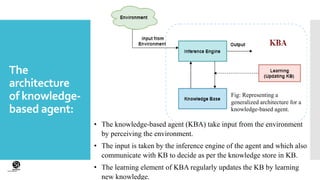
• The knowledge-based agent (KBA) take input from the environment
by perceiving the environment.
• The input is taken by the inference engine of the agent and which also
communicate with KB to decide as per the knowledge store in KB.
• The learning element of KBA regularly updates the KB by learning
new knowledge.
Fig: Representing a
generalized architecture for a
knowledge-based agent.
(CentreforKnowledgeTransfer)
institute
Knowledge
base
 Knowledge-base is a central component of a knowledge-based
agent, it is also known as KB.
 It is a collection of sentences (here 'sentence' is a technical term
and it is not identical to sentence in English).
 These sentences are expressed in a language which is called a
knowledge representation language.
 The Knowledge-base of KBA stores fact about the world.
(CentreforKnowledgeTransfer)
institute
Why use a
knowledge
base?
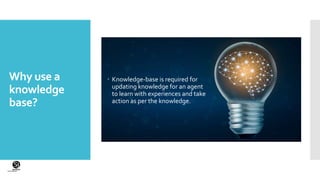
 Knowledge-base is required for
updating knowledge for an agent
to learn with experiences and take
action as per the knowledge.
(CentreforKnowledgeTransfer)
institute
Inference
system
 Inference means deriving new sentences from old. Inference
system allows us to add a new sentence to the knowledge base.
 A sentence is a proposition about the world. Inference system
applies logical rules to the KB to deduce new information.
 Inference system generates new facts so that an agent can update
the KB.
 An inference system works mainly in two rules which are given as:
 Forward chaining
 Backward chaining
(CentreforKnowledgeTransfer)
institute
Operations
Performed by
KBA
Following are three operations which are performed by KBA in
order to show the intelligent behavior:
1. TELL:This operation tells the knowledge base what it perceives
from the environment.
2. ASK:This operation asks the knowledge base what action it
should perform.
3. Perform: It performs the selected action.
(CentreforKnowledgeTransfer)
institute
Various levels
of knowledge-
based agent:
A knowledge-based agent can be viewed at different levels which
are given below:
1. Knowledge level
 Knowledge level is the first level of knowledge-based agent, and in
this level, we need to specify what the agent knows, and what the
agent goals are.
 With these specifications, we can fix its behavior.
 For example, suppose an automated taxi agent needs to go from a
stationA to station B, and he knows the way from A to B, so this
comes at the knowledge level.
(CentreforKnowledgeTransfer)
institute
Various levels
of knowledge-
based agent:
2. Logical level:
 At this level, we understand that how the knowledge
representation of knowledge is stored.
 At this level, sentences are encoded into different logics.
 At the logical level, an encoding of knowledge into logical
sentences occurs.
 At the logical level we can expect to the automated taxi agent to
reach to the destination B.
(CentreforKnowledgeTransfer)
institute
Various levels
of knowledge-
based agent:
3. Implementation level:
 This is the physical representation of logic and knowledge.
 At the implementation level agent perform actions as per logical
and knowledge level.
 At this level, an automated taxi agent actually implement his
knowledge and logic so that he can reach to the destination.
(CentreforKnowledgeTransfer)
institute
Approaches
to designing
a knowledge-
based agent
There are mainly two approaches to build a knowledge-based
agent:
1. Declarative approach: We can create a knowledge-based agent
by initializing with an empty knowledge base and telling the
agent all the sentences with which we want to start with.This
approach is called Declarative approach.
2. Procedural approach: In the procedural approach, we directly
encode desired behavior as a program code.Which means we
just need to write a program that already encodes the desired
behavior or agent.
 However, in the real world, a successful agent can be built by
combining both declarative and procedural approaches, and
declarative knowledge can often be compiled into more efficient
procedural code.

Knowledge based agents

  • 1.
    Knowledge-Based Agent inArtificial intelligence Dr. C.V.Suresh Babu (CentreforKnowledgeTransfer) institute
  • 2.
    (CentreforKnowledgeTransfer) institute Introduction • An intelligentagent needs knowledge about the real world for taking decisions and reasoning to act efficiently. https://www.youtube.com/watch?v=E8Ox6H64yu8
  • 3.
    (CentreforKnowledgeTransfer) institute Introduction  Knowledge-based agentsare those agents who have the capability of maintaining an internal state of knowledge, reason over that knowledge, update their knowledge after observations and take actions.  These agents can represent the world with some formal representation and act intelligently.
  • 4.
    (CentreforKnowledgeTransfer) institute Knowledge-based agents arecomposed of two main parts: Fig: Foundations of Computational Agents • Knowledge-base and • Inference system
  • 5.
    (CentreforKnowledgeTransfer) institute Why Knowledge BasedAgents? A knowledge-based agentmust able to do the following:  An agent should be able to represent states, actions, etc.  An agent Should be able to incorporate new percepts  An agent can update the internal representation of the world  An agent can deduce the internal representation of the world  An agent can deduce appropriate actions.
  • 6.
    (CentreforKnowledgeTransfer) institute The architecture of knowledge- based agent: •The knowledge-based agent (KBA) take input from the environment by perceiving the environment. • The input is taken by the inference engine of the agent and which also communicate with KB to decide as per the knowledge store in KB. • The learning element of KBA regularly updates the KB by learning new knowledge. Fig: Representing a generalized architecture for a knowledge-based agent.
  • 7.
    (CentreforKnowledgeTransfer) institute Knowledge base  Knowledge-base isa central component of a knowledge-based agent, it is also known as KB.  It is a collection of sentences (here 'sentence' is a technical term and it is not identical to sentence in English).  These sentences are expressed in a language which is called a knowledge representation language.  The Knowledge-base of KBA stores fact about the world.
  • 8.
    (CentreforKnowledgeTransfer) institute Why use a knowledge base? Knowledge-base is required for updating knowledge for an agent to learn with experiences and take action as per the knowledge.
  • 9.
    (CentreforKnowledgeTransfer) institute Inference system  Inference meansderiving new sentences from old. Inference system allows us to add a new sentence to the knowledge base.  A sentence is a proposition about the world. Inference system applies logical rules to the KB to deduce new information.  Inference system generates new facts so that an agent can update the KB.  An inference system works mainly in two rules which are given as:  Forward chaining  Backward chaining
  • 10.
    (CentreforKnowledgeTransfer) institute Operations Performed by KBA Following arethree operations which are performed by KBA in order to show the intelligent behavior: 1. TELL:This operation tells the knowledge base what it perceives from the environment. 2. ASK:This operation asks the knowledge base what action it should perform. 3. Perform: It performs the selected action.
  • 11.
    (CentreforKnowledgeTransfer) institute Various levels of knowledge- basedagent: A knowledge-based agent can be viewed at different levels which are given below: 1. Knowledge level  Knowledge level is the first level of knowledge-based agent, and in this level, we need to specify what the agent knows, and what the agent goals are.  With these specifications, we can fix its behavior.  For example, suppose an automated taxi agent needs to go from a stationA to station B, and he knows the way from A to B, so this comes at the knowledge level.
  • 12.
    (CentreforKnowledgeTransfer) institute Various levels of knowledge- basedagent: 2. Logical level:  At this level, we understand that how the knowledge representation of knowledge is stored.  At this level, sentences are encoded into different logics.  At the logical level, an encoding of knowledge into logical sentences occurs.  At the logical level we can expect to the automated taxi agent to reach to the destination B.
  • 13.
    (CentreforKnowledgeTransfer) institute Various levels of knowledge- basedagent: 3. Implementation level:  This is the physical representation of logic and knowledge.  At the implementation level agent perform actions as per logical and knowledge level.  At this level, an automated taxi agent actually implement his knowledge and logic so that he can reach to the destination.
  • 14.
    (CentreforKnowledgeTransfer) institute Approaches to designing a knowledge- basedagent There are mainly two approaches to build a knowledge-based agent: 1. Declarative approach: We can create a knowledge-based agent by initializing with an empty knowledge base and telling the agent all the sentences with which we want to start with.This approach is called Declarative approach. 2. Procedural approach: In the procedural approach, we directly encode desired behavior as a program code.Which means we just need to write a program that already encodes the desired behavior or agent.  However, in the real world, a successful agent can be built by combining both declarative and procedural approaches, and declarative knowledge can often be compiled into more efficient procedural code.