BASIC CONCEPT OF
CLASSIFICATION
DR. C.V. SURESH BABU
(CentreforKnowledgeTransfer)
institute
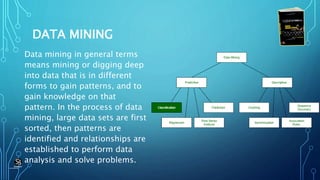
DATA MINING
Data mining in general terms
means mining or digging deep
into data that is in different
forms to gain patterns, and to
gain knowledge on that
pattern. In the process of data
mining, large data sets are first
sorted, then patterns are
identified and relationships are
established to perform data
analysis and solve problems.
(CentreforKnowledgeTransfer)
institute
CLASSIFICATION
It is a data analysis task, i.e. the process of finding a model that
describes and distinguishes data classes and concepts. Classification is
the problem of identifying to which of a set of categories
(subpopulations), a new observation belongs to, on the basis of a
training set of data containing observations and whose categories
membership is known.
Example: Before starting any project, we need to check its feasibility. In
this case, a classifier is required to predict class labels such as ‘Safe’
and ‘Risky’ for adopting the Project and to further approve it. It is a
two-step process such as :
1. Learning Step (Training Phase)
2. Classification Step
(CentreforKnowledgeTransfer)
institute
LEARNING STEP (TRAINING PHASE):
Construction of Classification Model
• Different Algorithms are used to
build a classifier by making the
model learn using the training set
available.
• The model has to be trained for the
prediction of accurate results.
(CentreforKnowledgeTransfer)
institute
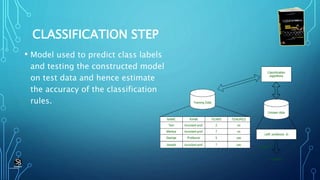
CLASSIFICATION STEP
• Model used to predict class labels
and testing the constructed model
on test data and hence estimate
the accuracy of the classification
rules.
(CentreforKnowledgeTransfer)
institute
TRAINING AND TESTING:
• Suppose there is a person who is sitting under a fan and the fan
starts falling on him, he should get aside in order not to get hurt.
• So, this is his training part to move away.
• While Testing if the person sees any heavy object coming towards
him or falling on him and moves aside then the system is tested
positively and if the person does not move aside then the system is
negatively tested.
• Same is the case with the data, it should be trained in order to get
the accurate and best results.
(CentreforKnowledgeTransfer)
institute
CLASSIFICATION MODELS
• Classifiers can be categorized into two major types:
1. Discriminative
2. Generative
(CentreforKnowledgeTransfer)
institute
DISCRIMINATIVE
• It is a very basic classifier and determines just one class for
each row of data. It tries to model just by depending on the
observed data, depends heavily on the quality of data rather
than on distributions.
Example: Logistic Regression
Acceptance of a student at a University (Test and Grades need
to be considered)
(CentreforKnowledgeTransfer)
institute
GENERATIVE
• It models the distribution of individual classes and tries to learn the model that
generates the data behind the scenes by estimating assumptions and
distributions of the model. Used to predict the unseen data.
Example: Naive Bayes Classifier
• Detecting Spam emails by looking at the previous data.
• Suppose 100 emails and that too divided in 1:4 i.e. Class A: 25%(Spam emails) and Class B:
75%(Non-Spam emails).
• Now if a user wants to check that if an email contains the word cheap, then that may be
termed as Spam.
• It seems to be that in Class A(i.e. in 25% of data), 20 out of 25 emails are spam and rest
not.
• And in Class B(i.e. in 75% of data), 70 out of 75 emails are not spam and rest are spam.
• So, if the email contains the word cheap, what is the probability of it being spam ?? (= 80%)
(CentreforKnowledgeTransfer)
institute
CLASSIFIERS OF MACHINE LEARNING
• Decision Trees
• Bayesian Classifiers
• Neural Networks
• K-Nearest Neighbour
• Support Vector Machines
• Linear Regression
• Logistic Regression
(CentreforKnowledgeTransfer)
institute
ASSOCIATED TOOLS AND LANGUAGES
Used to mine/ extract useful information from raw data.
• Main Languages used: R, SAS, Python, SQL
• Major Tools used: RapidMiner, Orange, KNIME, Spark, Weka
• Libraries used: Jupyter, NumPy, Matplotlib, Pandas, ScikitLearn,
NLTK, TensorFlow, Seaborn, Basemap, etc.
(CentreforKnowledgeTransfer)
institute
REAL–LIFE EXAMPLES
• Market Basket Analysis:
It is a modeling technique that has been associated with frequent
transactions of buying some combination of items.
Example: Amazon and many other Retailers use this technique. While
viewing some products, certain suggestions for the commodities are shown
that some people have bought in the past.
• Weather Forecasting:
Changing Patterns in weather conditions needs to be observed based on
parameters such as temperature, humidity, wind direction. This keen
observation also requires the use of previous records in order to predict it
accurately.
(CentreforKnowledgeTransfer)
institute
ADVANTAGES
• Mining Based Methods are cost-effective and efficient
• Helps in identifying criminal suspects
• Helps in predicting the risk of diseases
• Helps Banks and Financial Institutions to identify defaulters so
that they may approve Cards, Loan, etc.
(CentreforKnowledgeTransfer)
institute
DISADVANTAGES
• Privacy: When the data is either are chances that a company
may give some information about their customers to other
vendors or use this information for their profit.
Accuracy Problem: Selection of Accurate model must be there in
order to get the best accuracy and result.
(CentreforKnowledgeTransfer)
institute
APPLICATIONS
• Marketing and Retailing
• Manufacturing
• Telecommunication Industry
• Intrusion Detection
• Education System
• Fraud Detection
(CentreforKnowledgeTransfer)
institute
SUMMARY
• Choosing the correct classification method, like decision trees,
Bayesian networks, or neural networks.
• Need a sample of data, where all class values are known. Then
the data will be divided into two parts, a training set, and a test
set.
(CentreforKnowledgeTransfer)
institute
ASSOCIATION RULES
• Association rules are "if-then" statements, that help to show
the probability of relationships between data items, within
large data sets in various types of databases. Association rule
mining has a number of applications and is widely used to help
discover sales correlations in transactional data or in medical
data sets.
(CentreforKnowledgeTransfer)
institute
MEDICINE
• Doctors can use association rules to help diagnose patients.
There are many variables to consider when making a diagnosis,
as many diseases share symptoms. By using association rules
and machine learning-fueled data analysis, doctors can
determine the conditional probability of a given illness by
comparing symptom relationships in the data from past cases.
As new diagnoses get made, the machine learning model can
adapt the rules to reflect the updated data.
(CentreforKnowledgeTransfer)
institute
RETAIL
• Retailers can collect data about purchasing patterns, recording
purchase data as item barcodes are scanned by point-of-sale
systems. Machine learning models can look for co-occurrence
in this data to determine which products are most likely to be
purchased together. The retailer can then adjust marketing and
sales strategy to take advantage of this information.
(CentreforKnowledgeTransfer)
institute
USER EXPERIENCE (UX) DESIGN
• Developers can collect data on how consumers use a website
they create. They can then use associations in the data to
optimize the website user interface -- by analyzing where
users tend to click and what maximizes the chance that they
engage with a call to action, for example.
(CentreforKnowledgeTransfer)
institute
ENTERTAINMENT
• Services like Netflix and Spotify can use association rules to
fuel their content recommendation engines. Machine learning
models analyze past user behavior data for frequent patterns,
develop association rules and use those rules to recommend
content that a user is likely to engage with, or organize content
in a way that is likely to put the most interesting content for a
given user first.
(CentreforKnowledgeTransfer)
institute
HOW ASSOCIATION RULES WORK
• Association rule mining, at a basic level, involves the use
of machine learning models to analyze data for patterns, or co-
occurrences, in a database. It identifies frequent if-then
associations, which themselves are the association rules.
• An association rule has two parts: an antecedent (if) and a
consequent (then). An antecedent is an item found within the
data. A consequent is an item found in combination with the
antecedent.

Classification

  • 1.
  • 2.
    (CentreforKnowledgeTransfer) institute DATA MINING Data miningin general terms means mining or digging deep into data that is in different forms to gain patterns, and to gain knowledge on that pattern. In the process of data mining, large data sets are first sorted, then patterns are identified and relationships are established to perform data analysis and solve problems.
  • 3.
    (CentreforKnowledgeTransfer) institute CLASSIFICATION It is adata analysis task, i.e. the process of finding a model that describes and distinguishes data classes and concepts. Classification is the problem of identifying to which of a set of categories (subpopulations), a new observation belongs to, on the basis of a training set of data containing observations and whose categories membership is known. Example: Before starting any project, we need to check its feasibility. In this case, a classifier is required to predict class labels such as ‘Safe’ and ‘Risky’ for adopting the Project and to further approve it. It is a two-step process such as : 1. Learning Step (Training Phase) 2. Classification Step
  • 4.
    (CentreforKnowledgeTransfer) institute LEARNING STEP (TRAININGPHASE): Construction of Classification Model • Different Algorithms are used to build a classifier by making the model learn using the training set available. • The model has to be trained for the prediction of accurate results.
  • 5.
    (CentreforKnowledgeTransfer) institute CLASSIFICATION STEP • Modelused to predict class labels and testing the constructed model on test data and hence estimate the accuracy of the classification rules.
  • 6.
    (CentreforKnowledgeTransfer) institute TRAINING AND TESTING: •Suppose there is a person who is sitting under a fan and the fan starts falling on him, he should get aside in order not to get hurt. • So, this is his training part to move away. • While Testing if the person sees any heavy object coming towards him or falling on him and moves aside then the system is tested positively and if the person does not move aside then the system is negatively tested. • Same is the case with the data, it should be trained in order to get the accurate and best results.
  • 7.
    (CentreforKnowledgeTransfer) institute CLASSIFICATION MODELS • Classifierscan be categorized into two major types: 1. Discriminative 2. Generative
  • 8.
    (CentreforKnowledgeTransfer) institute DISCRIMINATIVE • It isa very basic classifier and determines just one class for each row of data. It tries to model just by depending on the observed data, depends heavily on the quality of data rather than on distributions. Example: Logistic Regression Acceptance of a student at a University (Test and Grades need to be considered)
  • 9.
    (CentreforKnowledgeTransfer) institute GENERATIVE • It modelsthe distribution of individual classes and tries to learn the model that generates the data behind the scenes by estimating assumptions and distributions of the model. Used to predict the unseen data. Example: Naive Bayes Classifier • Detecting Spam emails by looking at the previous data. • Suppose 100 emails and that too divided in 1:4 i.e. Class A: 25%(Spam emails) and Class B: 75%(Non-Spam emails). • Now if a user wants to check that if an email contains the word cheap, then that may be termed as Spam. • It seems to be that in Class A(i.e. in 25% of data), 20 out of 25 emails are spam and rest not. • And in Class B(i.e. in 75% of data), 70 out of 75 emails are not spam and rest are spam. • So, if the email contains the word cheap, what is the probability of it being spam ?? (= 80%)
  • 10.
    (CentreforKnowledgeTransfer) institute CLASSIFIERS OF MACHINELEARNING • Decision Trees • Bayesian Classifiers • Neural Networks • K-Nearest Neighbour • Support Vector Machines • Linear Regression • Logistic Regression
  • 11.
    (CentreforKnowledgeTransfer) institute ASSOCIATED TOOLS ANDLANGUAGES Used to mine/ extract useful information from raw data. • Main Languages used: R, SAS, Python, SQL • Major Tools used: RapidMiner, Orange, KNIME, Spark, Weka • Libraries used: Jupyter, NumPy, Matplotlib, Pandas, ScikitLearn, NLTK, TensorFlow, Seaborn, Basemap, etc.
  • 12.
    (CentreforKnowledgeTransfer) institute REAL–LIFE EXAMPLES • MarketBasket Analysis: It is a modeling technique that has been associated with frequent transactions of buying some combination of items. Example: Amazon and many other Retailers use this technique. While viewing some products, certain suggestions for the commodities are shown that some people have bought in the past. • Weather Forecasting: Changing Patterns in weather conditions needs to be observed based on parameters such as temperature, humidity, wind direction. This keen observation also requires the use of previous records in order to predict it accurately.
  • 13.
    (CentreforKnowledgeTransfer) institute ADVANTAGES • Mining BasedMethods are cost-effective and efficient • Helps in identifying criminal suspects • Helps in predicting the risk of diseases • Helps Banks and Financial Institutions to identify defaulters so that they may approve Cards, Loan, etc.
  • 14.
    (CentreforKnowledgeTransfer) institute DISADVANTAGES • Privacy: Whenthe data is either are chances that a company may give some information about their customers to other vendors or use this information for their profit. Accuracy Problem: Selection of Accurate model must be there in order to get the best accuracy and result.
  • 15.
    (CentreforKnowledgeTransfer) institute APPLICATIONS • Marketing andRetailing • Manufacturing • Telecommunication Industry • Intrusion Detection • Education System • Fraud Detection
  • 16.
    (CentreforKnowledgeTransfer) institute SUMMARY • Choosing thecorrect classification method, like decision trees, Bayesian networks, or neural networks. • Need a sample of data, where all class values are known. Then the data will be divided into two parts, a training set, and a test set.
  • 17.
    (CentreforKnowledgeTransfer) institute ASSOCIATION RULES • Associationrules are "if-then" statements, that help to show the probability of relationships between data items, within large data sets in various types of databases. Association rule mining has a number of applications and is widely used to help discover sales correlations in transactional data or in medical data sets.
  • 18.
    (CentreforKnowledgeTransfer) institute MEDICINE • Doctors canuse association rules to help diagnose patients. There are many variables to consider when making a diagnosis, as many diseases share symptoms. By using association rules and machine learning-fueled data analysis, doctors can determine the conditional probability of a given illness by comparing symptom relationships in the data from past cases. As new diagnoses get made, the machine learning model can adapt the rules to reflect the updated data.
  • 19.
    (CentreforKnowledgeTransfer) institute RETAIL • Retailers cancollect data about purchasing patterns, recording purchase data as item barcodes are scanned by point-of-sale systems. Machine learning models can look for co-occurrence in this data to determine which products are most likely to be purchased together. The retailer can then adjust marketing and sales strategy to take advantage of this information.
  • 20.
    (CentreforKnowledgeTransfer) institute USER EXPERIENCE (UX)DESIGN • Developers can collect data on how consumers use a website they create. They can then use associations in the data to optimize the website user interface -- by analyzing where users tend to click and what maximizes the chance that they engage with a call to action, for example.
  • 21.
    (CentreforKnowledgeTransfer) institute ENTERTAINMENT • Services likeNetflix and Spotify can use association rules to fuel their content recommendation engines. Machine learning models analyze past user behavior data for frequent patterns, develop association rules and use those rules to recommend content that a user is likely to engage with, or organize content in a way that is likely to put the most interesting content for a given user first.
  • 22.
    (CentreforKnowledgeTransfer) institute HOW ASSOCIATION RULESWORK • Association rule mining, at a basic level, involves the use of machine learning models to analyze data for patterns, or co- occurrences, in a database. It identifies frequent if-then associations, which themselves are the association rules. • An association rule has two parts: an antecedent (if) and a consequent (then). An antecedent is an item found within the data. A consequent is an item found in combination with the antecedent.