- Abhinav Baba
http://twitter.com/TheAbhinavbabahttp://facebook.com/thegooglebaba
Content List of Operating System Type
• Batch Operating System
• Time-Sharing Operating Systems
• Distributed Operating System
• Network Operating System
• Real Time Operating System
• Hard real-time systems
• Soft real-time systems
• Mobile Operating System
http://twitter.com/TheAbhinavbabahttp://facebook.com/thegooglebaba
Intro. to Operating System
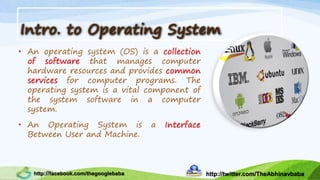
• An operating system (OS) is a collection
of software that manages computer
hardware resources and provides common
services for computer programs. The
operating system is a vital component of
the system software in a computer
system.
• An Operating System is a Interface
Between User and Machine.
http://twitter.com/TheAbhinavbabahttp://facebook.com/thegooglebaba
Batch Operating System
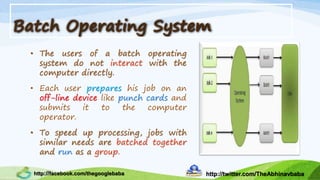
• The users of a batch operating
system do not interact with the
computer directly.
• Each user prepares his job on an
off-line device like punch cards and
submits it to the computer
operator.
• To speed up processing, jobs with
similar needs are batched together
and run as a group.
http://twitter.com/TheAbhinavbabahttp://facebook.com/thegooglebaba
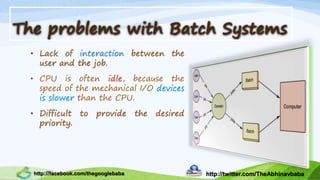
The problems with Batch Systems
• Lack of interaction between the
user and the job.
• CPU is often idle, because the
speed of the mechanical I/O devices
is slower than the CPU.
• Difficult to provide the desired
priority.
http://twitter.com/TheAbhinavbabahttp://facebook.com/thegooglebaba
Time-sharing operating systems
• Time-sharing is a technique which enables many people, located at various
terminals, to use a particular computer system at the same time.Add your
second bullet point here.
• Processor's time which is shared among multiple users simultaneously is
termed as time-sharing.
• Multiple jobs are executed by the CPU by switching between them, but the
switches occur so frequently. Thus, the user can receive an immediate
response. For example, in a transaction processing, the processor executes
each user program in a short burst or quantum of computation. That is,
if n users are present, then each user can get a time quantum. When the
user submits the command, the response time is in few seconds at most.
http://twitter.com/TheAbhinavbabahttp://facebook.com/thegooglebaba
The operating system uses CPU scheduling and multiprogramming to
provide each user with a small portion of a time. Computer systems that
were designed primarily as batch systems have been modified to time-
sharing systems.
Advantage
* Avoids duplication of software.
* Reduces CPU idle time.
* Provides the advantage of quick
response.
Disadvantage
* Problem of reliability
* Problem of data communication.
* Question of security and integrity of
user programs and data.
http://twitter.com/TheAbhinavbabahttp://facebook.com/thegooglebaba
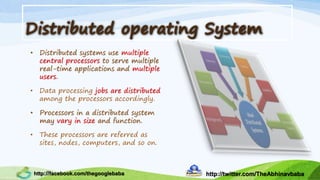
Distributed operating System
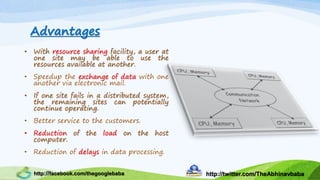
• Distributed systems use multiple
central processors to serve multiple
real-time applications and multiple
users.
• Data processing jobs are distributed
among the processors accordingly.
• Processors in a distributed system
may vary in size and function.
• These processors are referred as
sites, nodes, computers, and so on.
http://twitter.com/TheAbhinavbabahttp://facebook.com/thegooglebaba
Advantages
• With resource sharing facility, a user at
one site may be able to use the
resources available at another.
• Speedup the exchange of data with one
another via electronic mail.
• If one site fails in a distributed system,
the remaining sites can potentially
continue operating.
• Better service to the customers.
• Reduction of the load on the host
computer.
• Reduction of delays in data processing.
http://twitter.com/TheAbhinavbabahttp://facebook.com/thegooglebaba
Network operating System
• A Network Operating System runs on
a server and provides the server the
capability to manage data, users,
groups, security, applications, and
other networking functions.
• The primary purpose of the network
operating system is to allow shared
file and printer access among multiple
computers in a network, typically a
local area network LAN, a private
network or to other networks.
http://twitter.com/TheAbhinavbabahttp://facebook.com/thegooglebaba
Examples of network operating systems include Microsoft Windows Server
2003, Microsoft Windows Server 2008, UNIX, Linux, Mac OS X.
Advantage
• Centralized servers are highly
stable.
• Security is server managed.
• Upgrades to new technologies
and hardware can be easily
integrated into the system.
• Remote access to servers is
possible from different
locations and types of systems.
Disadvantage
• High cost of buying and
running a server.
• Dependency on a central
location for most operations.
• Regular maintenance and
updates are required.
http://twitter.com/TheAbhinavbabahttp://facebook.com/thegooglebaba
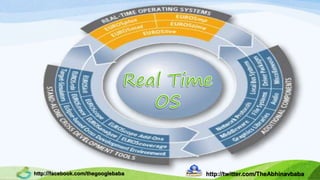
Real Time operating System
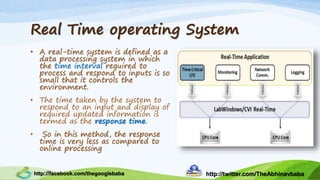
• A real-time system is defined as a
data processing system in which
the time interval required to
process and respond to inputs is so
small that it controls the
environment.
• The time taken by the system to
respond to an input and display of
required updated information is
termed as the response time.
• So in this method, the response
time is very less as compared to
online processing
http://twitter.com/TheAbhinavbabahttp://facebook.com/thegooglebaba
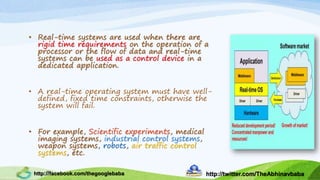
• Real-time systems are used when there are
rigid time requirements on the operation of a
processor or the flow of data and real-time
systems can be used as a control device in a
dedicated application.
• A real-time operating system must have well-
defined, fixed time constraints, otherwise the
system will fail.
• For example, Scientific experiments, medical
imaging systems, industrial control systems,
weapon systems, robots, air traffic control
systems, etc.
http://twitter.com/TheAbhinavbabahttp://facebook.com/thegooglebaba
There are two types of real-time operating systems.
Hard Real-Time OS.
• Hard real-time systems
guarantee that critical tasks
complete on time.
• In hard real-time systems,
secondary storage is limited or
missing and the data is stored
in ROM.
• In these systems, virtual
memory is almost never found.
Soft Real-Time OS.
• Soft real-time systems are less
restrictive.
• A critical real-time task gets
priority over other tasks and
retains the priority until it
completes.
• Soft real-time systems have limited
utility than hard real-time systems.
For example, multimedia, virtual
reality, Advanced Scientific Projects
like undersea exploration and
planetary rovers, etc
http://twitter.com/TheAbhinavbabahttp://facebook.com/thegooglebaba
Mobile Operating System
• Mobile operating system is the software platform on top of
which other programs can run on mobile devices.
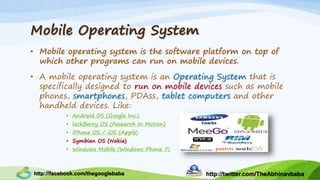
• A mobile operating system is an Operating System that is
specifically designed to run on mobile devices such as mobile
phones, smartphones, PDAss, tablet computers and other
handheld devices. Like:
• Android OS (Google Inc.)
• lackBerry OS (Research In Motion)
• iPhone OS / iOS (Apple)
• Symbian OS (Nokia)
• Windows Mobile (Windows Phone 7)
http://twitter.com/TheAbhinavbabahttp://facebook.com/thegooglebaba
Thank you !- Very much
http://twitter.com/TheAbhinavbabahttp://facebook.com/thegooglebaba

Operating System - Types Of Operating System Unit-1

  • 1.
  • 2.
    Content List ofOperating System Type • Batch Operating System • Time-Sharing Operating Systems • Distributed Operating System • Network Operating System • Real Time Operating System • Hard real-time systems • Soft real-time systems • Mobile Operating System http://twitter.com/TheAbhinavbabahttp://facebook.com/thegooglebaba
  • 3.
    Intro. to OperatingSystem • An operating system (OS) is a collection of software that manages computer hardware resources and provides common services for computer programs. The operating system is a vital component of the system software in a computer system. • An Operating System is a Interface Between User and Machine. http://twitter.com/TheAbhinavbabahttp://facebook.com/thegooglebaba
  • 4.
    Batch Operating System •The users of a batch operating system do not interact with the computer directly. • Each user prepares his job on an off-line device like punch cards and submits it to the computer operator. • To speed up processing, jobs with similar needs are batched together and run as a group. http://twitter.com/TheAbhinavbabahttp://facebook.com/thegooglebaba
  • 5.
    The problems withBatch Systems • Lack of interaction between the user and the job. • CPU is often idle, because the speed of the mechanical I/O devices is slower than the CPU. • Difficult to provide the desired priority. http://twitter.com/TheAbhinavbabahttp://facebook.com/thegooglebaba
  • 6.
    Time-sharing operating systems •Time-sharing is a technique which enables many people, located at various terminals, to use a particular computer system at the same time.Add your second bullet point here. • Processor's time which is shared among multiple users simultaneously is termed as time-sharing. • Multiple jobs are executed by the CPU by switching between them, but the switches occur so frequently. Thus, the user can receive an immediate response. For example, in a transaction processing, the processor executes each user program in a short burst or quantum of computation. That is, if n users are present, then each user can get a time quantum. When the user submits the command, the response time is in few seconds at most. http://twitter.com/TheAbhinavbabahttp://facebook.com/thegooglebaba
  • 7.
    The operating systemuses CPU scheduling and multiprogramming to provide each user with a small portion of a time. Computer systems that were designed primarily as batch systems have been modified to time- sharing systems. Advantage * Avoids duplication of software. * Reduces CPU idle time. * Provides the advantage of quick response. Disadvantage * Problem of reliability * Problem of data communication. * Question of security and integrity of user programs and data. http://twitter.com/TheAbhinavbabahttp://facebook.com/thegooglebaba
  • 8.
    Distributed operating System •Distributed systems use multiple central processors to serve multiple real-time applications and multiple users. • Data processing jobs are distributed among the processors accordingly. • Processors in a distributed system may vary in size and function. • These processors are referred as sites, nodes, computers, and so on. http://twitter.com/TheAbhinavbabahttp://facebook.com/thegooglebaba
  • 9.
    Advantages • With resourcesharing facility, a user at one site may be able to use the resources available at another. • Speedup the exchange of data with one another via electronic mail. • If one site fails in a distributed system, the remaining sites can potentially continue operating. • Better service to the customers. • Reduction of the load on the host computer. • Reduction of delays in data processing. http://twitter.com/TheAbhinavbabahttp://facebook.com/thegooglebaba
  • 10.
    Network operating System •A Network Operating System runs on a server and provides the server the capability to manage data, users, groups, security, applications, and other networking functions. • The primary purpose of the network operating system is to allow shared file and printer access among multiple computers in a network, typically a local area network LAN, a private network or to other networks. http://twitter.com/TheAbhinavbabahttp://facebook.com/thegooglebaba
  • 11.
    Examples of networkoperating systems include Microsoft Windows Server 2003, Microsoft Windows Server 2008, UNIX, Linux, Mac OS X. Advantage • Centralized servers are highly stable. • Security is server managed. • Upgrades to new technologies and hardware can be easily integrated into the system. • Remote access to servers is possible from different locations and types of systems. Disadvantage • High cost of buying and running a server. • Dependency on a central location for most operations. • Regular maintenance and updates are required. http://twitter.com/TheAbhinavbabahttp://facebook.com/thegooglebaba
  • 12.
    Real Time operatingSystem • A real-time system is defined as a data processing system in which the time interval required to process and respond to inputs is so small that it controls the environment. • The time taken by the system to respond to an input and display of required updated information is termed as the response time. • So in this method, the response time is very less as compared to online processing http://twitter.com/TheAbhinavbabahttp://facebook.com/thegooglebaba
  • 13.
  • 14.
    • Real-time systemsare used when there are rigid time requirements on the operation of a processor or the flow of data and real-time systems can be used as a control device in a dedicated application. • A real-time operating system must have well- defined, fixed time constraints, otherwise the system will fail. • For example, Scientific experiments, medical imaging systems, industrial control systems, weapon systems, robots, air traffic control systems, etc. http://twitter.com/TheAbhinavbabahttp://facebook.com/thegooglebaba
  • 15.
    There are twotypes of real-time operating systems. Hard Real-Time OS. • Hard real-time systems guarantee that critical tasks complete on time. • In hard real-time systems, secondary storage is limited or missing and the data is stored in ROM. • In these systems, virtual memory is almost never found. Soft Real-Time OS. • Soft real-time systems are less restrictive. • A critical real-time task gets priority over other tasks and retains the priority until it completes. • Soft real-time systems have limited utility than hard real-time systems. For example, multimedia, virtual reality, Advanced Scientific Projects like undersea exploration and planetary rovers, etc http://twitter.com/TheAbhinavbabahttp://facebook.com/thegooglebaba
  • 16.
    Mobile Operating System •Mobile operating system is the software platform on top of which other programs can run on mobile devices. • A mobile operating system is an Operating System that is specifically designed to run on mobile devices such as mobile phones, smartphones, PDAss, tablet computers and other handheld devices. Like: • Android OS (Google Inc.) • lackBerry OS (Research In Motion) • iPhone OS / iOS (Apple) • Symbian OS (Nokia) • Windows Mobile (Windows Phone 7) http://twitter.com/TheAbhinavbabahttp://facebook.com/thegooglebaba
  • 17.
    Thank you !-Very much http://twitter.com/TheAbhinavbabahttp://facebook.com/thegooglebaba