Submitted by
 Group71
Member:
Md Shahad Hossain ID: 152-15-6096
Tanvirul Islam ID: 152-15-6117
Shakib Hasan ID: 152-15-6113
SM Fahad Bin Islam Abir ID: 152-15-6120
Submitted to
Moushumi Zaman Bonny
Lecturer
Department of CSE
Daffodil International University.
Operating System
4
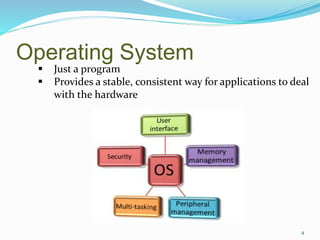
 Just a program
 Provides a stable, consistent way for applications to deal
with the hardware
 Graphical user interface Based.
 Signal tasking or multitasking.
 Weak or strong security.
 8,16,32,64 bits process at a time.
 Portable or not.
Main Functions of an
OS
• File management: create, read, modify, remove etc. files
• Process management : creates, schedules and destroy processes
• Memory management: Allocates and releases memory
• Security
• Command interpretation
– Text interface – command interpreter
– Graphical interface
Miscellaneous Task
 The OS continually monitors the system and it detect
if something wrong.
 The OS manages the use of memory and run each
program to its own protected space.
 To conserve power.power management cuts power at
those time when it is not needed.
 Manage file stored on the disks.
Types of operating system
 Desktop operating system.
That run on desktop computers are the lest powerful and lest secure operating system.
 Operating system for servers.
Computer in network are connected through servers that provide security to
the networks.These task required special operating system.
 Operating system for Mainframe.
In early days Mainframe and Minicomputer company developed it’s own operating
system.
File Management( continue )
 File Name
When file are saved they are assigned file name so that users can
identify them letter .File name have two part.
1. A name (to identify the file letter)
2.An extension (to identify the file format or the application that create
it)
As example “Jurassic world.mp4” a filename. Here Jurassic world is a
name to identify the file and .mp4 to identify the file format.
File Management( continue )
Folders
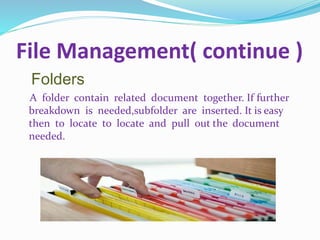
A folder contain related document together. If further
breakdown is needed,subfolder are inserted. It is easy
then to locate to locate and pull out the document
needed.
File Management( continue )
Drives
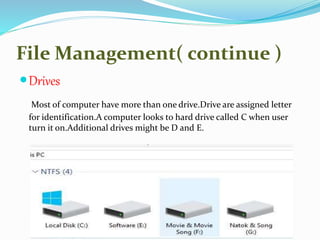
Most of computer have more than one drive.Drive are assigned letter
for identification.A computer looks to hard drive called C when user
turn it on.Additional drives might be D and E.
File Management( continue )
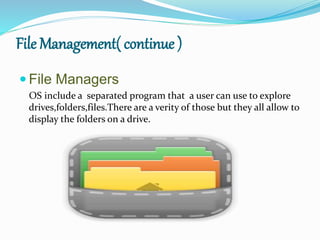
 File Managers
OS include a separated program that a user can use to explore
drives,folders,files.There are a verity of those but they all allow to
display the folders on a drive.
Utilities
 Disk Formatting.
Make the disk ready to store data.Formatting creates a destroy of the
location of each file called file allocation table(FAT)
 Disk scanning.
A utility program used to locate and mark any bad sectors and to fix those
bad sectors.
Process Management
A process is a program in executing.
Object program to be executed.
Resources required by the program
(i.e. files, etc..)
The input data to be processed and
the results is produced.
Real Time
Processing
Immediate response is needed.
For example
anti-missile defense system
airplane landing control system
interrupt error in computer system
Each user is given a time slice to
interact with the CPU.
The size of the time slice will depend
on the system.
Each user is served in sequence.
2 or more programs store in the main memory at the
same time
When one job reeds to wait (e.g. I/O operation), CPU
switch to another job to execute
When the first job finishes waiting, CPU will get back
the first job to execute
Some Popular Operating
Systems
JavaOS
- developed by Sun Microsystems in 1996 for use
in embedded systems. JavaOS is written primarily in
the Java programming language and includes a
Java virtual machine (which allows running of any Java
program regardless of the type of CPU used) as a
fundamental component.
Some Popular Operating Systems(continue)
 Linux - a high performance, yet completely free, Unix-like
operating system launched by Linus Torvalds in 1991. It is
suitable for use on a wide range of platforms and is
compatible with both 32 bit and 64 bit processors. More
than 200 distributions (i.e., versions) of Linux have been
introduced, among the most popular of which are Red Hat,
SuSE, Mandrake, Debian and Ubuntu. Although its overall
market share is still small, Linux is the most rapidly
growing of any major operating system.
Some Popular Operating Systems(continue)
 Microsoft Windows - the successors to the very popular MS-DOS, it
was announced in 1983, and the first version, Windows 1.0, was finally
released in 1985. Microsoft Windows encompasses two groups of
operating systems (i.e., Windows 95/98/ME/CE and Windows
NT/2000/XP) which resemble each other superficially and share
compatibility with many of the same application programs but which
have very different internal structures.
Some Popular Operating Systems(continue)
 SkyOS - This operating system developed by Robert
Szeleney from 1996. SkyOS has some features that
resemble Be OS. It is mostly POSIX compliant, and comes
with many of the GNU utilities, including the very highly
rated GCC (GNU Compiler Collection).
Palm OS - developed by PalmSource, Inc. for personal digital
assistants (PDAs). Palm OS features flexibility and ease of
use. It is the leading PDA operating system, used in more
than 36 million mobile devices, and there are more than
20,000 software titles for it, far more than for any other
handheld platform.
Some Popular Operating Systems(continue)
Solaris
- developed by Sun Microsystems for its SPARC processor.
Solaris was introduced as SunOS in 1989, and it was based
on BSD Unix. A version for x86 processors is also available.
Any Question?
Operating system

Operating system

  • 2.
    Submitted by  Group71 Member: MdShahad Hossain ID: 152-15-6096 Tanvirul Islam ID: 152-15-6117 Shakib Hasan ID: 152-15-6113 SM Fahad Bin Islam Abir ID: 152-15-6120
  • 3.
    Submitted to Moushumi ZamanBonny Lecturer Department of CSE Daffodil International University.
  • 4.
    Operating System 4  Justa program  Provides a stable, consistent way for applications to deal with the hardware
  • 5.
     Graphical userinterface Based.  Signal tasking or multitasking.  Weak or strong security.  8,16,32,64 bits process at a time.  Portable or not.
  • 6.
    Main Functions ofan OS • File management: create, read, modify, remove etc. files • Process management : creates, schedules and destroy processes • Memory management: Allocates and releases memory • Security • Command interpretation – Text interface – command interpreter – Graphical interface
  • 7.
    Miscellaneous Task  TheOS continually monitors the system and it detect if something wrong.  The OS manages the use of memory and run each program to its own protected space.  To conserve power.power management cuts power at those time when it is not needed.  Manage file stored on the disks.
  • 8.
    Types of operatingsystem  Desktop operating system. That run on desktop computers are the lest powerful and lest secure operating system.  Operating system for servers. Computer in network are connected through servers that provide security to the networks.These task required special operating system.  Operating system for Mainframe. In early days Mainframe and Minicomputer company developed it’s own operating system.
  • 9.
    File Management( continue)  File Name When file are saved they are assigned file name so that users can identify them letter .File name have two part. 1. A name (to identify the file letter) 2.An extension (to identify the file format or the application that create it) As example “Jurassic world.mp4” a filename. Here Jurassic world is a name to identify the file and .mp4 to identify the file format.
  • 10.
    File Management( continue) Folders A folder contain related document together. If further breakdown is needed,subfolder are inserted. It is easy then to locate to locate and pull out the document needed.
  • 11.
    File Management( continue) Drives Most of computer have more than one drive.Drive are assigned letter for identification.A computer looks to hard drive called C when user turn it on.Additional drives might be D and E.
  • 12.
    File Management( continue)  File Managers OS include a separated program that a user can use to explore drives,folders,files.There are a verity of those but they all allow to display the folders on a drive.
  • 13.
    Utilities  Disk Formatting. Makethe disk ready to store data.Formatting creates a destroy of the location of each file called file allocation table(FAT)  Disk scanning. A utility program used to locate and mark any bad sectors and to fix those bad sectors.
  • 14.
    Process Management A processis a program in executing. Object program to be executed. Resources required by the program (i.e. files, etc..) The input data to be processed and the results is produced.
  • 15.
    Real Time Processing Immediate responseis needed. For example anti-missile defense system airplane landing control system interrupt error in computer system
  • 16.
    Each user isgiven a time slice to interact with the CPU. The size of the time slice will depend on the system. Each user is served in sequence.
  • 17.
    2 or moreprograms store in the main memory at the same time When one job reeds to wait (e.g. I/O operation), CPU switch to another job to execute When the first job finishes waiting, CPU will get back the first job to execute
  • 18.
    Some Popular Operating Systems JavaOS -developed by Sun Microsystems in 1996 for use in embedded systems. JavaOS is written primarily in the Java programming language and includes a Java virtual machine (which allows running of any Java program regardless of the type of CPU used) as a fundamental component.
  • 19.
    Some Popular OperatingSystems(continue)  Linux - a high performance, yet completely free, Unix-like operating system launched by Linus Torvalds in 1991. It is suitable for use on a wide range of platforms and is compatible with both 32 bit and 64 bit processors. More than 200 distributions (i.e., versions) of Linux have been introduced, among the most popular of which are Red Hat, SuSE, Mandrake, Debian and Ubuntu. Although its overall market share is still small, Linux is the most rapidly growing of any major operating system.
  • 20.
    Some Popular OperatingSystems(continue)  Microsoft Windows - the successors to the very popular MS-DOS, it was announced in 1983, and the first version, Windows 1.0, was finally released in 1985. Microsoft Windows encompasses two groups of operating systems (i.e., Windows 95/98/ME/CE and Windows NT/2000/XP) which resemble each other superficially and share compatibility with many of the same application programs but which have very different internal structures.
  • 21.
    Some Popular OperatingSystems(continue)  SkyOS - This operating system developed by Robert Szeleney from 1996. SkyOS has some features that resemble Be OS. It is mostly POSIX compliant, and comes with many of the GNU utilities, including the very highly rated GCC (GNU Compiler Collection).
  • 22.
    Palm OS -developed by PalmSource, Inc. for personal digital assistants (PDAs). Palm OS features flexibility and ease of use. It is the leading PDA operating system, used in more than 36 million mobile devices, and there are more than 20,000 software titles for it, far more than for any other handheld platform. Some Popular Operating Systems(continue)
  • 23.
    Some Popular OperatingSystems(continue) Solaris - developed by Sun Microsystems for its SPARC processor. Solaris was introduced as SunOS in 1989, and it was based on BSD Unix. A version for x86 processors is also available.
  • 24.

Editor's Notes

  • #5 OS is a program which is very intimate with the hardware Provides stable way to interact with the hardware