
Formal Logic
Dr. C.V. Suresh Babu
(CentreforKnowledgeTransfer)
institute
(CentreforKnowledgeTransfer)
institute
Demo
https://youtu.be/IY1sPV9e9H0
(CentreforKnowledgeTransfer)
institute
Why?
• Logic can help AI and ML in complex domains or in domains with very
little data.
https://www.youtube.com/watch?v=K4ChzesrWKI
(CentreforKnowledgeTransfer)
institute
What?
• By logic we mean symbolic, knowledge-based, reasoning and other
similar approaches to AI that differ, at least on the surface, from
existing forms of classical machine learning and deep learning.
• It is crucial to keep in mind just as there are many forms of machine
learning; there are many different forms of logic-based approaches to
AI with their own sets of tradeoffs.
• Very briefly, logic-based AI systems can be thought of as high-level
programming systems that can easily encode human knowledge in a
compact and usable manner.
https://www.youtube.com/watch?v=QQwBLv9LarI
(CentreforKnowledgeTransfer)
institute
Introduction
• Starting with the simplest of logic systems, we have propositional
logic (sometimes called zero-order logic).
• Within propositional logic, we have objects known as sentences or
formulae that encode information.
• They denote some statement about the world.
• For building blocks, we have basic sentences known as atoms, usually
denoted by “P, Q, R, S, …..”
• For example, P might stand for “It is raining” and is an atom.
https://www.youtube.com/watch?v=_MhgsoPHvYo
(CentreforKnowledgeTransfer)
institute
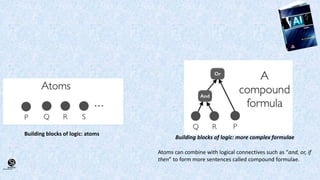
Building blocks of logic: atoms
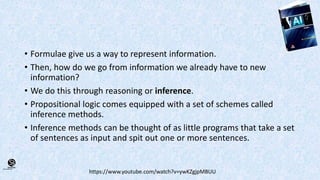
Building blocks of logic: more complex formulae
Atoms can combine with logical connectives such as “and, or, if
then” to form more sentences called compound formulae.
(CentreforKnowledgeTransfer)
institute
• Formulae give us a way to represent information.
• Then, how do we go from information we already have to new
information?
• We do this through reasoning or inference.
• Propositional logic comes equipped with a set of schemes called
inference methods.
• Inference methods can be thought of as little programs that take a set
of sentences as input and spit out one or more sentences.
https://www.youtube.com/watch?v=ywKZgjpMBUU
(CentreforKnowledgeTransfer)
institute
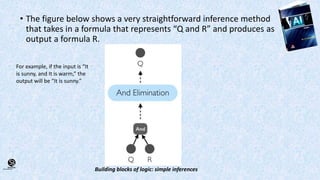
• The figure below shows a very straightforward inference method
that takes in a formula that represents “Q and R” and produces as
output a formula R.
For example, if the input is “It
is sunny, and It is warm,” the
output will be “It is sunny.”
Building blocks of logic: simple inferences
(CentreforKnowledgeTransfer)
institute
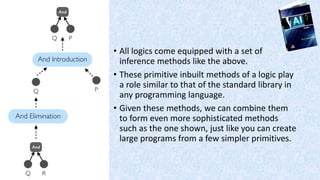
• All logics come equipped with a set of
inference methods like the above.
• These primitive inbuilt methods of a logic play
a role similar to that of the standard library in
any programming language.
• Given these methods, we can combine them
to form even more sophisticated methods
such as the one shown, just like you can create
large programs from a few simpler primitives.
(CentreforKnowledgeTransfer)
institute
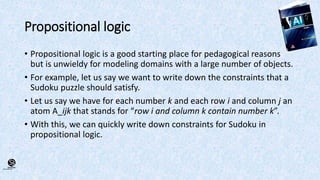
Propositional logic
• Propositional logic is a good starting place for pedagogical reasons
but is unwieldy for modeling domains with a large number of objects.
• For example, let us say we want to write down the constraints that a
Sudoku puzzle should satisfy.
• Let us say we have for each number k and each row i and column j an
atom A_ijk that stands for “row i and column k contain number k”.
• With this, we can quickly write down constraints for Sudoku in
propositional logic.
(CentreforKnowledgeTransfer)
institute
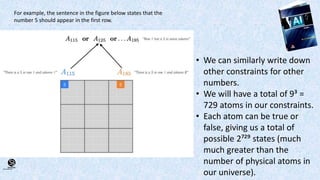
For example, the sentence in the figure below states that the
number 5 should appear in the first row.
• We can similarly write down
other constraints for other
numbers.
• We will have a total of 9³ =
729 atoms in our constraints.
• Each atom can be true or
false, giving us a total of
possible 2⁷²⁹ states (much
much greater than the
number of physical atoms in
our universe).
(CentreforKnowledgeTransfer)
institute
First-order logic
• First-order logic improves upon propositional logic by introducing
atoms that can take in arguments that stand in for objects in a
domain.
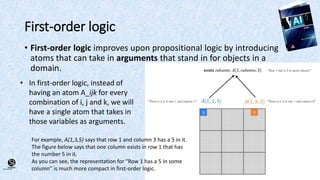
For example, A(1,3,5) says that row 1 and column 3 has a 5 in it.
The figure below says that one column exists in row 1 that has
the number 5 in it.
As you can see, the representation for “Row 1 has a 5 in some
column” is much more compact in first-order logic.
• In first-order logic, instead of
having an atom A_ijk for every
combination of i, j and k, we will
have a single atom that takes in
those variables as arguments.
(CentreforKnowledgeTransfer)
institute
Other logics
• First-order logic forms the basis of many modern logic systems used
in research and industry.
• Many other logic systems build upon and extend first-order logic (e.g.,
second-order logic, third-order logic, higher-order logic, and modal
logic).
• Each logic adds new a dimension or feature that makes it easy to
model some aspect of the world.
• For example, logics that are known as temporal logics are used to
model time and change.
(CentreforKnowledgeTransfer)
institute
Applications of Logic in AI and ML
• Automated Discovery in Science
• Inductive Programming
• Automation of Mathematical Reasoning
• Verification of Computer Systems (including ML)
• Logic-like Systems along with Machine Learning Models

Formal Logic in AI

  • 1.
    Formal Logic Dr. C.V.Suresh Babu (CentreforKnowledgeTransfer) institute
  • 2.
  • 3.
    (CentreforKnowledgeTransfer) institute Why? • Logic canhelp AI and ML in complex domains or in domains with very little data. https://www.youtube.com/watch?v=K4ChzesrWKI
  • 4.
    (CentreforKnowledgeTransfer) institute What? • By logicwe mean symbolic, knowledge-based, reasoning and other similar approaches to AI that differ, at least on the surface, from existing forms of classical machine learning and deep learning. • It is crucial to keep in mind just as there are many forms of machine learning; there are many different forms of logic-based approaches to AI with their own sets of tradeoffs. • Very briefly, logic-based AI systems can be thought of as high-level programming systems that can easily encode human knowledge in a compact and usable manner. https://www.youtube.com/watch?v=QQwBLv9LarI
  • 5.
    (CentreforKnowledgeTransfer) institute Introduction • Starting withthe simplest of logic systems, we have propositional logic (sometimes called zero-order logic). • Within propositional logic, we have objects known as sentences or formulae that encode information. • They denote some statement about the world. • For building blocks, we have basic sentences known as atoms, usually denoted by “P, Q, R, S, …..” • For example, P might stand for “It is raining” and is an atom. https://www.youtube.com/watch?v=_MhgsoPHvYo
  • 6.
    (CentreforKnowledgeTransfer) institute Building blocks oflogic: atoms Building blocks of logic: more complex formulae Atoms can combine with logical connectives such as “and, or, if then” to form more sentences called compound formulae.
  • 7.
    (CentreforKnowledgeTransfer) institute • Formulae giveus a way to represent information. • Then, how do we go from information we already have to new information? • We do this through reasoning or inference. • Propositional logic comes equipped with a set of schemes called inference methods. • Inference methods can be thought of as little programs that take a set of sentences as input and spit out one or more sentences. https://www.youtube.com/watch?v=ywKZgjpMBUU
  • 8.
    (CentreforKnowledgeTransfer) institute • The figurebelow shows a very straightforward inference method that takes in a formula that represents “Q and R” and produces as output a formula R. For example, if the input is “It is sunny, and It is warm,” the output will be “It is sunny.” Building blocks of logic: simple inferences
  • 9.
    (CentreforKnowledgeTransfer) institute • All logicscome equipped with a set of inference methods like the above. • These primitive inbuilt methods of a logic play a role similar to that of the standard library in any programming language. • Given these methods, we can combine them to form even more sophisticated methods such as the one shown, just like you can create large programs from a few simpler primitives.
  • 10.
    (CentreforKnowledgeTransfer) institute Propositional logic • Propositionallogic is a good starting place for pedagogical reasons but is unwieldy for modeling domains with a large number of objects. • For example, let us say we want to write down the constraints that a Sudoku puzzle should satisfy. • Let us say we have for each number k and each row i and column j an atom A_ijk that stands for “row i and column k contain number k”. • With this, we can quickly write down constraints for Sudoku in propositional logic.
  • 11.
    (CentreforKnowledgeTransfer) institute For example, thesentence in the figure below states that the number 5 should appear in the first row. • We can similarly write down other constraints for other numbers. • We will have a total of 9³ = 729 atoms in our constraints. • Each atom can be true or false, giving us a total of possible 2⁷²⁹ states (much much greater than the number of physical atoms in our universe).
  • 12.
    (CentreforKnowledgeTransfer) institute First-order logic • First-orderlogic improves upon propositional logic by introducing atoms that can take in arguments that stand in for objects in a domain. For example, A(1,3,5) says that row 1 and column 3 has a 5 in it. The figure below says that one column exists in row 1 that has the number 5 in it. As you can see, the representation for “Row 1 has a 5 in some column” is much more compact in first-order logic. • In first-order logic, instead of having an atom A_ijk for every combination of i, j and k, we will have a single atom that takes in those variables as arguments.
  • 13.
    (CentreforKnowledgeTransfer) institute Other logics • First-orderlogic forms the basis of many modern logic systems used in research and industry. • Many other logic systems build upon and extend first-order logic (e.g., second-order logic, third-order logic, higher-order logic, and modal logic). • Each logic adds new a dimension or feature that makes it easy to model some aspect of the world. • For example, logics that are known as temporal logics are used to model time and change.
  • 14.
    (CentreforKnowledgeTransfer) institute Applications of Logicin AI and ML • Automated Discovery in Science • Inductive Programming • Automation of Mathematical Reasoning • Verification of Computer Systems (including ML) • Logic-like Systems along with Machine Learning Models