Faculty of Engineering and
Technical Studies

Fluid Mechanics for
Mechanical Engineering
TUTORIAL 1 –

UNIT 1:
Chapter 1: Introduction to Fluid
Mechanics
Assoc Prof Dr Shahrir Abdullah
EBMF4103 Fluid Mechanics for Mechanical Engineering
Jan 2005
1
Subject Matter Expert/Author: Assoc Prof Dr Shahrir Abdullah

Copyright © ODL Jan 2005 Open University Malaysia
Faculty of Engineering and
Technical Studies

SEQUENCE OF CHAPTER 1
Introduction
Objectives
1.1 Fluid Concept
1.2 Units and Dimensions
1.3 Fluid Continuum
1.4 Flow Patterns
1.5 Fluid Density
1.6 Viscosity
1.7 Surface Tension
1.8 Vapour Pressure
Summary
Subject Matter Expert/Author: Assoc Prof Dr Shahrir Abdullah

2
Faculty of Engineering and
Technical Studies

Introduction
 This chapter will begin with several concepts, definition,
terminologies and approaches which should be understood by
the students before continuing reading the rest of this
module.
 Then, it introduces the student with typical properties of
fluid and their dimensions which are then being used
extensively in the next chapters and units like pressure,
velocity, density and viscosity.
 Some of these can be used to classify type and characteristic
of fluid, such as whether a fluid is incompressible or not or
whether the fluid is Newtonian or non-Newtonian.

Subject Matter Expert/Author: Assoc Prof Dr Shahrir Abdullah

3
Faculty of Engineering and
Technical Studies

Objectives
At the end of this chapter, you should be able to :
 explain the concept of fluid continuity and flow
representations using streamlines, streaklines and
pathlines,
 Identify and describe typical fluid properties and their
units and dimensions

Subject Matter Expert/Author: Assoc Prof Dr Shahrir Abdullah

4
Faculty of Engineering and
Technical Studies

1.1 Fluid Concept
• Fluid mechanics is a division in applied mechanics related to
the behaviour of liquid or gas which is either in rest or in
motion.
• The study related to a fluid in rest or stationary is referred
to fluid static, otherwise it is referred to as fluid dynamic.
• Fluid can be defined as a substance which can deform
continuously when being subjected to shear stress at any
magnitude. In other words, it can flow continuously as a
result of shearing action. This includes any liquid or gas.

Subject Matter Expert/Author: Assoc Prof Dr Shahrir Abdullah

5
Faculty of Engineering and
Technical Studies

1.1 Fluid Concept
• Thus, with exception to solids, any other matters can be
categorised as fluid. In microscopic point of view, this
concept corresponds to loose or very loose bonding between
molecules of liquid or gas, respectively.
• Examples of typical fluid used in engineering applications are
water, oil and air.
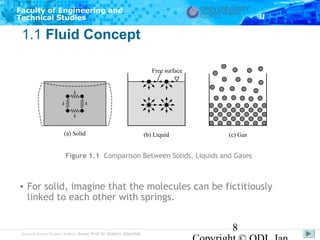
• An analogy of how to understand different bonding in solids
and fluids is depicted in Fig. 1.1

Subject Matter Expert/Author: Assoc Prof Dr Shahrir Abdullah

6
Faculty of Engineering and
Technical Studies

1.1 Fluid Concept
• Thus, with exception to solids, any other matters can be
categorised as fluid. In microscopic point of view, this
concept corresponds to loose or very loose bonding between
molecules of liquid or gas, respectively.
• Examples of typical fluid used in engineering applications are
water, oil and air.
• An analogy of how to understand different bonding in solids
and fluids is depicted in Fig. 1.1

Subject Matter Expert/Author: Assoc Prof Dr Shahrir Abdullah

7
Faculty of Engineering and
Technical Studies

1.1 Fluid Concept
Free surface

k
k

k
k

(a) Solid

(b) Liquid

(c) Gas

Figure 1.1 Comparison Between Solids, Liquids and Gases

• For solid, imagine that the molecules can be fictitiously
linked to each other with springs.

Subject Matter Expert/Author: Assoc Prof Dr Shahrir Abdullah

8
Faculty of Engineering and
Technical Studies

1.1 Fluid Concept
 In fluid, the molecules can move freely but are constrained
through a traction force called cohesion. This force is
interchangeable from one molecule to another.
 For gases, it is very weak which enables the gas to
disintegrate and move away from its container.
 For liquids, it is stronger which is sufficient enough to hold
the molecule together and can withstand high compression,
which is suitable for application as hydraulic fluid such as oil.
On the surface, the cohesion forms a resultant force directed
into the liquid region and the combination of cohesion forces
between adjacent molecules from a tensioned membrane
known as free surface.

Subject Matter Expert/Author: Assoc Prof Dr Shahrir Abdullah

9
Faculty of Engineering and
Technical Studies

1.2 Units and Dimensions
• The primary quantities which are also referred to as basic
dimensions, such as L for length, T for time, M for mass and
Q for temperature.
• This dimension system is known as the MLT system where it
can be used to provide qualitative description for secondary
quantities, or derived dimensions, such as area (L), velocity
(LT-1) and density (ML-3).
• In some countries, the FLT system is also used, where the
quantity F stands for force.

Subject Matter Expert/Author: Assoc Prof Dr Shahrir Abdullah

10
Faculty of Engineering and
Technical Studies

1.2 Units and Dimensions
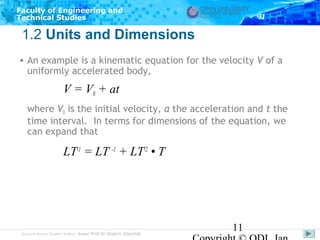
• An example is a kinematic equation for the velocity V of a
uniformly accelerated body,

V = V0 + at
where V0 is the initial velocity, a the acceleration and t the
time interval. In terms for dimensions of the equation, we
can expand that

LT-1 = LT -1 + LT-2 • T

Subject Matter Expert/Author: Assoc Prof Dr Shahrir Abdullah

11
Faculty of Engineering and
Technical Studies

Example 1.1
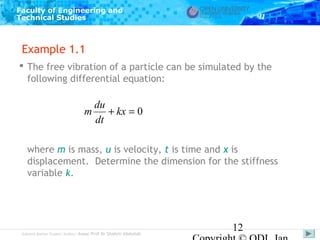
 The free vibration of a particle can be simulated by the
following differential equation:

du
m
+ kx = 0
dt
where m is mass, u is velocity, t is time and x is
displacement. Determine the dimension for the stiffness
variable k.

Subject Matter Expert/Author: Assoc Prof Dr Shahrir Abdullah

12
Faculty of Engineering and
Technical Studies

Example 1.1
 By making the dimension of the first term equal to the
second term:
[m] •

[u]
= [k]•[x]
[t]

Hence,

[m]•[u]
[k] =
=
[t]•[x]

M • LT-1
LT

= MT-2

Subject Matter Expert/Author: Assoc Prof Dr Shahrir Abdullah

13
Faculty of Engineering and
Technical Studies

1.3 Fluid Continuum
• Since the fluid flows continuously, any method and technique
developed to analyse flow problems should take into
consideration the continuity of the fluid. There are two
types of approaches that can be used:
1.Eulerian approach — analysis is performed by defining a
control volume to represent fluid domain which allows the
fluid to flow across the volume. This approach is more
appropriate to be used in fluid mechanics.
2.Lagrangian approach — analysis is performed by tracking down
all motion parameters and deformation of a domain as it
moves. This approach is more suitable and widely used for
particle and solid mechanics.

Subject Matter Expert/Author: Assoc Prof Dr Shahrir Abdullah

14
Faculty of Engineering and
Technical Studies

1.3 Fluid Continuum
 The fluid behaviour in which its properties are continuous
field variables, either scalar or vector, throughout the
control volume is known as continuum. From this concept,
several fluid or flow definitions can be made as follows:
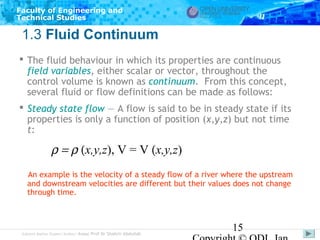
 Steady state flow — A flow is said to be in steady state if its
properties is only a function of position (x,y,z) but not time
t:

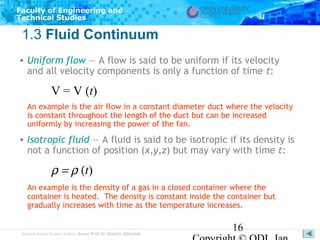
ρ = ρ (x,y,z), V = V (x,y,z)
An example is the velocity of a steady flow of a river where the upstream
and downstream velocities are different but their values does not change
through time.

Subject Matter Expert/Author: Assoc Prof Dr Shahrir Abdullah

15
Faculty of Engineering and
Technical Studies

1.3 Fluid Continuum
• Uniform flow — A flow is said to be uniform if its velocity
and all velocity components is only a function of time t:

V = V (t)
An example is the air flow in a constant diameter duct where the velocity
is constant throughout the length of the duct but can be increased
uniformly by increasing the power of the fan.

• Isotropic fluid — A fluid is said to be isotropic if its density is
not a function of position (x,y,z) but may vary with time t:

ρ = ρ (t)
An example is the density of a gas in a closed container where the
container is heated. The density is constant inside the container but
gradually increases with time as the temperature increases.

Subject Matter Expert/Author: Assoc Prof Dr Shahrir Abdullah

16
Faculty of Engineering and
Technical Studies

1.4 Flow Patterns
• The three ways to represent fluid flow:
1. Streamlines — A streamline is formed by tangents of the
velocity field of the flow.
2. Pathlines — A pathline can be formed from fluid
particles of different colour originated from the same
points, such as a line formed after the introduction of
ink into a shallow water flow.
3. Streaklines — A streakline represents a locus made by a
miniature particles or tracers that passes at a same
point.

Subject Matter Expert/Author: Assoc Prof Dr Shahrir Abdullah

17
Faculty of Engineering and
Technical Studies

1.5 Density
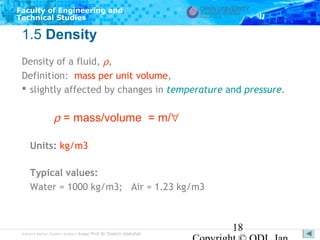
Density of a fluid, ρ,
Definition: mass per unit volume,
 slightly affected by changes in temperature and pressure.

ρ = mass/volume = m/∀
Units: kg/m3
Typical values:
Water = 1000 kg/m3; Air = 1.23 kg/m3

Subject Matter Expert/Author: Assoc Prof Dr Shahrir Abdullah

18
Faculty of Engineering and
Technical Studies

1.6 Viscosity
• Viscosity, µ, is a measure of resistance to fluid flow as a
result of intermolecular cohesion. In other words, viscosity
can be seen as internal friction to fluid motion which can
then lead to energy loss.
• Different fluids deform at different rates under the same
shear stress. The ease with which a fluid pours is an
indication of its viscosity. Fluid with a high viscosity such as
syrup deforms more slowly than fluid with a low viscosity
such as water. The viscosity is also known as dynamic
viscosity.
 Units: N.s/m2 or kg/m/s
 Typical values:
Water = 1.14x10⁻³ kg/m/s;
Subject Matter Expert/Author: Assoc Prof Dr Shahrir Abdullah

Air = 1.78x10⁻⁵ kg/m/s

19
Faculty of Engineering and
Technical Studies

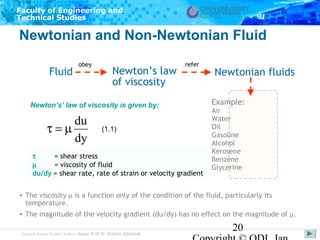
Newtonian and Non-Newtonian Fluid
Fluid

obey

Newton’s law
of viscosity

refer

Newton’s’ law of viscosity is given by;

du
τ=µ
dy

(1.1)

τ
= shear stress
µ
= viscosity of fluid
du/dy = shear rate, rate of strain or velocity gradient

Newtonian fluids
Example:
Air
Water
Oil
Gasoline
Alcohol
Kerosene
Benzene
Glycerine

• The viscosity µ is a function only of the condition of the fluid, particularly its
temperature.
• The magnitude of the velocity gradient (du/dy) has no effect on the magnitude of µ.
Subject Matter Expert/Author: Assoc Prof Dr Shahrir Abdullah

20
Faculty of Engineering and
Technical Studies

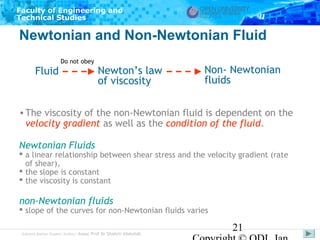
Newtonian and Non-Newtonian Fluid
Fluid

Do not obey

Newton’s law
of viscosity

Non- Newtonian
fluids

• The viscosity of the non-Newtonian fluid is dependent on the
velocity gradient as well as the condition of the fluid.
Newtonian Fluids

 a linear relationship between shear stress and the velocity gradient (rate
of shear),
 the slope is constant
 the viscosity is constant

non-Newtonian fluids

 slope of the curves for non-Newtonian fluids varies
Subject Matter Expert/Author: Assoc Prof Dr Shahrir Abdullah

21
Faculty of Engineering and
Technical Studies

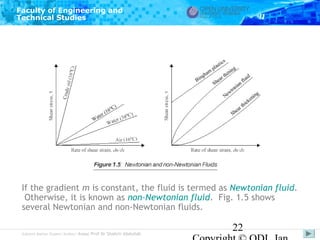
If the gradient m is constant, the fluid is termed as Newtonian fluid.
Otherwise, it is known as non-Newtonian fluid. Fig. 1.5 shows
several Newtonian and non-Newtonian fluids.
Subject Matter Expert/Author: Assoc Prof Dr Shahrir Abdullah

22
Faculty of Engineering and
Technical Studies

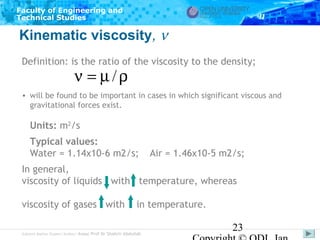
Kinematic viscosity, ν
Definition: is the ratio of the viscosity to the density;

ν = µ/ρ

• will be found to be important in cases in which significant viscous and
gravitational forces exist.

Units: m2/s
Typical values:
Water = 1.14x10⁻⁶ m2/s;

Air = 1.46x10⁻⁵ m2/s;

In general,
viscosity of liquids with temperature, whereas
viscosity of gases with

in temperature.

Subject Matter Expert/Author: Assoc Prof Dr Shahrir Abdullah

23
Faculty of Engineering and
Technical Studies

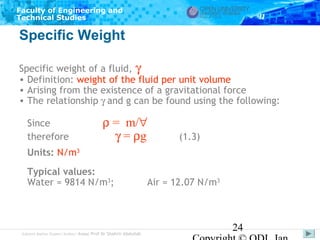
Specific Weight
Specific weight of a fluid, γ
• Definition: weight of the fluid per unit volume
• Arising from the existence of a gravitational force
• The relationship γ and g can be found using the following:
Since
therefore

ρ = m/∀
γ = ρg

(1.3)

Units: N/m3
Typical values:
Water = 9814 N/m3;

Subject Matter Expert/Author: Assoc Prof Dr Shahrir Abdullah

Air = 12.07 N/m3

24
Faculty of Engineering and
Technical Studies

Specific Gravity
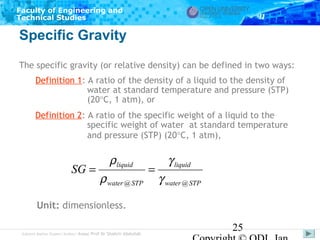
The specific gravity (or relative density) can be defined in two ways:
Definition 1: A ratio of the density of a liquid to the density of
water at standard temperature and pressure (STP)
(20°C, 1 atm), or
Definition 2: A ratio of the specific weight of a liquid to the
specific weight of water at standard temperature
and pressure (STP) (20°C, 1 atm),

SG =

ρ liquid
ρ water @ STP

=

γ liquid
γ water @ STP

Unit: dimensionless.
Subject Matter Expert/Author: Assoc Prof Dr Shahrir Abdullah

25
Faculty of Engineering and
Technical Studies

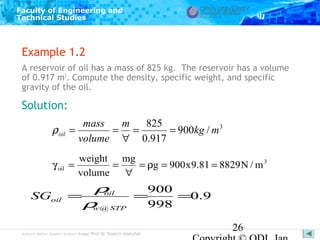
Example 1.2
A reservoir of oil has a mass of 825 kg. The reservoir has a volume
of 0.917 m3. Compute the density, specific weight, and specific
gravity of the oil.

Solution:
ρ oil

mass
m
825
=
= =
= 900kg / m 3
volume ∀ 0.917

γ oil

weight mg
=
=
= ρg = 900 x 9.81 = 8829 N / m 3
volume
∀

SGoil

ρ
900
oil
=
=
=0.9
ρ @ STP
998
w

Subject Matter Expert/Author: Assoc Prof Dr Shahrir Abdullah

26
Faculty of Engineering and
Technical Studies

1.7 Surface Tension
• Surface tension coefficient s can be defined as the intensity
of intermolecular traction per unit length along the free
surface of a fluid, and its SI unit is N/m.
• The surface tension effect is caused by unbalanced cohesion
forces at fluid surfaces which produce a downward resultant
force which can physically seen as a membrane.
• The coefficient is inversely proportional to temperature and
is also dependent on the type of the solid interface.
• For example, a drop of water on a glass surface will have a
different coefficient from the similar amount of water on a
wood surface.

Subject Matter Expert/Author: Assoc Prof Dr Shahrir Abdullah

27
Faculty of Engineering and
Technical Studies

1.7 Surface Tension
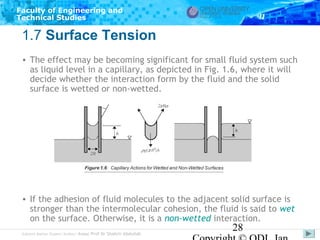
• The effect may be becoming significant for small fluid system such
as liquid level in a capillary, as depicted in Fig. 1.6, where it will
decide whether the interaction form by the fluid and the solid
surface is wetted or non-wetted.

• If the adhesion of fluid molecules to the adjacent solid surface is
stronger than the intermolecular cohesion, the fluid is said to wet
on the surface. Otherwise, it is a non-wetted interaction.
Subject Matter Expert/Author: Assoc Prof Dr Shahrir Abdullah

28
Faculty of Engineering and
Technical Studies

1.7 Surface Tension
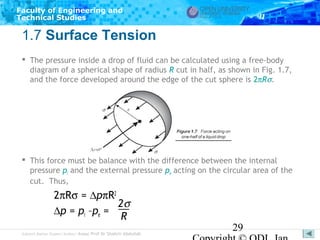
 The pressure inside a drop of fluid can be calculated using a free-body
diagram of a spherical shape of radius R cut in half, as shown in Fig. 1.7,
and the force developed around the edge of the cut sphere is 2πRσ.

 This force must be balance with the difference between the internal
pressure pi and the external pressure pe acting on the circular area of the
cut. Thus,

2πRσ = ∆pπR2
2σ
∆p = pi –pe =
R
Subject Matter Expert/Author: Assoc Prof Dr Shahrir Abdullah

29
Faculty of Engineering and
Technical Studies

1.8 Vapour Pressure
• Vapour pressure is the partial pressure produced by fluid vapour
in an open or a closed container, which reaches its saturated
condition or the transfer of fluid molecules is at equilibrium along
its free surface.
• In a closed container, the vapour pressure is solely dependent on
temperature. In a saturated condition, any further reduction in
temperature or atmospheric pressure below its dew point will
lead to the formation of water droplets.
• On the other hand, boiling occurs when the absolute fluid
pressure is reduced until it is lower than the vapour pressure of
the fluid at that temperature.
• For a network of pipes, the pressure at a point can be lower than
the vapour pressure, for example, at the suction section of a
pump. Otherwise, vapour bubbles will start to form and this
phenomenon is termed as cavitation.
Subject Matter Expert/Author: Assoc Prof Dr Shahrir Abdullah

30
Faculty of Engineering and
Technical Studies

Summary
This chapter has summarized on the aspect below:
 Understanding concept of a fluid
 Ways to visualise the flows and the continuity nature of
the fluid flow
 Fluid properties of density, specific weight, specific
gravity and viscosity were discussed.
 a Newtonian fluid against a non-Newtonian fluid, an inviscid flow against a viscous flow, and a wetted surface
against a non-wetted surface.
 Discussion on the surface tension and vapour pressure

Subject Matter Expert/Author: Assoc Prof Dr Shahrir Abdullah

31
Faculty of Engineering and
Technical Studies

Tha nk Yo u
Subject Matter Expert/Author: Assoc Prof Dr Shahrir Abdullah

32

fluid mechanics for mechanical engineering

  • 1.
    Faculty of Engineeringand Technical Studies Fluid Mechanics for Mechanical Engineering TUTORIAL 1 – UNIT 1: Chapter 1: Introduction to Fluid Mechanics Assoc Prof Dr Shahrir Abdullah EBMF4103 Fluid Mechanics for Mechanical Engineering Jan 2005 1 Subject Matter Expert/Author: Assoc Prof Dr Shahrir Abdullah Copyright © ODL Jan 2005 Open University Malaysia
  • 2.
    Faculty of Engineeringand Technical Studies SEQUENCE OF CHAPTER 1 Introduction Objectives 1.1 Fluid Concept 1.2 Units and Dimensions 1.3 Fluid Continuum 1.4 Flow Patterns 1.5 Fluid Density 1.6 Viscosity 1.7 Surface Tension 1.8 Vapour Pressure Summary Subject Matter Expert/Author: Assoc Prof Dr Shahrir Abdullah 2
  • 3.
    Faculty of Engineeringand Technical Studies Introduction  This chapter will begin with several concepts, definition, terminologies and approaches which should be understood by the students before continuing reading the rest of this module.  Then, it introduces the student with typical properties of fluid and their dimensions which are then being used extensively in the next chapters and units like pressure, velocity, density and viscosity.  Some of these can be used to classify type and characteristic of fluid, such as whether a fluid is incompressible or not or whether the fluid is Newtonian or non-Newtonian. Subject Matter Expert/Author: Assoc Prof Dr Shahrir Abdullah 3
  • 4.
    Faculty of Engineeringand Technical Studies Objectives At the end of this chapter, you should be able to :  explain the concept of fluid continuity and flow representations using streamlines, streaklines and pathlines,  Identify and describe typical fluid properties and their units and dimensions Subject Matter Expert/Author: Assoc Prof Dr Shahrir Abdullah 4
  • 5.
    Faculty of Engineeringand Technical Studies 1.1 Fluid Concept • Fluid mechanics is a division in applied mechanics related to the behaviour of liquid or gas which is either in rest or in motion. • The study related to a fluid in rest or stationary is referred to fluid static, otherwise it is referred to as fluid dynamic. • Fluid can be defined as a substance which can deform continuously when being subjected to shear stress at any magnitude. In other words, it can flow continuously as a result of shearing action. This includes any liquid or gas. Subject Matter Expert/Author: Assoc Prof Dr Shahrir Abdullah 5
  • 6.
    Faculty of Engineeringand Technical Studies 1.1 Fluid Concept • Thus, with exception to solids, any other matters can be categorised as fluid. In microscopic point of view, this concept corresponds to loose or very loose bonding between molecules of liquid or gas, respectively. • Examples of typical fluid used in engineering applications are water, oil and air. • An analogy of how to understand different bonding in solids and fluids is depicted in Fig. 1.1 Subject Matter Expert/Author: Assoc Prof Dr Shahrir Abdullah 6
  • 7.
    Faculty of Engineeringand Technical Studies 1.1 Fluid Concept • Thus, with exception to solids, any other matters can be categorised as fluid. In microscopic point of view, this concept corresponds to loose or very loose bonding between molecules of liquid or gas, respectively. • Examples of typical fluid used in engineering applications are water, oil and air. • An analogy of how to understand different bonding in solids and fluids is depicted in Fig. 1.1 Subject Matter Expert/Author: Assoc Prof Dr Shahrir Abdullah 7
  • 8.
    Faculty of Engineeringand Technical Studies 1.1 Fluid Concept Free surface k k k k (a) Solid (b) Liquid (c) Gas Figure 1.1 Comparison Between Solids, Liquids and Gases • For solid, imagine that the molecules can be fictitiously linked to each other with springs. Subject Matter Expert/Author: Assoc Prof Dr Shahrir Abdullah 8
  • 9.
    Faculty of Engineeringand Technical Studies 1.1 Fluid Concept  In fluid, the molecules can move freely but are constrained through a traction force called cohesion. This force is interchangeable from one molecule to another.  For gases, it is very weak which enables the gas to disintegrate and move away from its container.  For liquids, it is stronger which is sufficient enough to hold the molecule together and can withstand high compression, which is suitable for application as hydraulic fluid such as oil. On the surface, the cohesion forms a resultant force directed into the liquid region and the combination of cohesion forces between adjacent molecules from a tensioned membrane known as free surface. Subject Matter Expert/Author: Assoc Prof Dr Shahrir Abdullah 9
  • 10.
    Faculty of Engineeringand Technical Studies 1.2 Units and Dimensions • The primary quantities which are also referred to as basic dimensions, such as L for length, T for time, M for mass and Q for temperature. • This dimension system is known as the MLT system where it can be used to provide qualitative description for secondary quantities, or derived dimensions, such as area (L), velocity (LT-1) and density (ML-3). • In some countries, the FLT system is also used, where the quantity F stands for force. Subject Matter Expert/Author: Assoc Prof Dr Shahrir Abdullah 10
  • 11.
    Faculty of Engineeringand Technical Studies 1.2 Units and Dimensions • An example is a kinematic equation for the velocity V of a uniformly accelerated body, V = V0 + at where V0 is the initial velocity, a the acceleration and t the time interval. In terms for dimensions of the equation, we can expand that LT-1 = LT -1 + LT-2 • T Subject Matter Expert/Author: Assoc Prof Dr Shahrir Abdullah 11
  • 12.
    Faculty of Engineeringand Technical Studies Example 1.1  The free vibration of a particle can be simulated by the following differential equation: du m + kx = 0 dt where m is mass, u is velocity, t is time and x is displacement. Determine the dimension for the stiffness variable k. Subject Matter Expert/Author: Assoc Prof Dr Shahrir Abdullah 12
  • 13.
    Faculty of Engineeringand Technical Studies Example 1.1  By making the dimension of the first term equal to the second term: [m] • [u] = [k]•[x] [t] Hence, [m]•[u] [k] = = [t]•[x] M • LT-1 LT = MT-2 Subject Matter Expert/Author: Assoc Prof Dr Shahrir Abdullah 13
  • 14.
    Faculty of Engineeringand Technical Studies 1.3 Fluid Continuum • Since the fluid flows continuously, any method and technique developed to analyse flow problems should take into consideration the continuity of the fluid. There are two types of approaches that can be used: 1.Eulerian approach — analysis is performed by defining a control volume to represent fluid domain which allows the fluid to flow across the volume. This approach is more appropriate to be used in fluid mechanics. 2.Lagrangian approach — analysis is performed by tracking down all motion parameters and deformation of a domain as it moves. This approach is more suitable and widely used for particle and solid mechanics. Subject Matter Expert/Author: Assoc Prof Dr Shahrir Abdullah 14
  • 15.
    Faculty of Engineeringand Technical Studies 1.3 Fluid Continuum  The fluid behaviour in which its properties are continuous field variables, either scalar or vector, throughout the control volume is known as continuum. From this concept, several fluid or flow definitions can be made as follows:  Steady state flow — A flow is said to be in steady state if its properties is only a function of position (x,y,z) but not time t: ρ = ρ (x,y,z), V = V (x,y,z) An example is the velocity of a steady flow of a river where the upstream and downstream velocities are different but their values does not change through time. Subject Matter Expert/Author: Assoc Prof Dr Shahrir Abdullah 15
  • 16.
    Faculty of Engineeringand Technical Studies 1.3 Fluid Continuum • Uniform flow — A flow is said to be uniform if its velocity and all velocity components is only a function of time t: V = V (t) An example is the air flow in a constant diameter duct where the velocity is constant throughout the length of the duct but can be increased uniformly by increasing the power of the fan. • Isotropic fluid — A fluid is said to be isotropic if its density is not a function of position (x,y,z) but may vary with time t: ρ = ρ (t) An example is the density of a gas in a closed container where the container is heated. The density is constant inside the container but gradually increases with time as the temperature increases. Subject Matter Expert/Author: Assoc Prof Dr Shahrir Abdullah 16
  • 17.
    Faculty of Engineeringand Technical Studies 1.4 Flow Patterns • The three ways to represent fluid flow: 1. Streamlines — A streamline is formed by tangents of the velocity field of the flow. 2. Pathlines — A pathline can be formed from fluid particles of different colour originated from the same points, such as a line formed after the introduction of ink into a shallow water flow. 3. Streaklines — A streakline represents a locus made by a miniature particles or tracers that passes at a same point. Subject Matter Expert/Author: Assoc Prof Dr Shahrir Abdullah 17
  • 18.
    Faculty of Engineeringand Technical Studies 1.5 Density Density of a fluid, ρ, Definition: mass per unit volume,  slightly affected by changes in temperature and pressure. ρ = mass/volume = m/∀ Units: kg/m3 Typical values: Water = 1000 kg/m3; Air = 1.23 kg/m3 Subject Matter Expert/Author: Assoc Prof Dr Shahrir Abdullah 18
  • 19.
    Faculty of Engineeringand Technical Studies 1.6 Viscosity • Viscosity, µ, is a measure of resistance to fluid flow as a result of intermolecular cohesion. In other words, viscosity can be seen as internal friction to fluid motion which can then lead to energy loss. • Different fluids deform at different rates under the same shear stress. The ease with which a fluid pours is an indication of its viscosity. Fluid with a high viscosity such as syrup deforms more slowly than fluid with a low viscosity such as water. The viscosity is also known as dynamic viscosity.  Units: N.s/m2 or kg/m/s  Typical values: Water = 1.14x10⁻³ kg/m/s; Subject Matter Expert/Author: Assoc Prof Dr Shahrir Abdullah Air = 1.78x10⁻⁵ kg/m/s 19
  • 20.
    Faculty of Engineeringand Technical Studies Newtonian and Non-Newtonian Fluid Fluid obey Newton’s law of viscosity refer Newton’s’ law of viscosity is given by; du τ=µ dy (1.1) τ = shear stress µ = viscosity of fluid du/dy = shear rate, rate of strain or velocity gradient Newtonian fluids Example: Air Water Oil Gasoline Alcohol Kerosene Benzene Glycerine • The viscosity µ is a function only of the condition of the fluid, particularly its temperature. • The magnitude of the velocity gradient (du/dy) has no effect on the magnitude of µ. Subject Matter Expert/Author: Assoc Prof Dr Shahrir Abdullah 20
  • 21.
    Faculty of Engineeringand Technical Studies Newtonian and Non-Newtonian Fluid Fluid Do not obey Newton’s law of viscosity Non- Newtonian fluids • The viscosity of the non-Newtonian fluid is dependent on the velocity gradient as well as the condition of the fluid. Newtonian Fluids  a linear relationship between shear stress and the velocity gradient (rate of shear),  the slope is constant  the viscosity is constant non-Newtonian fluids  slope of the curves for non-Newtonian fluids varies Subject Matter Expert/Author: Assoc Prof Dr Shahrir Abdullah 21
  • 22.
    Faculty of Engineeringand Technical Studies If the gradient m is constant, the fluid is termed as Newtonian fluid. Otherwise, it is known as non-Newtonian fluid. Fig. 1.5 shows several Newtonian and non-Newtonian fluids. Subject Matter Expert/Author: Assoc Prof Dr Shahrir Abdullah 22
  • 23.
    Faculty of Engineeringand Technical Studies Kinematic viscosity, ν Definition: is the ratio of the viscosity to the density; ν = µ/ρ • will be found to be important in cases in which significant viscous and gravitational forces exist. Units: m2/s Typical values: Water = 1.14x10⁻⁶ m2/s; Air = 1.46x10⁻⁵ m2/s; In general, viscosity of liquids with temperature, whereas viscosity of gases with in temperature. Subject Matter Expert/Author: Assoc Prof Dr Shahrir Abdullah 23
  • 24.
    Faculty of Engineeringand Technical Studies Specific Weight Specific weight of a fluid, γ • Definition: weight of the fluid per unit volume • Arising from the existence of a gravitational force • The relationship γ and g can be found using the following: Since therefore ρ = m/∀ γ = ρg (1.3) Units: N/m3 Typical values: Water = 9814 N/m3; Subject Matter Expert/Author: Assoc Prof Dr Shahrir Abdullah Air = 12.07 N/m3 24
  • 25.
    Faculty of Engineeringand Technical Studies Specific Gravity The specific gravity (or relative density) can be defined in two ways: Definition 1: A ratio of the density of a liquid to the density of water at standard temperature and pressure (STP) (20°C, 1 atm), or Definition 2: A ratio of the specific weight of a liquid to the specific weight of water at standard temperature and pressure (STP) (20°C, 1 atm), SG = ρ liquid ρ water @ STP = γ liquid γ water @ STP Unit: dimensionless. Subject Matter Expert/Author: Assoc Prof Dr Shahrir Abdullah 25
  • 26.
    Faculty of Engineeringand Technical Studies Example 1.2 A reservoir of oil has a mass of 825 kg. The reservoir has a volume of 0.917 m3. Compute the density, specific weight, and specific gravity of the oil. Solution: ρ oil mass m 825 = = = = 900kg / m 3 volume ∀ 0.917 γ oil weight mg = = = ρg = 900 x 9.81 = 8829 N / m 3 volume ∀ SGoil ρ 900 oil = = =0.9 ρ @ STP 998 w Subject Matter Expert/Author: Assoc Prof Dr Shahrir Abdullah 26
  • 27.
    Faculty of Engineeringand Technical Studies 1.7 Surface Tension • Surface tension coefficient s can be defined as the intensity of intermolecular traction per unit length along the free surface of a fluid, and its SI unit is N/m. • The surface tension effect is caused by unbalanced cohesion forces at fluid surfaces which produce a downward resultant force which can physically seen as a membrane. • The coefficient is inversely proportional to temperature and is also dependent on the type of the solid interface. • For example, a drop of water on a glass surface will have a different coefficient from the similar amount of water on a wood surface. Subject Matter Expert/Author: Assoc Prof Dr Shahrir Abdullah 27
  • 28.
    Faculty of Engineeringand Technical Studies 1.7 Surface Tension • The effect may be becoming significant for small fluid system such as liquid level in a capillary, as depicted in Fig. 1.6, where it will decide whether the interaction form by the fluid and the solid surface is wetted or non-wetted. • If the adhesion of fluid molecules to the adjacent solid surface is stronger than the intermolecular cohesion, the fluid is said to wet on the surface. Otherwise, it is a non-wetted interaction. Subject Matter Expert/Author: Assoc Prof Dr Shahrir Abdullah 28
  • 29.
    Faculty of Engineeringand Technical Studies 1.7 Surface Tension  The pressure inside a drop of fluid can be calculated using a free-body diagram of a spherical shape of radius R cut in half, as shown in Fig. 1.7, and the force developed around the edge of the cut sphere is 2πRσ.  This force must be balance with the difference between the internal pressure pi and the external pressure pe acting on the circular area of the cut. Thus, 2πRσ = ∆pπR2 2σ ∆p = pi –pe = R Subject Matter Expert/Author: Assoc Prof Dr Shahrir Abdullah 29
  • 30.
    Faculty of Engineeringand Technical Studies 1.8 Vapour Pressure • Vapour pressure is the partial pressure produced by fluid vapour in an open or a closed container, which reaches its saturated condition or the transfer of fluid molecules is at equilibrium along its free surface. • In a closed container, the vapour pressure is solely dependent on temperature. In a saturated condition, any further reduction in temperature or atmospheric pressure below its dew point will lead to the formation of water droplets. • On the other hand, boiling occurs when the absolute fluid pressure is reduced until it is lower than the vapour pressure of the fluid at that temperature. • For a network of pipes, the pressure at a point can be lower than the vapour pressure, for example, at the suction section of a pump. Otherwise, vapour bubbles will start to form and this phenomenon is termed as cavitation. Subject Matter Expert/Author: Assoc Prof Dr Shahrir Abdullah 30
  • 31.
    Faculty of Engineeringand Technical Studies Summary This chapter has summarized on the aspect below:  Understanding concept of a fluid  Ways to visualise the flows and the continuity nature of the fluid flow  Fluid properties of density, specific weight, specific gravity and viscosity were discussed.  a Newtonian fluid against a non-Newtonian fluid, an inviscid flow against a viscous flow, and a wetted surface against a non-wetted surface.  Discussion on the surface tension and vapour pressure Subject Matter Expert/Author: Assoc Prof Dr Shahrir Abdullah 31
  • 32.
    Faculty of Engineeringand Technical Studies Tha nk Yo u Subject Matter Expert/Author: Assoc Prof Dr Shahrir Abdullah 32