Ministry of Higher Education & Scientific Research
Foundation of Technical Education
Technical College of Basrah
CH4: Fluid Kinematics
Training Package
in
Fluid Mechanics
Modular unit 4
Fluid Kinematics
By
Risala A. Mohammed
M.Sc. Civil Engineering
Asst. Lect.
Environmental & Pollution Engineering Department
2011
1- Over view
1-1 Target population
CH4: Fluid Kinematics
For the students of second class in
Environmental engineering Department in
Technical College
1-2 Rationale
CH4: Fluid Kinematics
A study of fluids in motion very important to
calculate the acceleration and speed of the fluid at
any point in the flow. And to the importance of flow
in many applied field such as flow of water in the
rivers, wind movement and flow of fluids in
industrial equipment
1-3 Central Idea
CH4: Fluid Kinematics
The main goal of this chapter are define the
following:
1- Fluid kinematic
2- Fluid velocity
3- Types of flow
4- Continuity equation
1-4 Instructions
CH4: Fluid Kinematics
1- Study over view thoroughly
2- Identify the goal of this modular unit
3- Do the Pretest and if you :-
*Get 9 or more you do not need to proceed
*Get less than 9 you have to study this modular
4- After studying the text of this modular unit , do the post test
and if you :-
*Get 9 or more , so go on studying modular unit five
*Get less than 9 , go back and study the modular unit four
1-5 Performance Objectives
CH4: Fluid Kinematics
At the end of this modular unit the student will be able to :
1- Define the fluid kinematic
2- Describe the fluid velocity and acceleration
3- Limit the type of fluid flow
4- Drive the continuity equation
2- Pre test
-
CH4: Fluid Kinematics
Q1)) Choose the Correct Answer (7 marks):
1- The motion of fluid particles may be described by which of the following methods?
a) Langrangian method (b) Eulerain method (c) both (a) and (b) (d) none of the above.
2- In which of the following methods, the observer concentrates on a point in the fluid system?
(a) Langrangian method b) Eulerian method (c) Any of the above (d) None of the above.
3- Ina steady flow the velocity
(a) does not change from place to place (b) at a given point does not change with time
(c) may change its direction but the magnitude remains unchanged (d) none of the above.
4- The flow in a pipe whose valve is being opened or closed gradually is an example of
(a) steady flow (b) unsteady flow c) rotational flow (d) compressible flow.
5- The type of flow in which the velocity at any given time does not change with respect to space is
called
(a) steady flow (b) compressible c) uniform flow d) rotational flow
Pre test
-
CH4: Fluid Kinematics
6- The flow in a river during the period of heavy rainfall is
(a) steady, non-uniform and three-dimensional (b) steady, uniform, two dimensional
(c) unsteady, uniform, three-dimensional (d) unsteady, non-uniform and three-dimensional.
7- If the flow is irrotational as well as steady it is known as
(a) non-uniform flow (b) one-dimensional flow (c) potential flow (d) none of the above.
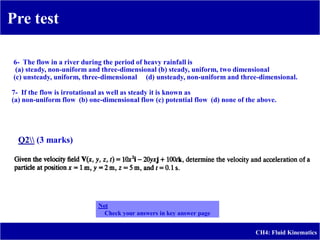
Q2 (3 marks)
Not
Check your answers in key answer page
Introduction
-
CH4: Fluid Kinematics
Fluid Kinematics deals with the motion of fluids without considering
the forces and moments which create the motion.
 Lagrangian description:
 properties of individual fluid particles are defined as a function of time
as they move through the fluid; the overall fluid motion is found by
solving the EOMs for all fluid particles.
 Eulerian description:
 properties are defined at fixed points in space as the fluid flows past
these points; this is the most common description and yields the field
representation of fluid flow.
The Velocity Field
CH4: Fluid Kinematics
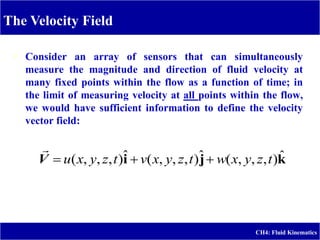
 Consider an array of sensors that can simultaneously
measure the magnitude and direction of fluid velocity at
many fixed points within the flow as a function of time; in
the limit of measuring velocity at all points within the flow,
we would have sufficient information to define the velocity
vector field:
k
j
i ˆ
)
,
,
,
(
ˆ
)
,
,
,
(
ˆ
)
,
,
,
( t
z
y
x
w
t
z
y
x
v
t
z
y
x
u 


V

The Velocity Field
CH4: Fluid Kinematics
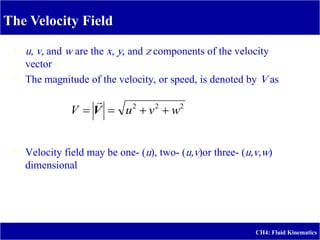
 u, v, and w are the x, y, and z components of the velocity
vector
 The magnitude of the velocity, or speed, is denoted by V as
 Velocity field may be one- (u), two- (u,v)or three- (u,v,w)
dimensional
2
2
2
w
v
u
V 


 V

Visualization of Fluid Flow
CH4: Fluid Kinematics
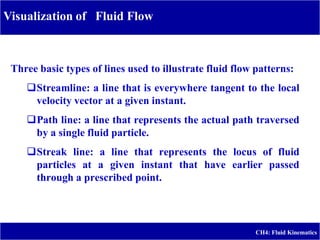
Three basic types of lines used to illustrate fluid flow patterns:
Streamline: a line that is everywhere tangent to the local
velocity vector at a given instant.
Path line: a line that represents the actual path traversed
by a single fluid particle.
Streak line: a line that represents the locus of fluid
particles at a given instant that have earlier passed
through a prescribed point.
Acceleration Field
CH4: Fluid Kinematics
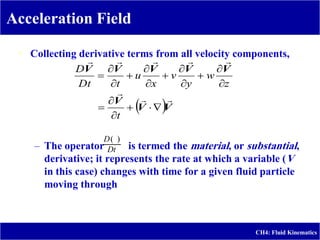
 Collecting derivative terms from all velocity components,
– The operator is termed the material, or substantial,
derivative; it represents the rate at which a variable (V
in this case) changes with time for a given fluid particle
moving through the flow field
 V
V
V
V
V
V
V
V


























t
z
w
y
v
x
u
t
Dt
D
Dt
D )
(
Acceleration Field
CH4: Fluid Kinematics
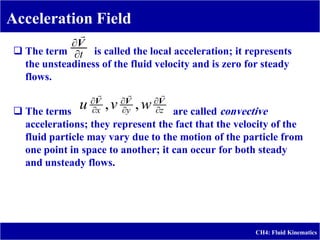
 The term is called the local acceleration; it represents
the unsteadiness of the fluid velocity and is zero for steady
flows.
 The terms are called convective
accelerations; they represent the fact that the velocity of the
fluid particle may vary due to the motion of the particle from
one point in space to another; it can occur for both steady
and unsteady flows.
t

V

z
y
x w
v
u 




 V
V
V



,
,
The Control Volume
CH4: Fluid Kinematics
 A control volume is a volume in space through which fluid
may flow; in some cases, the volume may move or deform
 The control volume has a boundary which separates it from
the surroundings and defines a control surface
 In the study of fluid dynamics, the control volume approach is
used to analyze fluid flow and fluid machinery
 The control volume approach is consistent with the Eulerian
description
Ideal Fluid in Motion
CH4: Fluid Kinematics
Four assumptions related to ideal flow:
Steady flow: the velocity of the moving fluid at any fixed
point does not change with time
Incompressible Flow: Fluid has constant density
Nonviscous flow: an object can move through the fluid at
constant speed- no resistive force within the fluid to moving
objects through it
Irrotational flow: Objects moving through the fluid do not
rotate about an axis through its center of mass
Types of Fluid Flow
CH4: Fluid Kinematics
Fluids may be classified as follows:
1. Steady and unsteady flows
2. Uniform and non-uniform flows
3. One, two and three dimensional flows
4. Rotational and irrotational flows
5.Laminar and turbulent flows
6.Compressible and incompressible flows.
Steady and unsteady flow
CH4: Fluid Kinematics
Steady flow.
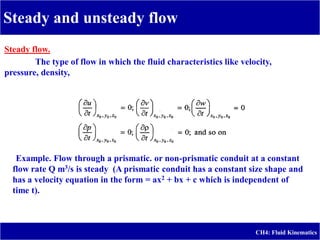
The type of flow in which the fluid characteristics like velocity,
pressure, density,
Example. Flow through a prismatic. or non-prismatic conduit at a constant
flow rate Q m3/s is steady (A prismatic conduit has a constant size shape and
has a velocity equation in the form = ax2 + bx + c which is independent of
time t).
Steady and unsteady flow
CH4: Fluid Kinematics
Unsteady flow.
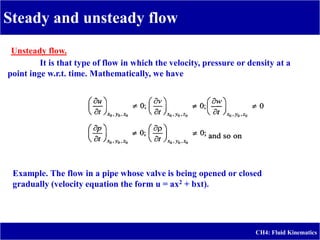
It is that type of flow in which the velocity, pressure or density at a
point inge w.r.t. time. Mathematically, we have
Example. The flow in a pipe whose valve is being opened or closed
gradually (velocity equation the form u = ax2 + bxt).
Uniform and non uniform flow
CH4: Fluid Kinematics
Uniform flow.
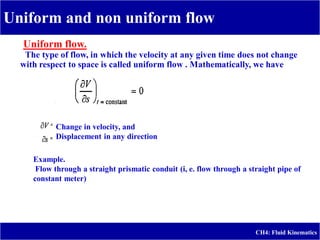
The type of flow, in which the velocity at any given time does not change
with respect to space is called uniform flow . Mathematically, we have
Change in velocity, and
Displacement in any direction
Example.
Flow through a straight prismatic conduit (i, e. flow through a straight pipe of
constant meter)
Uniform and non uniform flow
CH4: Fluid Kinematics
uniform flow.
-
Non
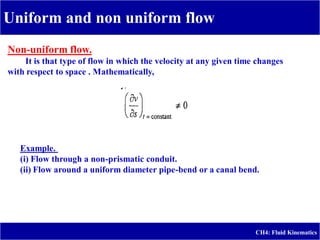
It is that type of flow in which the velocity at any given time changes
with respect to space . Mathematically,
Example.
(i) Flow through a non-prismatic conduit.
(ii) Flow around a uniform diameter pipe-bend or a canal bend.
One, two and three dimensional flow
CH4: Fluid Kinematics
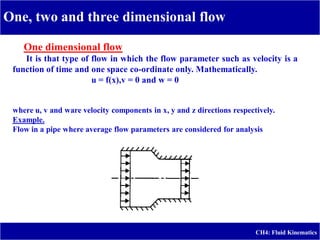
One dimensional flow
It is that type of flow in which the flow parameter such as velocity is a
function of time and one space co-ordinate only. Mathematically.
u = f(x),v = 0 and w = 0
where u, v and ware velocity components in x, y and z directions respectively.
.
Example
Flow in a pipe where average flow parameters are considered for analysis
One, two and three dimensional flow
CH4: Fluid Kinematics
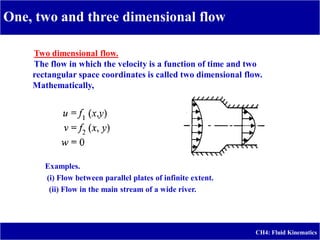
Two dimensional flow.
The flow in which the velocity is a function of time and two
rectangular space coordinates is called two dimensional flow.
Mathematically,
Examples.
(i) Flow between parallel plates of infinite extent.
(ii) Flow in the main stream of a wide river.
One, two and three dimensional flow
CH4: Fluid Kinematics
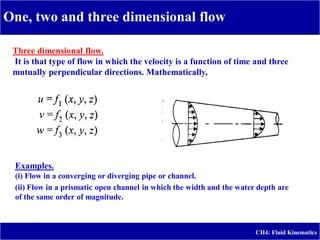
Three dimensional flow.
It is that type of flow in which the velocity is a function of time and three
mutually perpendicular directions. Mathematically,
Examples.
(i) Flow in a converging or diverging pipe or channel.
(ii) Flow in a prismatic open channel in which the width and the water depth are
of the same order of magnitude.
Rotational and irrotational flow
CH4: Fluid Kinematics
Rotational flow.
A flow is said to be rotational if the fluid particles while moving in the
direction of flow rotate about their mass centers. Flow near the solid
boundaries is rotational.
Example. Motion of liquid in a rotating tank.
Irrotational flow,
A flow is said to be irrotational if the fluid particles while moving in the
direction of flow do not rotate about their mass centers. Flow outside the
boundary layer is generally considered irrotationa1.
Example. Flow above a drain hole of a stationary tank or a wash basin.
Laminar and turbulent flow
CH4: Fluid Kinematics
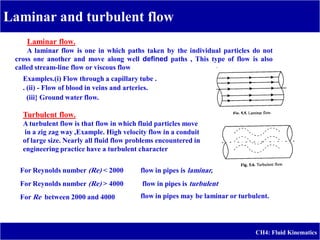
Laminar flow.
A laminar flow is one in which paths taken by the individual particles do not
cross one another and move along well defined paths , This type of flow is also
called stream-line flow or viscous flow,
Examples.(i) Flow through a capillary tube .
. (ii) - Flow of blood in veins and arteries.
(iii} Ground water flow.
Turbulent flow.
A turbulent flow is that flow in which fluid particles move
in a zig zag way ,Example. High velocity flow in a conduit
of large size. Nearly all fluid flow problems encountered in
engineering practice have a turbulent character
For Reynolds number (Re) < 2000
For Reynolds number (Re) > 4000
For Re between 2000 and 4000
flow in pipes is laminar,
flow in pipes is turbulent
flow in pipes may be laminar or turbulent.
Compressible flow.
It is that type of flow in which the density (p) of the fluid changes from
point to point (or in other words density is not constant for this flow
Mathematically
Example. Flow of gases through orifices, nozzles, gas turbines, etc .
Incompressible flow
It is that type of flow in which density is constant for the fluid flow.
Liquids are generally considered flowing incompressible.
Mathematically,
Example. Subsonic aerodynamics
Compressible an incompressible flow
CH4: Fluid Kinematics
Example (1)
CH4: Fluid Kinematics
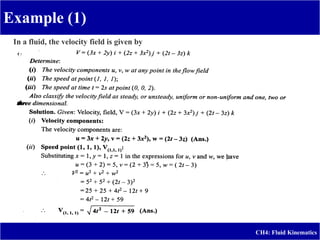
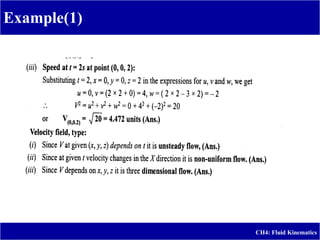
In a fluid, the velocity field is given by
Example(1)
CH4: Fluid Kinematics
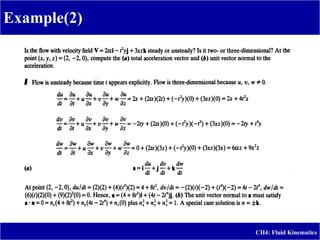
Example(2)
CH4: Fluid Kinematics
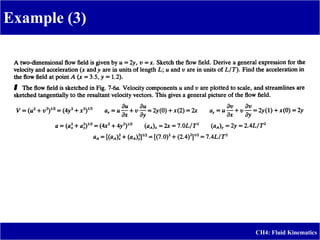
Example (3)
CH4: Fluid Kinematics
Equation of Continuity
CH4: Fluid Kinematics
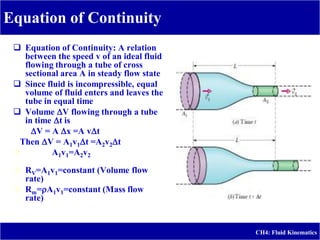
 Equation of Continuity: A relation
between the speed v of an ideal fluid
flowing through a tube of cross
sectional area A in steady flow state
 Since fluid is incompressible, equal
volume of fluid enters and leaves the
tube in equal time
 Volume V flowing through a tube
in time t is
V = A x =A vt
Then V = A1v1t =A2v2t
 A1v1=A2v2
 RV=A1v1=constant (Volume flow
rate)
 Rm=A1v1=constant (Mass flow
rate)
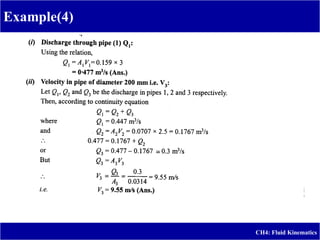
Example (4)
CH4: Fluid Kinematics
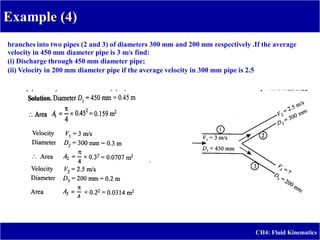
A pipe (J) 450 mm in diameter _
branches into two pipes (2 and 3) of diameters 300 mm and 200 mm respectively .If the average
velocity in 450 mm diameter pipe is 3 m/s find:
(i) Discharge through 450 mm diameter pipe;
(ii) Velocity in 200 mm diameter pipe if the average velocity in 300 mm pipe is 2.5 m/s.
Example(4)
CH4: Fluid Kinematics
Post test
CH4: Fluid Kinematics
A
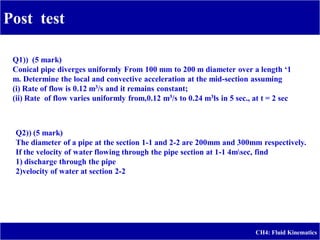
Q1)) (5 mark)
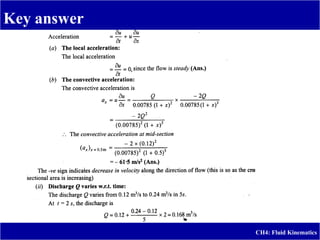
Conical pipe diverges uniformly From 100 mm to 200 m diameter over a length „1
m. Determine the local and convective acceleration at the mid-section assuming
(i) Rate of flow is 0.12 m3/s and it remains constant;
(ii) Rate of flow varies uniformly from,0.12 m3/s to 0.24 m3ls in 5 sec., at t = 2 sec.
Q2)) (5 mark)
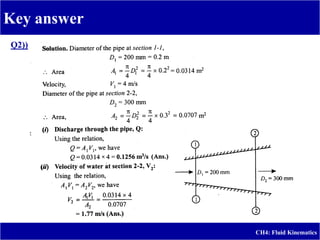
The diameter of a pipe at the section 1-1 and 2-2 are 200mm and 300mm respectively.
If the velocity of water flowing through the pipe section at 1-1 4msec, find
1) discharge through the pipe
2)velocity of water at section 2-2
Key answer
CH4: Fluid Kinematics
pre test
Q1))
1- ( c ) 2- ( d ) 3- ( b ) 4- ( b) 5- ( c ) 6- ( d ) 7- ( c )
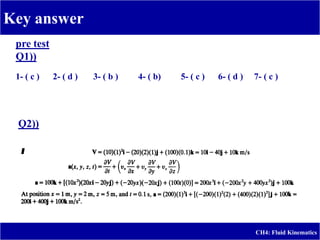
Q2))
Key answer
CH4: Fluid Kinematics
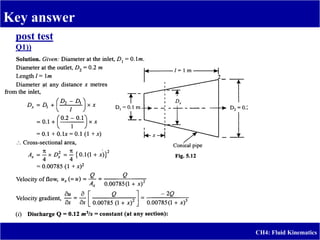
post test
Q1))
Key answer
CH4: Fluid Kinematics
Key answer
CH4: Fluid Kinematics
Q2))
References
CH1: Fluid Properties
1. Evett, J., B. and Liu, C. 1989 “2500 solved problems in fluid mechanics and
hydraulics” Library of Congress Cataloging- in-Publication Data, (Schaum's
solved problems series) ISBN 0-07-019783-0
2. Rajput, R.,K. 2000 “ A Text Book of Fluid Mechanics and Hydraulic
Machines”. S.Chand & Company LTD.
3. White, F., M. 2000 “ Fluid Mechanics”. McGraw-Hill Series in Mechanical
Engineering.
4. Wily, S., 1983 “ Fluid Mechanics”. McGraw-Hill Series in Mechanical
Engineering.

Fluid kinematics

  • 1.
    Ministry of HigherEducation & Scientific Research Foundation of Technical Education Technical College of Basrah CH4: Fluid Kinematics Training Package in Fluid Mechanics Modular unit 4 Fluid Kinematics By Risala A. Mohammed M.Sc. Civil Engineering Asst. Lect. Environmental & Pollution Engineering Department 2011
  • 2.
    1- Over view 1-1Target population CH4: Fluid Kinematics For the students of second class in Environmental engineering Department in Technical College
  • 3.
    1-2 Rationale CH4: FluidKinematics A study of fluids in motion very important to calculate the acceleration and speed of the fluid at any point in the flow. And to the importance of flow in many applied field such as flow of water in the rivers, wind movement and flow of fluids in industrial equipment
  • 4.
    1-3 Central Idea CH4:Fluid Kinematics The main goal of this chapter are define the following: 1- Fluid kinematic 2- Fluid velocity 3- Types of flow 4- Continuity equation
  • 5.
    1-4 Instructions CH4: FluidKinematics 1- Study over view thoroughly 2- Identify the goal of this modular unit 3- Do the Pretest and if you :- *Get 9 or more you do not need to proceed *Get less than 9 you have to study this modular 4- After studying the text of this modular unit , do the post test and if you :- *Get 9 or more , so go on studying modular unit five *Get less than 9 , go back and study the modular unit four
  • 6.
    1-5 Performance Objectives CH4:Fluid Kinematics At the end of this modular unit the student will be able to : 1- Define the fluid kinematic 2- Describe the fluid velocity and acceleration 3- Limit the type of fluid flow 4- Drive the continuity equation
  • 7.
    2- Pre test - CH4:Fluid Kinematics Q1)) Choose the Correct Answer (7 marks): 1- The motion of fluid particles may be described by which of the following methods? a) Langrangian method (b) Eulerain method (c) both (a) and (b) (d) none of the above. 2- In which of the following methods, the observer concentrates on a point in the fluid system? (a) Langrangian method b) Eulerian method (c) Any of the above (d) None of the above. 3- Ina steady flow the velocity (a) does not change from place to place (b) at a given point does not change with time (c) may change its direction but the magnitude remains unchanged (d) none of the above. 4- The flow in a pipe whose valve is being opened or closed gradually is an example of (a) steady flow (b) unsteady flow c) rotational flow (d) compressible flow. 5- The type of flow in which the velocity at any given time does not change with respect to space is called (a) steady flow (b) compressible c) uniform flow d) rotational flow
  • 8.
    Pre test - CH4: FluidKinematics 6- The flow in a river during the period of heavy rainfall is (a) steady, non-uniform and three-dimensional (b) steady, uniform, two dimensional (c) unsteady, uniform, three-dimensional (d) unsteady, non-uniform and three-dimensional. 7- If the flow is irrotational as well as steady it is known as (a) non-uniform flow (b) one-dimensional flow (c) potential flow (d) none of the above. Q2 (3 marks) Not Check your answers in key answer page
  • 9.
    Introduction - CH4: Fluid Kinematics FluidKinematics deals with the motion of fluids without considering the forces and moments which create the motion.  Lagrangian description:  properties of individual fluid particles are defined as a function of time as they move through the fluid; the overall fluid motion is found by solving the EOMs for all fluid particles.  Eulerian description:  properties are defined at fixed points in space as the fluid flows past these points; this is the most common description and yields the field representation of fluid flow.
  • 10.
    The Velocity Field CH4:Fluid Kinematics  Consider an array of sensors that can simultaneously measure the magnitude and direction of fluid velocity at many fixed points within the flow as a function of time; in the limit of measuring velocity at all points within the flow, we would have sufficient information to define the velocity vector field: k j i ˆ ) , , , ( ˆ ) , , , ( ˆ ) , , , ( t z y x w t z y x v t z y x u    V 
  • 11.
    The Velocity Field CH4:Fluid Kinematics  u, v, and w are the x, y, and z components of the velocity vector  The magnitude of the velocity, or speed, is denoted by V as  Velocity field may be one- (u), two- (u,v)or three- (u,v,w) dimensional 2 2 2 w v u V     V 
  • 12.
    Visualization of FluidFlow CH4: Fluid Kinematics Three basic types of lines used to illustrate fluid flow patterns: Streamline: a line that is everywhere tangent to the local velocity vector at a given instant. Path line: a line that represents the actual path traversed by a single fluid particle. Streak line: a line that represents the locus of fluid particles at a given instant that have earlier passed through a prescribed point.
  • 13.
    Acceleration Field CH4: FluidKinematics  Collecting derivative terms from all velocity components, – The operator is termed the material, or substantial, derivative; it represents the rate at which a variable (V in this case) changes with time for a given fluid particle moving through the flow field  V V V V V V V V                           t z w y v x u t Dt D Dt D ) (
  • 14.
    Acceleration Field CH4: FluidKinematics  The term is called the local acceleration; it represents the unsteadiness of the fluid velocity and is zero for steady flows.  The terms are called convective accelerations; they represent the fact that the velocity of the fluid particle may vary due to the motion of the particle from one point in space to another; it can occur for both steady and unsteady flows. t  V  z y x w v u       V V V    , ,
  • 15.
    The Control Volume CH4:Fluid Kinematics  A control volume is a volume in space through which fluid may flow; in some cases, the volume may move or deform  The control volume has a boundary which separates it from the surroundings and defines a control surface  In the study of fluid dynamics, the control volume approach is used to analyze fluid flow and fluid machinery  The control volume approach is consistent with the Eulerian description
  • 16.
    Ideal Fluid inMotion CH4: Fluid Kinematics Four assumptions related to ideal flow: Steady flow: the velocity of the moving fluid at any fixed point does not change with time Incompressible Flow: Fluid has constant density Nonviscous flow: an object can move through the fluid at constant speed- no resistive force within the fluid to moving objects through it Irrotational flow: Objects moving through the fluid do not rotate about an axis through its center of mass
  • 17.
    Types of FluidFlow CH4: Fluid Kinematics Fluids may be classified as follows: 1. Steady and unsteady flows 2. Uniform and non-uniform flows 3. One, two and three dimensional flows 4. Rotational and irrotational flows 5.Laminar and turbulent flows 6.Compressible and incompressible flows.
  • 18.
    Steady and unsteadyflow CH4: Fluid Kinematics Steady flow. The type of flow in which the fluid characteristics like velocity, pressure, density, Example. Flow through a prismatic. or non-prismatic conduit at a constant flow rate Q m3/s is steady (A prismatic conduit has a constant size shape and has a velocity equation in the form = ax2 + bx + c which is independent of time t).
  • 19.
    Steady and unsteadyflow CH4: Fluid Kinematics Unsteady flow. It is that type of flow in which the velocity, pressure or density at a point inge w.r.t. time. Mathematically, we have Example. The flow in a pipe whose valve is being opened or closed gradually (velocity equation the form u = ax2 + bxt).
  • 20.
    Uniform and nonuniform flow CH4: Fluid Kinematics Uniform flow. The type of flow, in which the velocity at any given time does not change with respect to space is called uniform flow . Mathematically, we have Change in velocity, and Displacement in any direction Example. Flow through a straight prismatic conduit (i, e. flow through a straight pipe of constant meter)
  • 21.
    Uniform and nonuniform flow CH4: Fluid Kinematics uniform flow. - Non It is that type of flow in which the velocity at any given time changes with respect to space . Mathematically, Example. (i) Flow through a non-prismatic conduit. (ii) Flow around a uniform diameter pipe-bend or a canal bend.
  • 22.
    One, two andthree dimensional flow CH4: Fluid Kinematics One dimensional flow It is that type of flow in which the flow parameter such as velocity is a function of time and one space co-ordinate only. Mathematically. u = f(x),v = 0 and w = 0 where u, v and ware velocity components in x, y and z directions respectively. . Example Flow in a pipe where average flow parameters are considered for analysis
  • 23.
    One, two andthree dimensional flow CH4: Fluid Kinematics Two dimensional flow. The flow in which the velocity is a function of time and two rectangular space coordinates is called two dimensional flow. Mathematically, Examples. (i) Flow between parallel plates of infinite extent. (ii) Flow in the main stream of a wide river.
  • 24.
    One, two andthree dimensional flow CH4: Fluid Kinematics Three dimensional flow. It is that type of flow in which the velocity is a function of time and three mutually perpendicular directions. Mathematically, Examples. (i) Flow in a converging or diverging pipe or channel. (ii) Flow in a prismatic open channel in which the width and the water depth are of the same order of magnitude.
  • 25.
    Rotational and irrotationalflow CH4: Fluid Kinematics Rotational flow. A flow is said to be rotational if the fluid particles while moving in the direction of flow rotate about their mass centers. Flow near the solid boundaries is rotational. Example. Motion of liquid in a rotating tank. Irrotational flow, A flow is said to be irrotational if the fluid particles while moving in the direction of flow do not rotate about their mass centers. Flow outside the boundary layer is generally considered irrotationa1. Example. Flow above a drain hole of a stationary tank or a wash basin.
  • 26.
    Laminar and turbulentflow CH4: Fluid Kinematics Laminar flow. A laminar flow is one in which paths taken by the individual particles do not cross one another and move along well defined paths , This type of flow is also called stream-line flow or viscous flow, Examples.(i) Flow through a capillary tube . . (ii) - Flow of blood in veins and arteries. (iii} Ground water flow. Turbulent flow. A turbulent flow is that flow in which fluid particles move in a zig zag way ,Example. High velocity flow in a conduit of large size. Nearly all fluid flow problems encountered in engineering practice have a turbulent character For Reynolds number (Re) < 2000 For Reynolds number (Re) > 4000 For Re between 2000 and 4000 flow in pipes is laminar, flow in pipes is turbulent flow in pipes may be laminar or turbulent.
  • 27.
    Compressible flow. It isthat type of flow in which the density (p) of the fluid changes from point to point (or in other words density is not constant for this flow Mathematically Example. Flow of gases through orifices, nozzles, gas turbines, etc . Incompressible flow It is that type of flow in which density is constant for the fluid flow. Liquids are generally considered flowing incompressible. Mathematically, Example. Subsonic aerodynamics Compressible an incompressible flow CH4: Fluid Kinematics
  • 28.
    Example (1) CH4: FluidKinematics In a fluid, the velocity field is given by
  • 29.
  • 30.
  • 31.
  • 32.
    Equation of Continuity CH4:Fluid Kinematics  Equation of Continuity: A relation between the speed v of an ideal fluid flowing through a tube of cross sectional area A in steady flow state  Since fluid is incompressible, equal volume of fluid enters and leaves the tube in equal time  Volume V flowing through a tube in time t is V = A x =A vt Then V = A1v1t =A2v2t  A1v1=A2v2  RV=A1v1=constant (Volume flow rate)  Rm=A1v1=constant (Mass flow rate)
  • 33.
    Example (4) CH4: FluidKinematics A pipe (J) 450 mm in diameter _ branches into two pipes (2 and 3) of diameters 300 mm and 200 mm respectively .If the average velocity in 450 mm diameter pipe is 3 m/s find: (i) Discharge through 450 mm diameter pipe; (ii) Velocity in 200 mm diameter pipe if the average velocity in 300 mm pipe is 2.5 m/s.
  • 34.
  • 35.
    Post test CH4: FluidKinematics A Q1)) (5 mark) Conical pipe diverges uniformly From 100 mm to 200 m diameter over a length „1 m. Determine the local and convective acceleration at the mid-section assuming (i) Rate of flow is 0.12 m3/s and it remains constant; (ii) Rate of flow varies uniformly from,0.12 m3/s to 0.24 m3ls in 5 sec., at t = 2 sec. Q2)) (5 mark) The diameter of a pipe at the section 1-1 and 2-2 are 200mm and 300mm respectively. If the velocity of water flowing through the pipe section at 1-1 4msec, find 1) discharge through the pipe 2)velocity of water at section 2-2
  • 36.
    Key answer CH4: FluidKinematics pre test Q1)) 1- ( c ) 2- ( d ) 3- ( b ) 4- ( b) 5- ( c ) 6- ( d ) 7- ( c ) Q2))
  • 37.
    Key answer CH4: FluidKinematics post test Q1))
  • 38.
  • 39.
    Key answer CH4: FluidKinematics Q2))
  • 40.
    References CH1: Fluid Properties 1.Evett, J., B. and Liu, C. 1989 “2500 solved problems in fluid mechanics and hydraulics” Library of Congress Cataloging- in-Publication Data, (Schaum's solved problems series) ISBN 0-07-019783-0 2. Rajput, R.,K. 2000 “ A Text Book of Fluid Mechanics and Hydraulic Machines”. S.Chand & Company LTD. 3. White, F., M. 2000 “ Fluid Mechanics”. McGraw-Hill Series in Mechanical Engineering. 4. Wily, S., 1983 “ Fluid Mechanics”. McGraw-Hill Series in Mechanical Engineering.