Pressure Measuring Devices
• Pressure:- It is the force applied perpendicular to the
surface of an object per unit area over which that force
is distributed.
Pressure= force/area
The devices used for measuring the fluid pressure are
termed as pressure measuring devices.
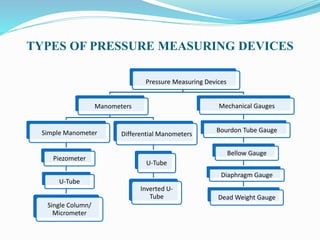
TYPES OF PRESSURE MEASURING DEVICES
Pressure Measuring Devices
Manometers
Simple Manometer
Piezometer
U-Tube
Single Column/
Micrometer
Differential Manometers
U-Tube
Inverted U-
Tube
Mechanical Gauges
Bourdon Tube Gauge
Bellow Gauge
Diaphragm Gauge
Dead Weight Gauge
Bourdon Tube Pressure Gauge
• The Bourdon Tube Gauge, invented about 1850, is still one of
the most widely used instruments for measuring the pressure
of liquids and gases of all kinds, including steam, water, and air
up to pressures of 100,000 pounds per square inch (70,000
Newton's per square cm).
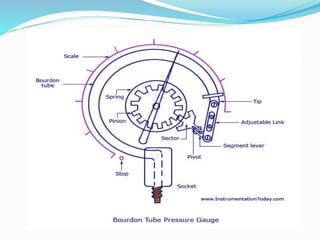
• The device consists of a flattened circular tube coiled into a
circular arc. One end is soldered to a central block and is open
to the fluid whose pressure is to be measured; the other end is
sealed and coupled to the pointer spindle. When the pressure
inside the tube is greater than the outside pressure, the tube
tends to straighten, thus turning the pointer. The pressure is
read on a circular scale.
• Bourdon tubes come in three basic types:-
a) C-type.
b) Spiral-type.
c) Helical-type.
• Common applications for a bourdon tube include:
i. Gas distribution.
ii. Automotive.
iii. Chemical.
iv. Medical .
v. Water.
Bellow Gauge
• Bellow type gauges are used for the measurement of
absolute pressure. They are more sensitive than
bourdon type. It may be used for measuring pressures
up to 40 mm Hg.
• The bellows are made up of an alloy with high strength
and ductility. It should have very little hysteresis effect.
Commonly brass or phosphor bronze is used for making
bellows.
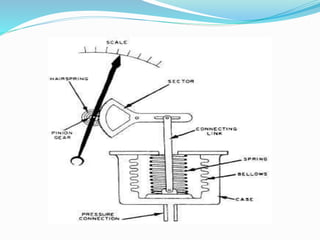
• Working:-The bellows are used in two forms. In one
arrangement, pressure is applied to one side of the
bellows and the resulting deflection is counter balanced
by a spring. This arrangement indicates the gauge
pressure. In the second arrangement, the differential
pressure is also indicated. In this device, one pressure is
applied to the inside of one sealed bellow while the other
pressure is applied to the inside of another sealed bellow.
By suitable linkage and calibration of the scale ,the
pressure difference is indicated by a pointer on a
scale.
Diaphragm Pressure Gauge
• Diaphragm pressure gauges are used to measure gases and
liquids. They cover measuring spans from 10 mbar to 40 bar.
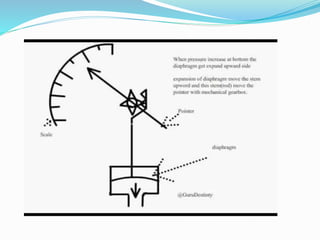
• The measuring element consists of one circular diaphragm
clamped between a pair of flanges. The positive or negative
pressure acting on these diaphragms causes deformation of
the measuring element. The magnitude of the deformation is
proportional to the pressure to be measured, and it is coupled
to the pointer mechanism.
• Working:-The diaphragm pressure gauge consists of a circular
membrane, made from sheet metal of precise dimensions,
which can either be flat or corrugated.
The diaphragm is mechanically connected to the transmission
mechanism which will amplify the small deflections of the
diaphragm and transfer them to the pointer.
The process pressure is applied to the lower side of the
diaphragm, while the upper side is at atmospheric pressure.
The differential pressure arising across the diaphragm, lifts up
the diaphragm and puts the pointer in motion.
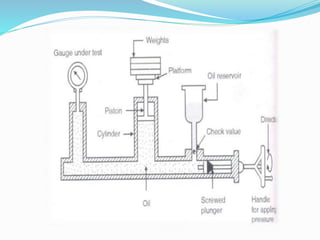
Dead Weight Pressure Gauge
• The Dead weight is basically a pressure producing and pressure
measuring device. It is used to calibrate pressure gauges. The
following procedure is adopted for calibrating pressure gauges.
Calibration of pressure gauge means introducing an accurately
known sample of pressure to the gauge under test and then
observing the response of the gauge.
• The Dead weight apparatus consists of a chamber which is filled
with oil free impurities and a piston – cylinder combination is fitted
above the chamber. The top portion of the piston is attached with a
platform to carry weights. A plunger with a handle has been
provided to vary the pressure of oil in the chamber. The pressure
gauge to be tested is fitted at an appropriate plate.
THANK YOU

Pressure measuring devices

  • 2.
    Pressure Measuring Devices •Pressure:- It is the force applied perpendicular to the surface of an object per unit area over which that force is distributed. Pressure= force/area The devices used for measuring the fluid pressure are termed as pressure measuring devices.
  • 3.
    TYPES OF PRESSUREMEASURING DEVICES Pressure Measuring Devices Manometers Simple Manometer Piezometer U-Tube Single Column/ Micrometer Differential Manometers U-Tube Inverted U- Tube Mechanical Gauges Bourdon Tube Gauge Bellow Gauge Diaphragm Gauge Dead Weight Gauge
  • 4.
    Bourdon Tube PressureGauge • The Bourdon Tube Gauge, invented about 1850, is still one of the most widely used instruments for measuring the pressure of liquids and gases of all kinds, including steam, water, and air up to pressures of 100,000 pounds per square inch (70,000 Newton's per square cm). • The device consists of a flattened circular tube coiled into a circular arc. One end is soldered to a central block and is open to the fluid whose pressure is to be measured; the other end is sealed and coupled to the pointer spindle. When the pressure inside the tube is greater than the outside pressure, the tube tends to straighten, thus turning the pointer. The pressure is read on a circular scale.
  • 6.
    • Bourdon tubescome in three basic types:- a) C-type. b) Spiral-type. c) Helical-type. • Common applications for a bourdon tube include: i. Gas distribution. ii. Automotive. iii. Chemical. iv. Medical . v. Water.
  • 7.
    Bellow Gauge • Bellowtype gauges are used for the measurement of absolute pressure. They are more sensitive than bourdon type. It may be used for measuring pressures up to 40 mm Hg. • The bellows are made up of an alloy with high strength and ductility. It should have very little hysteresis effect. Commonly brass or phosphor bronze is used for making bellows.
  • 8.
    • Working:-The bellowsare used in two forms. In one arrangement, pressure is applied to one side of the bellows and the resulting deflection is counter balanced by a spring. This arrangement indicates the gauge pressure. In the second arrangement, the differential pressure is also indicated. In this device, one pressure is applied to the inside of one sealed bellow while the other pressure is applied to the inside of another sealed bellow. By suitable linkage and calibration of the scale ,the pressure difference is indicated by a pointer on a scale.
  • 10.
    Diaphragm Pressure Gauge •Diaphragm pressure gauges are used to measure gases and liquids. They cover measuring spans from 10 mbar to 40 bar. • The measuring element consists of one circular diaphragm clamped between a pair of flanges. The positive or negative pressure acting on these diaphragms causes deformation of the measuring element. The magnitude of the deformation is proportional to the pressure to be measured, and it is coupled to the pointer mechanism.
  • 12.
    • Working:-The diaphragmpressure gauge consists of a circular membrane, made from sheet metal of precise dimensions, which can either be flat or corrugated. The diaphragm is mechanically connected to the transmission mechanism which will amplify the small deflections of the diaphragm and transfer them to the pointer. The process pressure is applied to the lower side of the diaphragm, while the upper side is at atmospheric pressure. The differential pressure arising across the diaphragm, lifts up the diaphragm and puts the pointer in motion.
  • 13.
    Dead Weight PressureGauge • The Dead weight is basically a pressure producing and pressure measuring device. It is used to calibrate pressure gauges. The following procedure is adopted for calibrating pressure gauges. Calibration of pressure gauge means introducing an accurately known sample of pressure to the gauge under test and then observing the response of the gauge. • The Dead weight apparatus consists of a chamber which is filled with oil free impurities and a piston – cylinder combination is fitted above the chamber. The top portion of the piston is attached with a platform to carry weights. A plunger with a handle has been provided to vary the pressure of oil in the chamber. The pressure gauge to be tested is fitted at an appropriate plate.
  • 15.