Fluid Mechanics I
ME 371
Chapter 0
Lecture 1
General Introduction
Coll Engg Yanbu - TU Fluid Mechanics I - General Introduction - Prof A Haddad
Crowe et al.-Engg Fluid Mechanics
2
General Introduction
- Introductory Information -
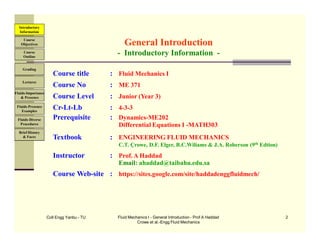
Course title : Fluid Mechanics I
Course No : ME 371
Course Level : Junior (Year 3)
Cr-Lt-Lb : 4-3-3
Prerequisite : Dynamics-ME202
Differential Equations I -MATH303
Textbook : ENGINEERING FLUID MECHANICS
C.T. Çrowe, D.F. Elger, B.C.Wiliams & J.A. Roberson (9th Edtion)
Instructor : Prof. A Haddad
Email: ahaddad@taibahu.edu.sa
Course Web-site : https://sites.google.com/site/haddadenggfluidmech/
Course
Objectives
Introductory
Information
Course
Outline
Grading
Lectures
Fluids-Importance
& Presence
Fluids-Presence
Examples
Fluids-Diverse
Procedures
Brief History
& Faces
Coll Engg Yanbu - TU Fluid Mechanics I - General Introduction - Prof A Haddad
Crowe et al.-Engg Fluid Mechanics
3
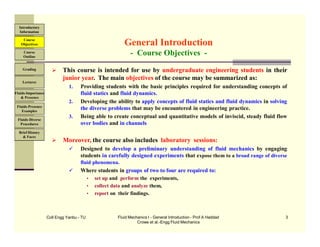
 This course is intended for use by undergraduate engineering students in their
junior year. The main objectives of the course may be summarized as:
1. Providing students with the basic principles required for understanding concepts of
fluid statics and fluid dynamics.
2. Developing the ability to apply concepts of fluid statics and fluid dynamics in solving
the diverse problems that may be encountered in engineering practice.
3. Being able to create conceptual and quantitative models of inviscid, steady fluid flow
over bodies and in channels
 Moreover, the course also includes laboratory sessions:
 Designed to develop a preliminary understanding of fluid mechanics by engaging
students in carefully designed experiments that expose them to a broad range of diverse
fluid phenomena.
 Where students in groups of two to four are required to:
• set up and perform the experiments,
• collect data and analyze them,
• report on their findings.
General Introduction
- Course Objectives -
Course
Objectives
Introductory
Information
Course
Outline
Grading
Lectures
Fluids-Importance
& Presence
Fluids-Presence
Examples
Fluids-Diverse
Procedures
Brief History
& Faces
Coll Engg Yanbu - TU Fluid Mechanics I - General Introduction - Prof A Haddad
Crowe et al.-Engg Fluid Mechanics
4
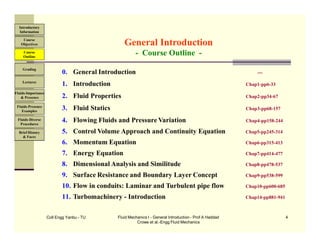
0. General Introduction ---
1. Introduction Chap1-pp6-33
2. Fluid Properties Chap2-pp34-67
3. Fluid Statics Chap3-pp68-157
4. Flowing Fluids and Pressure Variation Chap4-pp158-244
5. Control Volume Approach and Continuity Equation Chap5-pp245-314
6. Momentum Equation Chap6-pp315-413
7. Energy Equation Chap7-pp414-477
8. Dimensional Analysis and Similitude Chap8-pp478-537
9. Surface Resistance and Boundary Layer Concept Chap9-pp538-599
10. Flow in conduits: Laminar and Turbulent pipe flow Chap10-pp600-685
11. Turbomachinery - Introduction Chap14-pp881-941
General Introduction
- Course Outline -
Course
Objectives
Introductory
Information
Course
Outline
Grading
Lectures
Fluids-Importance
& Presence
Fluids-Presence
Examples
Fluids-Diverse
Procedures
Brief History
& Faces
Coll Engg Yanbu - TU Fluid Mechanics I - General Introduction - Prof A Haddad
Crowe et al.-Engg Fluid Mechanics
5
 The course will be covered through:
 3 hours lecture per week,
 3 hours laboratory per week.
 The grading of the subject will be distributed as follows:
 Class activities…………………….………. 50%
• Quizzes, Exams, HWs, Projects…….. 20%
• ½ Term Exam……………………….. 20%
• Lab work…………………………….. 10%
 Final Exam………………………….…….. 50%
• Theory………………………………… 40%
• Lab……………………………...…….. 10%
 Passing rate………………………………….…. 60%
General Introduction
- Grading -
Course
Objectives
Introductory
Information
Course
Outline
Grading
Lectures
Fluids-Importance
& Presence
Fluids-Presence
Examples
Fluids-Diverse
Procedures
Brief History
& Faces
Coll Engg Yanbu - TU Fluid Mechanics I - General Introduction - Prof A Haddad
Crowe et al.-Engg Fluid Mechanics
6
 Every Chapter :
 Begins with the objectives and a summary of the material to be covered,
 Contains example problems to be solved in the lecture as much as possible
or else in extra tutorial sessions,
 Ends up with a Quiz,
 Comes along with a set of questions and problems divided following the
chapter paragraphs. Students are encouraged to try to solve as much as
they can.
 Every Lecture:
 Begins with a reminder of last lecture,
 Follows up with the presentation of the subjects to be studied,
 Closes up with solving some examples related to the material studied.
General Introduction
- Lectures -
Course
Objectives
Introductory
Information
Course
Outline
Grading
Lectures
Fluids-Importance
& Presence
Fluids-Presence
Examples
Fluids-Diverse
Procedures
Brief History
& Faces
Coll Engg Yanbu - TU Fluid Mechanics I - General Introduction - Prof A Haddad
Crowe et al.-Engg Fluid Mechanics
7
 Fluids:
 are essential to life.
 Affect every part of our lives.
• Human body 65% water,
• Earth’s surface is 2/3 water,
• Atmosphere extends 17km above the earth’s surface.
 Fluids are omnipresent in our lives:
 Weather & Climate,
 Vehicles,
 Environment,
 Medicine,
 Sports,
 Others…
General Introduction
- Fluids-Importance & Presence -
Course
Objectives
Introductory
Information
Course
Outline
Grading
Lectures
Fluids-Importance
& Presence
Fluids-Presence
Examples
Fluids-Diverse
Procedures
Brief History
& Faces
Coll Engg Yanbu - TU Fluid Mechanics I - General Introduction - Prof A Haddad
Crowe et al.-Engg Fluid Mechanics
8
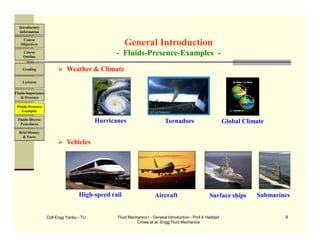
 Weather & Climate
 Vehicles
General Introduction
- Fluids-Presence-Examples -
Hurricanes Tornadoes Global Climate
Aircraft Submarines
High-speed rail Surface ships
Course
Objectives
Introductory
Information
Course
Outline
Grading
Lectures
Fluids-Importance
& Presence
Fluids-Presence
Examples
Fluids-Diverse
Procedures
Brief History
& Faces
Coll Engg Yanbu - TU Fluid Mechanics I - General Introduction - Prof A Haddad
Crowe et al.-Engg Fluid Mechanics
9
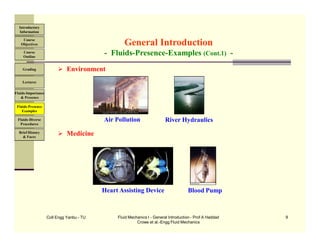
 Environment
 Medicine
General Introduction
- Fluids-Presence-Examples (Cont.1) -
Air Pollution River Hydraulics
Heart Assisting Device Blood Pump
Course
Objectives
Introductory
Information
Course
Outline
Grading
Lectures
Fluids-Importance
& Presence
Fluids-Presence
Examples
Fluids-Diverse
Procedures
Brief History
& Faces
Coll Engg Yanbu - TU Fluid Mechanics I - General Introduction - Prof A Haddad
Crowe et al.-Engg Fluid Mechanics
10
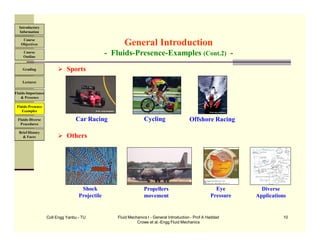
 Sports
 Others
General Introduction
- Fluids-Presence-Examples (Cont.2) -
Car Racing Cycling Offshore Racing
Propellers
movement
Eye
Pressure
Shock
Projectile
Diverse
Applications
Course
Objectives
Introductory
Information
Course
Outline
Grading
Lectures
Fluids-Importance
& Presence
Fluids-Presence
Examples
Fluids-Diverse
Procedures
Brief History
& Faces
Coll Engg Yanbu - TU Fluid Mechanics I - General Introduction - Prof A Haddad
Crowe et al.-Engg Fluid Mechanics
11
General Introduction
- Fluids-Diverse Procedures -
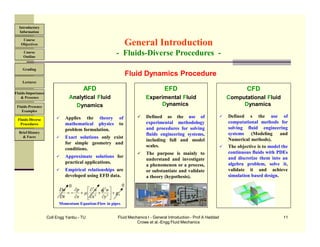
Fluid Dynamics Procedure
CFD
Computational Fluid
Dynamics
 Defined s the use of
computational methods for
solving fluid engineering
systems (Modeling and
Numerical methods).
 The objective is to model the
continuous fluids with PDEs
and discretize them into an
algebra problem, solve it,
validate it and achieve
simulation based design.
EFD
Experimental Fluid
Dynamics
 Defined as the use of
experimental methodology
and procedures for solving
fluids engineering systems,
including full and model
scales.
 The purpose is mainly to
understand and investigate
a phenomenon or a process,
or substantiate and validate
a theory (hypothesis).
AFD
Analytical Fluid
Dynamics
 Applies the theory of
mathematical physics to
problem formulation.
 Exact solutions only exist
for simple geometry and
conditions.
 Approximate solutions for
practical applications.
 Empirical relationships are
developed using EFD data.
0
x
g
y
u
x
u
x
p
Dt
Du
















 2
2
2
2

0
0
Momentum Equation-Flow in pipes
Course
Objectives
Introductory
Information
Course
Outline
Grading
Lectures
Fluids-Importance
& Presence
Fluids-Presence
Examples
Fluids-Diverse
Procedures
Brief History
& Faces
Coll Engg Yanbu - TU Fluid Mechanics I - General Introduction - Prof A Haddad
Crowe et al.-Engg Fluid Mechanics
12
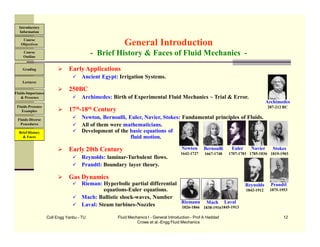
 Early Applications
 Ancient Egypt: Irrigation Systems.
 250BC
 Archimedes: Birth of Experimental Fluid Mechanics ~ Trial & Error.
 17th-18th Century
 Newton, Bernoulli, Euler, Navier, Stokes: Fundamental principles of Fluids.
 All of them were mathematicians.
 Development of the basic equations of
fluid motion.
 Early 20th Century
 Reynolds: laminar-Turbulent flows.
 Prandtl: Boundary layer theory.
 Gas Dynamics
 Rieman: Hyperbolic partial differential
equations-Euler equations.
 Mach: Ballistic shock-waves, Number
 Laval: Steam turbines-Nozzles
General Introduction
- Brief History & Faces of Fluid Mechanics -
Archimedes
287-212 BC
Newton
1642-1727
Bernoulli
1667-1748
Stokes
1819-1903
Navier
1785-1836
Euler
1707-1783
Prandtl
1875-1953
Reynolds
1842-1912
Riemann
1826-1866
Laval
1845-1913
Mach
1838-1916
Course
Objectives
Introductory
Information
Course
Outline
Grading
Lectures
Fluids-Importance
& Presence
Fluids-Presence
Examples
Fluids-Diverse
Procedures
Brief History
& Faces

MDF44444444444444444444444I_Chap0Lect1.pdf

  • 1.
    Fluid Mechanics I ME371 Chapter 0 Lecture 1 General Introduction
  • 2.
    Coll Engg Yanbu- TU Fluid Mechanics I - General Introduction - Prof A Haddad Crowe et al.-Engg Fluid Mechanics 2 General Introduction - Introductory Information - Course title : Fluid Mechanics I Course No : ME 371 Course Level : Junior (Year 3) Cr-Lt-Lb : 4-3-3 Prerequisite : Dynamics-ME202 Differential Equations I -MATH303 Textbook : ENGINEERING FLUID MECHANICS C.T. Çrowe, D.F. Elger, B.C.Wiliams & J.A. Roberson (9th Edtion) Instructor : Prof. A Haddad Email: ahaddad@taibahu.edu.sa Course Web-site : https://sites.google.com/site/haddadenggfluidmech/ Course Objectives Introductory Information Course Outline Grading Lectures Fluids-Importance & Presence Fluids-Presence Examples Fluids-Diverse Procedures Brief History & Faces
  • 3.
    Coll Engg Yanbu- TU Fluid Mechanics I - General Introduction - Prof A Haddad Crowe et al.-Engg Fluid Mechanics 3  This course is intended for use by undergraduate engineering students in their junior year. The main objectives of the course may be summarized as: 1. Providing students with the basic principles required for understanding concepts of fluid statics and fluid dynamics. 2. Developing the ability to apply concepts of fluid statics and fluid dynamics in solving the diverse problems that may be encountered in engineering practice. 3. Being able to create conceptual and quantitative models of inviscid, steady fluid flow over bodies and in channels  Moreover, the course also includes laboratory sessions:  Designed to develop a preliminary understanding of fluid mechanics by engaging students in carefully designed experiments that expose them to a broad range of diverse fluid phenomena.  Where students in groups of two to four are required to: • set up and perform the experiments, • collect data and analyze them, • report on their findings. General Introduction - Course Objectives - Course Objectives Introductory Information Course Outline Grading Lectures Fluids-Importance & Presence Fluids-Presence Examples Fluids-Diverse Procedures Brief History & Faces
  • 4.
    Coll Engg Yanbu- TU Fluid Mechanics I - General Introduction - Prof A Haddad Crowe et al.-Engg Fluid Mechanics 4 0. General Introduction --- 1. Introduction Chap1-pp6-33 2. Fluid Properties Chap2-pp34-67 3. Fluid Statics Chap3-pp68-157 4. Flowing Fluids and Pressure Variation Chap4-pp158-244 5. Control Volume Approach and Continuity Equation Chap5-pp245-314 6. Momentum Equation Chap6-pp315-413 7. Energy Equation Chap7-pp414-477 8. Dimensional Analysis and Similitude Chap8-pp478-537 9. Surface Resistance and Boundary Layer Concept Chap9-pp538-599 10. Flow in conduits: Laminar and Turbulent pipe flow Chap10-pp600-685 11. Turbomachinery - Introduction Chap14-pp881-941 General Introduction - Course Outline - Course Objectives Introductory Information Course Outline Grading Lectures Fluids-Importance & Presence Fluids-Presence Examples Fluids-Diverse Procedures Brief History & Faces
  • 5.
    Coll Engg Yanbu- TU Fluid Mechanics I - General Introduction - Prof A Haddad Crowe et al.-Engg Fluid Mechanics 5  The course will be covered through:  3 hours lecture per week,  3 hours laboratory per week.  The grading of the subject will be distributed as follows:  Class activities…………………….………. 50% • Quizzes, Exams, HWs, Projects…….. 20% • ½ Term Exam……………………….. 20% • Lab work…………………………….. 10%  Final Exam………………………….…….. 50% • Theory………………………………… 40% • Lab……………………………...…….. 10%  Passing rate………………………………….…. 60% General Introduction - Grading - Course Objectives Introductory Information Course Outline Grading Lectures Fluids-Importance & Presence Fluids-Presence Examples Fluids-Diverse Procedures Brief History & Faces
  • 6.
    Coll Engg Yanbu- TU Fluid Mechanics I - General Introduction - Prof A Haddad Crowe et al.-Engg Fluid Mechanics 6  Every Chapter :  Begins with the objectives and a summary of the material to be covered,  Contains example problems to be solved in the lecture as much as possible or else in extra tutorial sessions,  Ends up with a Quiz,  Comes along with a set of questions and problems divided following the chapter paragraphs. Students are encouraged to try to solve as much as they can.  Every Lecture:  Begins with a reminder of last lecture,  Follows up with the presentation of the subjects to be studied,  Closes up with solving some examples related to the material studied. General Introduction - Lectures - Course Objectives Introductory Information Course Outline Grading Lectures Fluids-Importance & Presence Fluids-Presence Examples Fluids-Diverse Procedures Brief History & Faces
  • 7.
    Coll Engg Yanbu- TU Fluid Mechanics I - General Introduction - Prof A Haddad Crowe et al.-Engg Fluid Mechanics 7  Fluids:  are essential to life.  Affect every part of our lives. • Human body 65% water, • Earth’s surface is 2/3 water, • Atmosphere extends 17km above the earth’s surface.  Fluids are omnipresent in our lives:  Weather & Climate,  Vehicles,  Environment,  Medicine,  Sports,  Others… General Introduction - Fluids-Importance & Presence - Course Objectives Introductory Information Course Outline Grading Lectures Fluids-Importance & Presence Fluids-Presence Examples Fluids-Diverse Procedures Brief History & Faces
  • 8.
    Coll Engg Yanbu- TU Fluid Mechanics I - General Introduction - Prof A Haddad Crowe et al.-Engg Fluid Mechanics 8  Weather & Climate  Vehicles General Introduction - Fluids-Presence-Examples - Hurricanes Tornadoes Global Climate Aircraft Submarines High-speed rail Surface ships Course Objectives Introductory Information Course Outline Grading Lectures Fluids-Importance & Presence Fluids-Presence Examples Fluids-Diverse Procedures Brief History & Faces
  • 9.
    Coll Engg Yanbu- TU Fluid Mechanics I - General Introduction - Prof A Haddad Crowe et al.-Engg Fluid Mechanics 9  Environment  Medicine General Introduction - Fluids-Presence-Examples (Cont.1) - Air Pollution River Hydraulics Heart Assisting Device Blood Pump Course Objectives Introductory Information Course Outline Grading Lectures Fluids-Importance & Presence Fluids-Presence Examples Fluids-Diverse Procedures Brief History & Faces
  • 10.
    Coll Engg Yanbu- TU Fluid Mechanics I - General Introduction - Prof A Haddad Crowe et al.-Engg Fluid Mechanics 10  Sports  Others General Introduction - Fluids-Presence-Examples (Cont.2) - Car Racing Cycling Offshore Racing Propellers movement Eye Pressure Shock Projectile Diverse Applications Course Objectives Introductory Information Course Outline Grading Lectures Fluids-Importance & Presence Fluids-Presence Examples Fluids-Diverse Procedures Brief History & Faces
  • 11.
    Coll Engg Yanbu- TU Fluid Mechanics I - General Introduction - Prof A Haddad Crowe et al.-Engg Fluid Mechanics 11 General Introduction - Fluids-Diverse Procedures - Fluid Dynamics Procedure CFD Computational Fluid Dynamics  Defined s the use of computational methods for solving fluid engineering systems (Modeling and Numerical methods).  The objective is to model the continuous fluids with PDEs and discretize them into an algebra problem, solve it, validate it and achieve simulation based design. EFD Experimental Fluid Dynamics  Defined as the use of experimental methodology and procedures for solving fluids engineering systems, including full and model scales.  The purpose is mainly to understand and investigate a phenomenon or a process, or substantiate and validate a theory (hypothesis). AFD Analytical Fluid Dynamics  Applies the theory of mathematical physics to problem formulation.  Exact solutions only exist for simple geometry and conditions.  Approximate solutions for practical applications.  Empirical relationships are developed using EFD data. 0 x g y u x u x p Dt Du                  2 2 2 2  0 0 Momentum Equation-Flow in pipes Course Objectives Introductory Information Course Outline Grading Lectures Fluids-Importance & Presence Fluids-Presence Examples Fluids-Diverse Procedures Brief History & Faces
  • 12.
    Coll Engg Yanbu- TU Fluid Mechanics I - General Introduction - Prof A Haddad Crowe et al.-Engg Fluid Mechanics 12  Early Applications  Ancient Egypt: Irrigation Systems.  250BC  Archimedes: Birth of Experimental Fluid Mechanics ~ Trial & Error.  17th-18th Century  Newton, Bernoulli, Euler, Navier, Stokes: Fundamental principles of Fluids.  All of them were mathematicians.  Development of the basic equations of fluid motion.  Early 20th Century  Reynolds: laminar-Turbulent flows.  Prandtl: Boundary layer theory.  Gas Dynamics  Rieman: Hyperbolic partial differential equations-Euler equations.  Mach: Ballistic shock-waves, Number  Laval: Steam turbines-Nozzles General Introduction - Brief History & Faces of Fluid Mechanics - Archimedes 287-212 BC Newton 1642-1727 Bernoulli 1667-1748 Stokes 1819-1903 Navier 1785-1836 Euler 1707-1783 Prandtl 1875-1953 Reynolds 1842-1912 Riemann 1826-1866 Laval 1845-1913 Mach 1838-1916 Course Objectives Introductory Information Course Outline Grading Lectures Fluids-Importance & Presence Fluids-Presence Examples Fluids-Diverse Procedures Brief History & Faces