CHAPTER 2: FLUIDPRESSURE
PREPARED BY :
NOOR ASSIKIN BINTI ABD WAHAB
Learn more about
Fluids
&
TODAY’S GOAL
PRESSURE
PRESSURE
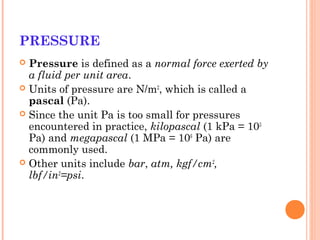
 Pressure is defined as a normal force exerted by
a fluid per unit area.
 Units of pressure are N/m2
, which is called a
pascal (Pa).
 Since the unit Pa is too small for pressures
encountered in practice, kilopascal (1 kPa = 103
Pa) and megapascal (1 MPa = 106
Pa) are
commonly used.
 Other units include bar, atm, kgf/cm2
,
lbf/in2
=psi.
Pressure
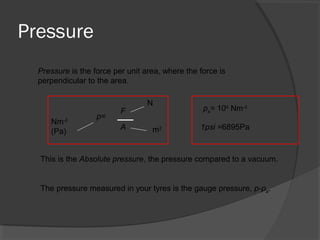
Pressure is the force per unit area, where the force is
perpendicular to the area.
p=
A m2
Nm-2
(Pa)
N
F
This is the Absolute pressure, the pressure compared to a vacuum.
pa= 105
Nm-2
1psi =6895Pa
The pressure measured in your tyres is the gauge pressure, p-pa.
Pressure
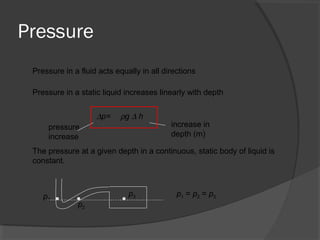
Pressure in a fluid acts equally in all directions
Pressure in a static liquid increases linearly with depth
∆p=
increase in
depth (m)
pressure
increase
ρg ∆ h
The pressure at a given depth in a continuous, static body of liquid is
constant.
p1
p2
p3 p1 = p2 = p3
Pressure
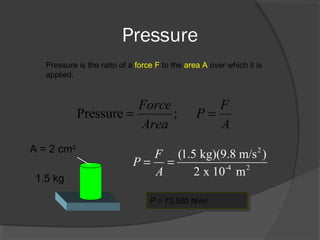
Pressure is the ratio of a force F to the area A over which it is
applied:
Pressure ;
Force F
P
Area A
= =
A = 2 cm2
1.5 kg
2
-4 2
(1.5 kg)(9.8 m/s )
2 x 10 m
F
P
A
= =
P = 73,500 N/m2P = 73,500 N/m2
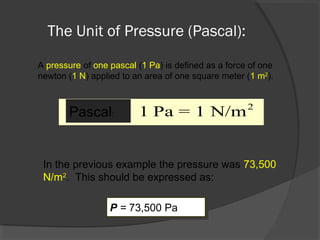
The Unit of Pressure (Pascal):
A pressure of one pascal (1 Pa) is defined as a force of one
newton (1 N) applied to an area of one square meter (1 m2
).
2
1 Pa = 1 N/mPascal:
In the previous example the pressure was 73,500
N/m2
. This should be expressed as:
P = 73,500 PaP = 73,500 Pa
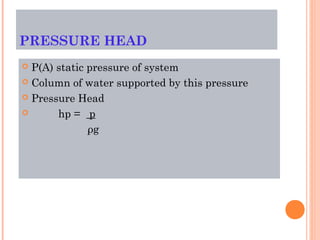
PRESSURE HEAD
 P(A) static pressure of system
 Column of water supported by this pressure
 Pressure Head
 hp = p
ρg
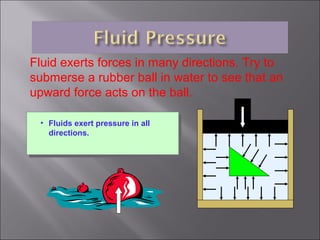
Fluid exerts forces in many directions. Try to
submerse a rubber ball in water to see that an
upward force acts on the ball.
• Fluids exert pressure in all
directions.
F
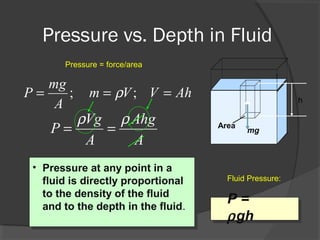
Pressure vs. Depth in Fluid
Pressure = force/area
; ;
mg
P m V V Ah
A
ρ= = =
Vg Ahg
P
A A
ρ ρ
= =
h
mg
Area
• Pressure at any point in a
fluid is directly proportional
to the density of the fluid
and to the depth in the fluid.
P =
ρgh
Fluid Pressure:
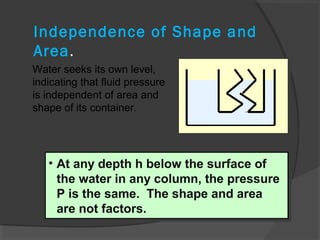
Independence of Shape and
Area.
Water seeks its own level,
indicating that fluid pressure
is independent of area and
shape of its container.
• At any depth h below the surface of
the water in any column, the pressure
P is the same. The shape and area
are not factors.
• At any depth h below the surface of
the water in any column, the pressure
P is the same. The shape and area
are not factors.
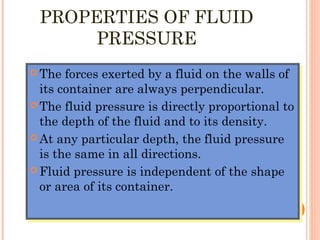
PROPERTIES OF FLUID
PRESSURE
 The forces exerted by a fluid on the walls of
its container are always perpendicular.
 The fluid pressure is directly proportional to
the depth of the fluid and to its density.
 At any particular depth, the fluid pressure
is the same in all directions.
 Fluid pressure is independent of the shape
or area of its container.
 The forces exerted by a fluid on the walls of
its container are always perpendicular.
 The fluid pressure is directly proportional to
the depth of the fluid and to its density.
 At any particular depth, the fluid pressure
is the same in all directions.
 Fluid pressure is independent of the shape
or area of its container.
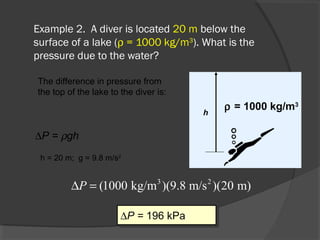
Example 2. A diver is located 20 m below the
surface of a lake (ρ = 1000 kg/m3
). What is the
pressure due to the water?
h
ρ = 1000 kg/m3
∆P = ρgh
The difference in pressure from
the top of the lake to the diver is:
h = 20 m; g = 9.8 m/s2
3 2
(1000 kg/m )(9.8 m/s )(20 m)P∆ =
∆P = 196 kPa∆P = 196 kPa
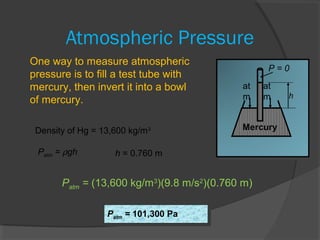
Atmospheric Pressure
at
m
at
m h
Mercury
P = 0
One way to measure atmospheric
pressure is to fill a test tube with
mercury, then invert it into a bowl
of mercury.
Density of Hg = 13,600 kg/m3
Patm = ρgh h = 0.760 m
Patm = (13,600 kg/m3
)(9.8 m/s2
)(0.760 m)
Patm = 101,300 PaPatm = 101,300 Pa
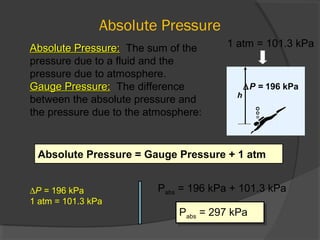
Absolute Pressure
Absolute Pressure:Absolute Pressure: The sum of the
pressure due to a fluid and the
pressure due to atmosphere.
Gauge Pressure:Gauge Pressure: The difference
between the absolute pressure and
the pressure due to the atmosphere:
Absolute Pressure = Gauge Pressure + 1 atmAbsolute Pressure = Gauge Pressure + 1 atm
h
∆P = 196 kPa
1 atm = 101.3 kPa
∆P = 196 kPa
1 atm = 101.3 kPa
Pabs = 196 kPa + 101.3 kPa
Pabs = 297 kPaPabs = 297 kPa
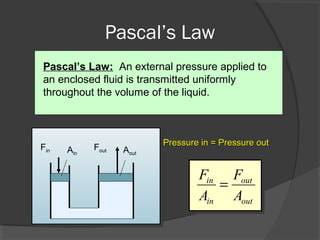
Pascal’s Law
Pascal’s Law: An external pressure applied to
an enclosed fluid is transmitted uniformly
throughout the volume of the liquid.
FoutFin AoutAin
Pressure in = Pressure outPressure in = Pressure out
in out
in out
F F
A A
=
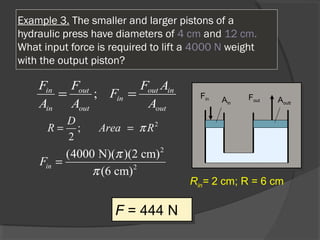
Example 3. The smaller and larger pistons of a
hydraulic press have diameters of 4 cm and 12 cm.
What input force is required to lift a 4000 N weight
with the output piston?
Fout
Fin AouttAin
;in out out in
in
in out out
F F F A
F
A A A
= =
2
2
(4000 N)( )(2 cm)
(6 cm)
inF
π
π
=
2
;
2
D
R Area Rπ= =
F = 444 NF = 444 N
Rin= 2 cm; R = 6 cm
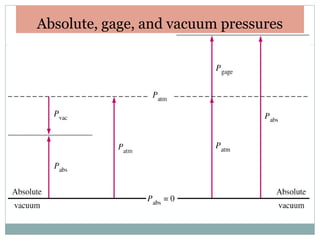
ABSOLUTE, GAGE, AND VACUUM
PRESSURES
 Actual pressure at a give point is called the
absolute pressure.
 Most pressure-measuring devices are calibrated
to read zero in the atmosphere, and therefore
indicate gage pressure, Pgage=Pabs - Patm.
 Pressure below atmospheric pressure are called
vacuum pressure, Pvac=Patm - Pabs.
Absolute, gage, and vacuum pressures
PRESSURE AT A POINT
 Pressure at any point in a fluid is the same in all
directions.
 Pressure has a magnitude, but not a specific
direction, and thus it is a scalar quantity.
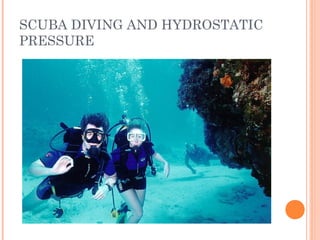
SCUBA DIVING AND HYDROSTATIC
PRESSURE
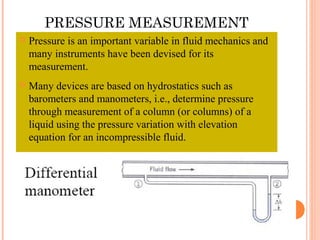
PRESSURE MEASUREMENT
 Pressure is an important variable in fluid mechanics and
many instruments have been devised for its
measurement.
 Many devices are based on hydrostatics such as
barometers and manometers, i.e., determine pressure
through measurement of a column (or columns) of a
liquid using the pressure variation with elevation
equation for an incompressible fluid.
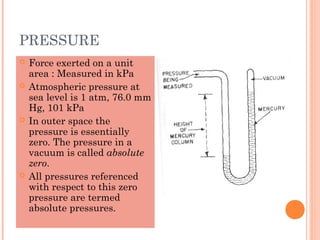
PRESSURE
 Force exerted on a unit
area : Measured in kPa
 Atmospheric pressure at
sea level is 1 atm, 76.0 mm
Hg, 101 kPa
 In outer space the
pressure is essentially
zero. The pressure in a
vacuum is called absolute
zero.
 All pressures referenced
with respect to this zero
pressure are termed
absolute pressures.
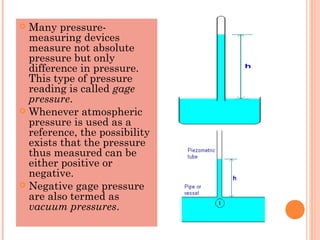
 Many pressure-
measuring devices
measure not absolute
pressure but only
difference in pressure.
This type of pressure
reading is called gage
pressure.
 Whenever atmospheric
pressure is used as a
reference, the possibility
exists that the pressure
thus measured can be
either positive or
negative.
 Negative gage pressure
are also termed as
vacuum pressures.
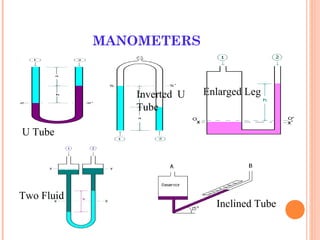
MANOMETERS
U Tube
Enlarged Leg
Two Fluid
Inclined Tube
Inverted U
Tube
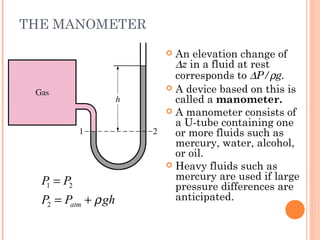
THE MANOMETER
1 2
2 atm
P P
P P ghρ
=
= +
 An elevation change of
∆z in a fluid at rest
corresponds to ∆P/ρg.
 A device based on this is
called a manometer.
 A manometer consists of
a U-tube containing one
or more fluids such as
mercury, water, alcohol,
or oil.
 Heavy fluids such as
mercury are used if large
pressure differences are
anticipated.
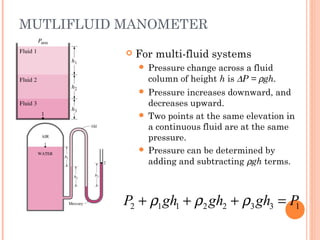
MUTLIFLUID MANOMETER
 For multi-fluid systems
 Pressure change across a fluid
column of height h is ∆P = ρgh.
 Pressure increases downward, and
decreases upward.
 Two points at the same elevation in
a continuous fluid are at the same
pressure.
 Pressure can be determined by
adding and subtracting ρgh terms.
2 1 1 2 2 3 3 1P gh gh gh Pρ ρ ρ+ + + =
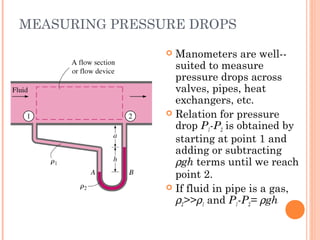
MEASURING PRESSURE DROPS
 Manometers are well--
suited to measure
pressure drops across
valves, pipes, heat
exchangers, etc.
 Relation for pressure
drop P1-P2 is obtained by
starting at point 1 and
adding or subtracting
ρgh terms until we reach
point 2.
 If fluid in pipe is a gas,
ρ2>>ρ1 and P1-P2= ρgh
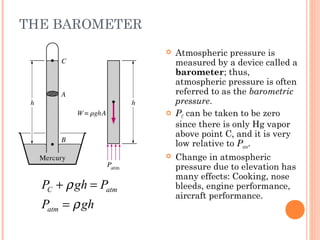
THE BAROMETER
C atm
atm
P gh P
P gh
ρ
ρ
+ =
=
 Atmospheric pressure is
measured by a device called a
barometer; thus,
atmospheric pressure is often
referred to as the barometric
pressure.
 PC can be taken to be zero
since there is only Hg vapor
above point C, and it is very
low relative to Patm.
 Change in atmospheric
pressure due to elevation has
many effects: Cooking, nose
bleeds, engine performance,
aircraft performance.
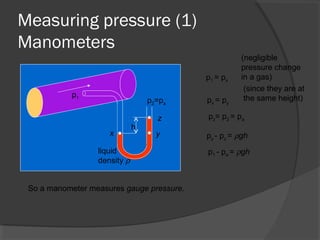
Measuring pressure (1)
Manometers
h
p1
p2=pa
liquid
density ρ
x y
z
p1 = px
px = py
pz= p2 = pa
(negligible
pressure change
in a gas)
(since they are at
the same height)
py - pz = ρgh
p1 - pa = ρgh
So a manometer measures gauge pressure.
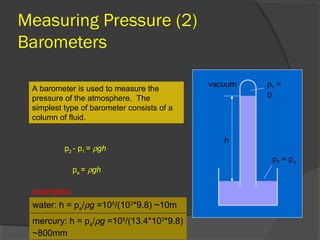
Measuring Pressure (2)
Barometers
A barometer is used to measure the
pressure of the atmosphere. The
simplest type of barometer consists of a
column of fluid.
p1 =
0
vacuum
h
p2 = pa
p2 - p1 = ρgh
pa = ρgh
examples
water: h = pa/ρg =105
/(103
*9.8) ~10m
mercury: h = pa/ρg =105
/(13.4*103
*9.8)
~800mm

S3 Chapter 2 Fluid Pressure

  • 1.
    CHAPTER 2: FLUIDPRESSURE PREPAREDBY : NOOR ASSIKIN BINTI ABD WAHAB
  • 2.
  • 3.
    PRESSURE  Pressure isdefined as a normal force exerted by a fluid per unit area.  Units of pressure are N/m2 , which is called a pascal (Pa).  Since the unit Pa is too small for pressures encountered in practice, kilopascal (1 kPa = 103 Pa) and megapascal (1 MPa = 106 Pa) are commonly used.  Other units include bar, atm, kgf/cm2 , lbf/in2 =psi.
  • 4.
    Pressure Pressure is theforce per unit area, where the force is perpendicular to the area. p= A m2 Nm-2 (Pa) N F This is the Absolute pressure, the pressure compared to a vacuum. pa= 105 Nm-2 1psi =6895Pa The pressure measured in your tyres is the gauge pressure, p-pa.
  • 5.
    Pressure Pressure in afluid acts equally in all directions Pressure in a static liquid increases linearly with depth ∆p= increase in depth (m) pressure increase ρg ∆ h The pressure at a given depth in a continuous, static body of liquid is constant. p1 p2 p3 p1 = p2 = p3
  • 6.
    Pressure Pressure is theratio of a force F to the area A over which it is applied: Pressure ; Force F P Area A = = A = 2 cm2 1.5 kg 2 -4 2 (1.5 kg)(9.8 m/s ) 2 x 10 m F P A = = P = 73,500 N/m2P = 73,500 N/m2
  • 7.
    The Unit ofPressure (Pascal): A pressure of one pascal (1 Pa) is defined as a force of one newton (1 N) applied to an area of one square meter (1 m2 ). 2 1 Pa = 1 N/mPascal: In the previous example the pressure was 73,500 N/m2 . This should be expressed as: P = 73,500 PaP = 73,500 Pa
  • 8.
    PRESSURE HEAD  P(A)static pressure of system  Column of water supported by this pressure  Pressure Head  hp = p ρg
  • 9.
    Fluid exerts forcesin many directions. Try to submerse a rubber ball in water to see that an upward force acts on the ball. • Fluids exert pressure in all directions. F
  • 10.
    Pressure vs. Depthin Fluid Pressure = force/area ; ; mg P m V V Ah A ρ= = = Vg Ahg P A A ρ ρ = = h mg Area • Pressure at any point in a fluid is directly proportional to the density of the fluid and to the depth in the fluid. P = ρgh Fluid Pressure:
  • 11.
    Independence of Shapeand Area. Water seeks its own level, indicating that fluid pressure is independent of area and shape of its container. • At any depth h below the surface of the water in any column, the pressure P is the same. The shape and area are not factors. • At any depth h below the surface of the water in any column, the pressure P is the same. The shape and area are not factors.
  • 12.
    PROPERTIES OF FLUID PRESSURE The forces exerted by a fluid on the walls of its container are always perpendicular.  The fluid pressure is directly proportional to the depth of the fluid and to its density.  At any particular depth, the fluid pressure is the same in all directions.  Fluid pressure is independent of the shape or area of its container.  The forces exerted by a fluid on the walls of its container are always perpendicular.  The fluid pressure is directly proportional to the depth of the fluid and to its density.  At any particular depth, the fluid pressure is the same in all directions.  Fluid pressure is independent of the shape or area of its container.
  • 13.
    Example 2. Adiver is located 20 m below the surface of a lake (ρ = 1000 kg/m3 ). What is the pressure due to the water? h ρ = 1000 kg/m3 ∆P = ρgh The difference in pressure from the top of the lake to the diver is: h = 20 m; g = 9.8 m/s2 3 2 (1000 kg/m )(9.8 m/s )(20 m)P∆ = ∆P = 196 kPa∆P = 196 kPa
  • 14.
    Atmospheric Pressure at m at m h Mercury P= 0 One way to measure atmospheric pressure is to fill a test tube with mercury, then invert it into a bowl of mercury. Density of Hg = 13,600 kg/m3 Patm = ρgh h = 0.760 m Patm = (13,600 kg/m3 )(9.8 m/s2 )(0.760 m) Patm = 101,300 PaPatm = 101,300 Pa
  • 15.
    Absolute Pressure Absolute Pressure:AbsolutePressure: The sum of the pressure due to a fluid and the pressure due to atmosphere. Gauge Pressure:Gauge Pressure: The difference between the absolute pressure and the pressure due to the atmosphere: Absolute Pressure = Gauge Pressure + 1 atmAbsolute Pressure = Gauge Pressure + 1 atm h ∆P = 196 kPa 1 atm = 101.3 kPa ∆P = 196 kPa 1 atm = 101.3 kPa Pabs = 196 kPa + 101.3 kPa Pabs = 297 kPaPabs = 297 kPa
  • 16.
    Pascal’s Law Pascal’s Law:An external pressure applied to an enclosed fluid is transmitted uniformly throughout the volume of the liquid. FoutFin AoutAin Pressure in = Pressure outPressure in = Pressure out in out in out F F A A =
  • 17.
    Example 3. Thesmaller and larger pistons of a hydraulic press have diameters of 4 cm and 12 cm. What input force is required to lift a 4000 N weight with the output piston? Fout Fin AouttAin ;in out out in in in out out F F F A F A A A = = 2 2 (4000 N)( )(2 cm) (6 cm) inF π π = 2 ; 2 D R Area Rπ= = F = 444 NF = 444 N Rin= 2 cm; R = 6 cm
  • 18.
    ABSOLUTE, GAGE, ANDVACUUM PRESSURES  Actual pressure at a give point is called the absolute pressure.  Most pressure-measuring devices are calibrated to read zero in the atmosphere, and therefore indicate gage pressure, Pgage=Pabs - Patm.  Pressure below atmospheric pressure are called vacuum pressure, Pvac=Patm - Pabs.
  • 19.
    Absolute, gage, andvacuum pressures
  • 20.
    PRESSURE AT APOINT  Pressure at any point in a fluid is the same in all directions.  Pressure has a magnitude, but not a specific direction, and thus it is a scalar quantity.
  • 21.
    SCUBA DIVING ANDHYDROSTATIC PRESSURE
  • 22.
    PRESSURE MEASUREMENT  Pressureis an important variable in fluid mechanics and many instruments have been devised for its measurement.  Many devices are based on hydrostatics such as barometers and manometers, i.e., determine pressure through measurement of a column (or columns) of a liquid using the pressure variation with elevation equation for an incompressible fluid.
  • 23.
    PRESSURE  Force exertedon a unit area : Measured in kPa  Atmospheric pressure at sea level is 1 atm, 76.0 mm Hg, 101 kPa  In outer space the pressure is essentially zero. The pressure in a vacuum is called absolute zero.  All pressures referenced with respect to this zero pressure are termed absolute pressures.
  • 24.
     Many pressure- measuringdevices measure not absolute pressure but only difference in pressure. This type of pressure reading is called gage pressure.  Whenever atmospheric pressure is used as a reference, the possibility exists that the pressure thus measured can be either positive or negative.  Negative gage pressure are also termed as vacuum pressures.
  • 25.
    MANOMETERS U Tube Enlarged Leg TwoFluid Inclined Tube Inverted U Tube
  • 26.
    THE MANOMETER 1 2 2atm P P P P ghρ = = +  An elevation change of ∆z in a fluid at rest corresponds to ∆P/ρg.  A device based on this is called a manometer.  A manometer consists of a U-tube containing one or more fluids such as mercury, water, alcohol, or oil.  Heavy fluids such as mercury are used if large pressure differences are anticipated.
  • 27.
    MUTLIFLUID MANOMETER  Formulti-fluid systems  Pressure change across a fluid column of height h is ∆P = ρgh.  Pressure increases downward, and decreases upward.  Two points at the same elevation in a continuous fluid are at the same pressure.  Pressure can be determined by adding and subtracting ρgh terms. 2 1 1 2 2 3 3 1P gh gh gh Pρ ρ ρ+ + + =
  • 28.
    MEASURING PRESSURE DROPS Manometers are well-- suited to measure pressure drops across valves, pipes, heat exchangers, etc.  Relation for pressure drop P1-P2 is obtained by starting at point 1 and adding or subtracting ρgh terms until we reach point 2.  If fluid in pipe is a gas, ρ2>>ρ1 and P1-P2= ρgh
  • 29.
    THE BAROMETER C atm atm Pgh P P gh ρ ρ + = =  Atmospheric pressure is measured by a device called a barometer; thus, atmospheric pressure is often referred to as the barometric pressure.  PC can be taken to be zero since there is only Hg vapor above point C, and it is very low relative to Patm.  Change in atmospheric pressure due to elevation has many effects: Cooking, nose bleeds, engine performance, aircraft performance.
  • 30.
    Measuring pressure (1) Manometers h p1 p2=pa liquid densityρ x y z p1 = px px = py pz= p2 = pa (negligible pressure change in a gas) (since they are at the same height) py - pz = ρgh p1 - pa = ρgh So a manometer measures gauge pressure.
  • 31.
    Measuring Pressure (2) Barometers Abarometer is used to measure the pressure of the atmosphere. The simplest type of barometer consists of a column of fluid. p1 = 0 vacuum h p2 = pa p2 - p1 = ρgh pa = ρgh examples water: h = pa/ρg =105 /(103 *9.8) ~10m mercury: h = pa/ρg =105 /(13.4*103 *9.8) ~800mm