


• Recommended Books:
                                       “Fluid Mechanics with Engineering
                                          Applications” 10th Edition
                                      By: E. John Finnemore & Joseph B.
                                          Franzini
                                       “Fluid Mechanics with Engineering
                                          Applications” SI Metric edition
                                      By: Robert L. Daugherty, Joseph B.
                                          Franzini & E. John Finnemore
                                       “Fundamentals of Fluid Mechanics”
FLUID MECHANICS-I                     By: Musen Young
CE-224
                                      ** Useful links:
                                      • http://www.civil.canterbury.ac.nz/
Engr. Fazal-E-Jalal                       pubs/FM4CE.pdf

   Prepared by: Engr. Fazal-E-Jalal     Fluid Mechanics-I                    1
COURSE CONTENTS

1.      Introduction
2.      Fluid Statics
3.      Forces on Immersed bodies
4.      Fluid Kinematics
5.      Hydrodynamics
6.      Flow measurement
7.      Steady Flow through pipes
8.      Uniform flow in open channels
9.      Dimensional Analysis and Similitude

Prepared by: Engr. Fazal-E-Jalal   Fluid Mechanics-I   2
LECTURE# 01


Prepared by: Engr. Fazal-E-Jalal   Fluid Mechanics-I                 3
Contents
• Scope of Fluid Mechanics
 1. Applications
 2. Branches of Fluid mechanics
 3. Advancement with advent of computers
• Dimensions and Units
 1. British Gravitational System
 2. System International
 3. Scope of above mentioned systems


Prepared by: Engr. Fazal-E-Jalal    Fluid Mechanics-I   4
Scope of Fluid Mechanics
• Fluid Mechanics is involved in:
1. Movement of clouds in atmosphere
2. Flight of birds through air
3. Flow of water in streams
4. Breaking of waves at seashore
• F.M include “gases” and “liquids”, with air
   and water as most prevalent.

Prepared by: Engr. Fazal-E-Jalal   Fluid Mechanics-I   5
Scope of Fluid Mechanics
• Some other aspects that include F.M are:
 Flow in pipelines and channels
 Movements of air and blood in body
 Air resistance or Drag
 Wind loading on buildings
 Motion of projectiles, jets, shock waves
 Lubrication

Prepared by: Engr. Fazal-E-Jalal   Fluid Mechanics-I   6
Scope of Fluid Mechanics
 Combustion
 Irrigation
 Sedimentation
 Meteorology
 Oceanography


Prepared by: Engr. Fazal-E-Jalal   Fluid Mechanics-I   7
Scope of Fluid Mechanics
• A knowledge of Fluid mechanics is required to
  properly design:
a) Water supply systems
b) Wastewater Treatment facilities
c) Dam Spillways
d) Valves, Windmills, Turbines, Pumps
e) Flow meters, Heating & Air-conditioning system
f) Hydraulic shock absorbers and brakes

Prepared by: Engr. Fazal-E-Jalal   Fluid Mechanics-I   8
Scope of Fluid Mechanics
g) Automatic transmissions
h) Aircrafts, Ships, Submarines
i) Windmills, Turbines, Pumps etc.
  It is clear that every body’s life is affected by
  Fluid mechanics in variety of ways. All
  engineers should have at least a basic
  knowledge of fluid phenomenon.


Prepared by: Engr. Fazal-E-Jalal   Fluid Mechanics-I   9
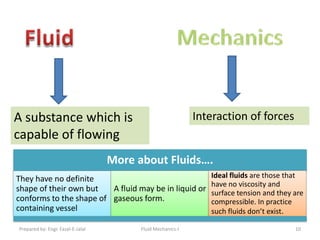
A substance which is                                         Interaction of forces
capable of flowing
                                   More about Fluids….
They have no definite                                           Ideal fluids are those that
                                                                have no viscosity and
shape of their own but   A fluid may be in liquid or            surface tension and they are
conforms to the shape of gaseous form.                          compressible. In practice
containing vessel                                               such fluids don’t exist.

Prepared by: Engr. Fazal-E-Jalal         Fluid Mechanics-I                               10
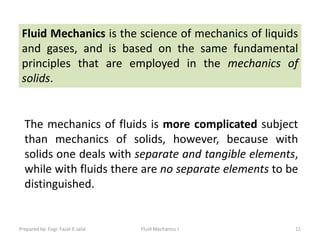
Fluid Mechanics is the science of mechanics of liquids
 and gases, and is based on the same fundamental
 principles that are employed in the mechanics of
 solids.


  The mechanics of fluids is more complicated subject
  than mechanics of solids, however, because with
  solids one deals with separate and tangible elements,
  while with fluids there are no separate elements to be
  distinguished.


Prepared by: Engr. Fazal-E-Jalal   Fluid Mechanics-I   11
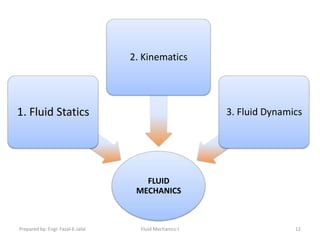
2. Kinematics


1. Fluid Statics                                         3. Fluid Dynamics


                                      FLUID
                                    MECHANICS


Prepared by: Engr. Fazal-E-Jalal     Fluid Mechanics-I                  12
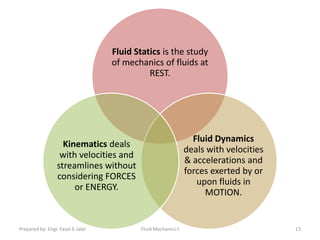
Fluid Statics is the study
                                   of mechanics of fluids at
                                             REST.


                                                                Fluid Dynamics
                    Kinematics deals
                                                              deals with velocities
                   with velocities and
                                                              & accelerations and
                  streamlines without
                                                              forces exerted by or
                  considering FORCES
                                                                 upon fluids in
                       or ENERGY.
                                                                   MOTION.


Prepared by: Engr. Fazal-E-Jalal          Fluid Mechanics-I                           13
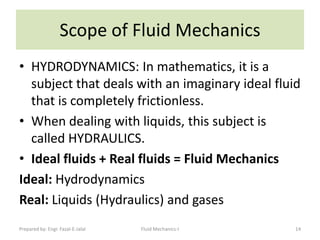
Scope of Fluid Mechanics
• HYDRODYNAMICS: In mathematics, it is a
  subject that deals with an imaginary ideal fluid
  that is completely frictionless.
• When dealing with liquids, this subject is
  called HYDRAULICS.
• Ideal fluids + Real fluids = Fluid Mechanics
Ideal: Hydrodynamics
Real: Liquids (Hydraulics) and gases
Prepared by: Engr. Fazal-E-Jalal   Fluid Mechanics-I   14
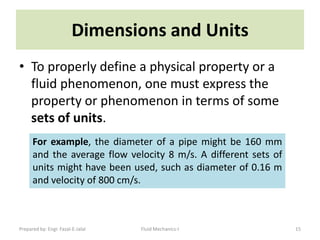
Dimensions and Units
• To properly define a physical property or a
  fluid phenomenon, one must express the
  property or phenomenon in terms of some
  sets of units.
      For example, the diameter of a pipe might be 160 mm
      and the average flow velocity 8 m/s. A different sets of
      units might have been used, such as diameter of 0.16 m
      and velocity of 800 cm/s.


Prepared by: Engr. Fazal-E-Jalal   Fluid Mechanics-I             15
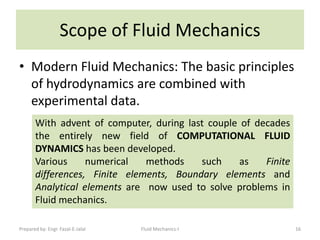
Scope of Fluid Mechanics
• Modern Fluid Mechanics: The basic principles
  of hydrodynamics are combined with
  experimental data.
       With advent of computer, during last couple of decades
       the entirely new field of COMPUTATIONAL FLUID
       DYNAMICS has been developed.
       Various     numerical   methods    such     as   Finite
       differences, Finite elements, Boundary elements and
       Analytical elements are now used to solve problems in
       Fluid mechanics.

Prepared by: Engr. Fazal-E-Jalal   Fluid Mechanics-I             16
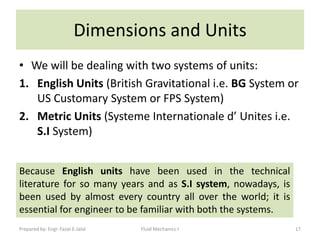
Dimensions and Units
• We will be dealing with two systems of units:
1. English Units (British Gravitational i.e. BG System or
   US Customary System or FPS System)
2. Metric Units (Systeme Internationale d’ Unites i.e.
   S.I System)


Because English units have been used in the technical
literature for so many years and as S.I system, nowadays, is
been used by almost every country all over the world; it is
essential for engineer to be familiar with both the systems.
Prepared by: Engr. Fazal-E-Jalal   Fluid Mechanics-I           17
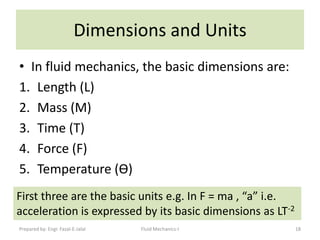
Dimensions and Units
• In fluid mechanics, the basic dimensions are:
1. Length (L)
2. Mass (M)
3. Time (T)
4. Force (F)
5. Temperature (Ѳ)
First three are the basic units e.g. In F = ma , “a” i.e.
acceleration is expressed by its basic dimensions as LT-2
Prepared by: Engr. Fazal-E-Jalal   Fluid Mechanics-I        18
In the two systems of units that we will be dealing, the
 commonly used units for the basic five dimensions are:

Dimension                          BG System                    SI Unit
Length (L)                         Foot (ft)                    Meter (m)

Mass (M)                           Slug ( = lb.sec2/ft)         Kilogram (kg)

Time (T)                           Second (sec)                 Second (sec)

Force (F)                          Pound (lb)                   Newton (N) (= kg.m/s2)

Temperature (Ѳ)

    Absolute                       Rankine (°R)                 Kelvin (K)

    Ordinary                       Fahrenheit ( °F)             Celsius ( °C)


Prepared by: Engr. Fazal-E-Jalal            Fluid Mechanics-I                            19
Dimensions and Units
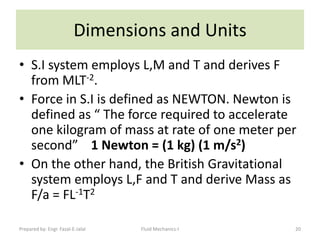
• S.I system employs L,M and T and derives F
  from MLT-2.
• Force in S.I is defined as NEWTON. Newton is
  defined as “ The force required to accelerate
  one kilogram of mass at rate of one meter per
  second” 1 Newton = (1 kg) (1 m/s2)
• On the other hand, the British Gravitational
  system employs L,F and T and derive Mass as
  F/a = FL-1T2

Prepared by: Engr. Fazal-E-Jalal   Fluid Mechanics-I   20
Dimensions and Units
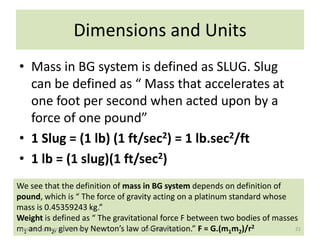
• Mass in BG system is defined as SLUG. Slug
  can be defined as “ Mass that accelerates at
  one foot per second when acted upon by a
  force of one pound”
• 1 Slug = (1 lb) (1 ft/sec2) = 1 lb.sec2/ft
• 1 lb = (1 slug)(1 ft/sec2)
We see that the definition of mass in BG system depends on definition of
pound, which is “ The force of gravity acting on a platinum standard whose
mass is 0.45359243 kg.”
Weight is defined as “ The gravitational force F between two bodies of masses
m1 and m2, given by Newton’s law of Gravitation.” F = G.(m1m2)/r2
 Prepared by: Engr. Fazal-E-Jalal  Fluid Mechanics-I                        21
Dimensions and Units
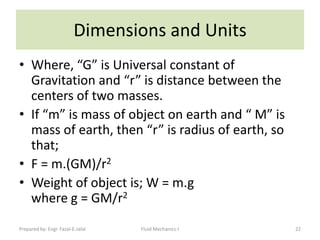
• Where, “G” is Universal constant of
  Gravitation and “r” is distance between the
  centers of two masses.
• If “m” is mass of object on earth and “ M” is
  mass of earth, then “r” is radius of earth, so
  that;
• F = m.(GM)/r2
• Weight of object is; W = m.g
  where g = GM/r2
Prepared by: Engr. Fazal-E-Jalal   Fluid Mechanics-I   22
Dimensions and Units
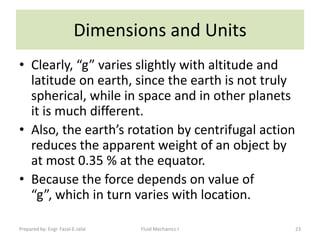
• Clearly, “g” varies slightly with altitude and
  latitude on earth, since the earth is not truly
  spherical, while in space and in other planets
  it is much different.
• Also, the earth’s rotation by centrifugal action
  reduces the apparent weight of an object by
  at most 0.35 % at the equator.
• Because the force depends on value of
  “g”, which in turn varies with location.

Prepared by: Engr. Fazal-E-Jalal   Fluid Mechanics-I   23
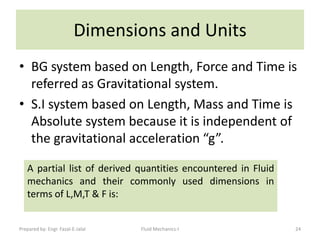
Dimensions and Units
• BG system based on Length, Force and Time is
  referred as Gravitational system.
• S.I system based on Length, Mass and Time is
  Absolute system because it is independent of
  the gravitational acceleration “g”.

   A partial list of derived quantities encountered in Fluid
   mechanics and their commonly used dimensions in
   terms of L,M,T & F is:


Prepared by: Engr. Fazal-E-Jalal   Fluid Mechanics-I           24
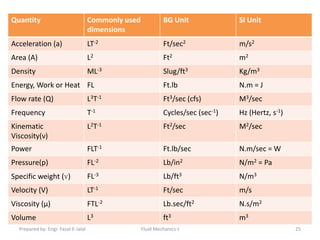
Quantity                             Commonly used            BG Unit              SI Unit
                                     dimensions
Acceleration (a)                     LT-2                     Ft/sec2              m/s2
Area (A)                             L2                       Ft2                  m2
Density                              ML-3                     Slug/ft3             Kg/m3
Energy, Work or Heat FL                                       Ft.lb                N.m = J
Flow rate (Q)                        L3T-1                    Ft3/sec (cfs)        M3/sec
Frequency                            T-1                      Cycles/sec (sec-1)   Hz (Hertz, s-1)
Kinematic                            L2T-1                    Ft2/sec              M2/sec
Viscosity(ν)
Power                                FLT-1                    Ft.lb/sec            N.m/sec = W
Pressure(p)                          FL-2                     Lb/in2               N/m2 = Pa
Specific weight (ɣ)                  FL-3                     Lb/ft3               N/m3
Velocity (V)                         LT-1                     Ft/sec               m/s
Viscosity (μ)                        FTL-2                    Lb.sec/ft2           N.s/m2
Volume                               L3                       ft3                  m3
  Prepared by: Engr. Fazal-E-Jalal                   Fluid Mechanics-I                               25
Dimensions and Units
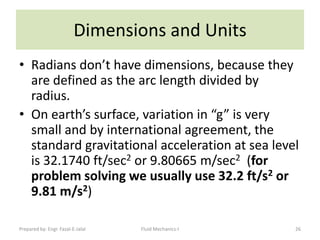
• Radians don’t have dimensions, because they
  are defined as the arc length divided by
  radius.
• On earth’s surface, variation in “g” is very
  small and by international agreement, the
  standard gravitational acceleration at sea level
  is 32.1740 ft/sec2 or 9.80665 m/sec2 (for
  problem solving we usually use 32.2 ft/s2 or
  9.81 m/s2)

Prepared by: Engr. Fazal-E-Jalal   Fluid Mechanics-I   26
Dimensions and Units
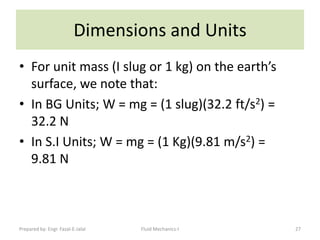
• For unit mass (I slug or 1 kg) on the earth’s
  surface, we note that:
• In BG Units; W = mg = (1 slug)(32.2 ft/s2) =
  32.2 N
• In S.I Units; W = mg = (1 Kg)(9.81 m/s2) =
  9.81 N


Prepared by: Engr. Fazal-E-Jalal   Fluid Mechanics-I   27
Dimensions and Units
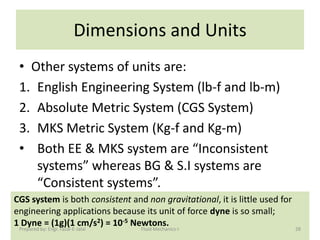
 • Other systems of units are:
 1. English Engineering System (lb-f and lb-m)
 2. Absolute Metric System (CGS System)
 3. MKS Metric System (Kg-f and Kg-m)
 • Both EE & MKS system are “Inconsistent
    systems” whereas BG & S.I systems are
    “Consistent systems”.
CGS system is both consistent and non gravitational, it is little used for
engineering applications because its unit of force dyne is so small;
1 Prepared by: Engr. Fazal-E-Jalal 2) = 10-5 Newtons.
   Dyne = (1g)(1 cm/s                          Fluid Mechanics-I             28
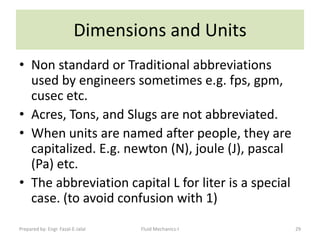
Dimensions and Units
• Non standard or Traditional abbreviations
  used by engineers sometimes e.g. fps, gpm,
  cusec etc.
• Acres, Tons, and Slugs are not abbreviated.
• When units are named after people, they are
  capitalized. E.g. newton (N), joule (J), pascal
  (Pa) etc.
• The abbreviation capital L for liter is a special
  case. (to avoid confusion with 1)
Prepared by: Engr. Fazal-E-Jalal   Fluid Mechanics-I   29
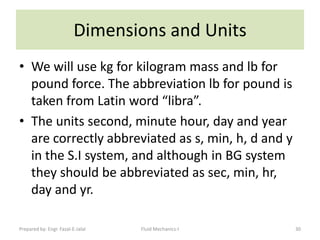
Dimensions and Units
• We will use kg for kilogram mass and lb for
  pound force. The abbreviation lb for pound is
  taken from Latin word “libra”.
• The units second, minute hour, day and year
  are correctly abbreviated as s, min, h, d and y
  in the S.I system, and although in BG system
  they should be abbreviated as sec, min, hr,
  day and yr.

Prepared by: Engr. Fazal-E-Jalal   Fluid Mechanics-I   30
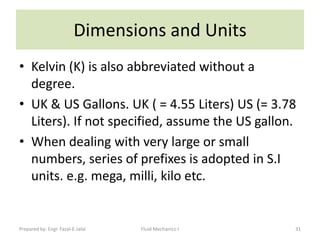
Dimensions and Units
• Kelvin (K) is also abbreviated without a
  degree.
• UK & US Gallons. UK ( = 4.55 Liters) US (= 3.78
  Liters). If not specified, assume the US gallon.
• When dealing with very large or small
  numbers, series of prefixes is adopted in S.I
  units. e.g. mega, milli, kilo etc.


Prepared by: Engr. Fazal-E-Jalal   Fluid Mechanics-I   31
Dimensions and Units
• Often we need to convert quantities from BG
  units into S.I units, and vice versa. Conversion
  factors may be used.
 In SI units, LENGTHS are commonly expressed in
 millimeters, centimeters, meters or kilometers,
 depending on the distance being measured.
 AREAS are usually expressed in square cm, square
 meters or hectares (ha), depending on the area being
 measured. 1 hectare = 10,000 m2 = 2.5 Acres

Prepared by: Engr. Fazal-E-Jalal   Fluid Mechanics-I    32
Dimensions and Units
•    1 N = 0.225 lb
•    Units for stress in S.I are N/m2 i.e. Pascal (Pa)
•    1 Pa = 0.021 lb/ft2 = .00015 psi
•    Units of Energy is Joule. 1 joule = 1 N.m
•    Unit of power is Watt (W). W = J/s = N.m/s
    When we have to work with less usual units, like
    centipoise (for viscosity) or ergs (for energy), It is best
    to convert them into S.I or BG units as soon as
    possible.
Prepared by: Engr. Fazal-E-Jalal   Fluid Mechanics-I          33
Prepared by: Engr. Fazal-E-Jalal   Fluid Mechanics-I   34

1. introduction

  • 1.
    • Recommended Books:  “Fluid Mechanics with Engineering Applications” 10th Edition By: E. John Finnemore & Joseph B. Franzini  “Fluid Mechanics with Engineering Applications” SI Metric edition By: Robert L. Daugherty, Joseph B. Franzini & E. John Finnemore  “Fundamentals of Fluid Mechanics” FLUID MECHANICS-I By: Musen Young CE-224 ** Useful links: • http://www.civil.canterbury.ac.nz/ Engr. Fazal-E-Jalal pubs/FM4CE.pdf Prepared by: Engr. Fazal-E-Jalal Fluid Mechanics-I 1
  • 2.
    COURSE CONTENTS 1. Introduction 2. Fluid Statics 3. Forces on Immersed bodies 4. Fluid Kinematics 5. Hydrodynamics 6. Flow measurement 7. Steady Flow through pipes 8. Uniform flow in open channels 9. Dimensional Analysis and Similitude Prepared by: Engr. Fazal-E-Jalal Fluid Mechanics-I 2
  • 3.
    LECTURE# 01 Prepared by:Engr. Fazal-E-Jalal Fluid Mechanics-I 3
  • 4.
    Contents • Scope ofFluid Mechanics 1. Applications 2. Branches of Fluid mechanics 3. Advancement with advent of computers • Dimensions and Units 1. British Gravitational System 2. System International 3. Scope of above mentioned systems Prepared by: Engr. Fazal-E-Jalal Fluid Mechanics-I 4
  • 5.
    Scope of FluidMechanics • Fluid Mechanics is involved in: 1. Movement of clouds in atmosphere 2. Flight of birds through air 3. Flow of water in streams 4. Breaking of waves at seashore • F.M include “gases” and “liquids”, with air and water as most prevalent. Prepared by: Engr. Fazal-E-Jalal Fluid Mechanics-I 5
  • 6.
    Scope of FluidMechanics • Some other aspects that include F.M are:  Flow in pipelines and channels  Movements of air and blood in body  Air resistance or Drag  Wind loading on buildings  Motion of projectiles, jets, shock waves  Lubrication Prepared by: Engr. Fazal-E-Jalal Fluid Mechanics-I 6
  • 7.
    Scope of FluidMechanics  Combustion  Irrigation  Sedimentation  Meteorology  Oceanography Prepared by: Engr. Fazal-E-Jalal Fluid Mechanics-I 7
  • 8.
    Scope of FluidMechanics • A knowledge of Fluid mechanics is required to properly design: a) Water supply systems b) Wastewater Treatment facilities c) Dam Spillways d) Valves, Windmills, Turbines, Pumps e) Flow meters, Heating & Air-conditioning system f) Hydraulic shock absorbers and brakes Prepared by: Engr. Fazal-E-Jalal Fluid Mechanics-I 8
  • 9.
    Scope of FluidMechanics g) Automatic transmissions h) Aircrafts, Ships, Submarines i) Windmills, Turbines, Pumps etc. It is clear that every body’s life is affected by Fluid mechanics in variety of ways. All engineers should have at least a basic knowledge of fluid phenomenon. Prepared by: Engr. Fazal-E-Jalal Fluid Mechanics-I 9
  • 10.
    A substance whichis Interaction of forces capable of flowing More about Fluids…. They have no definite Ideal fluids are those that have no viscosity and shape of their own but A fluid may be in liquid or surface tension and they are conforms to the shape of gaseous form. compressible. In practice containing vessel such fluids don’t exist. Prepared by: Engr. Fazal-E-Jalal Fluid Mechanics-I 10
  • 11.
    Fluid Mechanics isthe science of mechanics of liquids and gases, and is based on the same fundamental principles that are employed in the mechanics of solids. The mechanics of fluids is more complicated subject than mechanics of solids, however, because with solids one deals with separate and tangible elements, while with fluids there are no separate elements to be distinguished. Prepared by: Engr. Fazal-E-Jalal Fluid Mechanics-I 11
  • 12.
    2. Kinematics 1. FluidStatics 3. Fluid Dynamics FLUID MECHANICS Prepared by: Engr. Fazal-E-Jalal Fluid Mechanics-I 12
  • 13.
    Fluid Statics isthe study of mechanics of fluids at REST. Fluid Dynamics Kinematics deals deals with velocities with velocities and & accelerations and streamlines without forces exerted by or considering FORCES upon fluids in or ENERGY. MOTION. Prepared by: Engr. Fazal-E-Jalal Fluid Mechanics-I 13
  • 14.
    Scope of FluidMechanics • HYDRODYNAMICS: In mathematics, it is a subject that deals with an imaginary ideal fluid that is completely frictionless. • When dealing with liquids, this subject is called HYDRAULICS. • Ideal fluids + Real fluids = Fluid Mechanics Ideal: Hydrodynamics Real: Liquids (Hydraulics) and gases Prepared by: Engr. Fazal-E-Jalal Fluid Mechanics-I 14
  • 15.
    Dimensions and Units •To properly define a physical property or a fluid phenomenon, one must express the property or phenomenon in terms of some sets of units. For example, the diameter of a pipe might be 160 mm and the average flow velocity 8 m/s. A different sets of units might have been used, such as diameter of 0.16 m and velocity of 800 cm/s. Prepared by: Engr. Fazal-E-Jalal Fluid Mechanics-I 15
  • 16.
    Scope of FluidMechanics • Modern Fluid Mechanics: The basic principles of hydrodynamics are combined with experimental data. With advent of computer, during last couple of decades the entirely new field of COMPUTATIONAL FLUID DYNAMICS has been developed. Various numerical methods such as Finite differences, Finite elements, Boundary elements and Analytical elements are now used to solve problems in Fluid mechanics. Prepared by: Engr. Fazal-E-Jalal Fluid Mechanics-I 16
  • 17.
    Dimensions and Units •We will be dealing with two systems of units: 1. English Units (British Gravitational i.e. BG System or US Customary System or FPS System) 2. Metric Units (Systeme Internationale d’ Unites i.e. S.I System) Because English units have been used in the technical literature for so many years and as S.I system, nowadays, is been used by almost every country all over the world; it is essential for engineer to be familiar with both the systems. Prepared by: Engr. Fazal-E-Jalal Fluid Mechanics-I 17
  • 18.
    Dimensions and Units •In fluid mechanics, the basic dimensions are: 1. Length (L) 2. Mass (M) 3. Time (T) 4. Force (F) 5. Temperature (Ѳ) First three are the basic units e.g. In F = ma , “a” i.e. acceleration is expressed by its basic dimensions as LT-2 Prepared by: Engr. Fazal-E-Jalal Fluid Mechanics-I 18
  • 19.
    In the twosystems of units that we will be dealing, the commonly used units for the basic five dimensions are: Dimension BG System SI Unit Length (L) Foot (ft) Meter (m) Mass (M) Slug ( = lb.sec2/ft) Kilogram (kg) Time (T) Second (sec) Second (sec) Force (F) Pound (lb) Newton (N) (= kg.m/s2) Temperature (Ѳ) Absolute Rankine (°R) Kelvin (K) Ordinary Fahrenheit ( °F) Celsius ( °C) Prepared by: Engr. Fazal-E-Jalal Fluid Mechanics-I 19
  • 20.
    Dimensions and Units •S.I system employs L,M and T and derives F from MLT-2. • Force in S.I is defined as NEWTON. Newton is defined as “ The force required to accelerate one kilogram of mass at rate of one meter per second” 1 Newton = (1 kg) (1 m/s2) • On the other hand, the British Gravitational system employs L,F and T and derive Mass as F/a = FL-1T2 Prepared by: Engr. Fazal-E-Jalal Fluid Mechanics-I 20
  • 21.
    Dimensions and Units •Mass in BG system is defined as SLUG. Slug can be defined as “ Mass that accelerates at one foot per second when acted upon by a force of one pound” • 1 Slug = (1 lb) (1 ft/sec2) = 1 lb.sec2/ft • 1 lb = (1 slug)(1 ft/sec2) We see that the definition of mass in BG system depends on definition of pound, which is “ The force of gravity acting on a platinum standard whose mass is 0.45359243 kg.” Weight is defined as “ The gravitational force F between two bodies of masses m1 and m2, given by Newton’s law of Gravitation.” F = G.(m1m2)/r2 Prepared by: Engr. Fazal-E-Jalal Fluid Mechanics-I 21
  • 22.
    Dimensions and Units •Where, “G” is Universal constant of Gravitation and “r” is distance between the centers of two masses. • If “m” is mass of object on earth and “ M” is mass of earth, then “r” is radius of earth, so that; • F = m.(GM)/r2 • Weight of object is; W = m.g where g = GM/r2 Prepared by: Engr. Fazal-E-Jalal Fluid Mechanics-I 22
  • 23.
    Dimensions and Units •Clearly, “g” varies slightly with altitude and latitude on earth, since the earth is not truly spherical, while in space and in other planets it is much different. • Also, the earth’s rotation by centrifugal action reduces the apparent weight of an object by at most 0.35 % at the equator. • Because the force depends on value of “g”, which in turn varies with location. Prepared by: Engr. Fazal-E-Jalal Fluid Mechanics-I 23
  • 24.
    Dimensions and Units •BG system based on Length, Force and Time is referred as Gravitational system. • S.I system based on Length, Mass and Time is Absolute system because it is independent of the gravitational acceleration “g”. A partial list of derived quantities encountered in Fluid mechanics and their commonly used dimensions in terms of L,M,T & F is: Prepared by: Engr. Fazal-E-Jalal Fluid Mechanics-I 24
  • 25.
    Quantity Commonly used BG Unit SI Unit dimensions Acceleration (a) LT-2 Ft/sec2 m/s2 Area (A) L2 Ft2 m2 Density ML-3 Slug/ft3 Kg/m3 Energy, Work or Heat FL Ft.lb N.m = J Flow rate (Q) L3T-1 Ft3/sec (cfs) M3/sec Frequency T-1 Cycles/sec (sec-1) Hz (Hertz, s-1) Kinematic L2T-1 Ft2/sec M2/sec Viscosity(ν) Power FLT-1 Ft.lb/sec N.m/sec = W Pressure(p) FL-2 Lb/in2 N/m2 = Pa Specific weight (ɣ) FL-3 Lb/ft3 N/m3 Velocity (V) LT-1 Ft/sec m/s Viscosity (μ) FTL-2 Lb.sec/ft2 N.s/m2 Volume L3 ft3 m3 Prepared by: Engr. Fazal-E-Jalal Fluid Mechanics-I 25
  • 26.
    Dimensions and Units •Radians don’t have dimensions, because they are defined as the arc length divided by radius. • On earth’s surface, variation in “g” is very small and by international agreement, the standard gravitational acceleration at sea level is 32.1740 ft/sec2 or 9.80665 m/sec2 (for problem solving we usually use 32.2 ft/s2 or 9.81 m/s2) Prepared by: Engr. Fazal-E-Jalal Fluid Mechanics-I 26
  • 27.
    Dimensions and Units •For unit mass (I slug or 1 kg) on the earth’s surface, we note that: • In BG Units; W = mg = (1 slug)(32.2 ft/s2) = 32.2 N • In S.I Units; W = mg = (1 Kg)(9.81 m/s2) = 9.81 N Prepared by: Engr. Fazal-E-Jalal Fluid Mechanics-I 27
  • 28.
    Dimensions and Units • Other systems of units are: 1. English Engineering System (lb-f and lb-m) 2. Absolute Metric System (CGS System) 3. MKS Metric System (Kg-f and Kg-m) • Both EE & MKS system are “Inconsistent systems” whereas BG & S.I systems are “Consistent systems”. CGS system is both consistent and non gravitational, it is little used for engineering applications because its unit of force dyne is so small; 1 Prepared by: Engr. Fazal-E-Jalal 2) = 10-5 Newtons. Dyne = (1g)(1 cm/s Fluid Mechanics-I 28
  • 29.
    Dimensions and Units •Non standard or Traditional abbreviations used by engineers sometimes e.g. fps, gpm, cusec etc. • Acres, Tons, and Slugs are not abbreviated. • When units are named after people, they are capitalized. E.g. newton (N), joule (J), pascal (Pa) etc. • The abbreviation capital L for liter is a special case. (to avoid confusion with 1) Prepared by: Engr. Fazal-E-Jalal Fluid Mechanics-I 29
  • 30.
    Dimensions and Units •We will use kg for kilogram mass and lb for pound force. The abbreviation lb for pound is taken from Latin word “libra”. • The units second, minute hour, day and year are correctly abbreviated as s, min, h, d and y in the S.I system, and although in BG system they should be abbreviated as sec, min, hr, day and yr. Prepared by: Engr. Fazal-E-Jalal Fluid Mechanics-I 30
  • 31.
    Dimensions and Units •Kelvin (K) is also abbreviated without a degree. • UK & US Gallons. UK ( = 4.55 Liters) US (= 3.78 Liters). If not specified, assume the US gallon. • When dealing with very large or small numbers, series of prefixes is adopted in S.I units. e.g. mega, milli, kilo etc. Prepared by: Engr. Fazal-E-Jalal Fluid Mechanics-I 31
  • 32.
    Dimensions and Units •Often we need to convert quantities from BG units into S.I units, and vice versa. Conversion factors may be used. In SI units, LENGTHS are commonly expressed in millimeters, centimeters, meters or kilometers, depending on the distance being measured. AREAS are usually expressed in square cm, square meters or hectares (ha), depending on the area being measured. 1 hectare = 10,000 m2 = 2.5 Acres Prepared by: Engr. Fazal-E-Jalal Fluid Mechanics-I 32
  • 33.
    Dimensions and Units • 1 N = 0.225 lb • Units for stress in S.I are N/m2 i.e. Pascal (Pa) • 1 Pa = 0.021 lb/ft2 = .00015 psi • Units of Energy is Joule. 1 joule = 1 N.m • Unit of power is Watt (W). W = J/s = N.m/s When we have to work with less usual units, like centipoise (for viscosity) or ergs (for energy), It is best to convert them into S.I or BG units as soon as possible. Prepared by: Engr. Fazal-E-Jalal Fluid Mechanics-I 33
  • 34.
    Prepared by: Engr.Fazal-E-Jalal Fluid Mechanics-I 34