Fluid Mechanics (CE-201)
Course Instructor
Dr. Ghufran Ahmed Pasha
(Assistant Professor)
Office :Civil Engg. Dept
ghufran.ahmed@uettaxila.edu.pk
Ph : 051-9047648
What do you think about this course?
Objective
 The objective of subject is to impart basic knowledge of the
physical processes associated with water and its motion that
are essential to the understanding, protection and
improvement of the environment. It deal primarily with the
occurrence and movement of water and other fluids on the
surface of the earth.
 This module develops topics in fluid mechanics of broad
interest to civil engineers, and demonstrates the link between
theoretical studies and their practical application in river and
environmental engineering.
Fluid
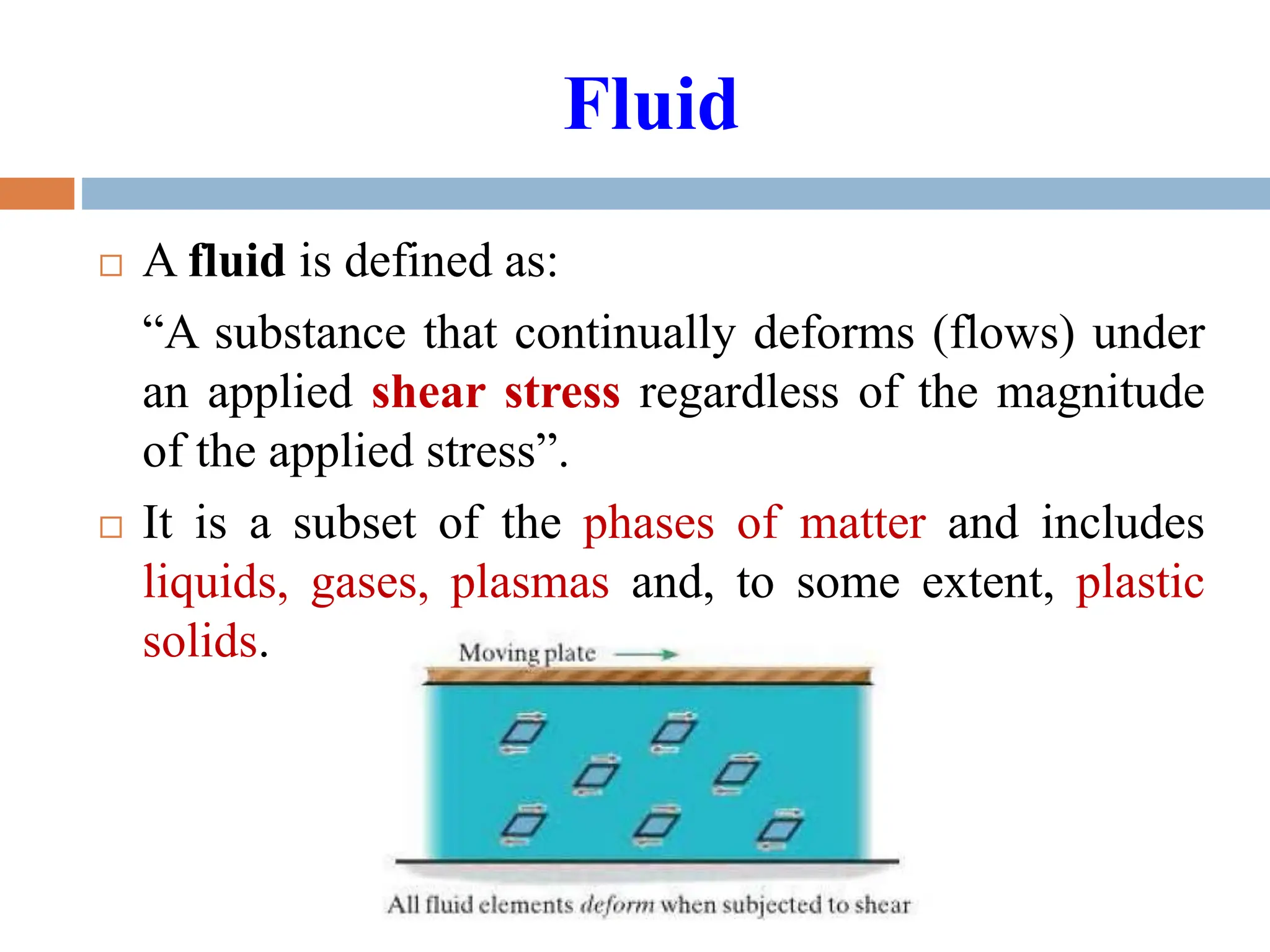
 A fluid is defined as:
“A substance that continually deforms (flows) under
an applied shear stress regardless of the magnitude
of the applied stress”.
 It is a subset of the phases of matter and includes
liquids, gases, plasmas and, to some extent, plastic
solids.
Fluid Vs Solid Mechanics
 Fluid mechanics:
“The study of the physics of materials which take the shape
of their container.” Or
“Branch of engineering science that studies fluids and forces
on them.” Or
“Fluid Mechanics is a study of the behavior of fluids that are
either at rest or in motion.”
 Solid Mechanics:
“The study of the physics of materials with a defined rest
shape.”
Introduction
 Fluid mechanics is a study of the behavior
of fluids that are, either at rest or in
motion.
 It is one of the primary engineering
sciences that has important applications in
many engineering disciplines. For example
aeronautical and aerospace engineers use
fluid mechanics principles to study flight, and
to design propulsion systems.
 Civil engineers use this subject to design
drainage channels, water networks, sewer
systems and water-resisting structures such
as dams and Levees (dyke, embankment).
 Fluid mechanics is used by mechanical engineers to design
pumps, compressors, turbines, control systems, heating and air
conditioning equipment, and to design wind turbines and
solar heating devices.
Introduction
 Chemical and petroleum engineers apply this subject to
design equipment used for filtering, pumping, and mixing
fluids.
 And finally engineers in the electronics and computer
industry use fluid mechanics principles to design switches,
screen displays, and data storage equipment.
Introduction
 Apart from the engineering profession, the principles of fluid
mechanics are also used in biomechanics, where it plays a
vita] role in the understanding of the circulatory, digestive,
and respiratory systems. and in meteorology to study the
motion and effects of tornadoes and hurricanes.
Introduction
Branches of Fluid Mechanics
Fluid
Mechanics
Hydrostatics Kinematics
Fluid
Dynamics
Branches of Fluid Mechanics
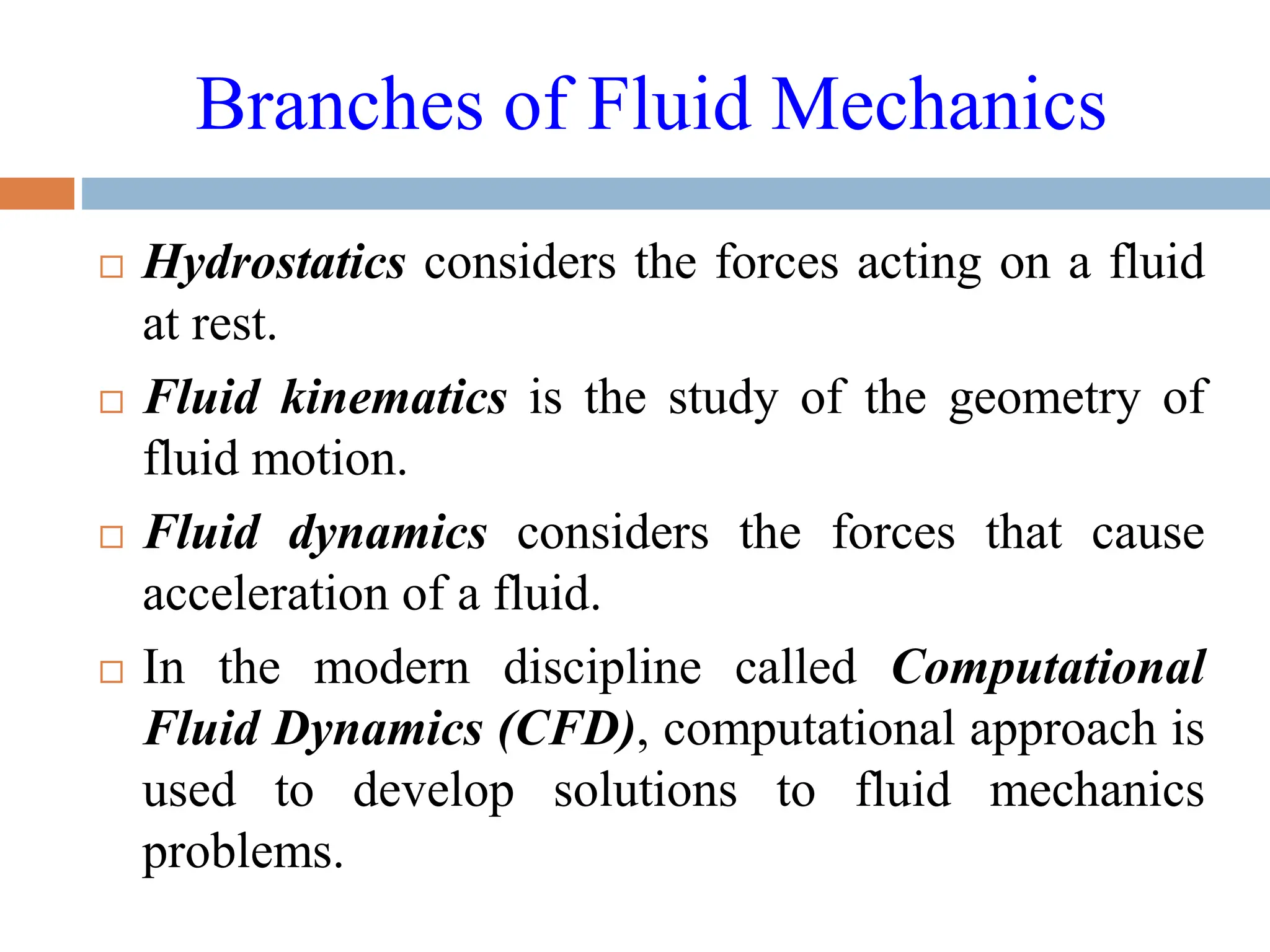
 Hydrostatics considers the forces acting on a fluid
at rest.
 Fluid kinematics is the study of the geometry of
fluid motion.
 Fluid dynamics considers the forces that cause
acceleration of a fluid.
 In the modern discipline called Computational
Fluid Dynamics (CFD), computational approach is
used to develop solutions to fluid mechanics
problems.
CLOs
At the end of this course, students will be able to:
No CLO Statement PLO Bloom’s
CLO-
1
Explain the basic concepts of fluid at rest
and motion.
PLO-1
(Engineering
Knowledge)
C-2
CLO-
2
Apply fundamental concepts for problem
solving in fluid statics and kinematics.
PLO-2
(Problem
Analysis)
C-3
PLOs
PLO-1
Engineering Knowledge: An ability to apply knowledge of
mathematics, science, engineering fundamentals and an
engineering specialization to the solution of complex engineering
problems.
PLO-2
Problem Analysis: An ability to identify, formulate, research
literature, and analyze complex engineering problems reaching
substantiated conclusions using first principles of mathematics,
natural sciences and engineering sciences.
Rubrics
 Assignments
 Title/assignment no, in proper cover
 Presentation
 Clarity
 Theory
 Numerical – steps
 (Statement, given data, figure, to find, solution)
 Time span
Recommended Books
Text Book:
 Fluid Mechanics With Engineering Applications (10th
Edition)
by E. John Finnemore & Joseph B. Franzini
Reference Books:
 Fluid Mechanics by R.C. Hibbler
 Applied Fluid Mechanics by Robert L. Mott
 Fluid Mechanics by A.K Jain
 A textbook of Hydraulics, Fluid Mechanics and Hydraulic
Machines by R.S. Khurmi
Course Contents:
 Properties of Fluid Mechanics
Introduction to Fluid Mechanics, Fluid Kinematics, Fluid Dynamics and
Hydraulics, Distinction between solids and fluids and liquids and Gases,
Brief description of physical properties: Density, specific volume, specific
weight, specific gravity and compressibility, ideal and real fluids,
Viscosity, Newton's Law of Viscosity, Types of Fluids, Units of Viscosity,
Measurement of Viscosity, Surface Tension.
 Fluid Statics
Pressure, Pressure-specific Relationship, Absolute and Gauge Pressure,
Measurement of Pressure, Bourdon Gauge, Pressure Transducer,
Piezometer, Simple Manometer, Differential Manometer, Forces on
submerged planes and curved surfaces and their application, Buoyancy and
stability of submerged and Floating Bodies.
Course Contents
 Kinematics of fluid Flow
Basic concepts about steady and unsteady flow, laminar and turbulent flow
and Uniform and Non-Uniform Flow, Path Line, streamline, Streak line
and stream Type, Flow Rate and Velocity, Equation of Continuity for
compressible and incompressible Fluids.
 Energy consideration in Steady Flow
Different forms of Energy in flowing liquid, Bernoulli's Equation and its
application, Head, Free & Forced Vortex.
 Flow Measurement
Measurement of Static Pressure and Velocity, Measurement of Discharge,
Orifices, Nozzles and Mouthpieces, Venturimeter, Sharp-Crested Weirs
and Notches.
 Steady Incompressible Flow in Pressure Conduits
Darcy-Weisbach equation for flow in pipes, Empirical formulae for pipe
flow, Losses in pipelines, Hydraulic Grade Line and Energy Line, Solution
of pipe flow problems, Transmission of Energy through pipes.
 Steady Flow in Open Channels
Chezy's and Manning's equations, Bazin's and Kutter's formula, Most
economical cross-section for open channels.
Course Contents
Marks Distribution
 Sessionals - 25%
 Attendance – 1%
 Assignments (including class project) – 9%
 Quizes – 10 %
 Mid Term - 25%
 Final Exam - 50%
Distinction between a Solid and a Fluid
Solid
 Definite Shape and definite
volume.
 Does not flow easily.
 Molecules are closer.
 Attractive forces between the
molecules are large enough to
retain its shape.
 An ideal Elastic Solid deform
under load and comes back to
original position upon removal of
load.
 Plastic Solid does not come back
to original position upon removal
of load, means permanent
deformation takes place.
Fluid
 Indefinite Shape and Indefinite
volume & it assumes the shape
of the container which it
occupies.
 Flow easily.
 Molecules are far apart.
 Attractive forces between the
molecules are smaller.
 Intermolecular cohesive forces
in a fluid are not great enough to
hold the various elements of
fluid together. Hence Fluid will
flow under the action of applied
stress. The flow will be
continuous as long as stress is
applied.
Distinction between a Gas and Liquid
 The molecules of a gas are
much farther apart than
those of a liquid.
 Hence a gas is very
compressible, and when
all external pressure is
removed, it tends to expand
indefinitely.
 A gas is therefore in
equilibrium only when it is
completely enclosed.
 A liquid is relatively
incompressible.
 If all pressure, except that
of its own vapor pressure,
is removed, the cohesion
between molecules holds
them together, so that the
liquid does not expand
indefinitely.
 Therefore a liquid may
have a free surface.
Systems of Units
SI Units
FPS Units
Important Terms
 Density (r):
Mass per unit volume of a substance.
 kg/m3 in SI units
 Slug/ft3 in FPS system of units
 Density of water is 1g/cm3 or 1000kg/m3
 Specific weight (g):
Weight per unit volume of substance.
 N/m3 in SI units
 lbs/ft3 in FPS units
 Sp. Wt. of water is 9.807 kN/m3 or 62.43 lb/ft3.
 Density and Specific Weight of a fluid are related as:
 Where g is the gravitational constant having value 9.8m/s2 or
32.2 ft/s2.
g
r
g 
V
w

g
V
m

r
Important Terms
 Specific Volume (v):
Volume occupied by unit mass of fluid.
 It is commonly applied to gases, and is usually expressed in
cubic feet per slug (m3/kg in SI units).
 Specific volume is the reciprocal of density.
r
/
1

 v
lume
SpecificVo
Important Terms
 Specific gravity:
It can be defined in either of two ways:
a. Specific gravity is the ratio of the density of a substance to
the density of water at 4°C.
b. Specific gravity is the ratio of the specific weight of a
substance to the specific weight of water at 4°C.
w
l
w
l
r
r
g
g


liquid
s
Example
The specific wt. of water at ordinary temperature and
pressure is 62.4lb/ft3. The specific gravity of mercury is
13.56. Compute density of water, Specific wt. of mercury,
and density of mercury.
Solution:
(Where Slug = lb.sec2/ ft)
3
mercury
3
mercury
3
/
3
.
26
938
.
1
56
.
13
3.
/
846
4
.
62
56
.
13
2.
slugs/ft
1.938
62.4/32.2
g
/
1.
ft
slugs
x
s
ft
lb
x
s
water
mercury
water
mercury
water
water









r
r
g
g
g
r
Example
A certain gas weighs 16.0 N/m3 at a certain temperature and
pressure. What are the values of its density, specific volume,
and specific gravity relative to air weighing 12.0 N/m3
Solution:
1.333
16/12
s
/γ
γ
s
gravity
Specific
3.
/kg
m
0.613
1/1.631
u
1/ρ
υ
volume
Specific
2.
kg/m
16.631
16/9.81
ρ
/g
γ
ρ
Density
1.
air
f
3
3









Example
The specific weight of glycerin is 78.6 lb/ft3. compute its density
and specific gravity. What is its specific weight in kN/m3
Solution:
3
3
3
3
w
3
kN/m
12.36
9.81
x
1260
g
x
kN/m
in
weight
Specific
3.
Kg/m
1260
kg/m
1.260x1000
so
1.260
78.6/62.4
s
/
s
gravity
Specific
2.
slugs/ft
2.44
78.6/32.2
g
/
Density
1.











g
r
g
r
r
g
g
r
g
r
l
Example
Calculate the specific weight, density, specific volume and
specific gravity of 1litre of petrol weights 7 N.
Solution:
Given Volume = 1 litre = 10-3 m3
Weight = 7 N
1. Specific weight,
w = Weight of Liquid/volume of Liquid
w = 7/ 10-3 = 7000 N/m3
2. Density, r = g /g
r = 7000/9.81 = 713.56 kg/m3
Solution (Cont.):
3. Specific Volume = 1/ r
 1/713.56
=1.4x10⁻³ m3/kg
4. Specific Gravity = s =
Specific Weight of Liquid/Specific Weight of Water
= Density of Liquid/Density of Water
s = 713.56/1000 = 0.7136
Example
If the specific gravity of petrol is 0.70.Calculate its Density,
Specific Volume and Specific Weight.
Solution:
Given
Specific gravity = s = 0.70
1. Density of Liquid, r  s x density of water
= 0.70x1000
= 700 kg/m3
2. Specific Volume = 1/ r
 1/700
 1.43 x 10⁻³
3. Specific Weight, = 700x9.81 = 6867 N/m3
Bulk Modulus
 The bulk modulus of elasticity, or simply the bulk modulus is
a measure of the amount by which a fluid offers a resistance to
compression.
To define this property, consider the cube of fluid in
Fig., where each face has an area A. and is
subjected to an incremental force dF. The intensity
of this force per unit area is the pressure. dp =
dF/A. As a result of this pressure, the original volume V
of the cube will decrease, by dv. This incremental
pressure, divided by this decrease in volume per unit
volume, dv/v, defines the bulk modulus. namely,
dp
dv
v
E
v
dv
dp
E
v
v










)
/
(
The minus sign is included to
show that the increase in
pressure (positive) causes a
decrease in volume
(negative).
Share your thoughts about bulk Modulus of liquid
and gas…
Compressibility
 It is defined as:
“Change in volume due to change in pressure.”
 The compressibility of a liquid is inversely proportional to
Bulk Modulus (volume modulus of elasticity) (1/Ev).
 Bulk modulus of a substance measures resistance of a
substance to uniform compression.
 Where; v is the specific volume and p is the pressure.
 Units: Psi, MPa , As v/dv is a dimensionless ratio, the units of
E and p are identical.
dp
dv
v
E
v
dv
dp
E
v
v










)
/
(
Example
At a depth of 8km in the ocean the pressure is 81.8Mpa. Assume
that the specific weight of sea water at the surface is 10.05 kN/m3
and that the average volume modulus is 2.34 x 10⁹ N/m3 for that
pressure range.
(a) What will be the change in specific volume between that at the
surface ant at that depth?
(b) What will be the specific volume at that depth?
(c) What will be the specific weight at that depth?
Solution:
3
2
2
3
1
2
3
6
-
9
6
3
1
1
1
/
10410
000942
.
0
/
81
.
9
/
)
(
/
0.000942
v
v
v
)
(
/
-34.1x10
)
10
34
.
2
/(
)
0
10
8
.
81
(
000976
.
0
/
000976
.
0
10050
/
81
.
9
/
/
1
v
)
(
m
N
v
g
c
kg
m
b
kg
m
x
x
v
kg
m
g
p
a
















g
g
v
v
v
E
p
p
v
v
v
E
p
v
dv
v
v
p
E
Us
1
2
1
1
2
)
/
(
:
Equation
ing











Viscosity
 Viscosity is a property of a fluid that measures the resistance
to movement of a very thin layer of fluid over an adjacent one.
 Viscosity is a measure of the resistance of a fluid to deform
under shear stress.
 It is commonly perceived as thickness, or resistance to flow.
 Viscosity describes a fluid's internal resistance to flow and
may be thought of as a measure of fluid friction. Thus, water
is "thin", having a lower viscosity, while vegetable oil is
"thick" having a higher viscosity.
Viscosity
 The friction forces in flowing fluid result from the cohesion
and momentum interchange between molecules.
 All real fluids (except super-fluids) have some resistance to
shear stress, but a fluid which has no resistance to shear stress
is known as an ideal fluid.
 It is also known as Absolute Viscosity or Dynamic Viscosity.
Viscosity
Dynamic Viscosity
 The fact that the shear stress in the fluid is directly
proportional to the velocity gradient can be stated
mathematically as
 where the constant of proportionality m (the Greek letter miu)
is called the dynamic viscosity of the fluid. The term absolute
viscosity is sometimes used.
dy
du
Y
U
A
F
m
m
 


Kinematic Viscosity
 The kinematic viscosity ν is defined as:
“Ratio of absolute viscosity to density.”
r
m
 
One way is to measure a fluid’s resistance to flow when an external force is applied.
This is dynamic viscosity.
The other way is to measure the resistive flow of a fluid under the weight of gravity.
The result is kinematic viscosity.
Put another way, kinematic viscosity is the measure of a fluid’s inherent resistance to
flow when no external force, except gravity, is acting on it.
Newtonian Fluid
 A Newtonian fluid; where stress is directly
proportional to rate of strain, and (named for Isaac
Newton) is a fluid that flows like water, its stress versus
rate of strain curve is linear and passes through the
origin. The constant of proportionality is known as the
viscosity.
 A simple equation to describe Newtonian fluid behavior
is
 Where m = absolute viscosity/Dynamic viscosity or
simply viscosity
 = shear stress
dy
du
m
 
Example
Find the kinematic viscosity of liquid in stokes whose
specific gravity is 0.85 and dynamic viscosity is 0.015
poise.
Solution:
Given S = 0.85
m = 0.015 poise
= 0.015 x 0.1 Ns/m2 = 1.5 x 10⁻³ Ns/m2
We know that S = density of liquid/density of water
density of liquid = S x density of water
r  0.85 x 1000  850 kg/m3
Kinematic Viscosity ,
u  m/ r  1.5 x 10⁻³/850
 1.76 x 10⁻⁶ m2/s = 1.76 x 10-6 x 104cm2/s
= 1.76 x 10⁻² stokes.
Example
A 1 in wide space between two horizontal plane surface is
filled with SAE 30 Western lubricating oil at 80 F. What
force is required to drag a very thin plate of 4 sq.ft area
through the oil at a velocity of 20 ft/min if the plate is 0.33
in from one surface.
lb
F
F
Force
lb
A
F
lb
A
F
ft
lb
ft
lb
dy
du
Y
U
A
F
A
From
463
.
0
158
.
0
4
*
0394
.
0
0305
.
0
4
*
0764
.
0
/
0394
.
0
)
12
/
67
.
0
/(
)
60
/
20
(
*
0063
.
0
/
0764
.
0
)
12
/
33
.
0
/(
)
60
/
20
(
*
0063
.
0
)
1
.
(
lb.sec/ft
0.0063
2
1
2
2
1
1
2
2
2
1
2






















m
m

m
Solution:
Example
Ideal Fluid
 An ideal fluid may be defined as:
“A fluid in which there is no friction i.e zero viscosity.”
 Although such a fluid does not exist in reality, many fluids
approximate frictionless flow at sufficient distances, and so
their behaviors can often be conveniently analyzed by
assuming an ideal fluid.
Real Fluid
 In a real fluid, either liquid or gas, tangential or shearing
forces always come into being whenever motion relative to a
body takes place, thus giving rise to fluid friction, because
these forces oppose the motion of one particle past another.
 These friction forces give rise to a fluid property called
viscosity.
Cohesion & Adhesion
 Cohesion: “Attraction between molecules of same surface”
It enables a liquid to resist tensile stresses.
 Adhesion: “Attraction between molecules of different surface”
It enables to adhere to another body.
Surface Tension
 “Surface Tension is the property of a liquid, which enables it
to resist tensile stress”.
 At the interface between liquid and a gas i.e at the liquid
surface, and at the interface between two immiscible (not
mixable) liquids, the attraction force between molecules form
an imaginary surface film which exerts a tension force in the
surface. This liquid property is known as Surface Tension.
Vapor Pressure
Metric to U.S. System Conversions,
Calculations, Equations, and Formulas
 Millimeters (mm) x 0.03937 = inches (")(in)
 Centimeters (cm) x 0.3937 = inches (")(in)
 Meters (m) x 39.37 = inches (")(in)
 Meters (m) x 3.281 = feet (')(ft)
 Meters (m) x 1.094 = yards (yds)
 Kilometers (km) x 0.62137 = miles (mi)
 Kilometers (km) x 3280.87 = feet (')(ft)
 Liters (l) x 0.2642 = gallons (U.S.)(gals)
Calculations, Equations & Formulas
 Bars x 14.5038 = pounds per square inch (PSI)
 Kilograms (kg) x 2.205 = Pounds (P)
 Kilometers (km) x 1093.62 = yards (yds)
 Square centimeters x 0.155 = square inches
 Liters (l) x 0.0353 = cubic feet
 Square meters x 10.76 = square feet
 Square kilometers x 0.386 = square miles
 Cubic centimeters x 0.06102 = cubic inches
 Cubic meters x 35.315 = cubic feet
Calculations, Equations & Formulas
 Inches (")(in) x 25.4 = millimeters (mm)
 Inches (")(in) x 2.54 = centimeters (cm)
 Inches (")(in) x 0.0254 = meters (m)
 Feet (')(ft) x 0.3048 = meters (m)
 Yards (yds) x 0.9144 = meters (m)
 Miles (mi) x 1.6093 = kilometers (km)
 Feet (')(ft) x 0.0003048 = kilometers (km)
Calculations, Equations & Formulas
 Gallons (gals) x 3.78 = liters (l)
 Cubic feet x 28.316 = liters (l)
 Pounds (P) x 0.4536 = kilograms (kg)
 Square inches x 6.452 = square centimeters
 Square feet x 0.0929 = square meters
 Square miles x 2.59 = square kilometers
 Acres x 4046.85 = square meters
 Cubic inches x 16.39 = cubic centimeters
 Cubic feet x 0.0283 = cubic meters

Fluid Mechanices Lecture-1-Fluid properties.pptx

  • 1.
  • 2.
    Course Instructor Dr. GhufranAhmed Pasha (Assistant Professor) Office :Civil Engg. Dept ghufran.ahmed@uettaxila.edu.pk Ph : 051-9047648
  • 3.
    What do youthink about this course?
  • 4.
    Objective  The objectiveof subject is to impart basic knowledge of the physical processes associated with water and its motion that are essential to the understanding, protection and improvement of the environment. It deal primarily with the occurrence and movement of water and other fluids on the surface of the earth.  This module develops topics in fluid mechanics of broad interest to civil engineers, and demonstrates the link between theoretical studies and their practical application in river and environmental engineering.
  • 5.
    Fluid  A fluidis defined as: “A substance that continually deforms (flows) under an applied shear stress regardless of the magnitude of the applied stress”.  It is a subset of the phases of matter and includes liquids, gases, plasmas and, to some extent, plastic solids.
  • 6.
    Fluid Vs SolidMechanics  Fluid mechanics: “The study of the physics of materials which take the shape of their container.” Or “Branch of engineering science that studies fluids and forces on them.” Or “Fluid Mechanics is a study of the behavior of fluids that are either at rest or in motion.”  Solid Mechanics: “The study of the physics of materials with a defined rest shape.”
  • 7.
    Introduction  Fluid mechanicsis a study of the behavior of fluids that are, either at rest or in motion.  It is one of the primary engineering sciences that has important applications in many engineering disciplines. For example aeronautical and aerospace engineers use fluid mechanics principles to study flight, and to design propulsion systems.  Civil engineers use this subject to design drainage channels, water networks, sewer systems and water-resisting structures such as dams and Levees (dyke, embankment).
  • 9.
     Fluid mechanicsis used by mechanical engineers to design pumps, compressors, turbines, control systems, heating and air conditioning equipment, and to design wind turbines and solar heating devices. Introduction
  • 10.
     Chemical andpetroleum engineers apply this subject to design equipment used for filtering, pumping, and mixing fluids.  And finally engineers in the electronics and computer industry use fluid mechanics principles to design switches, screen displays, and data storage equipment. Introduction
  • 11.
     Apart fromthe engineering profession, the principles of fluid mechanics are also used in biomechanics, where it plays a vita] role in the understanding of the circulatory, digestive, and respiratory systems. and in meteorology to study the motion and effects of tornadoes and hurricanes. Introduction
  • 12.
    Branches of FluidMechanics Fluid Mechanics Hydrostatics Kinematics Fluid Dynamics
  • 13.
    Branches of FluidMechanics  Hydrostatics considers the forces acting on a fluid at rest.  Fluid kinematics is the study of the geometry of fluid motion.  Fluid dynamics considers the forces that cause acceleration of a fluid.  In the modern discipline called Computational Fluid Dynamics (CFD), computational approach is used to develop solutions to fluid mechanics problems.
  • 15.
    CLOs At the endof this course, students will be able to: No CLO Statement PLO Bloom’s CLO- 1 Explain the basic concepts of fluid at rest and motion. PLO-1 (Engineering Knowledge) C-2 CLO- 2 Apply fundamental concepts for problem solving in fluid statics and kinematics. PLO-2 (Problem Analysis) C-3
  • 16.
    PLOs PLO-1 Engineering Knowledge: Anability to apply knowledge of mathematics, science, engineering fundamentals and an engineering specialization to the solution of complex engineering problems. PLO-2 Problem Analysis: An ability to identify, formulate, research literature, and analyze complex engineering problems reaching substantiated conclusions using first principles of mathematics, natural sciences and engineering sciences.
  • 18.
    Rubrics  Assignments  Title/assignmentno, in proper cover  Presentation  Clarity  Theory  Numerical – steps  (Statement, given data, figure, to find, solution)  Time span
  • 19.
    Recommended Books Text Book: Fluid Mechanics With Engineering Applications (10th Edition) by E. John Finnemore & Joseph B. Franzini Reference Books:  Fluid Mechanics by R.C. Hibbler  Applied Fluid Mechanics by Robert L. Mott  Fluid Mechanics by A.K Jain  A textbook of Hydraulics, Fluid Mechanics and Hydraulic Machines by R.S. Khurmi
  • 20.
    Course Contents:  Propertiesof Fluid Mechanics Introduction to Fluid Mechanics, Fluid Kinematics, Fluid Dynamics and Hydraulics, Distinction between solids and fluids and liquids and Gases, Brief description of physical properties: Density, specific volume, specific weight, specific gravity and compressibility, ideal and real fluids, Viscosity, Newton's Law of Viscosity, Types of Fluids, Units of Viscosity, Measurement of Viscosity, Surface Tension.  Fluid Statics Pressure, Pressure-specific Relationship, Absolute and Gauge Pressure, Measurement of Pressure, Bourdon Gauge, Pressure Transducer, Piezometer, Simple Manometer, Differential Manometer, Forces on submerged planes and curved surfaces and their application, Buoyancy and stability of submerged and Floating Bodies.
  • 21.
    Course Contents  Kinematicsof fluid Flow Basic concepts about steady and unsteady flow, laminar and turbulent flow and Uniform and Non-Uniform Flow, Path Line, streamline, Streak line and stream Type, Flow Rate and Velocity, Equation of Continuity for compressible and incompressible Fluids.  Energy consideration in Steady Flow Different forms of Energy in flowing liquid, Bernoulli's Equation and its application, Head, Free & Forced Vortex.  Flow Measurement Measurement of Static Pressure and Velocity, Measurement of Discharge, Orifices, Nozzles and Mouthpieces, Venturimeter, Sharp-Crested Weirs and Notches.
  • 22.
     Steady IncompressibleFlow in Pressure Conduits Darcy-Weisbach equation for flow in pipes, Empirical formulae for pipe flow, Losses in pipelines, Hydraulic Grade Line and Energy Line, Solution of pipe flow problems, Transmission of Energy through pipes.  Steady Flow in Open Channels Chezy's and Manning's equations, Bazin's and Kutter's formula, Most economical cross-section for open channels. Course Contents
  • 23.
    Marks Distribution  Sessionals- 25%  Attendance – 1%  Assignments (including class project) – 9%  Quizes – 10 %  Mid Term - 25%  Final Exam - 50%
  • 26.
    Distinction between aSolid and a Fluid Solid  Definite Shape and definite volume.  Does not flow easily.  Molecules are closer.  Attractive forces between the molecules are large enough to retain its shape.  An ideal Elastic Solid deform under load and comes back to original position upon removal of load.  Plastic Solid does not come back to original position upon removal of load, means permanent deformation takes place. Fluid  Indefinite Shape and Indefinite volume & it assumes the shape of the container which it occupies.  Flow easily.  Molecules are far apart.  Attractive forces between the molecules are smaller.  Intermolecular cohesive forces in a fluid are not great enough to hold the various elements of fluid together. Hence Fluid will flow under the action of applied stress. The flow will be continuous as long as stress is applied.
  • 27.
    Distinction between aGas and Liquid  The molecules of a gas are much farther apart than those of a liquid.  Hence a gas is very compressible, and when all external pressure is removed, it tends to expand indefinitely.  A gas is therefore in equilibrium only when it is completely enclosed.  A liquid is relatively incompressible.  If all pressure, except that of its own vapor pressure, is removed, the cohesion between molecules holds them together, so that the liquid does not expand indefinitely.  Therefore a liquid may have a free surface.
  • 30.
  • 31.
  • 33.
    Important Terms  Density(r): Mass per unit volume of a substance.  kg/m3 in SI units  Slug/ft3 in FPS system of units  Density of water is 1g/cm3 or 1000kg/m3  Specific weight (g): Weight per unit volume of substance.  N/m3 in SI units  lbs/ft3 in FPS units  Sp. Wt. of water is 9.807 kN/m3 or 62.43 lb/ft3.  Density and Specific Weight of a fluid are related as:  Where g is the gravitational constant having value 9.8m/s2 or 32.2 ft/s2. g r g  V w  g V m  r
  • 34.
    Important Terms  SpecificVolume (v): Volume occupied by unit mass of fluid.  It is commonly applied to gases, and is usually expressed in cubic feet per slug (m3/kg in SI units).  Specific volume is the reciprocal of density. r / 1   v lume SpecificVo
  • 35.
    Important Terms  Specificgravity: It can be defined in either of two ways: a. Specific gravity is the ratio of the density of a substance to the density of water at 4°C. b. Specific gravity is the ratio of the specific weight of a substance to the specific weight of water at 4°C. w l w l r r g g   liquid s
  • 36.
    Example The specific wt.of water at ordinary temperature and pressure is 62.4lb/ft3. The specific gravity of mercury is 13.56. Compute density of water, Specific wt. of mercury, and density of mercury. Solution: (Where Slug = lb.sec2/ ft) 3 mercury 3 mercury 3 / 3 . 26 938 . 1 56 . 13 3. / 846 4 . 62 56 . 13 2. slugs/ft 1.938 62.4/32.2 g / 1. ft slugs x s ft lb x s water mercury water mercury water water          r r g g g r
  • 37.
    Example A certain gasweighs 16.0 N/m3 at a certain temperature and pressure. What are the values of its density, specific volume, and specific gravity relative to air weighing 12.0 N/m3 Solution: 1.333 16/12 s /γ γ s gravity Specific 3. /kg m 0.613 1/1.631 u 1/ρ υ volume Specific 2. kg/m 16.631 16/9.81 ρ /g γ ρ Density 1. air f 3 3         
  • 38.
    Example The specific weightof glycerin is 78.6 lb/ft3. compute its density and specific gravity. What is its specific weight in kN/m3 Solution: 3 3 3 3 w 3 kN/m 12.36 9.81 x 1260 g x kN/m in weight Specific 3. Kg/m 1260 kg/m 1.260x1000 so 1.260 78.6/62.4 s / s gravity Specific 2. slugs/ft 2.44 78.6/32.2 g / Density 1.            g r g r r g g r g r l
  • 39.
    Example Calculate the specificweight, density, specific volume and specific gravity of 1litre of petrol weights 7 N. Solution: Given Volume = 1 litre = 10-3 m3 Weight = 7 N 1. Specific weight, w = Weight of Liquid/volume of Liquid w = 7/ 10-3 = 7000 N/m3 2. Density, r = g /g r = 7000/9.81 = 713.56 kg/m3
  • 40.
    Solution (Cont.): 3. SpecificVolume = 1/ r  1/713.56 =1.4x10⁻³ m3/kg 4. Specific Gravity = s = Specific Weight of Liquid/Specific Weight of Water = Density of Liquid/Density of Water s = 713.56/1000 = 0.7136
  • 41.
    Example If the specificgravity of petrol is 0.70.Calculate its Density, Specific Volume and Specific Weight. Solution: Given Specific gravity = s = 0.70 1. Density of Liquid, r  s x density of water = 0.70x1000 = 700 kg/m3 2. Specific Volume = 1/ r  1/700  1.43 x 10⁻³ 3. Specific Weight, = 700x9.81 = 6867 N/m3
  • 42.
    Bulk Modulus  Thebulk modulus of elasticity, or simply the bulk modulus is a measure of the amount by which a fluid offers a resistance to compression. To define this property, consider the cube of fluid in Fig., where each face has an area A. and is subjected to an incremental force dF. The intensity of this force per unit area is the pressure. dp = dF/A. As a result of this pressure, the original volume V of the cube will decrease, by dv. This incremental pressure, divided by this decrease in volume per unit volume, dv/v, defines the bulk modulus. namely, dp dv v E v dv dp E v v           ) / ( The minus sign is included to show that the increase in pressure (positive) causes a decrease in volume (negative).
  • 43.
    Share your thoughtsabout bulk Modulus of liquid and gas…
  • 45.
    Compressibility  It isdefined as: “Change in volume due to change in pressure.”  The compressibility of a liquid is inversely proportional to Bulk Modulus (volume modulus of elasticity) (1/Ev).  Bulk modulus of a substance measures resistance of a substance to uniform compression.  Where; v is the specific volume and p is the pressure.  Units: Psi, MPa , As v/dv is a dimensionless ratio, the units of E and p are identical. dp dv v E v dv dp E v v           ) / (
  • 46.
    Example At a depthof 8km in the ocean the pressure is 81.8Mpa. Assume that the specific weight of sea water at the surface is 10.05 kN/m3 and that the average volume modulus is 2.34 x 10⁹ N/m3 for that pressure range. (a) What will be the change in specific volume between that at the surface ant at that depth? (b) What will be the specific volume at that depth? (c) What will be the specific weight at that depth?
  • 47.
  • 48.
    Viscosity  Viscosity isa property of a fluid that measures the resistance to movement of a very thin layer of fluid over an adjacent one.  Viscosity is a measure of the resistance of a fluid to deform under shear stress.  It is commonly perceived as thickness, or resistance to flow.  Viscosity describes a fluid's internal resistance to flow and may be thought of as a measure of fluid friction. Thus, water is "thin", having a lower viscosity, while vegetable oil is "thick" having a higher viscosity.
  • 49.
    Viscosity  The frictionforces in flowing fluid result from the cohesion and momentum interchange between molecules.  All real fluids (except super-fluids) have some resistance to shear stress, but a fluid which has no resistance to shear stress is known as an ideal fluid.  It is also known as Absolute Viscosity or Dynamic Viscosity.
  • 51.
  • 56.
    Dynamic Viscosity  Thefact that the shear stress in the fluid is directly proportional to the velocity gradient can be stated mathematically as  where the constant of proportionality m (the Greek letter miu) is called the dynamic viscosity of the fluid. The term absolute viscosity is sometimes used. dy du Y U A F m m    
  • 57.
    Kinematic Viscosity  Thekinematic viscosity ν is defined as: “Ratio of absolute viscosity to density.” r m  
  • 58.
    One way isto measure a fluid’s resistance to flow when an external force is applied. This is dynamic viscosity. The other way is to measure the resistive flow of a fluid under the weight of gravity. The result is kinematic viscosity. Put another way, kinematic viscosity is the measure of a fluid’s inherent resistance to flow when no external force, except gravity, is acting on it.
  • 59.
    Newtonian Fluid  ANewtonian fluid; where stress is directly proportional to rate of strain, and (named for Isaac Newton) is a fluid that flows like water, its stress versus rate of strain curve is linear and passes through the origin. The constant of proportionality is known as the viscosity.  A simple equation to describe Newtonian fluid behavior is  Where m = absolute viscosity/Dynamic viscosity or simply viscosity  = shear stress dy du m  
  • 63.
    Example Find the kinematicviscosity of liquid in stokes whose specific gravity is 0.85 and dynamic viscosity is 0.015 poise. Solution: Given S = 0.85 m = 0.015 poise = 0.015 x 0.1 Ns/m2 = 1.5 x 10⁻³ Ns/m2 We know that S = density of liquid/density of water density of liquid = S x density of water r  0.85 x 1000  850 kg/m3 Kinematic Viscosity , u  m/ r  1.5 x 10⁻³/850  1.76 x 10⁻⁶ m2/s = 1.76 x 10-6 x 104cm2/s = 1.76 x 10⁻² stokes.
  • 64.
    Example A 1 inwide space between two horizontal plane surface is filled with SAE 30 Western lubricating oil at 80 F. What force is required to drag a very thin plate of 4 sq.ft area through the oil at a velocity of 20 ft/min if the plate is 0.33 in from one surface.
  • 65.
  • 66.
  • 69.
    Ideal Fluid  Anideal fluid may be defined as: “A fluid in which there is no friction i.e zero viscosity.”  Although such a fluid does not exist in reality, many fluids approximate frictionless flow at sufficient distances, and so their behaviors can often be conveniently analyzed by assuming an ideal fluid.
  • 70.
    Real Fluid  Ina real fluid, either liquid or gas, tangential or shearing forces always come into being whenever motion relative to a body takes place, thus giving rise to fluid friction, because these forces oppose the motion of one particle past another.  These friction forces give rise to a fluid property called viscosity.
  • 71.
    Cohesion & Adhesion Cohesion: “Attraction between molecules of same surface” It enables a liquid to resist tensile stresses.  Adhesion: “Attraction between molecules of different surface” It enables to adhere to another body.
  • 72.
    Surface Tension  “SurfaceTension is the property of a liquid, which enables it to resist tensile stress”.  At the interface between liquid and a gas i.e at the liquid surface, and at the interface between two immiscible (not mixable) liquids, the attraction force between molecules form an imaginary surface film which exerts a tension force in the surface. This liquid property is known as Surface Tension.
  • 76.
  • 77.
    Metric to U.S.System Conversions, Calculations, Equations, and Formulas  Millimeters (mm) x 0.03937 = inches (")(in)  Centimeters (cm) x 0.3937 = inches (")(in)  Meters (m) x 39.37 = inches (")(in)  Meters (m) x 3.281 = feet (')(ft)  Meters (m) x 1.094 = yards (yds)  Kilometers (km) x 0.62137 = miles (mi)  Kilometers (km) x 3280.87 = feet (')(ft)  Liters (l) x 0.2642 = gallons (U.S.)(gals)
  • 78.
    Calculations, Equations &Formulas  Bars x 14.5038 = pounds per square inch (PSI)  Kilograms (kg) x 2.205 = Pounds (P)  Kilometers (km) x 1093.62 = yards (yds)  Square centimeters x 0.155 = square inches  Liters (l) x 0.0353 = cubic feet  Square meters x 10.76 = square feet  Square kilometers x 0.386 = square miles  Cubic centimeters x 0.06102 = cubic inches  Cubic meters x 35.315 = cubic feet
  • 79.
    Calculations, Equations &Formulas  Inches (")(in) x 25.4 = millimeters (mm)  Inches (")(in) x 2.54 = centimeters (cm)  Inches (")(in) x 0.0254 = meters (m)  Feet (')(ft) x 0.3048 = meters (m)  Yards (yds) x 0.9144 = meters (m)  Miles (mi) x 1.6093 = kilometers (km)  Feet (')(ft) x 0.0003048 = kilometers (km)
  • 80.
    Calculations, Equations &Formulas  Gallons (gals) x 3.78 = liters (l)  Cubic feet x 28.316 = liters (l)  Pounds (P) x 0.4536 = kilograms (kg)  Square inches x 6.452 = square centimeters  Square feet x 0.0929 = square meters  Square miles x 2.59 = square kilometers  Acres x 4046.85 = square meters  Cubic inches x 16.39 = cubic centimeters  Cubic feet x 0.0283 = cubic meters

Editor's Notes

  • #28 The vapor pressure of a liquid is the equilibrium pressure of a vapor above its liquid (or solid); that is, the pressure of the vapor resulting from evaporation of a liquid (or solid) above a sample of the liquid (or solid) in a closed container.
  • #29 Squash-crush or squeeze (something) with force so that it becomes flat, soft, or out of shape.
  • #33 Inertia of an object refers to the reluctance of the object to change its state of rest or motion. Inertia of an object depends on its mass. An object with greater mass has greater inertia and vice versa an object with lower mass would have lower inertia. In other words the larger the mass of an object, the harder it is to start moving , slow down, move faster or change direction.
  • #34 Density is a measurement that compares the amount of matter an object has to its volume. An object with much matter in a certain volume has high density. An object with little matter in the same amount of volume has a low density.  Density is found by dividing the mass of an object by its volume.
  • #50 Cohesion is the intermolecular attraction between like-molecules.  liquid helium a super fluid