










INTERPRETATION
FOCUS
I. What is interpretation?
II. Level of interpretation
III. Difference between interpretation and
translation
IV. Modes of interpretation
I. What is interpretation
Interpretation or interpreting is an expression of a spoken 
message from an oral language in another spoken 
language, either simultaneously or consecutively, between 
users of different languages in which a speaker’s meaning is 
best expressed in his or her native tongue or is best 
understood in the languages of the listeners (phiên d ch là ị
s  di n đ t m t thông đi p nói t  m t ngôn ng  l i tho i ự ễ ạ ộ ệ ừ ộ ữ ờ ạ
b ng m t ngôn ng  nói khác)   ằ ộ ữ
Interpreter
An interpreter is a person who converts a thought or
expression in a source language into an expression
with a comparable meaning in a target language in
"real time". The interpreter's function is to convey
every semantic element (tone and register) and every
intention and feeling of the message that the source-
language speaker is directing to target-language
recipients.
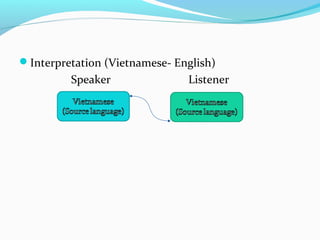
Interpretation (Vietnamese- English)
Speaker Listener
II. Levels of interpreter
Level 1+ (Minimal Performance) :
Unable to transfer information reliably, even if familiar
with the subject matter.
Level 1 (Minimal Performance Plus) :
Unable to transfer information reliably, even if familiar
with the subject matter.
Level 0+ (Memorized Performance) :
Unable to transfer more than isolated words.
Level 0 (No Performance) :
No functional ability to transfer information from one
language to another.
Level 2 (Limited Working Performance) :
Unable to transfer information reliably in most
instances. May communicate some meaning when
exchanges are short, involve subject matter that is
routine or discourse that is repetitive or predictable,
but may typically require repetition or clarification.
Expression in the target language is frequently
faulty.
Level 2+ (Limited Working Performance Plus):
Able to transfer information, not always accurately and
completely, during routine, everyday, repetitive
exchanges in informal settings, but unable to perform
adequately in the standard interpretation modes. May
falter, stammer, or pause, and often resort to
summarizing speech content. Idiomatic or cultural
expressions may not be rendered appropriately in
most instances. Language may be stilted or awkward.
Level 3 (Professional Performance) :
Able to interpret consistently in the mode
(simultaneous, consecutive, and sight) required by
the setting, provide renditions of informal as well as
some colloquial and formal speech with adequate
accuracy, and normally meet unpredictable
complications successfully. Can convey many
nuances, cultural allusions, and idioms, though
expression may not always reflect target language
conventions. Adequate delivery, with pleasant voice
quality. Hesitations, repetitions or corrections may
be noticeable but do not hinder successful
communication of the message. Can handle some
specialized subject matter with preparation.
Performance reflects high standards of professional
Level 3+ (Professional Performance Plus) :
Able to interpret accurately and consistently in the mode
(simultaneous, consecutive, and sight) required by the
setting and provide generally accurate renditions of
complex, colloquial and formal speech, conveying most
but not all details and nuances. Expression will generally
reflect target language conventions. Demonstrates
competence in the skills required for interpretation,
including command of both working languages, their
cultural context, and terminology in those specialized
fields in which the interpreter has developed expertise.
Good delivery, with pleasant voice quality, and few
hesitations, repetitions, or corrections. Performance
reflects high standards of professional conduct and ethics.
Level 4 (Advanced Professional Performance) :
Able to interpret in the mode (simultaneous, consecutive, and
sight) required by the setting and provide almost completely
accurate renditions of complex, colloquial, and idiomatic
speech as well as formal and some highly formal discourse.
Conveys the meaning of the speaker faithfully, including
many details and nuances, reflecting the style, register, and
cultural context of the source language, without omissions,
additions or embellishments. Demonstrates mastery of the
skills required for interpretation, including command of both
working languages and their cultural context, expertise in
some specialized fields, and ability to prepare new specialized
topics rapidly and routinely. Very good delivery, with
pleasant voice quality and only occasional hesitations,
repetitions or corrections. Performance reflects the highest
standards of professional conduct and ethics.
Level 4+ (Advanced Professional Performance
Plus)
Able to interpret in the mode (simultaneous, consecutive, and
sight) required by the setting and provide accurate
renditions of informal, formal, and most highly formal
discourse. Demonstrates mastery of the skills required for
interpretation, including command of both working
languages and their cultural context, expertise in a number
of specialized fields, and ability to prepare other specialized
topics rapidly and routinely. Excellent delivery, with
pleasant voice quality and rare hesitations, repetitions or
corrections. Performance reflects the highest standards of
professional conduct and ethics.
Level 5 (Master Professional Performance) :
Able to excel consistently at interpreting in the mode
(simultaneous, consecutive, and sight) required by the
setting and provide accurate renditions of informal,
formal, and highly formal discourse. Conveys the meaning
of the speaker faithfully and accurately, including all
details and nuances, reflecting the style, register, and
cultural context of the source language, without
omissions, additions or embellishments. Demonstrates
superior command of the skills required for interpretation,
including mastery of both working languages and their
cultural context, and wide-ranging expertise in specialized
fields. Outstanding delivery, with pleasant voice quality
and without hesitations, unnecessary repetitions, and
corrections. Exemplifies the highest standards of
professional conduct and ethics.
II. Difference between Interpretation and
translation
Despite being used in a non-technical sense as
interchangeable, interpretation and translation are not
synonymous. Interpreting takes a message from a
source language and renders that message into a
different target language(ex: English into French). In
interpreting, the interpreter will take in a complex
concept from one language, choose the most
appropriate vocabulary in the target language to
faithfully render the message in a linguistically,
emotionally, tonally, and culturally equivalent
message.
Translation is the transference of meaning from text to
text (written or recorded), with the translator having
time and access to resources (dictionaries, glossaries,
etc.) to produce an accurate document or verbal
artifact. Lesser known is "transliteration," used within
sign language interpreting, takes one form of a
language and transfer those same words into
another form (ex: spoken English into a signed form of
English, Signed Exact English, not ASL).
Otherwise,
A translator studies written material in one language
(the “source language”) and reproduces it in written
form in another language (the“target language”). An
interpreter listens to a spoken message in the source
language and renders it orally, consecutively or
simultaneously, in the target language. (người phiên
dịch tìm hiểu văn bản ở ngôn ngữ nguồn và tái tạo
dưới dạng viết ở đích ngữ. Người biên dịch lại phải
lắng nghe đoạn ngôn ngữ nói bằng ngôn ngữ nguồn
và nhắc lại ở đích ngữ bằng lời nói, đuổi theo ngôn
ngữ, hoặc song với ngôn ngữ nguồn)
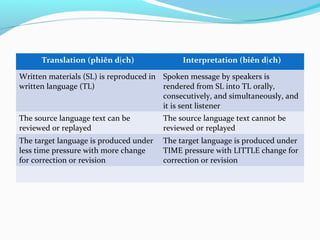
Translation (phiên d ch)ị Interpretation (biên d ch)ị
Written materials (SL) is reproduced in
written language (TL)
Spoken message by speakers is
rendered from SL into TL orally,
consecutively, and simultaneously, and
it is sent listener
The source language text can be
reviewed or replayed
The source language text cannot be
reviewed or replayed
The target language is produced under
less time pressure with more change
for correction or revision
The target language is produced under
TIME pressure with LITTLE change for
correction or revision
IV. Modes of interpretation
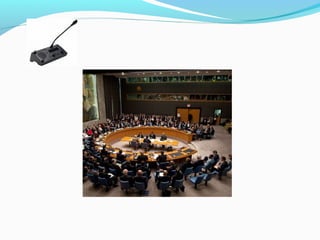
1. Simultaneous
In (extempore) simultaneous interpretation (SI), the
interpreter renders the message in the target-
language as quickly as he or she can formulate it from
the source language, while the source-language
speaker continuously speaks; a spoken language SI
interpreter, sitting in a sound-proof booth, speaks
into a microphone, while clearly seeing and hearing
the source-language speaker via earphones. The
simultaneous interpretation is rendered to the target-
language listeners via their earphones..
2. Consecutive
In consecutive interpreting (CI), the interpreter speaks
after the source-language speaker has finished
speaking. The speech is divided into segments, and the
interpreter sits or stands beside the source-language
speaker, listening and taking notes as the speaker
progresses through the message. When the speaker
pauses or finishes speaking, the interpreter then
renders a portion of the message or the entire message
in the target language.
3. Whispered
In whispered interpreting (chuchotage, in French), the
interpreter sits or stands next to the small target-
language audience whilst whispering a simultaneous
interpretation of the matter to hand; this method
requires no equipment, but may be done via a
microphone and headphones if the participants prefer.
Chuchotage is used in circumstances where the
majority of a group speaks the source language, and a
minority (ideally no more than three people) do not
speak it.
4. Relay
Relay interpreting is usually used when there are several
target languages. A source-language interpreter
interprets the text to a language common to every
interpreter, who then render the message to their
respective target languages. For example, a Japanese
source message first is rendered to English to a group of
interpreters, who listen to the English and render the
message into Arabic, French, and Russian, the other
target languages. In heavily multilingual meetings,
there may be more than one "intermediate" language,
i.e. a Greek source language could be interpreted into
English and then from English to other languages
5. Liaison
Liaison interpreting involves relaying what is spoken to
one, between two, or among many people. This can be
done after a short speech, or consecutively, sentence-
by-sentence, or as chuchotage (whispering); aside from
notes taken at the time, no equipment is used.
6. Escort
In escort interpreting, an interpreter accompanies a
person or a delegation on a tour, on a visit, or to a
meeting or interview. An interpreter in this role is
called an escort interpreter or an escorting interpreter.
This is liaison interpreting.
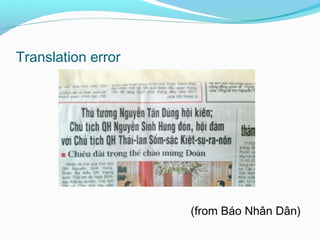
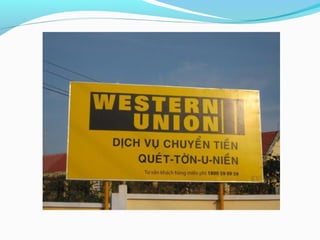
Translation error
(from Báo Nhân Dân)
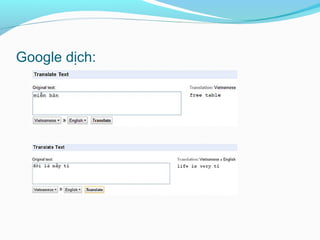
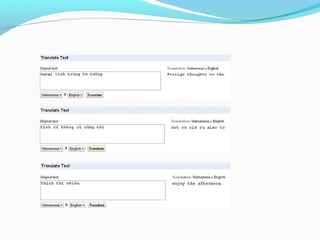
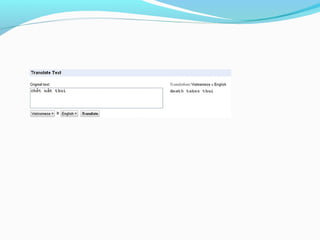
Google dịch:
Interpretation
Interpretation

Interpretation

  • 1.
  • 2.
    FOCUS I. What isinterpretation? II. Level of interpretation III. Difference between interpretation and translation IV. Modes of interpretation
  • 3.
    I. What isinterpretation Interpretation or interpreting is an expression of a spoken  message from an oral language in another spoken  language, either simultaneously or consecutively, between  users of different languages in which a speaker’s meaning is  best expressed in his or her native tongue or is best  understood in the languages of the listeners (phiên d ch là ị s  di n đ t m t thông đi p nói t  m t ngôn ng  l i tho i ự ễ ạ ộ ệ ừ ộ ữ ờ ạ b ng m t ngôn ng  nói khác)   ằ ộ ữ
  • 4.
    Interpreter An interpreter isa person who converts a thought or expression in a source language into an expression with a comparable meaning in a target language in "real time". The interpreter's function is to convey every semantic element (tone and register) and every intention and feeling of the message that the source- language speaker is directing to target-language recipients.
  • 5.
  • 6.
    II. Levels ofinterpreter Level 1+ (Minimal Performance) : Unable to transfer information reliably, even if familiar with the subject matter. Level 1 (Minimal Performance Plus) : Unable to transfer information reliably, even if familiar with the subject matter. Level 0+ (Memorized Performance) : Unable to transfer more than isolated words. Level 0 (No Performance) : No functional ability to transfer information from one language to another.
  • 7.
    Level 2 (LimitedWorking Performance) : Unable to transfer information reliably in most instances. May communicate some meaning when exchanges are short, involve subject matter that is routine or discourse that is repetitive or predictable, but may typically require repetition or clarification. Expression in the target language is frequently faulty.
  • 8.
    Level 2+ (LimitedWorking Performance Plus): Able to transfer information, not always accurately and completely, during routine, everyday, repetitive exchanges in informal settings, but unable to perform adequately in the standard interpretation modes. May falter, stammer, or pause, and often resort to summarizing speech content. Idiomatic or cultural expressions may not be rendered appropriately in most instances. Language may be stilted or awkward.
  • 9.
    Level 3 (ProfessionalPerformance) : Able to interpret consistently in the mode (simultaneous, consecutive, and sight) required by the setting, provide renditions of informal as well as some colloquial and formal speech with adequate accuracy, and normally meet unpredictable complications successfully. Can convey many nuances, cultural allusions, and idioms, though expression may not always reflect target language conventions. Adequate delivery, with pleasant voice quality. Hesitations, repetitions or corrections may be noticeable but do not hinder successful communication of the message. Can handle some specialized subject matter with preparation. Performance reflects high standards of professional
  • 10.
    Level 3+ (ProfessionalPerformance Plus) : Able to interpret accurately and consistently in the mode (simultaneous, consecutive, and sight) required by the setting and provide generally accurate renditions of complex, colloquial and formal speech, conveying most but not all details and nuances. Expression will generally reflect target language conventions. Demonstrates competence in the skills required for interpretation, including command of both working languages, their cultural context, and terminology in those specialized fields in which the interpreter has developed expertise. Good delivery, with pleasant voice quality, and few hesitations, repetitions, or corrections. Performance reflects high standards of professional conduct and ethics.
  • 11.
    Level 4 (AdvancedProfessional Performance) : Able to interpret in the mode (simultaneous, consecutive, and sight) required by the setting and provide almost completely accurate renditions of complex, colloquial, and idiomatic speech as well as formal and some highly formal discourse. Conveys the meaning of the speaker faithfully, including many details and nuances, reflecting the style, register, and cultural context of the source language, without omissions, additions or embellishments. Demonstrates mastery of the skills required for interpretation, including command of both working languages and their cultural context, expertise in some specialized fields, and ability to prepare new specialized topics rapidly and routinely. Very good delivery, with pleasant voice quality and only occasional hesitations, repetitions or corrections. Performance reflects the highest standards of professional conduct and ethics.
  • 12.
    Level 4+ (AdvancedProfessional Performance Plus) Able to interpret in the mode (simultaneous, consecutive, and sight) required by the setting and provide accurate renditions of informal, formal, and most highly formal discourse. Demonstrates mastery of the skills required for interpretation, including command of both working languages and their cultural context, expertise in a number of specialized fields, and ability to prepare other specialized topics rapidly and routinely. Excellent delivery, with pleasant voice quality and rare hesitations, repetitions or corrections. Performance reflects the highest standards of professional conduct and ethics.
  • 13.
    Level 5 (MasterProfessional Performance) : Able to excel consistently at interpreting in the mode (simultaneous, consecutive, and sight) required by the setting and provide accurate renditions of informal, formal, and highly formal discourse. Conveys the meaning of the speaker faithfully and accurately, including all details and nuances, reflecting the style, register, and cultural context of the source language, without omissions, additions or embellishments. Demonstrates superior command of the skills required for interpretation, including mastery of both working languages and their cultural context, and wide-ranging expertise in specialized fields. Outstanding delivery, with pleasant voice quality and without hesitations, unnecessary repetitions, and corrections. Exemplifies the highest standards of professional conduct and ethics.
  • 15.
    II. Difference betweenInterpretation and translation Despite being used in a non-technical sense as interchangeable, interpretation and translation are not synonymous. Interpreting takes a message from a source language and renders that message into a different target language(ex: English into French). In interpreting, the interpreter will take in a complex concept from one language, choose the most appropriate vocabulary in the target language to faithfully render the message in a linguistically, emotionally, tonally, and culturally equivalent message.
  • 16.
    Translation is thetransference of meaning from text to text (written or recorded), with the translator having time and access to resources (dictionaries, glossaries, etc.) to produce an accurate document or verbal artifact. Lesser known is "transliteration," used within sign language interpreting, takes one form of a language and transfer those same words into another form (ex: spoken English into a signed form of English, Signed Exact English, not ASL).
  • 17.
    Otherwise, A translator studieswritten material in one language (the “source language”) and reproduces it in written form in another language (the“target language”). An interpreter listens to a spoken message in the source language and renders it orally, consecutively or simultaneously, in the target language. (người phiên dịch tìm hiểu văn bản ở ngôn ngữ nguồn và tái tạo dưới dạng viết ở đích ngữ. Người biên dịch lại phải lắng nghe đoạn ngôn ngữ nói bằng ngôn ngữ nguồn và nhắc lại ở đích ngữ bằng lời nói, đuổi theo ngôn ngữ, hoặc song với ngôn ngữ nguồn)
  • 18.
    Translation (phiên dch)ị Interpretation (biên d ch)ị Written materials (SL) is reproduced in written language (TL) Spoken message by speakers is rendered from SL into TL orally, consecutively, and simultaneously, and it is sent listener The source language text can be reviewed or replayed The source language text cannot be reviewed or replayed The target language is produced under less time pressure with more change for correction or revision The target language is produced under TIME pressure with LITTLE change for correction or revision
  • 21.
    IV. Modes ofinterpretation 1. Simultaneous In (extempore) simultaneous interpretation (SI), the interpreter renders the message in the target- language as quickly as he or she can formulate it from the source language, while the source-language speaker continuously speaks; a spoken language SI interpreter, sitting in a sound-proof booth, speaks into a microphone, while clearly seeing and hearing the source-language speaker via earphones. The simultaneous interpretation is rendered to the target- language listeners via their earphones..
  • 23.
    2. Consecutive In consecutiveinterpreting (CI), the interpreter speaks after the source-language speaker has finished speaking. The speech is divided into segments, and the interpreter sits or stands beside the source-language speaker, listening and taking notes as the speaker progresses through the message. When the speaker pauses or finishes speaking, the interpreter then renders a portion of the message or the entire message in the target language.
  • 25.
    3. Whispered In whisperedinterpreting (chuchotage, in French), the interpreter sits or stands next to the small target- language audience whilst whispering a simultaneous interpretation of the matter to hand; this method requires no equipment, but may be done via a microphone and headphones if the participants prefer. Chuchotage is used in circumstances where the majority of a group speaks the source language, and a minority (ideally no more than three people) do not speak it.
  • 27.
    4. Relay Relay interpretingis usually used when there are several target languages. A source-language interpreter interprets the text to a language common to every interpreter, who then render the message to their respective target languages. For example, a Japanese source message first is rendered to English to a group of interpreters, who listen to the English and render the message into Arabic, French, and Russian, the other target languages. In heavily multilingual meetings, there may be more than one "intermediate" language, i.e. a Greek source language could be interpreted into English and then from English to other languages
  • 29.
    5. Liaison Liaison interpretinginvolves relaying what is spoken to one, between two, or among many people. This can be done after a short speech, or consecutively, sentence- by-sentence, or as chuchotage (whispering); aside from notes taken at the time, no equipment is used.
  • 31.
    6. Escort In escortinterpreting, an interpreter accompanies a person or a delegation on a tour, on a visit, or to a meeting or interview. An interpreter in this role is called an escort interpreter or an escorting interpreter. This is liaison interpreting.
  • 33.
  • 39.