from one recent quotation
Any scientific investigation , both statistical and
diagrammatic, of what goes on in the brain during
the process of translating is remote and at

present, speculative.
(some linguists and translation theorists make a fetish of
diagrams, schemas, and models).
a) What happens when translators translate?
b) What is the process as it is?
 It is essential that the balance be redressed
through the systematic study of the process.
 It is the process which creates the product
and it is only by understanding the process
that we can hope to improve skills as
translators.
Systematic study
of the process
1. Part of a theory of
translation would
account for the process
of moving from original
text to mental
representation and how
it differs from the
original text.
The need for such a
shift of attention has,
indeed, already been
argued for and we
strongly endorse the
sentiment expressed:
>> continuation >>
2. We must adopt a descriptive rather than
prescriptive approach to the investigation of
the process, recognizing that the purpose of
translation theory is:
 To reach an understanding of the process
undertaken in the act of translation and not to
provide a set of norms for effecting the perfect
translation.
 Orientation towards the objective
specification of the steps and stages through
which the translator works as the source text
in the original language is transformed into
the target text;
 Focus on the process which creates the
translation rather than on the translation
itself.
- de Beaugrande
“it is inappropriate to expect that a
theoretical model of translation should
solve all the problems a translator
encounters. Instead, it should formulate
a set of strategies for approaching
problems and for coordinating the
different aspects entailed.”
Warns:
1. Be re-oriented towards description, whether
of process or product, and away from
prescription
2. Have conventions of text-linguistics which is
increasingly the most revealing way of
dealing with the product
We need to be clear with what these mean and how they fit
into the investigative process in which we are engaged.
 It is essential to distinguish between sensation
and perception; and that
 The process of sensation and perception are
best explained by AGGREGATE,WHOLE, and
SYSTEM
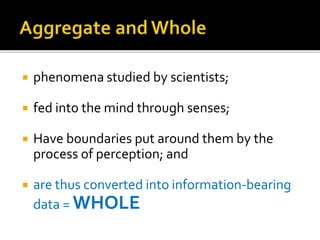
 phenomena studied by scientists;
 fed into the mind through senses;
 Have boundaries put around them by the
process of perception; and
 are thus converted into information-bearing
data = WHOLE
 It is theTHEORY of the scientist which, when
passed on to others, is realized as a model.
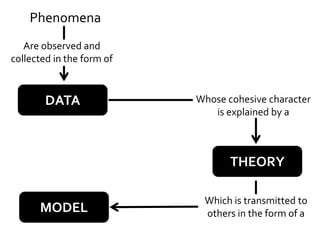
Phenomena
Are observed and
collected in the form of
DATA Whose cohesive character
is explained by a
THEORY
Which is transmitted to
others in the form of aMODEL
-Wilss
“neither psycholinguistics nor neurology
can as yet provide reliable information
on how linguistic data are stored in the
brain, how linguistic matching
procedures take place and what mental
structures are active in recalling
linguistic information.”
Warns:
Theories and Models
 THEORY is an explanation of a
phenomenon, the perception of
system and order in something
observed. It exists in the mind,
with no tangible manifestation;
an idea which constitutes the
internal representation of a
phenomenon.
Given that, we must
be clear about what
theories and models
are and how they
relate to each other.
Theories and Models
 MODEL is, in contrast, an
external representation of the
explanation; a realization of the
theory. It exists as a tangible
object (a diagram, formula, or text)
which ‘stands for’ the idea
embodied in the theory.
THEORY
exists in the mind, with
no tangible
manifestation; an idea
which constitutes the
internal representation
of a phenomenon.
1. It must faithfully represent the theory that it
stands for.
2. It must reveal significant characteristics of
the phenomenon explained in the theory; it
should be a ‘copy’ of the original
phenomenon, focusing on the essential
parts.
3. It must have heuristic function through
analogy (drawing similarities).
A theory of translation as…
1. PROCESS – requires a study of information
processing, and within that, such topics as:
a) Perception
b) Memory
c) Encoding and decoding messages
*Theory ofTranslating
A theory of translation as…
2. PRODUCT – requires a study of texts not
merely by means of the traditional levels of
linguistic analysis (syntax and semantics) but also by
making use of stylistics and recent advances in
text-linguistics and discourse analysis.
*Theory ofTranslatedTexts
A theory of translation as…
2. Both PROCESS & PRODUCT – requires the
integrated study of both and such a general
theory is, presumably, the long-term
*Theory ofTranslating andTranslation
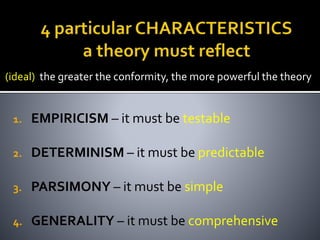
(ideal) the greater the conformity, the more powerful the theory
1. EMPIRICISM – it must be testable
2. DETERMINISM – it must be predictable
3. PARSIMONY – it must be simple
4. GENERALITY – it must be comprehensive
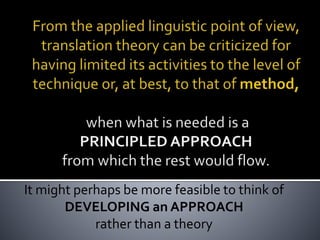
It might perhaps be more feasible to think of
DEVELOPING an APPROACH
rather than a theory
 If we adopt this plan of action,
we can draw upon considerable expertise in
applied linguistics, from which the approach,
method, technique series comes,
and produce a tentative initial list of what we
might expect from a theory of translation.
 We are in search of
‘an integrated, interdisciplinary,
multi-method, and multi-level approach’
to the explanation of the phenomenon of
translation and we would locate the approach
within a broadly defined applied linguistics
which would embrace in addition to the learning
of:
foreign languages, lexicology and lexicography,
speech pathology, stylistics, language planning
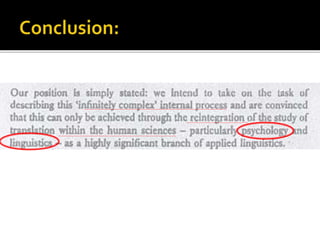
 Inside or between languages, human
communication equals translation.
 A study of translation is a study of language.
 The process of translation takes place in the
mind of the translator, given that, we have no
direct access to it, and shall be forced back
into precisely unsatisfactory kind of
description of the product which we have
been saying that we wish to avoid.
It is perfectly legitimate to build up a model on
the basis of inferences drawn from an objective
study of the product .
The development of psychology has shown a
multiple approach involving both induction and
deduction which is likely to be revealing than
using only one approach.
 What is the unit of translation?
 It is the smallest segment of a source
language text which can be translated as a
whole in isolation from other segments.
 SL: ‘as small as possible and as large as
necessary’ – author
a) What happens when translators translate?
b) What is the process as it is?
Translation theory
Translation theory

Translation theory

  • 3.
    from one recentquotation Any scientific investigation , both statistical and diagrammatic, of what goes on in the brain during the process of translating is remote and at present, speculative. (some linguists and translation theorists make a fetish of diagrams, schemas, and models).
  • 4.
    a) What happenswhen translators translate? b) What is the process as it is?
  • 5.
     It isessential that the balance be redressed through the systematic study of the process.  It is the process which creates the product and it is only by understanding the process that we can hope to improve skills as translators.
  • 6.
    Systematic study of theprocess 1. Part of a theory of translation would account for the process of moving from original text to mental representation and how it differs from the original text. The need for such a shift of attention has, indeed, already been argued for and we strongly endorse the sentiment expressed:
  • 7.
    >> continuation >> 2.We must adopt a descriptive rather than prescriptive approach to the investigation of the process, recognizing that the purpose of translation theory is:  To reach an understanding of the process undertaken in the act of translation and not to provide a set of norms for effecting the perfect translation.
  • 8.
     Orientation towardsthe objective specification of the steps and stages through which the translator works as the source text in the original language is transformed into the target text;  Focus on the process which creates the translation rather than on the translation itself.
  • 9.
    - de Beaugrande “itis inappropriate to expect that a theoretical model of translation should solve all the problems a translator encounters. Instead, it should formulate a set of strategies for approaching problems and for coordinating the different aspects entailed.” Warns:
  • 10.
    1. Be re-orientedtowards description, whether of process or product, and away from prescription 2. Have conventions of text-linguistics which is increasingly the most revealing way of dealing with the product
  • 11.
    We need tobe clear with what these mean and how they fit into the investigative process in which we are engaged.
  • 13.
     It isessential to distinguish between sensation and perception; and that  The process of sensation and perception are best explained by AGGREGATE,WHOLE, and SYSTEM
  • 14.
     phenomena studiedby scientists;  fed into the mind through senses;  Have boundaries put around them by the process of perception; and  are thus converted into information-bearing data = WHOLE
  • 15.
     It istheTHEORY of the scientist which, when passed on to others, is realized as a model.
  • 16.
    Phenomena Are observed and collectedin the form of DATA Whose cohesive character is explained by a THEORY Which is transmitted to others in the form of aMODEL
  • 17.
    -Wilss “neither psycholinguistics norneurology can as yet provide reliable information on how linguistic data are stored in the brain, how linguistic matching procedures take place and what mental structures are active in recalling linguistic information.” Warns:
  • 18.
    Theories and Models THEORY is an explanation of a phenomenon, the perception of system and order in something observed. It exists in the mind, with no tangible manifestation; an idea which constitutes the internal representation of a phenomenon. Given that, we must be clear about what theories and models are and how they relate to each other.
  • 19.
    Theories and Models MODEL is, in contrast, an external representation of the explanation; a realization of the theory. It exists as a tangible object (a diagram, formula, or text) which ‘stands for’ the idea embodied in the theory. THEORY exists in the mind, with no tangible manifestation; an idea which constitutes the internal representation of a phenomenon.
  • 20.
    1. It mustfaithfully represent the theory that it stands for. 2. It must reveal significant characteristics of the phenomenon explained in the theory; it should be a ‘copy’ of the original phenomenon, focusing on the essential parts. 3. It must have heuristic function through analogy (drawing similarities).
  • 21.
    A theory oftranslation as… 1. PROCESS – requires a study of information processing, and within that, such topics as: a) Perception b) Memory c) Encoding and decoding messages *Theory ofTranslating
  • 22.
    A theory oftranslation as… 2. PRODUCT – requires a study of texts not merely by means of the traditional levels of linguistic analysis (syntax and semantics) but also by making use of stylistics and recent advances in text-linguistics and discourse analysis. *Theory ofTranslatedTexts
  • 23.
    A theory oftranslation as… 2. Both PROCESS & PRODUCT – requires the integrated study of both and such a general theory is, presumably, the long-term *Theory ofTranslating andTranslation
  • 25.
    (ideal) the greaterthe conformity, the more powerful the theory 1. EMPIRICISM – it must be testable 2. DETERMINISM – it must be predictable 3. PARSIMONY – it must be simple 4. GENERALITY – it must be comprehensive
  • 26.
    It might perhapsbe more feasible to think of DEVELOPING an APPROACH rather than a theory
  • 27.
     If weadopt this plan of action, we can draw upon considerable expertise in applied linguistics, from which the approach, method, technique series comes, and produce a tentative initial list of what we might expect from a theory of translation.
  • 28.
     We arein search of ‘an integrated, interdisciplinary, multi-method, and multi-level approach’ to the explanation of the phenomenon of translation and we would locate the approach within a broadly defined applied linguistics which would embrace in addition to the learning of: foreign languages, lexicology and lexicography, speech pathology, stylistics, language planning
  • 29.
     Inside orbetween languages, human communication equals translation.  A study of translation is a study of language.
  • 32.
     The processof translation takes place in the mind of the translator, given that, we have no direct access to it, and shall be forced back into precisely unsatisfactory kind of description of the product which we have been saying that we wish to avoid.
  • 33.
    It is perfectlylegitimate to build up a model on the basis of inferences drawn from an objective study of the product . The development of psychology has shown a multiple approach involving both induction and deduction which is likely to be revealing than using only one approach.
  • 34.
     What isthe unit of translation?  It is the smallest segment of a source language text which can be translated as a whole in isolation from other segments.  SL: ‘as small as possible and as large as necessary’ – author
  • 37.
    a) What happenswhen translators translate? b) What is the process as it is?