INTERPRETING
By Alfriani Ndandara
Artha Wacana Christian University
2021
Meeting 1
4th March 2021
CONCEPT OF INTERPRETING
AND INTERPRETER
2
Hello!
I am Interpreting
I am here because I love share knowledge of interpretation
3
1. CONCEPT OF
INTERPRETING
AND INTERPRETER
Theories about Interpreting
“
“A term used to refer to
the oral translation of a
spoken message or text”
Suttleworth and Cowie
“Oral transfer between
speakers of different
languages” Gentile,
Ozolins and Vasilakakos
(1996: 5)
5
“
● “a translation of a source-
language text, presented only
once, usually in oral form, into
target –language text which is
very difficult to check and can
hardly to be corrected because of
lack of time” Vermeer in Nord
(2001:104)
● “a form of translation in which a
first and final rendition in other
language is produced on the
basis of a one-time presentation
of an utterance in a source
language” Pochhacker (2004:11) 6
7
“Interpreting is transferring the
messaged from source language
into target language orally, thus it
is hardly to be checked or
revised due to time pressure.”
Theories about Interpreter
● “a person who translate speech orally into sign
language for parties who speak different
language” Jesus Baigorri-Jalon in Mikkelson
and Jourdenais(2015 :11)
● “a person who knows and understand the
original language of a speech translates in into
sign language of another language honestly.”
Herodotus in Mikkelson and Jourdenais(2015:
12-13)
8
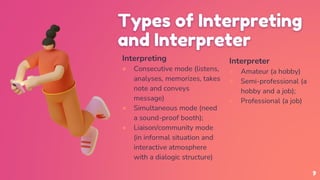
Types of Interpreting
and Interpreter
Interpreting
● Consecutive mode (listens,
analyses, memorizes, takes
note and conveys
message)
● Simultaneous mode (need
a sound-proof booth);
● Liaison/community mode
(in informal situation and
interactive atmosphere
with a dialogic structure)
Interpreter
● Amateur (a hobby)
● Semi-professional (a
hobby and a job);
● Professional (a job)
9
Similarities vs Differences
10
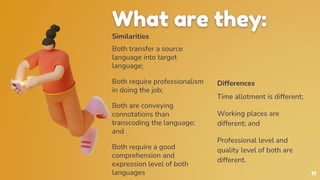
Similarities
Both transfer a source
language into target
language;
Both require professionalism
in doing the job;
Both are conveying
connotations than
transcoding the language;
and
Both require a good
comprehension and
expression level of both
languages
What are they:
Differences
Time allotment is different;
Working places are
different; and
Professional level and
quality level of both are
different.
11
Summary…
Interpreting
Transferring source
language into target
language orally in
short time without
giving any errors
relate to
grammatical issue
Interpreter
Person who have a
comprehend
understanding of
source language
and target language
thus he/she are able
to transfers from
source language
into target language
orally
Translation and
Interpretation
Both are activities in
rendering the source
language to target
language, bearing
some similarities
and differences
12
Thanks!
TIME TO ASK!
13

Concept of Interpreting and Interpreter

  • 1.
    INTERPRETING By Alfriani Ndandara ArthaWacana Christian University 2021
  • 2.
    Meeting 1 4th March2021 CONCEPT OF INTERPRETING AND INTERPRETER 2
  • 3.
    Hello! I am Interpreting Iam here because I love share knowledge of interpretation 3
  • 4.
    1. CONCEPT OF INTERPRETING ANDINTERPRETER Theories about Interpreting
  • 5.
    “ “A term usedto refer to the oral translation of a spoken message or text” Suttleworth and Cowie “Oral transfer between speakers of different languages” Gentile, Ozolins and Vasilakakos (1996: 5) 5
  • 6.
    “ ● “a translationof a source- language text, presented only once, usually in oral form, into target –language text which is very difficult to check and can hardly to be corrected because of lack of time” Vermeer in Nord (2001:104) ● “a form of translation in which a first and final rendition in other language is produced on the basis of a one-time presentation of an utterance in a source language” Pochhacker (2004:11) 6
  • 7.
    7 “Interpreting is transferringthe messaged from source language into target language orally, thus it is hardly to be checked or revised due to time pressure.”
  • 8.
    Theories about Interpreter ●“a person who translate speech orally into sign language for parties who speak different language” Jesus Baigorri-Jalon in Mikkelson and Jourdenais(2015 :11) ● “a person who knows and understand the original language of a speech translates in into sign language of another language honestly.” Herodotus in Mikkelson and Jourdenais(2015: 12-13) 8
  • 9.
    Types of Interpreting andInterpreter Interpreting ● Consecutive mode (listens, analyses, memorizes, takes note and conveys message) ● Simultaneous mode (need a sound-proof booth); ● Liaison/community mode (in informal situation and interactive atmosphere with a dialogic structure) Interpreter ● Amateur (a hobby) ● Semi-professional (a hobby and a job); ● Professional (a job) 9
  • 10.
  • 11.
    Similarities Both transfer asource language into target language; Both require professionalism in doing the job; Both are conveying connotations than transcoding the language; and Both require a good comprehension and expression level of both languages What are they: Differences Time allotment is different; Working places are different; and Professional level and quality level of both are different. 11
  • 12.
    Summary… Interpreting Transferring source language intotarget language orally in short time without giving any errors relate to grammatical issue Interpreter Person who have a comprehend understanding of source language and target language thus he/she are able to transfers from source language into target language orally Translation and Interpretation Both are activities in rendering the source language to target language, bearing some similarities and differences 12
  • 13.