DATA VISUALISATION
LITERACY
Andy Kirk
www.visualisingdata.com
@visualisingdata
READING
WRITING
The two sides of literacy
CONSUMING
CREATING
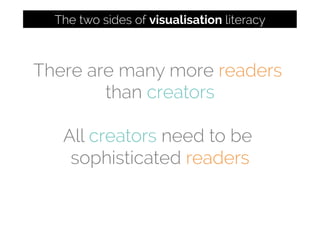
The two sides of visualisation literacy
There are many more readers
than creators
All creators need to be
sophisticated readers
The two sides of visualisation literacy
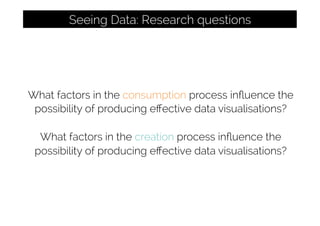
What factors in the consumption process influence the
possibility of producing effective data visualisations?
What factors in the creation process influence the
possibility of producing effective data visualisations?
Seeing Data: Research questions
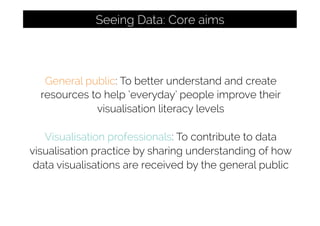
General public: To better understand and create
resources to help ‘everyday’ people improve their
visualisation literacy levels
Visualisation professionals: To contribute to data
visualisation practice by sharing understanding of how
data visualisations are received by the general public
Seeing Data: Core aims
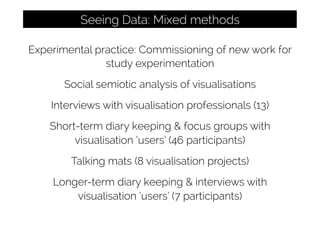
Experimental practice: Commissioning of new work for
study experimentation
Social semiotic analysis of visualisations
Interviews with visualisation professionals (13)
Short-term diary keeping & focus groups with
visualisation ‘users’ (46 participants)
Talking mats (8 visualisation projects)
Longer-term diary keeping & interviews with
visualisation ‘users’ (7 participants)
Seeing Data: Mixed methods
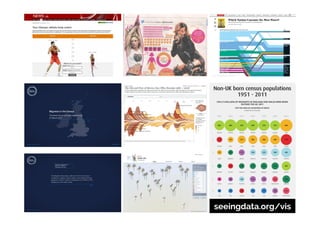
seeingdata.org/vis
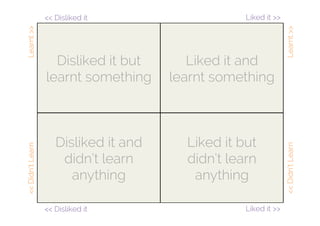
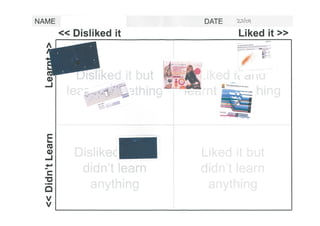
Liked it and
learnt something
Liked it but
didn’t learn
anything
Disliked it but
learnt something
Disliked it and
didn’t learn
anything
<<Didn’tLearnLearnt>>
Liked it >><< Disliked it
<<Didn’tLearnLearnt>>
Liked it >><< Disliked it
Socio-cultural factors that affect
the engagement of readers
Findings and reflections
relevant to creators
The two sides of visualisation literacy
Visualisation is about facilitating
UNDERSTANDING
What do we mean by engagement?
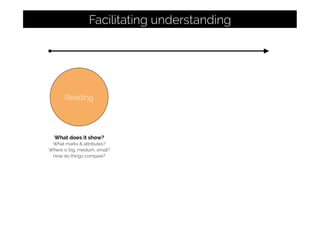
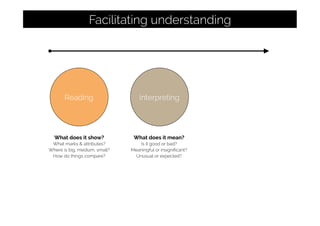
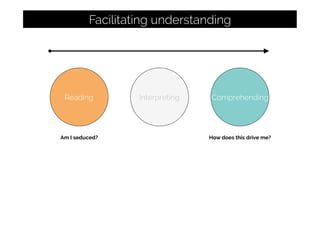
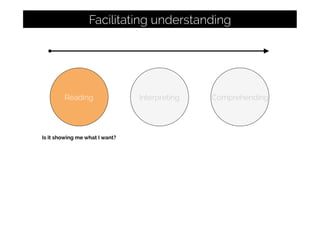
Reading
What does it show?
What marks & attributes?
Where is big, medium, small?
How do things compare?
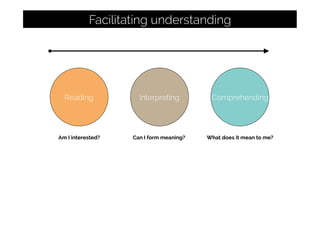
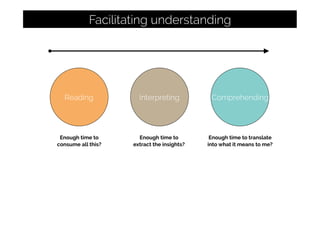
Facilitating understanding
Reading Interpreting
What does it mean?
Is it good or bad?
Meaningful or insignificant?
Unusual or expected?
What does it show?
What marks & attributes?
Where is big, medium, small?
How do things compare?
Facilitating understanding
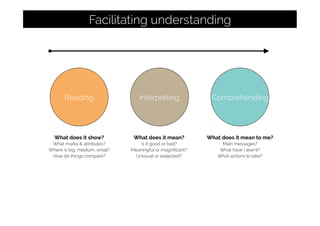
Reading
Facilitating understanding
Interpreting Comprehending
What does it mean?
Is it good or bad?
Meaningful or insignificant?
Unusual or expected?
What does it mean to me?
Main messages?
What have I learnt?
What actions to take?
What does it show?
What marks & attributes?
Where is big, medium, small?
How do things compare?
Subject matter and
relevance
“Data visualization is like family photos. If you
don't know the people in the picture, beauty of
the composition won't keep your attention.”
Zach Gemignani, Juice Analytics
https://twitter.com/zachgemignani/status/382498970603229185
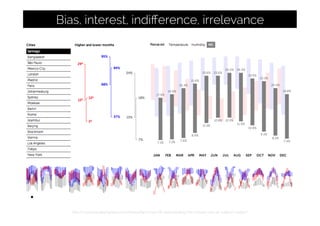
Bias, interest, indifference, irrelevance
http://www.visualisingdata.com/index.php/2013/06/appreciating-the-critical-role-of-subject-matter/
Bias, interest, indifference, irrelevance
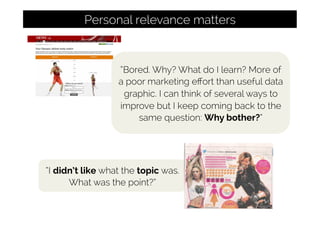
“I didn’t like what the topic was.
What was the point?”
Personal relevance matters
“Bored. Why? What do I learn? More of
a poor marketing effort than useful data
graphic. I can think of several ways to
improve but I keep coming back to the
same question: Why bother?”
0
10
20
30
40
50
60
70
80
2004/05 2005/06 2006/07 2007/08 2008/09 2009/10 2010/11 2011/12 2012/13 2013/14 2014/15
Games Goals
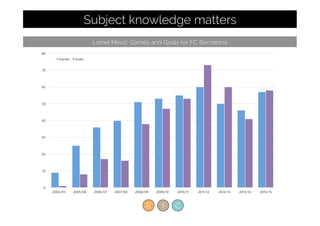
Lionel Messi: Games and Goals for FC Barcelona
R I C
Subject knowledge matters
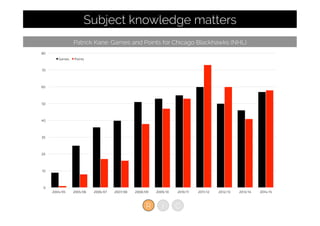
Patrick Kane: Games and Points for Chicago Blackhawks (NHL)
0
10
20
30
40
50
60
70
80
2004/05 2005/06 2006/07 2007/08 2008/09 2009/10 2010/11 2011/12 2012/13 2013/14 2014/15
Games Points
R I C
Subject knowledge matters
Reading
Facilitating understanding
Interpreting Comprehending
Can I form meaning? What does it mean to me?Am I interested?
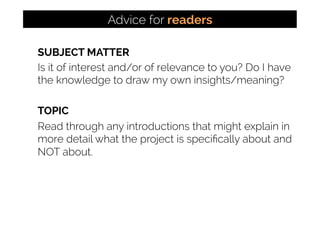
SUBJECT MATTER
Is it of interest and/or of relevance to you? Do I have
the knowledge to draw my own insights/meaning?
TOPIC
Read through any introductions that might explain in
more detail what the project is specifically about and
NOT about.
Advice for readers
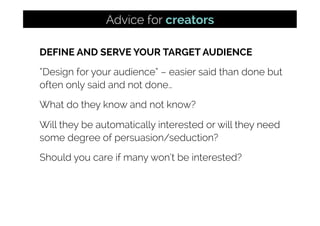
DEFINE AND SERVE YOUR TARGET AUDIENCE
“Design for your audience” – easier said than done but
often only said and not done…
What do they know and not know?
Will they be automatically interested or will they need
some degree of persuasion/seduction?
Should you care if many won’t be interested?
Advice for creators
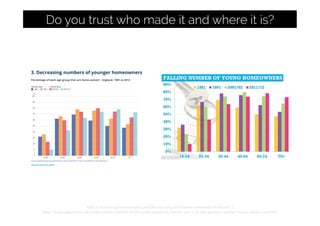
Trust and prejudice
http://visual.ons.gov.uk/uk-perspectives-housing-and-home-ownership-in-the-uk/ |
http://www.dailymail.co.uk/news/article-2921610/End-home-ownership-dream-Just-1-10-25s-property-ladder-house-prices-soar.html
Do you trust who made it and where it is?
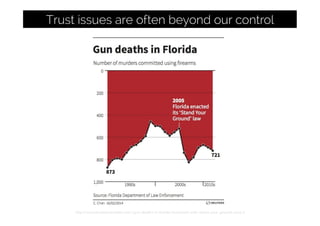
Trust issues are often beyond our control
http://www.businessinsider.com/gun-deaths-in-florida-increased-with-stand-your-ground-2014-2
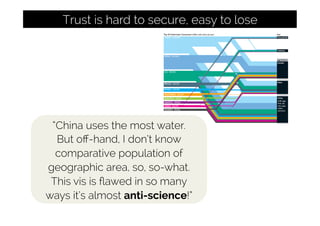
Trust is hard to secure, easy to lose
“China uses the most water.
But off-hand, I don’t know
comparative population of
geographic area, so, so-what.
This vis is flawed in so many
ways it’s almost anti-science!”
“Isn’t [sic] Asylum Seekers
on the up in 2014?”
Changing beliefs, opinions, prejudices is hard
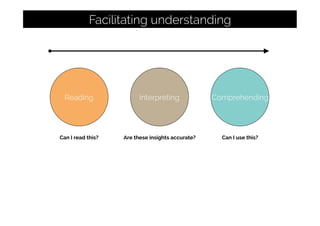
Facilitating understanding
Interpreting Comprehending
Are these insights accurate? Can I use this?
Reading
Can I read this?
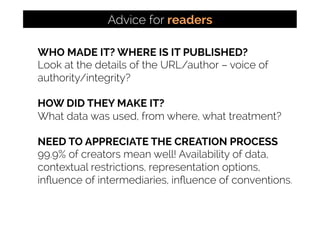
WHO MADE IT? WHERE IS IT PUBLISHED?
Look at the details of the URL/author – voice of
authority/integrity?
HOW DID THEY MAKE IT?
What data was used, from where, what treatment?
NEED TO APPRECIATE THE CREATION PROCESS
99.9% of creators mean well! Availability of data,
contextual restrictions, representation options,
influence of intermediaries, influence of conventions.
Advice for readers
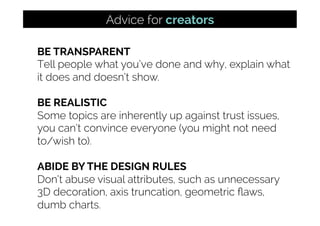
BE TRANSPARENT
Tell people what you’ve done and why, explain what
it does and doesn’t show.
BE REALISTIC
Some topics are inherently up against trust issues,
you can’t convince everyone (you might not need
to/wish to).
ABIDE BY THE DESIGN RULES
Don’t abuse visual attributes, such as unnecessary
3D decoration, axis truncation, geometric flaws,
dumb charts.
Advice for creators
Confidence and skills
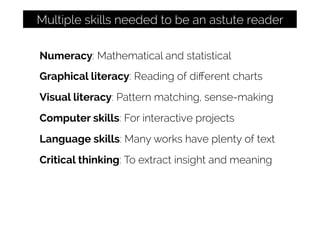
Numeracy: Mathematical and statistical
Graphical literacy: Reading of different charts
Visual literacy: Pattern matching, sense-making
Computer skills: For interactive projects
Language skills: Many works have plenty of text
Critical thinking: To extract insight and meaning
Multiple skills needed to be an astute reader
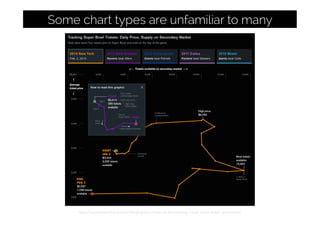
http://www.bloomberg.com/infographics/2014-01-16/tracking-super-bowl-ticket-prices.html
Reward > Effort (learnable)Some chart types are unfamiliar to many
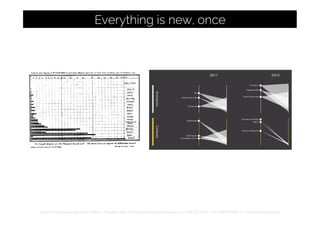
http://en.wikipedia.org/wiki/William_Playfair | http://infobawards.s3.amazonaws.com/SPOTLIGHT-ON-PROFITABILITY_Krisztina-Szucs.png
Everything is new, once
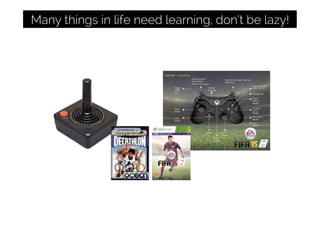
Many things in life need learning, don’t be lazy!
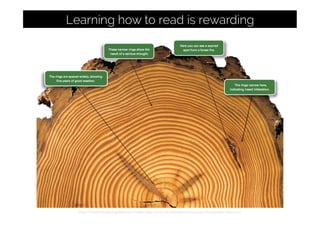
http://www.visualisingdata.com/index.php/2015/02/dendrochronology-visualisation-literacy/
Learning how to read is rewarding
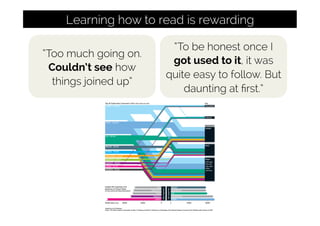
“To be honest once I
got used to it, it was
quite easy to follow. But
daunting at first.”
“Too much going on.
Couldn’t see how
things joined up”
Learning how to read is rewarding
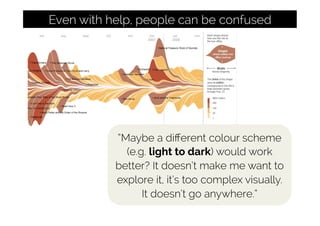
Even with help, people can be confused
“Maybe a different colour scheme
(e.g. light to dark) would work
better? It doesn’t make me want to
explore it, it’s too complex visually.
It doesn’t go anywhere.”
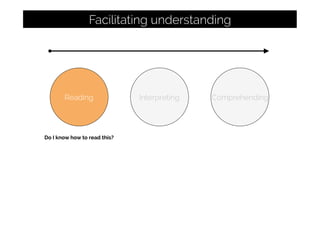
Reading
Facilitating understanding
Interpreting Comprehending
Do I know how to read this?
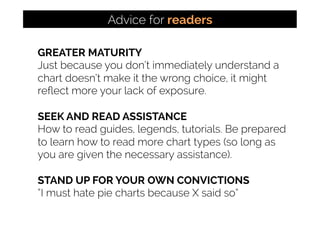
GREATER MATURITY
Just because you don’t immediately understand a
chart doesn’t make it the wrong choice, it might
reflect more your lack of exposure.
SEEK AND READ ASSISTANCE
How to read guides, legends, tutorials. Be prepared
to learn how to read more chart types (so long as
you are given the necessary assistance).
STAND UP FOR YOUR OWN CONVICTIONS
“I must hate pie charts because X said so”
Advice for readers
OFFER THE RIGHT LEVEL OF HELP
Beware the curse of knowledge - don’t assume!
More than just including scales and legends – user
guides, example readings
There is evidence that when people got over these
hurdles, insights were unlocked.
DON’T BE UNNECESSARILY SELF-RESTRICTED
Don’t avoid using a seemingly complex chart type if
it is the best way to show your data - respect
people’s capacity to learn with your help.
Advice for creators
Time and pressure
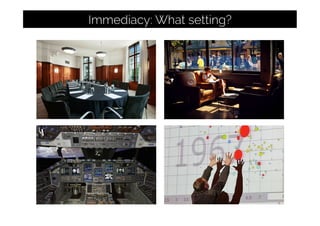
Immediacy: What setting?
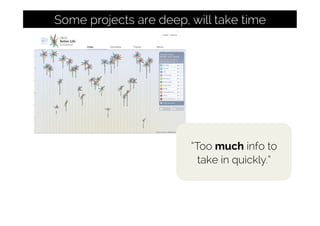
Some projects are deep, will take time
“Too much info to
take in quickly.”
http://13pt.com/projects/nyt071211/
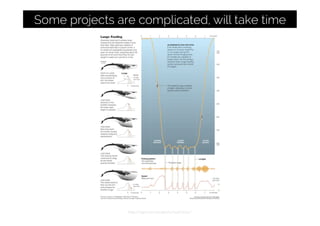
Some projects are complicated, will take time
http://www.nytimes.com/interactive/2011/10/23/sunday-review/an-overview-of-the-euro-crisis.html
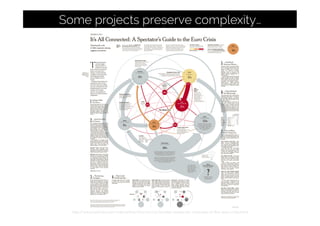
Some projects preserve complexity…
http://io9.com/5912155/watch-hans-rosling-use-rocks-to-deliver-the-shortest-ted-talk-ever
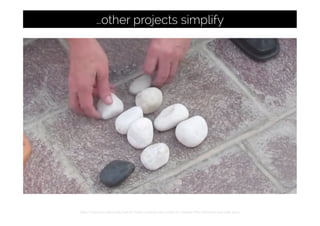
…other projects simplify
http://i.imgur.com/u7ikyWS.jpg
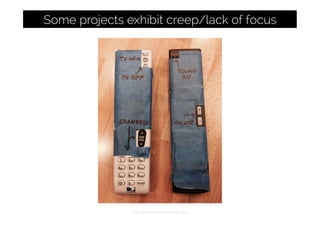
Some projects exhibit creep/lack of focus
Reading
Facilitating understanding
Interpreting Comprehending
Enough time to
extract the insights?
Enough time to translate
into what it means to me?
Enough time to
consume all this?
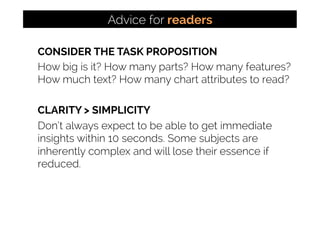
CONSIDER THE TASK PROPOSITION
How big is it? How many parts? How many features?
How much text? How many chart attributes to read?
CLARITY > SIMPLICITY
Don’t always expect to be able to get immediate
insights within 10 seconds. Some subjects are
inherently complex and will lose their essence if
reduced.
Advice for readers
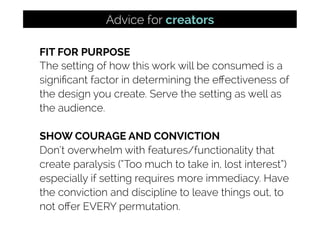
FIT FOR PURPOSE
The setting of how this work will be consumed is a
significant factor in determining the effectiveness of
the design you create. Serve the setting as well as
the audience.
SHOW COURAGE AND CONVICTION
Don’t overwhelm with features/functionality that
create paralysis (“Too much to take in, lost interest”)
especially if setting requires more immediacy. Have
the conviction and discipline to leave things out, to
not offer EVERY permutation.
Advice for creators
Emotions
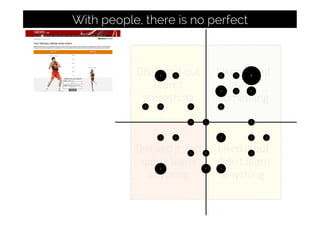
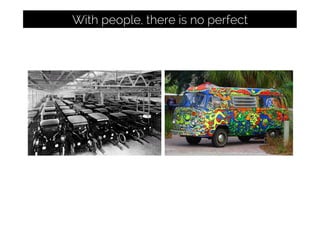
With people, there is no perfect
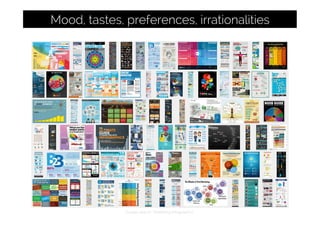
Google search: “Marketing Infographics”
Mood, tastes, preferences, irrationalities
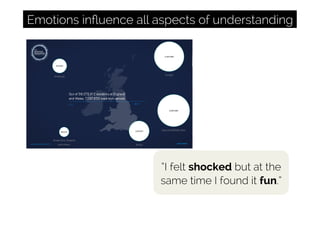
“I felt shocked but at the
same time I found it fun.”
Emotions influence all aspects of understanding
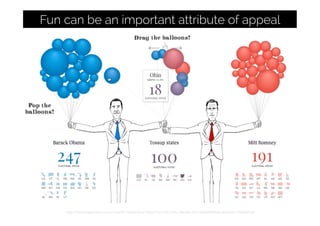
Fun can be an important attribute of appeal
http://www.guardian.co.uk/world/interactive/2012/nov/05/you-decide-the-presidential-election-interactive
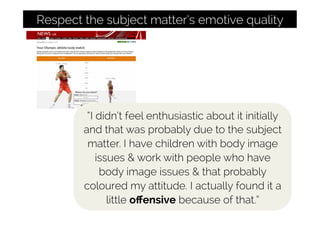
Respect the subject matter’s emotive quality
“I didn’t feel enthusiastic about it initially
and that was probably due to the subject
matter. I have children with body image
issues & work with people who have
body image issues & that probably
coloured my attitude. I actually found it a
little offensive because of that.”
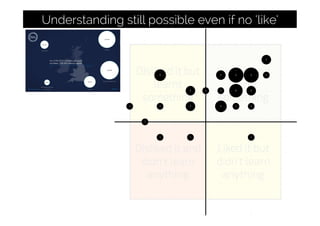
Understanding still possible even if no ‘like’
Reading
Facilitating understanding
Interpreting Comprehending
How does this drive me?Am I seduced?
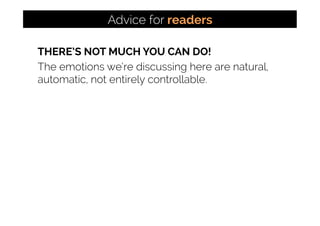
THERE’S NOT MUCH YOU CAN DO!
The emotions we’re discussing here are natural,
automatic, not entirely controllable.
Advice for readers
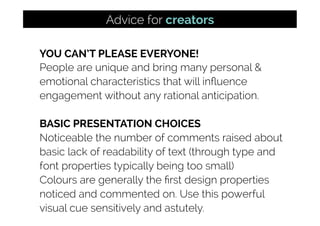
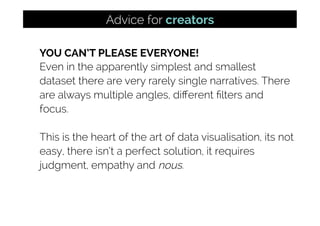
YOU CAN’T PLEASE EVERYONE!
People are unique and bring many personal &
emotional characteristics that will influence
engagement without any rational anticipation.
BASIC PRESENTATION CHOICES
Noticeable the number of comments raised about
basic lack of readability of text (through type and
font properties typically being too small)
Colours are generally the first design properties
noticed and commented on. Use this powerful
visual cue sensitively and astutely.
Advice for creators
Curiosities, wants and
needs
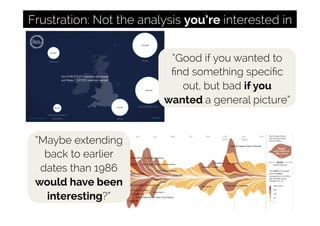
Frustration: Not the analysis you’re interested in
“Good if you wanted to
find something specific
out, but bad if you
wanted a general picture”
“Maybe extending
back to earlier
dates than 1986
would have been
interesting?”
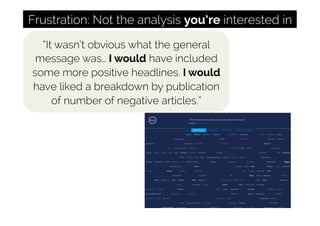
Frustration: Not the analysis you’re interested in
“It wasn’t obvious what the general
message was… I would have included
some more positive headlines. I would
have liked a breakdown by publication
of number of negative articles.”
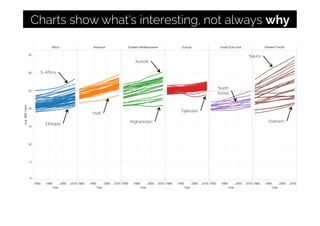
Haiti
Afghanistan
S. Africa
Kuwait
Vietnam
Nauru
North
Korea
Tajikistan
Ethiopia
Charts show what’s interesting, not always why
Reading
Facilitating understanding
Interpreting Comprehending
Is it showing me what I want?
WHAT ANALYSIS DOES IT SHOW
Explore titles, sub-headings
What different charts are on offer? What data do
they show and not show?
What interactive options do you have to manipulate,
interrogate and customise?
WHAT WOULD BE REASONABLE?
Is what you want to see available, feasible, of
sufficient broad interest to have been included? Is
there a good reason why it might not have been?
Advice for readers
YOU CAN’T PLEASE EVERYONE!
Even in the apparently simplest and smallest
dataset there are very rarely single narratives. There
are always multiple angles, different filters and
focus.
This is the heart of the art of data visualisation, its not
easy, there isn’t a perfect solution, it requires
judgment, empathy and nous.
Advice for creators
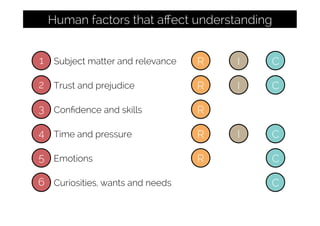
1
2
3
4
5
6
I C
I C
R
CR I
R
C
Subject matter and relevance
Trust and prejudice
Confidence and skills
Time and pressure
Emotions
Curiosities, wants and needs
C
Human factors that affect understanding
R
R
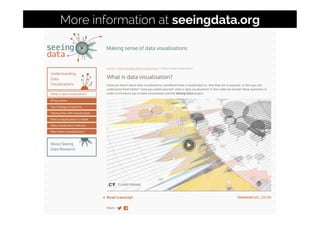
More information at seeingdata.org
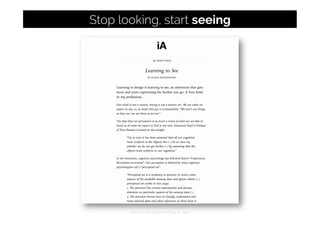
http://ia.net/blog/learning-to-see/
Stop looking, start seeing
“Chefs are able to more clearly discern
what they taste because through
constant exposure they have developed
improved senses as well as vocabulary
to express and discuss their
impressions.”
Oliver Reichenstein, “Learning to see”
Paraphrased from: http://ia.net/blog/learning-to-see/
Stop looking, start seeing
DATA VISUALISATION
LITERACY
Andy Kirk
www.visualisingdata.com
@visualisingdata

Data Visualisation Literacy - Learning to See