TRANSLATION AND INTERPRETATIONELIAS ALMORA, WENDY.FISCHER SANDI, KIMBERLYMaterial for educational purposes
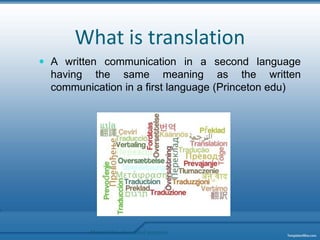
What is translationA written communication in a second language having the same meaning as the written communication in a first language (Princeton edu)Material for educational purposes
Basis of translation Ferdinand Saussure: Language is a structure that achieves meaning through oppositions. Conventional meaning “ Their most exact meaning is that they are what the other words are not.” 1793 Sign and referentMaterial for educational purposes
perception community speech hypothesis one to one correspondences not independent of a language communityattributed sense ( fleuve- riviere)Linguistic Determinism: thoughts and perceptions are determined by the categories of their languageMaterial for educational purposes
Translator’s Role“An excellent translation reads like a piece originally written in the target language, sentence structure,  linkages and discourse, are entirely appropriate to the target language.” U.K.  Linguistics AssociationMaterial for educational purposes
Translation methods Word for word TranslationLiteral translation: Grammatical constructions are converted but lexical items are out of contextFaithful translation: contextual meaningSemantic translation: Aesthetic meaningCommunicative translationIdiomatic translation: colloquialisms Free translation: paraphrasing Adaptation: plays, SL to TL culture Material for educational purposes
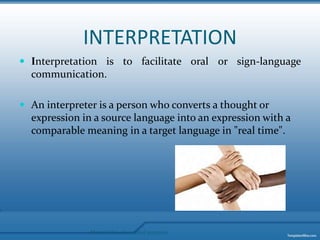
INTERPRETATIONInterpretation is to facilitate oral or sign-language communication. An interpreter is a person who converts a thought or expression in a source language into an expression with a comparable meaning in a target language in "real time". Material for educational purposes
INTERPRETATION TYPESSimultaneous: In simultaneous interpretation (SI), the interpreter renders the message in the target-language as quickly as he or she can formulate it from the source language, while the source-language speaker continuously speaks.Consecutive: In consecutive interpreting (CI), the interpreter speaks after the source-language speaker has finished speaking. The speech is divided into segments, and the interpreter sits or stands beside the source-language speaker, listening and taking notes as the speaker progresses through the message. Material for educational purposes
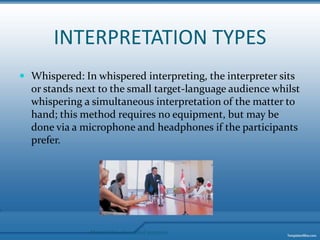
INTERPRETATION TYPESWhispered: In whispered interpreting, the interpreter sits or stands next to the small target-language audience whilst whispering a simultaneous interpretation of the matter to hand; this method requires no equipment, but may be done via a microphone and headphones if the participants prefer.Material for educational purposes
INTERPRETATION TYPESRelay: Relay interpreting is usually used when there are several target languages. A source-language interpreter interprets the text to a language common to every interpreter, who then render the message to their respective target languages.Liaison: Liaison interpreting involves relaying what is spoken to one, between two, or among many people. This can be done after a short speech, or consecutively, sentence-by-sentenceMaterial for educational purposes
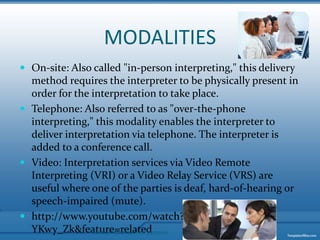
MODALITIESOn-site: Also called "in-person interpreting," this delivery method requires the interpreter to be physically present in order for the interpretation to take place. Telephone: Also referred to as "over-the-phone interpreting," this modality enables the interpreter to deliver interpretation via telephone. The interpreter is added to a conference call.Video: Interpretation services via Video Remote Interpreting (VRI) or a Video Relay Service (VRS) are useful where one of the parties is deaf, hard-of-hearing or speech-impaired (mute). http://www.youtube.com/watch?v=ZIG-YKwy_Zk&feature=relatedMaterial for educational purposes
Material for educational purposes

Translation and Interpretation

  • 1.
    TRANSLATION AND INTERPRETATIONELIASALMORA, WENDY.FISCHER SANDI, KIMBERLYMaterial for educational purposes
  • 2.
    What is translationAwritten communication in a second language having the same meaning as the written communication in a first language (Princeton edu)Material for educational purposes
  • 3.
    Basis of translationFerdinand Saussure: Language is a structure that achieves meaning through oppositions. Conventional meaning “ Their most exact meaning is that they are what the other words are not.” 1793 Sign and referentMaterial for educational purposes
  • 4.
    perception community speechhypothesis one to one correspondences not independent of a language communityattributed sense ( fleuve- riviere)Linguistic Determinism: thoughts and perceptions are determined by the categories of their languageMaterial for educational purposes
  • 5.
    Translator’s Role“An excellenttranslation reads like a piece originally written in the target language, sentence structure, linkages and discourse, are entirely appropriate to the target language.” U.K. Linguistics AssociationMaterial for educational purposes
  • 6.
    Translation methods Wordfor word TranslationLiteral translation: Grammatical constructions are converted but lexical items are out of contextFaithful translation: contextual meaningSemantic translation: Aesthetic meaningCommunicative translationIdiomatic translation: colloquialisms Free translation: paraphrasing Adaptation: plays, SL to TL culture Material for educational purposes
  • 7.
    INTERPRETATIONInterpretation is tofacilitate oral or sign-language communication. An interpreter is a person who converts a thought or expression in a source language into an expression with a comparable meaning in a target language in "real time". Material for educational purposes
  • 8.
    INTERPRETATION TYPESSimultaneous: Insimultaneous interpretation (SI), the interpreter renders the message in the target-language as quickly as he or she can formulate it from the source language, while the source-language speaker continuously speaks.Consecutive: In consecutive interpreting (CI), the interpreter speaks after the source-language speaker has finished speaking. The speech is divided into segments, and the interpreter sits or stands beside the source-language speaker, listening and taking notes as the speaker progresses through the message. Material for educational purposes
  • 9.
    INTERPRETATION TYPESWhispered: Inwhispered interpreting, the interpreter sits or stands next to the small target-language audience whilst whispering a simultaneous interpretation of the matter to hand; this method requires no equipment, but may be done via a microphone and headphones if the participants prefer.Material for educational purposes
  • 10.
    INTERPRETATION TYPESRelay: Relayinterpreting is usually used when there are several target languages. A source-language interpreter interprets the text to a language common to every interpreter, who then render the message to their respective target languages.Liaison: Liaison interpreting involves relaying what is spoken to one, between two, or among many people. This can be done after a short speech, or consecutively, sentence-by-sentenceMaterial for educational purposes
  • 11.
    MODALITIESOn-site: Also called"in-person interpreting," this delivery method requires the interpreter to be physically present in order for the interpretation to take place. Telephone: Also referred to as "over-the-phone interpreting," this modality enables the interpreter to deliver interpretation via telephone. The interpreter is added to a conference call.Video: Interpretation services via Video Remote Interpreting (VRI) or a Video Relay Service (VRS) are useful where one of the parties is deaf, hard-of-hearing or speech-impaired (mute). http://www.youtube.com/watch?v=ZIG-YKwy_Zk&feature=relatedMaterial for educational purposes
  • 12.