Presentation On:
Borrowing
Presentors :
Sarah, Sabaoon,
Hina, Sadaf
What is Borrowing…?
“Borrowing is a word adopted from another language
completely or partially naturalized.”
“Borrowing is process that takes over words from
most of the other languages with it has had contact.”
The language from which a words has been borrowed
will be called the donor language, and the language
into which it has been borrowed is the recipient
language.
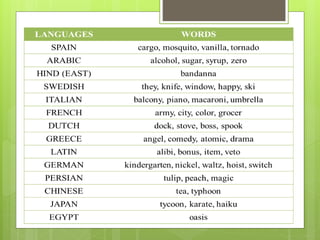
For example :
Television:
Tele from GREEK (Far off)
Visio from LATIN (to see)
Pizza from ITALY
Hamburger from JERMAN
Chili from SPANYOL
Theater from GREECE
Borrowings enter the language in 2
ways:
1) through oral speech (by immediate
contact between the peoples).
They took place in the early periods
of history.
They are usually short and undergo
considerable changes in the act of
adoption.
Ways Of Borrowings:
2. through written speech (by indirect
contact through books, etc.).
They gained importance in recent
times.
They preserve their spelling and
some
peculiarities of their sound-form, their
assimilation is long and laborious
process…
Motivations for change:
In general, we can say that speakers (generally
unconsciously) make changes in their languages
under the influence of another language for two
reasons:
+ First, those speakers fall under the influence of
another language because there is something
more “attractive” about that language – the
attraction largely being associated with the
higher prestige of the speakers of that language
or its wider use in the community where both
languages are spoken.
Borrowing is a consequence of
cultural contact between two
language communities..
Types of borrowing:
basically we have two types of borrowing….i.e.
1) Direct borrowing
2) Indirect/less direct borrowing
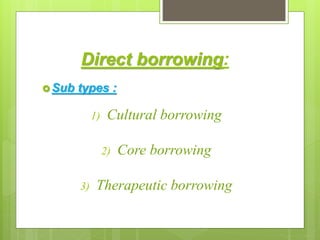
Direct borrowing:
 Sub types :
1) Cultural borrowing
2) Core borrowing
3) Therapeutic borrowing
Indirect or less direct borrowing:
1. Calque or loan translation.
2. Loan shifts.
3. Loan blends n Hybrids.
Direct borrowing:
1. Cultural borrowing:
Also called “loanwords by necessity”.
Cultural borrowings are words that fill gaps in
the recipient language’s store of words because
they stand for objects or concepts new to the
language’s culture. Most common CB’S around
the world are versions of English word
automobile or car because most cultures did not
have such motorized vehicles before contact with
Western cultures. E.g. words related to
computers.
Core Borrowings:
Core borrowings are words that duplicate
elements that the recipient language already
has in its word store. They are unnecessary – by
definition, another layer on the cake, because
the recipient language always has viable
equivalents.
Then, why are they borrowed? Cultural
pressure…language of prestige etc.
Therapeutic borrowing :
 Borrowing has also been said to occur for
therapeutic reasons, when the original word
became unavailable. Two subcases of this are:
(i) Borrowing due to word taboo: In some cultures,
there are strict word taboo rules,.
E.G. rules that prohibit a certain word that occurs
in a deceased person’s name, or a word that occurs
in the name of a taboo relative .
(ii) Borrowing for reasons of
homonymy avoidance:
If a word becomes too similar to another word due
to sound change, the homonymy clash might be
avoided by borrowing.
Thus, it has been suggested that the homonymy of
earlier English bread (from Old English bræde)
‘roast meat’and bread (from Old English bread)
‘morsel, bread’led to the replacement of the first by
a French loan (roast, from Old French rost) .
Less Direct Borrowing
THREE INDIRECT BORROWINGS
1. Calque or loan translation:
• Many calques consist of more than one word.
• Translation is loaned not the word.
Phonological shape is not loaned.
• E.g. English Skyscraper… French gratte-
ciel which literally means scratch sky.
2. Loan Shifts:
Phonological form is borrowed but
different meaning is given from it’s
original.
Last twenty years French n German
borrowed English gerunds, e.g. le
shampooing in French is name of
product not the process.
3. Loan blends and
Hybrids:
They consist parts from both
languages , the donor and
recipient language.
E.g. English grandfather is from
French grandpere and English
Borrowing and its types

Borrowing and its types

  • 1.
  • 2.
    What is Borrowing…? “Borrowingis a word adopted from another language completely or partially naturalized.” “Borrowing is process that takes over words from most of the other languages with it has had contact.” The language from which a words has been borrowed will be called the donor language, and the language into which it has been borrowed is the recipient language.
  • 3.
    For example : Television: Telefrom GREEK (Far off) Visio from LATIN (to see) Pizza from ITALY Hamburger from JERMAN Chili from SPANYOL Theater from GREECE
  • 5.
    Borrowings enter thelanguage in 2 ways: 1) through oral speech (by immediate contact between the peoples). They took place in the early periods of history. They are usually short and undergo considerable changes in the act of adoption. Ways Of Borrowings:
  • 6.
    2. through writtenspeech (by indirect contact through books, etc.). They gained importance in recent times. They preserve their spelling and some peculiarities of their sound-form, their assimilation is long and laborious process…
  • 7.
    Motivations for change: Ingeneral, we can say that speakers (generally unconsciously) make changes in their languages under the influence of another language for two reasons: + First, those speakers fall under the influence of another language because there is something more “attractive” about that language – the attraction largely being associated with the higher prestige of the speakers of that language or its wider use in the community where both languages are spoken.
  • 8.
    Borrowing is aconsequence of cultural contact between two language communities..
  • 9.
    Types of borrowing: basicallywe have two types of borrowing….i.e. 1) Direct borrowing 2) Indirect/less direct borrowing
  • 10.
    Direct borrowing:  Subtypes : 1) Cultural borrowing 2) Core borrowing 3) Therapeutic borrowing
  • 11.
    Indirect or lessdirect borrowing: 1. Calque or loan translation. 2. Loan shifts. 3. Loan blends n Hybrids.
  • 12.
    Direct borrowing: 1. Culturalborrowing: Also called “loanwords by necessity”. Cultural borrowings are words that fill gaps in the recipient language’s store of words because they stand for objects or concepts new to the language’s culture. Most common CB’S around the world are versions of English word automobile or car because most cultures did not have such motorized vehicles before contact with Western cultures. E.g. words related to computers.
  • 13.
    Core Borrowings: Core borrowingsare words that duplicate elements that the recipient language already has in its word store. They are unnecessary – by definition, another layer on the cake, because the recipient language always has viable equivalents. Then, why are they borrowed? Cultural pressure…language of prestige etc.
  • 14.
    Therapeutic borrowing : Borrowing has also been said to occur for therapeutic reasons, when the original word became unavailable. Two subcases of this are: (i) Borrowing due to word taboo: In some cultures, there are strict word taboo rules,. E.G. rules that prohibit a certain word that occurs in a deceased person’s name, or a word that occurs in the name of a taboo relative .
  • 15.
    (ii) Borrowing forreasons of homonymy avoidance: If a word becomes too similar to another word due to sound change, the homonymy clash might be avoided by borrowing. Thus, it has been suggested that the homonymy of earlier English bread (from Old English bræde) ‘roast meat’and bread (from Old English bread) ‘morsel, bread’led to the replacement of the first by a French loan (roast, from Old French rost) .
  • 16.
    Less Direct Borrowing THREEINDIRECT BORROWINGS 1. Calque or loan translation: • Many calques consist of more than one word. • Translation is loaned not the word. Phonological shape is not loaned. • E.g. English Skyscraper… French gratte- ciel which literally means scratch sky.
  • 17.
    2. Loan Shifts: Phonologicalform is borrowed but different meaning is given from it’s original. Last twenty years French n German borrowed English gerunds, e.g. le shampooing in French is name of product not the process.
  • 18.
    3. Loan blendsand Hybrids: They consist parts from both languages , the donor and recipient language. E.g. English grandfather is from French grandpere and English